Overview
Fragments are incomplete sentences that lack one or more essential components needed to express a complete thought. On the SAT Reading and Writing section, the ability to identify and correct fragments is a fundamental skill tested repeatedly across multiple question types. A fragment might be missing a subject, a verb, or fail to express a complete idea despite having both. Understanding fragments is crucial because the SAT frequently presents sentences that appear complete at first glance but are actually missing critical elements or are improperly connected to other clauses.
The SAT RW section tests fragments within the broader context of sentence boundaries and structure, making this one of the most high-yield topics for score improvement. Questions about fragments often appear in Standard English Conventions items, where students must identify grammatical errors or choose the most effective way to combine sentences. These questions assess whether students can distinguish between complete sentences, fragments, run-ons, and comma splices—all related concepts that form the foundation of sentence structure mastery.
Mastering fragments connects directly to understanding independent and dependent clauses, subordinating conjunctions, and punctuation rules. When students can reliably identify what makes a sentence complete, they gain the ability to tackle more complex sentence structure questions, improve their own writing clarity, and avoid common errors that appear throughout standardized testing. This topic serves as a gateway skill: once fragments are understood, students can more effectively analyze complex sentence constructions and make sophisticated choices about sentence boundaries.
Learning Objectives
- [ ] Identify key features of fragments and distinguish them from complete sentences
- [ ] Explain how fragments appear on the SAT and recognize common fragment patterns
- [ ] Apply fragment knowledge to answer SAT-style questions accurately and efficiently
- [ ] Analyze sentences to determine whether they contain subjects, predicates, and complete thoughts
- [ ] Correct fragments by adding missing elements or properly connecting clauses
- [ ] Evaluate answer choices to select options that eliminate fragments while maintaining meaning
- [ ] Recognize subordinate clause fragments and understand how subordinating conjunctions create dependency
Prerequisites
- Independent clauses: Understanding what constitutes a complete sentence (subject + predicate + complete thought) is essential for recognizing when these elements are missing
- Dependent clauses: Familiarity with clauses that cannot stand alone helps identify subordinate clause fragments
- Basic parts of speech: Knowing subjects, verbs, and objects enables quick identification of missing sentence components
- Punctuation fundamentals: Understanding how periods, commas, and semicolons separate sentences helps recognize boundary errors that create fragments
Why This Topic Matters
Fragment identification and correction represents one of the most frequently tested grammar concepts on the SAT, appearing in approximately 10-15% of all Standard English Conventions questions. The College Board consistently includes fragment questions because they assess a fundamental writing skill: the ability to construct and recognize complete, grammatically correct sentences. This skill directly correlates with college readiness, as academic writing demands clear, complete sentence construction.
In real-world applications, the ability to avoid fragments improves professional communication, academic writing, and any context where clarity and credibility matter. Fragments can confuse readers, obscure meaning, and undermine the writer's authority. While fragments occasionally serve stylistic purposes in creative writing or informal communication, the SAT tests standard written English conventions where complete sentences are the expectation.
On the exam, fragments typically appear in three contexts: (1) identifying sentence structure errors in revision questions, (2) choosing between multiple versions of a sentence where some options create fragments, and (3) determining the best way to combine or separate sentences. The SAT often embeds fragments within longer passages, requiring students to read carefully and analyze sentence boundaries within context. Questions may present a fragment as one of four answer choices, or they may show a fragment in the original text that needs correction. Understanding fragments also helps students avoid selecting answer choices that inadvertently create fragments while attempting to fix other errors.
Core Concepts
What Makes a Complete Sentence
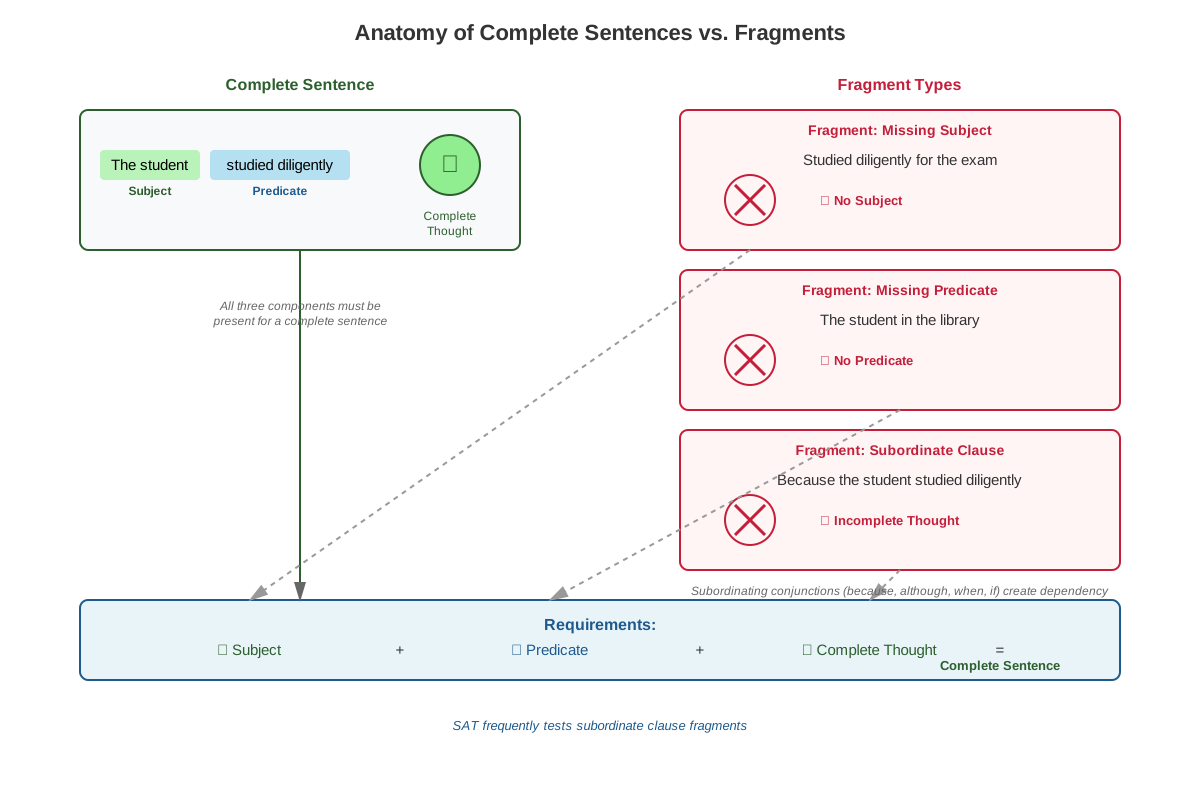
A complete sentence must contain three essential elements: a subject (who or what performs the action), a predicate (the verb and any associated information), and a complete thought (an idea that can stand independently). When any of these elements is missing, the result is a fragment. Consider this complete sentence: "The researcher analyzed the data." It has a subject (researcher), a predicate (analyzed the data), and expresses a complete thought that requires no additional information.
The complete thought requirement is often the most subtle element. A group of words might have both a subject and a verb but still fail to express a complete idea. For example: "Because the experiment failed." This has a subject (experiment) and a verb (failed), but the subordinating conjunction "because" creates dependency—the clause cannot stand alone and leaves readers expecting more information.
Types of Fragments
Missing Subject Fragments
These fragments lack a clear subject performing the action. Example: "Conducted three trials and recorded the results." The sentence has verbs (conducted, recorded) but no subject indicating who performed these actions. Correction: "The scientists conducted three trials and recorded the results."
Missing Verb Fragments
These fragments lack a complete verb or have only a verbal (gerund, participle, or infinitive) that cannot function as the main verb. Example: "The hypothesis about climate change." This has a subject (hypothesis) but no verb showing what the hypothesis does or is. Correction: "The hypothesis about climate change was confirmed."
Subordinate Clause Fragments
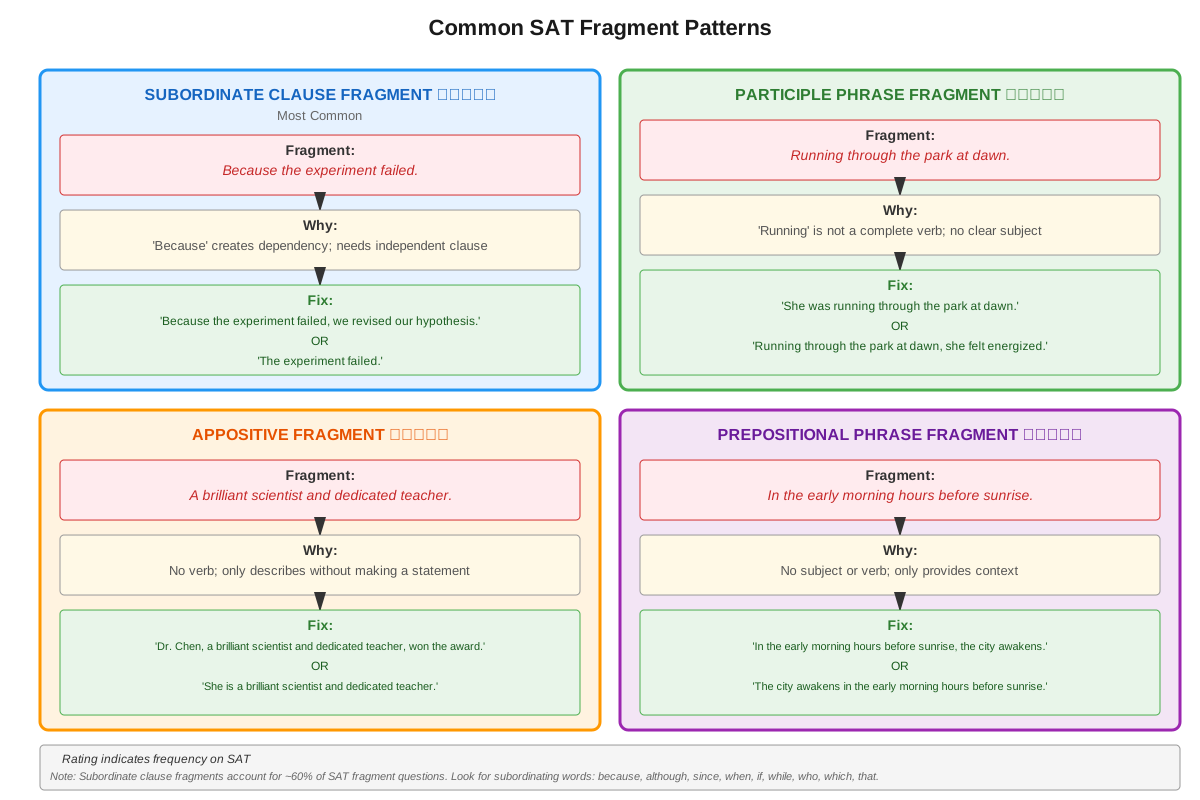
These are the most common fragments on the SAT. They occur when a dependent clause is punctuated as a complete sentence. Subordinating conjunctions like "although," "because," "since," "when," "while," "if," "unless," and "after" create dependency. Example: "Although the results were significant." This has a subject and verb but cannot stand alone due to "although." Correction: "Although the results were significant, the researchers continued testing" or "The results were significant."
Relative Clause Fragments
Relative pronouns ("who," "which," "that," "whose," "whom") create dependent clauses that cannot stand alone. Example: "Which was discovered in 2019." Correction: "The scientists studied the protein, which was discovered in 2019."
Appositive Fragments
An appositive renames or describes a noun but cannot stand alone as a sentence. Example: "A revolutionary approach to gene therapy." Correction: "CRISPR represents a revolutionary approach to gene therapy."
Fragment vs. Complete Sentence Comparison
| Element | Complete Sentence | Fragment |
|---|---|---|
| Subject | Present and clear | May be missing or unclear |
| Predicate | Complete verb present | May lack verb or have only verbal |
| Independence | Can stand alone | Cannot stand alone; needs more information |
| Subordination | No uncompleted subordination | Often begins with subordinating word |
| Punctuation | Properly bounded by periods/semicolons | Improperly separated from main clause |
Common Fragment Patterns on the SAT
The SAT typically presents fragments in specific, recognizable patterns. The most frequent involves a subordinate clause incorrectly separated from its independent clause: "The team published their findings. Because the data supported their hypothesis." The second sentence is a fragment that should be connected to the first.
Another common pattern involves participial phrases punctuated as sentences: "The experiment having been completed successfully." This lacks a main verb and should be either connected to an independent clause or revised to include one: "The experiment was completed successfully."
The SAT also tests fragments created by relative clauses: "Scientists discovered a new species. Which had adapted to extreme temperatures." The second sentence cannot stand alone and should be connected with a comma: "Scientists discovered a new species, which had adapted to extreme temperatures."
How to Identify Fragments
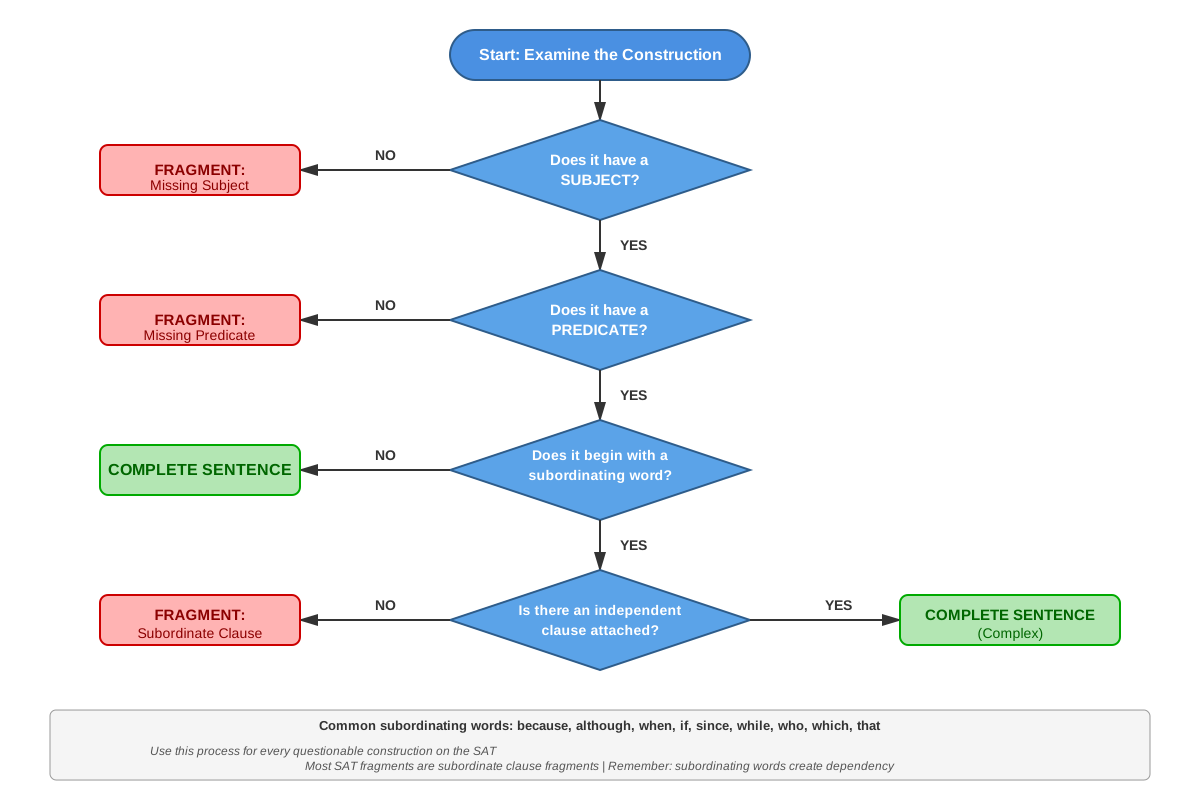
Apply this systematic approach:
- Locate the verb: Find the main action or state of being. Verbals (words ending in -ing, -ed, or infinitives with "to") often cannot serve as main verbs without helping verbs.
- Identify the subject: Determine who or what performs the verb's action. If no clear subject exists, the sentence is likely a fragment.
- Check for subordination: Look for subordinating conjunctions or relative pronouns at the beginning. If present, the clause needs to be attached to an independent clause.
- Test independence: Read the sentence alone and ask, "Does this express a complete thought, or does it leave me expecting more information?"
- Examine punctuation: Verify that sentence boundaries (periods, semicolons) separate independent clauses, not dependent clauses from their main clauses.
Correcting Fragments
Fragments can be corrected through several methods:
Method 1: Attach to nearby sentence - Connect the fragment to an adjacent independent clause using appropriate punctuation (comma, no punctuation, or dash depending on the relationship).
Method 2: Add missing elements - Supply the missing subject, verb, or both to create a complete sentence.
Method 3: Remove subordinating word - Delete the subordinating conjunction or relative pronoun that creates dependency, allowing the clause to stand independently.
Method 4: Complete the thought - Add an independent clause to complete the idea initiated by a subordinate clause.
Concept Relationships
Fragment identification builds directly on understanding independent and dependent clauses. An independent clause is essentially a complete sentence, while a dependent clause is a potential fragment. The relationship flows: Independent Clause Mastery → Fragment Recognition → Sentence Boundary Decisions → Run-on and Comma Splice Identification.
Fragments connect inversely to run-on sentences and comma splices—where fragments have too little to stand alone, run-ons and comma splices improperly join too much. Understanding one helps master the others because all involve sentence boundaries. The concept map looks like this:
Parts of Speech (subjects/verbs) → Clause Types (independent/dependent) → Subordinating Words → Fragment Identification → Sentence Boundaries → Complete Sentence Structure → Run-ons and Comma Splices
Within the topic itself, the different fragment types (missing subject, missing verb, subordinate clause) all relate to the three requirements for completeness. Subordinate clause fragments specifically connect to understanding conjunctions and how they create dependency. Relative clause fragments link to pronoun knowledge. This interconnection means that mastering one fragment type accelerates learning others because they share the same underlying principle: completeness requires subject, predicate, and independence.
High-Yield Facts
⭐ A fragment lacks a subject, a complete verb, or fails to express a complete thought that can stand independently
⭐ Subordinate clause fragments are the most common type on the SAT, created by subordinating conjunctions like "although," "because," "since," "when," and "while"
⭐ A group of words can have both a subject and a verb but still be a fragment if it doesn't express a complete thought
⭐ Fragments are corrected by either connecting them to independent clauses or adding missing elements to make them complete
⭐ Relative pronouns ("which," "who," "that") create dependent clauses that cannot stand alone as sentences
- Participial phrases (beginning with -ing or -ed words) often create fragments when punctuated as complete sentences
- Appositive phrases that rename or describe nouns cannot function as independent sentences
- The word "being" or "having been" at the start of a sentence often signals a fragment
- Infinitive phrases ("to + verb") cannot serve as the main verb of a sentence without additional elements
- On the SAT, fragments often appear in answer choices that attempt to fix other errors but inadvertently create new problems
- A semicolon can only separate two independent clauses; using it before a fragment creates an error
- Verbals (gerunds, participles, infinitives) look like verbs but cannot function as the main verb without helping verbs
Quick check — test yourself on Fragments so far.
Try Flashcards →Common Misconceptions
Misconception: Any group of words with a subject and verb is a complete sentence. → Correction: A sentence also requires a complete thought. "Because the scientist arrived" has both subject and verb but is incomplete due to the subordinating conjunction "because," which creates dependency and leaves the thought unfinished.
Misconception: Long groups of words cannot be fragments because they contain substantial information. → Correction: Length does not determine completeness. "The comprehensive study examining climate patterns across three decades and involving researchers from twelve countries" is a fragment despite its length because it lacks a main verb showing what the study did or was.
Misconception: Starting a sentence with "because," "although," or "since" always creates a fragment. → Correction: These subordinating conjunctions create fragments only when the dependent clause stands alone. When followed by an independent clause in the same sentence, the result is complete: "Because the data was inconclusive, the team continued testing."
Misconception: Words ending in -ing or -ed are always verbs that can anchor a sentence. → Correction: These verbals (participles) cannot serve as main verbs without helping verbs. "The researcher analyzing the data" is a fragment; it needs a helping verb: "The researcher was analyzing the data" or a main verb: "The researcher analyzed the data."
Misconception: Fragments are always wrong and should never be used. → Correction: While fragments are incorrect in standard written English tested on the SAT, they serve legitimate stylistic purposes in creative writing, advertising, and informal communication. The SAT tests formal academic writing conventions where complete sentences are required.
Misconception: A sentence beginning with "which" or "who" is automatically a fragment. → Correction: These relative pronouns create fragments only when they introduce a clause punctuated as a separate sentence. Within a sentence, they properly introduce relative clauses: "The study, which lasted five years, produced significant findings" is correct.
Worked Examples
Example 1: Identifying and Correcting a Subordinate Clause Fragment
Original passage: "The archaeological team made a significant discovery. Although they had been searching for only three weeks. The artifacts dated to the Bronze Age."
Analysis: The second sentence is a subordinate clause fragment. It contains a subject (they), a verb (had been searching), but the subordinating conjunction "although" creates dependency—the clause cannot stand alone and leaves readers expecting the main point.
Step 1: Identify the fragment by checking each sentence for independence. "The archaeological team made a significant discovery" is complete. "Although they had been searching for only three weeks" has subject and verb but begins with "although," signaling dependency.
Step 2: Determine the relationship between the fragment and surrounding sentences. The fragment provides contrasting information about the discovery mentioned in the first sentence.
Step 3: Evaluate correction methods:
- Option A: Attach to previous sentence with comma: "The archaeological team made a significant discovery, although they had been searching for only three weeks."
- Option B: Remove subordinating word: "They had been searching for only three weeks."
- Option C: Complete the thought by adding an independent clause: "Although they had been searching for only three weeks, the archaeological team made a significant discovery."
Best answer: Option A or C, depending on emphasis. Option A emphasizes the discovery first, then adds the contrasting detail. Option C emphasizes the short search time, making the discovery more surprising. Both are grammatically correct. Option B changes the meaning by removing the contrast.
Connection to learning objectives: This example demonstrates identifying fragment features (subordinating conjunction creating dependency), explaining how fragments appear on the SAT (as separate sentences that should be connected), and applying correction strategies.
Example 2: Multiple Fragment Types in Answer Choices
Question: Which choice completes the sentence with the most logical and precise information while maintaining standard English conventions?
Original: "Marie Curie's research on radioactivity revolutionized physics. ________"
A) Which led to her receiving two Nobel Prizes in different scientific fields.
B) Leading to her receiving two Nobel Prizes in different scientific fields.
C) It led to her receiving two Nobel Prizes in different scientific fields.
D) Because it led to her receiving two Nobel Prizes in different scientific fields.
Analysis:
Choice A: This is a relative clause fragment. "Which" creates a dependent clause that cannot stand as a separate sentence. It should be connected to the previous sentence with a comma.
Choice B: This is a participial phrase fragment. "Leading" is a participle, not a complete verb. The phrase lacks a subject and main verb, making it incomplete.
Choice C: This is a complete sentence. It has a subject (It), a complete verb (led), and expresses a complete thought. The pronoun "it" clearly refers to "research" from the previous sentence.
Choice D: This is a subordinate clause fragment. "Because" creates dependency, leaving the thought incomplete. Readers expect to learn what happened because of this result.
Step-by-step reasoning:
- The blank requires a complete sentence because it follows a period (sentence boundary).
- Eliminate A because relative clauses introduced by "which" cannot stand alone as sentences.
- Eliminate B because participial phrases lack main verbs and cannot function as complete sentences.
- Eliminate D because subordinating conjunctions create dependent clauses that need independent clauses to complete the thought.
- Select C as the only option that creates a complete, independent sentence.
Best answer: C
Connection to learning objectives: This example requires identifying multiple fragment types, understanding how the SAT presents fragments in answer choices, and applying systematic elimination to select the grammatically correct option.
Exam Strategy
When approaching SAT fragments questions, implement this systematic process:
Step 1: Identify sentence boundaries - Look for periods, semicolons, and question marks that separate sentences. The SAT often tests whether these boundaries are correctly placed.
Step 2: Check each sentence for the three requirements - Quickly verify that each sentence has a subject, a complete verb (not just a verbal), and expresses a complete thought.
Step 3: Watch for trigger words - Subordinating conjunctions (although, because, since, when, while, if, unless, after, before) and relative pronouns (which, who, that, whose) at the beginning of sentences often signal potential fragments.
Step 4: Test independence - Read the questionable sentence alone. If it leaves you expecting more information or sounds incomplete, it's likely a fragment.
Step 5: Evaluate correction methods in answer choices - When multiple options seem to fix a fragment, choose the one that maintains the original meaning while creating the clearest, most concise sentence.
Exam Tip: If an answer choice begins with a subordinating word or relative pronoun and is punctuated as a separate sentence, it's almost certainly a fragment. These are high-frequency wrong answers on the SAT.
Time allocation: Fragment questions should take 30-45 seconds each. They test straightforward grammatical rules, so avoid overthinking. If you can identify the sentence parts quickly, you can answer confidently.
Process of elimination specific to fragments:
- Eliminate any choice that separates a dependent clause from its independent clause with a period or semicolon
- Eliminate choices with participial phrases (-ing or -ed words) punctuated as complete sentences
- Eliminate choices where "which" or "who" begins a sentence that should be connected to the previous sentence
- Keep choices that either properly connect clauses or add missing subjects/verbs to create completeness
Common trigger phrases to watch for:
- "Although..." at the start of a sentence standing alone
- "Because..." beginning a sentence with no independent clause following
- "Which..." or "Who..." starting a new sentence after a period
- Sentences beginning with -ing words without helping verbs
- Phrases with "being" or "having been" punctuated as sentences
Memory Techniques
SIP Mnemonic for sentence completeness:
- Subject: Who or what does the action?
- Independent verb: What complete action or state of being?
- Point: Does it make a complete point that can stand alone?
AAAWWUBBIS for subordinating conjunctions that create fragments when clauses stand alone:
- After, Although, As, When, While, Until, Because, Before, If, Since
The "So What?" Test: Read a suspected fragment and ask "So what happened?" or "What's the main point?" If you can't answer without more information, it's a fragment.
Visualization Strategy: Picture a sentence as a bridge. A complete sentence bridges from one idea to a complete destination. A fragment is a bridge that ends in mid-air—it starts somewhere but doesn't reach a complete destination. Subordinating words like "although" and "because" are like "under construction" signs that signal the bridge isn't complete yet.
The Relative Pronoun Rule: Remember "WHICH-WHO-THAT need a WHAT." Relative clauses beginning with these words need to be attached to a main clause that tells what the sentence is really about.
Fragment Fix Acronym - CARE:
- Connect to nearby sentence
- Add missing subject or verb
- Remove subordinating word
- Extend to complete the thought
Summary
Fragments are incomplete sentences that lack essential elements—a subject, a complete verb, or a complete thought—needed to stand independently. On the SAT Reading and Writing section, fragment identification and correction represents a high-yield topic that appears frequently in Standard English Conventions questions. The most common fragments involve subordinate clauses incorrectly punctuated as separate sentences, created by subordinating conjunctions like "although," "because," and "since," or relative pronouns like "which" and "who." Other fragment types include missing subject or verb fragments, participial phrase fragments, and appositive fragments. To identify fragments, students must systematically check for a clear subject, a complete verb (not just a verbal), and independence—the ability to express a complete thought without leaving readers expecting more information. Correction methods include connecting fragments to independent clauses with appropriate punctuation, adding missing elements, removing subordinating words, or completing the thought with additional clauses. Mastering fragments requires understanding the relationship between independent and dependent clauses and recognizing that length and complexity do not determine completeness—only the presence of subject, predicate, and complete thought matter.
Key Takeaways
- A complete sentence requires three elements: a subject, a complete verb, and a complete thought that can stand independently
- Subordinate clause fragments are the most frequently tested type on the SAT, created by subordinating conjunctions and relative pronouns
- Words ending in -ing or -ed (verbals) cannot serve as main verbs without helping verbs and often create fragments
- Fragments appear on the SAT both in original passages requiring correction and as incorrect answer choices
- Systematic checking for subject, verb, and independence enables quick, accurate fragment identification
- Subordinating words like "although," "because," "since," and "while" create dependency, requiring connection to independent clauses
- Correction strategies include connecting to nearby sentences, adding missing elements, removing subordinating words, or completing thoughts
Related Topics
Run-on Sentences and Comma Splices: After mastering fragments (too little to stand alone), students naturally progress to run-ons and comma splices (too much improperly joined). These topics form a complete understanding of sentence boundaries.
Independent and Dependent Clauses: Deeper exploration of clause types provides the theoretical foundation for understanding why fragments cannot stand alone and how subordination creates dependency.
Subordinating and Coordinating Conjunctions: Understanding how different conjunctions affect clause relationships clarifies when clauses can stand independently versus when they require connection.
Punctuation and Sentence Boundaries: Mastering how periods, semicolons, commas, and dashes properly separate or connect clauses builds on fragment knowledge to create sophisticated sentence structures.
Parallel Structure: Once students can construct complete sentences, parallel structure teaches how to maintain consistency within those sentences, building on the foundation of grammatical completeness.
Practice CTA
Now that you understand the essential concepts of fragments, it's time to reinforce your learning through active practice. Complete the practice questions to test your ability to identify fragments in various contexts and apply correction strategies under timed conditions. The flashcards will help you memorize trigger words and fragment patterns for quick recognition on test day. Remember: fragment questions are highly predictable and follow consistent patterns—with focused practice, you can master this high-yield topic and secure easy points on the SAT. Every fragment question you answer correctly brings you closer to your target score!
Sign up free to keep reading
Create a free AnvayaPrep account to finish this SAT guide on Fragments — plus flashcards and practice questions.