Overview
Subject predicate completeness is a fundamental grammatical concept that appears frequently on the SAT Reading and Writing (RW) section. At its core, this concept tests whether a sentence contains all the essential elements needed to express a complete thought: a subject (who or what the sentence is about) and a predicate (what the subject does or is). The SAT regularly includes questions that require students to identify incomplete sentences—often called sentence fragments—and distinguish them from complete, grammatically correct sentences.
Understanding subject predicate completeness is crucial for success on the SAT because it forms the foundation of sentence structure questions, which constitute a significant portion of the Standard English Conventions domain. Students who master this concept can quickly identify structural errors that might otherwise appear subtle or confusing. These questions often appear deceptively simple, but they require careful attention to sentence boundaries and the ability to recognize when a group of words fails to express a complete thought, even if it contains many words or complex vocabulary.
This topic connects directly to broader concepts in sentence boundaries and structure, including subordinate clauses, relative clauses, and punctuation usage. Many SAT questions combine subject predicate completeness with other grammatical concepts, such as comma splices or run-on sentences, making it essential to understand how complete sentences function as building blocks for more complex grammatical structures. Mastering sat subject predicate completeness enables students to approach sentence structure questions systematically and confidently, improving both accuracy and speed on test day.
Learning Objectives
- [ ] Identify key features of subject predicate completeness
- [ ] Explain how subject predicate completeness appears on the SAT
- [ ] Apply subject predicate completeness to answer SAT-style questions
- [ ] Distinguish between complete sentences and sentence fragments in complex passages
- [ ] Recognize how subordinating conjunctions and relative pronouns affect sentence completeness
- [ ] Evaluate multiple sentence revision options to select the grammatically complete choice
Prerequisites
- Basic sentence structure: Understanding what constitutes a sentence is fundamental to identifying when one is incomplete
- Parts of speech identification: Recognizing nouns, verbs, pronouns, and conjunctions helps determine whether a subject and predicate are present
- Clause types: Distinguishing between independent and dependent clauses is essential for determining sentence completeness
- Punctuation fundamentals: Understanding how periods, commas, and semicolons separate thoughts aids in identifying sentence boundaries
Why This Topic Matters
Subject predicate completeness questions appear in approximately 10-15% of all Standard English Conventions questions on the SAT, making this a high-yield topic that directly impacts scores. These questions test a student's ability to recognize grammatical completeness, a skill that extends beyond standardized testing into academic writing, professional communication, and critical reading. The ability to identify incomplete sentences prevents common writing errors that undermine clarity and credibility in college essays, research papers, and workplace documents.
On the SAT, subject predicate completeness questions typically appear in two formats: identifying errors in underlined portions of passages and selecting the best revision from multiple options. The College Board frequently embeds these questions within complex sentences containing multiple clauses, making them challenging to spot without systematic analysis. Students who can quickly identify missing subjects or predicates gain a significant time advantage, as these questions can be answered in 20-30 seconds once the pattern is recognized.
In real-world contexts, sentence fragments occasionally serve stylistic purposes in creative writing or informal communication. However, the SAT tests formal, standard written English, where complete sentences are non-negotiable. Understanding this distinction helps students navigate questions that might include intentional fragments in dialogue or quotations while recognizing that the surrounding narrative prose must maintain grammatical completeness. This topic also connects to reading comprehension, as recognizing sentence boundaries aids in parsing complex academic texts efficiently.
Core Concepts
What Makes a Sentence Complete
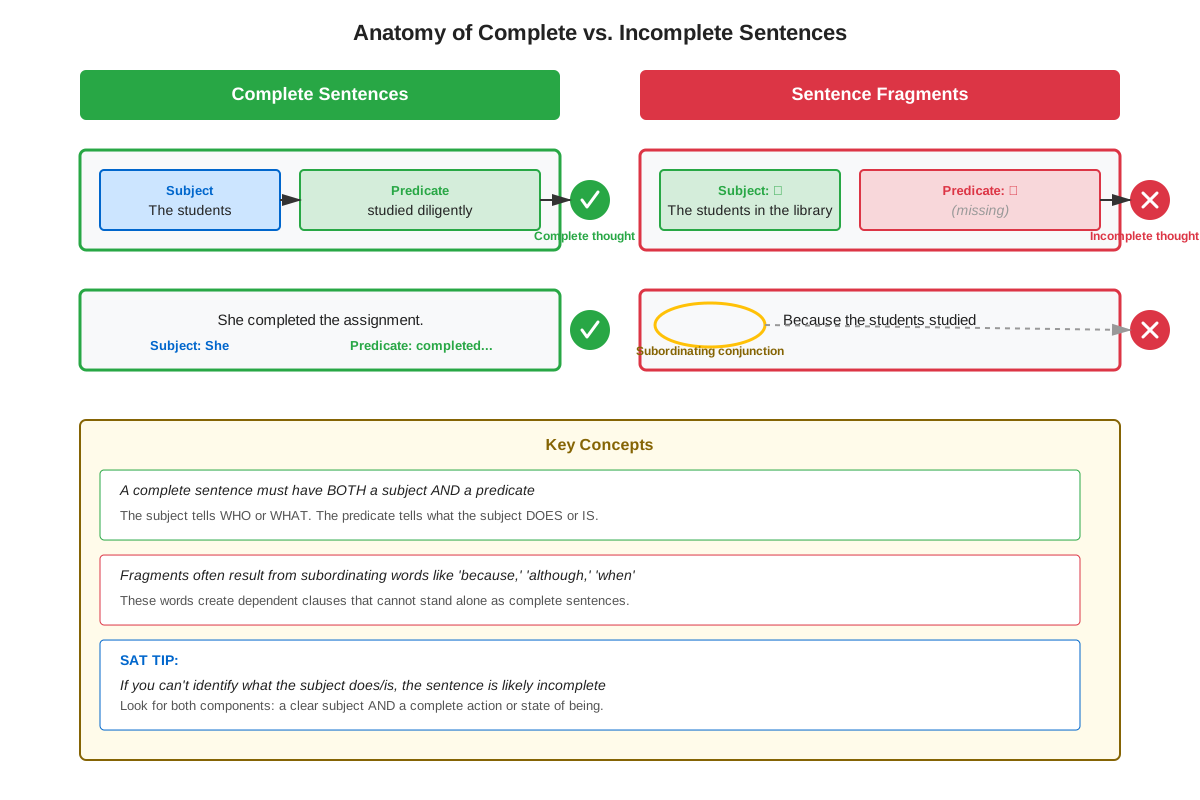
A complete sentence must contain two essential elements: a subject (the person, place, thing, or idea performing the action or being described) and a predicate (the verb and any accompanying information that tells what the subject does or is). These two components work together to express a complete thought that can stand independently. Without both elements, a group of words remains a fragment, regardless of its length or complexity.
The subject answers "who?" or "what?" before the verb. It can be a single word (a noun or pronoun) or a noun phrase containing multiple words. The predicate must include a complete verb—not just a verbal (gerund, participle, or infinitive)—that shows action or state of being. For example, "The student studies" contains both a subject ("The student") and a predicate ("studies"), forming a complete sentence. In contrast, "The student studying for the exam" lacks a complete verb and therefore remains a fragment.
Independent vs. Dependent Clauses
Understanding the distinction between independent and dependent clauses is crucial for mastering subject predicate completeness. An independent clause contains a subject and predicate and expresses a complete thought that can stand alone as a sentence. A dependent clause (also called a subordinate clause) contains a subject and verb but cannot stand alone because it begins with a subordinating word that makes the thought incomplete.
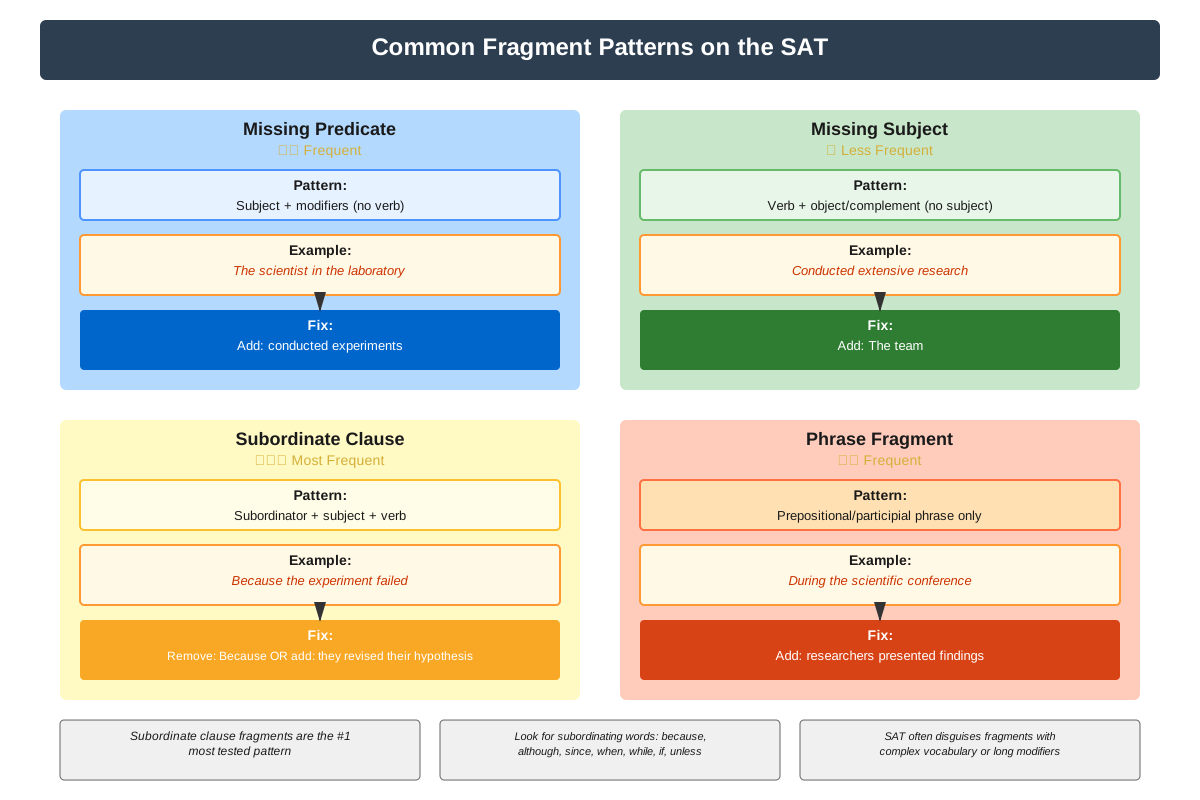
Common subordinating conjunctions include: although, because, since, when, while, if, unless, after, before, until, whereas, and though. When these words introduce a clause, they create dependency, meaning the clause requires an independent clause to complete the thought. For example, "Because the experiment failed" contains a subject ("the experiment") and a verb ("failed"), but the subordinating conjunction "because" makes it incomplete. It needs an independent clause: "Because the experiment failed, the researchers redesigned their methodology."
Relative Clauses and Sentence Fragments
Relative clauses begin with relative pronouns (who, whom, whose, which, that) and function as adjectives, modifying nouns in sentences. While relative clauses contain subjects and verbs, they cannot stand alone as complete sentences. The SAT frequently tests whether students recognize that a relative clause by itself constitutes a fragment.
Consider this fragment: "Which was the most challenging assignment of the semester." Despite containing a subject ("which") and a verb ("was"), this cannot stand alone because the relative pronoun "which" creates dependency. It must attach to an independent clause: "The research paper, which was the most challenging assignment of the semester, required extensive primary source analysis."
Verbals vs. Complete Verbs
A common source of sentence fragments involves verbals—verb forms that function as other parts of speech rather than as complete predicates. The three types of verbals are:
| Verbal Type | Form | Function | Example Fragment |
|---|---|---|---|
| Gerund | -ing | Acts as noun | "Running through the park every morning" |
| Participle | -ing or -ed | Acts as adjective | "The data collected from the survey" |
| Infinitive | to + base verb | Acts as noun, adjective, or adverb | "To understand the theory completely" |
None of these verbals can serve as the main verb in a complete sentence. They require a helping verb or a separate complete verb to form a predicate. For instance, "Running through the park every morning" becomes complete when we add a subject and complete verb: "Running through the park every morning is her favorite way to exercise."
Implied Subjects in Commands
One exception to the subject requirement involves imperative sentences (commands), where the subject "you" is implied rather than stated. "Close the door" is a complete sentence because the understood subject is "you." However, the SAT rarely tests this exception, focusing instead on declarative sentences where subjects must be explicit. Students should recognize that in formal academic writing—the style tested on the SAT—implied subjects appear only in direct commands, not in descriptive or analytical prose.
Compound Elements and Completeness
Sentences can have compound subjects (two or more subjects sharing the same predicate), compound predicates (two or more verbs sharing the same subject), or both. These remain complete sentences as long as at least one subject and one predicate are present. For example, "The hypothesis and methodology were both sound" contains a compound subject ("hypothesis and methodology") with a single predicate ("were sound"). Understanding compound structures prevents students from incorrectly identifying complete sentences as fragments simply because they contain multiple elements.
Concept Relationships
Subject predicate completeness serves as the foundation for understanding sentence boundaries, which in turn connects to punctuation rules and clause relationships. The hierarchy flows as follows: Complete sentence structure → enables recognition of → Independent vs. dependent clauses → which determines → Appropriate punctuation and conjunction use → which prevents → Run-ons and comma splices.
The concept of dependent clauses created by subordinating conjunctions directly relates to subject predicate completeness because these clauses contain subjects and verbs yet remain incomplete. This relationship extends to relative clauses, which similarly contain subject-verb pairs but cannot stand alone. Understanding these connections helps students recognize that the presence of a subject and verb does not automatically guarantee completeness—the grammatical context matters.
Verbals represent another critical connection, linking subject predicate completeness to parts of speech and verb forms. Students must understand verb conjugation and helping verbs to distinguish between complete predicates and verbal phrases that masquerade as predicates. This knowledge connects to verb tense consistency and subject-verb agreement, creating an integrated understanding of how verbs function in complete sentences.
Quick check — test yourself on Subject predicate completeness so far.
Try Flashcards →High-Yield Facts
⭐ A complete sentence must contain both a subject and a predicate that together express a complete thought
⭐ Dependent clauses beginning with subordinating conjunctions (because, although, when, if, etc.) cannot stand alone as complete sentences
⭐ Relative clauses starting with who, which, or that are always dependent and require an independent clause
⭐ Verbals (gerunds, participles, infinitives) cannot serve as the main verb in a complete sentence
⭐ The SAT tests subject predicate completeness by embedding fragments within complex passages where they appear deceptively complete
- A group of words can be very long and still be a fragment if it lacks a subject, predicate, or complete thought
- Compound subjects or compound predicates do not create fragments as long as the sentence contains at least one subject and one complete verb
- Prepositional phrases, no matter how many, cannot make a fragment complete if the essential subject-predicate structure is missing
- Appositive phrases (noun phrases that rename other nouns) cannot stand alone as complete sentences
- The word "being" by itself is never a complete verb and typically signals a fragment
Common Misconceptions
Misconception: If a group of words is long and contains many sophisticated vocabulary words, it must be a complete sentence. → Correction: Length and vocabulary complexity have no bearing on grammatical completeness. A sentence must contain a subject and complete predicate regardless of how many words it contains or how complex those words are.
Misconception: Any group of words containing a subject and a verb form is automatically a complete sentence. → Correction: The verb must be a complete verb, not a verbal (gerund, participle, or infinitive), and the clause must not begin with a subordinating word that creates dependency.
Misconception: Starting a sentence with "because" or "although" always creates a fragment. → Correction: Sentences can begin with subordinating conjunctions as long as they contain both a dependent clause and an independent clause. "Because it rained, the game was postponed" is complete.
Misconception: Relative clauses are complete sentences because they contain subjects and verbs. → Correction: Relative pronouns (who, which, that) create dependency, making these clauses unable to stand alone. They must modify nouns in independent clauses.
Misconception: On the SAT, fragments are always obviously wrong and easy to spot. → Correction: The SAT deliberately embeds fragments in contexts where they appear complete, often using complex vocabulary and multiple phrases to disguise the missing element. Systematic analysis is required.
Worked Examples
Example 1: Identifying the Fragment
Question: Which version corrects the error in the following passage?
"The archaeological team discovered artifacts dating back thousands of years. Which provided unprecedented insights into ancient trade routes."
A) NO CHANGE
B) years, which provided
C) years; which provided
D) years, providing
Solution:
Step 1: Identify sentence boundaries. The period after "years" creates two separate units.
Step 2: Analyze the second unit: "Which provided unprecedented insights into ancient trade routes." This contains a subject ("which") and a verb ("provided"), but the relative pronoun "which" creates dependency.
Step 3: Recognize that this is a relative clause fragment that cannot stand alone.
Step 4: Evaluate options:
- Option A keeps the fragment (incorrect)
- Option B connects the relative clause to the independent clause with a comma, creating a complete sentence
- Option C uses a semicolon, which can only connect two independent clauses (incorrect)
- Option D changes "which" to "providing," creating a participial phrase that correctly modifies the independent clause
Step 5: Both B and D are grammatically correct, but we must choose the best option. Option B maintains the original meaning more precisely by keeping the relative clause structure.
Answer: B
Connection to learning objectives: This example demonstrates how to identify fragments created by relative pronouns and apply knowledge of subject predicate completeness to select the correct revision.
Example 2: Recognizing Verbal Fragments
Question: Which choice completes the sentence with the most logical and precise information?
"The committee reviewing the proposal for the new community center. The members ______"
A) having concerns about the budget.
B) to express their concerns about the budget.
C) expressed concerns about the budget.
D) expressing concerns about the budget.
Solution:
Step 1: Analyze the first sentence: "The committee reviewing the proposal for the new community center." This contains a subject ("The committee") but "reviewing" is a present participle (verbal) functioning as an adjective, not a complete verb. This is a fragment.
Step 2: The question asks us to complete the second sentence, which begins "The members." This needs a complete predicate.
Step 3: Evaluate each option:
- Option A: "having concerns" is a gerund phrase, not a complete verb (fragment)
- Option B: "to express" is an infinitive, not a complete verb (fragment)
- Option C: "expressed" is a complete past tense verb (complete sentence)
- Option D: "expressing" is a present participle, not a complete verb (fragment)
Step 4: Only option C provides a complete predicate with a finite verb.
Answer: C
Connection to learning objectives: This example shows how to distinguish between verbals and complete verbs, a critical skill for identifying and correcting fragments on the SAT.
Exam Strategy
When approaching sat subject predicate completeness questions on the rw section, follow this systematic process:
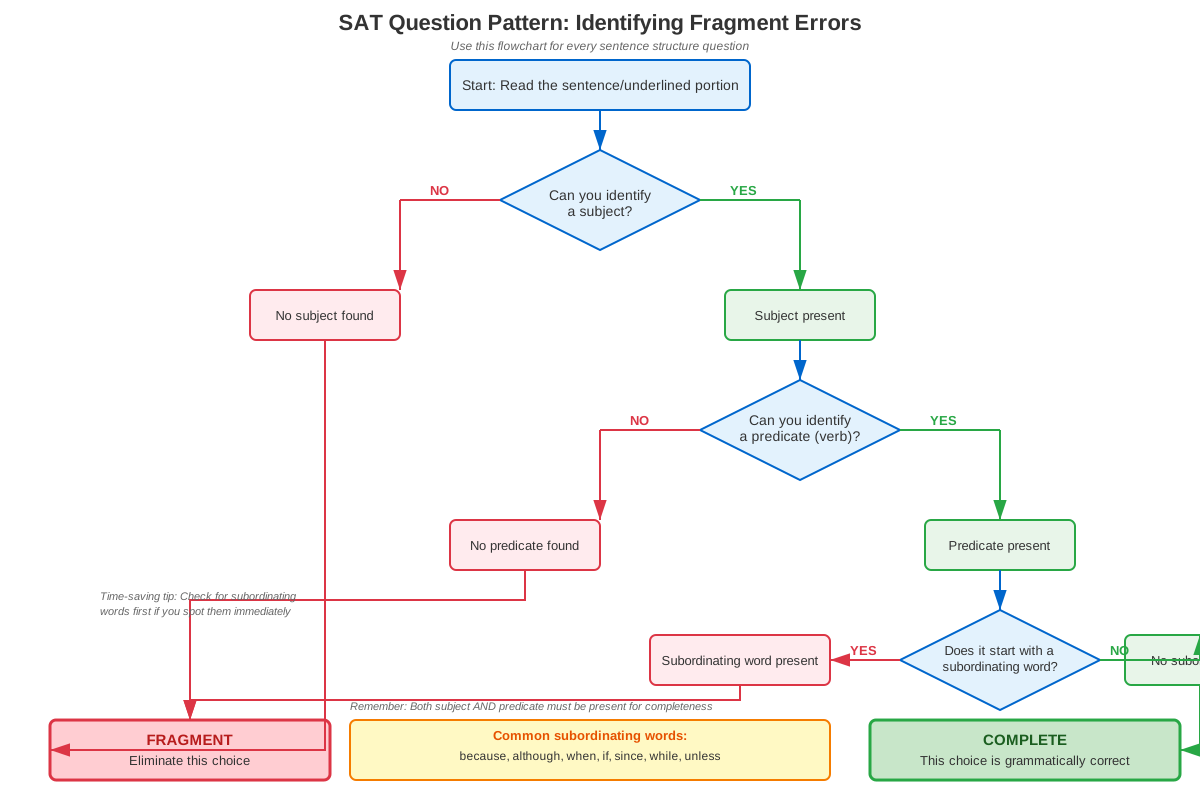
Step 1: Identify sentence boundaries by locating periods, semicolons, and coordinating conjunctions with commas. Each unit between these punctuation marks must be analyzed separately.
Step 2: Locate the subject by asking "Who or what is this sentence about?" Circle or mentally note the subject. If you cannot identify a clear subject, the sentence is likely a fragment.
Step 3: Locate the complete verb by finding the word or words that show action or state of being. Ensure it is a finite verb (conjugated form), not a verbal. Underline or mentally note the main verb.
Step 4: Check for subordinating words at the beginning of the clause. If you find "because," "although," "when," "which," "who," or similar words, verify that an independent clause exists somewhere in the sentence.
Step 5: Read the complete thought test by reading the sentence in isolation. Does it express a complete idea that makes sense on its own? If it leaves you waiting for more information, it is likely a fragment.
Exam Tip: Watch for trigger words like "which," "who," "because," "although," and "when" at the beginning of answer choices. These often signal dependency and potential fragments.
Time allocation: Spend no more than 30-45 seconds on subject predicate completeness questions once you recognize the pattern. These questions test a binary concept (complete or incomplete), so they should be among your fastest questions.
Process of elimination: Immediately eliminate any option that begins with a relative pronoun or subordinating conjunction without an independent clause. Also eliminate options where the main verb is a verbal (-ing form without a helping verb, infinitive, or past participle without auxiliary verb).
Memory Techniques
SWIFT Mnemonic for checking sentence completeness:
- Subject: Is there a clear who/what?
- Whole verb: Is the verb complete (not a verbal)?
- Independent: Can it stand alone?
- Fragment triggers: Check for subordinating words
- Thought: Does it express a complete idea?
Visualization Strategy: Picture a sentence as a bridge. The subject is one support pillar, the predicate is the other pillar, and the complete thought is the roadway connecting them. If either pillar is missing or if a subordinating word cuts the bridge, it cannot stand alone.
The "Because Test": If you can add "because" to the beginning of a group of words and it still makes sense grammatically (even if the meaning changes), it was already a complete sentence. If adding "because" makes it feel incomplete, it was likely already a fragment or the addition creates a fragment.
Verbal Alert Acronym - GPI: Remember that Gerunds, Participles, and Infinitives are not complete verbs. If the main verb fits one of these categories, you have found a fragment.
Summary
Subject predicate completeness is a foundational grammatical concept that requires every sentence to contain both a subject (who or what the sentence is about) and a complete predicate (a finite verb and accompanying information about the subject) that together express a complete thought. The SAT tests this concept by presenting fragments that appear complete due to length, complexity, or the presence of verbals that resemble complete verbs. Students must distinguish between independent clauses that can stand alone and dependent clauses created by subordinating conjunctions or relative pronouns. Mastery requires recognizing that verbals (gerunds, participles, infinitives) cannot serve as main verbs and that the presence of a subject and verb does not guarantee completeness if subordinating words create dependency. Success on these questions depends on systematic analysis: identifying sentence boundaries, locating subjects and complete verbs, checking for subordinating words, and applying the complete thought test. This high-yield topic appears frequently on the SAT and connects to broader concepts in sentence structure, punctuation, and clause relationships.
Key Takeaways
- Every complete sentence must have both a subject and a complete predicate that express a complete thought
- Dependent clauses beginning with subordinating conjunctions or relative pronouns cannot stand alone as sentences
- Verbals (gerunds, participles, infinitives) are not complete verbs and cannot form predicates by themselves
- Length and vocabulary complexity do not determine sentence completeness—grammatical structure does
- The SAT embeds fragments in complex contexts where systematic analysis using the SWIFT method reveals the error
- Subject predicate completeness questions are high-yield and should be answered quickly once the pattern is recognized
- Understanding this concept is essential for mastering sentence boundaries and preventing run-ons and comma splices
Related Topics
Comma Splices and Run-On Sentences: Once students master identifying complete sentences, they can progress to recognizing when two complete sentences are incorrectly joined, either with only a comma (comma splice) or with no punctuation (run-on). This topic builds directly on subject predicate completeness.
Subordination and Coordination: Understanding how to properly connect independent and dependent clauses using subordinating conjunctions and coordinating conjunctions extends the foundation of sentence completeness into more sophisticated sentence construction.
Punctuation Rules: Mastering subject predicate completeness enables students to understand why certain punctuation marks (periods, semicolons, colons) can only appear between independent clauses, while others (commas) have different requirements.
Modifier Placement: Recognizing complete sentence structure helps students identify where modifying phrases and clauses should be placed to avoid ambiguity and maintain clarity.
Practice CTA
Now that you have mastered the core concepts of subject predicate completeness, it is time to reinforce your learning through active practice. Complete the practice questions to test your ability to identify fragments, distinguish between complete and incomplete sentences, and select the best revisions in SAT-style contexts. Use the flashcards to drill the key distinctions between independent and dependent clauses, verbals and complete verbs, and common fragment triggers. Remember that mastery comes through repeated application—each practice question strengthens your pattern recognition and increases your speed on test day. You have built a solid foundation; now apply it with confidence!
Sign up free to keep reading
Create a free AnvayaPrep account to finish this SAT guide on Subject predicate completeness — plus flashcards and practice questions.