Overview
Modifier placement is a critical grammar concept tested extensively on the SAT Reading and Writing section. A modifier is a word, phrase, or clause that describes, clarifies, or provides additional information about another element in a sentence. The placement of modifiers determines what they modify, and incorrect placement can create confusion, ambiguity, or unintended meanings. On the SAT, questions about sat modifier placement require students to identify sentences where modifiers are misplaced or dangling, then select the revision that places the modifier correctly to convey the intended meaning clearly and logically.
Understanding modifier placement is essential for the SAT because these questions appear frequently in the rw (Reading and Writing) section, typically within the Standard English Conventions domain. The College Board tests whether students can recognize when a modifier is positioned too far from the word it modifies (misplaced modifier) or when the word being modified is missing entirely from the sentence (dangling modifier). These errors can make sentences confusing or even comical, and the SAT expects students to identify and correct them efficiently.
Modifier placement connects directly to broader sentence structure concepts, including subject-verb relationships, clause boundaries, and logical sentence construction. Mastering this topic strengthens overall writing clarity and prepares students for more complex grammatical concepts. Since modifier errors often appear subtle, developing a systematic approach to identifying and correcting them is crucial for achieving a high score on the SAT Reading and Writing section.
Learning Objectives
- [ ] Identify key features of modifier placement
- [ ] Explain how modifier placement appears on the SAT
- [ ] Apply modifier placement to answer SAT-style questions
- [ ] Distinguish between misplaced modifiers and dangling modifiers
- [ ] Recognize introductory modifying phrases and identify what they modify
- [ ] Evaluate multiple sentence revisions to determine which correctly places modifiers
- [ ] Analyze sentence structure to ensure modifiers are positioned adjacent to the words they modify
Prerequisites
- Basic sentence structure: Understanding subjects, verbs, and objects is necessary to identify what element a modifier should logically describe
- Phrase and clause recognition: Distinguishing between different types of phrases (prepositional, participial, infinitive) helps identify modifying elements
- Logical relationships: Recognizing cause-effect and descriptive relationships enables students to determine intended meanings
- Comma usage fundamentals: Many modifier placement issues involve introductory phrases set off by commas
Why This Topic Matters
Modifier placement questions appear consistently on every SAT administration, typically accounting for 2-4 questions per test. These questions fall within the Standard English Conventions category and are considered medium-difficulty, making them high-yield targets for score improvement. Students who master modifier placement can reliably earn these points, which often make the difference between score bands.
Beyond the exam, proper modifier placement is essential for clear professional and academic writing. Misplaced or dangling modifiers create ambiguity that can undermine credibility in college essays, research papers, and workplace communications. The ability to construct sentences where every element clearly relates to its intended referent demonstrates sophisticated writing skills valued in higher education and professional contexts.
On the SAT, modifier placement questions typically appear in two formats: error identification within a passage context, where students must recognize that a sentence contains a modifier error, and revision questions, where students must select the option that correctly places the modifier. These questions often feature introductory participial phrases, prepositional phrases describing actions or characteristics, and relative clauses. The College Board frequently tests whether students can identify when a modifier illogically modifies the wrong noun or when the intended noun is absent from the sentence entirely.
Core Concepts
What Are Modifiers?
A modifier is any word, phrase, or clause that provides descriptive information about another element in a sentence. Modifiers can be single adjectives ("the red car"), adverbs ("she ran quickly"), phrases ("the book on the table"), or entire clauses ("which was published last year"). The fundamental rule of modifier placement is that modifiers should be positioned as close as possible to the words they modify to ensure clarity and prevent confusion.
Modifiers answer questions like "which one?", "what kind?", "how?", "when?", "where?", or "to what extent?" about other sentence elements. When properly placed, modifiers enhance meaning without creating ambiguity. However, when separated from their intended referents, modifiers can attach themselves to the wrong words, creating logical errors or unintended humor.
Misplaced Modifiers
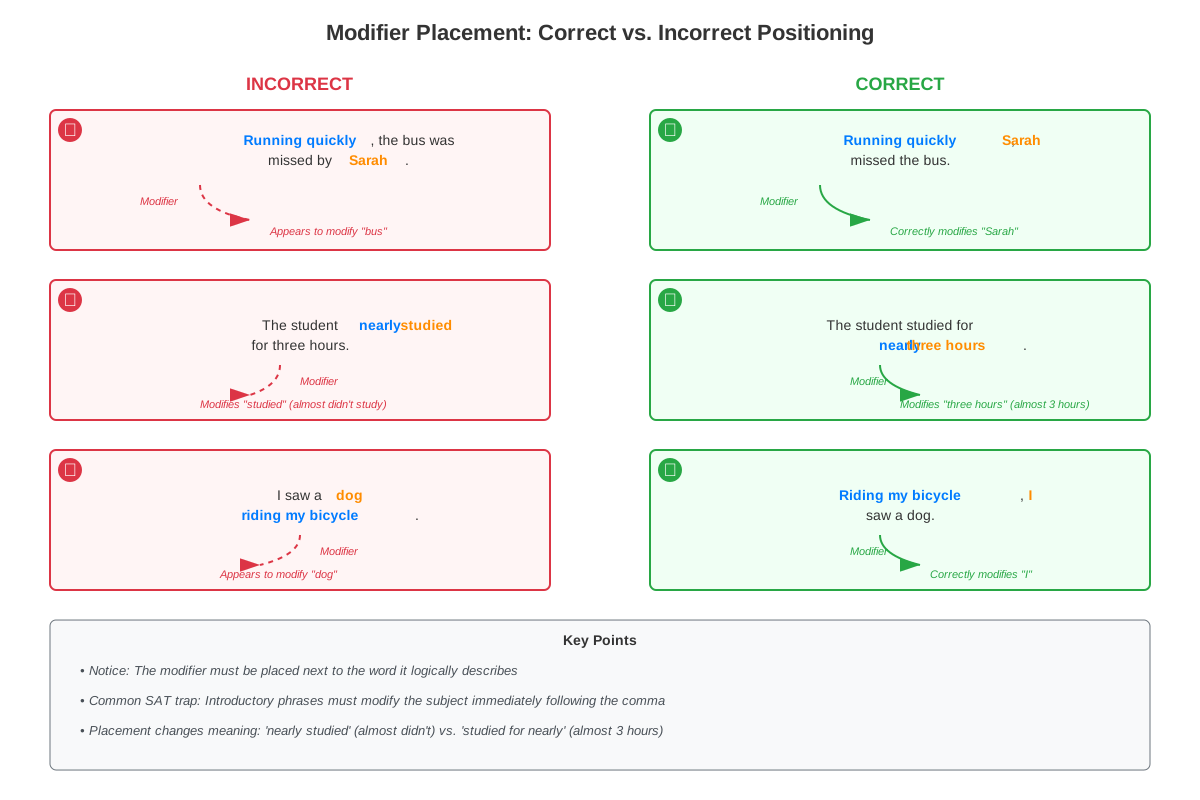
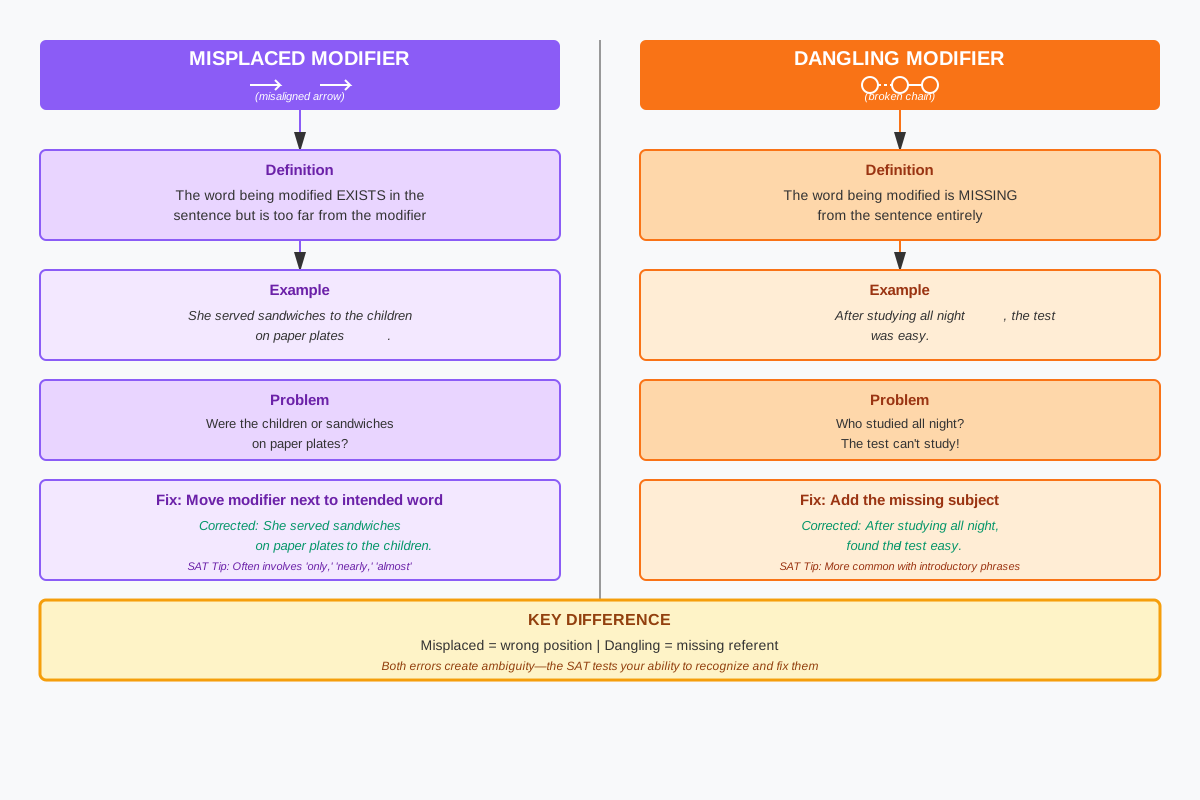
A misplaced modifier occurs when a modifying word or phrase is positioned too far from the element it's meant to describe, causing it to appear to modify something else instead. This creates confusion about the sentence's intended meaning.
Example of a misplaced modifier:
"She served sandwiches to the children on paper plates."
In this sentence, the prepositional phrase "on paper plates" appears to modify "children," suggesting the children were standing on paper plates. The intended meaning is that the sandwiches were on paper plates. The corrected version places the modifier closer to what it modifies:
"She served sandwiches on paper plates to the children."
Misplaced modifiers often involve:
- Prepositional phrases placed far from their referents
- Adverbs like "only," "almost," "nearly," "just," and "even" positioned incorrectly
- Relative clauses separated from the nouns they modify
Dangling Modifiers
A dangling modifier is a more serious error that occurs when the word being modified doesn't appear in the sentence at all. This typically happens with introductory phrases, especially participial phrases, where the implied subject of the modifier doesn't match the actual subject of the main clause.
Example of a dangling modifier:
"Walking through the park, the flowers were beautiful."
The participial phrase "Walking through the park" requires a person as its logical subject, but the sentence's actual subject is "the flowers." Flowers cannot walk, creating an illogical construction. The sentence needs revision to include the person who was walking:
"Walking through the park, I noticed the flowers were beautiful."
or
"As I walked through the park, the flowers were beautiful."
Dangling modifiers most commonly occur with:
- Introductory participial phrases (present or past participles)
- Introductory infinitive phrases
- Introductory prepositional phrases implying action
The Proximity Principle
The proximity principle states that modifiers should be placed immediately before or after the words they modify. This principle applies to all modifier types and is the foundation for identifying and correcting modifier errors on the SAT.
| Modifier Type | Correct Placement | Example |
|---|---|---|
| Single-word adjective | Before the noun | "The exhausted runner collapsed" |
| Adjective phrase | After the noun | "The runner, exhausted from the heat, collapsed" |
| Adverb | Near the verb/adjective it modifies | "She quickly finished" or "She finished quickly" |
| Introductory phrase | Before the subject it describes | "Exhausted from the heat, the runner collapsed" |
Introductory Modifying Phrases
Introductory modifying phrases are among the most frequently tested modifier constructions on the SAT. These phrases appear at the beginning of a sentence, set off by a comma, and must logically modify the subject that immediately follows the comma.
The rule is absolute: whatever noun or pronoun comes immediately after the comma must be what the introductory phrase describes.
Correct example:
"Having studied for weeks, Maria felt confident about the exam."
(Maria is the one who studied)
Incorrect example:
"Having studied for weeks, the exam seemed manageable."
(The exam didn't study; this is a dangling modifier)
Limiting Modifiers
Limiting modifiers are words like "only," "almost," "nearly," "just," "even," "merely," and "simply" that restrict or limit the meaning of what they modify. These words are particularly tricky because their placement dramatically changes sentence meaning.
Consider how placement of "only" changes meaning:
- "Only she told him the secret" (no one else told him)
- "She only told him the secret" (she told but didn't do anything else)
- "She told only him the secret" (she told no one else)
- "She told him only the secret" (she told nothing else)
On the SAT, limiting modifiers should be placed immediately before the word or phrase they're meant to limit.
Squinting Modifiers
A squinting modifier is positioned between two elements and could logically modify either one, creating ambiguity about the intended meaning.
Example:
"Students who study frequently score higher on tests."
Does "frequently" modify "study" (students who study often) or "score" (frequently score higher)? The sentence should be revised for clarity:
- "Students who frequently study score higher on tests."
- "Students who study score higher frequently on tests."
While less common than misplaced or dangling modifiers, squinting modifiers occasionally appear on the SAT in questions testing clarity and precision.
Concept Relationships
Modifier placement connects directly to fundamental sentence structure principles. The relationship flows as follows:
Sentence Structure → establishes the framework of subjects, verbs, and objects → Modifier Placement → determines how descriptive elements relate to core sentence components → Sentence Clarity → ensures readers understand intended relationships.
Within modifier placement itself, concepts build hierarchically:
- Basic Proximity Principle → establishes that modifiers must be near what they modify
- Misplaced Modifiers → occur when proximity is violated but the modified element exists
- Dangling Modifiers → represent more severe errors where the modified element is absent
- Introductory Phrases → create the most common testing scenario for dangling modifiers
- Limiting Modifiers → require precise placement to convey exact meaning
Modifier placement also connects to comma usage, as introductory modifying phrases require commas to separate them from main clauses. Understanding clause boundaries helps identify where modifiers begin and end, which is essential for determining what they modify.
The relationship to broader SAT grammar concepts includes connections to parallelism (modifiers in series must be parallel), verb tense (participial phrases must align temporally with main verbs), and logical comparison (modifiers must create logical relationships between compared elements).
High-Yield Facts
⭐ Introductory modifying phrases must logically describe the subject that immediately follows the comma.
⭐ A dangling modifier occurs when the word being modified doesn't appear in the sentence at all.
⭐ Misplaced modifiers are positioned too far from what they modify, causing them to appear to modify the wrong element.
⭐ The word "only" should be placed immediately before the word or phrase it limits.
⭐ Participial phrases (beginning with -ing or -ed verbs) at the start of sentences must describe the sentence's subject.
- Modifiers should be positioned as close as possible to the words they modify to ensure clarity.
- Prepositional phrases can function as modifiers and should be placed near their referents.
- Relative clauses (beginning with who, which, that) should immediately follow the nouns they modify.
- Adverbs like "almost," "nearly," "just," and "even" change meaning based on their position.
- Correcting a dangling modifier requires either adding the missing subject or restructuring the sentence.
- Squinting modifiers create ambiguity by appearing between two potential referents.
- Infinitive phrases at the beginning of sentences can dangle if the sentence subject isn't the logical actor.
- Multiple modifiers describing the same noun should be arranged logically, typically from general to specific.
Quick check — test yourself on Modifier placement so far.
Try Flashcards →Common Misconceptions
Misconception: Any phrase at the beginning of a sentence is automatically a modifier that describes the subject.
Correction: While introductory modifying phrases must describe the subject, not all introductory elements are modifiers. Prepositional phrases indicating time or place ("In 1920, the law changed") don't necessarily modify the subject; they provide context for the entire sentence.
Misconception: Misplaced modifiers and dangling modifiers are the same thing.
Correction: Misplaced modifiers occur when the modified element exists in the sentence but is positioned too far away; dangling modifiers occur when the modified element is completely absent from the sentence. Dangling modifiers are more serious errors requiring more substantial revision.
Misconception: As long as the sentence meaning is somewhat clear, modifier placement doesn't matter.
Correction: The SAT tests precise, unambiguous writing. Even if readers can infer the intended meaning, sentences with modifier errors are considered incorrect. The test requires modifiers to be positioned so that only one interpretation is possible.
Misconception: The word "only" can be placed anywhere near the element it modifies.
Correction: The position of "only" dramatically changes sentence meaning. It must be placed immediately before the specific word or phrase it limits. "She only ate pizza" (she didn't do anything else with pizza) differs from "She ate only pizza" (she ate nothing else).
Misconception: If a sentence starts with a participial phrase, you can fix a dangling modifier by changing the verb tense.
Correction: Changing verb tense doesn't fix a dangling modifier. The problem is that the logical subject of the participial phrase doesn't match the sentence subject. The fix requires either changing the sentence subject to match the phrase or restructuring the sentence entirely.
Misconception: Passive voice automatically creates dangling modifiers.
Correction: While passive voice can contribute to dangling modifiers, it doesn't automatically create them. The issue is whether the sentence subject logically performs the action implied by the introductory phrase, regardless of whether the sentence uses active or passive voice.
Worked Examples
Example 1: Identifying and Correcting a Dangling Modifier
Original sentence:
"After reviewing the data carefully, the conclusion seemed obvious."
Step 1: Identify the introductory modifying phrase
"After reviewing the data carefully" is a prepositional phrase containing a gerund ("reviewing") that implies someone performed the action of reviewing.
Step 2: Identify what comes immediately after the comma
"The conclusion" is the subject that follows the comma.
Step 3: Check logical relationship
Can a conclusion review data? No. This is a dangling modifier because the person who reviewed the data doesn't appear in the sentence.
Step 4: Determine the intended meaning
Someone (likely researchers or the writer) reviewed the data and reached a conclusion.
Step 5: Revise to include the logical subject
Correct options:
- "After reviewing the data carefully, the researchers found the conclusion obvious."
- "After reviewing the data carefully, we found the conclusion obvious."
- "After the data was reviewed carefully, the conclusion seemed obvious." (restructured to avoid the modifier)
Connection to learning objectives: This example demonstrates how to identify a dangling modifier (the modified element is absent) and apply multiple revision strategies to correct it.
Example 2: SAT-Style Question with Limiting Modifier
Passage context:
"The committee decided to allocate funds for the project. They _____ approved the budget after minimal discussion."
Options:
A) only
B) have only
C) only have
D) had only
Step 1: Identify what "only" should limit
The sentence suggests the committee approved the budget but perhaps didn't do other things, OR they approved only the budget (not other items), OR the approval happened with minimal discussion (only after minimal discussion).
Step 2: Analyze each option's meaning
- A) "They only approved" = they approved but did nothing else (unlikely intended meaning)
- B) "They have only approved" = they have approved but done nothing else (wrong tense)
- C) "They only have approved" = awkward and unclear
- D) "They had only approved" = they had approved but done nothing else (past perfect suggests this happened before something else)
Step 3: Consider context
The previous sentence mentions the decision to allocate funds. The second sentence describes the approval process. The intended meaning is likely that the approval happened quickly, with minimal discussion.
Step 4: Recognize the issue
None of these options correctly places "only" to modify "minimal discussion." The best revision would be: "They approved the budget after only minimal discussion."
Step 5: Select the best available option
If forced to choose from these options, A) creates the clearest sentence, though it changes the emphasis. However, this example illustrates that "only" placement requires careful attention to intended meaning.
Connection to learning objectives: This example shows how limiting modifiers change meaning based on position and how to analyze SAT answer choices for proper modifier placement.
Exam Strategy
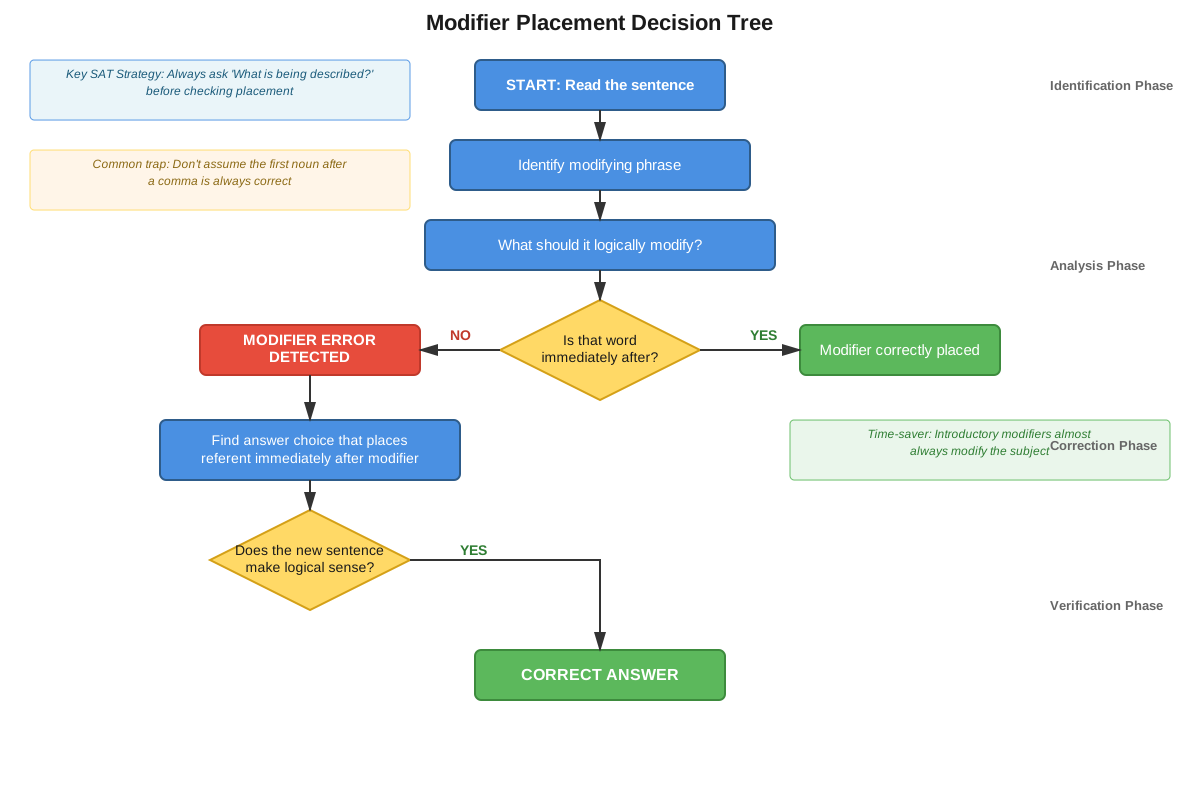
When approaching modifier placement questions on the SAT, follow this systematic process:
Step 1: Identify introductory phrases
Look for phrases at the beginning of sentences, especially those set off by commas. These are high-probability locations for modifier errors.
Step 2: Apply the "who/what is doing the action?" test
For introductory participial phrases or phrases implying action, ask who or what is performing that action. The answer must be the subject immediately following the comma.
Step 3: Watch for trigger words
Words like "only," "almost," "nearly," "just," and "even" signal limiting modifier questions. Check whether they're positioned immediately before what they limit.
Step 4: Check proximity
For any descriptive phrase, identify what it modifies and verify that it's positioned as close as possible to that element.
Step 5: Eliminate obviously incorrect options
On revision questions, eliminate choices that create new errors (wrong verb tense, subject-verb disagreement) or that place modifiers even farther from their referents.
Exam Tip: If a sentence begins with a participial phrase (-ing or -ed verb form), immediately check whether the subject after the comma can logically perform that action. This catches most dangling modifier errors.
Time allocation: Modifier placement questions should take 30-45 seconds each. If you can quickly identify the introductory phrase and check what follows the comma, you can answer efficiently. Don't overthink—apply the proximity principle and move on.
Common trigger phrases to watch for:
- "Having [past participle]..."
- "While [verb]-ing..."
- "After [verb]-ing..."
- "To [verb]..."
- "Upon [verb]-ing..."
- Any sentence with "only," "just," "nearly," "almost," or "even"
Process of elimination strategy:
- Eliminate options that create dangling modifiers (subject doesn't match the modifier)
- Eliminate options that place modifiers farther from their referents
- Eliminate options that change the intended meaning
- Choose the option that places the modifier closest to what it modifies while maintaining logical sense
Memory Techniques
Mnemonic for checking introductory phrases: "COMMA = Check Our Main Modifier Attachment"
When you see a comma after an introductory phrase, Check that the subject after the comma is what the modifier describes.
The "Who's Doing What?" Question
For any introductory phrase with an action, immediately ask "Who's doing what?" The answer must be the subject after the comma. If it's not, you've found a dangling modifier.
The ONLY Rule: "ONLY goes ONLY where it belongs"
Visualize "only" as a spotlight that illuminates exactly one word or phrase. It must be positioned immediately before what it illuminates.
The Proximity Principle Visualization
Imagine modifiers as magnets that must stick to what they describe. The farther apart they are, the weaker the connection. Keep them touching or as close as possible.
Dangling vs. Misplaced: "Dangling = Disappeared, Misplaced = Mispositioned"
- Dangling = Disappeared (the modified word is gone)
- Misplaced = Mispositioned (the modified word exists but is too far away)
The Subject-After-Comma Rule
Create a mental image of a comma as a gate. Whatever comes through that gate (the subject) must be what the introductory phrase describes. If the wrong thing comes through, the modifier is dangling.
Summary
Modifier placement is a high-yield SAT grammar concept that tests whether students can identify and correct sentences where descriptive elements are positioned incorrectly or where the modified element is missing entirely. The fundamental principle is proximity: modifiers must be placed as close as possible to the words they modify to ensure clarity and prevent ambiguity. Misplaced modifiers occur when the modified element exists but is too far away, while dangling modifiers occur when the modified element is absent from the sentence entirely. Introductory modifying phrases, especially participial phrases, must logically describe the subject that immediately follows the comma. Limiting modifiers like "only" must be positioned immediately before the specific word or phrase they limit, as their placement dramatically changes sentence meaning. Success on SAT modifier placement questions requires systematically checking whether introductory phrases match their subjects, whether descriptive phrases are positioned near their referents, and whether limiting modifiers are placed precisely to convey the intended meaning.
Key Takeaways
- Modifiers must be positioned as close as possible to the words they modify to ensure clarity and prevent confusion
- Introductory modifying phrases must logically describe the subject that immediately follows the comma
- Dangling modifiers occur when the modified element is completely absent from the sentence, requiring either addition of the missing subject or sentence restructuring
- Misplaced modifiers occur when the modified element exists but is positioned too far away, appearing to modify the wrong word
- Limiting modifiers like "only," "almost," "nearly," and "just" must be placed immediately before the word or phrase they limit
- The "who's doing what?" test quickly identifies dangling modifiers in introductory participial phrases
- Modifier placement questions appear consistently on every SAT and are high-yield targets for score improvement
Related Topics
Comma Usage and Punctuation: Understanding how commas set off introductory phrases and separate clauses helps identify modifier boundaries and determine what elements modifiers describe. Mastering modifier placement provides a foundation for understanding more complex punctuation rules.
Parallelism: When multiple modifiers describe the same element, they must be parallel in structure. Modifier placement skills transfer directly to recognizing and correcting parallelism errors.
Subject-Verb Agreement: Identifying sentence subjects is essential for checking whether introductory modifiers logically describe those subjects. Strong modifier placement skills reinforce subject identification abilities.
Sentence Fragments and Run-ons: Understanding complete sentences helps distinguish between introductory modifying phrases and independent clauses, which is crucial for proper punctuation and structure.
Logical Comparison: Modifiers often create comparisons between elements, and proper placement ensures these comparisons are logical and clear. Mastering modifier placement prepares students for more complex comparison questions.
Practice CTA
Now that you understand the principles of modifier placement, it's time to apply these concepts to SAT-style questions. Work through the practice questions to reinforce your ability to identify misplaced and dangling modifiers quickly and accurately. Use the flashcards to memorize key rules and trigger phrases that signal modifier errors. Remember, modifier placement questions are high-yield opportunities—mastering this topic can reliably boost your Reading and Writing score. Approach each practice question systematically, applying the "who's doing what?" test and the proximity principle. With focused practice, you'll develop the pattern recognition skills needed to spot and correct modifier errors in seconds. You've got this!
Sign up free to keep reading
Create a free AnvayaPrep account to finish this SAT guide on Modifier placement — plus flashcards and practice questions.