Overview
The best evidence for a claim is one of the most critical skills tested in the SAT Reading and Writing section. This concept requires students to identify which specific textual evidence most directly and effectively supports a given claim, argument, or interpretation. Unlike questions that ask students to make their own inferences, best evidence questions explicitly test the ability to evaluate and select the most relevant supporting details from a passage.
On the SAT, these questions appear frequently throughout the RW (Reading and Writing) section and represent a significant portion of the "Central Ideas and Details" question category. Students must demonstrate not only reading comprehension but also analytical reasoning—distinguishing between evidence that is merely related to a topic and evidence that genuinely proves or supports a specific claim. This skill mirrors real-world critical thinking: evaluating sources, assessing the strength of arguments, and determining which facts actually substantiate conclusions.
Mastering sat best evidence for a claim questions builds a foundation for success across the entire Reading and Writing section. The ability to identify supporting evidence connects directly to understanding main ideas, analyzing authorial purpose, interpreting data from informational graphics, and evaluating rhetorical strategies. Students who excel at evidence-based questions typically perform well on the SAT overall because this skill underlies virtually every reading comprehension task—from understanding what a passage explicitly states to evaluating how effectively an author builds an argument.
Learning Objectives
- [ ] Identify key features of best evidence for a claim
- [ ] Explain how best evidence for a claim appears on the SAT
- [ ] Apply best evidence for a claim to answer SAT-style questions
- [ ] Distinguish between strong and weak textual evidence for specific claims
- [ ] Evaluate multiple pieces of evidence to determine which provides the most direct support
- [ ] Recognize common distractors in evidence-based questions and avoid them systematically
Prerequisites
- Basic reading comprehension: Understanding literal meaning of sentences and paragraphs is essential before evaluating which details support specific claims
- Vocabulary in context: Recognizing word meanings helps determine whether evidence actually relates to the claim being evaluated
- Understanding of main ideas: Distinguishing between central points and supporting details provides the foundation for identifying evidence relationships
- Claim identification: Recognizing what constitutes a claim or argument enables students to match appropriate evidence to that claim
Why This Topic Matters
In academic and professional contexts, the ability to identify and evaluate evidence is fundamental to critical thinking. Scientists must determine which data supports their hypotheses, lawyers must select evidence that proves their cases, and journalists must verify which facts substantiate their reporting. The SAT tests this real-world skill in a standardized format, preparing students for college-level research, writing, and analytical thinking.
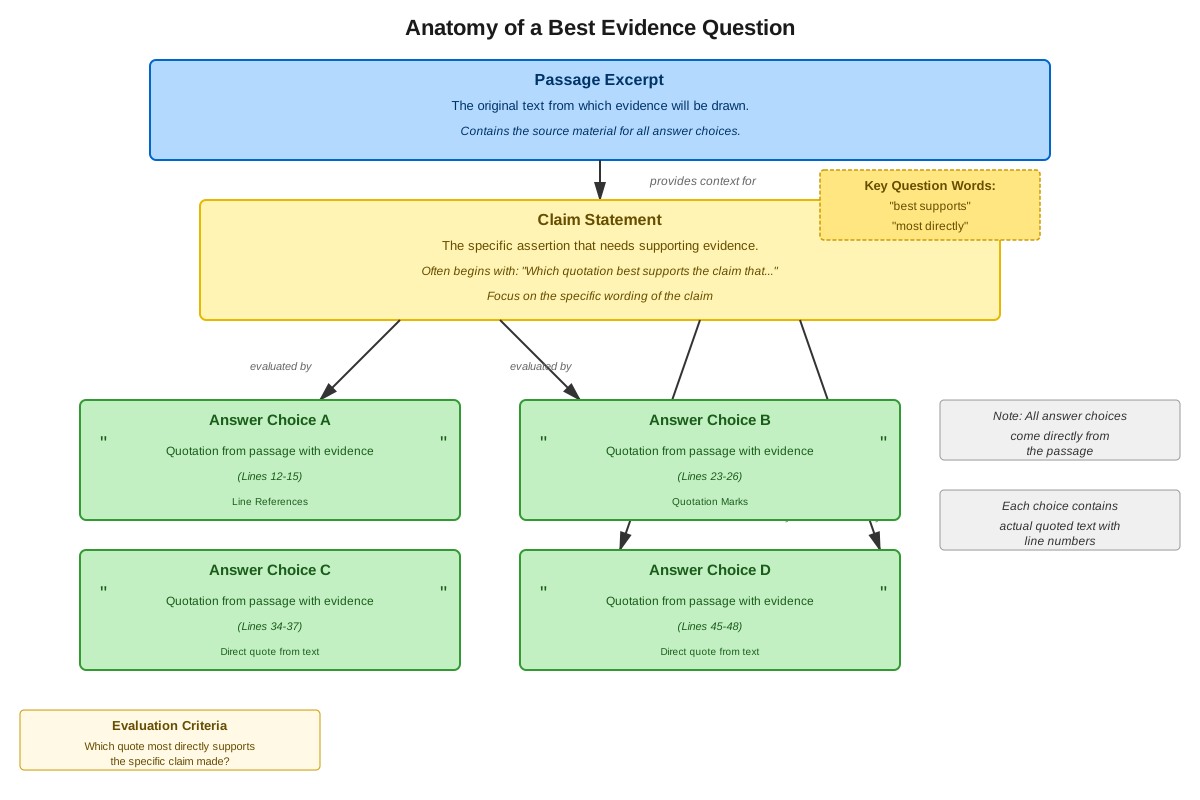
On the SAT, evidence-based questions appear in approximately 15-20% of all Reading and Writing questions, making them one of the highest-yield question types to master. These questions typically present a claim followed by four answer choices, each containing a different quotation or reference to the passage. Students must select which piece of evidence most directly supports the stated claim. The College Board has increased emphasis on evidence-based questions in recent SAT versions, reflecting the importance of this skill in college readiness standards.
Evidence questions commonly appear after passages discussing scientific research, historical analysis, literary interpretation, or social science findings. The passages may be informational texts explaining phenomena, argumentative essays defending positions, or narrative excerpts requiring interpretation. Regardless of passage type, the fundamental task remains consistent: match the most relevant, specific, and direct evidence to the claim being evaluated. Questions may ask students to support claims about an author's perspective, a character's motivation, a scientific conclusion, a historical cause-and-effect relationship, or the meaning of specific textual elements.
Core Concepts
What Constitutes "Best Evidence"
Best evidence for a claim refers to the specific textual support that most directly, clearly, and completely substantiates a particular statement or argument. Not all evidence is created equal—some details relate tangentially to a topic while others provide direct proof. The "best" evidence meets three critical criteria: relevance (it directly addresses the specific claim), specificity (it provides concrete details rather than vague generalities), and sufficiency (it adequately proves the claim without requiring additional logical leaps).
Consider the difference between weak and strong evidence. If a claim states "The scientist was surprised by the experimental results," weak evidence might mention that "The scientist conducted an experiment," which is related but doesn't prove surprise. Strong evidence would be "The scientist exclaimed, 'These results contradict everything we predicted!'" which directly demonstrates the emotional response claimed.
The Relationship Between Claims and Evidence
A claim is an assertion, argument, or interpretation that requires support. Evidence is the factual information, quotations, data, or specific details that prove or substantiate that claim. The relationship is hierarchical: claims are broader statements while evidence consists of specific supporting details. On the SAT, students must work backward from a given claim to locate the evidence that best supports it.
This relationship operates on a principle of logical connection. The best evidence creates a clear, direct line of reasoning from the textual detail to the claim. Weaker evidence requires the reader to make assumptions, inferences, or logical leaps to connect the detail to the claim. SAT questions specifically test whether students can identify evidence that requires minimal inferential distance from the claim.
Types of Evidence in SAT Passages
SAT passages contain various types of evidence, and recognizing these categories helps students evaluate their strength:
| Evidence Type | Description | Example Context |
|---|---|---|
| Direct quotations | Exact words from a person or text | Character dialogue, expert statements |
| Specific examples | Concrete instances illustrating a point | Historical events, experimental results |
| Statistical data | Numerical information or measurements | Research findings, demographic information |
| Descriptive details | Sensory or factual observations | Setting descriptions, physical characteristics |
| Causal explanations | Information showing cause-effect relationships | Scientific mechanisms, historical causation |
Each evidence type has different strengths depending on the claim. For claims about someone's beliefs or feelings, direct quotations typically provide the strongest evidence. For claims about trends or patterns, statistical data often works best. For claims about physical characteristics or settings, descriptive details are most effective.
Evaluating Evidence Strength
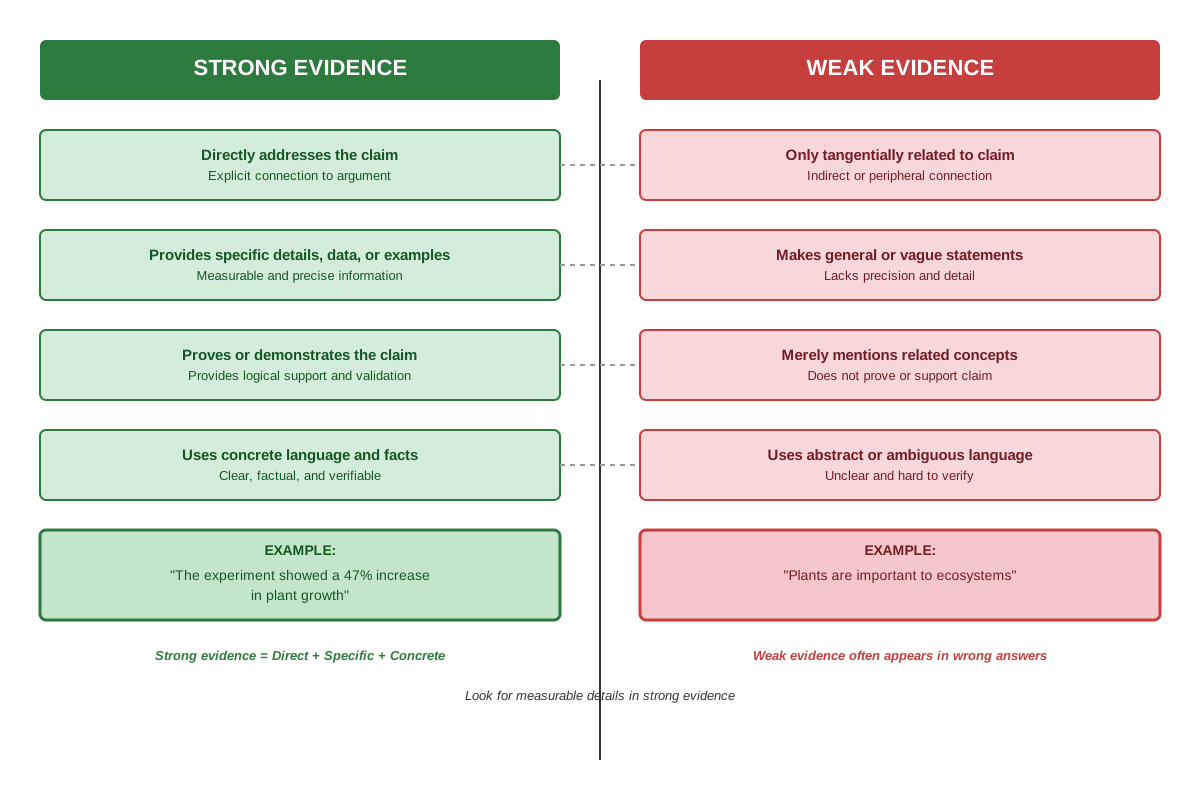
The strength of evidence depends on how directly it supports the specific claim without requiring additional assumptions. Strong evidence is:
- Explicitly stated: The connection between evidence and claim is clear and direct
- Specific and concrete: Provides particular details rather than generalizations
- Relevant to all parts of the claim: Addresses every component of what needs to be proven
- Sufficient on its own: Doesn't require combining with other information to prove the claim
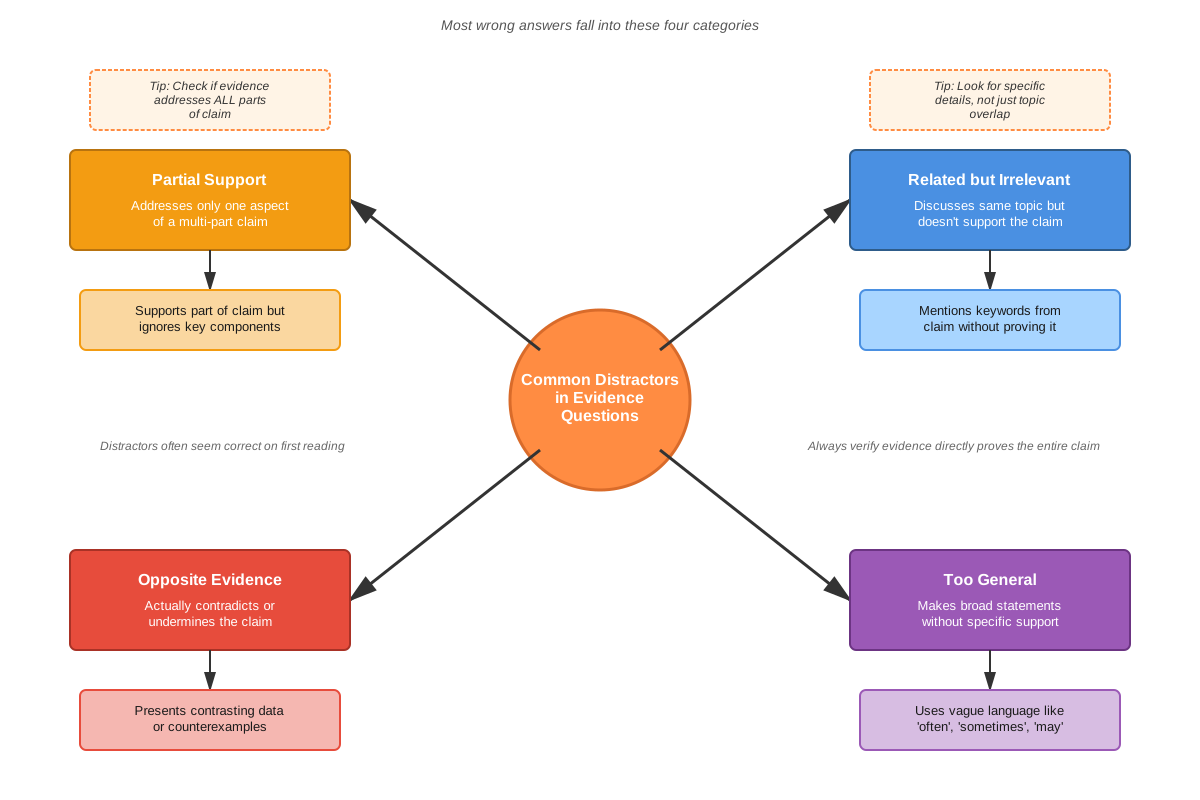
Weak evidence, conversely, may be tangentially related, overly general, address only part of the claim, or require significant inference to connect to the claim. On the SAT, incorrect answer choices often contain weak evidence that seems related but doesn't actually prove the specific claim stated in the question.
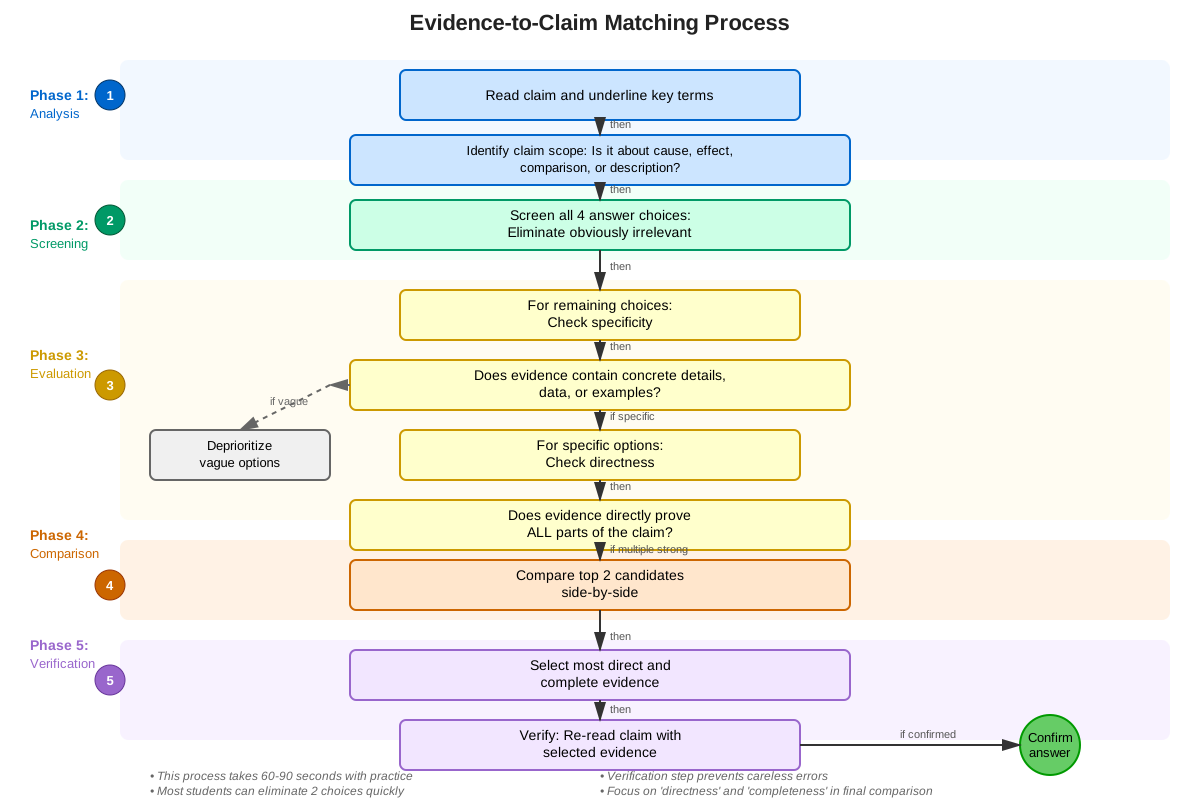
The Process of Matching Evidence to Claims
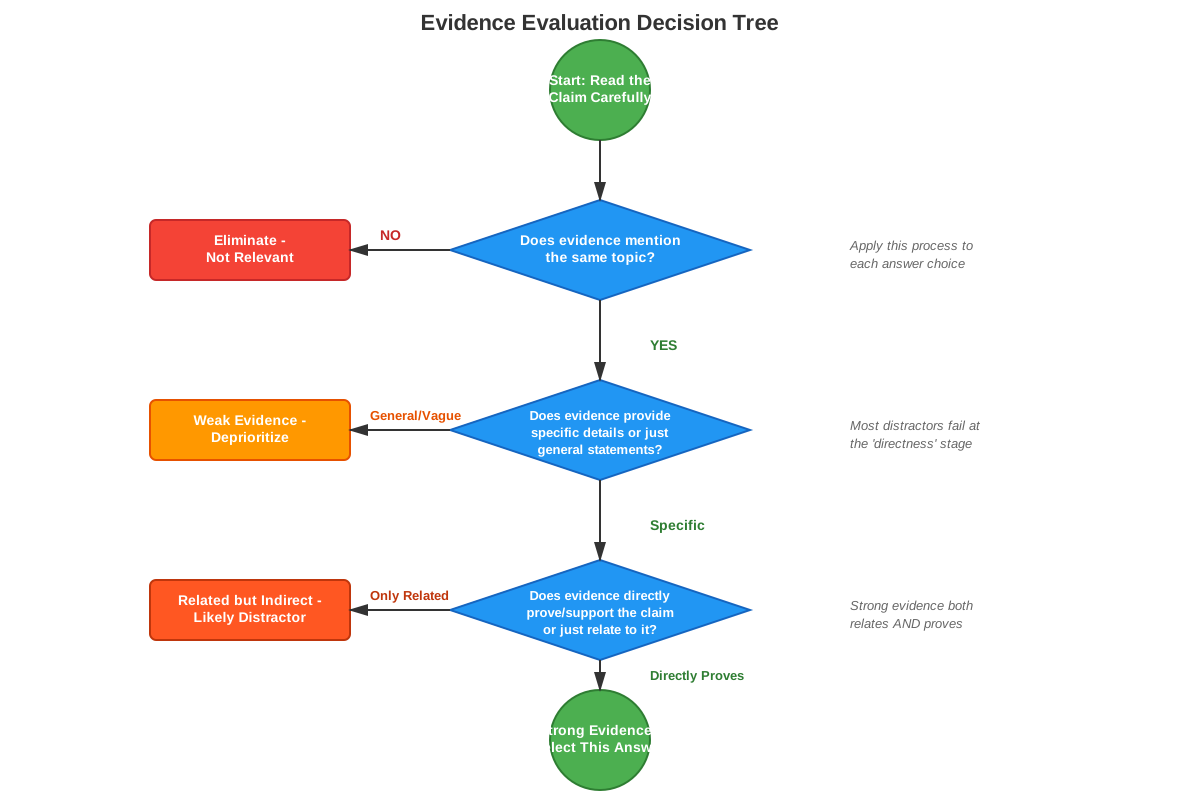
Successfully answering evidence questions requires a systematic approach:
- Analyze the claim carefully: Identify exactly what needs to be proven, including all specific components
- Predict what evidence would prove it: Before looking at answer choices, consider what type of information would directly support this claim
- Evaluate each answer choice: Check whether each piece of evidence directly proves the claim
- Eliminate weak connections: Remove options that are merely related but don't prove the specific claim
- Select the most direct support: Choose the evidence requiring the least inference
This process prevents students from selecting answers that "sound good" or relate to the general topic without actually proving the specific claim. The SAT deliberately includes distractors that discuss the same topic as the claim but don't provide direct support.
Common Evidence Question Formats
SAT evidence questions typically follow several standard formats:
Format 1: "Which quotation from the passage best supports the claim that [specific claim]?"
Format 2: "Which finding, if true, would most directly support the researcher's hypothesis?"
Format 3: "The author's statement in lines X-Y is best supported by which detail from the passage?"
Recognizing these formats helps students quickly identify what the question asks and focus their attention appropriately. Regardless of format, the fundamental task remains identifying the strongest textual support for a given claim.
Concept Relationships
The concepts within this topic form an interconnected system. Understanding what constitutes best evidence provides the foundation for evaluating evidence strength, which in turn enables students to successfully complete the process of matching evidence to claims. The relationship between claims and evidence underlies all these skills, while knowledge of types of evidence helps students recognize what they're looking for in passages.
This topic connects directly to prerequisite knowledge of main ideas and supporting details—best evidence questions essentially ask students to identify which supporting detail best proves a main idea or claim. The skill also relates to inference questions, though with an important distinction: evidence questions ask students to find explicit support for a given claim rather than make their own inferences.
Concept flow: Claim identification → Evidence type recognition → Evidence strength evaluation → Systematic matching process → Answer selection
Mastering this topic enables progression to more complex skills like evaluating rhetorical strategies, analyzing argumentative structure, and synthesizing information across multiple texts—all of which require identifying and evaluating evidence as a foundational skill.
High-Yield Facts
⭐ The best evidence directly proves the specific claim without requiring additional inferences or assumptions
⭐ Evidence that discusses the same general topic as the claim is not necessarily the best support for that specific claim
⭐ Direct quotations showing someone's words or thoughts provide the strongest evidence for claims about that person's beliefs, feelings, or attitudes
⭐ The correct answer will address all components of the claim, not just part of it
⭐ Specific, concrete details provide stronger evidence than general statements or summaries
- Evidence questions typically appear 3-5 times per SAT Reading and Writing section
- The passage always contains the evidence needed to answer the question—no outside knowledge is required
- Incorrect answer choices often contain evidence that appears earlier or later in the passage but doesn't directly support the specific claim
- Numerical data and statistics provide strong evidence for claims about quantities, trends, or comparisons
- Descriptive details about actions or events provide strong evidence for claims about what happened or how something occurred
- The word "best" in the question indicates that multiple answers may have some connection to the claim, but only one provides the strongest, most direct support
- Evidence from the same paragraph as the claim is not automatically the correct answer—the best evidence may appear elsewhere in the passage
Quick check — test yourself on Best evidence for a claim so far.
Try Flashcards →Common Misconceptions
Misconception: Any evidence related to the topic of the claim is good evidence for that claim.
Correction: Evidence must specifically prove the particular claim stated, not just discuss the same general subject. A passage about climate change might contain many facts about temperature, but only specific data directly supports a claim about temperature increase rates.
Misconception: The longest or most detailed answer choice is usually correct.
Correction: The best evidence is the most direct and relevant, regardless of length. A single sentence can provide stronger support than a lengthy quotation if it more directly proves the claim.
Misconception: Evidence must come from the same paragraph or section as the claim.
Correction: The best evidence can appear anywhere in the passage. SAT questions deliberately test whether students can locate relevant support throughout an entire text, not just in proximity to where a claim appears.
Misconception: If evidence requires making an inference, it cannot be the correct answer.
Correction: While the best evidence should be as direct as possible, some minimal inference is acceptable. The key is selecting evidence that requires the least inferential distance from the claim compared to other options.
Misconception: Evidence that sounds impressive or uses sophisticated vocabulary is more likely to be correct.
Correction: The strength of evidence depends on its logical connection to the claim, not on how it's worded. Simple, direct statements often provide better support than complex sentences that don't directly address the claim.
Misconception: The first answer choice that seems related to the claim is probably correct.
Correction: All answer choices should be evaluated systematically. The SAT deliberately places plausible but incorrect options throughout the answer choices, and the correct answer may be the last option listed.
Worked Examples
Example 1: Scientific Research Passage
Passage excerpt: "Dr. Martinez conducted a three-year study of coral reef recovery following bleaching events. In the first year, only 12% of affected coral showed signs of recovery. However, by the end of the third year, 67% of the coral had regained normal coloration and polyp activity. Martinez noted, 'The resilience of these ecosystems exceeded our initial projections by a significant margin.' The recovery rate was particularly pronounced in areas with lower water temperatures and reduced human activity."
Claim: Dr. Martinez was surprised by how well the coral recovered.
Answer choices:
A) "Dr. Martinez conducted a three-year study of coral reef recovery following bleaching events."
B) "In the first year, only 12% of affected coral showed signs of recovery."
C) "Martinez noted, 'The resilience of these ecosystems exceeded our initial projections by a significant margin.'"
D) "The recovery rate was particularly pronounced in areas with lower water temperatures and reduced human activity."
Analysis:
- Choice A provides context about the study but says nothing about Martinez's reaction or surprise—it's merely background information. Eliminate.
- Choice B gives data about first-year recovery but doesn't indicate whether this surprised Martinez or met expectations. It's related to recovery but doesn't prove surprise. Eliminate.
- Choice C directly quotes Martinez stating that results "exceeded our initial projections by a significant margin"—this explicitly demonstrates surprise by showing expectations were surpassed. This is strong, direct evidence.
- Choice D provides additional findings about recovery patterns but doesn't address Martinez's emotional or intellectual response to the results. Eliminate.
Correct answer: C
This example demonstrates how direct quotations showing someone's explicit statement provide the strongest evidence for claims about that person's reactions or beliefs. The other options discuss the same general topic (coral recovery) but don't prove the specific claim about Martinez's surprise.
Example 2: Historical Analysis Passage
Passage excerpt: "The introduction of the printing press in 15th-century Europe transformed information dissemination. Before Gutenberg's innovation, books were copied by hand, a process requiring months of labor and resulting in texts affordable only to wealthy institutions. A single Bible might cost the equivalent of a year's wages for a skilled craftsman. After the printing press became widespread, book production time decreased from months to days, and prices fell by approximately 80% within fifty years. By 1500, an estimated 20 million books had been printed across Europe, compared to perhaps 30,000 hand-copied manuscripts produced in the entire previous century."
Claim: The printing press made books accessible to a much broader segment of European society.
Answer choices:
A) "The introduction of the printing press in 15th-century Europe transformed information dissemination."
B) "Before Gutenberg's innovation, books were copied by hand, a process requiring months of labor."
C) "A single Bible might cost the equivalent of a year's wages for a skilled craftsman."
D) "After the printing press became widespread, book production time decreased from months to days, and prices fell by approximately 80% within fifty years."
Analysis:
- Choice A makes a general statement about transformation but doesn't specifically address accessibility or broader segments of society. Too vague. Eliminate.
- Choice B describes the old method but doesn't prove that the new method increased accessibility—it only establishes the baseline. Eliminate.
- Choice C shows books were expensive before the printing press but doesn't prove they became more accessible afterward. It addresses only the "before" situation, not the change. Eliminate.
- Choice D provides specific evidence that production time decreased and prices fell 80%—both factors directly support the claim that books became accessible to more people. Lower prices and faster production directly enable broader accessibility.
Correct answer: D
This example shows how evidence must address the complete claim. The claim is about increased accessibility, which requires evidence showing change that enabled more people to obtain books. Only Choice D provides data demonstrating this change through reduced time and cost.
Exam Strategy
When approaching sat best evidence for a claim questions, follow this systematic process:
Step 1: Read and analyze the claim carefully. Underline or mentally note the specific components that need to be proven. If the claim states "The author was skeptical of the new theory," recognize that evidence must prove both skepticism and that it relates to the new theory specifically.
Step 2: Predict the type of evidence needed. Before looking at answer choices, consider what would prove this claim. For emotional states, look for quotations or descriptions of reactions. For factual claims, look for data or specific examples. This prediction prevents you from being swayed by attractive but incorrect options.
Step 3: Evaluate each answer choice against the claim. Ask: "Does this directly prove what the claim states?" Be ruthless—if the connection requires assumptions or additional information, it's probably not the best evidence.
Exam Tip: Watch for trigger phrases in questions like "best supports," "most directly," and "primarily demonstrates." These signal that multiple answers may have some connection, but only one provides the strongest support.
Step 4: Eliminate answers that are merely related. The most common distractors discuss the same topic as the claim but don't actually prove it. Just because an answer mentions the same subject doesn't make it the best evidence.
Step 5: Choose the most direct support. Between two seemingly good options, select the one requiring less inference or fewer logical steps to connect to the claim.
Time allocation: Spend approximately 45-60 seconds per evidence question. These questions reward careful analysis but don't require extensive time if you follow a systematic approach. If you're uncertain, mark the question and return to it after completing easier questions.
Trigger words to watch for: "suggests," "indicates," "demonstrates," "supports," "shows," "reveals," "proves." These words in the question stem tell you exactly what relationship you're looking for between evidence and claim.
Process of elimination tip: Cross out answer choices that address only part of the claim, require significant inference, or provide only background information without proving the specific point at issue.
Memory Techniques
DIRECT mnemonic for evaluating evidence strength:
- Directly addresses the claim
- Includes specific details
- Requires minimal inference
- Explicitly stated in passage
- Complete (addresses all parts of claim)
- Textually supported (not assumed)
The "Prove It" Test: When evaluating each answer choice, imagine you're in a debate and must prove your claim to a skeptical opponent. Would this evidence convince them? If you'd need to add explanations or make logical leaps, it's not the best evidence.
Visualization strategy: Picture the claim as a target's bullseye. The best evidence hits the center directly, while weaker evidence lands in outer rings—still on the target but not as precise. This mental image helps distinguish between related information and direct proof.
The Specificity Scale: Remember that evidence strength increases with specificity. General statements < Specific examples < Direct quotations < Quantitative data (for appropriate claims). Visualize this as a ladder where you're climbing toward stronger evidence.
Summary
Best evidence for a claim questions test the critical skill of identifying which textual support most directly and effectively proves a specific statement or argument. Success requires understanding that the "best" evidence is not merely related to the claim's topic but directly proves the claim with minimal inference required. Students must systematically analyze what the claim asserts, predict what would prove it, evaluate each answer choice against the claim's specific components, eliminate merely related information, and select the most direct support. The key distinction is between evidence that discusses the same subject and evidence that actually proves the particular point at issue. Strong evidence is explicit, specific, relevant to all parts of the claim, and sufficient on its own. These questions appear frequently on the SAT Reading and Writing section and represent a foundational skill for college-level analytical thinking. Mastering this topic requires practice distinguishing between strong and weak textual support and developing a systematic approach to matching evidence to claims rather than relying on intuition or selecting answers that simply "sound good."
Key Takeaways
- The best evidence directly proves the specific claim without requiring additional assumptions or logical leaps
- Evidence that merely discusses the same topic as the claim is not necessarily the best support for that particular claim
- Direct quotations provide the strongest evidence for claims about beliefs, feelings, attitudes, or perspectives
- All components of the claim must be addressed by the evidence—partial support is insufficient
- Systematic evaluation of each answer choice against the claim prevents falling for attractive distractors
- Specific, concrete details provide stronger evidence than general statements or summaries
- The correct answer requires the least inferential distance from the evidence to the claim
Related Topics
Main Ideas and Supporting Details: Understanding how authors structure arguments with central claims and supporting evidence builds directly on evidence evaluation skills and helps students see the broader organizational patterns in passages.
Inference Questions: While evidence questions ask students to find explicit support for given claims, inference questions require making logical conclusions from evidence—the inverse skill that deepens understanding of evidence-claim relationships.
Rhetorical Analysis: Evaluating how authors use evidence to build arguments extends the skills learned in this topic to more complex analysis of persuasive techniques and argumentative structure.
Command of Evidence in Writing: The SAT Writing section tests similar skills in evaluating whether added sentences or revisions provide appropriate evidence for claims, applying these reading skills to writing contexts.
Practice CTA
Now that you understand how to identify and evaluate the best evidence for claims, it's time to apply these skills! Work through the practice questions to test your ability to distinguish strong evidence from weak distractors and develop your systematic approach to these high-yield SAT questions. The flashcards will help you internalize key concepts and recognition patterns. Remember: evidence questions reward careful, methodical analysis—and with practice, you'll develop the instinct to spot the best support quickly and confidently. Every practice question you complete strengthens your ability to think critically about claims and evidence, a skill that will serve you well beyond the SAT!
Sign up free to keep reading
Create a free AnvayaPrep account to finish this SAT guide on Best evidence for a claim — plus flashcards and practice questions.