Overview
The ability to distinguish main idea from detail is one of the most fundamental and frequently tested skills in the SAT Reading and Writing (RW) section. This skill requires students to identify the central purpose or primary claim of a passage while recognizing which information serves as supporting evidence, examples, or elaboration. On the digital SAT, approximately 20-25% of reading questions directly or indirectly assess this competency, making it a high-yield area for score improvement.
Mastering distinguishing main idea from detail enables students to navigate complex passages efficiently, eliminate incorrect answer choices that confuse supporting information with central claims, and demonstrate reading comprehension at the level expected for college readiness. This skill forms the foundation for understanding author's purpose, analyzing argumentative structure, and synthesizing information across multiple texts—all critical competencies tested throughout the SAT RW section.
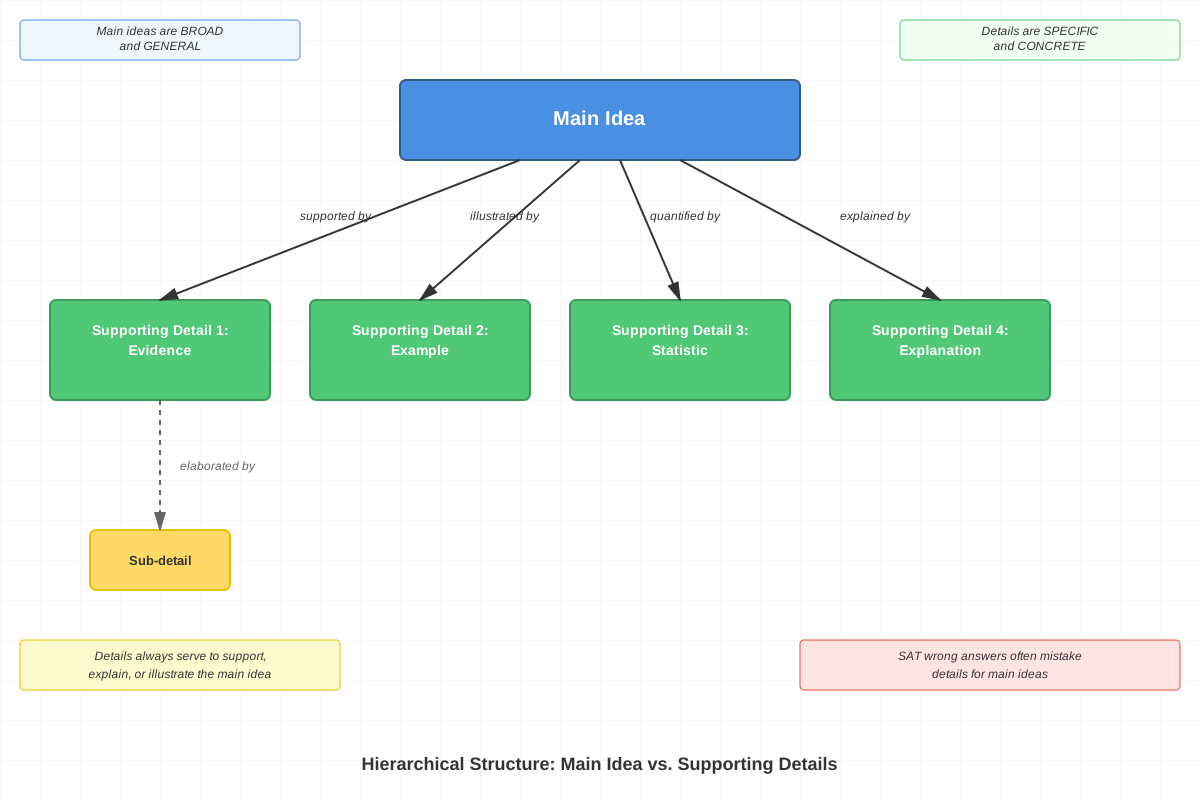
The relationship between main ideas and details operates hierarchically: main ideas represent the overarching message or thesis that the author wants readers to understand, while details function as the evidence, examples, statistics, anecdotes, or explanations that support, illustrate, or develop that central message. Understanding this relationship allows students to approach passages strategically, focusing on what matters most while recognizing the supporting role of specific information. This topic connects directly to other SAT RW concepts including central ideas and themes, purpose and function questions, and text structure analysis.
Learning Objectives
- [ ] Identify key features of distinguishing main idea from detail
- [ ] Explain how distinguishing main idea from detail appears on the SAT
- [ ] Apply distinguishing main idea from detail to answer SAT-style questions
- [ ] Differentiate between explicit and implicit main ideas in SAT passages
- [ ] Analyze the hierarchical relationship between main ideas and supporting details
- [ ] Evaluate answer choices to identify those that confuse details with main ideas
- [ ] Synthesize information from multiple paragraphs to determine overarching main ideas
Prerequisites
- Basic reading comprehension: Understanding literal meaning of sentences and paragraphs is essential before identifying which ideas are central versus supporting
- Vocabulary knowledge: Recognizing common academic and transitional words helps identify signals that introduce main ideas or supporting details
- Paragraph structure awareness: Understanding that paragraphs typically contain topic sentences and supporting sentences provides a framework for distinguishing main ideas from details
- Ability to paraphrase: Restating ideas in different words helps students recognize when answer choices accurately capture main ideas versus specific details
Why This Topic Matters
In academic and professional contexts, the ability to distinguish main ideas from details enables efficient information processing, critical evaluation of arguments, and effective communication. Students who master this skill can quickly extract key information from textbooks, research articles, and professional documents—a competency essential for college success and career advancement.
On the SAT, questions testing this skill appear in multiple formats across the Reading and Writing section. Approximately 4-6 questions per test directly ask students to identify main ideas, central claims, or primary purposes. Additionally, many other question types—including inference questions, function questions, and synthesis questions—require students to distinguish main ideas from details as a foundational step in the reasoning process. This makes the topic one of the highest-yield areas for focused study.
Common manifestations on the SAT include passages where the main idea appears in the opening or closing sentences, passages where the main idea must be inferred from multiple supporting details, and passages where compelling but ultimately secondary information might distract students from the central claim. The test frequently presents answer choices that accurately describe details from the passage but fail to capture the overarching main idea, making this distinction critical for success.
Core Concepts
Defining Main Ideas and Details
The main idea represents the central message, primary claim, or overarching point that an author wants to communicate in a passage or paragraph. It answers the question "What is this passage fundamentally about?" or "What does the author most want me to understand?" Main ideas are typically broad enough to encompass the entire passage while remaining specific enough to distinguish the passage from other texts on similar topics.
Details, by contrast, are specific pieces of information that support, illustrate, explain, or develop the main idea. Details include examples, statistics, quotations, anecdotes, descriptions, definitions, and evidence. While details are important for understanding and believing the main idea, they serve a subordinate function in the passage's hierarchy of information.
Characteristics of Main Ideas
Main ideas possess several distinguishing characteristics that help readers identify them:
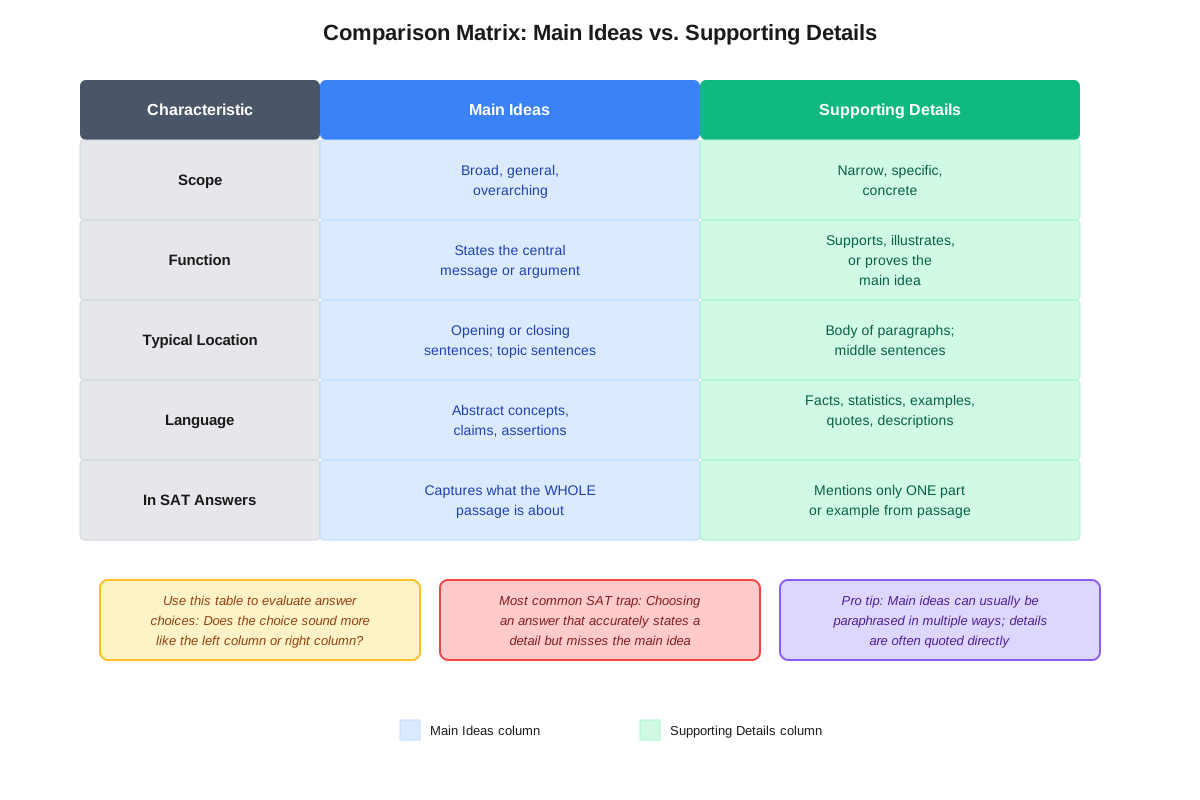
- Generality: Main ideas are broader and more encompassing than details
- Centrality: They relate to the entire passage or substantial portions of it
- Independence: They can stand alone as complete thoughts
- Recurrence: Concepts related to the main idea often appear multiple times throughout the passage
- Position: They frequently (though not always) appear in opening or closing positions
Characteristics of Supporting Details
Supporting details exhibit contrasting characteristics:
- Specificity: Details provide concrete, particular information
- Limited scope: They relate to portions of the passage rather than the whole
- Dependence: They make most sense in relation to the larger point they support
- Variety: Details come in many forms (examples, data, quotes, descriptions)
- Subordination: They answer questions like "how?" "why?" or "for example?"
The Hierarchical Relationship
The relationship between main ideas and details operates on multiple levels:
| Level | Function | Example |
|---|---|---|
| Passage-level main idea | Overall purpose or thesis | "Renewable energy adoption faces economic challenges" |
| Paragraph-level main idea | Topic sentence or key claim | "Solar panel installation costs remain prohibitive for many homeowners" |
| Supporting detail | Evidence or example | "The average installation costs $15,000-$25,000" |
| Minor detail | Elaboration of supporting detail | "This includes equipment, labor, and permits" |
Understanding this hierarchy helps students recognize that a statement might be a "main idea" at the paragraph level while functioning as a "detail" supporting the passage-level main idea.
Explicit vs. Implicit Main Ideas
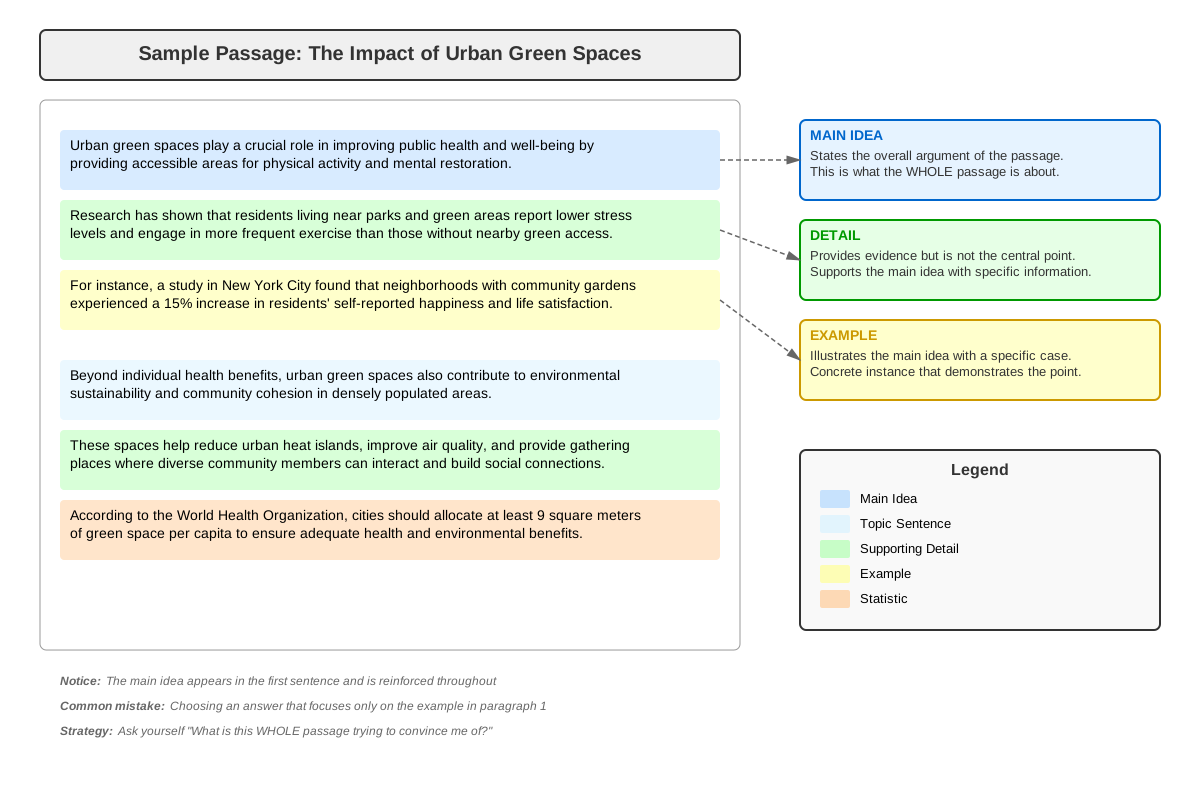
Explicit main ideas are directly stated in the passage, often in topic sentences or thesis statements. Students can point to specific sentences that articulate the main idea. On the SAT, passages with explicit main ideas test whether students can distinguish these statements from compelling details.
Implicit main ideas are not directly stated but must be inferred from the accumulation of details and supporting information. Students must synthesize multiple pieces of information to determine what the passage is fundamentally about. SAT passages with implicit main ideas require higher-level comprehension and are typically considered more challenging.
Signal Words and Phrases
Certain linguistic markers help identify main ideas and details:
Main idea signals:
- "The primary/main/central point is..."
- "Fundamentally/essentially..."
- "The key issue/question is..."
- "Overall/in general..."
Detail signals:
- "For example/for instance..."
- "Specifically/in particular..."
- "According to/research shows..."
- "One reason/another factor..."
- "Such as/including..."
Common Passage Structures
Understanding typical passage structures helps students locate main ideas:
- Deductive structure: Main idea appears early, followed by supporting details
- Inductive structure: Details build toward a main idea stated at the end
- Problem-solution structure: Problem (main idea) followed by solution details
- Compare-contrast structure: Main idea about relationship between subjects, with details about each
- Chronological structure: Main idea about significance of events, with details about sequence
Concept Relationships
The skill of distinguishing main idea from detail serves as a foundational competency that enables mastery of more complex SAT RW tasks. This relationship can be mapped as follows:
Distinguishing main idea from detail → enables → Understanding author's purpose (recognizing that the main idea reveals why the author wrote the passage)
Distinguishing main idea from detail → supports → Analyzing text structure (understanding how details are organized to develop the main idea)
Distinguishing main idea from detail → facilitates → Making inferences (using details as evidence while keeping the main idea as context)
Distinguishing main idea from detail → strengthens → Evaluating arguments (identifying claims versus evidence)
Within the topic itself, concepts connect hierarchically: understanding the characteristics of main ideas and details leads to recognizing their relationship, which enables identification of signal words, which supports application of passage structure knowledge, which ultimately allows successful answering of SAT questions.
The prerequisite knowledge of paragraph structure directly supports this topic by providing a familiar framework (topic sentence + supporting sentences) that students can apply at the passage level. Vocabulary knowledge connects by helping students recognize transitional and signal words that mark main ideas versus details.
High-Yield Facts
⭐ Main ideas are broad enough to encompass the entire passage but specific enough to distinguish it from other passages on similar topics
⭐ Details answer questions like "how?" "why?" "for example?" or "what evidence?" in relation to the main idea
⭐ The most common SAT trap answer confuses a compelling detail with the passage's main idea
⭐ Main ideas can be explicit (directly stated) or implicit (must be inferred from details)
⭐ Signal phrases like "for example" and "specifically" almost always introduce details, not main ideas
- Main ideas often (but not always) appear in the first or last sentence of a passage or paragraph
- A statement can function as a main idea at the paragraph level while serving as a detail supporting the passage-level main idea
- If an answer choice mentions specific examples, statistics, or names from the passage, it likely describes a detail rather than the main idea
- The correct main idea answer will be supported by multiple details from the passage, not just one section
- Eliminating answer choices that are too broad (could apply to many passages) or too narrow (only cover part of the passage) helps identify the main idea
Common Misconceptions
Misconception: The main idea is always stated in the first sentence of the passage.
Correction: While main ideas frequently appear early in passages, they can also appear at the end (inductive structure), in the middle, or must be inferred from the entire passage. Students should read the complete passage before selecting a main idea answer.
Misconception: The longest or most detailed section of the passage contains the main idea.
Correction: Extensive detail often indicates supporting information rather than the main idea. Authors frequently spend more words on examples and evidence than on stating the central claim. Length and detail level do not determine whether information represents the main idea.
Misconception: If information appears in the passage, it's acceptable as a main idea answer.
Correction: All answer choices for main idea questions typically contain information from the passage. The key is distinguishing which information represents the central message versus which information supports or illustrates that message. Accuracy alone does not make an answer correct.
Misconception: Main ideas must be interesting or surprising.
Correction: Students sometimes select answer choices that describe the most compelling or unexpected detail rather than the actual main idea. The main idea might be straightforward or even predictable, while details provide the interesting specifics. Compelling content does not equal central importance.
Misconception: Each paragraph has equal weight in determining the passage's main idea.
Correction: Some paragraphs primarily provide background, context, or minor supporting details, while others develop the central argument. Students should consider how much of the passage relates to each potential main idea rather than treating all paragraphs as equally significant.
Quick check — test yourself on Distinguishing main idea from detail so far.
Try Flashcards →Worked Examples
Example 1: Explicit Main Idea with Distracting Details
Passage:
"The development of CRISPR gene-editing technology represents a watershed moment in biological research. Since its introduction in 2012, CRISPR has enabled scientists to modify DNA sequences with unprecedented precision and efficiency. For instance, researchers at the Broad Institute successfully used CRISPR to correct the genetic mutation responsible for sickle cell disease in laboratory studies. The technique costs approximately 99% less than previous gene-editing methods and requires only weeks rather than months to implement. Despite these advantages, ethical concerns about human germline editing have prompted calls for regulatory oversight."
Question: Which choice best states the main idea of the passage?
A) CRISPR technology has made gene editing more affordable and faster than previous methods.
B) The Broad Institute has used CRISPR to address sickle cell disease in laboratory settings.
C) CRISPR gene-editing technology represents a significant advancement in biological research.
D) Ethical concerns about CRISPR have led to demands for regulatory oversight.
Analysis:
Step 1: Identify the passage's scope. The passage discusses CRISPR technology broadly—its significance, capabilities, specific applications, advantages, and concerns.
Step 2: Locate potential main idea statements. The first sentence ("The development of CRISPR gene-editing technology represents a watershed moment in biological research") makes a broad claim about CRISPR's significance.
Step 3: Evaluate each answer choice:
- Choice A: This describes specific advantages (cost and speed) mentioned in the passage. These are supporting details that illustrate why CRISPR is significant, but they don't capture the passage's overall point. This is a classic detail-as-main-idea trap.
- Choice B: This describes one specific example from the passage. The sickle cell research illustrates CRISPR's capabilities but represents only one detail among several. Too narrow to be the main idea.
- Choice C: This matches the opening sentence and is broad enough to encompass all the information in the passage—the capabilities, advantages, specific applications, and even the ethical concerns all relate to why CRISPR represents a significant advancement. This is the main idea.
- Choice D: This describes information from the final sentence. While accurate, ethical concerns represent one aspect of the CRISPR discussion, not the passage's central focus. The passage emphasizes CRISPR's significance, with ethics as one consideration.
Answer: C
Connection to learning objectives: This example demonstrates how to identify key features of main ideas (breadth, centrality) and apply the skill to eliminate answer choices that confuse compelling details with the central message.
Example 2: Implicit Main Idea Requiring Synthesis
Passage:
"In 1847, Hungarian physician Ignaz Semmelweis noticed that women giving birth in hospital wards attended by doctors had mortality rates three times higher than those in midwife-attended wards. He observed that doctors often came directly from autopsy rooms to delivery wards without washing their hands. After implementing a handwashing protocol using chlorinated lime solution, mortality rates in the doctor-attended ward dropped from 18% to 2%. Despite this dramatic evidence, Semmelweis's contemporaries rejected his findings, and he died in obscurity. Only decades later, after Louis Pasteur's germ theory gained acceptance, did the medical community recognize Semmelweis's contribution."
Question: Which choice best describes the main idea of the passage?
A) Semmelweis discovered that handwashing with chlorinated lime solution reduced mortality rates from 18% to 2%.
B) Doctors in the 1840s frequently moved between autopsy rooms and delivery wards without proper hygiene.
C) Semmelweis made an important medical discovery that was not recognized until after his death.
D) Louis Pasteur's germ theory helped the medical community understand infectious disease transmission.
Analysis:
Step 1: Note that no single sentence explicitly states the passage's main idea. Students must synthesize information from the entire passage.
Step 2: Identify the passage's narrative arc: Semmelweis made an observation → conducted an intervention → achieved dramatic results → faced rejection → died unrecognized → later received recognition. The passage tells a story about delayed recognition of an important discovery.
Step 3: Evaluate each answer choice:
- Choice A: This accurately describes Semmelweis's specific findings (the 18% to 2% reduction). However, this is a supporting detail that illustrates the significance of his discovery. The passage's focus extends beyond just the statistical results to include the rejection and later recognition.
- Choice B: This describes the observation that led to Semmelweis's hypothesis. It's background information that explains why he implemented handwashing, but it's not the passage's central message.
- Choice C: This captures the passage's overall narrative: an important discovery (supported by the mortality rate details) that wasn't recognized during Semmelweis's lifetime (supported by the rejection and death in obscurity) but was later acknowledged (supported by the final sentence). This synthesizes the passage's key elements into a main idea.
- Choice D: Pasteur appears only in the final sentence as context for when Semmelweis's work gained recognition. The passage is about Semmelweis, not Pasteur. This choice confuses a minor detail with the main idea.
Answer: C
Connection to learning objectives: This example demonstrates how to identify implicit main ideas by synthesizing information across the passage and distinguishing the overarching narrative from specific supporting details.
Exam Strategy
Approaching Main Idea Questions
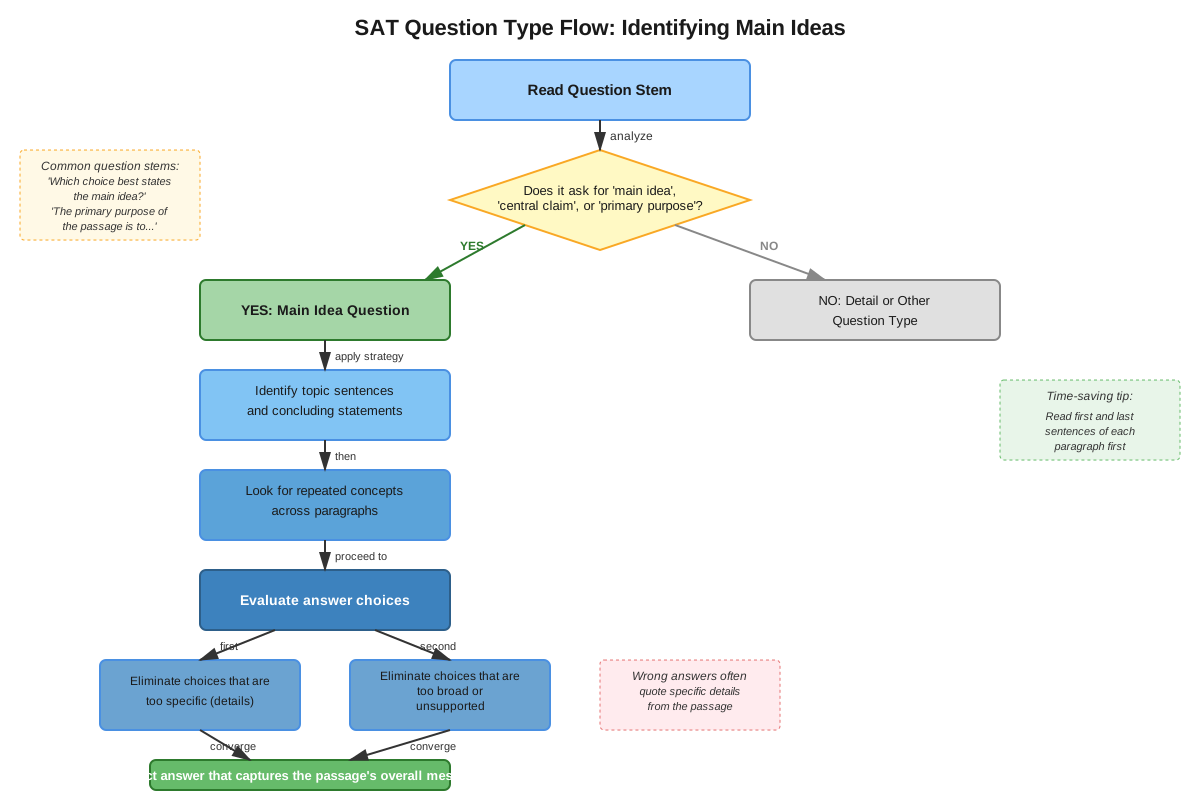
When encountering questions that ask for the "main idea," "central claim," "primary purpose," or what the passage is "mainly about," follow this systematic approach:
- Read the entire passage first: Never attempt to answer main idea questions based on the first paragraph alone. The main idea might be stated at the end or must be inferred from the complete text.
- Identify the passage's scope: Ask "What topic does this passage address?" and "What specific aspect of that topic does it focus on?" This helps eliminate answers that are too broad or too narrow.
- Look for repetition and emphasis: Concepts that appear multiple times or receive significant attention are more likely to relate to the main idea than information mentioned once.
- Apply the "umbrella test": The correct main idea should be broad enough that all or most of the passage's details fit "under" it as supporting information.
Trigger Words and Phrases
Questions testing this skill often include these phrases:
- "Which choice best states the main idea of the passage?"
- "The primary purpose of the passage is to..."
- "The passage is mainly about..."
- "Which choice best describes the central claim?"
- "The author's main point is that..."
When you see these triggers, immediately recognize that you need to distinguish between the overarching message and supporting information.
Process of Elimination Strategy
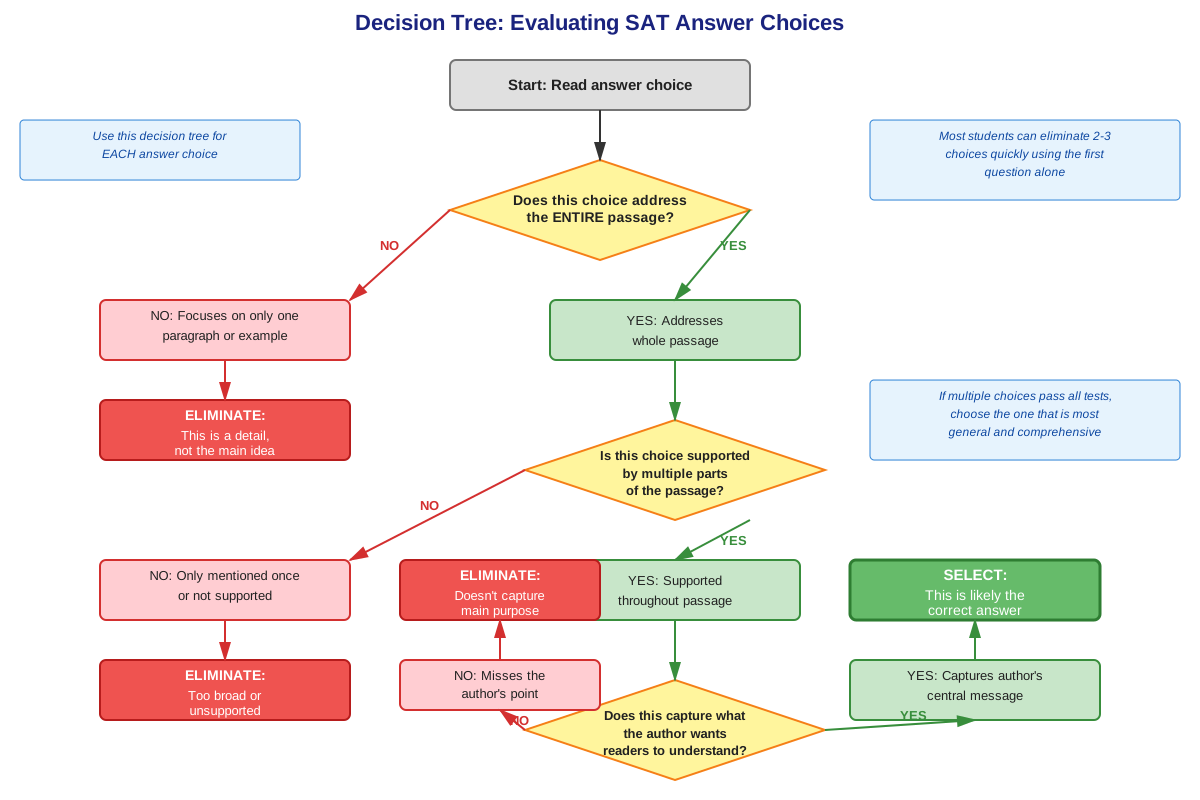
Use these criteria to eliminate incorrect answer choices:
- Eliminate "too narrow" answers: If the choice describes only one paragraph, one example, or one aspect of the passage, it's likely a detail rather than the main idea.
- Eliminate "too broad" answers: If the choice could accurately describe dozens of different passages on the topic, it's too general to be the main idea of this specific passage.
- Eliminate answers with specific examples: Choices that mention particular names, dates, statistics, or examples from the passage usually describe details. Main ideas are typically more general.
- Eliminate answers about minor points: If the choice describes information from only the beginning or end of the passage without connecting to the rest, it's probably not the main idea.
Time Allocation
Main idea questions should take approximately 45-60 seconds to answer, including passage reading time. If you find yourself spending more than 90 seconds, you may be overthinking. Return to the passage's opening and closing sentences, which often contain or hint at the main idea, and apply the elimination strategies above.
Exam Tip: If you're stuck between two answers, ask yourself: "Which choice would make a better title for this passage?" The main idea should be broad enough and central enough to serve as an effective title.
Memory Techniques
The MAIN Acronym
Use MAIN to remember the characteristics of main ideas:
- Most important point (not just interesting details)
- All-encompassing (relates to the whole passage)
- Independent (can stand alone as a complete thought)
- Not specific (broader than individual examples or statistics)
The Detail Detective Method
Visualize yourself as a detective investigating the passage. Details are the clues and evidence you collect, but the main idea is the conclusion you draw from all that evidence. Just as a detective doesn't confuse a fingerprint (detail) with the solution to the case (main idea), don't confuse supporting information with the central message.
The Umbrella Visualization
Picture the main idea as an umbrella and details as raindrops. The umbrella (main idea) should be large enough to cover all or most of the raindrops (details). If your "umbrella" only covers one or two raindrops, it's actually a detail itself, not the main idea.
The "So What?" Test
When evaluating whether a statement is the main idea, ask "So what?" If the answer requires referring to other information in the passage, you're looking at a detail. If the answer is "That's the point of the whole passage," you've found the main idea.
Signal Word Sorting
Create mental categories:
MAIN IDEA signals: "primarily," "fundamentally," "overall," "central," "key point"
DETAIL signals: "for example," "specifically," "such as," "including," "one reason"
When you see detail signals, the information that follows is almost certainly supporting information, not the main idea.
Summary
Distinguishing main idea from detail is a foundational SAT Reading and Writing skill that requires students to identify the central message or primary claim of a passage while recognizing supporting information. Main ideas are broad, central, and encompass the entire passage, while details are specific pieces of information that support, illustrate, or develop that central message. This skill appears frequently on the SAT in questions asking about main ideas, central claims, or primary purposes, and it underlies many other question types. Success requires understanding the hierarchical relationship between main ideas and details, recognizing signal words that introduce each type of information, and applying systematic elimination strategies to avoid trap answers that confuse compelling details with central messages. Students must read complete passages before answering, apply the "umbrella test" to ensure their chosen answer encompasses all major content, and eliminate choices that are too narrow (covering only part of the passage) or too broad (applying to many passages on the topic).
Key Takeaways
- Main ideas are broad, central claims that encompass the entire passage, while details are specific information that supports those claims
- The most common SAT trap answer presents an accurate but ultimately secondary detail as if it were the main idea
- Signal phrases like "for example" and "specifically" almost always introduce details, not main ideas
- Main ideas can be explicit (directly stated) or implicit (inferred from accumulated details)
- Apply the "umbrella test": the correct main idea should be broad enough that most passage details fit under it as supporting information
- Eliminate answer choices that mention specific examples, statistics, or names—these typically describe details
- Read the complete passage before selecting a main idea answer; never rely solely on the opening paragraph
Related Topics
Central Ideas and Themes: Building on the ability to distinguish main ideas from details, this topic explores how to identify overarching themes across longer passages and multiple texts, requiring synthesis of several main ideas into broader patterns.
Author's Purpose and Point of View: Understanding main ideas enables analysis of why authors write passages and what perspectives they bring, as the main idea often reveals the author's primary purpose.
Text Structure and Organization: Recognizing how authors organize details to develop main ideas helps students understand passage architecture and predict where key information will appear.
Supporting Evidence and Claims: This topic inverts the main idea/detail relationship by focusing on how to evaluate whether details effectively support claims, a critical skill for argument analysis questions.
Mastering distinguishing main idea from detail provides the foundation for all these advanced topics, as students cannot analyze purpose, structure, or evidence without first identifying what is central versus what is supporting.
Practice CTA
Now that you understand the principles of distinguishing main idea from detail, it's time to apply this knowledge! Work through the practice questions to test your ability to identify main ideas, eliminate detail-focused trap answers, and apply the strategies you've learned. The flashcards will help you internalize key concepts and signal words. Remember: this skill improves dramatically with practice, and mastering it will boost your performance not just on main idea questions but across the entire SAT Reading and Writing section. You've got this!
Sign up free to keep reading
Create a free AnvayaPrep account to finish this SAT guide on Distinguishing main idea from detail — plus flashcards and practice questions.