Overview
Understanding author's purpose is one of the most fundamental skills tested in the SAT Reading and Writing (RW) section. Every text—whether a historical document, scientific article, literary passage, or argumentative essay—is written with a specific intention in mind. The author may aim to inform readers about a topic, persuade them to adopt a viewpoint, entertain through narrative or humor, or describe a phenomenon in vivid detail. Recognizing these purposes allows test-takers to comprehend not just what a text says, but why it was written and how its structure serves that goal.
On the SAT, questions about author's purpose appear frequently across multiple question types. Students must identify the overall purpose of a passage, determine why an author includes specific details or examples, understand the function of particular paragraphs or sentences, and recognize how rhetorical choices support the author's goals. These questions test reading comprehension at a deeper level than simple recall—they require analytical thinking about the relationship between content and intent. Mastering author's purpose enables students to approach passages strategically, predict question types, and eliminate incorrect answer choices efficiently.
Author's purpose connects intimately with other Reading and Writing concepts tested on the SAT. Understanding purpose helps students analyze text structure (how authors organize information to achieve their goals), evaluate rhetorical choices (why authors select particular words, examples, or evidence), and interpret tone and point of view (how attitude reveals intention). This topic serves as a foundation for the entire Text Structure and Purpose unit, making it essential for achieving a competitive score on the digital SAT.
Learning Objectives
- [ ] Identify key features of author's purpose in various text types
- [ ] Explain how author's purpose appears on the SAT and in different question formats
- [ ] Apply author's purpose to answer SAT-style questions accurately and efficiently
- [ ] Distinguish between primary and secondary purposes within a single passage
- [ ] Analyze how specific textual evidence supports an author's overall purpose
- [ ] Evaluate how rhetorical strategies and structural choices reveal authorial intent
- [ ] Recognize purpose-related trigger words and phrases in SAT questions
Prerequisites
- Basic reading comprehension skills: Understanding literal meaning is necessary before analyzing deeper intentions
- Familiarity with different text types: Recognizing genres (narrative, expository, argumentative) helps predict likely purposes
- Understanding of main idea vs. supporting details: Purpose relates to why the main idea matters, not just what it states
- Basic vocabulary knowledge: Recognizing words like "advocate," "critique," "illustrate," and "demonstrate" signals purpose
Why This Topic Matters
Author's purpose questions constitute approximately 15-20% of all Reading and Writing questions on the digital SAT, making this one of the highest-yield topics for test preparation. These questions appear in both the Craft and Structure domain and the Rhetoric domain, testing students' ability to understand why texts exist and how they function. Unlike simple comprehension questions that ask "what does the passage say," purpose questions require deeper analysis: "why did the author write this, and how do the parts work together to achieve that goal?"
In real-world contexts, understanding author's purpose is essential for critical literacy. Readers who recognize persuasive intent can evaluate arguments more carefully, identify bias, and resist manipulation. Those who understand informative purposes can better extract and organize information. This skill applies to analyzing news articles, evaluating sources for research, understanding political speeches, interpreting scientific communications, and navigating the information-rich digital landscape.
On the SAT, author's purpose appears in several common question formats: questions asking about the overall purpose of a passage, questions about why the author includes specific examples or quotations, questions about the function of particular paragraphs, and questions asking students to identify which statement best describes what the author is "primarily concerned with" or "mainly attempting to do." Passages may come from historical documents, scientific research, literary fiction, social science studies, or contemporary commentary, each with distinct purpose patterns that strategic test-takers learn to recognize.
Core Concepts
The Four Primary Purposes
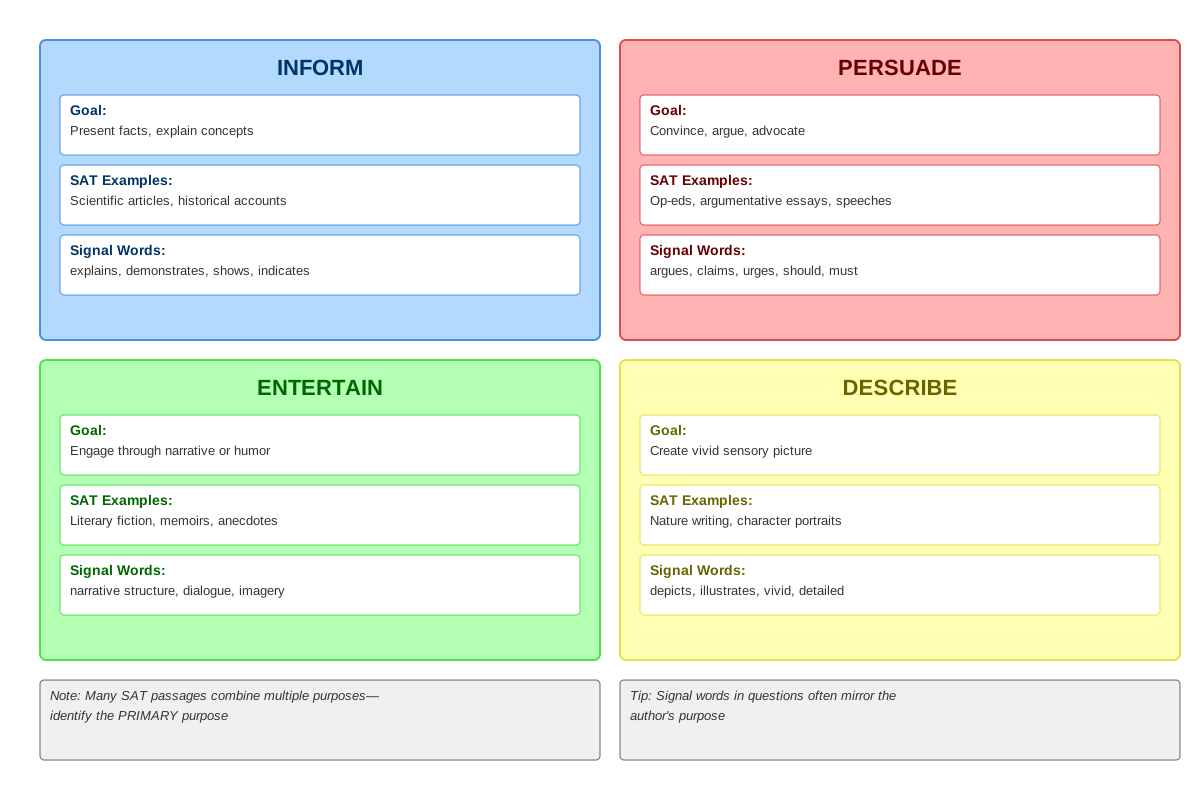
Author's purpose refers to the reason an author creates a text—the goal they hope to accomplish through their writing. While purposes can be complex and multifaceted, most texts on the SAT author's purpose questions fall into four primary categories:
To Inform/Explain: The author presents factual information, explains concepts, or educates readers about a topic. These texts prioritize clarity, accuracy, and comprehensive coverage. Scientific articles explaining research findings, historical accounts describing events, and expository essays defining concepts typically serve informative purposes. Key indicators include neutral tone, objective language, definitions, data, and logical organization.
To Persuade/Argue: The author advocates for a position, attempts to change readers' minds, or argues for a particular interpretation. These texts present claims supported by evidence and reasoning. Opinion pieces, argumentative essays, political speeches, and critical analyses typically serve persuasive purposes. Key indicators include thesis statements, evaluative language, counterarguments, calls to action, and rhetorical questions.
To Entertain/Narrate: The author tells a story, creates an aesthetic experience, or engages readers emotionally. Literary fiction, memoirs, humorous essays, and narrative accounts typically serve entertainment purposes. Key indicators include vivid descriptions, dialogue, plot development, character development, and figurative language.
To Describe: The author creates a detailed picture of a person, place, object, or phenomenon. While related to informing, descriptive purposes emphasize sensory details and imagery over explanation. Travel writing, nature essays, and character sketches typically serve descriptive purposes. Key indicators include sensory language, spatial organization, and concrete details.
Primary vs. Secondary Purposes
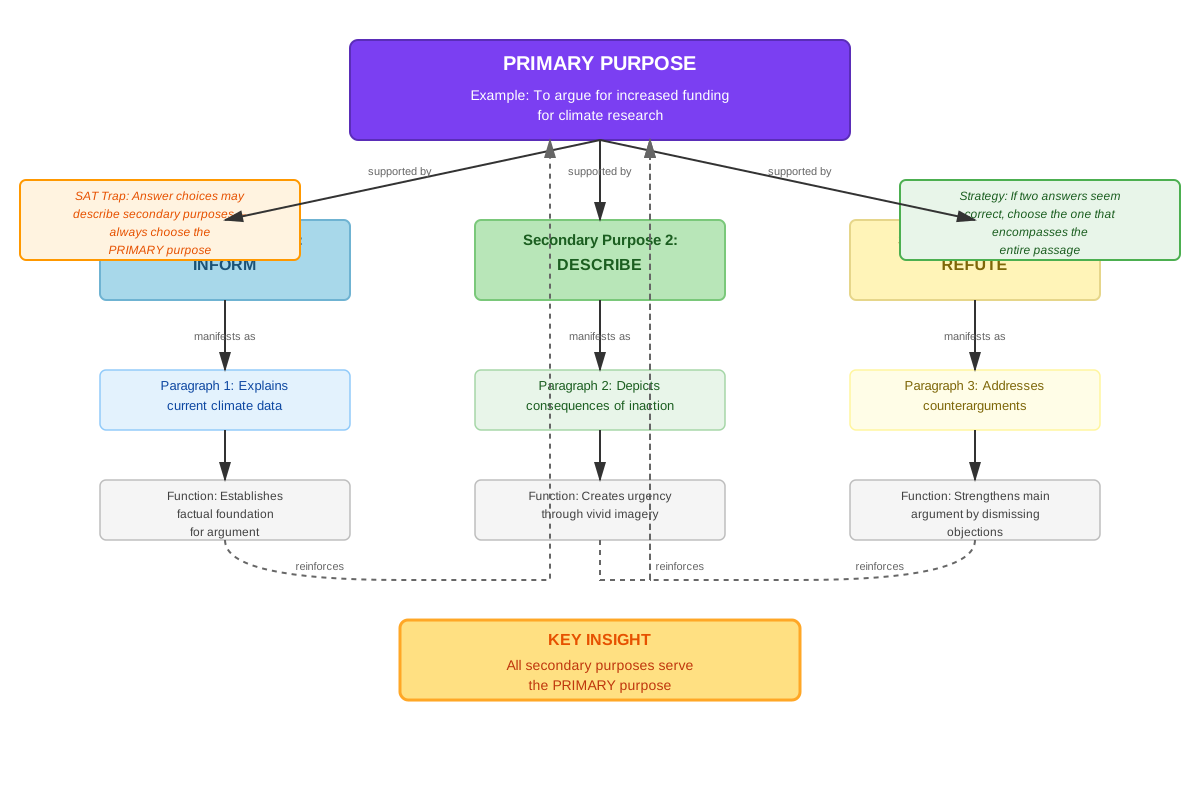
Most SAT passages have a primary purpose—the main reason the text exists—but may also serve secondary purposes that support or complement the main goal. For example, a scientific article primarily written to inform readers about climate change research might secondarily persuade readers that the issue requires attention. A historical narrative primarily written to entertain might secondarily inform readers about actual events.
SAT questions typically ask about the primary purpose, using phrases like "mainly," "primarily," "chiefly," or "most likely." Students must distinguish the overarching goal from subordinate functions. The primary purpose usually relates to the passage as a whole, while secondary purposes may apply to specific paragraphs or sections.
Purpose and Text Structure
Authors structure texts to serve their purposes effectively. Understanding this relationship helps students predict purpose and verify their analysis:
| Purpose | Common Structural Features | Typical Organization |
|---|---|---|
| Inform/Explain | Topic sentences, transitions, definitions, examples | Logical sequence, classification, comparison, cause-effect |
| Persuade/Argue | Thesis statement, evidence, counterarguments, conclusion | Claim-evidence-reasoning, problem-solution |
| Entertain/Narrate | Plot structure, character development, conflict | Chronological, flashback, in medias res |
| Describe | Spatial organization, sensory details, figurative language | Spatial order, order of importance |
Purpose Indicators in Language
Specific word choices and rhetorical strategies signal authorial purpose:
Informative indicators: "research shows," "according to," "defined as," "consists of," "the process involves," "studies indicate," neutral verbs (is, are, has, contains)
Persuasive indicators: "should," "must," "ought to," "clearly," "obviously," "unfortunately," "importantly," evaluative adjectives (effective, problematic, beneficial), modal verbs expressing necessity or obligation
Narrative indicators: past tense verbs, dialogue tags, action verbs, temporal transitions (then, next, suddenly), character thoughts and feelings
Descriptive indicators: sensory verbs (appears, feels, sounds), color and size adjectives, similes and metaphors, spatial prepositions (above, beside, beyond)
Purpose in Different Passage Types
The SAT includes passages from various domains, each with characteristic purposes:
Literature passages (fiction, memoirs): Primarily entertain/narrate, but may also explore themes, develop characters, or create mood. Questions often ask about the purpose of specific narrative techniques or why the author includes particular details.
Historical/Founding documents: Primarily persuade (advocating for political positions) or inform (explaining policies). Questions often ask about the author's rhetorical strategies or the function of specific arguments.
Science passages: Primarily inform/explain research findings, methods, or theories. Questions often ask about the purpose of experiments, examples, or data presentation.
Social science passages: May inform (presenting research), persuade (arguing for interpretations), or both. Questions often ask about the relationship between evidence and claims.
Recognizing Purpose in Questions
SAT questions signal that they're testing author's purpose through specific phrasings:
- "The main purpose of the passage is to..."
- "The author's primary concern is..."
- "The author includes [detail/example] primarily to..."
- "Which choice best describes what the passage is mainly about?"
- "The main function of the [paragraph/sentence] is to..."
- "The author mentions [X] most likely to..."
These questions require students to think beyond content to intention—not just what information appears, but why the author chose to include it and how it serves the larger goal.
Concept Relationships
Author's purpose serves as the foundation for understanding text structure and rhetorical choices. The relationship flows as follows:
Author's Purpose → Text Structure: Once an author determines their purpose (inform, persuade, entertain, describe), they select an organizational structure that best serves that goal. A persuasive purpose leads to argumentative structure with claims and evidence; an informative purpose leads to logical, sequential organization.
Author's Purpose → Rhetorical Choices: Purpose determines word choice, tone, evidence selection, and stylistic devices. An author writing to persuade selects emotionally resonant examples and evaluative language; an author writing to inform chooses neutral terminology and comprehensive data.
Text Structure → Supporting the Purpose: The way information is organized reinforces the author's goal. Cause-effect structure supports explanatory purposes; problem-solution structure supports persuasive purposes; chronological structure supports narrative purposes.
Evidence and Examples → Revealing Purpose: The types of evidence authors include signal their intentions. Statistical data suggests informative or persuasive purposes; anecdotes and personal stories suggest narrative or persuasive purposes; sensory details suggest descriptive purposes.
Within the broader SAT Reading and Writing curriculum, author's purpose connects to:
- Main Idea: Purpose explains why the main idea matters
- Supporting Details: Purpose determines which details authors include
- Tone and Point of View: Attitude reveals intention
- Rhetorical Analysis: Understanding purpose enables evaluation of effectiveness
High-Yield Facts
⭐ Author's purpose questions appear in 15-20% of SAT Reading and Writing questions, making this one of the highest-yield topics.
⭐ The four primary purposes are: inform/explain, persuade/argue, entertain/narrate, and describe.
⭐ SAT questions about purpose use trigger words like "mainly," "primarily," "chiefly," and "most likely" to indicate they're asking about the primary (not secondary) purpose.
⭐ Informative texts use neutral, objective language; persuasive texts use evaluative language and modal verbs (should, must, ought).
⭐ The purpose of a specific detail or example may differ from the passage's overall purpose—always check what the question is asking about.
- Purpose questions often ask "why" the author includes something, not just "what" the author says.
- Historical and founding documents on the SAT typically serve persuasive purposes, even when presenting information.
- Science passages primarily inform but may include persuasive elements when authors argue for interpretations of data.
- Literary passages primarily entertain but may serve secondary purposes like exploring themes or developing characters.
- The correct answer to a purpose question must account for the entire passage or specified section, not just one part.
- Authors may have multiple purposes, but SAT questions ask for the primary or main purpose.
- Purpose determines structure: persuasive texts often use problem-solution or claim-evidence patterns; informative texts use classification, sequence, or comparison.
- Wrong answers to purpose questions often describe secondary purposes, specific details rather than overall goals, or purposes that are too broad or too narrow.
- Recognizing purpose helps predict question types and eliminate incorrect answers efficiently.
- Understanding purpose improves reading speed because students can anticipate how information will be organized and used.
Quick check — test yourself on Author's purpose so far.
Try Flashcards →Common Misconceptions
Misconception: Author's purpose is always stated explicitly in the text.
Correction: While some texts include explicit purpose statements (thesis statements, topic sentences), most SAT passages require students to infer purpose from evidence like tone, structure, language choices, and content. The purpose is often implicit rather than directly stated.
Misconception: If a passage contains facts and information, its purpose must be to inform.
Correction: Persuasive passages frequently include factual information and data as evidence to support arguments. The presence of facts doesn't automatically indicate an informative purpose—consider whether the author is presenting information neutrally or using it to advocate for a position.
Misconception: The purpose of a passage is the same as its main idea or topic.
Correction: Topic identifies what the passage is about (the subject matter); main idea states the central point about that topic; purpose explains why the author wrote about it (their goal or intention). A passage about climate change (topic) might argue that immediate action is necessary (main idea) to persuade readers to support policy changes (purpose).
Misconception: Literary passages always have the sole purpose of entertaining.
Correction: While entertainment is often the primary purpose of literature, literary passages may also explore complex themes, critique social issues, develop philosophical ideas, or evoke specific emotional responses. The SAT often asks about these deeper purposes beyond simple entertainment.
Misconception: If any part of a passage is persuasive, the entire passage's purpose is to persuade.
Correction: Passages can have different purposes in different sections. An informative article might include a brief persuasive conclusion; a narrative might include informative background. SAT questions specify whether they're asking about the overall passage purpose or the purpose of a specific paragraph, sentence, or detail.
Misconception: The author's purpose is always serious and academic.
Correction: SAT passages include various tones and purposes, including humorous, satirical, reflective, and critical. Authors may write to entertain through humor, challenge assumptions through satire, or explore personal experiences through reflection. Don't assume all purposes are straightforward or solemn.
Misconception: Purpose questions are just asking for my opinion about why the author wrote something.
Correction: Purpose questions require evidence-based analysis, not personal opinion. The correct answer must be supported by specific textual evidence like language choices, structural patterns, tone, and content. Students must point to features of the text that reveal the author's intention.
Worked Examples
Example 1: Identifying Overall Purpose
Passage:
"The monarch butterfly's annual migration from Canada to Mexico represents one of nature's most remarkable phenomena. Each fall, millions of monarchs travel up to 3,000 miles to reach their wintering grounds in the oyamel fir forests of central Mexico. Unlike most migratory species, no individual butterfly completes the entire round-trip journey. Instead, the migration spans multiple generations, with each butterfly inheriting navigational information through genetic programming. Recent research has revealed that monarchs use a combination of the sun's position and an internal circadian clock to maintain their southward trajectory. However, this extraordinary migration now faces unprecedented threats. Habitat loss, climate change, and pesticide use have caused monarch populations to decline by more than 80% over the past two decades. Conservation efforts must address these multiple threats simultaneously if we hope to preserve this natural wonder for future generations."
Question: The primary purpose of the passage is to:
A) Describe the physical characteristics of monarch butterflies
B) Explain the mechanism of monarch butterfly migration and advocate for conservation
C) Argue that monarch butterflies are more important than other endangered species
D) Narrate the author's personal experience observing monarch migration
Step 1: Identify the passage structure
The passage begins with informative content (facts about migration distance, generational patterns, navigation mechanisms) but shifts in the final sentences to evaluative language ("unprecedented threats," "must address") and advocacy ("if we hope to preserve").
Step 2: Analyze language choices
- Informative language: "represents," "research has revealed," "use a combination"
- Persuasive language: "extraordinary," "unprecedented threats," "must address," "if we hope"
- The passage includes both neutral explanation and evaluative advocacy
Step 3: Determine primary vs. secondary purposes
The passage dedicates most space to explaining how migration works (informative), but concludes with a clear call for conservation action (persuasive). Both purposes are present, but the passage wouldn't include the conservation information if the primary goal were purely informative.
Step 4: Evaluate answer choices
- A) Too narrow—physical characteristics aren't discussed; migration behavior is the focus
- B) Captures both the informative explanation and persuasive advocacy; accounts for the entire passage
- C) Too extreme—the passage doesn't compare monarchs to other species or claim superiority
- D) Incorrect—no personal narrative or first-person experience appears
Answer: B
Connection to learning objectives: This example demonstrates how to identify key features of author's purpose (informative + persuasive), recognize how purpose appears in SAT questions (asking about "primary purpose"), and apply systematic analysis to answer correctly.
Example 2: Purpose of a Specific Detail
Passage:
"Nineteenth-century physician Ignaz Semmelweis made a discovery that would revolutionize medical practice, though his contemporaries largely rejected his findings. Working in Vienna General Hospital's maternity wards, Semmelweis noticed a disturbing pattern: women giving birth in the ward staffed by doctors and medical students died from puerperal fever at rates three times higher than those in the ward staffed by midwives. After systematically investigating possible causes, Semmelweis realized that doctors performed autopsies in the morning and then delivered babies without washing their hands, while midwives did not conduct autopsies. He instituted a hand-washing protocol using chlorinated lime solution, and mortality rates in the doctors' ward immediately dropped to match those in the midwives' ward. Despite this dramatic evidence, the medical establishment ridiculed Semmelweis's theory that invisible 'cadaverous particles' caused disease, as it contradicted prevailing medical beliefs and implied that doctors themselves were responsible for patient deaths."
Question: The author most likely mentions the comparison between mortality rates in the two wards primarily to:
A) Criticize midwives for their lack of medical training
B) Illustrate the evidence that led Semmelweis to his hypothesis about disease transmission
C) Argue that hospitals should eliminate maternity wards
D) Describe the typical organization of nineteenth-century hospitals
Step 1: Locate the specific detail
The comparison appears early in the passage: "women giving birth in the ward staffed by doctors and medical students died from puerperal fever at rates three times higher than those in the ward staffed by midwives."
Step 2: Determine the detail's function in context
This comparison comes immediately before Semmelweis's investigation and realization. The passage structure shows: observation of pattern → investigation → hypothesis → intervention → results. The mortality comparison is the observation that prompted everything else.
Step 3: Consider the passage's overall purpose
The passage primarily informs readers about Semmelweis's discovery and explains how he reached his conclusion. The mortality comparison serves this explanatory purpose by showing what evidence led to his insight.
Step 4: Evaluate answer choices
- A) Incorrect—the passage doesn't criticize midwives; it uses them as a comparison group showing lower mortality
- B) Correct—the comparison is the key evidence that made Semmelweis investigate further; it illustrates the reasoning process
- C) Too extreme and unsupported—the passage doesn't argue against maternity wards
- D) Too general—while the detail does describe hospital organization, that's not its primary function in the passage's argument
Answer: B
Connection to learning objectives: This example shows how to identify the purpose of a specific detail (not the overall passage), recognize that purpose relates to function within the larger text, and distinguish between what a detail says and why the author includes it.
Exam Strategy
Approaching Purpose Questions Systematically
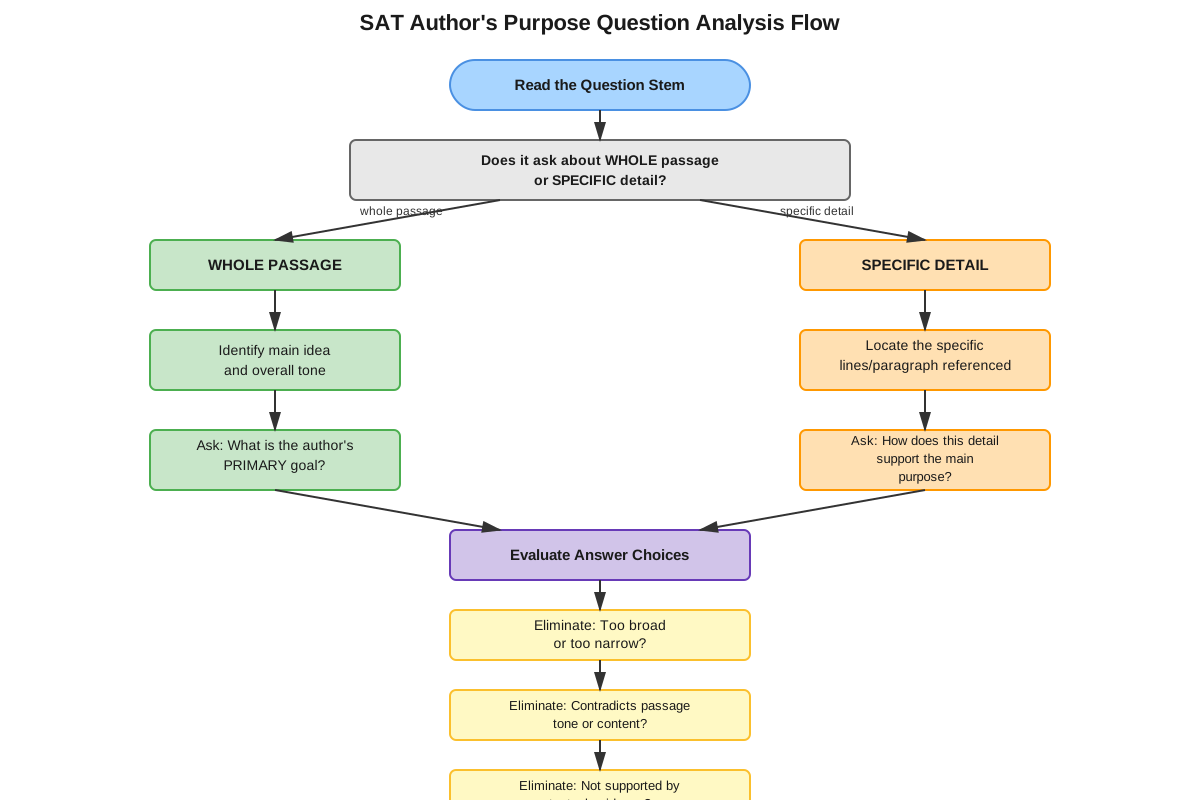
Step 1: Identify what the question is asking about
Determine whether the question asks about the overall passage purpose or the purpose of a specific paragraph, sentence, or detail. Read carefully for scope indicators like "the passage as a whole," "the third paragraph," or "the example in lines 15-18."
Step 2: Look for purpose indicators in the text
Scan for language that reveals intention: evaluative words (should, must, important, problematic), neutral explanatory language (consists of, defined as, research shows), narrative elements (dialogue, plot), or descriptive details (sensory language, spatial organization).
Step 3: Consider the passage structure
How information is organized reveals purpose. Problem-solution structure suggests persuasive intent; chronological narrative suggests entertainment or storytelling; classification and definition suggest informative intent.
Step 4: Eliminate answers that are too broad, too narrow, or unsupported
- Too broad: "to discuss nature" when the passage specifically argues for protecting monarch butterflies
- Too narrow: "to define puerperal fever" when the passage's main purpose is explaining Semmelweis's discovery
- Unsupported: purposes that aren't reflected in the text's language, tone, or content
Trigger Words and Phrases
In questions:
- "mainly," "primarily," "chiefly" → asking for the primary purpose, not secondary purposes
- "most likely" → requires inference based on evidence
- "the author includes [X] in order to" → asking about function/purpose of specific detail
- "serves to" → asking about function/purpose
- "the main function of" → asking about purpose
In answer choices:
- "advocate," "argue," "persuade," "convince" → persuasive purpose
- "explain," "inform," "describe," "illustrate" → informative/explanatory purpose
- "entertain," "narrate," "recount" → narrative purpose
- "criticize," "challenge," "question" → persuasive purpose with negative stance
- "support," "defend," "justify" → persuasive purpose with positive stance
Process of Elimination Tips
Eliminate answers that:
- Describe content rather than purpose (what vs. why)
- Focus on minor details rather than main points
- Use extreme language unsupported by the passage's tone
- Describe purposes opposite to the passage's actual intent
- Confuse primary and secondary purposes
Keep answers that:
- Account for the entire passage or specified section
- Match the passage's tone and language
- Explain why the author wrote, not just what they wrote
- Are supported by multiple pieces of textual evidence
- Use appropriately qualified language (not too extreme)
Time Allocation
Purpose questions typically require 30-60 seconds to answer. Spend:
- 10-15 seconds re-reading the relevant section if needed
- 15-20 seconds analyzing purpose indicators
- 15-25 seconds evaluating answer choices
Don't spend excessive time on purpose questions—they test comprehension you should develop while reading the passage initially. If you understood the passage's main point and structure during your first read, purpose questions should be relatively quick.
Exam Tip: Read SAT passages actively by asking yourself "Why is the author writing this?" as you go. This makes purpose questions much faster to answer because you've already identified the author's goal during your initial reading.
Memory Techniques
The PIED Mnemonic
Remember the four primary purposes with PIED:
- Persuade/argue
- Inform/explain
- Entertain/narrate
- Describe
The "Why Not What" Reminder
Purpose questions ask WHY (the author's intention), not WHAT (the content). When you see a purpose question, write a small "why?" in your scratch work to remind yourself to think about intention, not just information.
The Purpose-Structure Connection
Visualize this relationship:
- Persuade → Problem-Solution or Claim-Evidence structure
- Inform → Classification, Sequence, or Comparison structure
- Entertain → Chronological or Plot-based structure
- Describe → Spatial or Sensory organization
The Language Clue System
Create mental associations between language types and purposes:
- "Should/Must" words = Persuasive purpose
- "Is/Are/Has" neutral verbs = Informative purpose
- Past tense + dialogue = Narrative purpose
- Sensory adjectives = Descriptive purpose
The Scope Spectrum
Visualize purpose questions on a spectrum from narrow to broad:
[Specific Detail] ← → [Sentence] ← → [Paragraph] ← → [Whole Passage]Always check where on this spectrum the question is asking about, and make sure your answer matches that scope.
Summary
Author's purpose—the reason an author creates a text—is a foundational concept for SAT Reading and Writing success, appearing in 15-20% of questions. The four primary purposes (inform/explain, persuade/argue, entertain/narrate, and describe) can be identified through analysis of language choices, text structure, tone, and content. SAT questions test both overall passage purpose and the purpose of specific details, paragraphs, or examples, requiring students to distinguish primary from secondary purposes and to think about why authors include information rather than just what they say. Successful students recognize purpose indicators in both questions (trigger words like "mainly," "primarily," "in order to") and passages (evaluative language for persuasion, neutral language for information, narrative elements for entertainment, sensory details for description). Purpose connects intimately with text structure and rhetorical choices—authors organize information and select language to serve their goals. By approaching purpose questions systematically (identifying scope, analyzing language and structure, eliminating unsupported answers), students can answer these high-yield questions accurately and efficiently, building a foundation for understanding all aspects of text analysis on the SAT.
Key Takeaways
- Author's purpose questions appear in 15-20% of SAT RW questions and test why authors write, not just what they say
- The four primary purposes are inform/explain, persuade/argue, entertain/narrate, and describe, each with characteristic language and structure
- Always check whether questions ask about overall passage purpose or the purpose of specific details, paragraphs, or examples
- Purpose indicators include language choices (evaluative vs. neutral), text structure (problem-solution vs. chronological), and tone
- Eliminate answers that are too broad, too narrow, unsupported by evidence, or that describe content rather than intention
- Understanding purpose improves reading efficiency because it helps predict how information will be organized and used
- Purpose connects to all other RW concepts: it determines structure, influences rhetorical choices, and explains why main ideas matter
Related Topics
Text Structure and Organization: Understanding how authors organize information to serve their purposes; includes comparison-contrast, cause-effect, problem-solution, chronological, and spatial structures. Mastering author's purpose enables deeper analysis of why specific structures are chosen.
Rhetorical Analysis: Examining how authors use language, evidence, and appeals to achieve their purposes; includes analysis of ethos, pathos, logos, and rhetorical devices. Purpose provides the foundation for evaluating rhetorical effectiveness.
Tone and Point of View: Analyzing the author's attitude toward the subject and their perspective; tone often reveals purpose (critical tone suggests persuasive purpose; neutral tone suggests informative purpose).
Main Ideas and Supporting Details: Identifying central claims and the evidence that supports them; understanding purpose helps distinguish main ideas (what the author wants readers to know) from the reason those ideas matter (why the author is writing).
Evidence and Claims: Analyzing how authors support their points; particularly relevant for persuasive purposes where claims must be backed by evidence and reasoning.
Practice CTA
Now that you've mastered the core concepts of author's purpose, it's time to apply your knowledge! Work through the practice questions to test your ability to identify purposes in various passage types, analyze the function of specific details, and distinguish primary from secondary purposes. Use the flashcards to reinforce key terminology and purpose indicators. Remember: understanding author's purpose isn't just about memorizing categories—it's about developing the analytical skill to recognize why texts exist and how their parts work together. Each practice question you complete strengthens your ability to read strategically and answer efficiently on test day. You've built a strong foundation; now practice applying it!
Sign up free to keep reading
Create a free AnvayaPrep account to finish this SAT guide on Author's purpose — plus flashcards and practice questions.