Overview
Eliminating unsupported choices is one of the most powerful and practical skills students can develop for the SAT Reading and Writing section. This strategic approach involves systematically removing answer options that lack direct textual evidence or logical support from the passage. Rather than searching for the "perfect" answer immediately, skilled test-takers learn to identify and eliminate choices that contradict the passage, introduce information not mentioned in the text, or make claims that go beyond what the passage actually states. This process of elimination dramatically increases the probability of selecting the correct answer, even when uncertainty exists.
The SAT Reading and Writing section is fundamentally an evidence-based test. Every correct answer must be directly supported by information explicitly stated or strongly implied in the passage. The test makers deliberately craft incorrect answer choices—called distractors—that may sound plausible, use vocabulary from the passage, or seem partially correct. However, these distractors always contain at least one fatal flaw: they lack complete support from the text. Understanding how to spot these flaws and systematically eliminate unsupported choices transforms test performance, particularly on questions about central ideas, details, inferences, and author's purpose.
This topic connects directly to broader Reading and Writing concepts including close reading, textual evidence evaluation, and critical thinking. Eliminating unsupported choices serves as the foundation for nearly every question type on the SAT, from main idea questions to vocabulary-in-context items. Mastering this skill creates a reliable, repeatable process that reduces anxiety, improves accuracy, and increases speed—three critical factors for achieving a top score on the RW section.
Learning Objectives
- [ ] Identify key features of eliminating unsupported choices
- [ ] Explain how eliminating unsupported choices appears on the SAT
- [ ] Apply eliminating unsupported choices to answer SAT-style questions
- [ ] Distinguish between answer choices that are partially supported versus fully supported by textual evidence
- [ ] Recognize the five most common types of unsupported distractors on the SAT
- [ ] Develop a systematic elimination process that can be applied under timed conditions
- [ ] Evaluate answer choices by matching specific textual evidence to each option
Prerequisites
- Basic reading comprehension: The ability to understand the literal meaning of passages is essential because eliminating unsupported choices requires accurate comprehension of what the text actually states.
- Understanding of main idea versus details: Distinguishing between central claims and supporting information helps identify when answer choices confuse these elements or introduce irrelevant details.
- Familiarity with SAT question formats: Knowing how questions are structured allows students to focus on the elimination process rather than decoding what the question asks.
- Ability to locate information in passages: Quickly finding relevant sections of text is necessary to verify or eliminate answer choices efficiently.
Why This Topic Matters
In real-world contexts, the ability to eliminate unsupported claims is fundamental to critical thinking, media literacy, and academic research. Students who master this skill become better consumers of information, able to distinguish between evidence-based arguments and unsupported assertions. This capability extends far beyond standardized testing into college coursework, professional communication, and informed citizenship.
On the SAT specifically, eliminating unsupported choices is not just one skill among many—it is the core methodology for approaching virtually every Reading and Writing question. Statistical analysis of SAT questions reveals that approximately 85-90% of all RW questions can be answered more accurately and efficiently using systematic elimination rather than attempting to identify the correct answer immediately. Questions about central ideas, supporting details, inferences, purpose, and structure all benefit from this approach. The College Board designs three incorrect answers for every question, meaning that 75% of all answer choices are deliberately crafted to be eliminated.
This topic appears in multiple question formats throughout the exam. Students encounter it in questions asking "Which choice best states the main idea of the text?", "According to the passage...", "The author suggests that...", and "Which choice most logically completes the text?" In each case, three answers will contain unsupported elements—contradictions, exaggerations, irrelevant information, or claims that go beyond the text. The student who can efficiently identify and eliminate these flawed choices gains a significant competitive advantage.
Core Concepts
What Makes a Choice "Unsupported"
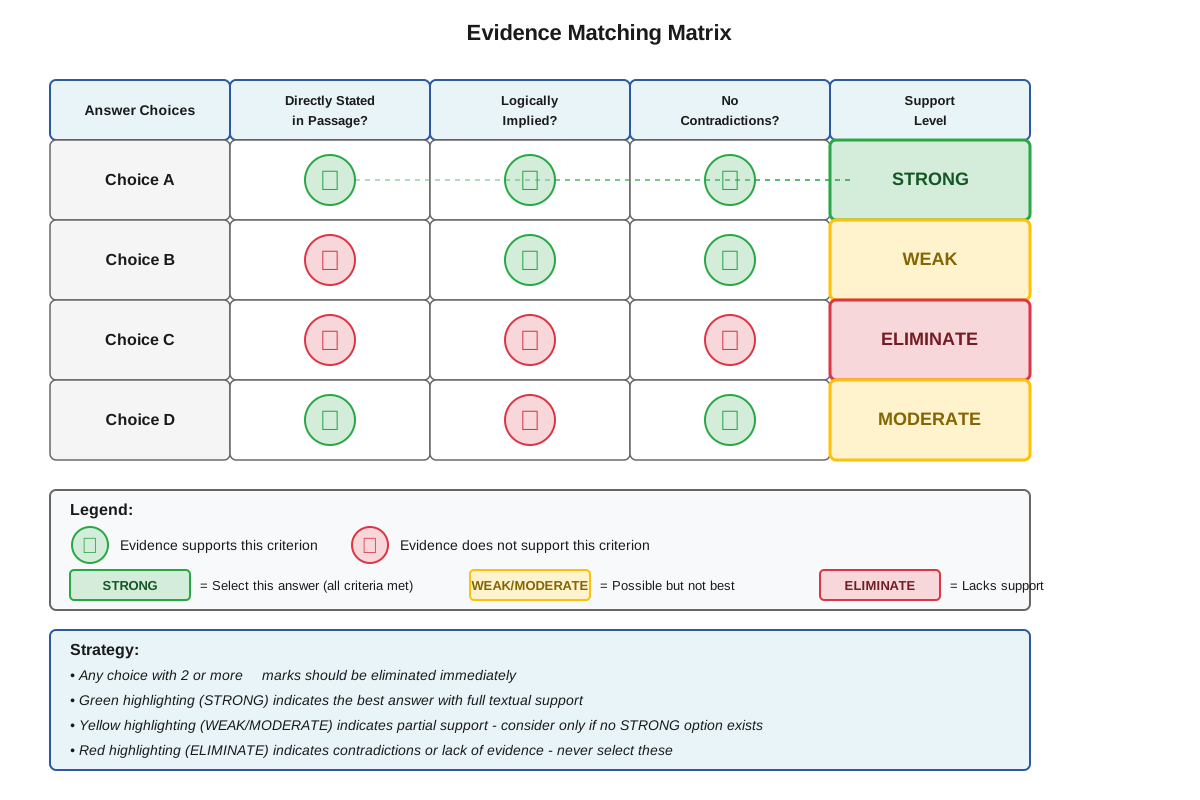
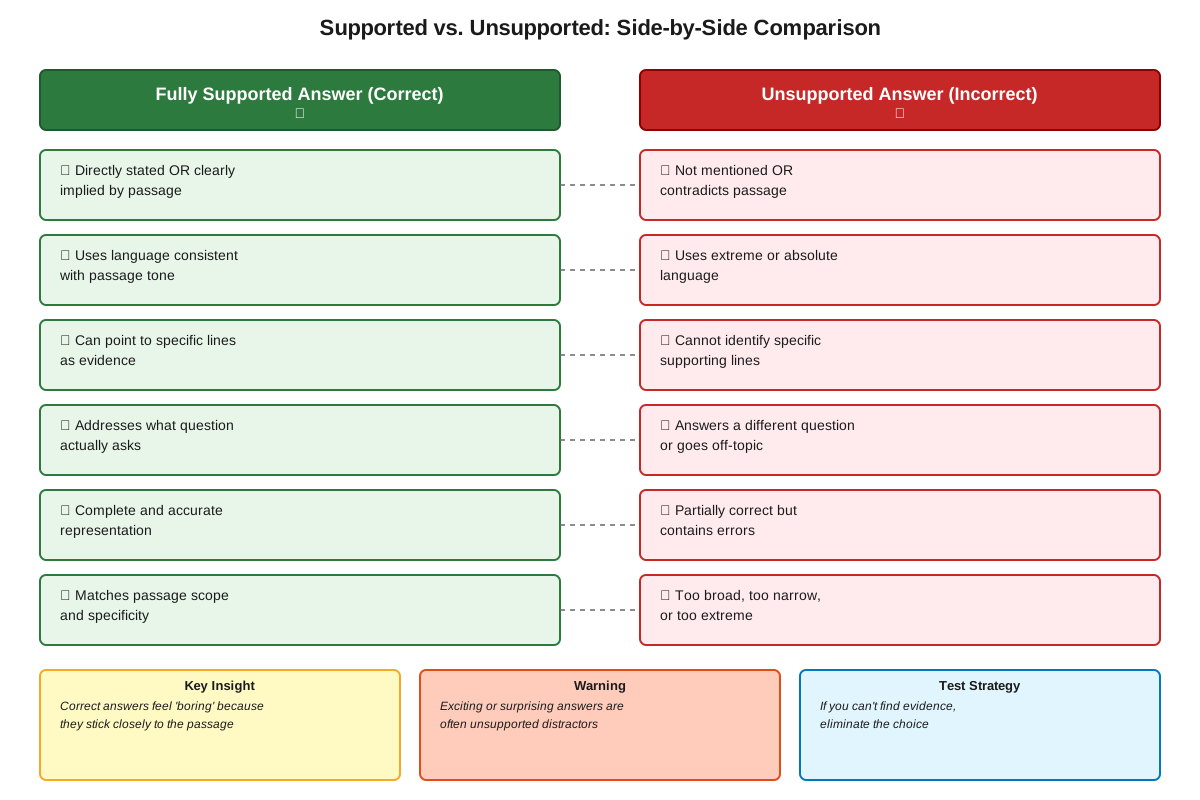
An unsupported choice is any answer option that cannot be fully justified by the information provided in the passage. The key word here is "fully"—partial support is not sufficient on the SAT. For a choice to be correct, every element of that answer must be verifiable through direct textual evidence or logical inference that stays within the bounds of what the passage states. An unsupported choice typically fails this test in one or more specific ways.
The SAT operates on a principle of textual fidelity: the correct answer is always the one that most accurately reflects what the passage says, no more and no less. This means that even if an answer choice contains a true statement about the world, it is incorrect if that information is not supported by the specific passage in question. Students must train themselves to evaluate answers based solely on the text provided, not on outside knowledge or assumptions.
The Five Types of Unsupported Distractors
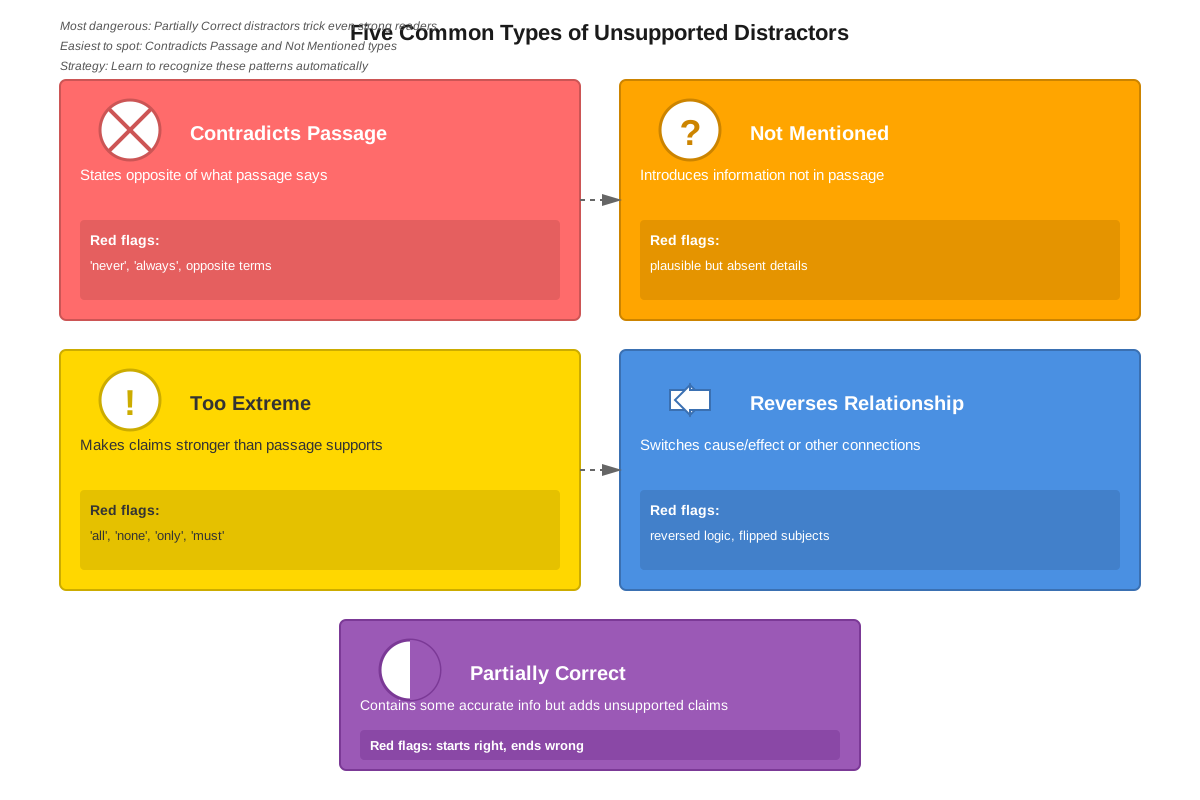
Understanding the specific ways that answer choices fail to be supported helps students eliminate them quickly and confidently. The SAT test makers use five primary categories of unsupported distractors:
| Distractor Type | Definition | Example Signal |
|---|---|---|
| Contradicts the passage | States the opposite of what the text says | "However," "unlike," "instead" when passage says otherwise |
| Goes beyond the text | Makes claims stronger or broader than passage supports | "Always," "never," "all," "proves," "demonstrates conclusively" |
| Introduces outside information | Includes facts or ideas not mentioned in the passage | New concepts, examples, or data not in the text |
| Confuses details | Mixes up which detail connects to which concept | Attributes a characteristic to the wrong subject |
| Partially correct | Contains some accurate information but includes one unsupported element | Half the answer matches the text, half doesn't |
Contradictions
A contradictory choice directly opposes information stated in the passage. These are often the easiest distractors to eliminate because the conflict is clear. For example, if a passage states that "the experiment yielded unexpected results," an answer choice claiming "the results confirmed the researchers' predictions" contradicts the text. Watch for answer choices that reverse cause and effect, flip positive and negative assessments, or attribute actions to the wrong agent.
Overstatements and Extreme Language
Choices that go beyond the text are particularly common on SAT questions about central ideas and inferences. The passage might state that "some scientists believe" a particular theory, but the answer choice says "scientists have proven" or "all experts agree." This type of distractor takes a qualified, limited claim from the passage and makes it absolute or universal. Key warning words include: always, never, all, none, only, must, proves, impossible, and guarantees. While these words don't automatically make a choice wrong, they should trigger careful verification against the passage.
Outside Information
Introducing outside information is a subtle trap that catches students who bring their own knowledge to the test. An answer choice might state something factually true about the topic but not mentioned in the passage. For instance, if a passage discusses Marie Curie's research on radioactivity, an answer choice mentioning her Nobel Prizes would be unsupported if the passage doesn't mention those awards—even though it's historically accurate. The SAT tests reading comprehension, not general knowledge.
Detail Confusion
Confusing details involves taking accurate information from the passage but misapplying it. A passage might discuss two different studies: Study A found increased productivity, while Study B found decreased satisfaction. A distractor might claim "Study A found decreased satisfaction," mixing up which finding belongs to which study. These errors are especially common in passages with multiple examples, comparisons, or chronological sequences.
Partial Correctness
The partially correct distractor is perhaps the most dangerous because it seems right at first glance. These answer choices contain 60-80% accurate information but include one critical unsupported element. For example, if a passage states "The new policy reduced costs but created implementation challenges," a partially correct answer might say "The new policy reduced costs and was easy to implement." The first part is supported; the second part contradicts the passage. Students must verify every component of an answer choice, not just the parts that sound familiar.
The Elimination Process
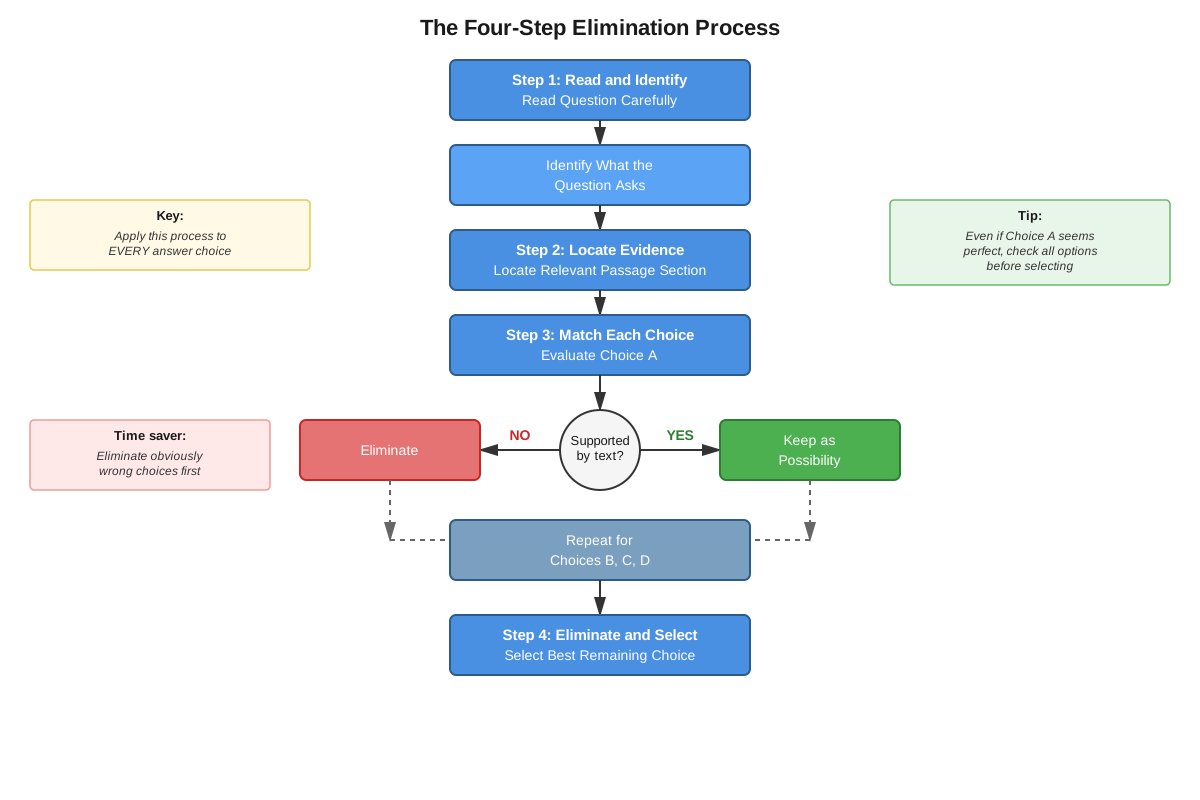
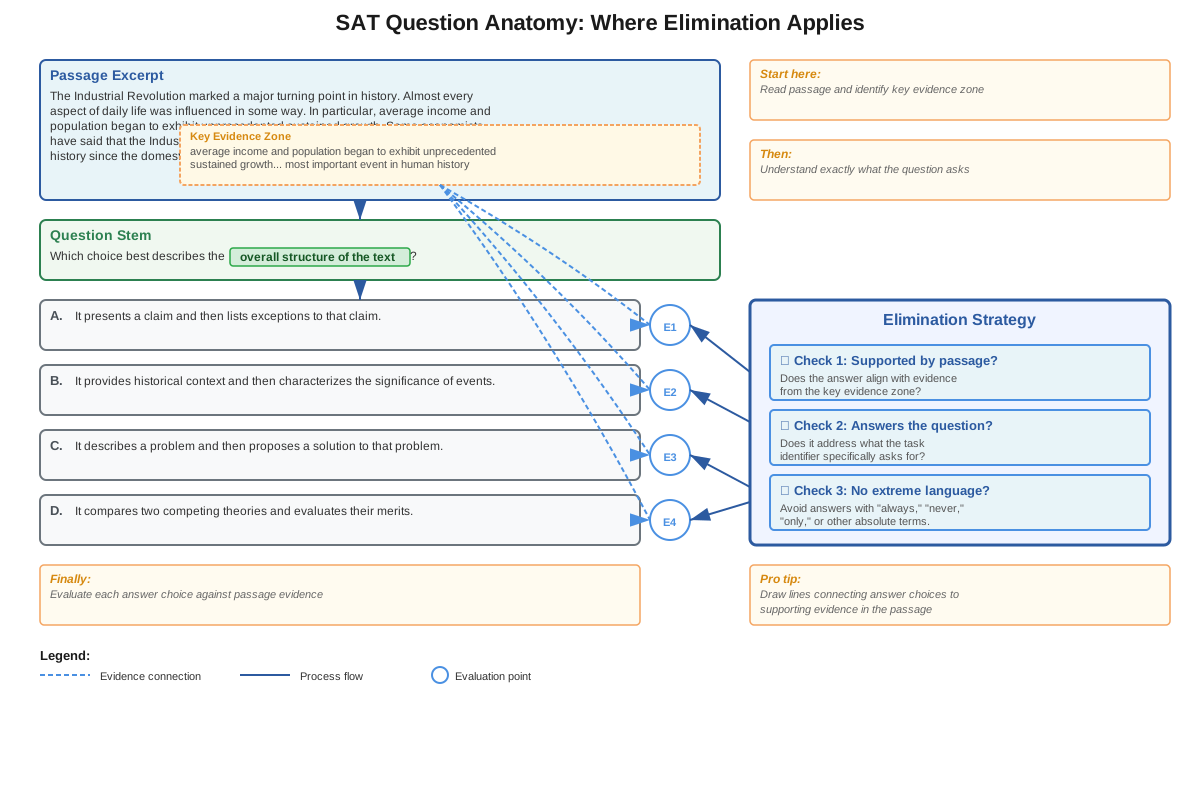
Effective SAT eliminating unsupported choices follows a systematic process:
- Read the passage carefully, noting main ideas and key details
- Read the question and identify what it's asking for (main idea, detail, inference, etc.)
- Before looking at answers, predict what a good answer might include based on the passage
- Evaluate each answer choice individually against the passage
- Eliminate choices that contain any unsupported element
- Compare remaining choices if more than one survives initial elimination
- Select the answer that is most completely and accurately supported
This process should become automatic with practice, allowing students to work efficiently under timed conditions.
Concept Relationships
The skill of eliminating unsupported choices serves as the methodological foundation for all other Reading and Writing skills on the SAT. It connects directly to close reading because students must understand the passage accurately before they can evaluate answer choices. Without comprehension of what the text actually says, elimination becomes guesswork.
This topic also links closely to identifying central ideas and details. When a question asks about the main idea, unsupported choices often focus on minor details or introduce ideas not central to the passage. Conversely, when a question asks about a specific detail, unsupported choices might offer the main idea or details from different parts of the passage. Understanding the hierarchy of information—what's central versus peripheral—helps eliminate choices that operate at the wrong level of specificity.
The relationship flows as follows: Close Reading → enables → Accurate Comprehension → enables → Identifying Supported vs. Unsupported Elements → enables → Systematic Elimination → leads to → Correct Answer Selection. Each step depends on the previous one, making elimination both a standalone skill and an integrative process that brings together multiple competencies.
Furthermore, this topic connects to inference questions and vocabulary in context. For inferences, unsupported choices often make logical leaps that go too far beyond what the passage implies. For vocabulary, unsupported choices might offer a common definition of a word that doesn't fit the specific context of the passage. In both cases, the elimination process remains the same: verify complete support from the text.
High-Yield Facts
⭐ Every correct SAT answer must be fully supported by the passage—partial support is insufficient
⭐ Approximately 75% of all answer choices are designed to be eliminated through systematic analysis
⭐ Extreme language (always, never, all, none, proves) often signals unsupported choices, though not automatically
⭐ The most dangerous distractors are partially correct answers that include one unsupported element
⭐ Answer choices that introduce information not mentioned in the passage are always incorrect, even if factually true
- Contradictory choices that reverse cause-effect relationships or flip positive-negative assessments can usually be eliminated quickly
- Detail confusion distractors mix up which characteristic belongs to which subject or example in the passage
- Overstatements take qualified claims ("some researchers suggest") and make them absolute ("researchers have proven")
- The elimination process should be applied to every answer choice individually before comparing remaining options
- Bringing outside knowledge to answer choices is a common error that leads to selecting unsupported answers
- Questions about central ideas often include distractors that focus on minor details or examples
- Time spent carefully eliminating three wrong answers is more efficient than searching for one right answer
- Answer choices that sound sophisticated or use passage vocabulary are not necessarily correct
- The correct answer is always the one that most accurately reflects the passage, no more and no less
Quick check — test yourself on Eliminating unsupported choices so far.
Try Flashcards →Common Misconceptions
Misconception: If an answer choice contains true information, it must be correct.
Correction: An answer choice must be supported by the specific passage provided, regardless of whether the statement is true in the real world. The SAT tests reading comprehension, not general knowledge.
Misconception: The correct answer will always use the same words as the passage.
Correction: Correct answers often paraphrase or summarize passage content using different vocabulary. Conversely, distractors frequently use words directly from the passage to seem familiar and correct. Evaluate meaning, not just word matching.
Misconception: Extreme words like "always" or "never" automatically make an answer wrong.
Correction: While extreme language often signals unsupported choices, these words can appear in correct answers if the passage itself makes absolute claims. Always verify against the text rather than applying rigid rules.
Misconception: If part of an answer choice is correct, the whole answer is probably correct.
Correction: Every element of an answer choice must be supported. Partially correct answers are designed to trap students who don't verify the entire option. One unsupported word or phrase makes the entire choice incorrect.
Misconception: The longest or most detailed answer is usually correct.
Correction: Answer length has no correlation with correctness on the SAT. Test makers deliberately vary answer length to prevent pattern-based guessing. Some correct answers are the shortest option; others are the longest.
Misconception: Elimination takes too much time and should only be used when stuck.
Correction: Systematic elimination is the most efficient approach for all questions, not just difficult ones. Students who eliminate first and select second are consistently faster and more accurate than those who try to identify the correct answer immediately.
Misconception: If two answers seem equally supported, it's acceptable to guess between them.
Correction: When two answers seem equally valid, one always has a subtle unsupported element. Careful re-reading of both the passage and the answer choices will reveal the distinction. True 50-50 situations are extremely rare on the SAT.
Worked Examples
Example 1: Central Ideas Question
Passage: "The discovery of penicillin by Alexander Fleming in 1928 revolutionized medicine, but the path from laboratory observation to widespread clinical use was neither quick nor straightforward. Fleming noticed that a mold contaminating one of his bacterial cultures had killed the surrounding bacteria, suggesting antibacterial properties. However, he struggled to produce penicillin in sufficient quantities for medical testing. It wasn't until the 1940s, when researchers Howard Florey and Ernst Boris Chain developed methods for mass production, that penicillin became available to treat infections on a large scale. The collaboration between Fleming's initial discovery and the later production innovations demonstrates how scientific breakthroughs often require multiple contributors working across years or even decades."
Question: Which choice best states the main idea of the text?
A) Alexander Fleming's discovery of penicillin in 1928 immediately transformed medical treatment of bacterial infections.
B) The development of penicillin from initial discovery to widespread medical use required both Fleming's observation and subsequent production innovations by other researchers.
C) Howard Florey and Ernst Boris Chain were more important to the development of penicillin than Alexander Fleming because they solved the production challenges.
D) Scientific breakthroughs in medicine always require collaboration between multiple researchers working over extended periods.
Elimination Process:
Choice A: Contains "immediately transformed"—this contradicts the passage, which explicitly states the path was "neither quick nor straightforward" and that widespread use didn't occur until the 1940s, over a decade after Fleming's discovery. ELIMINATE (contradicts passage).
Choice C: Claims Florey and Chain were "more important" than Fleming. The passage presents both contributions as necessary and doesn't rank their importance. This goes beyond what the text supports. ELIMINATE (unsupported comparison).
Choice D: Uses "always require"—an absolute statement. The passage uses this example to demonstrate how breakthroughs "often require" multiple contributors, not that they always do. This overstates the passage's claim. ELIMINATE (goes beyond the text).
Choice B: States that development required both Fleming's discovery and later production work. This directly matches the passage's main point about the collaboration between initial discovery and production innovations. Every element is supported: Fleming's observation (mentioned), production innovations by others (Florey and Chain's work), and the requirement of both (stated in the final sentence). CORRECT.
Example 2: Detail Question
Passage: "Recent studies of urban heat islands have revealed that cities can be significantly warmer than surrounding rural areas, with temperature differences sometimes exceeding 10°F. This phenomenon results primarily from the replacement of vegetation with heat-absorbing surfaces like asphalt and concrete. Researchers have found that strategic tree planting in urban areas can reduce local temperatures by 2-5°F through shade and evapotranspiration. However, the cooling effect varies depending on tree species, placement, and local climate conditions. Cities in arid regions may see less benefit from tree planting than those in humid climates, where evapotranspiration is more effective."
Question: According to the passage, which factor affects how much tree planting reduces urban temperatures?
A) The amount of asphalt and concrete that has been removed to plant the trees
B) The climate conditions of the region where the city is located
C) The temperature difference between the city and surrounding rural areas
D) The number of years that have passed since the urban heat island formed
Elimination Process:
Choice A: Discusses removing asphalt and concrete to plant trees. The passage mentions that asphalt and concrete contribute to heat islands, but it never states that these surfaces must be removed for tree planting or that removal affects the cooling benefit. ELIMINATE (introduces unsupported information).
Choice C: Suggests that the existing temperature difference affects how much trees help. The passage doesn't establish this relationship—it states that heat islands can have large temperature differences and that trees can reduce temperatures, but doesn't connect these two facts causally. ELIMINATE (unsupported connection).
Choice D: Mentions how long the heat island has existed. This information never appears in the passage. ELIMINATE (introduces outside information).
Choice B: States that regional climate conditions affect the cooling benefit of trees. This directly matches the passage's final sentence: "Cities in arid regions may see less benefit from tree planting than those in humid climates." The passage explicitly identifies climate conditions as a factor affecting the cooling effect. CORRECT.
Exam Strategy
When approaching SAT Reading and Writing questions, implement this strategic framework for eliminating unsupported choices:
Before Reading Answer Choices: After reading the passage and question, take 5-10 seconds to mentally summarize what the passage actually says about the topic. This creates a mental "filter" that helps identify unsupported elements when you encounter them.
Trigger Words to Watch: Train yourself to slow down and verify carefully when you see these high-risk words in answer choices: always, never, all, none, only, must, proves, demonstrates, impossible, guarantees, primarily, mainly, most important. These words make strong claims that require strong textual support.
The "Point to It" Test: For each answer choice, ask "Can I point to the specific sentence or sentences in the passage that support this?" If you cannot identify concrete textual evidence, the choice is likely unsupported. This physical or mental pointing creates accountability and prevents vague "it seems right" reasoning.
Process of Elimination Sequence: Eliminate in this order for maximum efficiency:
- First pass: Remove obvious contradictions and choices introducing completely new information (usually 1-2 choices)
- Second pass: Eliminate overstatements and detail confusions (usually 1 choice)
- Final comparison: Carefully evaluate remaining 1-2 choices for subtle unsupported elements
Time Allocation: Spend approximately 45-60 seconds per question, with 20-25 seconds on passage comprehension, 5-10 seconds on question analysis, and 20-25 seconds on systematic elimination. This pacing allows thorough evaluation without rushing.
When Stuck Between Two Choices: Return to the passage and re-read the relevant section. Then examine each answer choice word-by-word, asking "Is this specific word/phrase supported?" The unsupported element is often a single word that makes a claim too strong or introduces an unsupported nuance.
Avoid the Familiarity Trap: Answer choices that use vocabulary directly from the passage often feel correct because they're familiar. However, test makers deliberately include passage words in distractors. Evaluate the meaning and claim of the entire answer, not just whether words appear in the text.
Memory Techniques
PROVE Acronym for evaluating answer choices:
- Passage-based: Does every element appear in or follow logically from the passage?
- Reasonable: Does it avoid extreme or absolute claims unsupported by the text?
- On-topic: Does it address what the question actually asks?
- Verifiable: Can you point to specific textual evidence?
- Entire: Is the complete answer supported, not just part of it?
The "Red Flag" Visualization: Imagine extreme words (always, never, proves, all) as red flags waving in the answer choice. When you see a red flag, pause and verify that the passage makes an equally strong claim. If the passage is more moderate or qualified, the red flag signals an unsupported choice.
The Three-Strike Rule: An answer choice is out if it commits any of three "strikes":
- Strike One: Contradicts the passage
- Strike Two: Goes beyond the passage
- Strike Three: Introduces information not in the passage
One strike is enough to eliminate a choice. This simple framework helps maintain systematic evaluation under time pressure.
The "Goldilocks Principle": The correct answer is never too broad (overgeneralizing beyond the passage) or too narrow (focusing on a minor detail when the question asks for the main idea). It's "just right"—matching the scope and specificity of what the passage actually states.
Summary
Eliminating unsupported choices is the foundational strategy for achieving high scores on the SAT Reading and Writing section. This approach recognizes that 75% of all answer choices are deliberately designed to be eliminated through careful analysis of textual support. An unsupported choice is any answer that cannot be fully justified by the passage, whether because it contradicts the text, goes beyond what the passage states, introduces outside information, confuses details, or is only partially correct. The five types of unsupported distractors—contradictions, overstatements, outside information, detail confusion, and partial correctness—appear consistently across all question types. Mastering the systematic elimination process involves reading carefully, evaluating each answer choice individually against the passage, and verifying that every element of an answer is supported by textual evidence. This skill connects to all other Reading and Writing competencies and provides a reliable, repeatable method for approaching questions efficiently and accurately under timed conditions.
Key Takeaways
- Every correct SAT answer must be completely supported by the passage—partial support means the answer is incorrect
- Systematic elimination of unsupported choices is more efficient and accurate than trying to identify the correct answer immediately
- The five types of unsupported distractors are contradictions, overstatements, outside information, detail confusion, and partial correctness
- Extreme language (always, never, all, proves) requires careful verification but doesn't automatically make an answer wrong
- The "point to it" test—identifying specific textual evidence for each answer element—prevents selection of unsupported choices
- Partially correct answers are the most dangerous distractors because they seem right until every element is verified
- The elimination process should be applied systematically to every question, not just difficult ones
Related Topics
Identifying Central Ideas: Once unsupported choices are eliminated, distinguishing between main ideas and supporting details becomes easier. This topic builds directly on elimination skills by helping students recognize when answer choices operate at the wrong level of generality.
Making Inferences: Inference questions require eliminating choices that make logical leaps beyond what the passage supports. Mastering elimination provides the foundation for distinguishing between reasonable inferences and unsupported speculation.
Analyzing Author's Purpose and Point of View: These questions often include distractors that mischaracterize the author's tone or intent. Elimination skills help identify when answer choices attribute attitudes or purposes not supported by the passage.
Evaluating Evidence and Reasoning: This advanced skill involves assessing how well evidence supports claims. The ability to eliminate unsupported choices transfers directly to evaluating whether evidence in a passage adequately supports the author's conclusions.
Practice CTA
Now that you understand the systematic process for eliminating unsupported choices, it's time to apply these strategies to real SAT-style questions. The practice questions and flashcards will help you internalize the five types of unsupported distractors and develop the automatic recognition skills needed for test day. Remember: elimination is not a backup strategy for when you're stuck—it's the primary method that top scorers use on every question. Each practice question you complete strengthens your ability to spot unsupported elements quickly and confidently. Start practicing now to transform this knowledge into the automatic skill that will boost your score!
Sign up free to keep reading
Create a free AnvayaPrep account to finish this SAT guide on Eliminating unsupported choices — plus flashcards and practice questions.