Overview
Evidence-based reading is the cornerstone skill tested throughout the SAT Reading and Writing section. This approach requires students to ground their answers exclusively in what the passage explicitly states or directly implies, rather than relying on outside knowledge, assumptions, or personal interpretations. The SAT consistently emphasizes that every correct answer must be supported by specific textual evidence—a principle that distinguishes this exam from other reading comprehension tests. Mastering this skill means learning to identify, interpret, and apply relevant passages to answer questions with precision and confidence.
The importance of sat evidence-based reading cannot be overstated: it forms the foundation for approximately 50% of all questions in the rw (Reading and Writing) section. Questions may ask students to identify main ideas, understand details, interpret vocabulary in context, analyze author's purpose, or evaluate arguments—but all require the same fundamental skill of locating and correctly interpreting textual support. Students who excel at evidence-based reading understand that the passage itself is the ultimate authority, and they develop systematic strategies for connecting questions back to specific lines or paragraphs.
Within the broader Reading and Writing curriculum, evidence-based reading serves as the gateway skill that enables success across all question types. Whether analyzing central ideas, interpreting details, understanding rhetorical choices, or evaluating arguments, students must first master the ability to identify relevant evidence and determine what it actually supports. This topic directly connects to "Central Ideas and Details" because finding the main point of a passage requires synthesizing multiple pieces of evidence, while understanding supporting details demands precise identification of specific textual support.
Learning Objectives
- [ ] Identify key features of evidence-based reading
- [ ] Explain how evidence-based reading appears on the SAT
- [ ] Apply evidence-based reading to answer SAT-style questions
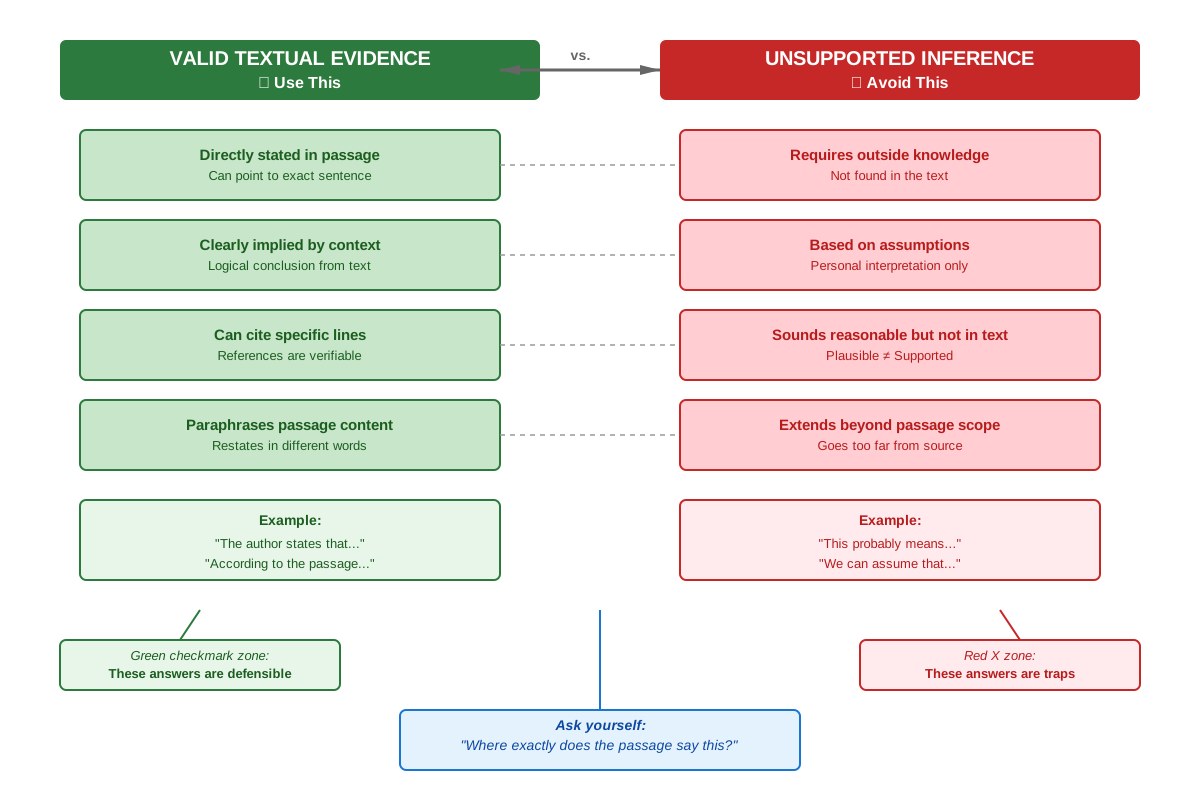
- [ ] Distinguish between valid textual evidence and unsupported inferences
- [ ] Locate specific lines or passages that support or refute answer choices
- [ ] Evaluate the strength and relevance of evidence for different claims
- [ ] Synthesize multiple pieces of evidence to support comprehensive answers
Prerequisites
- Basic reading comprehension: Understanding literal meaning of sentences and paragraphs is essential before evaluating evidence
- Vocabulary fundamentals: Recognizing common academic vocabulary helps students understand what passages actually state
- Paragraph structure awareness: Knowing how topic sentences, supporting details, and transitions work aids in locating relevant evidence
- Question-reading skills: Understanding what a question asks is necessary before searching for supporting evidence
Why This Topic Matters
Evidence-based reading represents a fundamental shift in how students approach reading comprehension. In academic settings, professional contexts, and everyday life, the ability to support claims with specific evidence is crucial for critical thinking, persuasive writing, and informed decision-making. This skill helps students distinguish between facts and opinions, evaluate arguments, and avoid drawing conclusions based on insufficient information or personal bias.
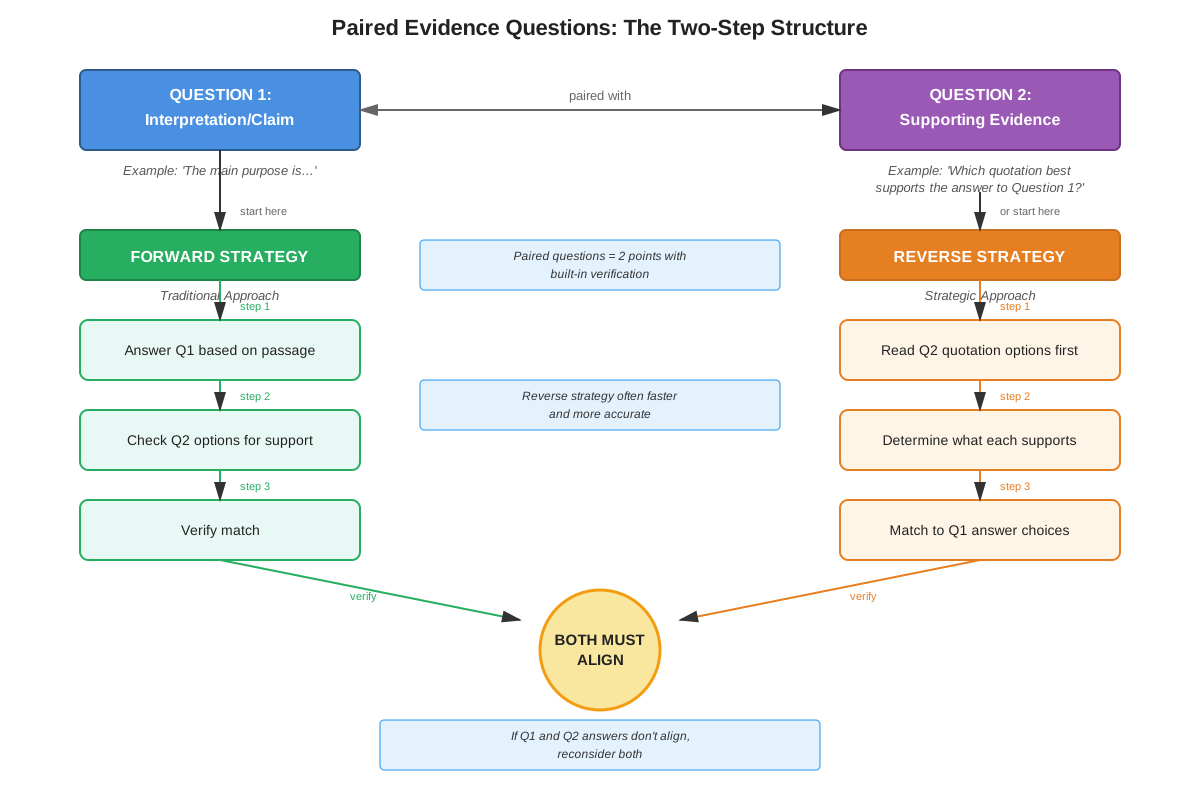
On the SAT, evidence-based reading appears in every single passage-based question across the Reading and Writing section. The exam includes approximately 54 reading and writing questions total, with roughly 27-30 questions directly testing the ability to identify, interpret, or apply textual evidence. Questions explicitly testing evidence skills often appear as paired questions: the first asks for an interpretation or conclusion, while the second asks "Which quotation from the passage best supports the answer to the previous question?" However, even questions that don't explicitly mention evidence still require students to ground their answers in the text.
Common manifestations include: questions asking for the "main purpose" of a passage (requiring synthesis of evidence throughout), questions about what a passage "suggests" or "implies" (requiring inference from stated evidence), questions asking what would "most strengthen" or "weaken" an argument (requiring evaluation of evidence quality), and questions about specific details (requiring precise location of supporting text). The passages span literature, history, social studies, and science, but the evidence-based approach remains constant across all content areas.
Core Concepts
What Evidence-Based Reading Means
Evidence-based reading is the practice of supporting all interpretations, answers, and conclusions with specific, identifiable passages from the text. Unlike reading approaches that encourage personal response or creative interpretation, evidence-based reading treats the passage as the sole source of authority. Every answer choice must be defensible by pointing to particular words, phrases, sentences, or paragraphs that directly support it.
This approach has three essential components: locating relevant evidence (finding where in the passage information appears), interpreting that evidence correctly (understanding what it actually says and means), and applying it appropriately (determining which answer choice it supports). Students must resist the temptation to select answers that "sound right" or align with their prior knowledge if those answers lack textual support.
Types of Evidence on the SAT
The SAT presents several distinct types of evidence that students must recognize and work with effectively:
| Evidence Type | Description | Example Signal Words |
|---|---|---|
| Explicit statements | Direct, clearly stated information | "The author states," "According to the passage" |
| Implicit evidence | Information that must be inferred from stated facts | "The passage suggests," "implies," "indicates" |
| Quantitative data | Numbers, statistics, or data from graphs/tables | "The data shows," "According to the figure" |
| Comparative evidence | Information showing relationships between ideas | "Unlike," "in contrast to," "similarly" |
| Causal evidence | Information showing cause-effect relationships | "Because," "as a result," "consequently" |
Understanding these categories helps students recognize what kind of evidence a question requires and where to look for it in the passage.
The Evidence-Question Connection
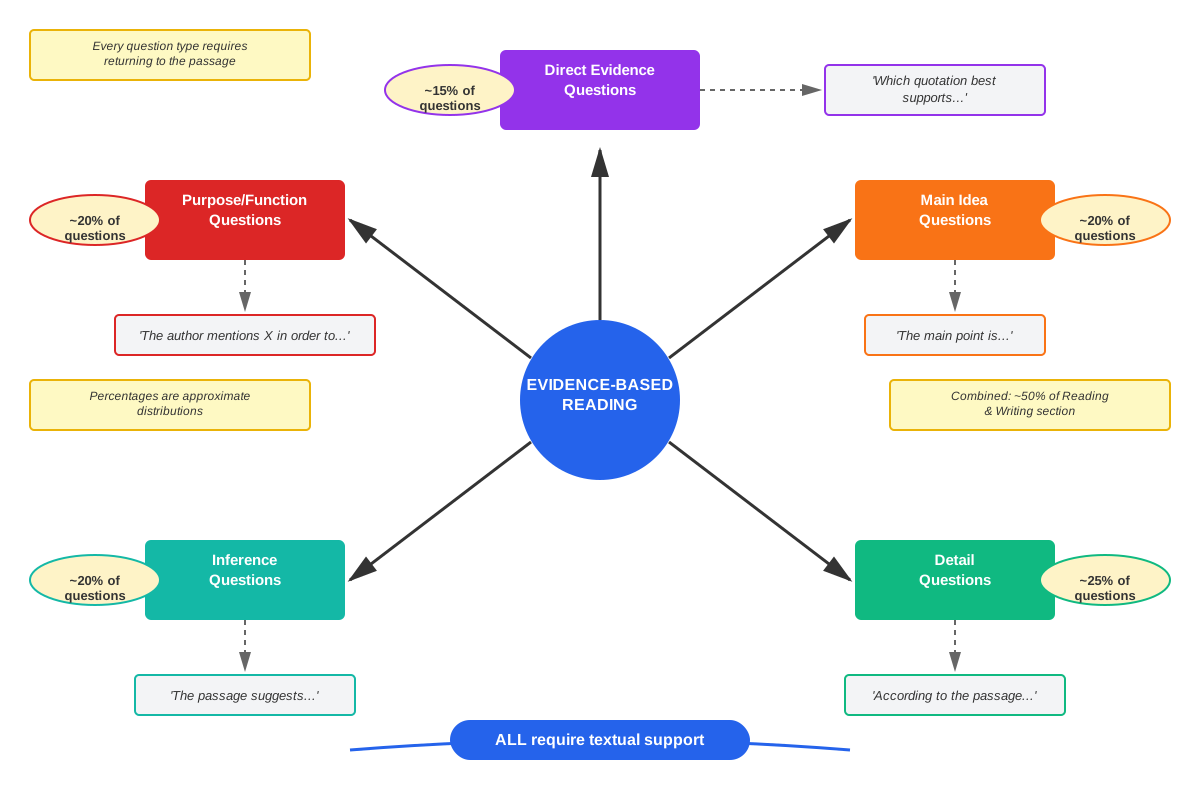
SAT questions test evidence-based reading through several question formats:
- Direct evidence questions: These explicitly ask students to identify supporting quotations, often appearing as the second question in paired sets
- Inference questions: These require students to draw conclusions supported by evidence, using words like "suggests," "implies," or "most likely"
- Main idea questions: These demand synthesis of evidence from throughout the passage
- Detail questions: These ask about specific information that must be located precisely
- Purpose and function questions: These require evidence about why an author included certain information
Each format requires the same fundamental skill: connecting answer choices back to specific textual support.
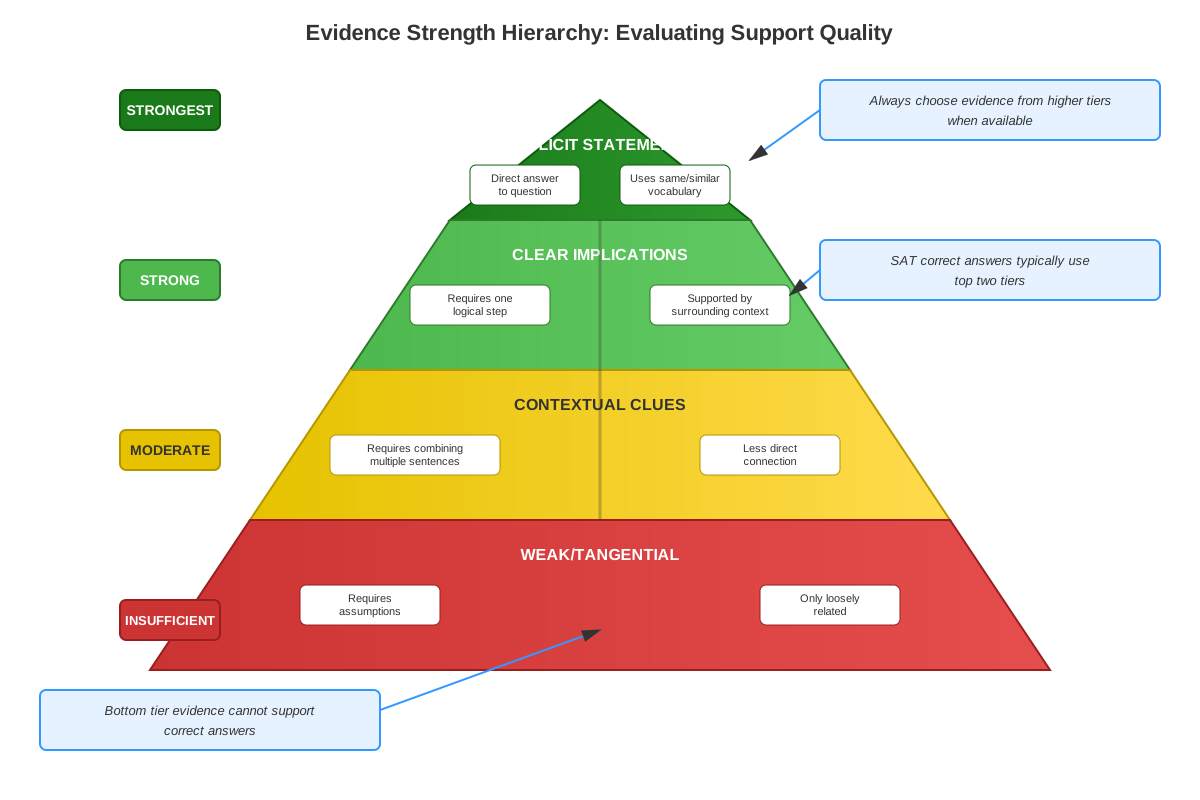
Strong vs. Weak Evidence
Not all evidence equally supports a claim. Students must evaluate evidence quality:
Strong evidence is:
- Directly relevant to the specific question asked
- Clearly stated or logically inferable from stated facts
- Sufficient in scope (covers the full claim, not just part of it)
- Unambiguous in meaning
Weak evidence is:
- Tangentially related but doesn't directly address the question
- Requires multiple unsupported assumptions to connect to the answer
- Too narrow or too broad for the claim being made
- Open to multiple interpretations
The SAT frequently includes wrong answer choices supported by weak evidence, testing whether students can distinguish between "somewhat related" and "directly supportive."
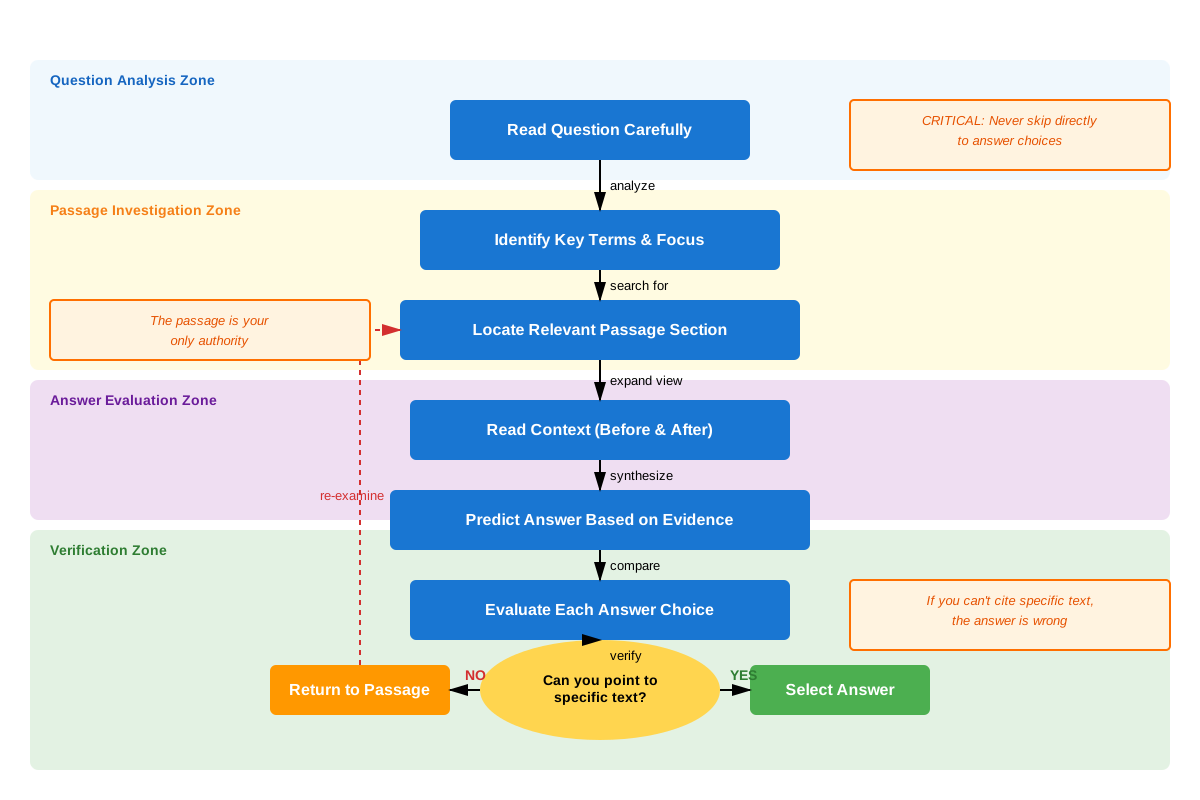
The Process of Evidence-Based Reading
Effective evidence-based reading follows a systematic process:
- Read the question carefully to understand exactly what evidence is needed
- Identify key terms in the question that will help locate relevant passage sections
- Return to the passage with the question in mind (don't rely on memory)
- Locate the relevant section using line references, paragraph indicators, or key terms
- Read carefully in context (usually 2-3 sentences before and after the target area)
- Predict an answer based on the evidence before looking at choices
- Evaluate each answer choice against the evidence, eliminating those unsupported
- Verify the selected answer by confirming it matches the evidence
This process prevents common errors like selecting answers based on vague recollection or choosing options that sound sophisticated but lack textual support.
Evidence in Different Passage Types
The SAT includes passages from various domains, and evidence appears differently in each:
Literary passages often require evidence about character motivation, thematic development, or narrative perspective. Evidence may be subtle, requiring attention to word choice, imagery, and character actions.
Historical/Social science passages typically present arguments with explicit evidence in the form of examples, data, or expert testimony. Students must identify which evidence supports which claims.
Science passages frequently include quantitative evidence from experiments or studies. Students must interpret data and connect it to textual claims.
Regardless of passage type, the fundamental principle remains: answers must be grounded in what the passage actually states or clearly implies.
Concept Relationships
Evidence-based reading serves as the foundation for all other Reading and Writing skills. The relationship flows as follows:
Evidence-based reading → enables → Central Ideas identification (main ideas must be supported by evidence throughout the passage)
Evidence-based reading → enables → Detail comprehension (understanding specific information requires locating and interpreting precise evidence)
Evidence-based reading → enables → Inference skills (valid inferences must be grounded in stated evidence)
Evidence-based reading → enables → Author's purpose analysis (determining why an author wrote something requires evidence about their choices and emphasis)
Within the topic itself, concepts connect hierarchically: understanding what evidence is → learning to locate evidence → developing skills to interpret evidence → applying evidence to answer questions → evaluating evidence quality. Each skill builds on the previous one, creating a comprehensive approach to passage-based questions.
The connection to prerequisite knowledge is direct: basic reading comprehension provides the foundation for understanding what passages state, which is necessary before evaluating whether that information serves as evidence for specific claims. Vocabulary knowledge ensures students correctly interpret the evidence they locate, preventing misunderstanding of key terms.
High-Yield Facts
⭐ Every correct SAT answer must be directly supported by specific textual evidence—no exceptions
⭐ Wrong answers often include information that appears in the passage but doesn't answer the specific question asked
⭐ The phrase "according to the passage" signals that the answer must be explicitly stated, not inferred
⭐ When questions ask what a passage "suggests" or "implies," the inference must still be directly supported by stated evidence
⭐ In paired evidence questions, the second question's answer must support the first question's answer—use this to check your work
- Evidence can appear anywhere in a passage; don't assume it's always in the introduction or conclusion
- Multiple pieces of evidence may support the same answer, but one piece of strong evidence is sufficient
- The SAT never requires outside knowledge to answer evidence-based questions; if you're using information not in the passage, you're on the wrong track
- Extreme language in answer choices (always, never, only, must) often signals wrong answers unless the passage uses equally extreme language
- Evidence for main idea questions typically appears in multiple locations throughout the passage, not just one spot
- When two answer choices seem supported, the correct one will have more direct, comprehensive evidence
- Line reference questions are gifts—they tell you exactly where to look for evidence
Quick check — test yourself on Evidence-based reading so far.
Try Flashcards →Common Misconceptions
Misconception: If information appears in the passage, it can support any answer choice about that passage.
Correction: Information must be specifically relevant to the question asked. The SAT includes wrong answers that contain true statements from the passage that don't address the particular question.
Misconception: Evidence-based reading means finding exact word matches between the question and passage.
Correction: Evidence often involves paraphrasing or synthesis. The passage might say "the temperature increased rapidly" while the correct answer states "the temperature rose quickly"—these convey the same meaning despite different wording.
Misconception: Personal knowledge about a topic should guide answer selection when the passage discusses that topic.
Correction: Outside knowledge is irrelevant and often misleading. Even if you know facts about a topic, you must answer based solely on what this specific passage states.
Misconception: Inference questions allow for creative interpretation or "reading between the lines" without textual support.
Correction: Valid inferences must be directly supported by stated evidence. "Inference" on the SAT means "logical conclusion based on stated facts," not "creative interpretation."
Misconception: Evidence for main idea questions appears only in the introduction or conclusion.
Correction: Main ideas are supported by evidence throughout the entire passage. Students must synthesize information from multiple paragraphs to identify the central claim.
Misconception: In paired evidence questions, you should answer the first question, then find evidence for your answer.
Correction: More effective strategy: examine the evidence choices first to see what each supports, then select the answer pair where the evidence most strongly supports the interpretation.
Misconception: Longer, more complex answer choices are more likely to be correct.
Correction: The SAT doesn't reward complexity. Correct answers are those supported by evidence, regardless of length or sophistication of language.
Worked Examples
Example 1: Direct Evidence Question
Passage excerpt:
"The introduction of wolves to Yellowstone National Park in 1995 triggered a cascade of ecological changes. Elk populations, which had grown unchecked for decades, began to avoid certain areas where they were vulnerable to predation. This behavioral shift allowed willow and aspen trees in those areas to recover after years of overgrazing. The regenerating vegetation stabilized riverbanks, reducing erosion and creating better habitat for beavers, whose dams further transformed the ecosystem."
Question 1: According to the passage, what was the primary cause of vegetation recovery in certain areas of Yellowstone?
A) Beavers built dams that created better growing conditions
B) Elk changed their behavior to avoid areas where wolves could hunt them
C) Park managers planted new willow and aspen trees
D) Erosion decreased due to natural climate patterns
Question 2: Which quotation from the passage best supports the answer to the previous question?
A) "The introduction of wolves to Yellowstone National Park in 1995 triggered a cascade of ecological changes."
B) "Elk populations, which had grown unchecked for decades, began to avoid certain areas where they were vulnerable to predation."
C) "This behavioral shift allowed willow and aspen trees in those areas to recover after years of overgrazing."
D) "The regenerating vegetation stabilized riverbanks, reducing erosion and creating better habitat for beavers."
Solution:
For Question 1, we need evidence about what caused vegetation recovery. Let's trace the causal chain in the passage:
- Wolves were introduced
- Elk avoided certain areas (where wolves could hunt)
- This behavioral shift allowed vegetation to recover
- Recovering vegetation had additional effects
The passage explicitly states that "This behavioral shift allowed willow and aspen trees in those areas to recover." The behavioral shift refers to elk avoiding certain areas. Therefore, Answer B is correct—elk changing their behavior was the primary cause.
Answer A is wrong because beavers came after vegetation recovery (the vegetation "created better habitat for beavers"). Answer C is unsupported—the passage never mentions planting. Answer D is unsupported—erosion decreased as a result of vegetation recovery, not as a cause.
For Question 2, we need the quotation that best supports Answer B from Question 1. Answer C is correct: "This behavioral shift allowed willow and aspen trees in those areas to recover after years of overgrazing." This sentence directly connects the elk's behavioral change to vegetation recovery.
Answer A is too general—it mentions changes but doesn't specify the cause of vegetation recovery. Answer B describes the behavioral shift but doesn't connect it to vegetation recovery. Answer D describes effects that came after vegetation recovery, not the cause of it.
Key lesson: In paired questions, the evidence must directly support the specific answer chosen, not just relate to the general topic.
Example 2: Inference with Evidence
Passage excerpt:
"Maria Mitchell's discovery of a comet in 1847 earned her international recognition, but her subsequent career faced obstacles that male astronomers did not encounter. Despite her expertise, she struggled to access major observatories, which rarely admitted women. When she finally secured a position at Vassar College in 1865, she became one of the first female astronomy professors in the United States, though she was paid significantly less than her male colleagues with equivalent qualifications."
Question: The passage most strongly suggests which of the following about Maria Mitchell's career?
A) Her discovery of a comet was her only significant scientific achievement
B) Gender discrimination affected her professional opportunities and compensation
C) She preferred teaching at Vassar College to working at major observatories
D) Male astronomers in the 1800s were more skilled than female astronomers
Solution:
This inference question requires us to identify what the passage suggests, meaning we need stated evidence that supports a logical conclusion.
Let's evaluate each answer against textual evidence:
Answer A is contradicted by evidence. The passage states she had "expertise" and became a professor, suggesting ongoing scientific work beyond the single discovery.
Answer B is strongly supported by multiple pieces of evidence:
- "her subsequent career faced obstacles that male astronomers did not encounter"
- "she struggled to access major observatories, which rarely admitted women"
- "she was paid significantly less than her male colleagues with equivalent qualifications"
These statements directly indicate that gender affected both her opportunities (observatory access) and compensation (lower pay despite equivalent qualifications).
Answer C is unsupported. The passage never discusses her preferences, only what positions she could access.
Answer D is contradicted. The passage states she had "equivalent qualifications" to male colleagues, suggesting equal skill.
Answer B is correct because multiple pieces of explicit evidence support the inference that gender discrimination affected her career.
Key lesson: Valid inferences are logical conclusions drawn from stated evidence. The passage doesn't need to use the exact words "gender discrimination," but it must provide specific facts that support that conclusion.
Exam Strategy
Approaching Evidence-Based Questions
When facing any SAT reading question, follow this strategic approach:
- Read the question stem first before looking at answer choices. Identify exactly what type of evidence you need (explicit statement, inference, main idea, etc.).
- Note any line references or paragraph indicators. These are roadmaps telling you where to find evidence. Even if a question doesn't include line references, identify key terms that will help you locate the relevant passage section.
- Return to the passage before evaluating answer choices. Never rely on memory alone—the SAT designs wrong answers to exploit imperfect recollection.
- Read in context. If a question references line 15, read lines 13-17 at minimum. Evidence often requires understanding the surrounding sentences.
- Predict an answer based on the evidence before looking at choices. This prevents you from being swayed by attractive but unsupported options.
Trigger Words and Phrases
Recognize these question stems and what they demand:
- "According to the passage" = explicit evidence required; answer must be directly stated
- "The passage suggests/implies/indicates" = inference required, but must be supported by stated evidence
- "Which quotation best supports" = evaluate each option for direct relevance to the previous answer
- "The main purpose/primary function" = synthesize evidence from throughout the passage
- "As used in line X" = use context from surrounding sentences as evidence for meaning
Process of Elimination Tips
Wrong answers in evidence-based questions typically fall into these categories:
- True but irrelevant: Information that appears in the passage but doesn't answer the specific question asked
- Unsupported inference: Conclusions that require assumptions not grounded in textual evidence
- Opposite: Contradicts what the passage actually states
- Too extreme: Uses absolute language (always, never, only) not supported by the passage
- Partial truth: Addresses only part of what the question asks
Eliminate answers systematically by asking: "Can I point to specific evidence that supports this?"
Time Allocation
For evidence-based questions:
- Spend 30-45 seconds locating and reading relevant evidence
- Spend 15-20 seconds predicting an answer
- Spend 20-30 seconds evaluating answer choices
- Total: approximately 65-95 seconds per question
Don't rush the evidence-location phase—time spent finding the right passage section prevents wasted time on wrong answers.
Exam Tip: In paired evidence questions, if you're unsure about Question 1, examine the evidence choices in Question 2 first. Often, seeing the specific quotations helps clarify what the passage actually supports.
Memory Techniques
The LOCATE Acronym
Remember the process of evidence-based reading with LOCATE:
- Look at the question carefully
- Orient yourself to the passage section
- Consider the context (read surrounding sentences)
- Analyze what the evidence actually states
- Test each answer choice against the evidence
- Eliminate unsupported options
The "Point to It" Rule
Develop the habit of physically pointing to (or mentally marking) the specific evidence that supports your answer. If you can't point to it, you can't select it. This simple technique prevents the common error of choosing answers that "feel right" without textual support.
The Three-Question Test
Before selecting an answer, ask yourself:
- Where is it? (Can I locate specific evidence?)
- What does it say? (Do I understand the evidence correctly?)
- Does it match? (Does the evidence directly support this answer?)
If you can't answer all three questions affirmatively, the answer choice is likely wrong.
Visualization Strategy
Picture the passage as a courtroom and yourself as a lawyer. Every answer you select must be defended with specific evidence. If opposing counsel asked "Prove it—where does the passage say that?", could you point to convincing evidence? This mental framework reinforces the evidence-based approach.
Summary
Evidence-based reading is the fundamental skill underlying all SAT Reading and Writing questions. It requires students to ground every answer in specific, identifiable textual support rather than personal interpretation, outside knowledge, or vague recollection. The SAT tests this skill through various question types—including direct evidence questions, inference questions, main idea questions, and detail questions—but all demand the same core ability: locating relevant passages, interpreting them correctly, and applying them to answer choices. Success requires a systematic approach: carefully reading questions to understand what evidence is needed, returning to the passage to locate that evidence, reading in context to ensure proper interpretation, and evaluating each answer choice against the textual support. Students must distinguish between strong evidence (directly relevant, clearly stated or logically inferable, sufficient in scope) and weak evidence (tangentially related, requiring unsupported assumptions, too narrow or broad). The most common errors involve selecting answers that contain information from the passage but don't address the specific question, or choosing answers that require outside knowledge rather than textual support. Mastering evidence-based reading enables success across all Reading and Writing question types and represents the single most important skill for achieving a high score on the SAT.
Key Takeaways
- Every correct SAT answer must be supported by specific textual evidence—treat the passage as the sole authority
- Evidence-based reading involves three skills: locating relevant evidence, interpreting it correctly, and applying it to answer choices
- Wrong answers often contain true information from the passage that doesn't answer the specific question asked
- Valid inferences must be directly supported by stated evidence; "inference" means logical conclusion, not creative interpretation
- In paired evidence questions, use the evidence choices to verify or reconsider your answer to the first question
- Always return to the passage rather than relying on memory; read in context (surrounding sentences) to ensure proper interpretation
- Develop a systematic approach: read the question carefully, locate evidence, predict an answer, then evaluate choices
Related Topics
Inference and Interpretation: Building on evidence-based reading, this topic explores how to draw valid conclusions from textual evidence and distinguish between what passages state explicitly versus what they imply. Mastering evidence-based reading provides the foundation for making supported inferences.
Author's Purpose and Rhetoric: Understanding why authors make specific choices requires identifying evidence of their goals, tone, and persuasive strategies. Evidence-based reading skills enable students to support claims about authorial intent.
Synthesis Across Multiple Texts: Advanced questions may require combining evidence from paired passages or integrating information from text and graphics. The evidence-based approach extends to evaluating how multiple sources support or contradict each other.
Command of Evidence in Writing: The evidence-based reading skills developed here transfer directly to the Writing section, where students must evaluate whether added sentences provide relevant support for claims.
Practice CTA
Now that you understand the principles and strategies of evidence-based reading, it's time to apply these skills! Complete the practice questions to test your ability to locate, interpret, and apply textual evidence. Use the flashcards to reinforce key concepts and strategies. Remember: evidence-based reading is a skill that improves with deliberate practice. Each question you work through strengthens your ability to identify supporting evidence quickly and accurately. Approach each practice question systematically, using the LOCATE process and the three-question test. You're building the foundation for success across the entire SAT Reading and Writing section—invest the time to master this crucial skill!
Sign up free to keep reading
Create a free AnvayaPrep account to finish this SAT guide on Evidence-based reading — plus flashcards and practice questions.