Overview
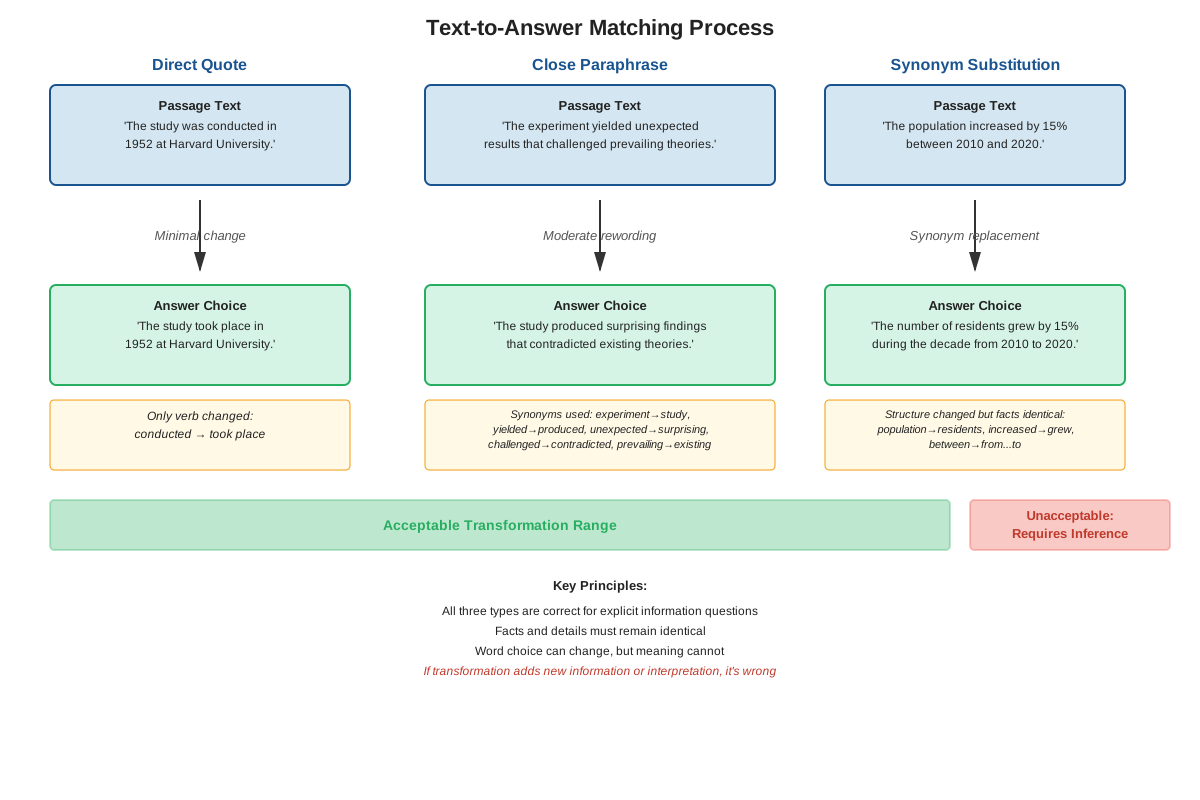
Explicit information refers to details that are directly stated in a text—facts, descriptions, and statements that appear word-for-word or with minimal paraphrasing in the passage. On the SAT Reading and Writing section (RW), questions testing explicit information ask students to identify, locate, or retrieve specific details that the author has clearly communicated without requiring inference or interpretation. These questions form a foundational question type that appears consistently across the exam, making mastery essential for achieving a competitive score.
Understanding how to efficiently locate and verify sat explicit information is crucial because these questions often serve as "quick points"—questions that can be answered rapidly and accurately when approached with the right strategy. Unlike questions requiring complex analysis or synthesis of multiple ideas, explicit information questions reward careful reading and precise text matching. Students who excel at these questions demonstrate strong reading comprehension fundamentals and attention to textual detail.
Within the broader context of the Central Ideas and Details domain, explicit information questions connect closely to main idea identification, supporting detail recognition, and textual evidence evaluation. While central idea questions ask students to synthesize the overall message, explicit information questions focus on the building blocks—the specific facts, examples, and statements that authors use to construct their arguments. Mastering explicit information retrieval creates a foundation for more advanced analytical skills tested elsewhere on the SAT.
Learning Objectives
By the end of this study guide, students will be able to:
- [ ] Identify key features of explicit information in SAT passages
- [ ] Explain how explicit information appears on the SAT
- [ ] Apply explicit information strategies to answer SAT-style questions
- [ ] Distinguish between explicit information and implicit meaning in complex texts
- [ ] Locate specific textual evidence efficiently within time constraints
- [ ] Evaluate answer choices by matching them precisely to passage language
- [ ] Recognize common distractor patterns in explicit information questions
Prerequisites
Students should have the following foundational knowledge before studying this topic:
- Basic reading comprehension skills: Ability to understand grade-level texts is necessary to process SAT passages efficiently
- Vocabulary at the high school level: Familiarity with common academic vocabulary enables faster comprehension of passage content
- Understanding of passage structure: Recognition of how paragraphs organize information helps locate details quickly
- Familiarity with question stems: Basic experience with standardized test formats reduces cognitive load during the exam
Why This Topic Matters
Real-World Applications
The ability to extract explicit information from texts is fundamental to academic success, professional communication, and informed citizenship. Students use this skill when reading textbooks, following instructions, analyzing research articles, interpreting contracts, and evaluating news sources. In professional contexts, accurately retrieving stated information prevents costly misunderstandings and ensures compliance with written guidelines.
Exam Statistics and Frequency
Explicit information questions constitute approximately 25-30% of all Reading and Writing questions on the digital SAT. These questions appear across all passage types—literary fiction, historical documents, scientific texts, and argumentative essays. The College Board consistently includes 8-12 explicit information questions per test, making this one of the highest-frequency question categories. Students who master this topic can secure a significant portion of their total score through efficient, accurate responses.
Common Exam Appearances
On the SAT, explicit information questions typically appear in several formats:
- Direct retrieval questions: "According to the passage, what did the researcher discover?"
- Completion questions: "The text indicates that the primary cause of the phenomenon was..."
- Verification questions: "Which statement about the subject is supported by the text?"
- Detail-specific questions: "The passage states that the event occurred in which year?"
These questions often reference specific paragraph numbers or line references in the digital format, guiding students to the relevant section while still requiring careful reading to identify the correct answer.
Core Concepts
What Constitutes Explicit Information
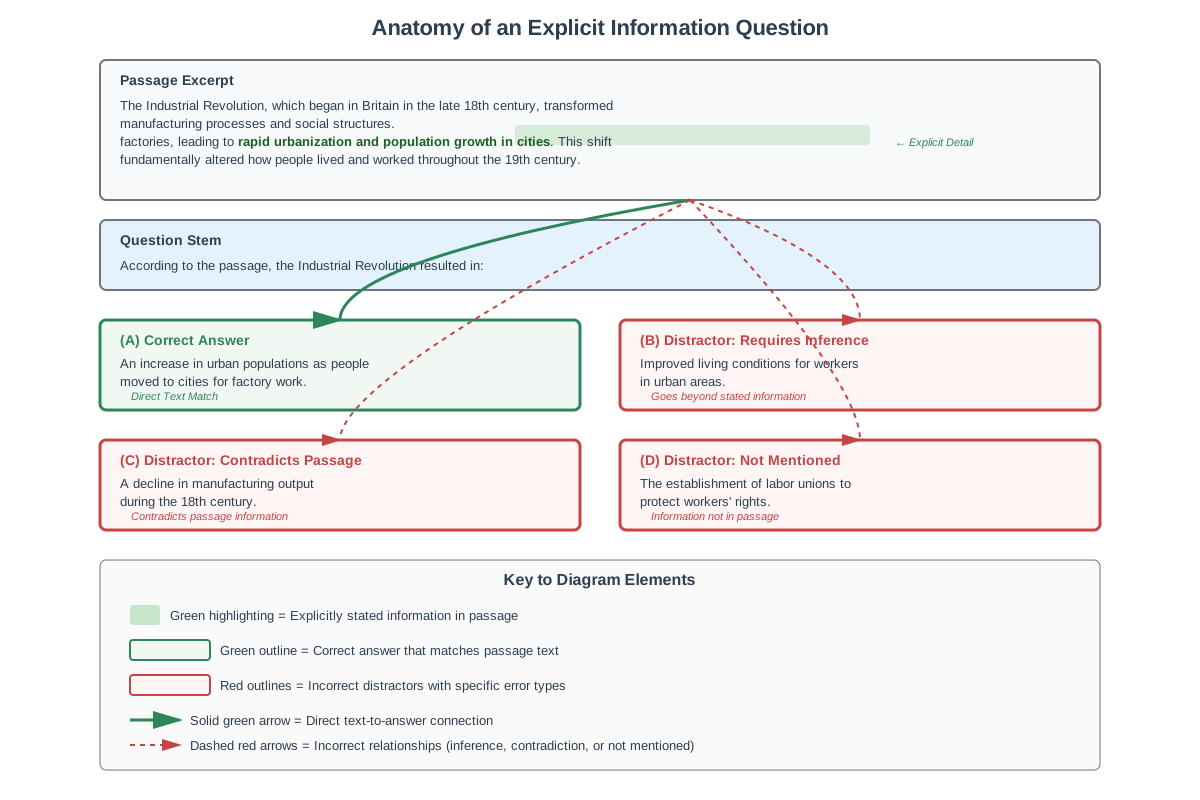
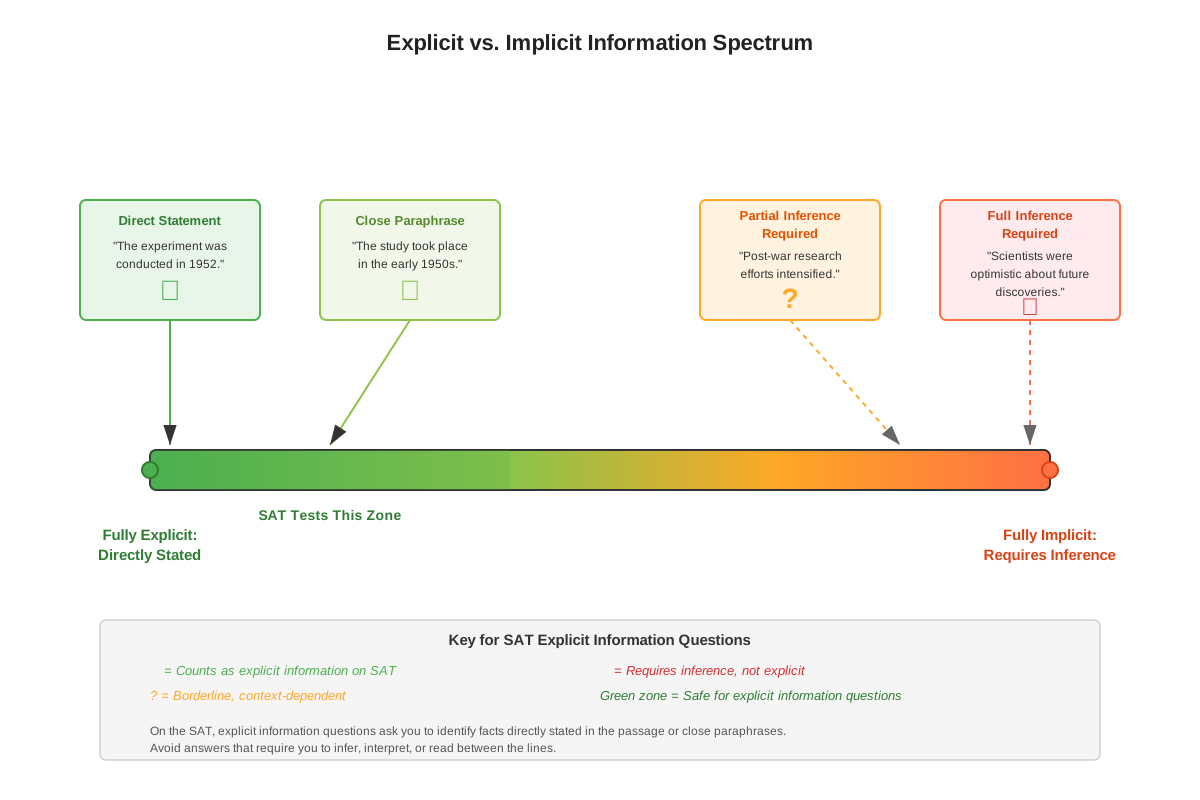
Explicit information consists of facts, details, statements, and descriptions that an author directly communicates in the text without requiring readers to make inferences or draw conclusions. This information is "on the surface" of the text—visible, stated, and unambiguous. When a passage says, "The experiment was conducted in 1952," the year 1952 is explicit information. When it states, "Three factors contributed to the outcome," the number three is explicitly stated.
The key characteristic of explicit information is its direct retrievability: a reader can point to specific words or sentences in the passage that contain the answer. Unlike implicit information, which requires reading between the lines, explicit details are present in the author's actual language, though they may be paraphrased in answer choices.
Characteristics of Explicit Information Questions
SAT explicit information questions share several identifying features:
| Feature | Description | Example Stem |
|---|---|---|
| Direct reference | Questions point to specific passage content | "According to the text..." |
| Factual focus | Questions ask about stated details, not interpretations | "The passage indicates that..." |
| Text-based answers | Correct answers match passage language closely | "Which statement is supported by the passage?" |
| Minimal inference | Questions require finding, not concluding | "The author states that..." |
Types of Explicit Information
Understanding the categories of explicit information helps students recognize what they're searching for:
- Factual details: Specific data points, dates, numbers, names, and measurements
- Descriptive information: Characteristics, qualities, and attributes directly stated about subjects
- Sequential information: Steps in a process, chronological events, or ordered lists
- Comparative information: Explicit comparisons, contrasts, or relationships stated by the author
- Quoted material: Direct quotations or paraphrased statements attributed to sources
- Definitional information: Terms and concepts explicitly defined within the passage
Locating Explicit Information Efficiently
The digital SAT format often provides paragraph numbers or line references to guide students to relevant sections. When these references appear, students should:
- Navigate directly to the indicated section
- Read 1-2 sentences before and after the reference for context
- Identify the specific detail requested in the question stem
- Match the passage language to answer choices
When no reference is provided, students should use keyword scanning: identify the key terms in the question stem and scan the passage for those terms or close synonyms. Most explicit information appears in topic sentences, concluding sentences, or sentences containing signal words like "specifically," "in particular," "for example," or "notably."
Paraphrasing and Synonyms
A critical aspect of SAT explicit information questions is that correct answers often paraphrase passage language rather than quoting it verbatim. The College Board tests whether students understand the meaning of explicit information, not just whether they can match identical words.
For example:
- Passage: "The population declined by half between 1990 and 2000."
- Correct answer: "The number of inhabitants decreased 50% during the final decade of the twentieth century."
Students must recognize that "declined," "decreased," and "reduced" are synonyms, that "by half" equals "50%," and that "1990 and 2000" represents "the final decade of the twentieth century." This synonym recognition is essential for success.
Distinguishing Explicit from Implicit Information
Understanding what explicit information is NOT helps students avoid common errors:
- Explicit: "The study included 200 participants." (Directly stated)
- Implicit: "The study was large-scale." (Requires judgment about what constitutes "large")
- Explicit: "Sales increased in March, April, and May." (Stated fact)
- Implicit: "Sales showed a spring trend." (Requires inference about seasonal patterns)
When a question asks what is "stated," "indicated," "mentioned," or "according to the passage," students should look for information that appears directly in the text, not conclusions they must draw from that information.
Concept Relationships
The concepts within explicit information questions form a logical progression:
Question stem identification → Passage location → Detail extraction → Synonym recognition → Answer verification
Each step depends on the previous one. Students must first recognize they're dealing with an explicit information question (through stems like "according to the passage"), then locate the relevant section, extract the specific detail requested, recognize how that detail might be paraphrased in answer choices, and verify their selection against the passage.
Explicit information questions connect to other SAT Reading and Writing topics:
- Central Ideas: Explicit details serve as evidence supporting main ideas
- Purpose and Function: Authors use explicit information to achieve rhetorical goals
- Textual Evidence: Explicit information questions often ask students to identify which quotation supports a claim
- Vocabulary in Context: Understanding precise word meanings helps identify explicit information accurately
The relationship can be visualized as: Explicit Details (foundation) → Supporting Evidence (structure) → Central Ideas (synthesis) → Author's Purpose (interpretation)
High-Yield Facts
⭐ Explicit information questions account for 25-30% of SAT Reading and Writing questions, making them one of the most frequent question types.
⭐ Correct answers to explicit information questions are always directly supported by passage text, even when paraphrased.
⭐ The digital SAT often provides paragraph numbers or references to guide students to relevant sections for explicit information questions.
⭐ Explicit information requires minimal to no inference—if you're drawing conclusions, you're likely dealing with implicit information instead.
⭐ Answer choices frequently use synonyms and paraphrasing rather than exact quotations from the passage.
- Explicit information questions use stems like "according to," "states that," "indicates," "mentions," and "the text says."
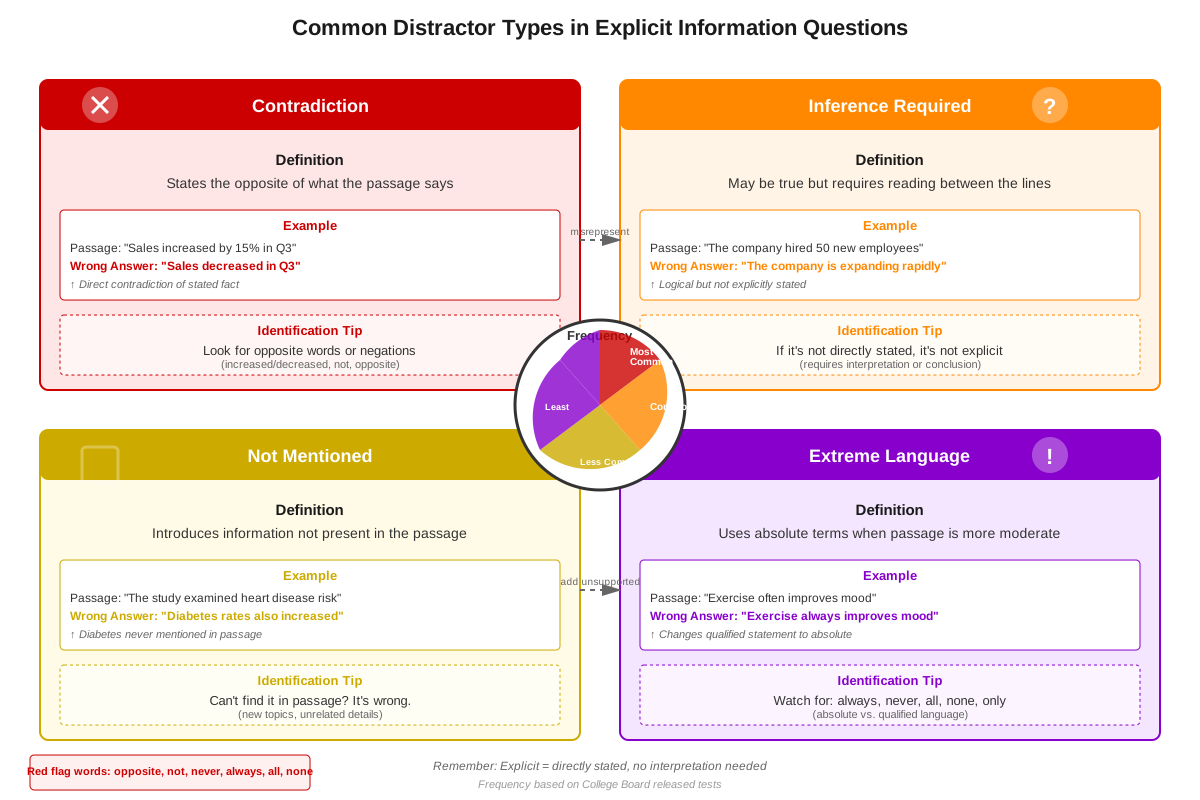
- Wrong answers often include information that appears in the passage but doesn't answer the specific question asked.
- Scanning for keywords from the question stem helps locate relevant passage sections quickly.
- Explicit information can appear anywhere in a passage—introduction, body paragraphs, or conclusion.
- Time-efficient students spend 30-45 seconds on straightforward explicit information questions.
- Explicit details include facts, dates, names, numbers, descriptions, and direct statements.
- The most common error is selecting an answer that requires inference rather than one directly stated.
- Reading 1-2 sentences before and after a reference point provides necessary context.
- Explicit information questions reward careful, literal reading rather than interpretive analysis.
- Students should verify their answer by finding the exact sentence in the passage that supports it.
Quick check — test yourself on Explicit information so far.
Try Flashcards →Common Misconceptions
Misconception: Explicit information questions are always easy and require no strategy.
Correction: While these questions test straightforward comprehension, they require systematic approaches to avoid traps. Wrong answers often include plausible information from the passage that doesn't answer the specific question, or they introduce subtle distortions of stated facts. Strategic reading and verification prevent careless errors.
Misconception: The correct answer will use the exact same words as the passage.
Correction: The SAT deliberately paraphrases explicit information in correct answers to test comprehension rather than simple word-matching. Students must recognize synonyms, equivalent phrases, and reworded concepts. For example, "doubled" might appear as "increased by 100%" or "twice as large."
Misconception: If information appears in the passage, it's a correct answer.
Correction: Wrong answers frequently contain true statements from the passage that don't address the specific question being asked. Students must match both the content AND the focus of the question. A passage might state both "The experiment lasted three weeks" and "The experiment included 50 subjects," but only one answers "How long did the experiment last?"
Misconception: Explicit information questions don't require reading the entire relevant section.
Correction: Context matters even for explicit details. Reading only the sentence containing a keyword can cause students to miss qualifiers, exceptions, or clarifications. Phrases like "initially," "however," "except," or "primarily" can completely change the meaning of explicit information.
Misconception: Longer, more complex answer choices are more likely to be correct.
Correction: Answer length and complexity don't correlate with correctness on explicit information questions. The College Board creates wrong answers of varying lengths and sophistication levels. Students should focus on accuracy of content, not presentation style.
Misconception: Explicit information questions always have obvious answers that jump out immediately.
Correction: Some explicit information questions require careful reading of dense or technical passages where multiple similar details appear. Students must distinguish between closely related facts and match the precise detail requested. In scientific passages, for example, multiple numbers or dates might appear, requiring careful attention to which specific data point answers the question.
Worked Examples
Example 1: Scientific Passage
Passage excerpt:
"The research team, led by Dr. Maria Chen, conducted field observations in the Amazon rainforest between March and August 2019. During this period, they documented 127 distinct bird species, including 14 species previously unrecorded in the region. The team's methodology involved establishing observation points at three different elevations: 200 meters, 450 meters, and 680 meters above sea level. The highest elevation site yielded the greatest diversity, with 89 species observed."
Question:
According to the passage, how many bird species were observed at the highest elevation site?
A) 14
B) 89
C) 127
D) 680
Solution:
Step 1: Identify the question type
The stem "According to the passage" signals an explicit information question requiring direct retrieval.
Step 2: Locate keywords
Key terms: "highest elevation site" and "how many bird species"
Step 3: Scan the passage
The phrase "highest elevation site" appears in the final sentence: "The highest elevation site yielded the greatest diversity, with 89 species observed."
Step 4: Extract the explicit information
The passage directly states "89 species observed" at the highest elevation site.
Step 5: Eliminate wrong answers
- A) 14 refers to previously unrecorded species (different detail)
- B) 89 matches the explicit statement ✓
- C) 127 refers to total species documented (different detail)
- D) 680 refers to meters above sea level (different measurement)
Answer: B
This question demonstrates how explicit information questions include multiple numbers in the passage to test whether students can match the specific detail requested.
Example 2: Historical Passage
Passage excerpt:
"The Homestead Act of 1862 fundamentally transformed American westward expansion. Under its provisions, any adult citizen or intended citizen could claim 160 acres of surveyed government land. Claimants were required to improve the plot by building a dwelling and cultivating crops. After five years of continuous residence, the original filer was entitled to the property, free and clear, except for a small registration fee. Alternatively, settlers could acquire the land after only six months of residency by paying $1.25 per acre."
Question:
The text indicates that under the standard provisions of the Homestead Act, settlers could obtain land ownership after
A) six months of residency by paying a fee per acre
B) five years of continuous residence and a small registration fee
C) building a dwelling without any residency requirement
D) cultivating crops for 160 acres
Solution:
Step 1: Identify the question type
"The text indicates" signals explicit information retrieval.
Step 2: Identify what's being asked
The question asks about the "standard provisions" for obtaining land ownership, focusing on time requirements and conditions.
Step 3: Locate relevant information
The passage states: "After five years of continuous residence, the original filer was entitled to the property, free and clear, except for a small registration fee."
Step 4: Note the alternative provision
The passage also mentions: "Alternatively, settlers could acquire the land after only six months of residency by paying $1.25 per acre." The word "alternatively" indicates this is NOT the standard provision.
Step 5: Evaluate answer choices
- A) Describes the alternative provision, not the standard one
- B) Accurately matches "five years of continuous residence" and "small registration fee" ✓
- C) Building a dwelling was required but not sufficient alone for ownership
- D) Misrepresents the cultivation requirement and confuses acreage with time
Answer: B
This example shows how explicit information questions test careful reading of qualifiers like "alternatively" and the ability to distinguish between multiple stated conditions.
Exam Strategy
Approaching Explicit Information Questions
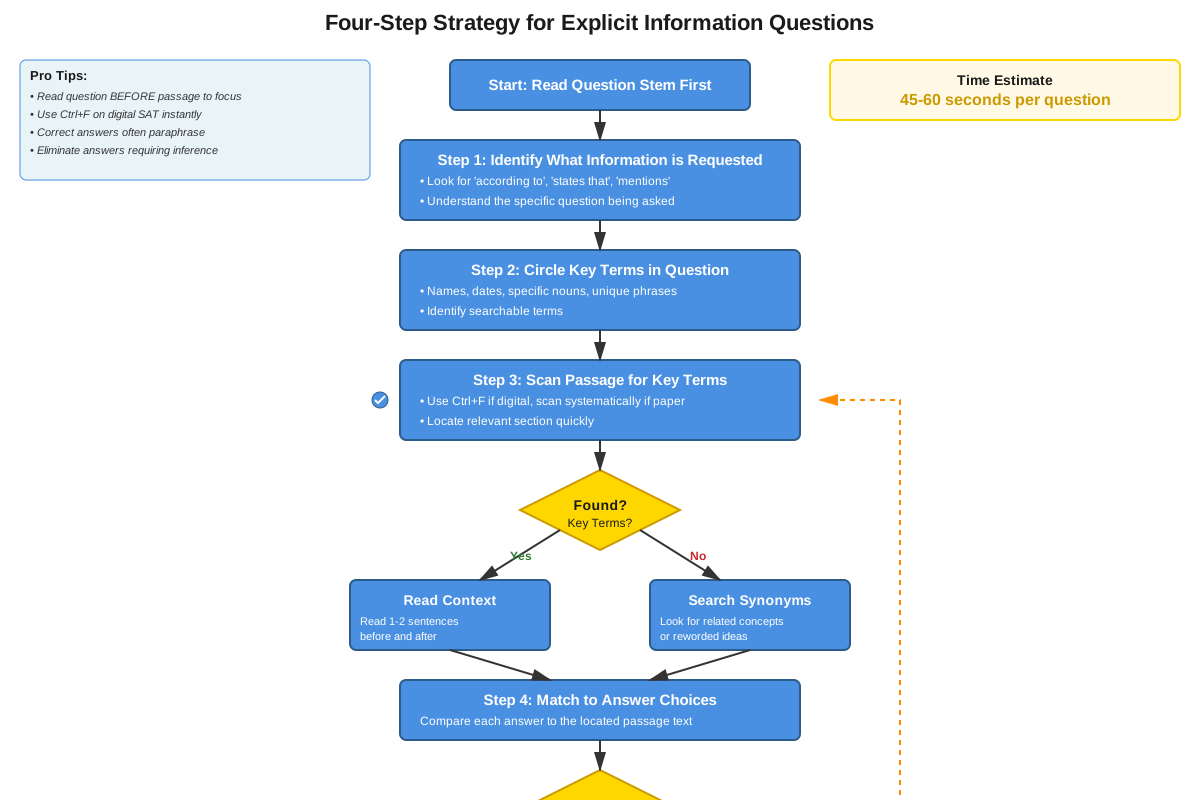
Follow this systematic process for maximum accuracy and efficiency:
- Recognize the question type through stems containing "according to," "states," "indicates," "mentions," or "the text says"
- Identify the specific detail requested before returning to the passage
- Use provided references (paragraph numbers) or scan for keywords
- Read contextually—include sentences before and after the target information
- Predict the answer based on passage content before looking at choices
- Match carefully, recognizing paraphrasing and synonyms
- Verify by confirming the passage directly supports your selection
Trigger Words and Phrases
Watch for these question stems that signal explicit information questions:
High-yield triggers: "According to the passage," "The text states," "The author mentions," "The passage indicates," "As stated in the text," "The text says that," "Which statement is supported by the passage?"
These phrases tell students to look for directly stated information rather than implied meanings or interpretations.
Process of Elimination Tips
When eliminating wrong answers on explicit information questions:
- Eliminate answers that require inference beyond what's directly stated
- Eliminate answers with absolute language ("always," "never," "only") unless the passage uses equally absolute terms
- Eliminate answers that distort passage details through subtle word changes
- Eliminate answers that reference the wrong part of the passage (true statements that don't answer the question)
- Eliminate answers that contradict explicit statements, even if they seem logical
Time Allocation
Explicit information questions should be among the fastest to answer:
- Target time: 30-45 seconds per question
- Maximum time: 60 seconds before flagging for review
- Time-saving tip: When a paragraph reference is provided, go directly there rather than re-reading the entire passage
Students who spend more than 60 seconds on an explicit information question are likely overthinking or searching inefficiently. These questions reward quick, accurate retrieval rather than extended analysis.
Memory Techniques
The LOCATE Method
Use this acronym to remember the systematic approach:
Look for question type indicators ("according to," "states")
Observe what specific detail is requested
Check for paragraph references or keywords
Analyze the relevant passage section with context
Test answer choices against passage language
Eliminate and verify your selection
Visualization Strategy
Picture explicit information as highlighted text in the passage—information that could be marked with a highlighter because it's directly visible on the page. If you can't imagine highlighting the exact words that support an answer, it's likely requiring inference rather than explicit retrieval.
The "Point and Prove" Technique
For every explicit information answer selected, mentally (or physically on scratch paper) note the sentence number or first few words of the sentence that proves the answer. This habit ensures answers are truly supported by explicit text rather than assumptions.
Synonym Recognition Practice
Create mental synonym clusters for common SAT concepts:
- Increase: rise, grow, expand, escalate, climb
- Decrease: decline, fall, diminish, reduce, drop
- Cause: lead to, result in, produce, generate, bring about
- Show: demonstrate, reveal, indicate, display, illustrate
Recognizing these equivalencies helps match paraphrased answers to passage content.
Summary
Explicit information questions form a foundational component of SAT Reading and Writing success, accounting for approximately 25-30% of all questions in this section. These questions test the ability to locate, retrieve, and recognize directly stated facts, details, and descriptions from passages without requiring inference or interpretation. Success depends on systematic approaches: identifying question types through trigger words like "according to" and "states," efficiently locating relevant passage sections using references or keyword scanning, reading contextually to capture qualifiers and nuances, and carefully matching paraphrased answer choices to passage language through synonym recognition. The most common pitfalls include selecting answers that require inference, choosing true statements that don't address the specific question asked, and failing to recognize paraphrased versions of explicit information. Students who master explicit information retrieval secure quick, reliable points while building the foundational skills necessary for more complex analytical questions elsewhere on the exam.
Key Takeaways
- Explicit information questions ask for directly stated details that can be pointed to in the passage text
- These questions constitute 25-30% of SAT Reading and Writing questions, making them high-yield for score improvement
- Correct answers frequently paraphrase passage language using synonyms rather than exact quotations
- Question stems like "according to," "states," and "indicates" signal explicit information questions
- Efficient strategies include using paragraph references, scanning for keywords, and reading contextually
- Wrong answers often include true passage information that doesn't answer the specific question asked
- Verification is essential—students should confirm that passage text directly supports their answer choice
Related Topics
Central Ideas and Main Purpose: After mastering explicit information retrieval, students can progress to synthesizing these details into understanding overall passage themes and author intentions. Explicit details serve as the evidence base for central idea questions.
Textual Evidence Questions: These questions explicitly ask students to identify which quotation best supports a previous answer, directly applying explicit information skills to justify interpretations.
Command of Evidence: This advanced skill builds on explicit information mastery by requiring students to evaluate the strength and relevance of stated details as support for claims.
Vocabulary in Context: Precise understanding of word meanings enhances the ability to recognize paraphrased explicit information and distinguish between similar details.
Inference Questions: Understanding what constitutes explicit information creates a clear boundary for recognizing when questions require inference—reading between the lines rather than retrieving stated facts.
Practice CTA
Now that you've mastered the core concepts of explicit information retrieval, it's time to apply these strategies to authentic SAT-style questions. Complete the practice questions associated with this topic to reinforce your systematic approach, build speed and accuracy, and identify any remaining areas for improvement. Use the flashcards to cement your understanding of key terms and trigger words. Remember: explicit information questions are among the most reliable point-earners on the SAT when approached with the right strategy. Your investment in practice now will pay dividends in both confidence and score improvement on test day. You've got this!
Sign up free to keep reading
Create a free AnvayaPrep account to finish this SAT guide on Explicit information — plus flashcards and practice questions.