Overview
The main purpose question type is one of the most fundamental and frequently tested concepts in the SAT Reading and Writing section. These questions ask students to identify the primary reason an author wrote a passage or the central function a passage serves. Unlike detail-oriented questions that focus on specific information, main purpose questions require students to synthesize the entire passage and understand the author's overarching intent. This skill is essential because it tests reading comprehension at the highest level—the ability to distinguish between what an author says and why they're saying it.
On the SAT main purpose questions, students must look beyond individual facts, examples, and supporting details to grasp the broader communicative goal. Is the author trying to persuade readers of a particular viewpoint? Are they explaining a scientific phenomenon? Perhaps they're comparing two theories or describing a historical event's significance? The ability to answer these questions accurately demonstrates sophisticated reading comprehension and is a strong predictor of college readiness. Main purpose questions typically appear in the RW (Reading and Writing) section and account for a significant portion of the "Central Ideas and Details" question category.
Understanding main purpose connects directly to other critical reading skills tested on the SAT. It builds upon the ability to identify central ideas, distinguish between main points and supporting details, and recognize organizational patterns. Mastering main purpose questions also enhances performance on inference questions, tone questions, and questions about authorial intent. This topic serves as a foundation for advanced analytical reading—a skill that extends far beyond standardized testing into academic success and professional communication.
Learning Objectives
- [ ] Identify key features of Main purpose
- [ ] Explain how Main purpose appears on the SAT
- [ ] Apply Main purpose to answer SAT-style questions
- [ ] Distinguish between the main purpose and supporting details in complex passages
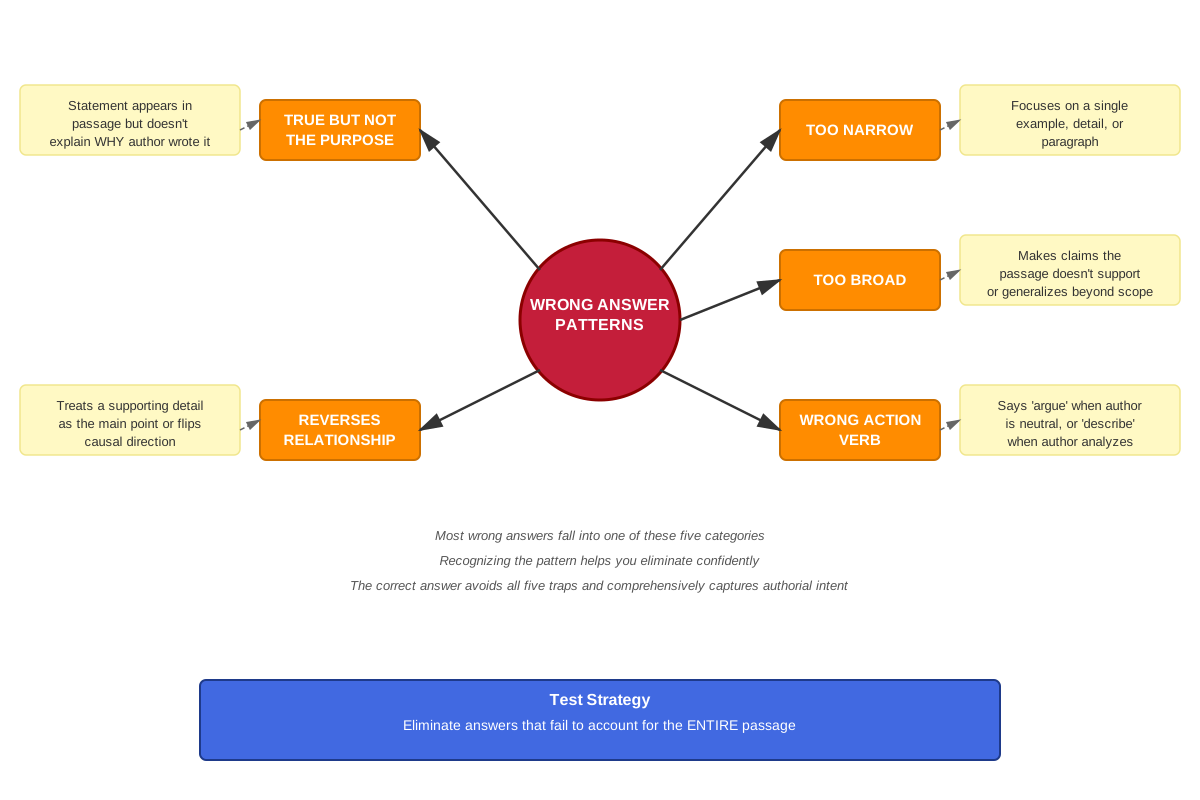
- [ ] Recognize common wrong answer patterns in main purpose questions
- [ ] Evaluate answer choices by testing them against the entire passage rather than isolated sections
- [ ] Synthesize information from multiple paragraphs to determine overarching authorial intent
Prerequisites
- Basic reading comprehension skills: The ability to understand literal meaning in written passages is essential before analyzing deeper purpose and intent.
- Understanding of paragraph structure: Recognizing topic sentences, supporting details, and concluding statements helps identify how individual parts contribute to overall purpose.
- Familiarity with common text types: Knowing the difference between argumentative, expository, narrative, and descriptive writing provides context for determining purpose.
- Vocabulary at grade level: Understanding the passage's language is necessary before analyzing why the author wrote it.
Why This Topic Matters
Main purpose questions appear with remarkable consistency on every SAT administration, typically comprising 10-15% of all Reading and Writing questions. This frequency makes them high-yield content that directly impacts overall scores. Students who master main purpose questions gain a strategic advantage because these questions often appear early in a passage set and, when answered correctly, provide a framework for understanding subsequent detail-oriented questions.
Beyond test performance, the ability to identify an author's main purpose is a critical life skill. In academic settings, students must quickly grasp the central argument of scholarly articles, textbook chapters, and research papers. In professional contexts, identifying the purpose of business communications, reports, and proposals enables efficient decision-making. In daily life, recognizing the underlying purpose of news articles, opinion pieces, and advertisements promotes media literacy and critical thinking.
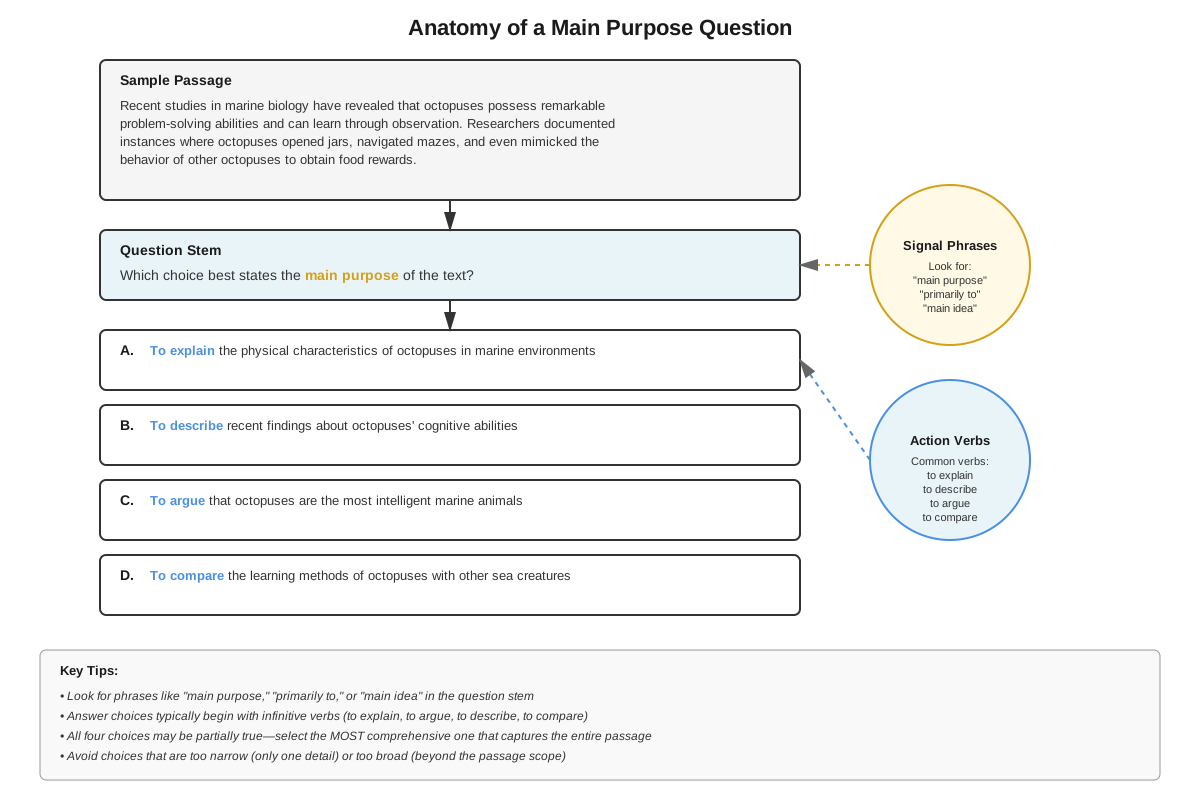
On the SAT, main purpose questions commonly appear in several formats. Students might encounter passages from scientific journals explaining research findings, historical documents arguing for social change, literary criticism analyzing artistic works, or social science texts describing cultural phenomena. The passages range from 25 to 150 words in the digital SAT format, and the main purpose question typically asks: "Which choice best states the main purpose of the text?" or "The main purpose of the text is to..." Understanding how to approach these questions across diverse passage types is essential for consistent performance.
Core Concepts
Defining Main Purpose
The main purpose of a passage represents the author's primary reason for writing—the overarching goal that unifies all elements of the text. This differs from the topic (what the passage is about) or the main idea (the central point being made). The main purpose answers the question: "Why did the author write this?" rather than "What is this about?" For example, a passage might be about climate change (topic), argue that immediate action is necessary (main idea), and have the purpose of persuading readers to support environmental legislation (main purpose).
Main purpose operates at the macro level of text analysis. While individual sentences and paragraphs serve specific functions—introducing evidence, providing examples, acknowledging counterarguments—the main purpose encompasses the entire passage's communicative goal. Identifying this requires students to mentally step back from details and consider the text as a unified whole with a single driving intention.
Common Purpose Categories
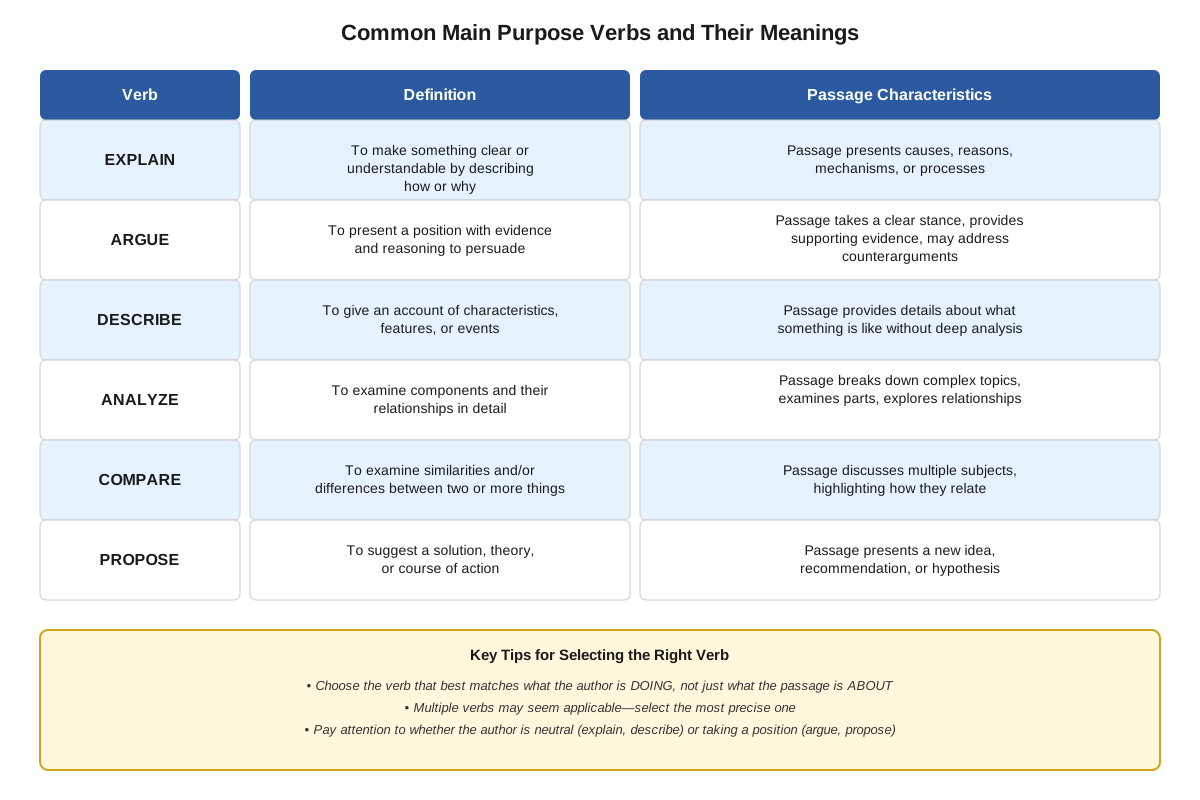
SAT passages typically fall into several purpose categories, each with characteristic features:
| Purpose Category | Key Characteristics | Common Verbs in Correct Answers |
|---|---|---|
| To explain | Presents information objectively; describes how or why something works | explain, describe, illustrate, clarify |
| To argue/persuade | Takes a position; provides reasoning and evidence for a claim | argue, persuade, advocate, convince |
| To compare/contrast | Examines similarities and differences between two or more things | compare, contrast, distinguish, differentiate |
| To analyze | Breaks down a concept, work, or phenomenon into components | analyze, examine, evaluate, assess |
| To describe | Provides detailed characteristics or features of something | describe, depict, characterize, portray |
| To inform | Presents factual information without strong opinion | inform, report, present, outline |
Recognizing these categories helps students predict the type of purpose they're looking for based on passage characteristics. An objective scientific passage likely aims to explain or inform, while an editorial excerpt probably seeks to argue or persuade.
Distinguishing Purpose from Related Concepts
Students frequently confuse main purpose with closely related but distinct concepts:
Main Purpose vs. Topic: The topic is the subject matter—what the passage discusses. The purpose is why the author discusses it. A passage about renewable energy (topic) might have the purpose of explaining how solar panels work, or arguing for increased solar investment, or comparing solar and wind power efficiency.
Main Purpose vs. Main Idea: The main idea is the central point or thesis—the key message the author wants readers to understand. The purpose is the function this message serves. Consider: Main idea = "Exercise improves mental health"; Purpose = "to inform readers about the psychological benefits of physical activity."
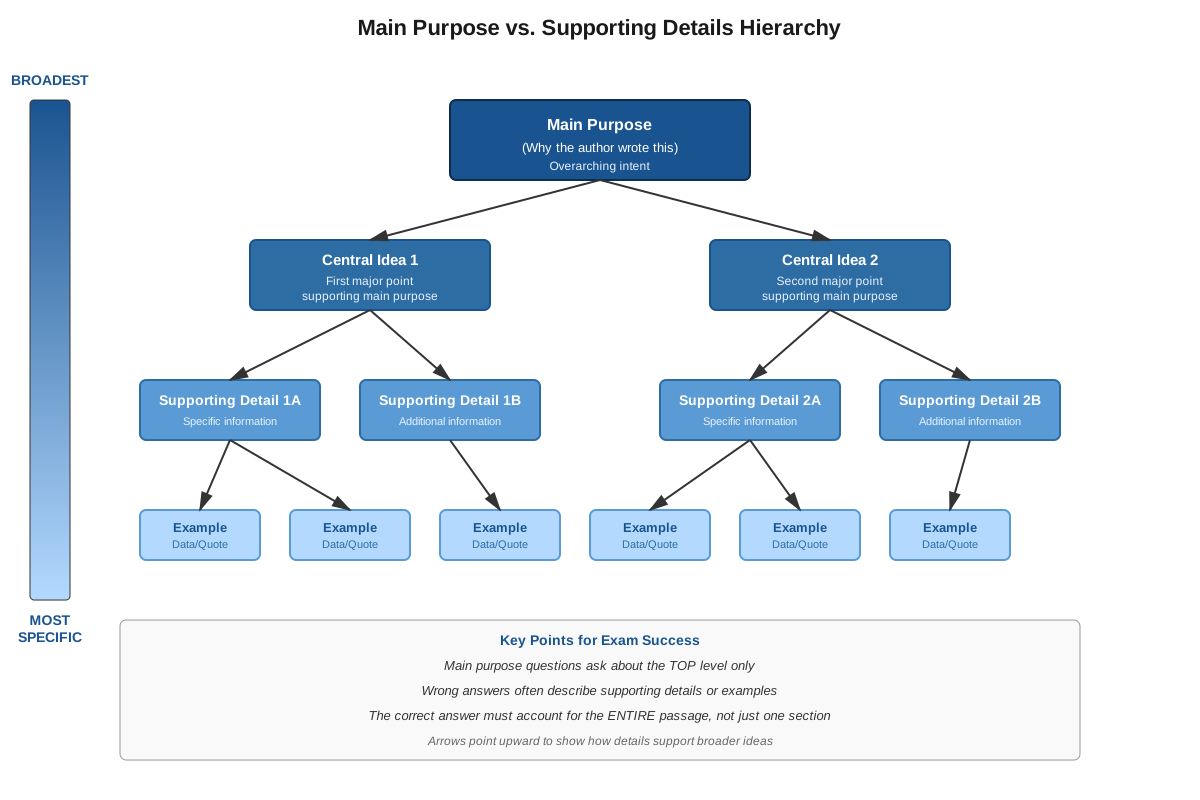
Main Purpose vs. Supporting Details: Supporting details are specific facts, examples, statistics, or anecdotes that develop the main purpose. They answer "what evidence does the author provide?" while purpose answers "what is the author trying to accomplish?"
Textual Evidence for Main Purpose
Certain passage elements provide strong clues about main purpose:
- Opening sentences: Often establish the passage's direction and hint at purpose through framing language
- Concluding sentences: Frequently reinforce the main purpose by restating the primary goal or implication
- Transitional phrases: Words like "however," "therefore," "in contrast," and "consequently" signal the author's organizational strategy and intent
- Tone and word choice: Objective language suggests explanatory or informative purpose; evaluative language indicates analytical or argumentative purpose
- Question structures: Passages that pose questions often aim to answer them (explanatory) or explore why they're difficult to answer (analytical)
Scope and Main Purpose
The correct answer to a main purpose question must match the passage's scope—neither too broad nor too narrow. A passage discussing one scientist's specific discovery shouldn't have a purpose "to explain all of modern physics" (too broad) or "to describe the equipment used in one experiment" (too narrow). The purpose should encompass everything in the passage without extending beyond it.
Testing scope involves asking: "Does this purpose account for the entire passage?" If the proposed purpose only explains the first paragraph or ignores the conclusion, it's too narrow. If it includes topics the passage never addresses, it's too broad.
Concept Relationships
Main purpose serves as the apex concept in a hierarchy of reading comprehension skills. At the foundation lies literal comprehension—understanding what individual sentences mean. This supports identifying supporting details—recognizing specific facts and examples. These details collectively point toward the central idea—the main point being made. The central idea, in turn, reveals the main purpose—why the author is making this point.
This hierarchy flows in one direction during reading: Details → Central Idea → Main Purpose. However, during question-answering, the relationship reverses: understanding the main purpose helps students evaluate which details are relevant and which are merely tangential.
Main purpose also connects laterally to other SAT Reading and Writing concepts. Tone and style questions relate closely because an author's purpose influences their word choice and attitude. Organizational structure connects because how an author arranges information reflects their purpose (chronological for narrative purposes, problem-solution for persuasive purposes, etc.). Inference questions often require understanding purpose because recognizing why an author includes certain information helps predict what they might conclude or imply.
The relationship map looks like this:
Literal Comprehension → Supporting Details → Central Idea → Main Purpose
Main Purpose ↔ Tone/Style (bidirectional: purpose influences tone; tone reveals purpose)
Main Purpose → Organizational Structure (purpose determines structure)
Main Purpose → Inference (understanding purpose enables stronger inferences)
High-Yield Facts
⭐ Main purpose questions ask WHY the author wrote the passage, not WHAT the passage is about—this distinction is the most commonly tested concept.
⭐ The correct answer must account for the ENTIRE passage, not just one paragraph or section—scope matching is critical.
⭐ Wrong answers often describe supporting details or secondary purposes rather than the primary purpose—these are attractive distractors.
⭐ Opening and closing sentences provide the strongest clues about main purpose—these positions typically frame the author's intent.
⭐ The main purpose is usually stated in general terms rather than specific details—correct answers avoid overly specific language.
- Main purpose questions typically use verbs like "explain," "argue," "describe," "compare," or "analyze" in correct answers.
- Passages with multiple examples usually have an explanatory or illustrative purpose rather than a narrative purpose.
- If a passage presents a problem and solution, the purpose likely involves advocating for or explaining the solution.
- Objective, neutral language in a passage suggests an informative or explanatory purpose rather than persuasive.
- When a passage discusses conflicting viewpoints, the purpose often involves comparing perspectives or analyzing a debate.
- The main purpose should never be more specific than the passage's most specific section or more general than its broadest claim.
- Time markers and chronological organization often indicate a purpose of describing development or explaining historical progression.
- Questions posed in the passage that are subsequently answered indicate an explanatory purpose.
- Evaluative language (words like "significant," "important," "problematic") suggests analytical or argumentative purpose.
- If you can eliminate the first or last paragraph and the proposed purpose still fits, that purpose is too narrow.
Quick check — test yourself on Main purpose so far.
Try Flashcards →Common Misconceptions
Misconception: The main purpose is always stated explicitly in the passage.
Correction: While some passages directly state their purpose, many require readers to infer it from the overall content, structure, and tone. The SAT tests the ability to synthesize information and determine implicit purpose, not just locate explicit purpose statements.
Misconception: The longest paragraph or section indicates the main purpose.
Correction: Length doesn't determine importance. A passage might spend considerable space on examples or background information while the main purpose relates to a brief but crucial argument or conclusion. Focus on function, not length.
Misconception: If an answer choice mentions something in the passage, it could be the main purpose.
Correction: Correct main purpose answers must capture the PRIMARY reason for writing, not just any element present in the passage. Supporting details, tangential examples, and background information appear in passages but don't represent the main purpose.
Misconception: Main purpose and main idea are interchangeable terms.
Correction: Main idea refers to the central point or thesis (WHAT the author wants you to know), while main purpose refers to the author's reason for writing (WHY they're telling you). A passage's main idea might be "renewable energy is cost-effective," while its purpose is "to argue for increased renewable energy investment."
Misconception: The correct answer will use the same words as the passage.
Correction: Correct answers typically paraphrase or generalize the passage's content rather than quoting it directly. SAT answer choices test comprehension, not just word-matching ability. Students should focus on matching concepts, not identical vocabulary.
Misconception: If the passage discusses multiple topics, it has multiple main purposes.
Correction: Even passages covering several topics have ONE overarching purpose that unifies them. Multiple topics might serve as examples supporting a single explanatory purpose, or as contrasting viewpoints in a comparative purpose. The main purpose encompasses all topics under one umbrella.
Misconception: Emotional or interesting details indicate the main purpose.
Correction: Authors often use vivid examples, anecdotes, or emotional appeals as rhetorical devices to support their main purpose, but these elements themselves aren't the purpose. A passage might include a moving personal story (detail) to support a purpose of arguing for policy change (purpose).
Worked Examples
Example 1: Scientific Explanation Passage
Passage: "Bioluminescence, the production and emission of light by living organisms, occurs through a chemical reaction involving the molecule luciferin and the enzyme luciferase. When luciferin is oxidized in the presence of luciferase, light is produced with minimal heat generation, making it an extremely efficient process. This phenomenon appears in various marine species, including certain jellyfish, fish, and bacteria. Scientists have discovered that different species use bioluminescence for distinct purposes: some employ it for attracting prey, others for communication with potential mates, and still others as a defense mechanism to startle predators."
Question: Which choice best states the main purpose of the text?
A) To argue that bioluminescence is the most efficient light-producing process in nature
B) To explain what bioluminescence is and describe its various functions in marine species
C) To compare the bioluminescence mechanisms of jellyfish, fish, and bacteria
D) To persuade readers that scientists should study bioluminescence more extensively
Analysis:
Step 1: Identify what the passage discusses (topic): Bioluminescence in marine organisms
Step 2: Determine what the author does with this topic:
- First sentence: Defines bioluminescence and explains the chemical process
- Second sentence: Provides additional detail about the process's efficiency
- Third sentence: Notes where bioluminescence appears
- Fourth sentence: Describes different purposes bioluminescence serves
Step 3: Evaluate each answer choice against the entire passage:
Choice A: "To argue that bioluminescence is the most efficient light-producing process"
- The passage mentions efficiency but doesn't argue it's THE MOST efficient or compare it to other processes
- This is too narrow (focuses only on one detail) and too strong (uses "argue" when the tone is explanatory)
- Eliminate
Choice B: "To explain what bioluminescence is and describe its various functions"
- Covers the definition and chemical explanation (first part of passage)
- Covers the different purposes in various species (second part of passage)
- Matches the objective, informative tone
- Accounts for the entire passage
- Strong candidate
Choice C: "To compare the bioluminescence mechanisms of jellyfish, fish, and bacteria"
- The passage mentions these organisms but doesn't compare their mechanisms
- It compares the PURPOSES (prey attraction, communication, defense) not the mechanisms
- This misrepresents what the passage actually does
- Eliminate
Choice D: "To persuade readers that scientists should study bioluminescence"
- The passage mentions what scientists have discovered but doesn't advocate for more research
- The tone is informative, not persuasive
- This purpose doesn't appear anywhere in the passage
- Eliminate
Answer: B
Connection to Learning Objectives: This example demonstrates how to distinguish between main purpose (explaining and describing) and supporting details (efficiency, specific species). It shows the importance of matching answer scope to passage scope and recognizing explanatory purpose through objective tone.
Example 2: Argumentative Passage
Passage: "Many educators advocate for later school start times for adolescents, citing research on teenage sleep patterns. However, this proposal overlooks significant practical challenges. Transportation logistics would require complete restructuring, as many districts use the same buses for elementary, middle, and high schools in sequence. Additionally, later dismissal times would conflict with after-school employment, which many students depend on for college savings and family financial support. While the sleep research is compelling, implementation costs and disruption to students' work schedules make later start times an impractical solution for most districts."
Question: Which choice best states the main purpose of the text?
A) To describe the sleep patterns of adolescent students
B) To explain why many educators support later school start times
C) To argue against implementing later school start times due to practical obstacles
D) To compare the benefits and drawbacks of different school schedules
Analysis:
Step 1: Identify the passage structure:
- Opens by acknowledging a position (educators advocate for later start times)
- Immediately signals disagreement ("However, this proposal overlooks...")
- Provides two specific objections (transportation, employment)
- Concludes by reaffirming the position against later start times
Step 2: Note the tone and language:
- "overlooks significant practical challenges" = critical language
- "impractical solution" = evaluative, argumentative language
- The author takes a clear position against the proposal
Step 3: Evaluate answer choices:
Choice A: "To describe the sleep patterns of adolescent students"
- Sleep patterns are mentioned only as background context
- The passage doesn't actually describe these patterns
- Too narrow and misses the argumentative purpose
- Eliminate
Choice B: "To explain why many educators support later start times"
- This describes only the first sentence
- The passage mentions this support but doesn't explain the reasoning behind it
- Ignores the entire argumentative thrust of the passage
- Eliminate
Choice C: "To argue against implementing later school start times due to practical obstacles"
- Captures the argumentative nature (the author takes a position)
- Identifies the position (against later start times)
- Includes the reasoning (practical obstacles)
- Accounts for the entire passage structure
- Strong candidate
Choice D: "To compare the benefits and drawbacks of different school schedules"
- The passage focuses on ONE proposed change (later start times), not different schedules
- While it mentions benefits briefly, the focus is on drawbacks
- "Compare" suggests balanced treatment, but the passage clearly argues one side
- Eliminate
Answer: C
Connection to Learning Objectives: This example illustrates how to recognize argumentative purpose through tone, structure, and evaluative language. It demonstrates the importance of distinguishing between background information (educators' position) and the author's actual purpose (arguing against that position).
Exam Strategy
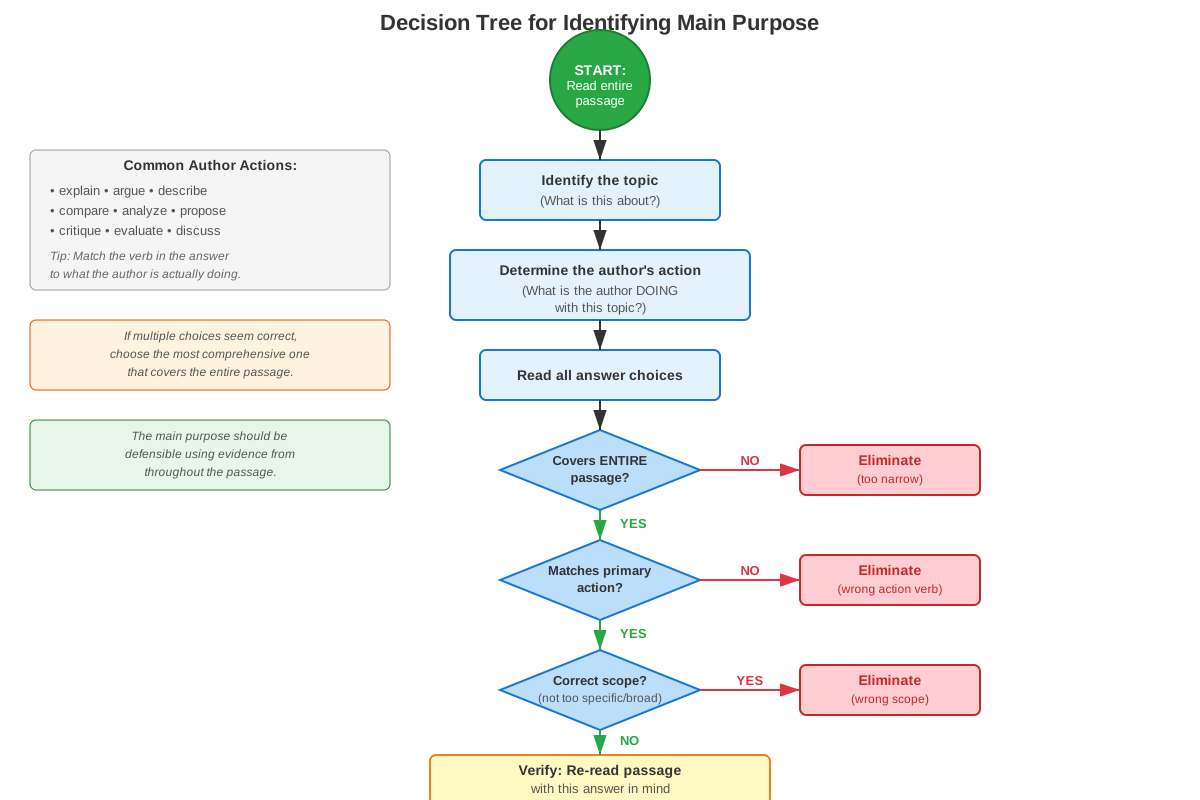
When approaching main purpose questions on the SAT, employ this systematic process:
Before Reading Answer Choices:
- Read the entire passage actively, noting the opening sentence (often frames purpose), concluding sentence (often reinforces purpose), and any transitional words that signal the author's organizational strategy.
- Formulate your own answer in simple terms: "The author wrote this to [explain/argue/describe/compare] [general topic]." This prediction prevents answer choices from misleading you.
- Identify the passage type: Is it objective and informative? Persuasive and evaluative? Narrative and descriptive? This narrows the likely purpose category.
When Evaluating Answer Choices:
Exam Tip: Always test each answer choice against the ENTIRE passage. Ask: "Does this purpose account for the beginning, middle, AND end?"
- Eliminate answers that are too specific. If an answer choice focuses on a detail from one paragraph or mentions specific examples rather than general concepts, it's likely describing a supporting detail, not the main purpose.
- Eliminate answers that are too broad. If an answer choice includes topics the passage never addresses or makes claims beyond the passage's scope, it overreaches.
- Watch for purpose verb mismatches. If the passage is objective and informative, eliminate answers using "argue" or "persuade." If the passage takes a clear position, eliminate answers using neutral verbs like "describe" or "present."
Trigger Words and Phrases:
- In questions: "main purpose," "primary purpose," "author's purpose," "the text is mainly about," "the text primarily serves to"
- In correct answers: "explain," "describe," "argue," "illustrate," "compare," "analyze," "demonstrate"
- In wrong answers: Overly specific details, extreme language ("prove," "definitively show"), purposes never mentioned in the passage
Process of Elimination Tips:
- The "too narrow" trap: Wrong answers often describe the purpose of one paragraph or section. Test this by asking: "Does this answer explain why the author included the last paragraph?"
- The "supporting detail" trap: Wrong answers frequently elevate a supporting example or piece of evidence to main purpose status. Ask: "Is this something the author uses to support their purpose, or is it the purpose itself?"
- The "topic confusion" trap: Wrong answers may correctly identify the topic but misidentify the purpose. Remember: topic = what; purpose = why.
Time Allocation:
Main purpose questions deserve 45-60 seconds of focused attention. While this seems substantial, correctly answering the main purpose question often makes subsequent detail questions easier because you understand the passage's framework. Invest the time upfront for efficiency later.
Memory Techniques
PURPOSE Acronym for Evaluation:
- Primary goal (not secondary details)
- Unifies entire passage (not just one section)
- Reflects author's intent (why they wrote it)
- Phrased generally (not overly specific)
- Overall scope (matches passage breadth)
- Supported by structure (opening/closing align)
- Expressed through tone (word choice confirms)
The "Zoom Out" Visualization:
Imagine reading the passage while zoomed in on details, then physically zooming out to see the entire text as one unified piece. This mental image helps shift from detail-level thinking to purpose-level thinking. When evaluating answers, visualize zooming out—does the answer still fit the whole picture?
Common Purpose Verbs Mnemonic - "DEAD PACE":
- Describe
- Explain
- Analyze
- Demonstrate
- Persuade
- Argue
- Compare
- Evaluate
These verbs commonly appear in correct main purpose answers. If an answer choice uses a verb not on this list, scrutinize it carefully.
The "Headline Test":
Imagine the passage is a news article. What would the headline be? Headlines capture main purpose, not supporting details. If an answer choice would make a good headline for the passage, it's likely correct. If it would only work as a subheading for one section, it's too narrow.
Summary
Main purpose questions test the highest level of reading comprehension: understanding why an author wrote a passage rather than simply what they wrote. These questions require students to synthesize information across an entire passage, distinguish between primary intent and supporting details, and match answer scope to passage scope. The main purpose differs from both the topic (subject matter) and the main idea (central point)—it represents the author's overarching communicative goal. Common purpose categories include explaining, arguing, comparing, analyzing, describing, and informing, each with characteristic textual features. Success on these questions depends on reading actively for structure and tone, formulating predictions before viewing answer choices, and systematically eliminating options that are too narrow, too broad, or mismatched to the passage's purpose. Because main purpose questions appear frequently on the SAT and provide a framework for understanding subsequent questions, mastering this skill yields significant score improvements and develops critical reading abilities essential for academic success.
Key Takeaways
- Main purpose answers "why the author wrote this," not "what the passage is about"—this fundamental distinction separates correct from incorrect answers.
- Correct answers must account for the entire passage—test each choice against the beginning, middle, and end to ensure complete coverage.
- Opening and closing sentences provide the strongest purpose clues—these positions typically frame and reinforce authorial intent.
- Purpose categories (explain, argue, compare, analyze, describe, inform) have predictable textual features—recognizing these patterns accelerates accurate identification.
- Wrong answers typically fall into three traps: too narrow (one section only), too broad (beyond passage scope), or detail-focused (supporting information rather than purpose)—actively watch for these patterns.
- Tone and verb choice reveal purpose—objective language suggests explanatory purpose; evaluative language suggests argumentative purpose.
- Formulate your own answer before reading choices—this prevents attractive distractors from misleading your thinking.
Related Topics
Central Ideas and Thesis Statements: Understanding how to identify the main idea of a passage builds directly on main purpose skills. While purpose explains why an author wrote something, the central idea captures what they want readers to understand. Mastering main purpose makes identifying central ideas more intuitive.
Supporting Details and Evidence: Once students can identify main purpose, recognizing how authors use specific details, examples, and evidence to support that purpose becomes clearer. This relationship works bidirectionally—understanding purpose helps evaluate which details are relevant.
Tone and Style Analysis: An author's purpose directly influences their tone, word choice, and stylistic decisions. Students who master main purpose are better equipped to analyze how rhetorical choices support communicative goals.
Text Structure and Organization: Different purposes require different organizational patterns. Argumentative purposes often use problem-solution or claim-evidence structures, while explanatory purposes might use cause-effect or sequential organization. Understanding this connection enhances both purpose identification and structure analysis.
Inference and Implication Questions: Recognizing an author's purpose enables stronger inferences about what they might conclude, imply, or suggest beyond explicit statements. Purpose provides context for understanding implicit meaning.
Practice CTA
Now that you've mastered the core concepts of main purpose questions, it's time to apply this knowledge! Work through the practice questions to test your ability to distinguish purpose from topic and main idea, evaluate answer scope, and recognize common wrong answer patterns. Use the flashcards to reinforce key concepts and purpose category characteristics. Remember: main purpose questions are high-yield content that appears on every SAT administration. The time you invest in practice now will pay dividends in both your Reading and Writing score and your overall reading comprehension abilities. You've built a strong foundation—now strengthen it through deliberate practice!
Sign up free to keep reading
Create a free AnvayaPrep account to finish this SAT guide on Main purpose — plus flashcards and practice questions.