Overview
Finding proof in the passage is one of the most fundamental and frequently tested skills in the SAT Reading and Writing (RW) section. This skill requires students to locate specific textual evidence that directly supports or justifies an answer choice, claim, or interpretation. Unlike questions that ask for inference or analysis, proof-based questions demand that students identify explicit statements, facts, or details within the passage that serve as concrete evidence for their answers.
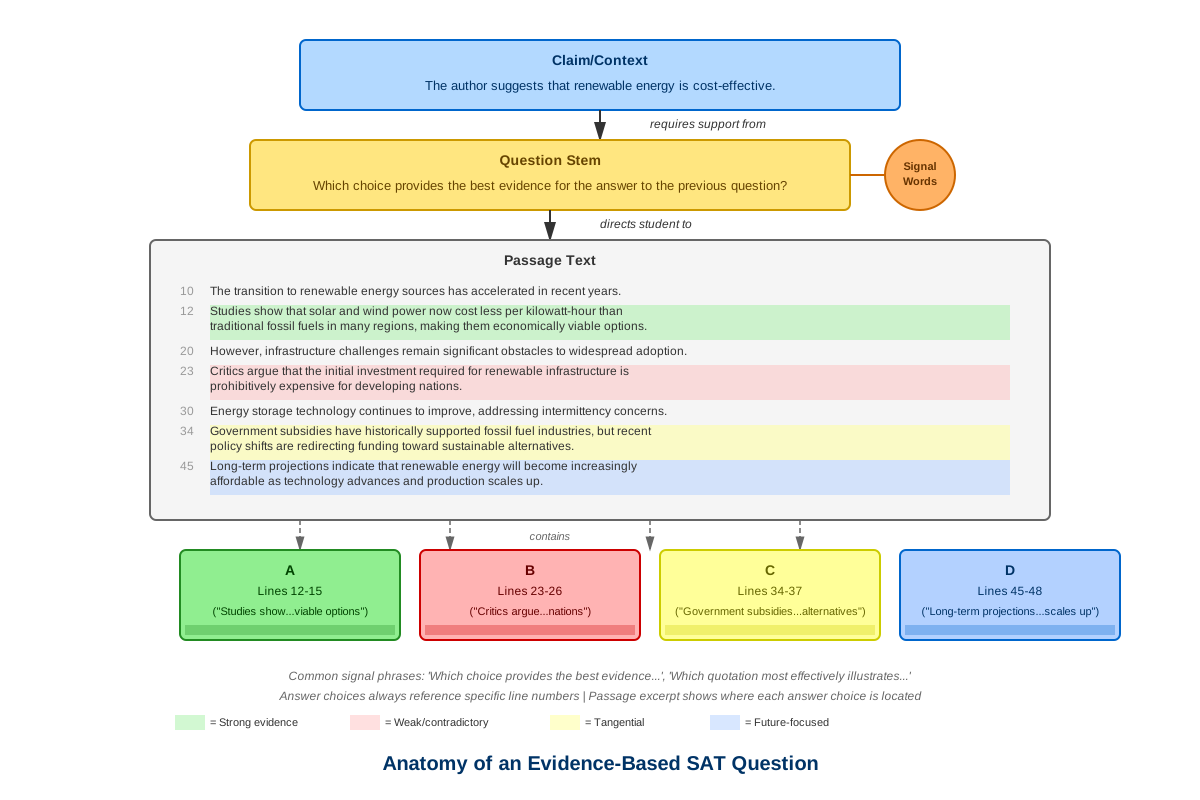
The SAT consistently includes questions that explicitly ask students to identify which lines, sentences, or details best support a previous answer or provide evidence for a particular claim. These questions typically appear as "Which choice provides the best evidence for the answer to the previous question?" or "Which quotation from the passage most effectively illustrates the claim that...?" Understanding how to efficiently locate and evaluate textual evidence is essential because it directly impacts performance on approximately 15-20% of all Reading and Writing questions. Moreover, even when questions don't explicitly ask for evidence, the ability to ground answers in specific textual proof prevents students from selecting answer choices based on assumptions or outside knowledge.
Within the broader framework of SAT Reading and Writing, finding proof in the passage serves as the foundation for nearly every other skill tested. Whether analyzing central ideas, understanding vocabulary in context, interpreting author's purpose, or evaluating arguments, students must consistently return to the text to verify their thinking. This topic bridges literal comprehension and higher-order analytical skills, making it an essential competency that supports success across all question types in the Central Ideas and Details unit and beyond.
Learning Objectives
- [ ] Identify key features of finding proof in the passage
- [ ] Explain how finding proof in the passage appears on the SAT
- [ ] Apply finding proof in the passage to answer SAT-style questions
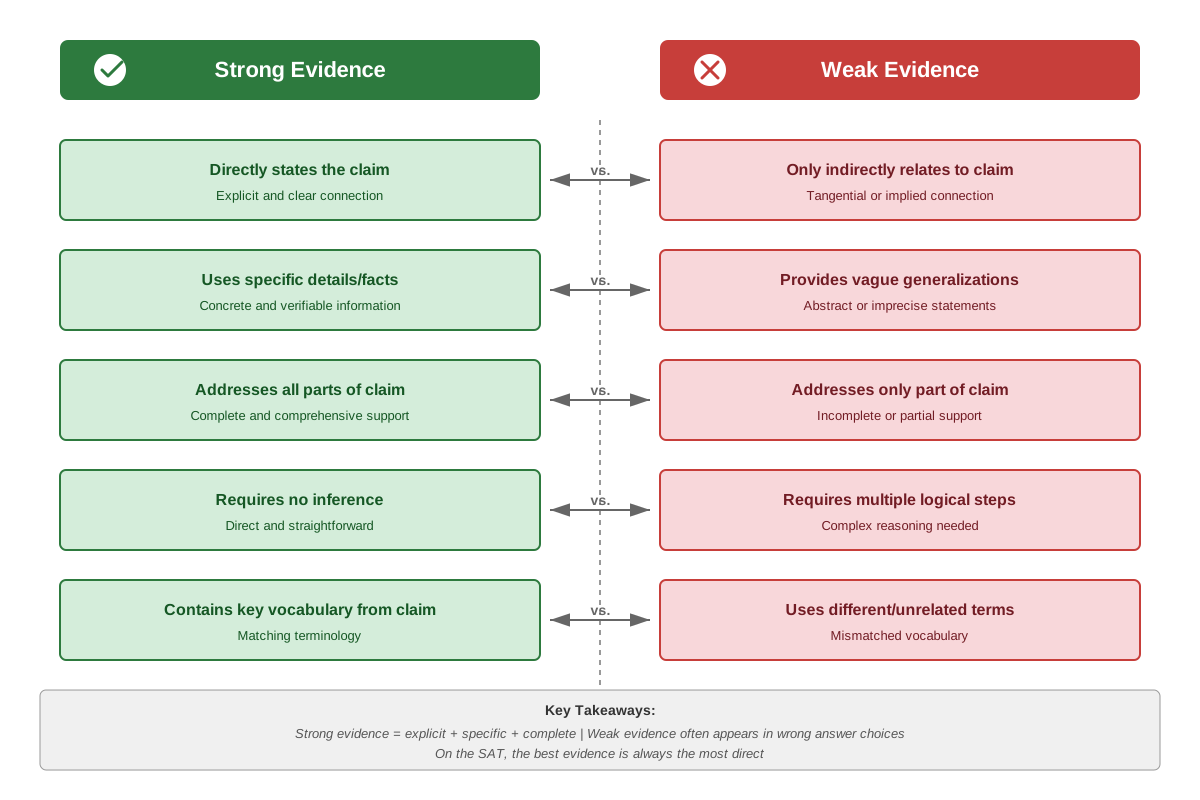
- [ ] Distinguish between strong textual evidence and weak or irrelevant support
- [ ] Evaluate multiple pieces of evidence to determine which provides the most direct support for a claim
- [ ] Recognize common distractors in evidence-based questions and avoid selecting them
Prerequisites
- Basic reading comprehension: The ability to understand the literal meaning of sentences and paragraphs is essential because finding proof requires first comprehending what the text explicitly states.
- Understanding of main ideas vs. details: Students must distinguish between broad themes and specific supporting details, as proof typically comes from concrete details rather than general statements.
- Familiarity with passage structure: Recognizing how passages are organized (introduction, body paragraphs, conclusion) helps students locate relevant evidence more efficiently.
- Vocabulary at grade level: Understanding the words used in both questions and passages ensures students can accurately identify when text serves as proof for a particular claim.
Why This Topic Matters
In real-world contexts, the ability to find and cite evidence is fundamental to academic writing, professional communication, legal reasoning, and informed citizenship. Whether writing research papers, evaluating news sources, participating in debates, or making evidence-based decisions, the skill of grounding claims in concrete proof is universally valuable. Students who master this skill develop critical thinking abilities that extend far beyond standardized testing.
On the SAT specifically, finding proof in the passage appears with remarkable consistency and high frequency. Approximately 3-5 questions per test explicitly ask students to identify supporting evidence, and these questions appear across all passage types (literature, history/social studies, and science). Evidence-based questions typically follow a two-question sequence: first, students answer an interpretive question, then immediately answer a follow-up question asking which lines best support their previous answer. Additionally, many single questions ask students to identify which quotation best illustrates a claim or supports a particular interpretation.
The SAT presents this topic through several common question formats: paired questions where the second asks for evidence supporting the first answer; standalone questions asking which quotation best supports a stated claim; questions requiring students to identify which detail from the passage justifies a particular conclusion; and questions asking which lines most directly answer a specific question about the passage. Understanding these formats and developing systematic approaches to each significantly improves both accuracy and efficiency on test day.
Core Concepts
What Constitutes Valid Textual Proof
Valid textual proof consists of specific words, phrases, sentences, or details from the passage that directly support, illustrate, or justify a particular claim, answer, or interpretation. The key characteristic of strong evidence is directness—the connection between the proof and the claim should be explicit and unmistakable, requiring minimal inference or interpretation. Strong evidence typically includes concrete facts, direct statements, specific examples, quoted material, or explicit descriptions that align precisely with the claim being supported.
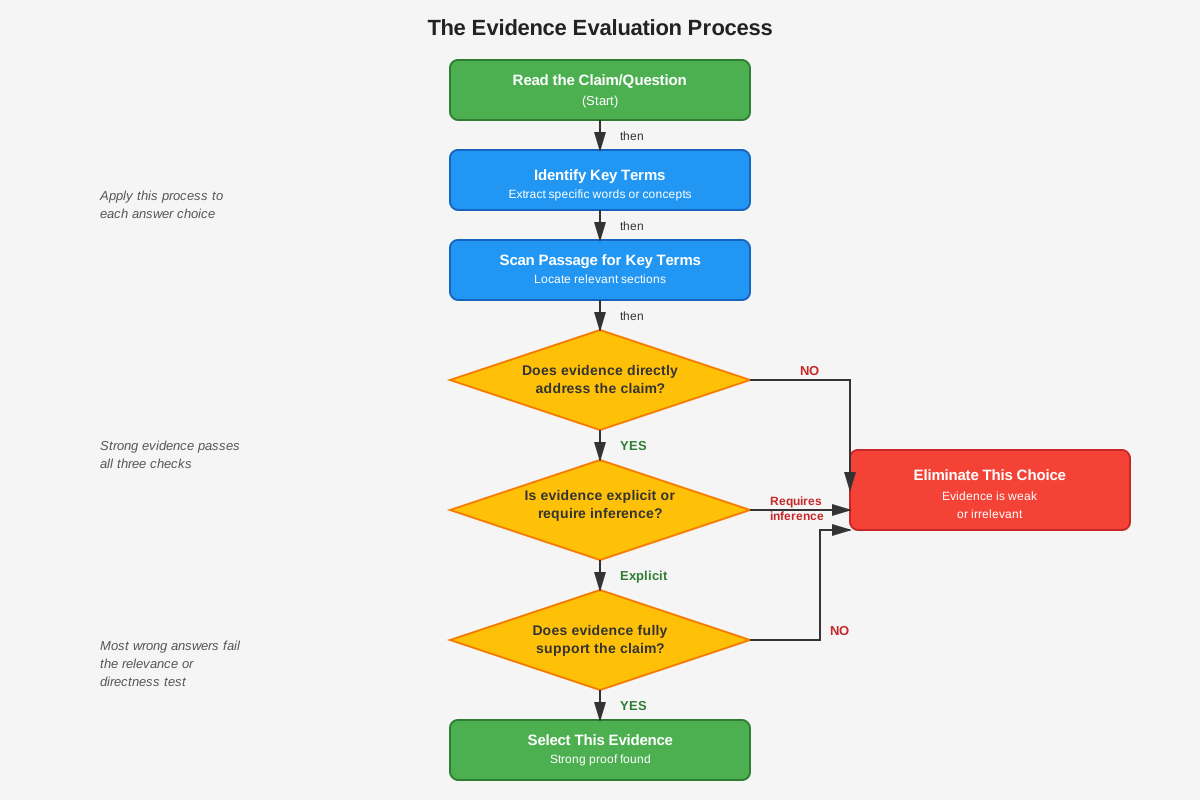
When evaluating whether a passage excerpt serves as valid proof, students should ask: Does this text directly address the claim? Does it provide specific support rather than tangential information? Would someone reading only this excerpt understand why it supports the claim? The strongest evidence creates an immediate, clear connection that doesn't require additional explanation or logical leaps.
The Difference Between Evidence and Inference
A critical distinction in sat finding proof in the passage questions involves understanding the difference between explicit evidence and inference. Evidence refers to information directly stated in the text—facts, descriptions, or statements that appear in the actual words of the passage. Inference, by contrast, involves drawing conclusions based on evidence but going beyond what is explicitly stated.
For proof-based questions, the SAT typically seeks evidence rather than inference. If a question asks "Which quotation best supports the claim that the scientist was skeptical?" the correct answer will contain words that directly indicate skepticism (such as "doubted," "questioned," or "remained unconvinced") rather than details from which skepticism might be inferred. This distinction is crucial because many incorrect answer choices on the SAT contain information that relates to the topic but doesn't directly prove the specific claim in question.
Types of Evidence Questions on the SAT
The SAT presents evidence-based questions in several distinct formats, each requiring slightly different approaches:
| Question Type | Format | Strategy |
|---|---|---|
| Paired Evidence Questions | Two-question sequence: interpretive question followed by "Which choice provides the best evidence?" | Answer both questions together; verify that evidence truly supports your first answer |
| Direct Support Questions | "Which quotation from the passage best supports the claim that...?" | Identify the specific claim, then find text that directly states or illustrates it |
| Illustration Questions | "Which detail most effectively illustrates...?" | Look for concrete examples or specific instances rather than general statements |
| Justification Questions | "Which lines best justify the conclusion that...?" | Find text that provides logical support or reasoning for the stated conclusion |
The Evidence-Claim Relationship
Understanding the relationship between claims and evidence is fundamental to mastering this topic. A claim is an assertion, interpretation, or conclusion about the passage content. Evidence is the specific textual support that proves, demonstrates, or justifies that claim. The relationship should be direct and logical: when the evidence is presented, it should make the claim obviously true or well-supported.
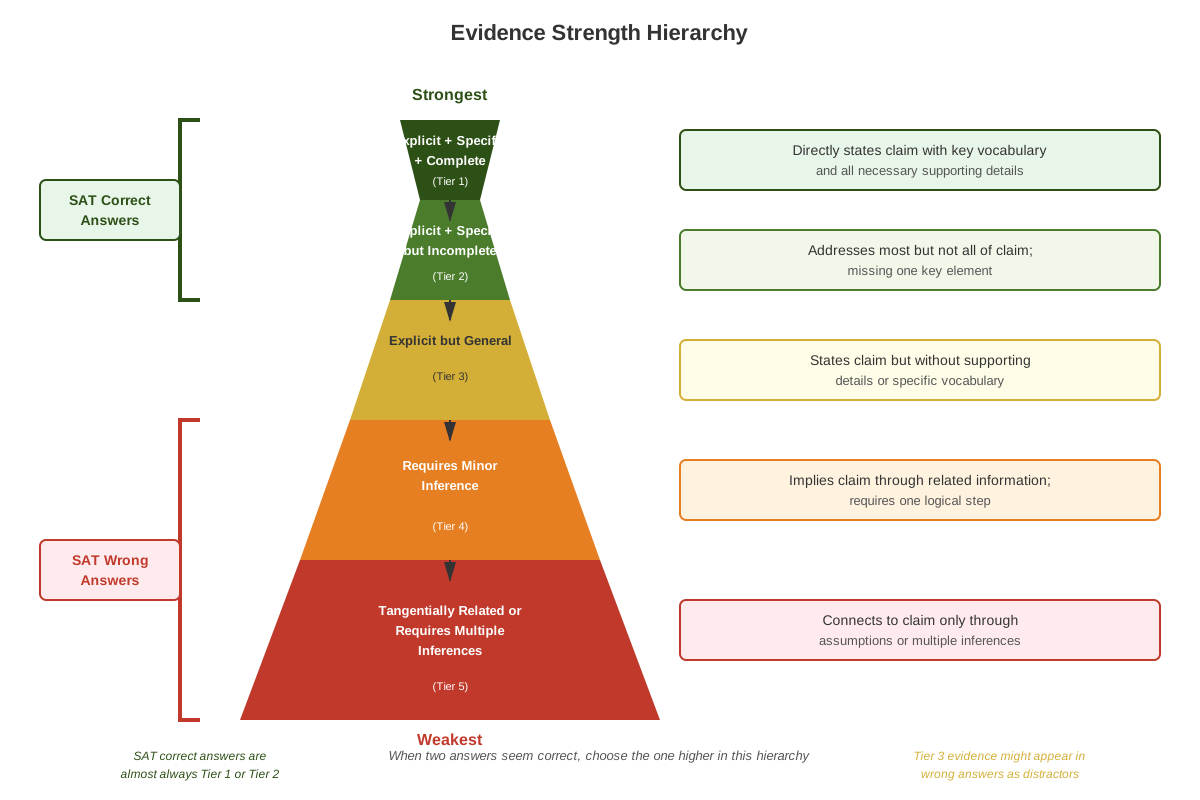
Strong evidence-claim relationships exhibit three characteristics: relevance (the evidence addresses the same topic as the claim), specificity (the evidence provides concrete details rather than vague statements), and directness (the connection is explicit rather than requiring multiple inferential steps). Weak evidence-claim relationships often involve evidence that is topically related but doesn't actually prove the specific claim, evidence that is too general to provide meaningful support, or evidence that requires significant inference to connect to the claim.
Locating Evidence Efficiently
Efficient evidence location requires systematic passage navigation. When approaching evidence questions, students should first clearly identify what claim needs support—reading the question stem carefully to understand exactly what must be proven. Next, consider where in the passage relevant information likely appears based on passage structure and the topic of the claim. Most passages follow logical organizational patterns: introductions present main ideas, body paragraphs develop specific points with supporting details, and conclusions synthesize information.
For paired questions, students should use the answer choices strategically. Rather than reading the entire passage again, examine the four line references provided in the evidence question, reading each in context to determine which directly supports the answer to the previous question. This targeted approach saves time while maintaining accuracy. When questions provide line references, always read 1-2 sentences before and after the referenced lines to ensure full context.
Evaluating Multiple Evidence Options
Many students struggle when multiple answer choices seem potentially relevant. The key to selecting the best evidence involves comparing options based on directness and specificity. The correct answer will typically be the most direct support—the option that requires the least inference and most clearly proves the claim.
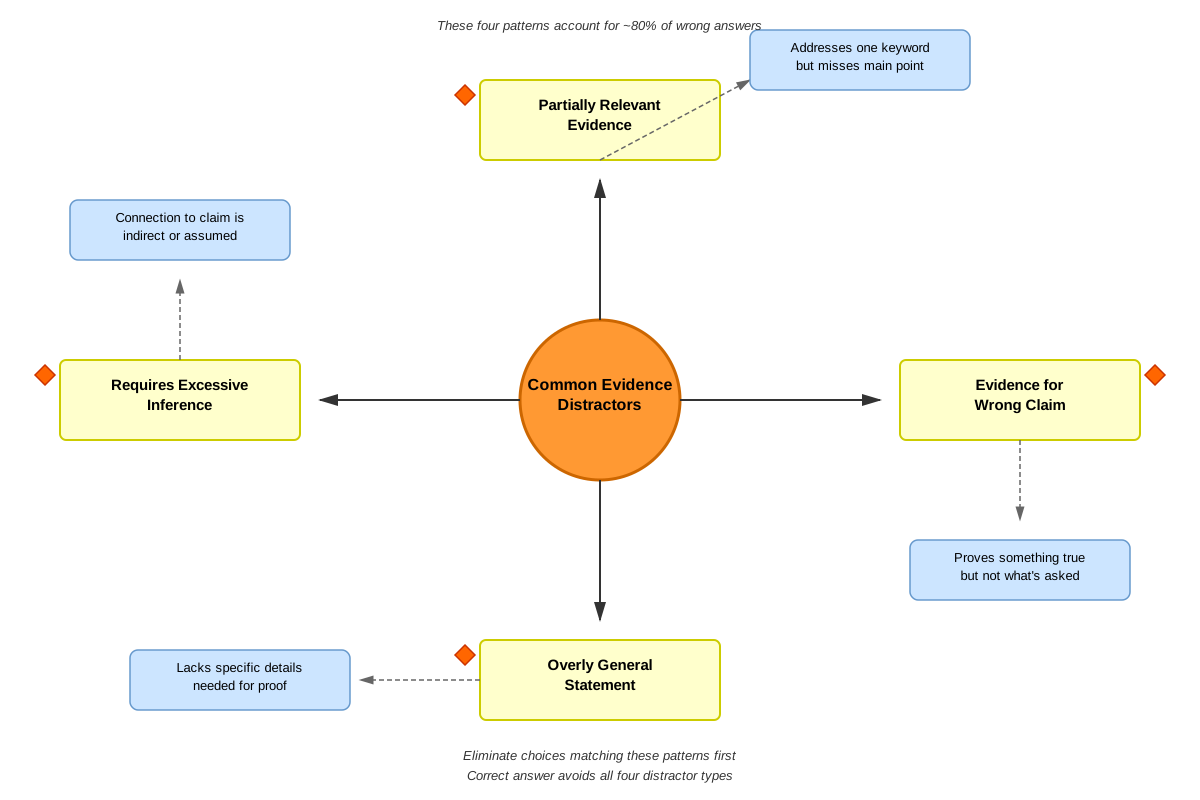
When comparing evidence options, eliminate choices that are off-topic (discussing different aspects of the passage), too general (making broad statements without specific support for the particular claim), indirect (requiring multiple logical steps to connect to the claim), or partial (supporting only part of the claim rather than the whole). The remaining choice should create an immediate, obvious connection to the claim being supported.
Concept Relationships
The concepts within finding proof in the passage build upon each other in a logical progression. Understanding what constitutes valid textual proof serves as the foundation, enabling students to distinguish between evidence and inference. This distinction then allows students to recognize different types of evidence questions and apply appropriate strategies to each. The evidence-claim relationship concept integrates these earlier ideas, showing how proof and claims connect. Finally, the practical skills of locating evidence efficiently and evaluating multiple options apply all previous concepts to actual test-taking scenarios.
This topic connects directly to prerequisite knowledge of main ideas versus details: evidence typically consists of specific details that support broader main ideas. The relationship flows as: Main Idea → requires support from → Specific Details → which serve as → Textual Evidence. Understanding passage structure (another prerequisite) enables efficient evidence location because students can predict where certain types of information appear.
Finding proof in the passage also serves as a foundational skill for related SAT rw topics. The progression flows: Finding Proof in the Passage → enables → Analyzing Central Ideas (by identifying supporting evidence) → enables → Understanding Author's Purpose (by examining what evidence the author chooses to include) → enables → Evaluating Arguments (by assessing the strength of evidence provided). Mastery of this topic essentially unlocks success across the entire Central Ideas and Details unit.
High-Yield Facts
⭐ Evidence questions account for approximately 15-20% of all SAT Reading and Writing questions, making this one of the most frequently tested skills.
⭐ The correct evidence answer directly states or clearly illustrates the claim without requiring significant inference.
⭐ In paired evidence questions, the correct answer to the evidence question must support the correct answer to the previous question—use this relationship to verify both answers.
⭐ Wrong answer choices in evidence questions often contain information that is topically related but doesn't directly prove the specific claim.
⭐ Always read 1-2 sentences before and after line references to ensure full context when evaluating evidence.
- Evidence questions appear across all passage types: literature, history/social studies, and science passages.
- The most direct evidence is always preferable to evidence that requires multiple inferential steps.
- General statements rarely serve as the best evidence; specific details and concrete examples are typically stronger.
- When two evidence options seem equally valid, the one that requires less interpretation is usually correct.
- Evidence can take many forms: direct statements, specific examples, quoted material, statistical data, or descriptive details.
- Time-efficient students read evidence answer choices strategically rather than re-reading entire passages.
- The word "best" in evidence questions indicates that multiple options may provide some support, but only one provides the strongest, most direct support.
Quick check — test yourself on Finding proof in the passage so far.
Try Flashcards →Common Misconceptions
Misconception: Any information related to the topic serves as valid evidence for a claim. → Correction: Valid evidence must directly support the specific claim being made, not just discuss the same general topic. Topical relevance is necessary but not sufficient; the evidence must prove the particular point in question.
Misconception: The longest or most detailed answer choice is usually the best evidence. → Correction: Length and detail don't determine evidence quality. The best evidence is the most direct and specific support for the claim, which may be concisely stated. Longer options often include extraneous information that dilutes their effectiveness as proof.
Misconception: Evidence questions should be answered by finding information that seems important or interesting. → Correction: Evidence questions require finding text that specifically supports a stated claim or previous answer. Importance and interest are irrelevant; only the direct connection between evidence and claim matters.
Misconception: If evidence requires some inference to connect to the claim, it's still acceptable as long as the inference is reasonable. → Correction: The SAT consistently rewards the most direct evidence that requires minimal inference. When comparing options, the choice requiring less interpretive work is typically correct, even if other options could support the claim through more complex reasoning.
Misconception: In paired questions, students should answer the first question, then look for evidence; if no evidence strongly supports their answer, they should keep their original answer anyway. → Correction: Paired questions should be answered together, with students verifying that strong textual evidence exists before committing to an answer on the first question. If no evidence clearly supports an answer choice, that choice is likely incorrect, and students should reconsider their interpretation.
Misconception: Evidence from the introduction or conclusion is always stronger because these sections contain main ideas. → Correction: While introductions and conclusions present main ideas, the best evidence for specific claims often appears in body paragraphs where details and examples are developed. Evidence location depends on what claim needs support, not on which section is generally more important.
Worked Examples
Example 1: Paired Evidence Question
Passage Excerpt:
"Dr. Martinez had spent fifteen years studying coral reef ecosystems, but the data from her most recent expedition troubled her deeply. The water temperature readings showed an increase of 2.3 degrees Celsius over the past decade—far exceeding her initial projections. More concerning still, the bleaching patterns she observed affected not just the shallow reefs, as previous studies had documented, but extended to depths of 40 meters, where cooler temperatures had historically provided refuge for coral populations. 'We're witnessing changes that fundamentally challenge our understanding of reef resilience,' she noted in her field journal."
Question 1: Based on the passage, Dr. Martinez's reaction to her recent findings can best be described as:
A) Enthusiastic about unexpected discoveries
B) Concerned about alarming trends
C) Confused by contradictory data
D) Skeptical of measurement accuracy
Question 2: Which quotation from the passage best supports the answer to the previous question?
A) "Dr. Martinez had spent fifteen years studying coral reef ecosystems"
B) "the data from her most recent expedition troubled her deeply"
C) "far exceeding her initial projections"
D) "she noted in her field journal"
Solution:
For Question 1, we need to identify Dr. Martinez's reaction. The passage describes her as "troubled" by the data and uses phrases like "More concerning still," indicating worry about negative developments. This points to answer choice B.
For Question 2, we must find the most direct evidence for "concerned about alarming trends." Let's evaluate each option:
- Option A provides background information but says nothing about her reaction to findings.
- Option B directly states the data "troubled her deeply"—this explicitly indicates concern and directly supports answer B from Question 1.
- Option C describes one aspect of the data but doesn't directly state her emotional or intellectual reaction.
- Option D is a neutral statement about documentation with no indication of her reaction.
Answer: Question 1: B; Question 2: B
The phrase "troubled her deeply" provides direct, explicit evidence of concern. While option C describes alarming data, it doesn't directly state her reaction to it. This example illustrates the importance of finding evidence that explicitly states what the claim asserts rather than evidence from which the claim could be inferred.
Example 2: Direct Support Question
Passage Excerpt:
"The introduction of the printing press in the 15th century revolutionized information dissemination across Europe. Before Gutenberg's innovation, books were painstakingly copied by hand, a process so labor-intensive that a single Bible might require a year of work by a skilled scribe. The printing press reduced this timeline dramatically: a printer could produce hundreds of copies in the time previously needed for one. This efficiency transformed books from rare luxury items, affordable only to wealthy institutions and individuals, into commodities accessible to the emerging middle class. By 1500, an estimated 20 million books had been printed—more than all the scribes of Europe had produced in the previous thousand years combined."
Question: Which quotation from the passage most effectively illustrates the claim that the printing press significantly increased the speed of book production?
A) "books were painstakingly copied by hand, a process so labor-intensive that a single Bible might require a year of work"
B) "a printer could produce hundreds of copies in the time previously needed for one"
C) "transformed books from rare luxury items, affordable only to wealthy institutions"
D) "an estimated 20 million books had been printed"
Solution:
The claim specifically addresses "increased the speed of book production." We need evidence that directly compares production speed before and after the printing press.
- Option A describes the slow pre-printing press process but doesn't mention the printing press's speed or make a comparison.
- Option B directly compares production speed: "hundreds of copies in the time previously needed for one." This explicitly demonstrates increased speed through direct comparison.
- Option C addresses affordability and accessibility, not production speed.
- Option D provides impressive numbers but doesn't directly address speed of production (many books could result from many printers working over time, not necessarily faster production).
Answer: B
This example demonstrates that the best evidence directly addresses the specific aspect of the claim in question. While options A and D relate to the topic and could support related claims, only option B specifically proves the claim about increased production speed through explicit comparison.
Exam Strategy
When approaching finding proof in the passage questions on the SAT, employ a systematic process that maximizes both accuracy and efficiency. First, read the question stem carefully to identify exactly what claim, answer, or interpretation needs textual support. Underline or mentally note the key words that specify what must be proven. This focused understanding prevents selecting evidence that is topically related but doesn't prove the specific point.
For paired evidence questions, use a strategic approach: read the first question and identify what it's asking, then immediately look at the four evidence options in the second question. Read each option in context (including surrounding sentences) and determine which one provides the strongest support. This evidence should point you toward the correct answer for the first question. Verify by checking that your answer to the first question and your selected evidence create a clear, direct connection. If they don't align well, reconsider both answers.
Trigger words and phrases that signal evidence questions include: "best supports," "provides the best evidence," "most effectively illustrates," "best justifies," "which quotation," "which detail," and "which lines." When you encounter these phrases, immediately shift into evidence-evaluation mode, focusing on directness and specificity rather than general relevance.
Process of elimination is particularly powerful for evidence questions. Quickly eliminate options that are off-topic (discussing different aspects than the claim addresses), too general (making broad statements without specific support), or indirect (requiring multiple inferential steps). Among remaining options, select the one that most directly and explicitly supports the claim with minimal interpretation required.
Time Management Tip: Spend approximately 60-75 seconds on paired evidence questions (both questions together) and 45-60 seconds on standalone evidence questions. If you're taking longer, you may be overthinking the connection. The correct evidence should create an obvious, immediate link to the claim.
For passages with line numbers or paragraph numbers, use these references strategically. When evidence options provide specific line references, you don't need to re-read the entire passage—focus on the referenced sections and their immediate context. This targeted approach saves valuable time while maintaining accuracy.
Memory Techniques
DIRECT Acronym for evaluating evidence quality:
- Directly addresses the specific claim
- Includes concrete details or specific information
- Requires minimal inference to connect to claim
- Explicitly states or clearly shows what needs to be proven
- Connects obviously to the claim without logical leaps
- Targeted to the particular aspect being questioned
The "Quote Test" Visualization: Imagine you're writing an essay and need to include a quotation to support your thesis. The best evidence is the quotation you would choose—the one that, when a reader sees it, immediately understands why it supports your point without requiring additional explanation. Visualize yourself presenting the evidence to someone unfamiliar with the passage; if they would immediately see the connection, it's strong evidence.
The Three-Second Rule: When you read a potential evidence option, you should be able to connect it to the claim within three seconds. If you find yourself thinking "Well, this could support it if you consider that..." or "This relates because it implies that...," you're probably looking at a distractor rather than the best evidence. Strong evidence creates instant recognition.
Evidence Hierarchy Mnemonic - "Specific Beats General": Remember that on the SAT evidence hierarchy, specific examples and concrete details beat general statements, direct statements beat implied meanings, and explicit support beats inferential connections. When comparing options, mentally rank them on this hierarchy.
Summary
Finding proof in the passage is a foundational SAT Reading and Writing skill that requires students to locate specific textual evidence directly supporting claims, answers, or interpretations. Success depends on understanding that valid evidence must be direct, specific, and explicitly connected to the claim being supported—topical relevance alone is insufficient. The SAT tests this skill through paired evidence questions, direct support questions, and illustration questions, all requiring students to distinguish between strong evidence (concrete, direct, minimal inference required) and weak evidence (general, indirect, or off-topic). Efficient test-takers systematically evaluate evidence options by eliminating those that don't directly address the specific claim, then selecting the most explicit support from remaining choices. The key principle underlying all evidence questions is directness: the best answer requires the least interpretation and creates the clearest connection between text and claim. Mastering this skill not only improves performance on evidence-specific questions but also strengthens accuracy across all question types by grounding interpretations in textual support rather than assumptions.
Key Takeaways
- Evidence questions constitute 15-20% of SAT Reading and Writing questions, making this a high-yield topic for focused study and practice.
- The best evidence always directly supports the specific claim with minimal inference required—when comparing options, choose the most explicit and direct support.
- In paired evidence questions, answer both questions together, using the evidence options to guide your answer to the first question and verifying that they align.
- Wrong answers in evidence questions typically fall into predictable categories: off-topic, too general, indirect, or only partially supportive.
- Always read evidence options in context (1-2 sentences before and after) to ensure you understand their full meaning and connection to the claim.
- Specific details, concrete examples, and explicit statements consistently outperform general statements and implied meanings as textual evidence.
- Systematic elimination of weak evidence options followed by comparison of remaining choices based on directness is the most efficient and accurate approach to these questions.
Related Topics
Analyzing Central Ideas: Once students can find proof in passages, they can identify and analyze how authors develop central ideas through the accumulation of supporting evidence and details. This progression moves from locating individual pieces of evidence to understanding how multiple pieces work together to support main ideas.
Understanding Textual Inferences: While finding proof focuses on explicit evidence, inference questions require students to draw conclusions based on evidence. Mastering explicit evidence location provides the foundation for making well-supported inferences rather than unsupported assumptions.
Evaluating Author's Purpose and Point of View: Authors reveal their purposes and perspectives through the evidence they choose to include and emphasize. Students who can identify textual proof can analyze why authors selected particular evidence and what these choices reveal about authorial intent.
Analyzing Arguments and Claims: Argument analysis requires evaluating whether claims are well-supported by evidence. The skills developed in finding proof transfer directly to assessing argument strength by examining the quality and relevance of supporting evidence.
Vocabulary in Context: Evidence-based reasoning helps students determine word meanings by finding contextual clues—essentially locating "proof" of what a word means based on surrounding text.
Practice CTA
Now that you've mastered the core concepts of finding proof in the passage, it's time to apply these strategies to authentic SAT-style questions. The practice questions and flashcards will reinforce your ability to quickly identify direct textual evidence, distinguish between strong and weak support, and efficiently navigate paired evidence questions. Remember: every practice question you complete strengthens your pattern recognition and builds the confidence you need to excel on test day. Approach each practice item systematically, using the DIRECT acronym and evidence evaluation strategies you've learned. Your investment in deliberate practice with this high-yield topic will pay dividends across the entire Reading and Writing section!
Sign up free to keep reading
Create a free AnvayaPrep account to finish this SAT guide on Finding proof in the passage — plus flashcards and practice questions.