Overview
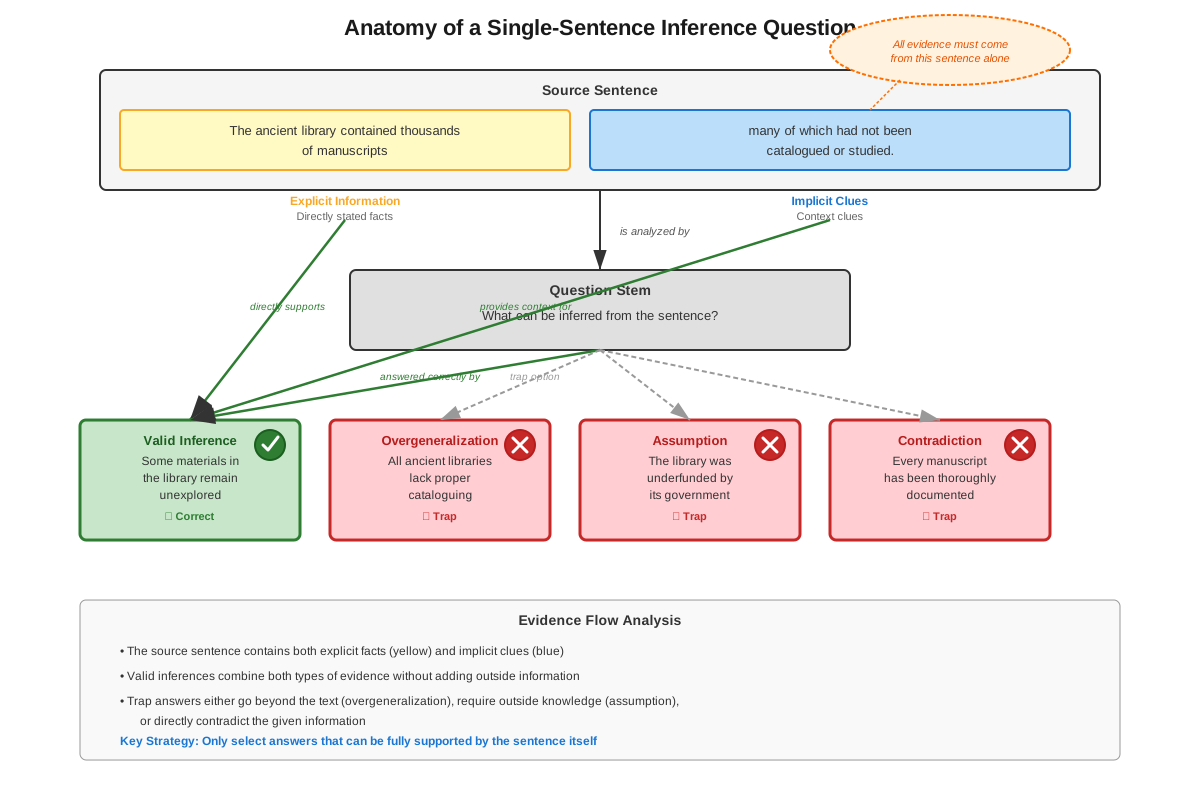
Inference from one sentence is a critical skill tested extensively on the SAT Reading and Writing section. This question type requires students to draw logical conclusions based on information explicitly stated in a single sentence, without relying on outside knowledge or making unsupported leaps. Unlike broader inference questions that may span entire passages, these focused questions assess the ability to extract implicit meaning from compact textual evidence.
The SAT frequently presents students with a sentence containing specific details, relationships, or contextual clues, then asks what can be reasonably concluded from that information alone. Success on these questions depends on careful reading, attention to logical relationships, and the discipline to avoid overreaching beyond what the text actually supports. Students must distinguish between what is directly stated, what can be logically inferred, and what represents speculation or assumption.
This topic forms a foundational component of the broader Reading and Writing (RW) section, connecting directly to skills in textual analysis, logical reasoning, and evidence-based interpretation. Mastering SAT inference from one sentence questions strengthens overall reading comprehension abilities and prepares students for more complex inference tasks involving multiple sentences or full paragraphs. These questions typically appear 3-5 times per test and represent a high-yield opportunity for score improvement, as they follow predictable patterns once students understand the underlying logic.
Learning Objectives
- [ ] Identify key features of inference from one sentence questions on the SAT
- [ ] Explain how inference from one sentence appears on the SAT and recognize question stems
- [ ] Apply inference from one sentence strategies to answer SAT-style questions accurately
- [ ] Distinguish between valid inferences and unsupported assumptions or overgeneralizations
- [ ] Analyze sentence structure and context clues to extract implicit meaning
- [ ] Evaluate answer choices systematically to eliminate options that go beyond textual support
- [ ] Recognize common trap patterns in inference questions and avoid them consistently
Prerequisites
- Basic reading comprehension: Understanding literal meaning of sentences is essential before attempting to infer implicit information
- Vocabulary knowledge: Recognizing word meanings and connotations enables accurate interpretation of sentence content
- Logical reasoning fundamentals: Understanding cause-effect relationships and basic logic helps distinguish valid inferences from invalid ones
- Sentence structure awareness: Recognizing how clauses, phrases, and modifiers work together aids in extracting complete meaning
Why This Topic Matters
Inference skills extend far beyond standardized testing into academic, professional, and everyday contexts. Reading between the lines, understanding implications, and drawing logical conclusions from limited information are essential for analyzing scientific papers, interpreting legal documents, evaluating news articles, and making informed decisions. The ability to extract meaning from compact textual evidence represents a fundamental literacy skill that supports success across all disciplines.
On the SAT specifically, inference from one sentence questions appear with high frequency—typically 3-5 questions per test in the Reading and Writing section. These questions carry the same weight as all other questions, making them significant contributors to overall scores. The College Board reports that inference questions collectively (including both single-sentence and multi-sentence types) constitute approximately 20-25% of Reading and Writing questions, making this one of the most heavily tested skill areas.
These questions commonly appear in several formats: after brief passages (25-150 words) where students must infer from a highlighted sentence; in questions asking what a specific sentence "most strongly suggests"; or in questions requiring students to identify what "must be true" based on a given statement. The sentences themselves may come from various domains including literature, history, science, and social studies, requiring students to apply inference skills flexibly across content areas. Understanding the mechanics of these questions provides a reliable pathway to correct answers and improved scores.
Core Concepts
What Is Inference from One Sentence?
An inference is a logical conclusion drawn from evidence presented in text. When making an inference from one sentence, students must identify what the sentence implies or suggests without explicitly stating it. This differs from simple comprehension (restating what is directly said) and requires recognizing unstated but logically necessary conclusions.
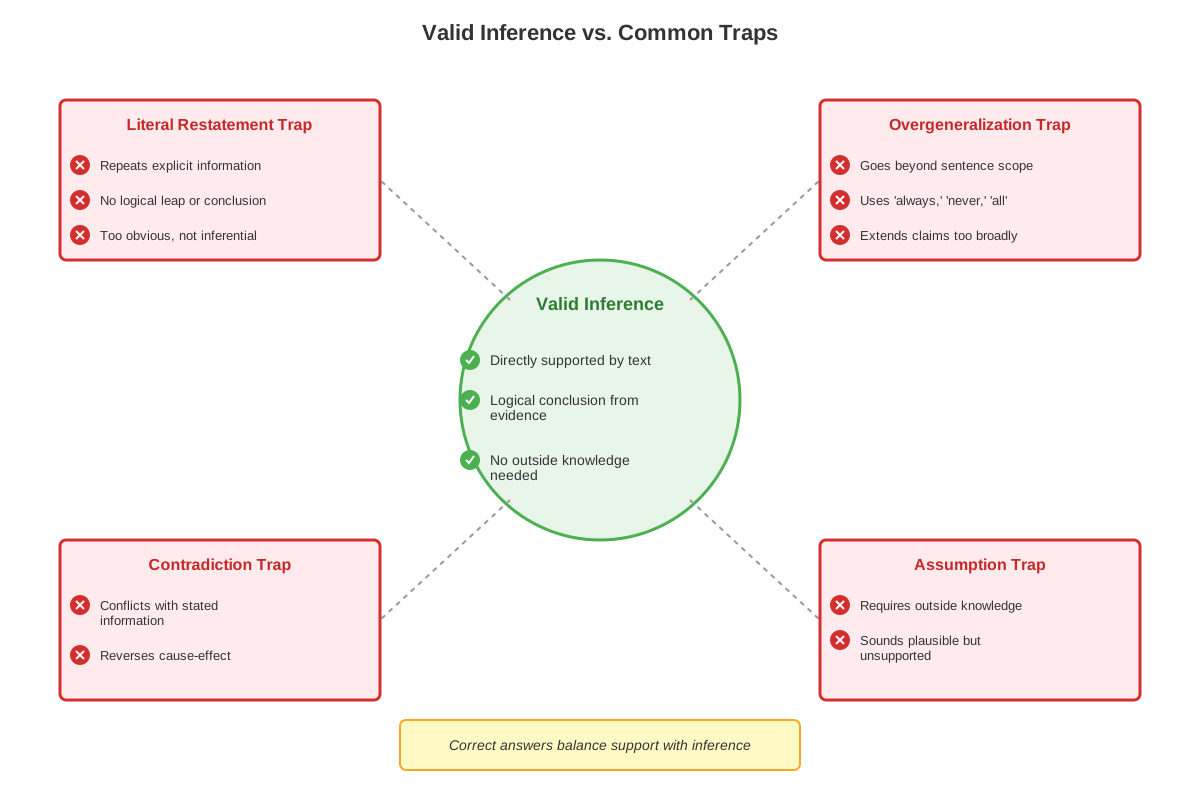
Valid inferences must be:
- Supported by textual evidence: Every element of the inference must connect to something in the sentence
- Logically necessary or highly probable: The conclusion should follow naturally from the given information
- Limited in scope: The inference should not extend beyond what the sentence reasonably supports
Invalid inferences typically:
- Introduce outside knowledge not present in the text
- Make extreme generalizations from limited evidence
- Confuse possibility with probability
- Rely on assumptions rather than textual support
The Logic of Single-Sentence Inference
Understanding the logical structure underlying inference questions helps students approach them systematically. Consider this framework:
Given Information → Logical Connection → Valid Inference
The sentence provides explicit facts, descriptions, or relationships (Given Information). Students must identify the logical relationship between these elements (Logical Connection), which then supports a specific conclusion (Valid Inference).
For example:
- Sentence: "Despite receiving numerous awards for her groundbreaking research, Dr. Martinez remains largely unknown outside academic circles."
- Given Information: Dr. Martinez has awards, groundbreaking research, but limited fame beyond academia
- Logical Connection: Recognition within one sphere doesn't guarantee recognition in another
- Valid Inference: Public recognition doesn't always correspond to professional achievement
Types of Logical Relationships in Inference Questions
Different sentences establish different types of relationships that support specific inferences:
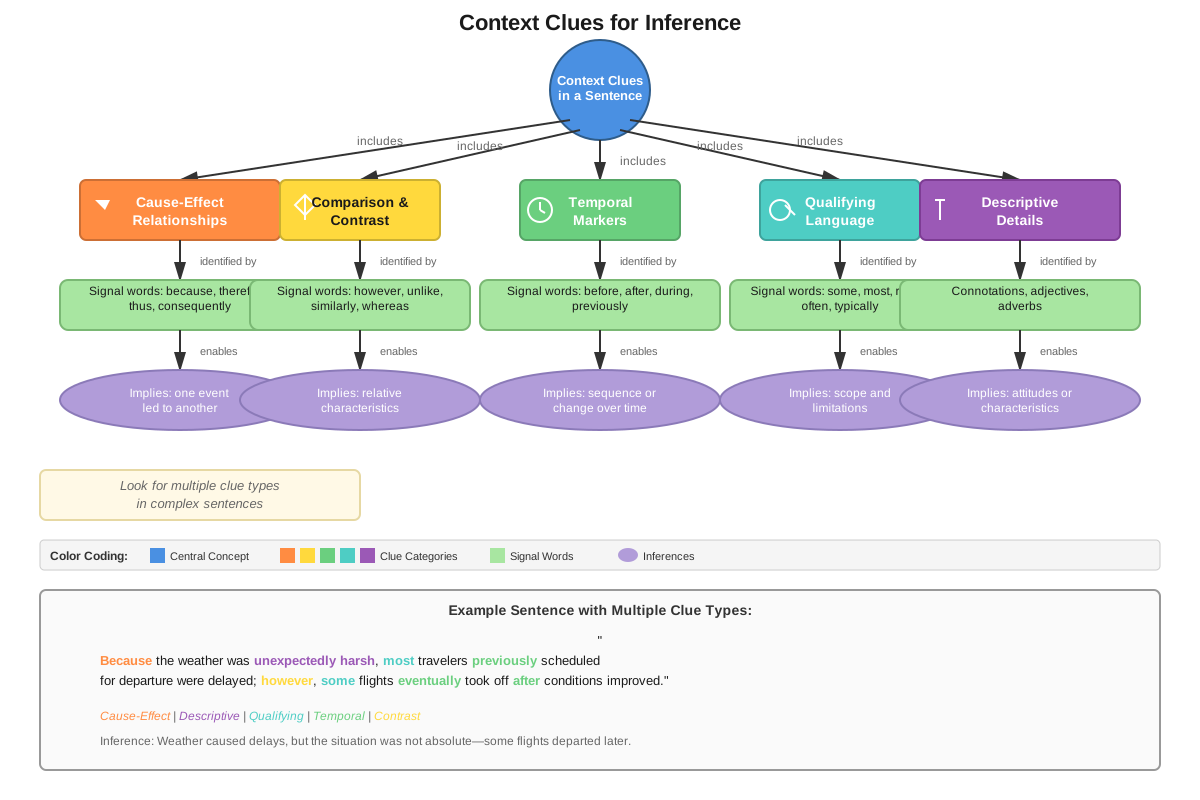
| Relationship Type | Signal Words/Patterns | What Can Be Inferred |
|---|---|---|
| Contrast/Opposition | despite, although, however, while | Expectations were defied; two things differ in important ways |
| Cause and Effect | because, therefore, as a result, led to | One event or condition produced another |
| Comparison | more than, less than, similar to, unlike | Relative qualities or quantities between items |
| Temporal Sequence | before, after, previously, subsequently | Order of events and their relationships |
| Condition/Qualification | if, unless, only when, provided that | Circumstances necessary for something to occur |
Context Clues and Implicit Meaning
Sentences contain both explicit information (directly stated) and implicit information (suggested but not stated). Context clues help readers access implicit meaning:
- Descriptive details: Specific adjectives, adverbs, and modifiers reveal attitudes, qualities, or circumstances
- Word choice and connotation: The specific words chosen (rather than synonyms) carry additional meaning
- Structural emphasis: What appears in main clauses versus subordinate clauses indicates relative importance
- Quantifiers and qualifiers: Words like "some," "most," "rarely," "often" establish scope and frequency
The Scope Principle
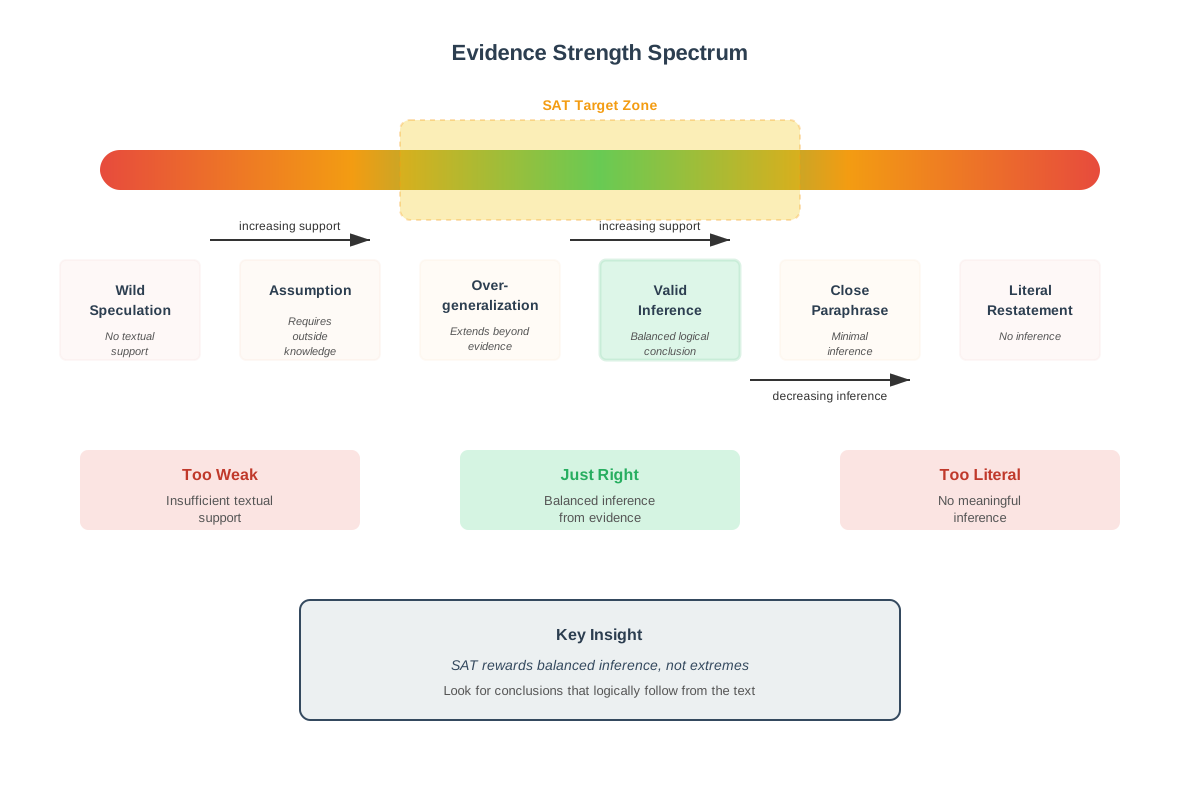
One of the most critical concepts for inference questions is scope—the range or extent of a claim. Valid inferences must match the scope of the original sentence:
- If the sentence discusses "some scientists," the inference cannot claim "all scientists"
- If the sentence describes one instance, the inference cannot generalize to all instances
- If the sentence presents a possibility, the inference cannot state a certainty
Scope errors represent the most common reason students select incorrect answers. The SAT deliberately includes answer choices that are factually related to the topic but exceed the scope of what the sentence actually supports.
Evidence-Based Reasoning
Every valid inference must be evidence-based, meaning each component of the inference connects to specific words or phrases in the sentence. Students should be able to point to textual evidence supporting each part of their inference.
The evidence-based approach involves:
- Identifying key words and phrases in the sentence
- Determining what these words explicitly state
- Considering what these statements logically imply
- Checking that the inference doesn't add unsupported information
Common Inference Patterns on the SAT
The SAT employs recurring patterns in how sentences are constructed and what students must infer:
Pattern 1: Unexpected Outcomes
Sentences present situations where results differ from expectations, requiring students to infer about assumptions, norms, or contrasts.
Pattern 2: Partial Information
Sentences provide incomplete information, requiring students to infer what must be true for the stated information to make sense.
Pattern 3: Comparative Relationships
Sentences establish comparisons requiring students to infer relative qualities, quantities, or characteristics.
Pattern 4: Causal Chains
Sentences present causes or effects, requiring students to infer the corresponding effects or causes.
Concept Relationships
The concepts within inference from one sentence form an interconnected system. Logical relationships (contrast, cause-effect, comparison) provide the framework through which context clues reveal implicit meaning. Understanding scope prevents students from making inferences that exceed textual support, while evidence-based reasoning ensures all inferences remain grounded in the text.
This topic builds directly on prerequisite knowledge: basic reading comprehension provides the foundation for understanding explicit meaning, which must precede inferring implicit meaning. Vocabulary knowledge enables accurate interpretation of context clues and connotations. Logical reasoning skills allow students to evaluate whether inferences follow necessarily from given information.
Inference from one sentence connects forward to more advanced topics in the Central Ideas and Details unit, including multi-sentence inference, main idea identification, and supporting evidence analysis. The skills developed here—careful reading, logical analysis, and scope awareness—transfer directly to these more complex tasks.
Relationship Map:
Sentence Structure → Context Clues → Implicit Meaning → Logical Relationships → Valid Inference → Evidence-Based Verification → Scope Checking → Correct Answer
High-Yield Facts
⭐ Inference questions ask what is suggested or implied, not what is directly stated
⭐ Valid inferences must be supported by specific textual evidence from the sentence
⭐ The correct answer will match the scope of the original sentence—no broader, no narrower
⭐ Contrast words (despite, although, however) signal that expectations were defied or two things differ
⭐ The most common wrong answers exceed the scope of what the sentence actually supports
- Inference questions typically use stems like "most strongly suggests," "implies," or "indicates"
- Every part of a valid inference must connect to something explicitly stated in the sentence
- Extreme language in answer choices (always, never, all, none) often signals incorrect answers
- Correct inferences often restate relationships using different words than the original sentence
- Students should be able to explain exactly which words in the sentence support their inference
- Temporal and causal relationships in sentences frequently form the basis for inference questions
- Answer choices that introduce new information not present in the sentence are typically incorrect
- Descriptive details and word choice carry implicit meaning beyond literal definitions
- The SAT tests logical reasoning ability, not outside knowledge about the topic
- Inference questions reward careful, conservative reading over creative interpretation
Quick check — test yourself on Inference from one sentence so far.
Try Flashcards →Common Misconceptions
Misconception: Inference means guessing or making creative interpretations based on the topic.
Correction: Inference requires logical reasoning strictly based on textual evidence. Every inference must be supported by specific words or phrases in the sentence, and students should be able to point to this evidence.
Misconception: If an answer choice is factually true or relates to the topic, it must be correct.
Correction: The correct answer must be supported by the specific sentence provided, regardless of whether other statements about the topic might be true. The SAT tests reading comprehension, not general knowledge.
Misconception: Longer, more complex answer choices are more likely to be correct.
Correction: Answer length has no correlation with correctness. The SAT often uses longer answer choices as distractors that include accurate-sounding but unsupported details.
Misconception: The correct inference will use the same words as the original sentence.
Correction: Correct answers typically paraphrase the sentence's meaning using different vocabulary. Direct word matching often appears in incorrect answers designed to trap students who aren't reading carefully.
Misconception: If something could possibly be true based on the sentence, it's a valid inference.
Correction: Valid inferences must be probable or necessary based on the evidence, not merely possible. The SAT distinguishes between what might be true and what the sentence actually supports.
Misconception: Making inferences requires reading between the lines and adding your own ideas.
Correction: While inferences do involve implicit meaning, they must remain tightly constrained by textual evidence. "Reading between the lines" means recognizing what the text logically implies, not adding external ideas.
Misconception: Inference questions are subjective and different interpretations are equally valid.
Correction: The SAT designs inference questions to have one definitively correct answer based on logical analysis of textual evidence. The questions test objective reasoning skills, not subjective interpretation.
Worked Examples
Example 1: Contrast Relationship
Sentence: "Although the ancient city's defensive walls were considered impregnable by contemporary observers, archaeological evidence reveals that the city was successfully besieged at least three times during its history."
Question: Which of the following can most reasonably be inferred from the sentence?
A) The city's walls were poorly constructed and easily breached.
B) Contemporary observers' assessments of the walls' strength were inaccurate.
C) Archaeological methods are more reliable than historical accounts.
D) The city was eventually abandoned due to repeated sieges.
Step 1: Identify the logical relationship
The word "Although" signals a contrast between what was believed (walls were impregnable) and what actually happened (city was besieged three times).
Step 2: Determine what is explicitly stated
- Contemporary observers thought the walls couldn't be breached
- Archaeological evidence shows the city was besieged successfully three times
- These facts contradict each other
Step 3: Consider what this logically implies
If the walls were thought to be impregnable but the city was actually besieged multiple times, the observers' assessment must have been wrong.
Step 4: Evaluate each answer choice
Choice A: Exceeds scope—the sentence doesn't specify why the sieges succeeded or describe construction quality. The walls might have been well-built but still breachable under certain conditions.
Choice B: Matches the logical implication. If observers said "impregnable" but sieges succeeded, their assessments were inaccurate. This is directly supported by the contrast in the sentence.
Choice C: Introduces a comparison not present in the sentence. While archaeological evidence contradicted observers' beliefs in this case, the sentence doesn't make a general claim about reliability of methods.
Choice D: Adds unsupported information. The sentence mentions sieges but says nothing about abandonment.
Correct Answer: B
Connection to Learning Objectives: This example demonstrates identifying key features (contrast structure), explaining how inference appears (through logical relationships), and applying strategies (scope checking) to select the correct answer.
Example 2: Causal and Temporal Relationship
Sentence: "The sudden decline in bee populations during the 1990s prompted researchers to investigate potential causes, leading to the identification of colony collapse disorder as a distinct phenomenon requiring urgent study."
Question: Based on the sentence, which statement must be true?
A) Colony collapse disorder was the primary cause of bee population decline in the 1990s.
B) Before the 1990s, researchers were unaware that bee populations could decline.
C) The investigation of bee population decline resulted in recognizing colony collapse disorder as a specific issue.
D) Urgent study of colony collapse disorder successfully reversed bee population decline.
Step 1: Identify the logical structure
The sentence presents a temporal and causal sequence: decline occurred → prompted investigation → led to identification of colony collapse disorder.
Step 2: Map the explicit information
- Bee populations declined suddenly in the 1990s
- This decline prompted research
- Research led to identifying colony collapse disorder as distinct
- Colony collapse disorder required urgent study
Step 3: Determine what must be true
The causal chain shows that investigating the decline resulted in identifying colony collapse disorder. The word "leading to" establishes this cause-effect relationship.
Step 4: Evaluate each answer choice
Choice A: Reverses the logic. The sentence says decline led to discovering colony collapse disorder, not that colony collapse disorder caused the decline. While this might be true, the sentence doesn't establish it.
Choice B: Introduces information not present. The sentence doesn't discuss researchers' knowledge before the 1990s.
Choice C: Accurately captures the causal relationship stated in the sentence. Investigation (prompted by decline) led to identification of colony collapse disorder. This directly reflects the sentence's structure.
Choice D: Adds an outcome not mentioned. The sentence discusses identification and need for study but says nothing about reversing the decline.
Correct Answer: C
Connection to Learning Objectives: This example shows how to analyze sentence structure (causal chains), distinguish valid inferences from assumptions (Choice A reverses causation), and apply evidence-based reasoning to eliminate unsupported answers.
Exam Strategy
Approaching Inference Questions Systematically
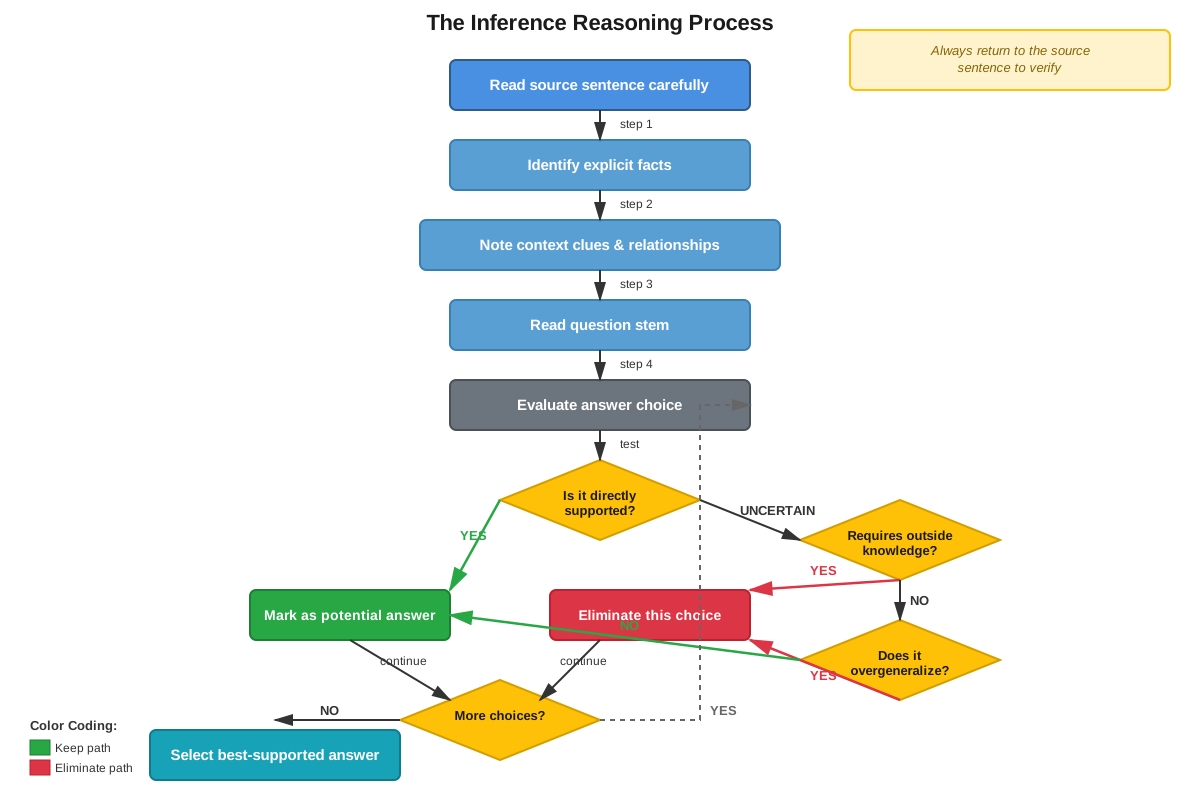
Step 1: Identify the question type
Look for trigger phrases: "most strongly suggests," "implies," "indicates," "can reasonably be inferred," "must be true based on," or "the author suggests."
Step 2: Read the sentence carefully
Read slowly and deliberately, noting:
- Contrast words (despite, although, however)
- Causal language (because, therefore, led to)
- Qualifiers (some, most, rarely, often)
- Descriptive details and specific word choices
Step 3: Predict the inference
Before looking at answer choices, articulate what the sentence implies. Ask: "What does this sentence suggest without directly stating it?"
Step 4: Evaluate answer choices systematically
For each option, ask:
- Is this supported by specific words in the sentence?
- Does this match the scope of the sentence?
- Does this add information not present in the text?
- Does this follow logically from what's stated?
Trigger Words and Phrases
In question stems:
- "suggests" or "most strongly suggests"
- "implies" or "most reasonably implies"
- "indicates"
- "can be inferred"
- "must be true"
- "the author suggests"
In sentences (signal logical relationships):
- Contrast: despite, although, however, while, yet, nevertheless
- Cause: because, since, as a result, therefore, consequently
- Condition: if, unless, only when, provided that
- Comparison: more than, less than, unlike, similar to
Process of Elimination Tips
Eliminate answers that:
- Exceed scope: Make broader claims than the sentence supports (watch for "all," "always," "never," "none")
- Introduce new information: Add details, concepts, or ideas not present in the sentence
- Reverse logic: Flip cause and effect or misrepresent relationships
- State the obvious: Simply restate what's explicitly said rather than inferring implicit meaning
- Require outside knowledge: Depend on information about the topic not provided in the sentence
Keep answers that:
- Connect directly to specific textual evidence
- Match the scope and tone of the original sentence
- Represent logical implications rather than possibilities
- Paraphrase the sentence's implicit meaning using different words
Time Allocation
Inference from one sentence questions should take approximately 45-60 seconds each:
- 15 seconds: Read and analyze the sentence
- 10 seconds: Predict the inference
- 25-35 seconds: Evaluate answer choices
If a question exceeds 90 seconds, mark it for review and move on. These questions reward careful reading but shouldn't consume excessive time.
Exam Tip: The correct answer will feel almost boring—it will be the logical, conservative choice that stays closest to textual evidence. If an answer feels creative, interesting, or requires you to make assumptions, it's likely incorrect.
Memory Techniques
The SCOPE Acronym
Supported by text
Conservative interpretation
Only what's implied
Precise match to evidence
Eliminate assumptions
Use SCOPE to evaluate whether an inference is valid before selecting an answer.
The "Point to It" Technique
For any inference you're considering, physically point to (or mentally identify) the specific words in the sentence that support each part of the inference. If you can't point to supporting evidence, the inference isn't valid.
The Contrast Signal Mnemonic: "DAD HAD"
Despite
Although
Different from
However
Actually
Different than
These words signal that expectations are being defied or contrasts are being drawn—prime opportunities for inference questions.
Visualization Strategy
Picture the sentence as a bridge: the explicit information is the visible structure, while the inference is the space the bridge crosses. The inference must be supported by the bridge's structure (textual evidence) and can't extend beyond where the bridge reaches (scope).
The "Must Be True" Test
When evaluating an answer choice, replace "suggests" or "implies" with "must be true based on this sentence." If the statement doesn't have to be true based on the evidence, it's not a valid inference.
Summary
Inference from one sentence questions test the ability to draw logical conclusions from compact textual evidence without overreaching beyond what the text supports. Success requires identifying logical relationships (contrast, cause-effect, comparison, temporal sequence) within sentences, using context clues to access implicit meaning, and maintaining strict adherence to textual evidence. The most critical skill is scope awareness—ensuring inferences match the breadth and certainty of the original sentence. Valid inferences must be supported by specific words or phrases, follow logically from stated information, and avoid introducing outside knowledge or unsupported assumptions. The SAT designs these questions with predictable patterns: contrast words signal defied expectations, causal language establishes relationships between events, and qualifiers determine scope. Students should approach these questions systematically by reading carefully, predicting the inference before viewing answer choices, and eliminating options that exceed scope, introduce new information, or reverse logic. The correct answer will be the conservative choice that stays closest to textual evidence while capturing what the sentence implies rather than explicitly states.
Key Takeaways
- Inference from one sentence requires drawing logical conclusions strictly based on textual evidence from a single sentence
- Valid inferences must match the scope of the original sentence—the most common errors involve answers that are too broad or too narrow
- Contrast words (despite, although, however) and causal language (because, therefore, led to) signal logical relationships that form the basis for inferences
- Every part of a correct inference must connect to specific words or phrases in the sentence—use the "point to it" technique
- Wrong answers typically exceed scope, introduce unsupported information, reverse logic, or require outside knowledge
- The correct answer will be the conservative, evidence-based choice that captures implicit meaning without creative interpretation
- These questions appear 3-5 times per SAT and represent high-yield opportunities for score improvement through systematic approach
Related Topics
Multi-Sentence Inference: Building on single-sentence skills, this topic involves drawing conclusions from multiple sentences or short passages, requiring synthesis of information across textual units.
Main Ideas and Themes: Understanding inference from one sentence strengthens the ability to identify central ideas, as both require distinguishing between explicit statements and implicit meaning.
Supporting Evidence: The evidence-based reasoning developed through inference questions directly applies to questions asking students to identify which evidence best supports a claim.
Author's Purpose and Tone: Inference skills enable students to determine why authors include specific information and what attitudes they convey through word choice and structure.
Textual Analysis in Literature: The close reading and logical reasoning practiced in inference questions transfer to analyzing literary devices, character development, and thematic elements.
Practice CTA
Now that you understand the principles and strategies for inference from one sentence questions, it's time to apply these skills! Work through the practice questions to reinforce your learning and build confidence. Each practice question provides an opportunity to implement the systematic approach outlined in this guide: identify logical relationships, check scope, verify textual support, and eliminate unsupported answers. The flashcards will help you internalize key concepts and trigger words. Remember, inference questions reward careful, conservative reading—trust the evidence and avoid overreaching. With focused practice, these high-yield questions will become reliable score boosters on test day!
Sign up free to keep reading
Create a free AnvayaPrep account to finish this SAT guide on Inference from one sentence — plus flashcards and practice questions.