Overview
Interpreting implied meaning is one of the most critical skills tested in the SAT Reading and Writing (RW) section. Unlike questions that ask students to identify explicitly stated information, implied meaning questions require readers to make logical inferences based on textual evidence, context clues, and the author's choices in language and structure. These questions assess a student's ability to read between the lines and understand what an author suggests without directly stating it.
On the SAT, approximately 15-20% of Reading and Writing questions involve some form of inference or implied meaning interpretation. These questions appear across various passage types—from literary fiction and historical documents to scientific articles and argumentative essays. Success with these questions demonstrates sophisticated reading comprehension that goes beyond surface-level understanding to grasp nuance, tone, purpose, and unstated assumptions. This skill is foundational because it underlies many other question types, including those about author's purpose, rhetorical choices, and textual relationships.
Mastering sat interpreting implied meaning connects directly to broader Reading and Writing competencies. It builds upon literal comprehension skills while serving as a gateway to more complex analytical tasks. Students who excel at identifying implied meaning can better understand how authors construct arguments, develop characters, establish tone, and communicate complex ideas indirectly. This topic integrates seamlessly with central ideas, supporting details, and textual evidence analysis—all core components of the SAT's approach to measuring reading proficiency.
Learning Objectives
- [ ] Identify key features of interpreting implied meaning in SAT passages
- [ ] Explain how interpreting implied meaning appears on the SAT across different passage types
- [ ] Apply interpreting implied meaning strategies to answer SAT-style questions accurately
- [ ] Distinguish between valid inferences supported by textual evidence and unsupported assumptions
- [ ] Analyze context clues, word choice, and structural elements to determine implied meanings
- [ ] Evaluate answer choices to identify those that accurately reflect textual implications without overreaching
Prerequisites
- Literal comprehension skills: The ability to understand explicitly stated information forms the foundation for making valid inferences about unstated meanings.
- Vocabulary knowledge: Understanding denotative and connotative meanings of words enables recognition of subtle implications in author's word choices.
- Basic understanding of textual evidence: Recognizing how to locate and cite supporting details is essential for grounding inferences in the text rather than personal assumptions.
- Awareness of passage structure: Understanding how sentences and paragraphs connect helps identify logical relationships that imply meaning beyond explicit statements.
Why This Topic Matters
In real-world contexts, interpreting implied meaning is essential for effective communication across professional, academic, and personal domains. Readers must regularly infer intentions from emails, understand unstated assumptions in research articles, recognize bias in news reporting, and grasp subtext in literature. This skill enables critical thinking and prevents misunderstandings that arise from taking everything at face value.
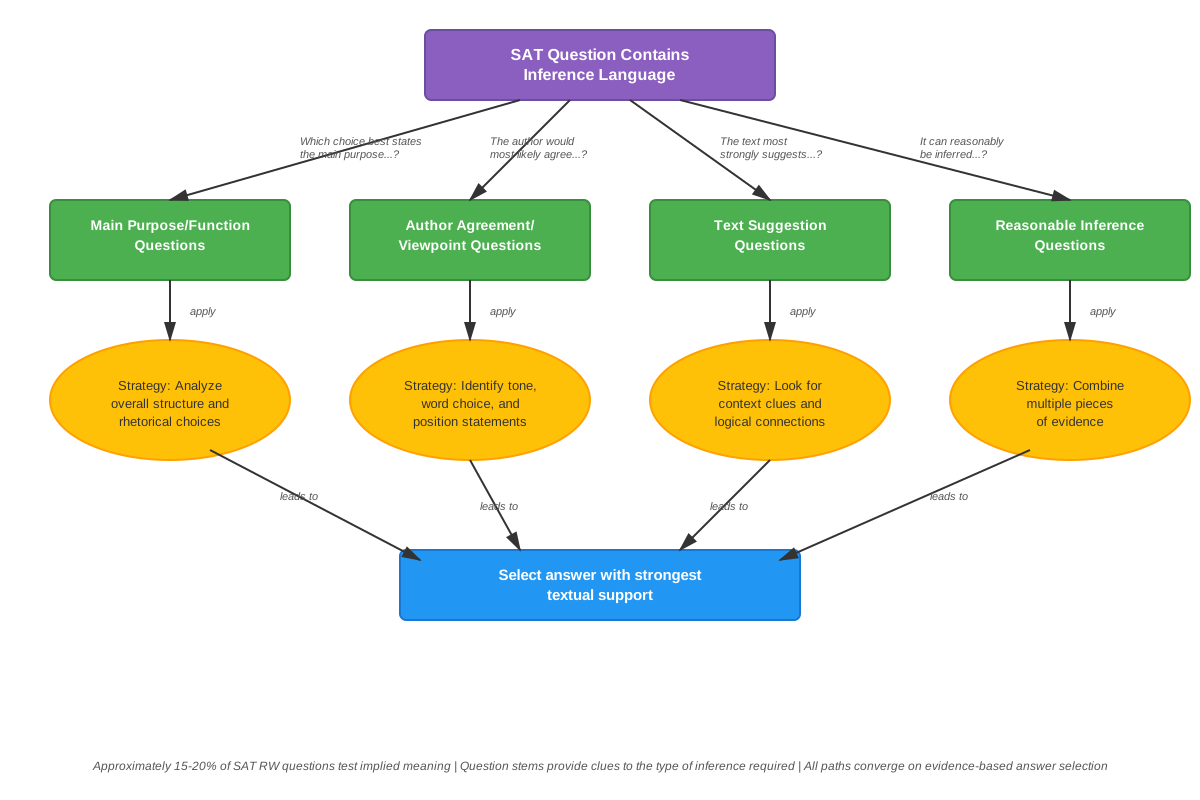
On the SAT specifically, implied meaning questions appear in approximately 3-5 questions per test form, making them a high-yield topic for score improvement. These questions typically appear as:
- "Which choice best states the main purpose of the text?"
- "Based on the text, the author would most likely agree with which statement?"
- "The text most strongly suggests which of the following?"
- "It can reasonably be inferred from the passage that..."
The College Board designs these questions to assess college readiness by measuring whether students can engage with complex texts at a sophisticated level. Passages may imply meaning through tone, juxtaposition, selective detail inclusion, figurative language, or logical relationships between ideas. Students who master this skill gain a significant advantage because these questions often separate mid-range scorers from high scorers—they require careful reasoning rather than simple recall.
Core Concepts
What Is Implied Meaning?
Implied meaning refers to information, ideas, or attitudes that an author communicates indirectly rather than stating explicitly. While the text doesn't directly say something, the reader can logically conclude it based on available evidence. This differs from explicit meaning, where information is stated directly and requires no inference.
For example, if a passage states, "Maria slammed the door and refused to speak for the rest of the evening," the explicit meaning is that Maria performed these actions. The implied meaning might be that Maria was angry or upset—the text doesn't state her emotion directly, but her actions strongly suggest it.
Types of Implied Meaning on the SAT
The SAT tests several distinct categories of implied meaning:
Author's Purpose or Attitude: Questions may ask what the author's unstated goal is or how they feel about their subject. Clues include word choice (positive vs. negative connotations), selection of details (what's emphasized or omitted), and tone markers.
Logical Inferences About Content: These questions require combining multiple pieces of information to reach a conclusion the text supports but doesn't state. For instance, if a passage mentions that a species thrives in temperatures above 70°F and that climate change is raising average temperatures, one might infer that the species' habitat range could expand.
Character Motivations or Traits (in literary passages): The text may describe actions and dialogue without explicitly stating why characters behave as they do or what personality traits they possess.
Cause-and-Effect Relationships: Sometimes passages present events or facts without explicitly stating causal connections, requiring readers to infer relationships.
Evidence-Based Inference
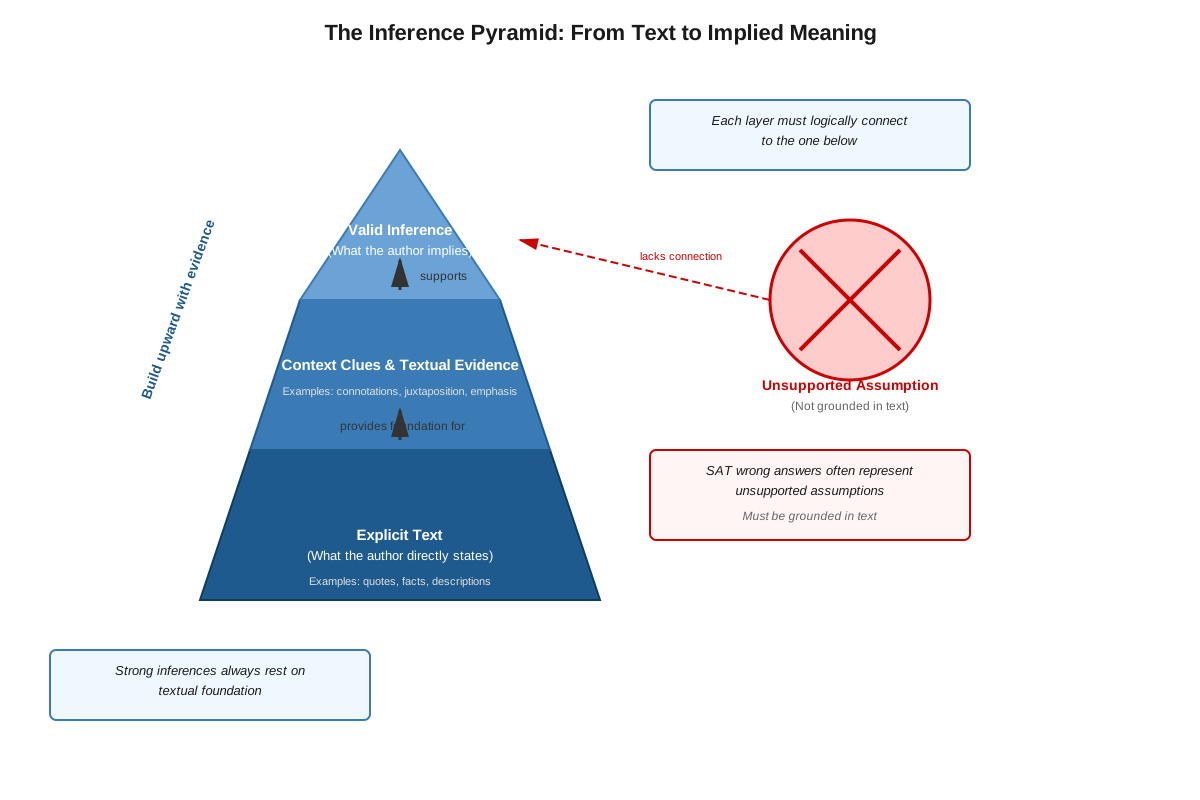
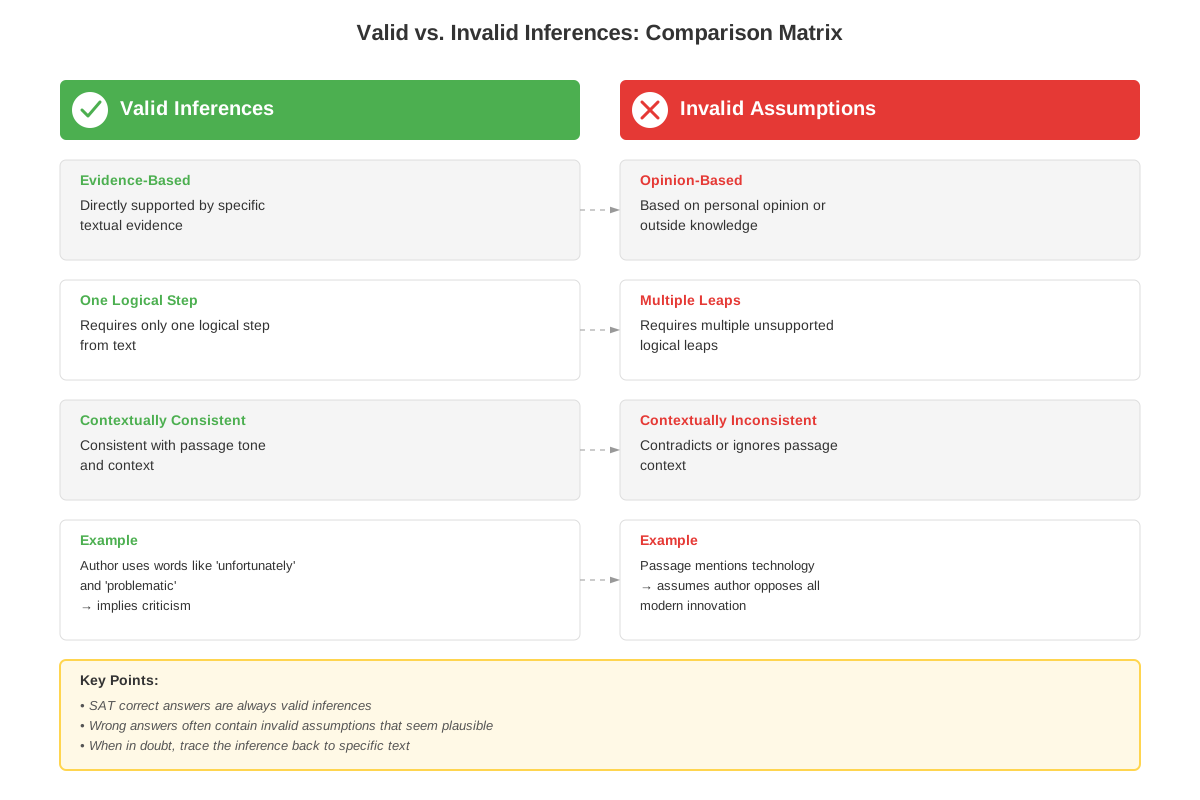
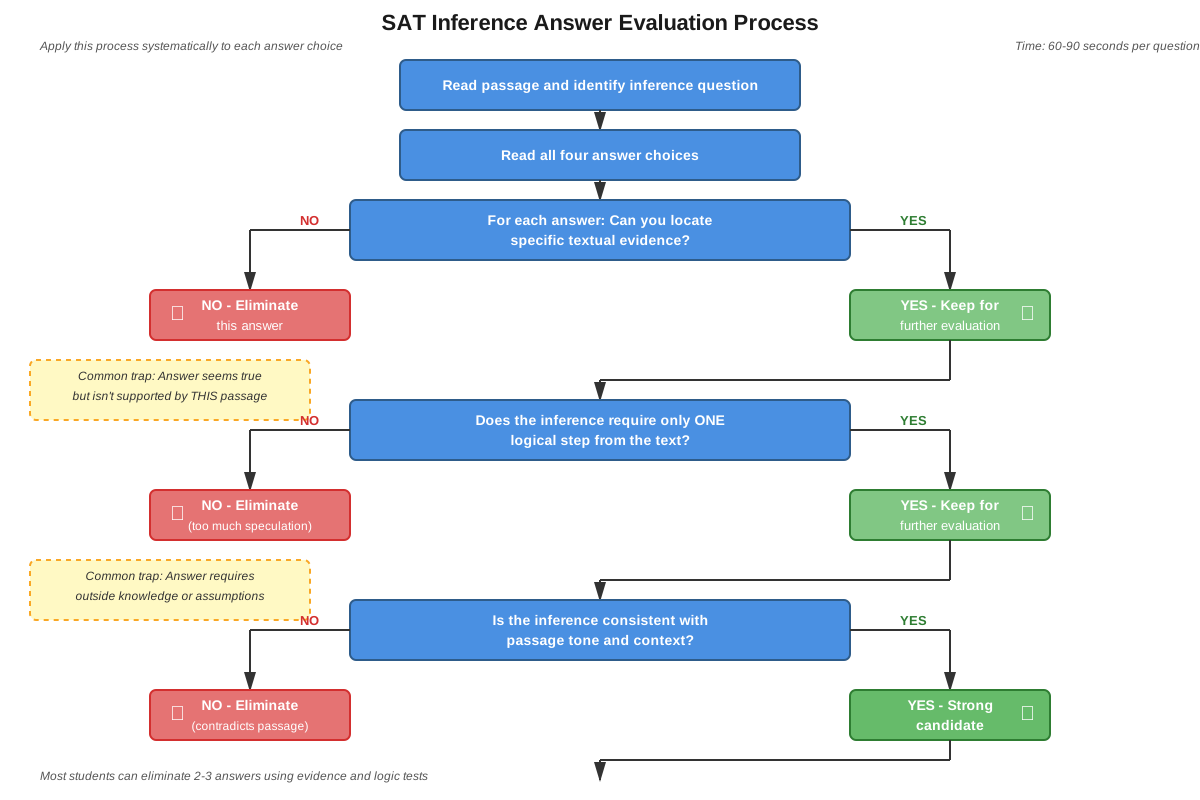
A critical principle for SAT success is that valid inferences must be grounded in textual evidence. The SAT doesn't reward creative interpretation or outside knowledge—it rewards careful reading that stays close to what the text actually supports.
| Valid Inference | Invalid Inference |
|---|---|
| Directly supported by specific textual details | Based on personal opinion or outside knowledge |
| Requires only one logical step from stated information | Requires multiple assumptions or leaps in logic |
| Consistent with the passage's overall tone and purpose | Contradicts other information in the passage |
| The most reasonable conclusion given the evidence | One of many possible interpretations without clear support |
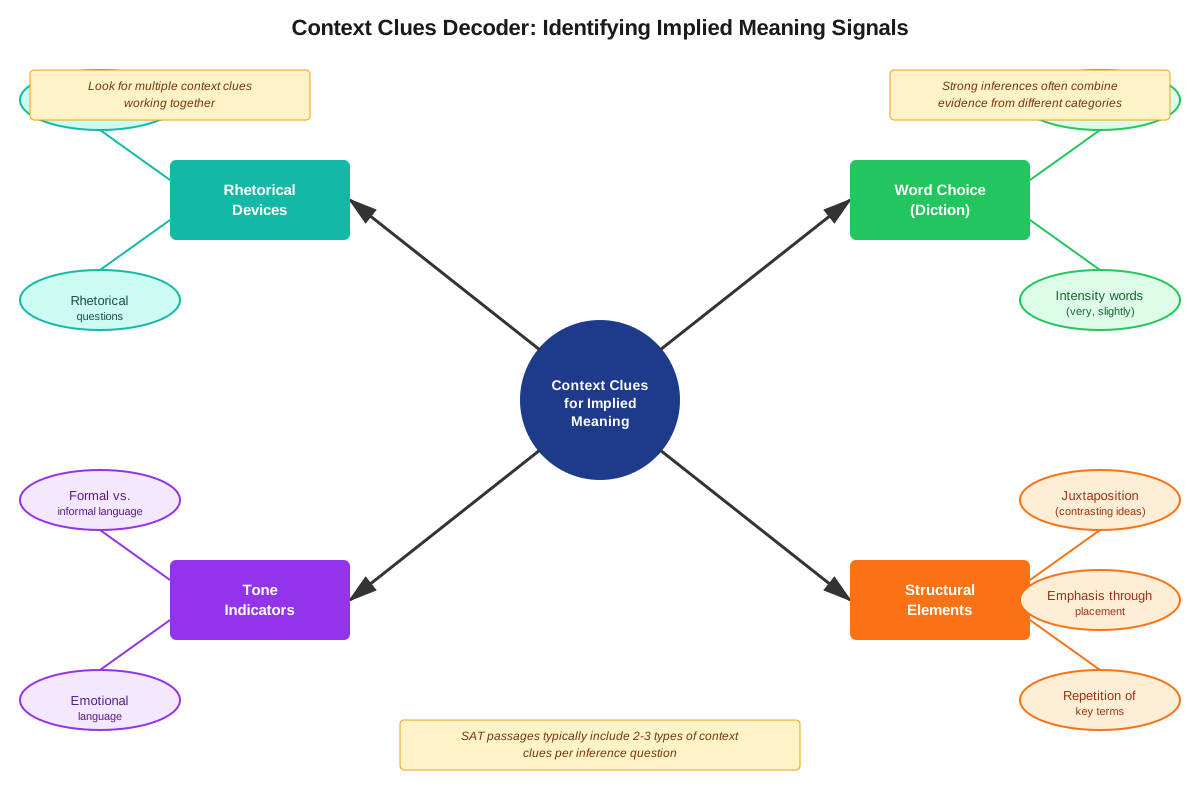
Context Clues for Implied Meaning
Skilled readers use multiple types of context clues to determine implied meaning:
- Word Choice and Connotation: Authors select words with specific emotional associations. "Slender" vs. "scrawny" both mean thin, but imply different attitudes.
- Juxtaposition and Contrast: Placing ideas side-by-side often implies comparison or irony. If a passage describes a politician's promises followed immediately by contradictory actions, the implication is hypocrisy.
- Emphasis and Repetition: Ideas mentioned multiple times or given extensive detail are implicitly more important to the author's purpose.
- Tone Markers: Phrases like "surprisingly," "unfortunately," or "remarkably" signal the author's attitude toward information.
- Structural Signals: Transition words (however, therefore, in contrast) indicate logical relationships between ideas that may imply meaning.
The Inference Process
When approaching implied meaning questions on the SAT, follow this systematic process:
- Read the question carefully to understand exactly what type of inference is required
- Return to the relevant passage section (questions usually indicate line numbers or paragraph references)
- Identify explicit statements that relate to the question
- Ask "What does this suggest?" about the explicit information
- Predict an answer before looking at choices
- Evaluate each answer choice against textual evidence
- Eliminate answers that go too far, contradict the passage, or lack support
- Select the choice that requires the smallest logical step from stated information
Common Question Formats
The SAT uses specific language to signal implied meaning questions:
- "The author most likely mentions X in order to..."
- "Based on the text, it can reasonably be inferred that..."
- "Which choice best describes the overall structure of the text?"
- "The text most strongly suggests that..."
- "The author's attitude toward X can best be described as..."
Recognizing these trigger phrases helps students activate appropriate reading strategies and avoid treating inference questions like literal comprehension questions.
Concept Relationships
The concepts within interpreting implied meaning form an interconnected system. Evidence-based inference serves as the foundation, establishing that all valid interpretations must connect to specific textual support. This principle governs how readers use context clues (word choice, structure, tone markers) to determine what authors suggest indirectly. The types of implied meaning (purpose, attitude, logical inferences, character traits, cause-effect) represent different applications of the same fundamental skill—reading between the lines while staying grounded in the text.
The inference process integrates all other concepts into a systematic approach: it requires identifying relevant evidence, applying knowledge of context clues, determining which type of implied meaning is being tested, and ensuring conclusions don't overreach textual support.
This topic builds directly on prerequisite skills: literal comprehension provides the explicit information from which inferences are drawn, vocabulary knowledge enables recognition of connotative meanings that imply attitudes, and understanding textual evidence ensures inferences remain grounded rather than speculative.
Interpreting implied meaning also connects forward to more advanced rw skills. It's essential for analyzing rhetorical choices (understanding why authors make specific decisions), evaluating arguments (recognizing unstated assumptions), and synthesizing information across multiple texts (inferring relationships between sources).
Relationship Map:
Literal Comprehension → Provides explicit statements → Evidence-Based Inference → Uses Context Clues (word choice, structure, tone) → Determines Types of Implied Meaning (purpose, attitude, logical conclusions) → Applies Inference Process → Produces Valid Interpretations → Enables Advanced Analysis (rhetoric, argument evaluation)
High-Yield Facts
⭐ Implied meaning questions require inferences supported by specific textual evidence, not personal opinions or outside knowledge.
⭐ Valid SAT inferences require only one small logical step from explicitly stated information—if reasoning requires multiple assumptions, the inference is likely incorrect.
⭐ Approximately 15-20% of SAT Reading and Writing questions test implied meaning in some form, making it a high-impact topic for score improvement.
⭐ Word choice and connotation are primary tools authors use to imply attitudes and tone without stating them directly.
⭐ The correct answer to an inference question is often the most conservative choice—the one that stays closest to what the text actually supports.
- Implied meaning questions often use phrases like "suggests," "most likely," "can reasonably be inferred," and "the author would probably agree."
- Juxtaposition (placing contrasting ideas side-by-side) is a common technique for implying comparison, irony, or criticism.
- Tone markers (words like "unfortunately," "remarkably," "merely") signal the author's unstated attitude toward their subject.
- Structural elements like paragraph placement and transition words often imply logical relationships (cause-effect, contrast, support) between ideas.
- In literary passages, character actions and dialogue often imply motivations and personality traits without explicit statement.
- Scientific and historical passages frequently present data or events and expect readers to infer significance or implications.
- Incorrect answer choices for inference questions typically fall into three categories: too extreme (overreaching the evidence), contradicting the passage, or introducing outside information.
Quick check — test yourself on Interpreting implied meaning so far.
Try Flashcards →Common Misconceptions
Misconception: Implied meaning questions ask for creative interpretations or personal reactions to the text.
Correction: SAT inference questions have objectively correct answers based on textual evidence. The test rewards careful reading that stays close to what the passage actually supports, not creative or personal interpretations.
Misconception: If something could possibly be true based on the passage, it's a valid inference.
Correction: Valid SAT inferences must be the most reasonable conclusion given the evidence, not merely possible. The correct answer is strongly supported by the text, while incorrect answers may be possible but lack clear textual support.
Misconception: Longer or more complex answer choices are more likely to be correct for inference questions.
Correction: Answer length and complexity don't correlate with correctness. In fact, the correct answer is often simpler and more conservative than incorrect choices that overreach with elaborate claims.
Misconception: Implied meaning questions can be answered without returning to the passage if you remember the general content.
Correction: These questions require careful attention to specific textual details. Even if you remember the passage well, you should return to the relevant section to verify that your inference is supported by actual evidence, not memory or assumption.
Misconception: If the passage doesn't explicitly contradict an answer choice, that choice could be correct.
Correction: Correct answers must be positively supported by evidence, not merely non-contradicted. The absence of contradiction is insufficient—there must be clear textual support for the inference.
Misconception: Implied meaning is the same as reading between the lines to find hidden messages the author didn't intend.
Correction: Implied meaning refers to information the author deliberately communicates indirectly through word choice, structure, and context. It's intentional communication, not hidden messages. The SAT tests whether students can recognize these deliberate implications.
Worked Examples
Example 1: Literary Passage Inference
Passage: "Eleanor arrived at the gallery opening precisely at 7:00 PM, as the invitation specified. She surveyed the crowded room, noting the clusters of animated conversation, the clinking of champagne glasses, and the bursts of laughter echoing off the high ceilings. After a moment's hesitation, she turned and walked back toward the exit."
Question: Based on the text, which statement about Eleanor is most strongly supported?
A) She is an artist whose work is displayed in the gallery.
B) She feels uncomfortable in crowded social situations.
C) She forgot something important and needs to retrieve it.
D) She is searching for a specific person who hasn't arrived yet.
Solution Process:
- Identify explicit information: Eleanor arrives on time, observes the crowded, lively scene, hesitates, then leaves.
- Consider what these actions imply: Her punctuality suggests she intended to attend. Her observation of the crowd and subsequent departure (after hesitation) suggests the environment influenced her decision to leave.
- Evaluate each choice against evidence:
- A: Nothing in the text suggests she's an artist—unsupported
- B: Her hesitation and departure after observing the crowded, noisy scene implies discomfort with this environment—supported
- C: The text says she "walked back toward the exit," not that she's retrieving something—requires assumption
- D: She doesn't look around for someone; she surveys the general scene—unsupported
- Select the best answer: B is correct because it requires only one logical step from the evidence: observing a crowded scene → hesitating → leaving implies discomfort with that environment.
Connection to Learning Objectives: This example demonstrates identifying character traits through implied meaning (objective 1), shows how inference questions appear in literary contexts (objective 2), and illustrates the process of distinguishing valid inferences from unsupported assumptions (objective 4).
Example 2: Scientific Passage Inference
Passage: "Researchers observed that coral reefs in waters with higher concentrations of dissolved nitrogen showed increased algae growth on coral surfaces. In these same locations, coral polyps exhibited reduced feeding activity and slower calcification rates. Meanwhile, reefs in low-nitrogen waters maintained typical algae levels and normal coral growth patterns."
Question: Which conclusion is most strongly supported by the research findings?
A) Nitrogen pollution is the primary cause of all coral reef decline worldwide.
B) Excessive nitrogen may negatively impact coral health through increased algae growth.
C) Coral polyps require nitrogen-free water to survive.
D) Algae growth always prevents coral reefs from calcifying.
Solution Process:
- Identify explicit information:
- High nitrogen → more algae on corals + reduced coral feeding + slower growth
- Low nitrogen → normal algae + normal coral growth
- Identify the implied relationship: The correlation between high nitrogen, increased algae, and reduced coral health suggests a negative impact, though causation isn't definitively proven.
- Evaluate choices:
- A: "Primary cause of all coral reef decline worldwide" is too extreme—the passage discusses one study, not global patterns—overreaches
- B: "May negatively impact" is appropriately cautious and directly supported by the correlation described—valid inference
- C: "Nitrogen-free water" is extreme; the passage mentions "low-nitrogen," not zero nitrogen—overreaches
- D: "Always prevents" is absolute; the passage shows correlation in specific cases, not universal causation—overreaches
- Select the best answer: B is correct because it makes a conservative inference (may impact, not definitely causes) directly supported by the observed correlation.
Connection to Learning Objectives: This example shows how to analyze scientific passages for implied cause-effect relationships (objective 5), demonstrates the importance of staying close to textual evidence without overreaching (objective 4), and illustrates typical SAT question formats for scientific content (objective 2).
Exam Strategy
Approaching Implied Meaning Questions
Step 1: Identify the Question Type
Recognize trigger phrases: "suggests," "implies," "most likely," "can reasonably be inferred," "the author would probably agree." These signal that you need to go beyond explicit statements.
Step 2: Locate Relevant Text
Most questions reference specific lines or paragraphs. Return to that section and read slightly before and after for context. Don't rely on memory alone.
Step 3: Predict Before Looking at Choices
Based on the evidence, formulate your own answer to "What does this suggest?" Having a prediction helps you recognize the correct answer and avoid being misled by attractive wrong choices.
Step 4: Apply the "One Step" Rule
The correct inference should require only one small logical step from stated information. If you find yourself thinking "Well, if this is true, and then if that's also true, then maybe..." you're probably overreaching.
Trigger Words and Phrases
In Questions:
- "most strongly suggests"
- "can reasonably be inferred"
- "most likely"
- "the author would probably agree"
- "based on the text"
- "the main purpose"
In Passages (indicating implied meaning):
- Tone markers: "surprisingly," "unfortunately," "remarkably," "merely"
- Contrast signals: "however," "yet," "although," "despite"
- Emphasis: "particularly," "especially," "notably"
- Hedging language: "may," "might," "could suggest"
Process of Elimination Tips
Eliminate answers that:
- Contradict the passage: If any part of the choice conflicts with stated information, eliminate it immediately.
- Require outside knowledge: Choices that depend on information not in the passage are incorrect, even if factually true in the real world.
- Use extreme language: Words like "always," "never," "only," "all," "none" are red flags. The correct answer usually uses moderate language like "may," "suggests," "often."
- Overreach the evidence: If the choice makes a claim that requires multiple assumptions or leaps in logic, it's likely wrong.
- Are too specific or too broad: The correct answer matches the scope of the passage. If the passage discusses one study, an answer about "all scientists worldwide" is too broad.
Time Allocation
Implied meaning questions typically require 45-75 seconds:
- 15-20 seconds: Read and understand the question
- 20-30 seconds: Locate and reread relevant passage section
- 15-20 seconds: Predict an answer
- 10-15 seconds: Evaluate choices and select
Don't rush these questions—they reward careful reasoning. However, if you're stuck between two choices after reasonable consideration, make your best selection and move on rather than spending excessive time.
Exam Tip: The correct answer to an inference question often feels "obvious" once you see it—it should seem like a natural, logical conclusion from the evidence. If an answer requires complex reasoning to justify, it's probably wrong.
Memory Techniques
CITE Acronym for Valid Inferences:
- Close to the text (requires only one small logical step)
- In the passage (supported by specific evidence)
- Textually grounded (not based on outside knowledge)
- Evidence-based (not assumption or opinion)
The "Conservative Choice" Rule:
When stuck between two answers, choose the more conservative one—the choice that makes a smaller claim and stays closer to what's explicitly stated. The SAT rewards careful reading, not bold interpretation.
Visualization Strategy:
Picture implied meaning questions as icebergs: the explicit text is the visible tip above water, and the implied meaning is the larger structure just below the surface—it's there and connected to what's visible, but requires looking beneath the obvious.
TONE Mnemonic for Identifying Author's Attitude:
- Tone markers (unfortunately, remarkably, etc.)
- Opinion words (should, must, important)
- Negative or positive connotations in word choice
- Emphasis through repetition or detail
The "One Step" Mantra:
Before selecting an answer, ask: "Is this one small step from the text, or am I jumping?" Valid inferences are steps, not jumps.
Summary
Interpreting implied meaning is a high-yield SAT skill that requires readers to make logical inferences based on textual evidence while avoiding unsupported assumptions. The key principle is that valid inferences must be grounded in specific details from the passage and require only one small logical step from explicitly stated information. Authors communicate implied meaning through word choice and connotation, structural elements, juxtaposition, tone markers, and selective emphasis. The SAT tests this skill through questions about author's purpose and attitude, logical inferences about content, character motivations, and cause-effect relationships. Success requires a systematic approach: identifying the question type, locating relevant text, predicting an answer, and eliminating choices that contradict the passage, require outside knowledge, use extreme language, or overreach the evidence. The correct answer is typically the most conservative choice—the one that stays closest to textual support. Mastering this skill not only improves SAT scores but also develops critical reading abilities essential for college-level work and real-world communication.
Key Takeaways
- Implied meaning questions test your ability to make logical inferences supported by textual evidence, not creative interpretations or personal opinions
- Valid SAT inferences require only one small logical step from explicitly stated information—multiple assumptions indicate an incorrect answer
- Word choice, connotation, tone markers, and structural elements are the primary tools authors use to communicate meaning indirectly
- The correct answer is usually the most conservative choice that stays closest to what the passage actually supports
- Approximately 15-20% of SAT Reading and Writing questions involve implied meaning, making this a high-impact topic for score improvement
- Always return to the passage to verify your inference against specific textual evidence rather than relying on memory
- Eliminate answer choices that contradict the passage, require outside knowledge, use extreme language, or overreach the evidence
Related Topics
Author's Purpose and Rhetorical Choices: Understanding implied meaning is foundational for analyzing why authors make specific decisions about structure, word choice, and emphasis. Mastering inference enables deeper analysis of rhetorical strategies.
Textual Evidence and Support: This topic extends implied meaning skills by focusing on how to cite and explain evidence that supports interpretations, both explicit and inferred.
Tone and Attitude Analysis: Building on implied meaning, this advanced topic examines how authors create and convey complex attitudes through subtle linguistic choices across entire passages.
Argument Analysis and Evaluation: Recognizing unstated assumptions—a form of implied meaning—is essential for evaluating the strength and validity of arguments in persuasive texts.
Synthesis Across Multiple Texts: Advanced inference skills enable students to identify implied relationships, agreements, and contradictions when working with paired passages or multiple sources.
Practice CTA
Now that you've mastered the core concepts of interpreting implied meaning, it's time to apply these strategies to authentic SAT-style questions. The practice questions and flashcards will help you internalize the inference process, recognize common question patterns, and build confidence in distinguishing valid inferences from overreaching interpretations. Remember: every practice question is an opportunity to refine your approach and move closer to your target score. Approach each question systematically, stay grounded in textual evidence, and trust the strategies you've learned. You've got this!
Sign up free to keep reading
Create a free AnvayaPrep account to finish this SAT guide on Interpreting implied meaning — plus flashcards and practice questions.