Overview
The primary claim is the central argument, main point, or thesis that an author presents in a passage. On the SAT Reading and Writing section, identifying the primary claim is one of the most fundamental and frequently tested skills. This concept appears across multiple question types and serves as the foundation for understanding how authors construct arguments, present evidence, and develop ideas throughout a text.
Understanding primary claims is essential because the SAT RW section requires students to distinguish between main ideas and supporting details, recognize how evidence relates to arguments, and evaluate the logical structure of passages. Questions about primary claims typically ask students to identify what an author is fundamentally arguing, what conclusion a passage supports, or which statement best captures the central point of a text. These questions appear in approximately 15-20% of all Reading and Writing questions, making this a high-yield topic that directly impacts overall scores.
The primary claim concept connects to broader Reading and Writing skills including evidence evaluation, argument analysis, and passage comprehension. Mastering primary claims enables students to approach complex passages strategically, quickly identifying the author's purpose and main argument before getting lost in supporting details. This skill also supports success with inference questions, purpose questions, and structure questions—all of which require understanding what the author is fundamentally trying to communicate.
Learning Objectives
- [ ] Identify key features of Primary claim
- [ ] Explain how Primary claim appears on the SAT
- [ ] Apply Primary claim to answer SAT-style questions
- [ ] Distinguish between primary claims and supporting evidence in complex passages
- [ ] Evaluate whether a given statement accurately represents an author's main argument
- [ ] Recognize how primary claims are developed and supported throughout a passage
- [ ] Analyze the relationship between topic sentences, thesis statements, and primary claims
Prerequisites
- Basic reading comprehension: Understanding literal meaning of sentences and paragraphs is necessary before identifying abstract claims and arguments
- Vocabulary knowledge: Recognizing transition words, argument indicators, and common academic terms helps locate where claims appear in passages
- Paragraph structure awareness: Knowing how topic sentences and supporting details function helps distinguish main ideas from evidence
- Ability to summarize: Condensing information into main points is the foundation for identifying what matters most in a passage
Why This Topic Matters
Primary claim questions are among the most common on the SAT Reading and Writing section, appearing in multiple forms across both literature and informational passages. Students encounter these questions in approximately 3-5 questions per test, making them critical for score optimization. The ability to quickly and accurately identify primary claims saves time and improves accuracy across all question types, since understanding the main argument helps answer detail questions, inference questions, and structure questions more efficiently.
In real-world contexts, identifying primary claims is essential for academic success, professional communication, and critical thinking. College courses require students to extract main arguments from scholarly articles, textbooks, and lectures. Professional environments demand the ability to identify key points in reports, proposals, and presentations. Media literacy depends on recognizing what sources are actually claiming versus what they're merely suggesting or supporting with evidence.
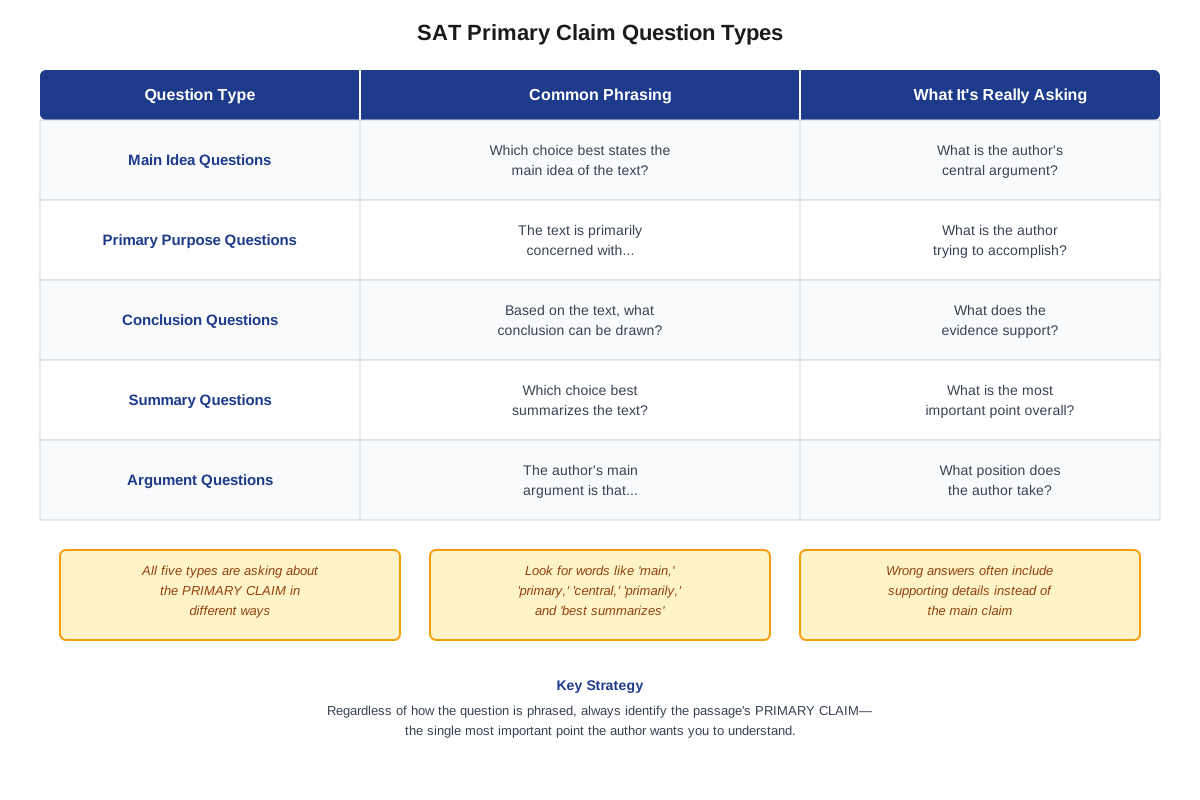
On the SAT, primary claim questions typically appear in several formats: direct questions asking "Which choice best states the main idea of the text?", questions about what the author is "primarily concerned with," and questions asking what claim is "most strongly supported" by the passage. These questions appear across all passage types—from scientific research summaries to literary analysis, from historical arguments to contemporary social commentary. The passages range from 25 to 150 words, with primary claim questions appearing most frequently in the 75-100 word range where distinguishing main ideas from details becomes more challenging.
Core Concepts
Defining Primary Claims
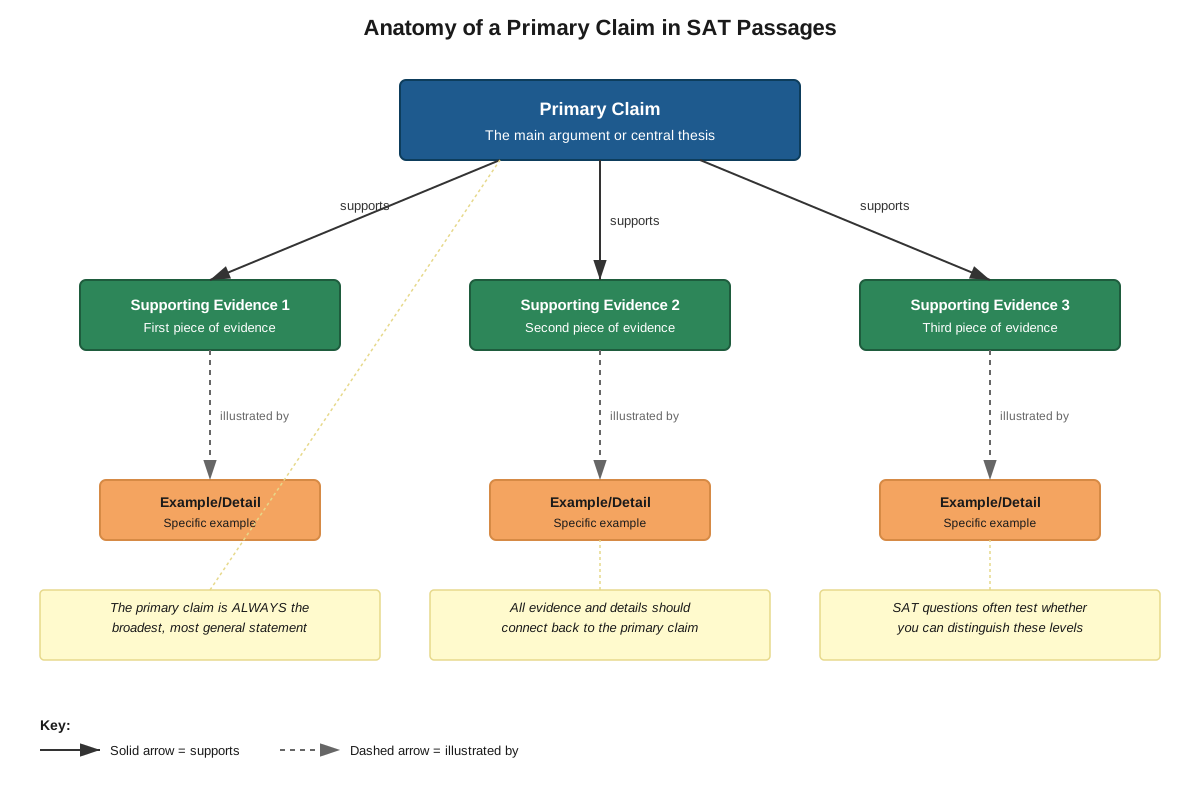
A primary claim is the main assertion, argument, or thesis that an author advances in a passage. It represents the central point the author wants readers to accept or understand. Unlike supporting details, which provide evidence, examples, or elaboration, the primary claim is the overarching statement that all other elements of the passage work to establish, prove, or explain.
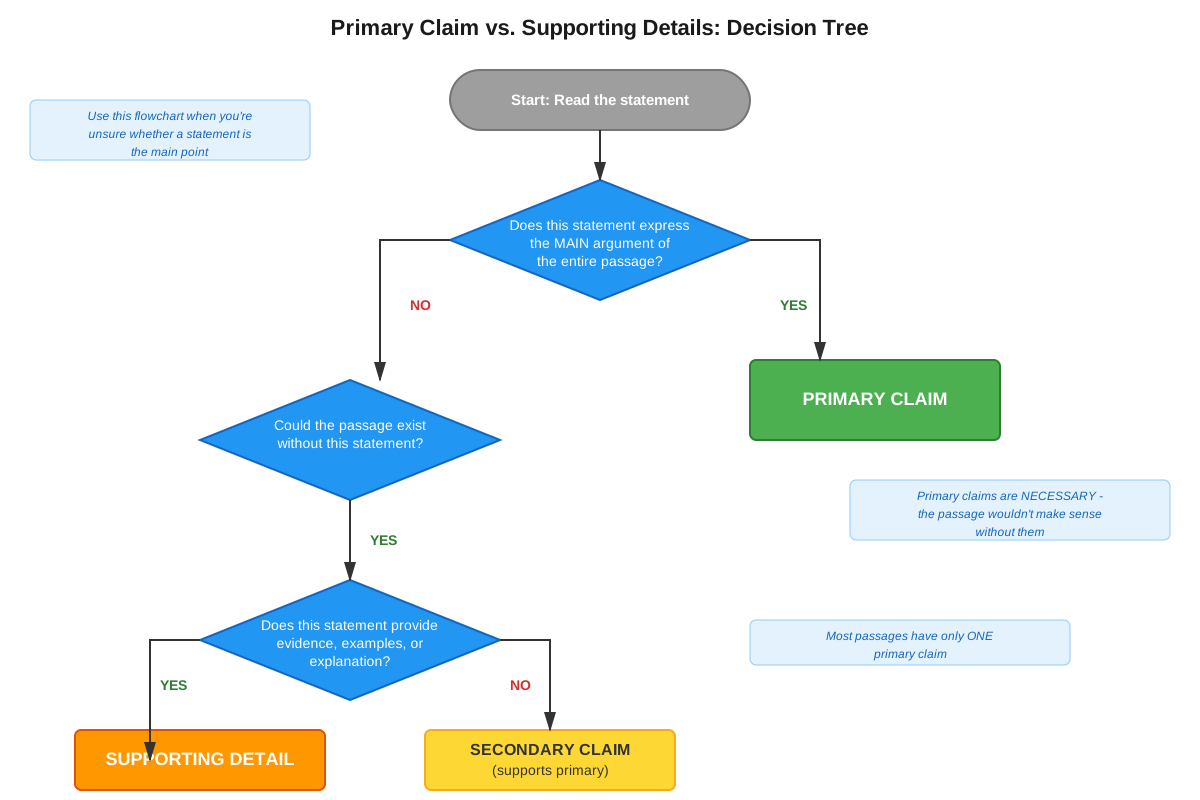
Primary claims possess several distinguishing characteristics. They are general rather than specific—they make broad statements that encompass the passage's scope rather than focusing on narrow details. They are arguable or informative—they present a position that requires support or convey information that needs explanation. They are comprehensive—they account for the passage's main focus without being so broad as to include irrelevant information.
Types of Primary Claims
Primary claims on the sat primary claim questions fall into several categories:
Argumentative Claims: These assert a position or make a judgment. Example: "Urban green spaces provide essential mental health benefits that justify their cost." These claims take a stance and require evidence to support them.
Explanatory Claims: These explain a phenomenon, process, or relationship. Example: "The decline in bee populations results from a combination of pesticide use, habitat loss, and climate change." These claims inform rather than persuade but still represent the passage's central point.
Descriptive Claims: These characterize something or identify its key features. Example: "Emily Dickinson's poetry is characterized by unconventional punctuation, slant rhyme, and themes of death and immortality." These claims summarize essential characteristics.
Comparative Claims: These establish relationships between two or more things. Example: "While both approaches reduce carbon emissions, renewable energy proves more economically sustainable than carbon capture technology." These claims position ideas relative to each other.
Locating Primary Claims in Passages
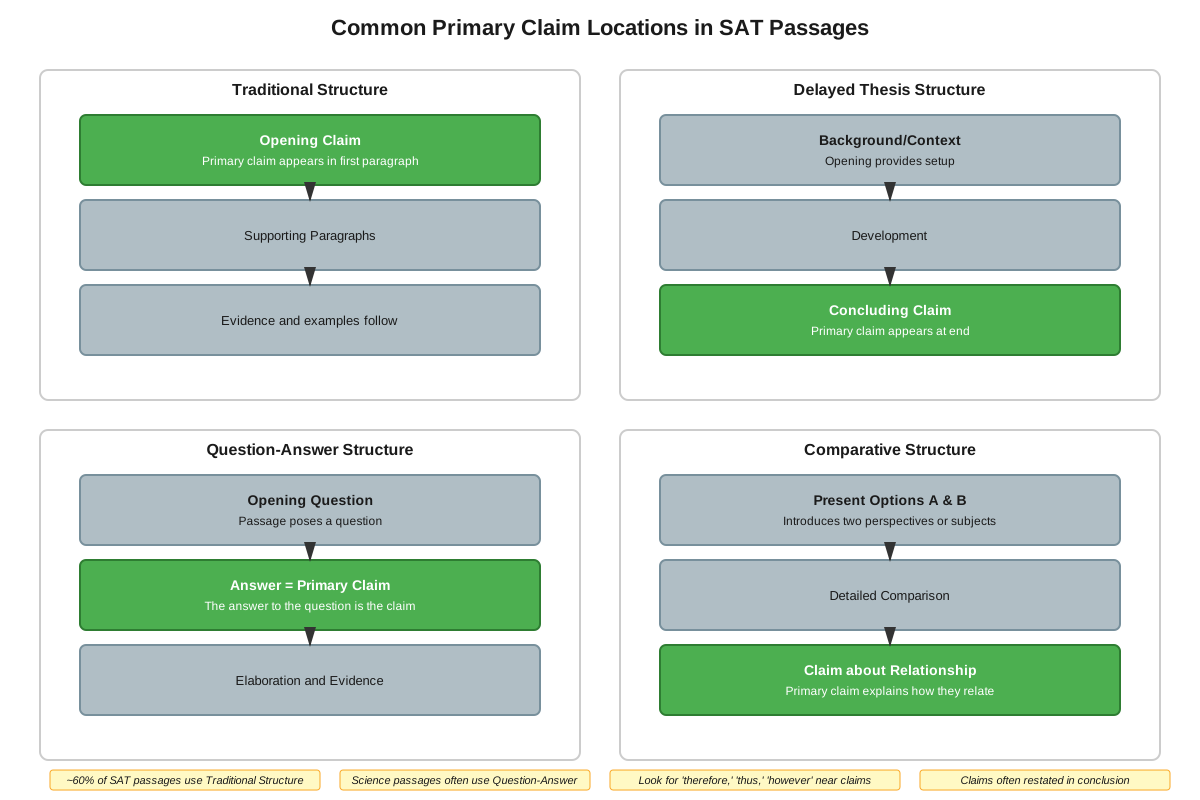
Primary claims typically appear in predictable locations within passages, though SAT passages sometimes deliberately place them in unexpected positions to test careful reading:
Opening Position: Many passages state the primary claim in the first or second sentence, establishing the main point before providing support. Signal phrases include "This paper argues," "Recent research demonstrates," or "The key factor is."
Concluding Position: Some passages build evidence before stating the primary claim in the final sentence, using phrases like "Therefore," "Thus," or "This suggests that."
Middle Position: Occasionally, passages introduce context, state the primary claim mid-passage, then elaborate. Transition words like "However," "In fact," or "The crucial point is" often signal these claims.
Implicit Position: Advanced passages may never explicitly state the primary claim, requiring readers to synthesize information and infer the main point from accumulated evidence.
Distinguishing Primary Claims from Supporting Elements
| Element | Function | Characteristics | Example |
|---|---|---|---|
| Primary Claim | States main argument | General, comprehensive, central | "Social media algorithms amplify political polarization" |
| Supporting Evidence | Proves or illustrates claim | Specific, factual, subordinate | "A 2022 study found 73% of users encounter primarily like-minded content" |
| Background Information | Provides context | Introductory, foundational | "Social media platforms use algorithms to determine content visibility" |
| Counterarguments | Acknowledges opposing views | Contrasting, often refuted | "Some researchers argue algorithms merely reflect existing preferences" |
| Implications | Extends consequences | Forward-looking, speculative | "This polarization may threaten democratic discourse" |
Identifying Claim Indicators
Certain linguistic markers signal that a primary claim is being presented:
Assertion Verbs: "argues," "demonstrates," "reveals," "suggests," "indicates," "shows," "proves," "establishes"
Conclusion Markers: "therefore," "thus," "consequently," "as a result," "this means that," "in conclusion"
Emphasis Phrases: "most importantly," "the key point is," "fundamentally," "essentially," "primarily," "above all"
Contrast Markers: "however," "nevertheless," "despite," "although" (often introduce the author's actual position after acknowledging alternatives)
Evaluating Claim Accuracy
When answering primary claim questions, students must evaluate whether proposed answers accurately capture the passage's scope and focus. Accurate primary claims are:
Neither too broad nor too narrow: They encompass the passage's full scope without including irrelevant information or excluding important elements.
Supported by passage evidence: Every major element of the claim should connect to specific passage content.
Aligned with author's purpose: The claim should reflect what the author is trying to accomplish—persuade, inform, explain, or describe.
Appropriately qualified: Claims should match the passage's level of certainty, using appropriate hedging ("may," "suggests") or definitive language ("demonstrates," "proves") as the passage does.
Concept Relationships
Primary claims serve as the organizational center around which all other passage elements revolve. Supporting evidence flows from and substantiates the primary claim, providing the specific facts, examples, statistics, or quotations that make the claim credible. Background information precedes the primary claim, establishing necessary context that helps readers understand why the claim matters or what situation it addresses.
The relationship flows: Background/Context → Primary Claim → Supporting Evidence → Implications/Conclusions. However, passages may rearrange this sequence, placing the primary claim at the end (inductive structure) or beginning (deductive structure).
Primary claims connect to prerequisite knowledge of paragraph structure, as they function similarly to topic sentences but at the passage level. Understanding how topic sentences relate to supporting sentences within paragraphs helps students recognize how primary claims relate to supporting paragraphs or sections within longer passages.
This topic also connects forward to more advanced skills like evaluating argument strength, identifying logical fallacies, and analyzing rhetorical strategies. Students cannot effectively evaluate whether evidence supports a claim without first identifying what that claim actually is. Similarly, understanding author's purpose depends on recognizing the primary claim, since the claim reveals what the author fundamentally wants to communicate.
High-Yield Facts
⭐ The primary claim is the single most important statement in a passage—everything else supports, explains, or contextualizes it
⭐ Primary claims are general and comprehensive, while supporting details are specific and narrow
⭐ On the SAT, incorrect answer choices for primary claim questions are often supporting details presented as if they were main ideas
⭐ Primary claims can appear at the beginning, middle, or end of a passage, though beginning and end positions are most common
⭐ Words like "however," "in fact," and "actually" often signal that the author's true primary claim is about to be stated
⭐ A correct primary claim answer must be supported by the passage without requiring outside knowledge or assumptions
- Primary claims answer the question "What is the author's main point?" rather than "What is one thing the author mentions?"
- Passages may acknowledge counterarguments or alternative views, but these are not the primary claim unless the author endorses them
- The primary claim should account for the majority of the passage's content, not just one section or paragraph
- Correct answers to primary claim questions often paraphrase rather than directly quote the passage
- If two answer choices seem correct, the one that is more comprehensive and general is typically the primary claim
- Primary claims in scientific passages often describe findings, relationships, or explanations rather than making value judgments
- Literary passages may have primary claims about themes, characterization, or authorial techniques
- Historical passages typically make claims about causes, effects, significance, or interpretations of events
Quick check — test yourself on Primary claim so far.
Try Flashcards →Common Misconceptions
Misconception: The primary claim is always stated explicitly in the passage.
Correction: While primary claims are often explicitly stated, some passages require readers to synthesize information and infer the main point from accumulated evidence. The SAT tests both explicit and implicit primary claim identification.
Misconception: The first sentence of a passage is always the primary claim.
Correction: Though many passages do state their primary claim early, others build context first or use inductive reasoning to present evidence before stating the conclusion. Students must read the entire passage to accurately identify the primary claim.
Misconception: The longest or most detailed sentence contains the primary claim.
Correction: Length and detail do not indicate importance. Supporting evidence often requires more words than the primary claim because it provides specific examples, data, or explanations. Primary claims are often concise statements.
Misconception: If a statement is true according to the passage, it could be the primary claim.
Correction: Many true statements in a passage are supporting details, background information, or minor points. The primary claim must be the central, most important point that the passage as a whole works to establish.
Misconception: Primary claims always use strong, definitive language.
Correction: Many primary claims, especially in scientific or academic passages, use qualified language like "suggests," "may indicate," or "appears to" because they reflect tentative conclusions or ongoing research. The presence of hedging language does not disqualify a statement from being the primary claim.
Misconception: The primary claim is whatever the passage spends the most words discussing.
Correction: Passages may spend considerable space on background information, methodology, or detailed examples while stating the primary claim briefly. Word count does not determine importance—function and relationship to other passage elements do.
Misconception: Each paragraph has its own primary claim that is equally important.
Correction: While paragraphs have topic sentences, a passage has one overarching primary claim. Paragraph-level main ideas are subordinate to and support the passage-level primary claim.
Worked Examples
Example 1: Scientific Research Passage
Passage: "For decades, researchers believed that brain development was largely complete by early adulthood. However, recent neuroimaging studies have revealed that the prefrontal cortex—the brain region responsible for decision-making, impulse control, and planning—continues developing well into the mid-twenties. This extended development period helps explain why adolescents and young adults often exhibit greater risk-taking behavior than older adults. The findings have significant implications for legal policies regarding age-based restrictions and responsibilities."
Question: Which choice best states the main idea of the text?
A) The prefrontal cortex is responsible for decision-making and impulse control.
B) Adolescents engage in more risk-taking behavior than older adults.
C) Recent research shows that brain development continues longer than previously thought, particularly in areas affecting decision-making.
D) Legal policies should account for neurological research about brain development.
Analysis:
Step 1: Identify the passage structure. The passage begins with old belief (background), introduces new findings with "However" (signal word), explains what the findings show, provides an implication of the findings, and mentions broader significance.
Step 2: Locate claim indicators. "However" signals a contrast with previous belief, suggesting the author's main point follows. "Recent neuroimaging studies have revealed" is an assertion verb indicating a claim.
Step 3: Evaluate each answer choice:
- Choice A is a supporting detail about what the prefrontal cortex does, but this isn't the passage's main point—it's background information explaining why the development timing matters.
- Choice B is an implication or explanation that follows from the main finding, but it's not the central claim itself. The passage mentions this to explain the significance of the brain development finding.
- Choice C captures the central finding that the passage presents: brain development (specifically prefrontal cortex development) continues longer than previously believed. This is what the "recent neuroimaging studies have revealed," and everything else in the passage relates to this finding.
- Choice D is mentioned only in the final sentence as one implication of the findings. It's too narrow and appears only as a concluding thought rather than the main point.
Step 4: Verify the answer. Choice C is general enough to encompass the passage's scope (it covers the new research findings), specific enough to capture what's unique about this passage (the extended timeline of development), and supported throughout the passage. The passage's primary purpose is to inform readers about this new understanding of brain development timing.
Answer: C
Example 2: Literary Analysis Passage
Passage: "In her novel 'Beloved,' Toni Morrison employs a fragmented narrative structure that mirrors the psychological trauma experienced by formerly enslaved people. Rather than presenting events chronologically, Morrison shifts between time periods without warning, forcing readers to piece together the story just as the characters must reconstruct their fractured memories. This technique does more than simply tell a story about slavery's aftermath—it creates an immersive experience that helps readers understand trauma's disorienting effects. By making the form reflect the content, Morrison transforms the novel into a powerful meditation on memory, trauma, and healing."
Question: The text most strongly suggests that Morrison's narrative technique serves primarily to:
A) Challenge readers by presenting events out of chronological order
B) Demonstrate the author's skill with complex literary techniques
C) Make readers experience the disorienting nature of trauma rather than merely learning about it
D) Explore themes of memory and healing in African American literature
Analysis:
Step 1: Identify what the passage emphasizes. The passage describes Morrison's technique (fragmented narrative), explains what it does (mirrors trauma), and most importantly, states its purpose with "This technique does more than simply tell a story... it creates an immersive experience."
Step 2: Recognize the primary claim indicator. "This technique does more than simply... it creates" is a strong signal that the author is stating the main point about Morrison's purpose. The phrase "does more than simply" explicitly tells us the author is moving beyond surface description to deeper significance.
Step 3: Evaluate each choice:
- Choice A describes what Morrison does (presents events non-chronologically) but not why it matters. This is a description of technique, not an explanation of purpose or effect.
- Choice B might be true but isn't mentioned in the passage and misses the point. The passage focuses on the technique's effect on readers' understanding of trauma, not on showcasing Morrison's skill.
- Choice C directly captures the passage's main point: the technique "creates an immersive experience that helps readers understand trauma's disorienting effects." The passage emphasizes that Morrison makes readers experience rather than just learn about trauma—this is the "more than simply tell a story" point.
- Choice D is too general. While the passage mentions memory and healing, the primary claim is specifically about how the narrative technique creates experiential understanding of trauma, not broadly about exploring themes.
Step 4: Confirm by checking if other passage elements support this claim. The passage explains that the fragmented structure "mirrors" trauma, "forces readers to piece together" the story, and "makes the form reflect the content"—all supporting the idea that the technique creates experiential understanding.
Answer: C
Exam Strategy
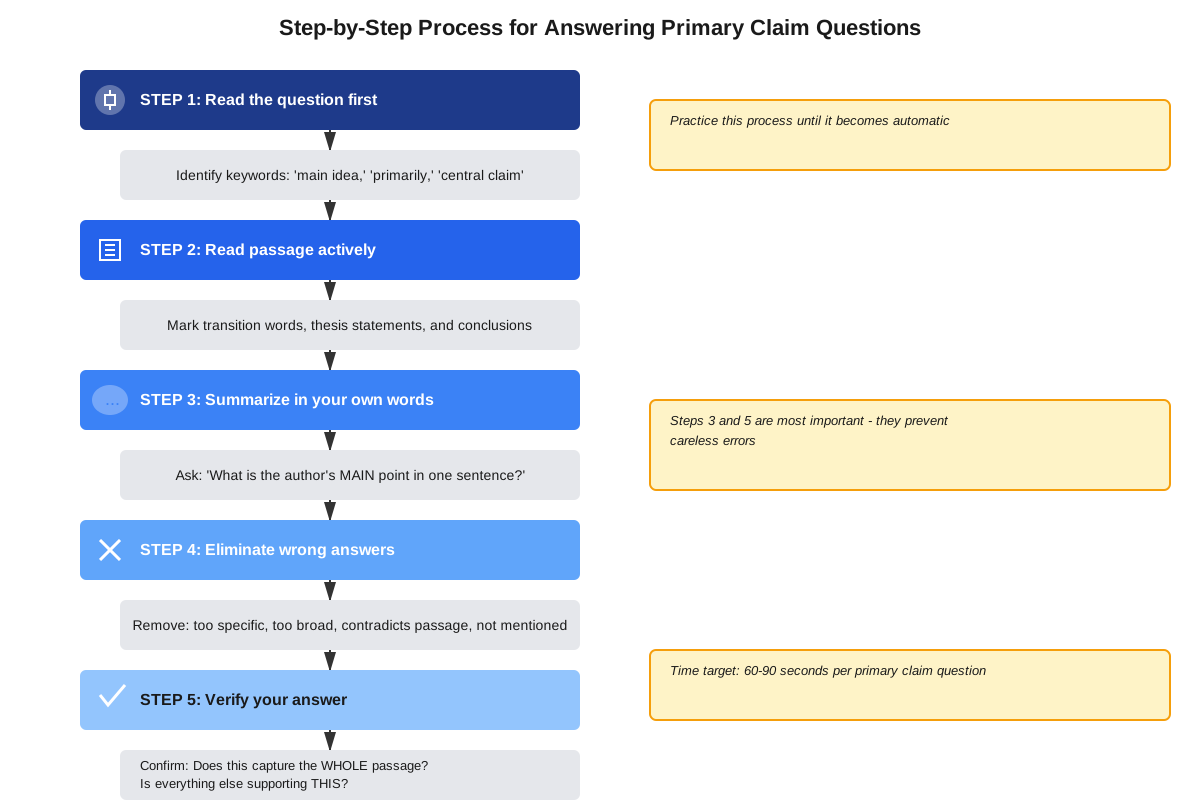
When approaching primary claim questions on the SAT, employ a systematic process that maximizes accuracy while managing time effectively:
Read the entire passage first before looking at answer choices. Primary claims cannot be identified from partial reading, and answer choices may bias interpretation if read too early. Invest 45-60 seconds in careful initial reading.
Identify the passage's purpose by asking "What is the author trying to accomplish?" Is the author arguing for a position, explaining a phenomenon, describing characteristics, or comparing alternatives? The purpose guides claim identification.
Watch for structural signals that indicate where the primary claim appears. Look for transition words like "however," "in fact," "therefore," and "thus." Notice if the passage follows a problem-solution, cause-effect, or claim-evidence structure.
Eliminate answers that are too narrow by checking if they account for the entire passage or just one section. If an answer choice relates to only one paragraph or example, it's likely a supporting detail rather than the primary claim.
Eliminate answers that are too broad by verifying that every element of the answer choice is actually discussed in the passage. If an answer introduces concepts or makes claims beyond the passage's scope, eliminate it.
Use the "umbrella test": The correct primary claim should act as an umbrella under which all major passage elements fit. If significant portions of the passage don't relate to an answer choice, it's not the primary claim.
Beware of "true but irrelevant" answers. The SAT often includes answer choices that accurately state something from the passage but don't capture the main point. Just because a statement is true doesn't make it the primary claim.
Pay attention to verb tense and qualification. If the passage uses tentative language ("suggests," "may indicate"), the correct answer should too. If the passage makes definitive claims ("proves," "demonstrates"), the answer should reflect that certainty.
Time allocation: Spend approximately 90 seconds total on primary claim questions—60 seconds reading and understanding the passage, 30 seconds evaluating answers. These questions reward careful initial reading more than extended deliberation over answer choices.
Exam Tip: If stuck between two answers, choose the one that is more general and comprehensive. Primary claims are broader than supporting details, so when in doubt, select the answer with wider scope.
Memory Techniques
The CLAIM Acronym for identifying primary claims:
- Comprehensive (covers the whole passage)
- Logically central (other elements support it)
- Arguable or informative (makes a point worth stating)
- Indicated by signals (transition words, assertion verbs)
- Main focus (what the passage is fundamentally about)
The Umbrella Visualization: Picture the primary claim as an umbrella with supporting details as raindrops beneath it. If a statement doesn't shelter most of the passage's content, it's not the primary claim.
The "So What?" Test: After reading a potential primary claim, ask "So what?" If the rest of the passage answers this question by providing evidence, examples, or explanation, you've found the primary claim. If asking "So what?" reveals that the statement itself is answering a larger question, keep looking for the broader claim.
The Three-Second Summary: If you had to tell someone what the passage is about in one sentence with three seconds to speak, what would you say? That's likely the primary claim.
Signal Word Spotlight: Create a mental highlight effect for these high-yield signal words: "however," "therefore," "in fact," "demonstrates," "reveals," "suggests," "argues." When you see these words, the primary claim is often nearby.
Summary
The primary claim represents the central argument, main point, or thesis that an author advances in a passage—the single most important statement that all other elements support, explain, or contextualize. On the SAT Reading and Writing section, identifying primary claims is a high-frequency, high-value skill that appears across multiple question types and passage genres. Primary claims are distinguished from supporting details by being more general, comprehensive, and central to the passage's purpose. They can appear at the beginning, middle, or end of passages, and are often signaled by transition words, assertion verbs, and emphasis phrases. Successful identification requires reading the entire passage, understanding the author's purpose, distinguishing between main ideas and supporting elements, and selecting answers that are neither too broad nor too narrow. The ability to quickly and accurately identify primary claims improves performance across all Reading and Writing question types by establishing a clear understanding of what the passage fundamentally communicates.
Key Takeaways
- The primary claim is the single most important statement in a passage—the main point that everything else supports or explains
- Primary claims are general and comprehensive, while supporting details are specific and narrow; this distinction is the key to answering questions correctly
- Signal words like "however," "therefore," "demonstrates," and "reveals" often indicate that a primary claim is being stated
- Incorrect answers to primary claim questions are typically supporting details, implications, or statements that are too broad or too narrow
- The correct primary claim must account for the majority of the passage's content and be directly supported by passage evidence
- Primary claims can be argumentative (taking a position), explanatory (describing how or why), descriptive (characterizing features), or comparative (relating ideas)
- Systematic strategy—reading the full passage, identifying purpose, using elimination, and applying the "umbrella test"—maximizes accuracy on these high-yield questions
Related Topics
Supporting Evidence and Details: Understanding how authors use specific facts, examples, statistics, and quotations to substantiate primary claims; this topic builds directly on primary claim identification by examining the relationship between claims and their support.
Author's Purpose and Point of View: Analyzing why authors write passages and what perspectives they bring; recognizing primary claims is essential for understanding purpose, as the claim reveals what the author fundamentally wants to communicate.
Argument Structure and Reasoning: Examining how authors construct logical arguments, including premises, conclusions, and reasoning patterns; primary claims serve as conclusions that argument structure supports.
Inference and Implication Questions: Drawing conclusions based on passage information; understanding primary claims helps distinguish between what passages directly state and what they imply.
Text Structure and Organization: Analyzing how passages are organized (chronologically, compare-contrast, cause-effect, problem-solution); recognizing structure helps locate primary claims and understand their function.
Practice CTA
Now that you understand how to identify and analyze primary claims, it's time to apply these skills to authentic SAT-style questions. The practice questions and flashcards will reinforce your ability to distinguish primary claims from supporting details, recognize signal words, and select answers that accurately capture passages' main points. Remember: primary claim questions are high-frequency and high-value on the SAT—mastering this skill will directly improve your Reading and Writing score. Approach each practice question systematically, using the strategies and techniques you've learned. With focused practice, identifying primary claims will become automatic, allowing you to work through these questions quickly and confidently on test day.
Sign up free to keep reading
Create a free AnvayaPrep account to finish this SAT guide on Primary claim — plus flashcards and practice questions.