Overview
The SAT Reading and Writing section frequently presents students with challenging passages drawn from academic journals, scientific research, historical documents, and scholarly essays. These texts are characterized by sophisticated vocabulary, complex sentence structures, and abstract concepts that require careful, strategic reading. Reading dense academic prose is not merely about decoding difficult words—it demands the ability to extract central ideas, understand nuanced arguments, and synthesize information quickly under timed conditions.
Mastering SAT reading dense academic prose is essential because approximately 40-50% of SAT Reading and Writing questions involve passages with elevated academic language and intricate logical structures. Students who struggle with dense prose often lose valuable time re-reading passages, misidentify main ideas, or become overwhelmed by technical terminology. Conversely, students who develop systematic approaches to academic texts can confidently navigate even the most challenging passages, accurately identifying author's purpose, central claims, and supporting evidence within the allotted time.
This topic sits at the intersection of vocabulary comprehension, syntactic analysis, and critical reasoning within the RW (Reading and Writing) section. It builds upon fundamental reading comprehension skills while preparing students for the analytical demands of college-level coursework. Success with dense academic prose directly enhances performance across all question types in the Central Ideas and Details unit, including main idea questions, detail questions, and inference questions.
Learning Objectives
- [ ] Identify key features of reading dense academic prose
- [ ] Explain how reading dense academic prose appears on the SAT
- [ ] Apply reading dense academic prose to answer SAT-style questions
- [ ] Analyze complex sentence structures to extract core meaning efficiently
- [ ] Distinguish between essential information and supplementary details in academic passages
- [ ] Synthesize information from multiple sentences to construct complete understanding of central ideas
- [ ] Evaluate the relationship between technical terminology and overall passage meaning
Prerequisites
- Basic reading comprehension: Understanding literal meaning of straightforward texts is necessary before tackling complex academic writing
- Fundamental grammar knowledge: Recognizing sentence components (subjects, verbs, clauses) enables parsing of complex syntax
- Core vocabulary skills: A foundation of common academic words allows focus on context-specific terminology rather than basic language
- Paragraph structure awareness: Understanding how topic sentences, supporting details, and transitions function helps navigate dense passages
Why This Topic Matters
Dense academic prose represents the language of higher education, professional research, and intellectual discourse. Students who master this skill gain access not only to higher SAT scores but also to success in college coursework across disciplines. The ability to efficiently extract meaning from challenging texts is fundamental to academic achievement in STEM fields, humanities, and social sciences.
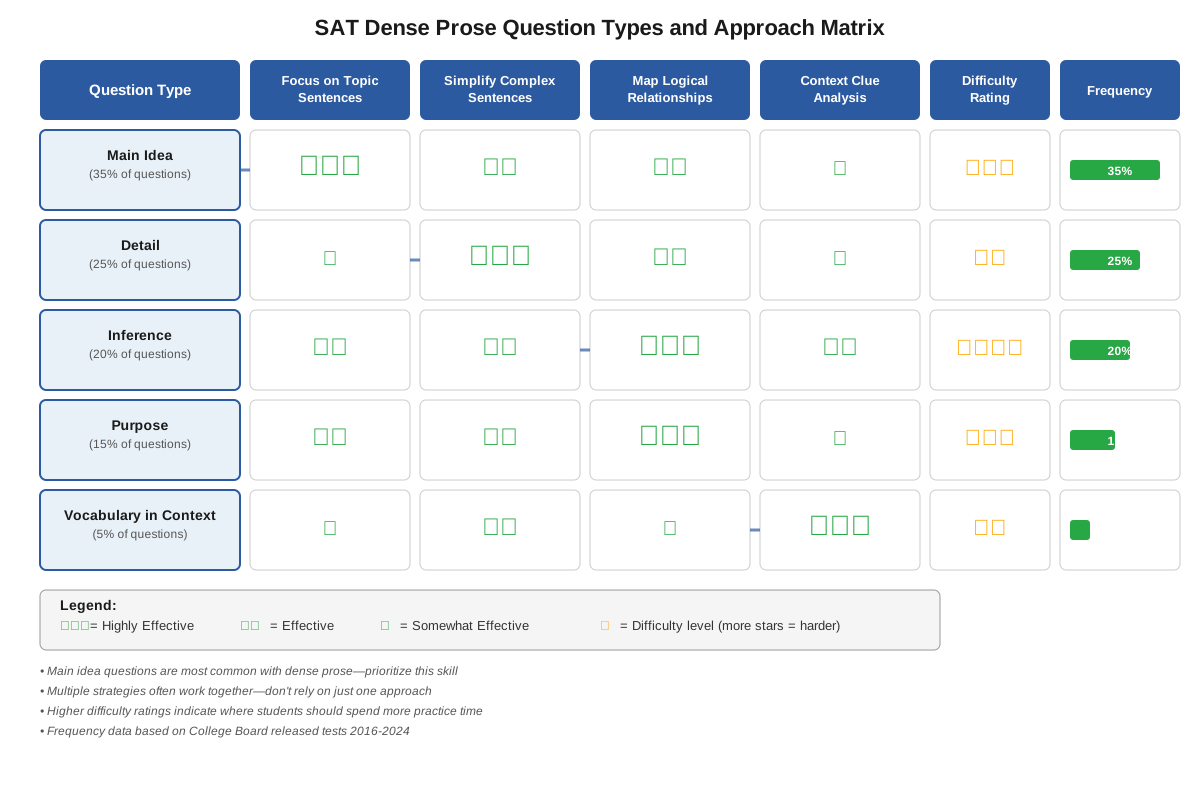
On the SAT, dense academic prose appears in 15-20 questions per test, representing roughly 30-40% of the Reading and Writing section. These passages typically range from 75-150 words and cover topics in natural sciences (biology, chemistry, physics), social sciences (psychology, sociology, economics), and humanities (history, literature, philosophy). The College Board intentionally includes these challenging texts to assess college readiness and differentiate between proficient and advanced readers.
Common manifestations include:
- Scientific research summaries with technical terminology and complex causal relationships
- Historical analyses featuring sophisticated argumentation and period-specific language
- Philosophical or theoretical discussions with abstract concepts and nuanced distinctions
- Economic or sociological studies presenting data interpretation and methodological explanations
- Literary criticism employing specialized analytical vocabulary and layered interpretations
Questions accompanying these passages frequently test whether students can identify the central claim despite distracting details, understand how evidence supports conclusions, or recognize the author's purpose within dense explanatory text.
Core Concepts
Characteristics of Dense Academic Prose
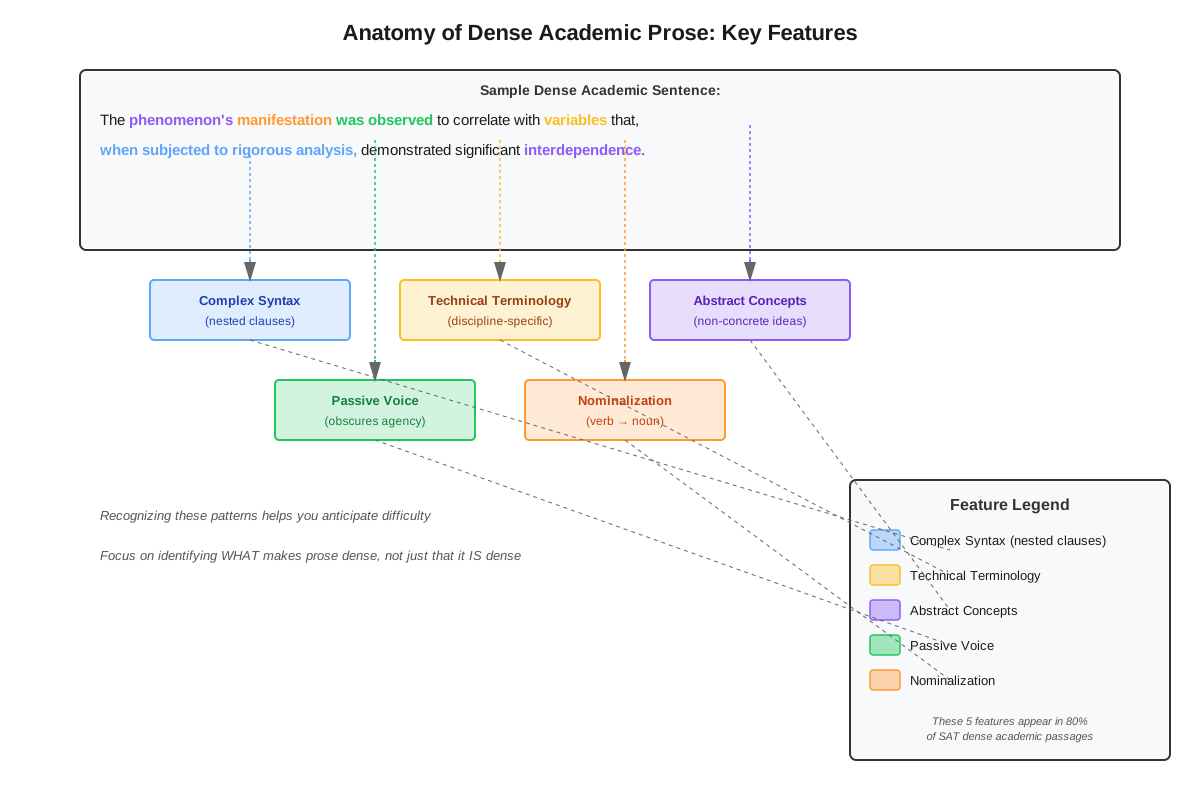
Dense academic prose exhibits several distinctive features that distinguish it from everyday writing. First, it employs elevated vocabulary—words like "elucidate," "paradigm," "empirical," and "substantiate" that rarely appear in casual conversation. Second, it features complex syntax with multiple embedded clauses, parenthetical information, and lengthy sentences that pack numerous ideas into single grammatical units. Third, it assumes background knowledge, referencing concepts, theories, or historical events without extensive explanation. Fourth, it prioritizes precision over simplicity, using specific technical terms rather than general language to convey exact meaning.
These passages also demonstrate high information density, meaning each sentence contains multiple important ideas rather than elaborating single points across several sentences. Academic writers frequently employ nominalization (turning verbs into nouns: "investigate" becomes "investigation"), which creates more abstract, formal prose. Additionally, these texts often include hedging language ("may suggest," "appears to indicate," "potentially contributes") that reflects scholarly caution about claims.
Syntactic Complexity and Sentence Structure
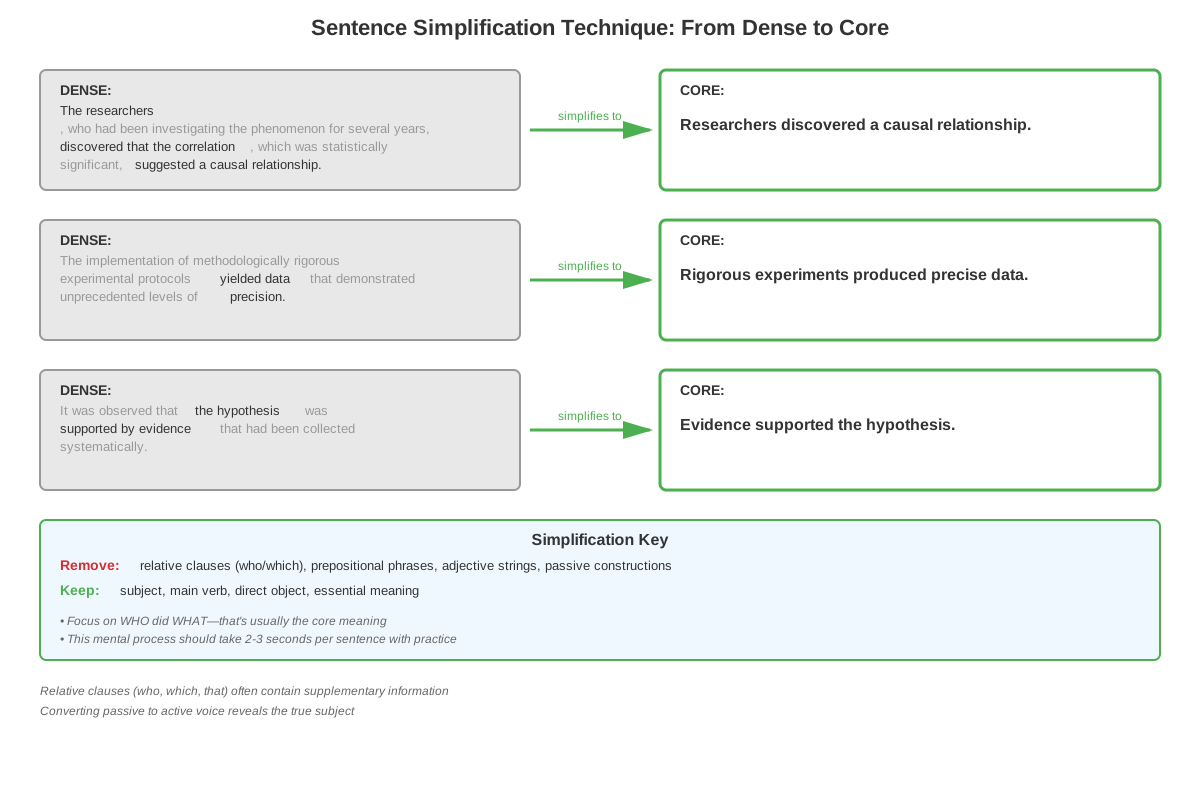
Understanding how academic writers construct complex sentences is crucial for efficient comprehension. Subordinate clauses frequently interrupt main ideas: "The researcher, having analyzed data from three distinct populations, concluded that genetic factors, while significant, played a smaller role than environmental influences." Here, the core claim—"The researcher concluded that genetic factors played a smaller role than environmental influences"—is embedded within qualifying information.
Appositive phrases provide additional information about nouns: "Photosynthesis, the process by which plants convert light energy into chemical energy, depends on chlorophyll molecules." Recognizing these as supplementary rather than essential to the main idea prevents cognitive overload. Participial phrases at sentence beginnings often establish context: "Seeking to understand migration patterns, scientists tracked individual birds across continents." The main clause follows the participial phrase.
| Sentence Element | Function | Example |
|---|---|---|
| Main clause | Core idea | "Scientists discovered a new species" |
| Subordinate clause | Qualifying information | "although previous research suggested none existed" |
| Appositive | Defining/explaining | "the species, a type of deep-sea fish," |
| Participial phrase | Context/method | "Using advanced sonar technology" |
Technical Terminology and Context Clues
Academic passages introduce domain-specific vocabulary that may be unfamiliar. However, SAT passages typically provide sufficient context clues to infer meaning without prior knowledge of technical terms. These clues appear in several forms:
- Definition clues: The term is directly defined—"Mitochondria, the cellular organelles responsible for energy production, contain their own DNA."
- Example clues: Specific instances illustrate the concept—"Renewable resources, such as solar power and wind energy, offer sustainable alternatives."
- Contrast clues: The term is explained through opposition—"Unlike exothermic reactions that release heat, endothermic reactions absorb thermal energy."
- Restatement clues: The idea is expressed differently—"The hypothesis was corroborated; in other words, the evidence supported the initial theory."
Effective readers identify these clues rather than panicking over unfamiliar vocabulary. The SAT tests comprehension of ideas, not memorization of specialized terminology.
Information Hierarchy and Main Ideas
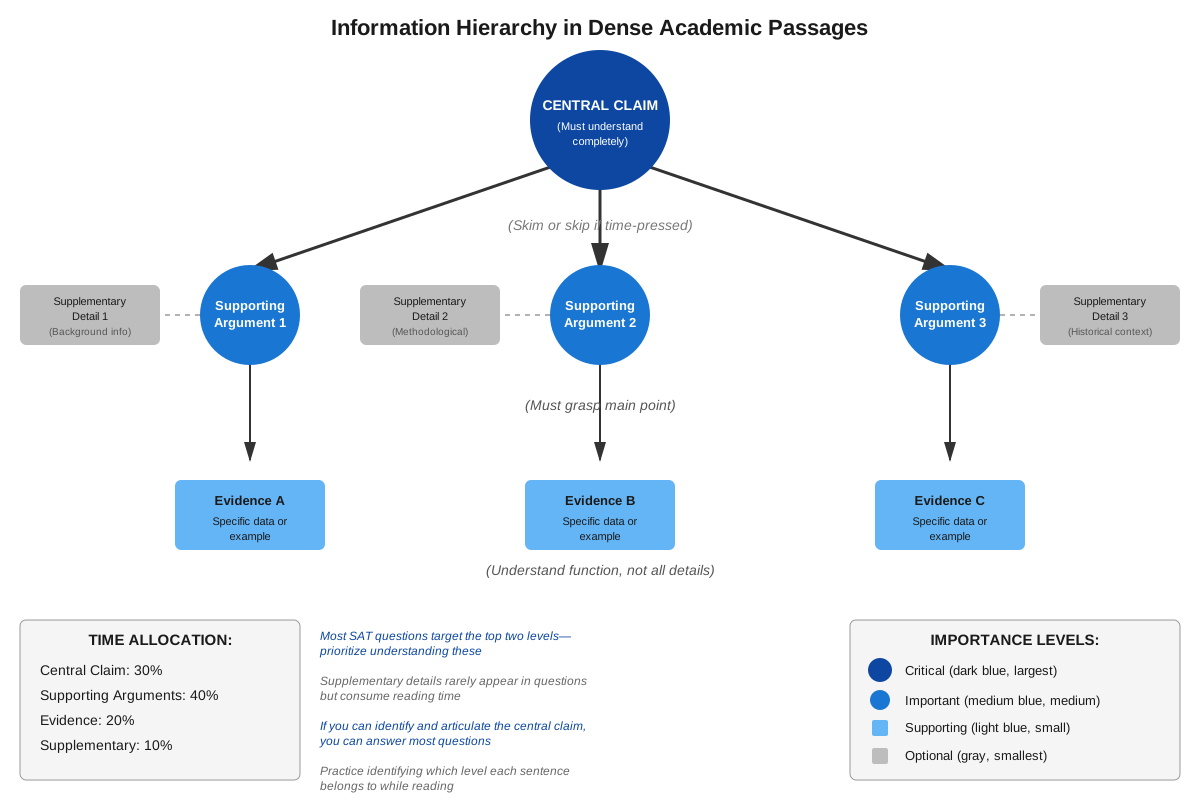
Dense passages contain primary claims (the central argument or finding), supporting evidence (data, examples, or reasoning), and contextual information (background, methodology, or implications). Distinguishing these levels prevents confusion about what matters most.
The topic sentence often appears at the paragraph's beginning but may be delayed until after contextual setup. In scientific passages, the main finding frequently appears after methodology description. In historical passages, the thesis may follow background information. Skilled readers identify transition words that signal relationships: "however," "therefore," "moreover," "consequently," "nevertheless."
Logical Relationships and Argumentation
Academic prose presents ideas in logical sequences: cause-effect ("Because temperatures rose, glaciers retreated"), comparison-contrast ("While Theory A emphasizes economic factors, Theory B prioritizes cultural influences"), problem-solution ("To address declining populations, conservationists implemented protected habitats"), and chronological progression ("Initially, researchers believed X; subsequent studies revealed Y").
Recognizing these rhetorical patterns accelerates comprehension. Signal words indicate relationships: "as a result," "in contrast," "similarly," "subsequently," "despite." Understanding how ideas connect reveals the passage's organizational logic.
Author's Purpose and Tone
Dense academic writing serves specific purposes: to inform (presenting research findings), to explain (clarifying complex phenomena), to argue (advocating for particular interpretations), or to analyze (examining relationships between concepts). The author's tone—objective, analytical, cautious, or critical—provides insight into their stance.
Academic writers typically maintain formal register and objective distance, avoiding emotional language or personal anecdotes. However, subtle word choices reveal perspective: "merely," "significantly," "surprisingly," "unfortunately" indicate evaluation despite overall objectivity.
Concept Relationships
The core concepts within dense academic prose reading form an interconnected system. Syntactic complexity directly impacts information hierarchy—complex sentences often embed supporting details within main claims, requiring readers to parse structure to identify central ideas. Technical terminology interacts with context clues; understanding how academic writers define specialized terms enables comprehension without prior subject knowledge.
Logical relationships connect to author's purpose—recognizing whether a passage presents cause-effect reasoning or comparison-contrast reveals whether the author aims to explain mechanisms or evaluate competing theories. Information density relates to sentence structure; writers pack multiple ideas into single sentences through subordinate clauses and participial phrases, creating the characteristic density of academic prose.
The relationship map flows as follows:
Complex Syntax → requires → Sentence Parsing Skills → enables → Identifying Main Ideas
↓
Technical Vocabulary → addressed through → Context Clue Recognition → supports → Comprehension
↓
Information Density → necessitates → Distinguishing Essential from Supplementary Details → leads to → Efficient Reading
↓
Logical Relationships → reveal → Author's Purpose → guides → Question Answering
These skills build upon prerequisite knowledge of basic grammar and vocabulary while preparing students for the analytical demands of inference questions and synthesis tasks in other SAT Reading and Writing units.
High-Yield Facts
- ⭐ Dense academic prose appears in 30-40% of SAT Reading and Writing questions, making it one of the most frequently tested skills
- ⭐ The main idea often appears in the first or last sentence of academic paragraphs, though complex passages may delay thesis statements
- ⭐ Context clues within the passage provide sufficient information to understand technical terms without prior subject knowledge
- ⭐ Subordinate clauses and parenthetical information are typically supplementary rather than essential to the central claim
- ⭐ Transition words signal logical relationships between ideas and guide readers through complex argumentation
- Nominalization (verb-to-noun conversion) increases abstraction and is characteristic of formal academic writing
- Academic writers use hedging language ("may," "suggests," "appears") to reflect scholarly caution about claims
- Appositive phrases provide definitions or explanations and can be temporarily skipped when identifying main ideas
- Information density means each sentence contains multiple important concepts requiring careful attention
- Author's purpose in academic passages is typically to inform, explain, analyze, or argue rather than to entertain or persuade emotionally
- Participial phrases at sentence beginnings often establish context or methodology before presenting main findings
- Complex sentences can be simplified by identifying the subject-verb core and temporarily setting aside modifying phrases
- Academic passages assume background knowledge but provide necessary context for SAT comprehension questions
- Formal register and objective tone characterize academic prose, though subtle word choices reveal author perspective
Quick check — test yourself on Reading dense academic prose so far.
Try Flashcards →Common Misconceptions
Misconception: Every unfamiliar word must be fully understood before proceeding.
Correction: The SAT provides sufficient context clues to grasp necessary meaning; attempting to define every technical term wastes time and creates anxiety. Focus on understanding the overall idea rather than memorizing definitions.
Misconception: Longer sentences are always more important than shorter ones.
Correction: Sentence length doesn't indicate importance. A short sentence may state the main claim while longer sentences provide supporting details. Evaluate content, not length, to determine significance.
Misconception: Academic passages require specialized subject knowledge to answer questions correctly.
Correction: The SAT is designed to test reading comprehension, not content knowledge. All necessary information appears within the passage itself. Questions can be answered using only what the text provides.
Misconception: Reading slowly and carefully is always the best strategy for dense prose.
Correction: While careful reading matters, excessive slowness causes time management problems. Effective readers adjust pace—skimming contextual information while focusing attention on claims and evidence. Strategic reading is more efficient than uniformly slow reading.
Misconception: The first sentence always contains the main idea.
Correction: Academic writers frequently provide background information or methodology before stating central claims. The main idea may appear mid-paragraph or even at the end, particularly in scientific passages that follow research report structure.
Misconception: All information in the passage is equally important for answering questions.
Correction: Dense passages contain hierarchical information—central claims, supporting evidence, and contextual details. Questions typically focus on main ideas and direct support, not minor details. Distinguishing levels of importance improves efficiency.
Misconception: Difficult vocabulary indicates poor writing that should be avoided.
Correction: Academic prose uses precise technical terminology to convey exact meaning. This vocabulary reflects disciplinary standards and enables nuanced communication. The challenge is comprehension, not quality of writing.
Worked Examples
Example 1: Scientific Research Passage
Passage: "Researchers investigating neural plasticity—the brain's capacity to reorganize synaptic connections in response to experience—have discovered that environmental enrichment, characterized by increased sensory, cognitive, and motor stimulation, promotes dendritic branching in the hippocampus. While previous studies suggested that such neurological changes occurred primarily during developmental periods, recent evidence indicates that adult brains retain significant plasticity, though the rate of structural modification diminishes with age."
Question: Which finding is presented as challenging earlier assumptions?
Step 1: Identify the main claim structure. The passage presents a contrast signaled by "While previous studies suggested... recent evidence indicates..."
Step 2: Parse the complex syntax. The core contrast is: "Previous studies suggested changes occurred during development" versus "Recent evidence indicates adult brains retain plasticity."
Step 3: Recognize technical terms through context. "Neural plasticity" is defined immediately ("the brain's capacity to reorganize"), "environmental enrichment" is characterized ("increased sensory, cognitive, and motor stimulation"), and "dendritic branching" is presented as a result of enrichment.
Step 4: Determine what challenges earlier assumptions. The phrase "While previous studies suggested" introduces the old view, and "recent evidence indicates" presents the new finding that contradicts it.
Answer: The finding that adult brains retain significant plasticity challenges the earlier assumption that neurological changes occurred primarily during developmental periods.
Connection to Learning Objectives: This example demonstrates identifying key features (contrast structure, technical terminology with definitions) and applying comprehension to answer questions about central claims versus supporting details.
Example 2: Historical Analysis Passage
Passage: "The historiographical debate surrounding the Industrial Revolution's impact on working-class living standards has generated two competing interpretations. Optimists, citing increased real wages and expanded consumer goods availability, argue that industrialization ultimately improved material conditions despite short-term disruptions. Pessimists, however, emphasize deteriorating urban environments, exploitative labor practices, and widening inequality, contending that aggregate economic growth masked significant suffering among industrial workers. Recent scholarship attempts to reconcile these positions by acknowledging regional variation and temporal complexity."
Question: The passage suggests that recent scholarship differs from earlier interpretations by:
Step 1: Identify the organizational structure. The passage presents two opposing views (optimists vs. pessimists) followed by a newer approach (recent scholarship).
Step 2: Understand each position's core claim:
- Optimists: industrialization improved conditions (evidence: wages, consumer goods)
- Pessimists: industrialization worsened conditions (evidence: urban problems, exploitation, inequality)
- Recent scholarship: reconciles positions through nuance (regional variation, temporal complexity)
Step 3: Recognize the logical relationship. "However" signals contrast between optimists and pessimists. "Recent scholarship attempts to reconcile" indicates a synthesis approach rather than choosing sides.
Step 4: Determine how recent scholarship differs. It doesn't simply agree with one side but instead acknowledges complexity that both earlier interpretations oversimplified.
Answer: Recent scholarship differs by recognizing that the impact varied by region and time period rather than being uniformly positive or negative.
Connection to Learning Objectives: This example shows how to navigate competing interpretations in academic prose, distinguish between contrasting positions, and identify synthesis approaches—all essential skills for SAT reading dense academic prose questions.
Exam Strategy
Approaching Dense Prose Questions
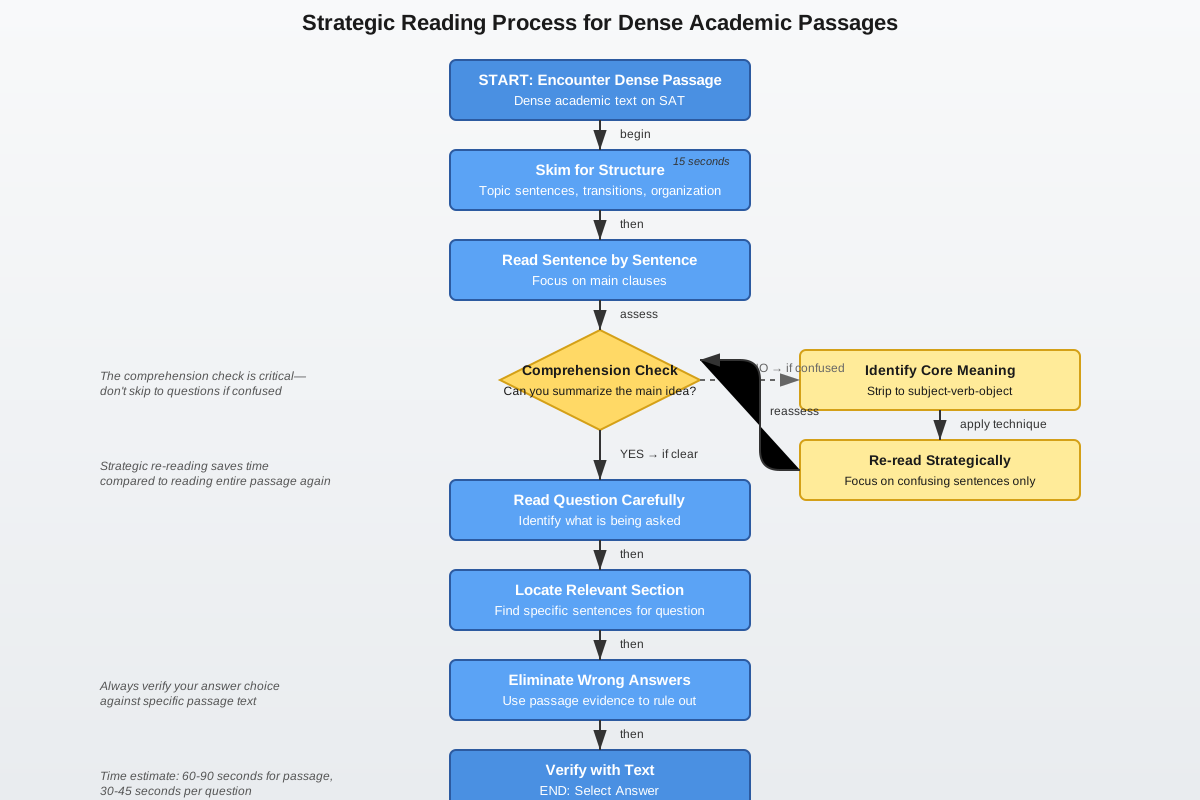
When encountering a challenging academic passage, follow this systematic approach:
- Read the question first to establish purpose—knowing what you're looking for focuses attention on relevant information
- Identify the passage type (scientific, historical, philosophical) to anticipate structure and vocabulary
- Locate the main claim by scanning for thesis statements, typically in opening or closing sentences
- Parse complex sentences by finding subject-verb cores and temporarily bracketing modifying phrases
- Use context clues for unfamiliar terminology rather than getting stuck on individual words
Trigger Words and Phrases
Watch for these signal words that indicate important information:
- Contrast indicators: "however," "nevertheless," "despite," "although," "while" (signal shifts in argument)
- Causation markers: "because," "therefore," "consequently," "as a result," "thus" (show logical relationships)
- Evidence introducers: "for example," "specifically," "in particular," "such as" (distinguish support from claims)
- Emphasis signals: "significantly," "importantly," "notably," "primarily" (highlight key points)
- Qualification language: "may," "suggests," "appears," "potentially" (indicate scholarly caution)
Process of Elimination Tips
For questions about dense passages:
- Eliminate answers with absolute language ("always," "never," "only") unless the passage explicitly uses such terms
- Reject options that introduce outside knowledge not present in the passage—SAT questions test comprehension of provided text
- Eliminate answers that confuse supporting details with main ideas—correct answers about central claims won't focus on minor examples
- Discard options that misrepresent logical relationships—if the passage shows causation, answers suggesting mere correlation are incorrect
- Remove choices that overstate or understate the author's position—academic prose typically uses measured language
Time Allocation
For passages with dense academic prose:
- Spend 60-75 seconds on initial reading to grasp main idea and structure
- Allocate 30-45 seconds per question for locating relevant information and evaluating options
- Don't re-read entire passages—use question stems to guide targeted re-reading of specific sentences
- If stuck after 45 seconds, make your best guess and move forward—time management matters more than perfecting every question
Exam Tip: If a sentence seems incomprehensible on first reading, skip to the next sentence. Often, subsequent sentences clarify or restate the idea in more accessible language. Return to difficult sentences only if questions specifically reference them.
Memory Techniques
PARSE Method for Complex Sentences
Pause and identify the subject
Analyze the main verb
Remove parenthetical information temporarily
Simplify by stating the core claim
Examine modifying phrases for additional meaning
CONTEXT Acronym for Vocabulary
Comparison—is the term contrasted with something familiar?
Opposition—does the sentence show what it's NOT?
Nearby definition—is it defined in the same sentence?
Type or category—is it described as an example of something?
Explanation—does the next sentence clarify it?
X-ample—are specific instances provided?
Visualization Strategy
Picture academic passages as layered structures:
- Top layer: Main claim (the roof)
- Middle layer: Supporting evidence (the walls)
- Bottom layer: Background context (the foundation)
When reading, mentally sort information into these layers. Questions typically ask about the roof or walls, rarely about the foundation alone.
The "Three-Pass" Approach
- First pass: Read for gist—what is this passage about?
- Second pass: Identify structure—how is the argument organized?
- Third pass: Answer questions—where is the specific information?
This prevents the common mistake of trying to memorize everything on first reading.
Summary
Reading dense academic prose on the SAT requires strategic approaches to complex syntax, technical vocabulary, and information-dense passages. Success depends on recognizing that these passages, while challenging, provide all necessary information through context clues and logical structure. The key skills include parsing complex sentences by identifying subject-verb cores, using context to understand unfamiliar terminology, distinguishing main ideas from supporting details, and recognizing logical relationships through transition words. Students must resist the temptation to read uniformly slowly or to panic over difficult vocabulary; instead, they should adjust reading pace strategically, focus on claims rather than minor details, and trust that the passage contains sufficient information to answer questions. The SAT tests reading comprehension, not prior subject knowledge, meaning that careful attention to what the text actually says—rather than assumptions about what it should say—leads to correct answers. Mastering these techniques enables confident navigation of even the most challenging academic passages within the time constraints of the exam.
Key Takeaways
- Dense academic prose appears in 30-40% of SAT Reading and Writing questions, making it a high-priority skill for test preparation
- Complex sentences can be simplified by identifying subject-verb cores and temporarily setting aside modifying phrases and parenthetical information
- Context clues within passages provide sufficient information to understand technical terminology without prior subject knowledge
- Main ideas often appear in first or last sentences, but academic passages may delay thesis statements after providing context or methodology
- Transition words ("however," "therefore," "for example") signal logical relationships and guide readers through complex argumentation
- Strategic reading—adjusting pace based on information importance—is more efficient than uniformly slow, careful reading
- Questions test comprehension of provided text, not outside knowledge, so all answers must be supported by passage content
Related Topics
Inference Questions in Academic Contexts: Building on dense prose comprehension, inference questions require students to draw logical conclusions from explicitly stated information in challenging passages. Mastering dense prose reading provides the foundation for making accurate inferences.
Author's Purpose and Rhetorical Strategy: Understanding why authors structure arguments in particular ways and how they use evidence connects directly to comprehending dense academic prose, as recognizing purpose aids in identifying main ideas.
Synthesis Across Multiple Texts: Advanced SAT questions may require comparing information from two related passages. The skills developed for reading single dense passages—identifying main claims, recognizing evidence, parsing complex syntax—transfer directly to multi-text synthesis.
Vocabulary in Context: While dense prose comprehension involves understanding technical terms through context, dedicated vocabulary-in-context questions test this skill more explicitly, making dense prose reading excellent preparation.
Data Interpretation in Scientific Passages: Many dense academic passages include references to research findings or data. Developing comfort with scientific prose prepares students for questions requiring interpretation of quantitative information presented in text form.
Practice CTA
Now that you've mastered the strategies for reading dense academic prose, it's time to apply these skills! Complete the practice questions to test your ability to parse complex sentences, identify main ideas in challenging passages, and use context clues for unfamiliar terminology. The flashcards will reinforce key concepts like signal words, sentence structure patterns, and common passage types. Remember: dense prose becomes manageable with systematic approaches. Each practice question you complete builds the confidence and automaticity you need to excel on test day. You've learned the strategies—now prove to yourself that you can execute them under exam conditions!
Sign up free to keep reading
Create a free AnvayaPrep account to finish this SAT guide on Reading dense academic prose — plus flashcards and practice questions.