Overview
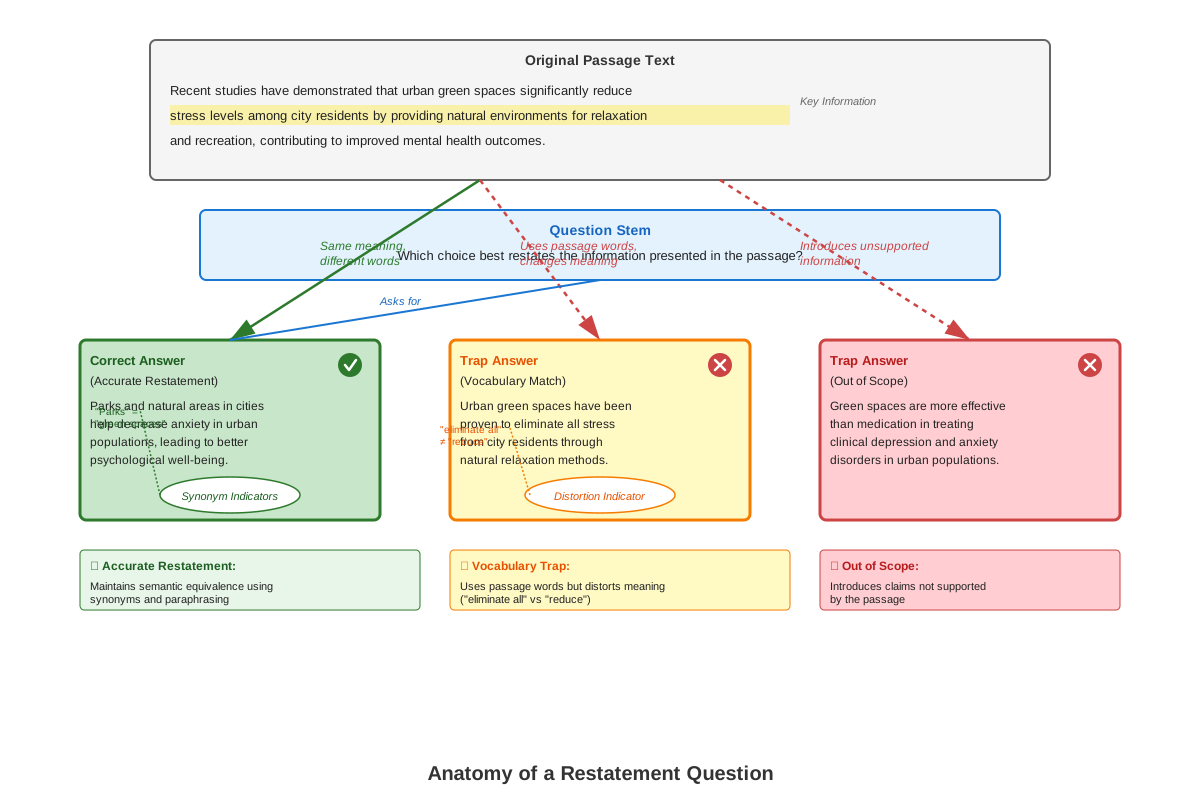
The restatement of information is a fundamental skill tested extensively throughout the SAT Reading and Writing (RW) section. This concept requires students to recognize when information from a passage has been expressed using different words, sentence structures, or phrasing while maintaining the same essential meaning. Unlike simple vocabulary matching, restatement questions assess whether students truly comprehend the passage's content by asking them to identify paraphrased versions of key ideas, details, or claims.
On the SAT, restatement questions appear frequently across multiple question types within the Reading and Writing section. Students must demonstrate their ability to move beyond surface-level word recognition and engage with the deeper meaning of texts. These questions test reading comprehension at its core: can the student extract meaning from one presentation of information and recognize that same meaning when expressed differently? This skill is particularly crucial because the SAT deliberately uses synonyms, restructured sentences, and alternative phrasings in correct answer choices to ensure students understand content rather than simply matching words.
Mastering sat restatement of information connects directly to broader reading comprehension skills essential for success on the exam. This topic serves as a foundation for understanding central ideas, supporting details, and the relationship between different parts of a text. Students who excel at identifying restated information are better equipped to handle inference questions, main idea questions, and questions about textual evidence—making this a high-impact area for focused study and practice.
Learning Objectives
- [ ] Identify key features of restatement of information in SAT passages
- [ ] Explain how restatement of information appears on the SAT
- [ ] Apply restatement of information to answer SAT-style questions
- [ ] Distinguish between accurate restatements and distortions of passage content
- [ ] Recognize common paraphrasing techniques used in correct answer choices
- [ ] Evaluate answer choices for semantic equivalence to passage statements
- [ ] Identify trap answers that use passage vocabulary without maintaining meaning
Prerequisites
- Basic reading comprehension: Understanding literal meaning of sentences and paragraphs is essential before identifying alternative expressions of that meaning
- Vocabulary knowledge: Recognizing synonyms and related terms helps identify when concepts are being restated using different words
- Sentence structure awareness: Understanding how ideas can be expressed through different grammatical constructions aids in recognizing restatements
- Attention to detail: Careful reading is necessary to distinguish between accurate restatements and subtle distortions
Why This Topic Matters
Restatement of information represents one of the most frequently tested skills on the SAT Reading and Writing section. Approximately 20-25% of all RW questions either directly test restatement or require restatement recognition as part of the solution process. This makes it one of the highest-yield topics for focused preparation, as improvement in this area directly translates to points across multiple question types.
In real-world contexts, the ability to recognize restated information is essential for academic success, professional communication, and critical thinking. Students encounter restatement constantly when reading textbooks that explain concepts multiple ways, when comparing sources that discuss the same topic using different terminology, or when verifying that summaries accurately capture original content. This skill underpins effective note-taking, research synthesis, and the ability to identify when sources agree or disagree on substantive points.
On the SAT, restatement appears in several distinct question formats. Command of Evidence questions frequently ask students to identify which quotation best supports a stated claim—requiring recognition that the quotation restates the claim's meaning. Central Ideas questions present answer choices that paraphrase main points from passages. Detail questions ask students to identify what the passage states about a specific topic, with correct answers restating passage content. Even Inference questions often include wrong answers that seem tempting because they use passage vocabulary but don't actually restate what the passage conveys. Understanding restatement is therefore not just important for one question type—it's foundational for success across the entire Reading and Writing section.
Core Concepts
What Constitutes Restatement
Restatement of information occurs when the same essential meaning is conveyed using different words, phrases, or sentence structures. The key principle is semantic equivalence: the core idea, claim, or detail remains unchanged even though the expression differs. On the SAT, restatements preserve the meaning, scope, and specificity of the original passage content while altering the surface-level presentation.
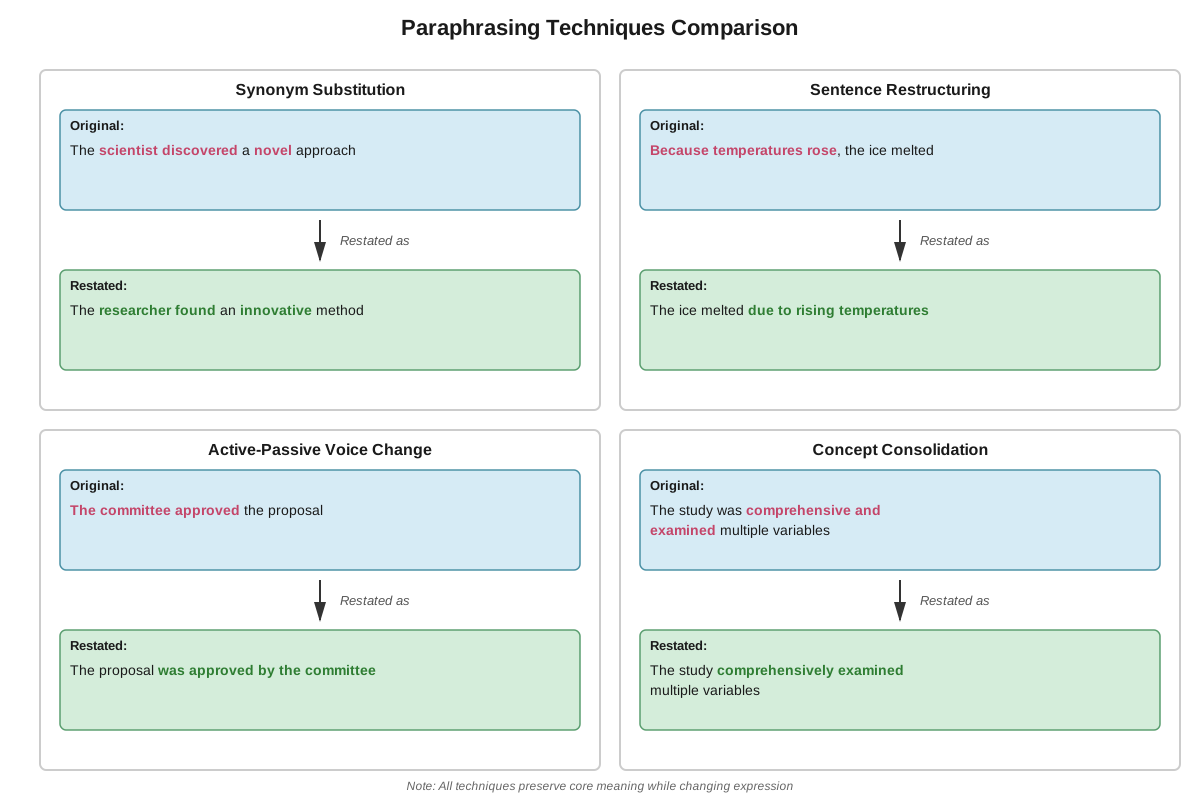
Effective restatement involves several techniques:
- Synonym substitution: Replacing words with synonyms (e.g., "rapid" becomes "quick")
- Structural transformation: Changing sentence structure while maintaining meaning (e.g., active to passive voice)
- Conceptual paraphrasing: Expressing the same idea through different conceptual framing
- Detail consolidation: Combining multiple related details into a single statement
- Elaboration reversal: Condensing elaborated explanations into concise statements
Accurate vs. Inaccurate Restatement
Understanding what makes a restatement accurate versus inaccurate is crucial for SAT success. An accurate restatement maintains three critical elements:
| Element | Accurate Restatement | Inaccurate Restatement |
|---|---|---|
| Meaning | Preserves the exact claim or detail | Subtly shifts the meaning |
| Scope | Maintains the same breadth (general vs. specific) | Overgeneralizes or overspecifies |
| Certainty | Keeps the same level of confidence (definite, possible, etc.) | Changes from certain to uncertain or vice versa |
For example, if a passage states: "The experiment demonstrated that increased sunlight exposure led to faster plant growth in tomatoes," an accurate restatement might be: "Greater amounts of sunlight caused tomato plants to grow more rapidly." An inaccurate restatement would be: "Sunlight is essential for all plant growth"—this overgeneralizes beyond what the passage actually states.
Common Restatement Patterns on the SAT
The SAT employs predictable patterns when creating restatement-based questions and answer choices:
- Vocabulary elevation: Replacing common words with more sophisticated synonyms (e.g., "showed" becomes "demonstrated" or "revealed")
- Causal restructuring: Expressing cause-and-effect relationships in different orders (e.g., "A caused B" becomes "B resulted from A")
- Negative-positive conversion: Changing negative constructions to positive ones or vice versa while maintaining meaning (e.g., "not uncommon" becomes "fairly common")
- Quantifier adjustment: Using different but equivalent quantifiers (e.g., "many" becomes "numerous" or "a significant number")
- Temporal reframing: Expressing time relationships differently (e.g., "before the discovery" becomes "prior to when scientists found")
Trap Answer Characteristics
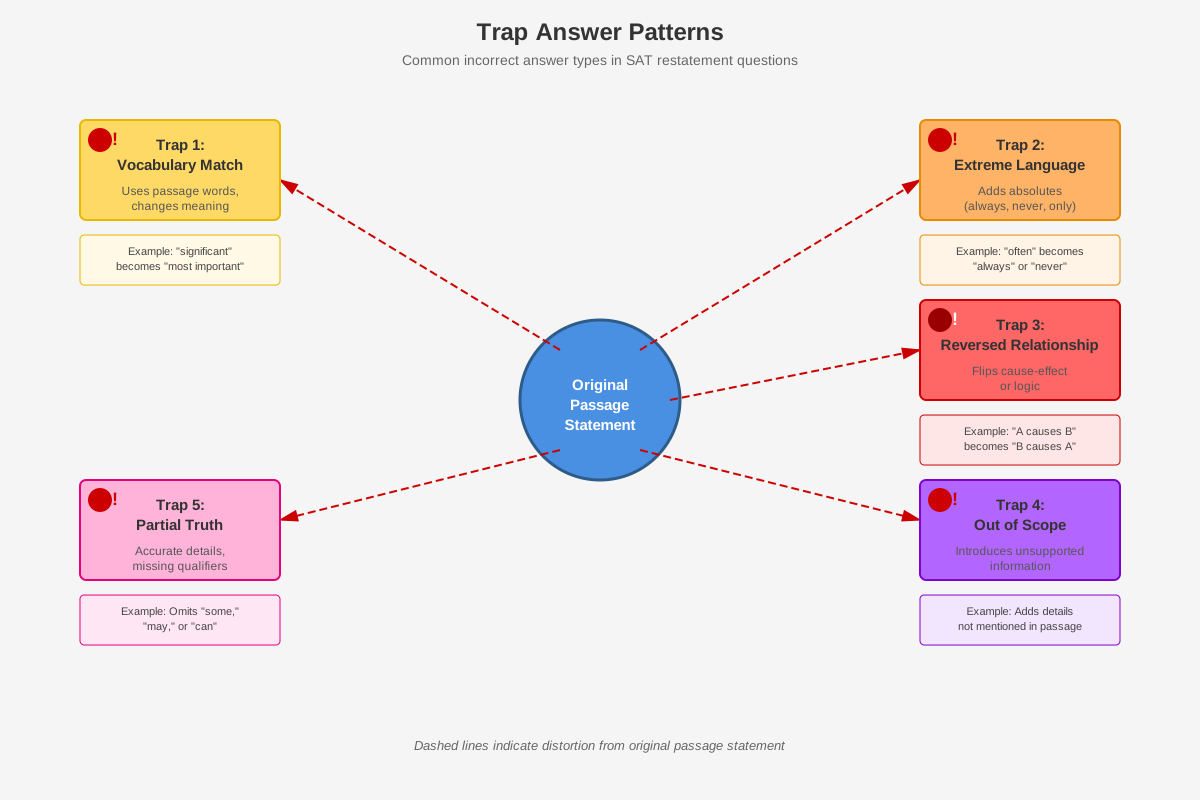
The SAT deliberately creates wrong answers that appear related to the passage but fail to accurately restate information. Recognizing these traps is essential:
- Vocabulary mimicry: Uses exact words from the passage but combines them in ways that distort meaning
- Scope creep: Takes a specific claim and inappropriately generalizes it
- Detail mixing: Combines accurate details from different parts of the passage in ways that create false statements
- Extreme language: Introduces absolute terms (always, never, only) not present in the original
- Logical distortion: Reverses cause and effect or changes relationships between ideas
The Paraphrasing Spectrum
Not all restatements are created equal. Understanding the spectrum of paraphrasing helps students evaluate answer choices:
Close paraphrase → Changes only a few words while maintaining structure
Moderate paraphrase → Alters both vocabulary and some structural elements
Distant paraphrase → Completely restructures while preserving core meaning
Summary restatement → Condenses multiple sentences into one statement
The SAT uses all points on this spectrum, though moderate to distant paraphrases are most common in correct answers. This ensures students must understand meaning rather than simply match words.
Concept Relationships
Restatement of information serves as a foundational skill that connects to virtually every other aspect of SAT Reading and Writing comprehension. The relationship flows as follows:
Basic vocabulary knowledge → enables → Recognition of synonyms → enables → Identification of restatements → enables → Answering detail questions, evidence questions, and main idea questions
Within the topic itself, understanding accurate restatement depends on first recognizing what constitutes semantic equivalence, then learning to distinguish accurate from inaccurate restatements, and finally applying this knowledge to identify trap answers. The progression moves from conceptual understanding to practical application.
Restatement connects to prerequisite topics through vocabulary and sentence structure awareness—students must understand both individual word meanings and how sentence construction affects meaning to recognize when information has been restated. Looking forward, mastery of restatement enables success with more complex skills like inference (which requires understanding what the passage states before determining what it implies) and synthesis (which requires recognizing when multiple sources express similar ideas differently).
The relationship between restatement and central ideas is particularly strong: identifying a passage's main idea often requires recognizing that several sentences or paragraphs restate the same core concept using different examples or phrasings. Similarly, supporting details questions depend on restatement recognition because correct answers typically paraphrase specific passage content rather than quoting it directly.
High-Yield Facts
⭐ Correct SAT answers typically restate passage content using different vocabulary rather than quoting directly
⭐ Wrong answers often use exact passage words but distort the meaning or relationship between ideas
⭐ Restatement questions appear in approximately 20-25% of all Reading and Writing questions
⭐ Accurate restatements preserve three elements: meaning, scope, and level of certainty
⭐ The SAT frequently uses synonym substitution, structural transformation, and conceptual paraphrasing in correct answers
- Trap answers commonly introduce extreme language (always, never, only) not present in the original passage
- Restatement recognition is essential for Command of Evidence questions, which ask students to identify supporting quotations
- Negative constructions in passages are often restated as positive constructions in answer choices and vice versa
- The SAT tests whether students understand content, not whether they can match words, making restatement recognition crucial
- Detail-mixing trap answers combine accurate information from different passage sections to create false statements
- Quantifiers (many, some, few) must match between passage and answer for accurate restatement
- Causal relationships must be preserved in restatements—reversing cause and effect creates an inaccurate restatement
Quick check — test yourself on Restatement of information so far.
Try Flashcards →Common Misconceptions
Misconception: If an answer choice uses words directly from the passage, it must be correct.
Correction: The SAT deliberately creates trap answers that use passage vocabulary but distort meaning, combine details incorrectly, or change relationships between ideas. Correct answers often use synonyms and paraphrasing rather than direct quotation.
Misconception: Restatement means saying exactly the same thing in slightly different words.
Correction: Effective restatement can involve significant structural changes, different conceptual framing, and substantial vocabulary changes while maintaining semantic equivalence. The SAT uses a wide spectrum of paraphrasing techniques.
Misconception: If an answer choice is true in general, it's a correct restatement of passage content.
Correction: Correct answers must restate what the specific passage actually states, not what might be generally true. An answer can be factually accurate in the real world but still be wrong if it doesn't match passage content.
Misconception: Longer, more detailed answer choices are more likely to be correct restatements.
Correction: Length has no correlation with correctness. The SAT includes both concise and elaborate correct answers. Longer answers sometimes contain additional details that make them incorrect.
Misconception: Restatement questions are easier than other question types.
Correction: While restatement is a fundamental skill, SAT restatement questions can be quite challenging because trap answers are carefully designed to appear correct. Success requires careful attention to subtle differences in meaning, scope, and certainty.
Misconception: If you understand the general idea of the passage, you can answer restatement questions without careful reading.
Correction: Restatement questions often hinge on specific details, precise relationships between ideas, or exact scope of claims. Careful, attentive reading of both passage and answer choices is essential.
Worked Examples
Example 1: Detail Restatement
Passage excerpt: "The archaeological team discovered that the ancient settlement had been continuously occupied for nearly three centuries, from approximately 1200 BCE to 900 BCE, based on pottery fragments found in distinct layers of soil."
Question: According to the passage, what did the archaeological team determine about the ancient settlement?
Answer choices:
A) The settlement existed for exactly 300 years during the Bronze Age.
B) Pottery evidence indicated the site was inhabited for roughly three hundred years.
C) The settlement was abandoned in 900 BCE due to pottery production decline.
D) Archaeological discoveries proved continuous human presence throughout ancient times.
Analysis:
Choice A is incorrect despite using numbers from the passage. It states "exactly 300 years" when the passage says "nearly three centuries" (approximately, not exactly). It also adds "Bronze Age," which isn't mentioned in the passage—this is an example of adding outside knowledge.
Choice B is correct. It accurately restates the key information: pottery (pottery fragments) provided evidence (based on) that the site was inhabited (occupied) for roughly three hundred years (nearly three centuries). The restatement uses synonyms and restructures the sentence while preserving meaning, scope, and certainty level.
Choice C is incorrect because it distorts the passage's meaning. While 900 BCE is mentioned, the passage doesn't state the settlement was "abandoned" or that this was "due to pottery production decline." This is an example of using passage details to create a false claim.
Choice D is incorrect due to scope creep. The passage discusses one specific settlement over three centuries, but this answer overgeneralizes to "continuous human presence throughout ancient times"—a much broader claim than the passage supports.
Key takeaway: The correct answer (B) demonstrates moderate paraphrasing with synonym substitution and structural changes while maintaining semantic equivalence to the passage.
Example 2: Evidence-Based Restatement
Passage excerpt: "While many historians attribute the rapid industrialization of the region solely to the discovery of coal deposits, recent scholarship suggests that the existing network of rivers and canals played an equally significant role by facilitating the transportation of raw materials and finished goods."
Question: Which quotation from the passage best supports the claim that transportation infrastructure was crucial to industrialization?
Answer choices:
A) "many historians attribute the rapid industrialization"
B) "discovery of coal deposits"
C) "the existing network of rivers and canals played an equally significant role by facilitating the transportation"
D) "raw materials and finished goods"
Analysis:
This question requires identifying which quotation restates or supports the claim about transportation infrastructure being crucial.
Choice A is incorrect because it introduces what historians believe but doesn't address transportation infrastructure's importance.
Choice B is incorrect because it mentions coal deposits, not transportation infrastructure.
Choice C is correct. It directly restates the claim's meaning: "network of rivers and canals" = transportation infrastructure; "played an equally significant role" = was crucial; "facilitating the transportation" = explains how it was crucial. This quotation provides the evidence that supports the claim.
Choice D is incorrect because while these items were transported, the quotation fragment doesn't establish that transportation infrastructure was crucial—it only names what was transported.
Key takeaway: Evidence questions require finding the passage section that restates or directly supports the given claim. The correct answer preserves the claim's core meaning even when using different words.
Exam Strategy
Approaching Restatement Questions
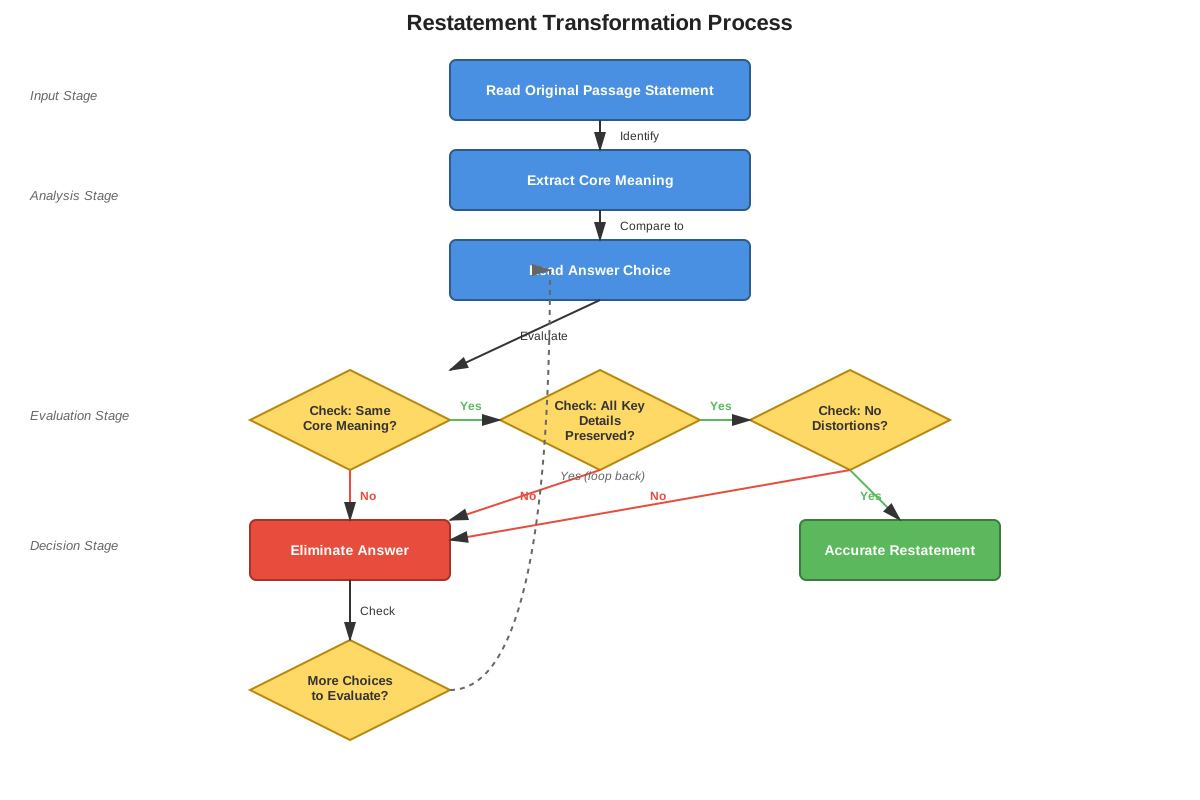
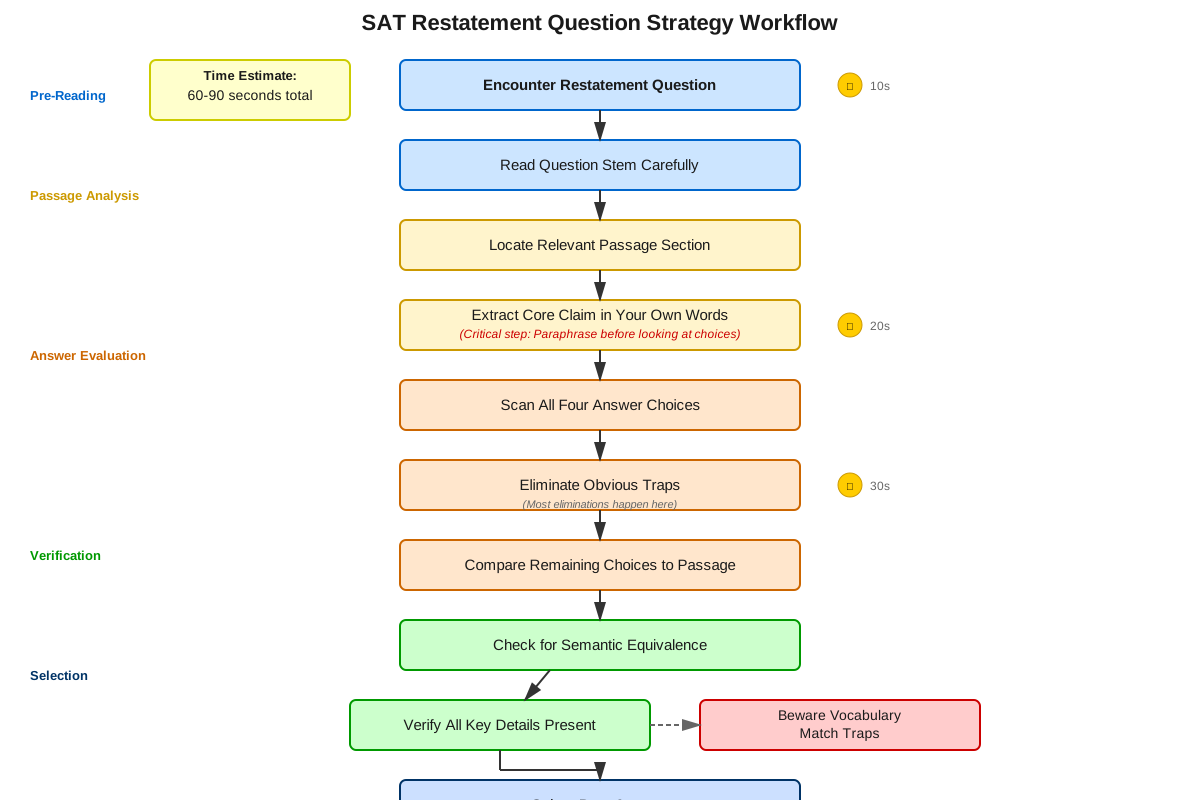
When encountering questions that test restatement of information, follow this systematic approach:
- Read the question stem carefully to identify exactly what information you need to find or verify
- Locate the relevant passage section before looking at answer choices
- Paraphrase the passage content in your own words to ensure comprehension
- Predict what a correct answer might say before reading choices
- Evaluate each answer choice against the passage content, not your own knowledge
- Eliminate answers with scope problems, distortions, or added information
Trigger Words and Phrases
Watch for these question stems that signal restatement questions:
- "According to the passage..."
- "The passage indicates that..."
- "Which statement best describes..."
- "The author claims that..."
- "Which quotation best supports..."
- "The passage states that..."
- "Based on the passage..."
These phrases indicate you need to find information directly stated (though likely paraphrased) in the passage rather than making inferences.
Process of Elimination Tips
Eliminate answers that:
- Introduce extreme language (always, never, only, all, none) unless the passage uses equally extreme language
- Combine details from different passage sections in ways that create new, unsupported claims
- Use passage vocabulary but change the relationships between ideas
- Overgeneralize specific claims or overspecify general claims
- Change the level of certainty (definite vs. possible, proven vs. suggested)
Keep answers that:
- Maintain the same scope as the passage statement
- Preserve cause-and-effect relationships accurately
- Use synonyms and paraphrasing while maintaining meaning
- Match the passage's level of certainty and qualification
Time Allocation
Restatement questions should typically take 45-60 seconds each. If you find yourself spending more than 75 seconds:
- You may be overthinking the question
- Return to the passage to verify the specific detail
- Focus on eliminating clearly wrong answers rather than agonizing between similar choices
Exam Tip: The SAT rewards careful reading over speed. Take the time to verify that your chosen answer truly restates passage content without distortion.
Memory Techniques
The SAME Acronym
Use SAME to verify accurate restatement:
- Scope: Does the answer match the passage's breadth (specific vs. general)?
- Accuracy: Is the core meaning preserved without distortion?
- Meaning: Are the essential claims or details maintained?
- Equivalence: Would the passage author agree this says the same thing?
The "Synonym Swap" Visualization
Visualize correct restatements as having the same "skeleton" (structure of meaning) with different "clothing" (vocabulary and phrasing). The underlying structure remains identical even when the surface appearance changes.
The Three-Level Check
Remember three levels of verification:
- Word level: Are synonyms used appropriately?
- Sentence level: Is the relationship between ideas preserved?
- Concept level: Is the overall meaning equivalent?
All three levels must align for accurate restatement.
The "Passage Says, Answer Says" Method
When evaluating answer choices, explicitly state:
- "The passage says [X]"
- "This answer says [Y]"
- "Are X and Y the same thing?"
This verbalization helps catch subtle distortions that might be missed when reading quickly.
Summary
Restatement of information is a foundational skill for SAT Reading and Writing success, appearing in approximately one-quarter of all questions across multiple question types. Accurate restatement preserves three critical elements—meaning, scope, and level of certainty—while changing vocabulary, sentence structure, or conceptual framing. The SAT tests whether students truly comprehend passage content by requiring them to recognize when information has been paraphrased rather than quoted directly. Success requires distinguishing between accurate restatements and trap answers that use passage vocabulary but distort meaning, overgeneralize or overspecify claims, or combine details incorrectly. Students must read carefully, verify that answer choices maintain semantic equivalence to passage statements, and avoid selecting answers based on vocabulary matching alone. Mastering restatement recognition enables success with detail questions, evidence questions, main idea questions, and serves as a foundation for more advanced comprehension skills tested throughout the exam.
Key Takeaways
- Correct SAT answers typically restate passage content using synonyms and paraphrasing rather than direct quotation
- Accurate restatement preserves meaning, scope, and certainty level while changing surface-level expression
- Trap answers often use exact passage words but distort relationships, combine details incorrectly, or change scope
- Restatement questions appear across multiple question types and represent approximately 20-25% of Reading and Writing questions
- The SAME acronym (Scope, Accuracy, Meaning, Equivalence) provides a systematic method for verifying restatements
- Extreme language in answer choices (always, never, only) typically signals incorrect answers unless the passage uses equally extreme terms
- Success requires careful reading of both passages and answer choices, with attention to subtle differences in meaning and scope
Related Topics
Inference Questions: After mastering restatement, students can progress to inference questions, which require understanding what the passage implies rather than explicitly states. Restatement skills provide the foundation for accurate inference by ensuring students first understand what is directly stated.
Central Ideas and Main Purpose: Identifying main ideas often requires recognizing that multiple sentences or paragraphs restate the same core concept using different examples or phrasings. Restatement mastery directly enables main idea identification.
Command of Evidence: These questions explicitly test restatement by asking students to identify which quotation supports a given claim. The quotation must restate or provide evidence for the claim's meaning.
Synthesis Across Texts: When comparing multiple passages, students must recognize when different sources express similar ideas using different terminology—an advanced application of restatement recognition.
Vocabulary in Context: Understanding how words function in specific contexts helps students recognize when different words can express the same meaning, supporting restatement identification.
Practice CTA
Now that you've mastered the core concepts of restatement of information, it's time to put your knowledge into action! Complete the practice questions to reinforce your understanding and build confidence with SAT-style restatement questions. The flashcards will help you internalize key concepts and recognition patterns. Remember: restatement recognition is a skill that improves with deliberate practice. Each question you work through strengthens your ability to distinguish accurate restatements from subtle distortions, bringing you closer to your target score. You've built a strong foundation—now apply it!
Sign up free to keep reading
Create a free AnvayaPrep account to finish this SAT guide on Restatement of information — plus flashcards and practice questions.