Overview
Textual evidence selection is one of the most fundamental and frequently tested skills on the SAT Reading and Writing section. This skill requires students to identify which specific quotation from a passage best supports a given claim, interpretation, or conclusion. Unlike questions that ask students to make their own inferences, textual evidence questions explicitly test the ability to match evidence to claims—a critical reading comprehension skill that underlies academic success across all disciplines.
On the digital SAT, sat textual evidence selection questions typically present a brief passage followed by a statement or claim about that passage. Students must then choose from four quoted excerpts, selecting the one that most directly and completely supports the given statement. These questions assess whether students can distinguish between evidence that is relevant versus irrelevant, strong versus weak, and direct versus tangential. Mastering this skill is essential because it appears in approximately 15-20% of all rw (Reading and Writing) questions, making it one of the highest-yield topics for score improvement.
The ability to select appropriate textual evidence connects deeply to other central concepts in SAT Reading and Writing, including identifying main ideas, understanding authorial purpose, analyzing arguments, and making valid inferences. When students excel at evidence selection, they simultaneously strengthen their overall reading comprehension, critical thinking, and analytical reasoning—skills that extend far beyond standardized testing into college coursework and professional communication.
Learning Objectives
- [ ] Identify key features of textual evidence selection questions on the SAT
- [ ] Explain how textual evidence selection appears on the SAT and what makes it distinct from other question types
- [ ] Apply textual evidence selection strategies to answer SAT-style questions accurately and efficiently
- [ ] Distinguish between strong evidence that directly supports a claim and weak evidence that is only tangentially related
- [ ] Evaluate multiple pieces of textual evidence to determine which provides the most complete and relevant support
- [ ] Recognize common distractors in evidence selection questions and avoid typical reasoning errors
Prerequisites
- Basic reading comprehension: Understanding literal meaning of sentences and paragraphs is essential because evidence selection requires accurate interpretation of both the claim and the potential supporting quotations.
- Vocabulary knowledge: Familiarity with common academic vocabulary enables students to quickly grasp the meaning of passages and identify relevant evidence without getting stuck on word meanings.
- Understanding of main ideas vs. details: Distinguishing between central points and supporting information helps students recognize when evidence directly addresses a claim versus when it merely relates to the general topic.
- Claim and support structure: Recognizing how arguments are constructed allows students to understand what type of evidence would logically support different kinds of claims.
Why This Topic Matters
In academic and professional contexts, the ability to support claims with appropriate evidence is fundamental to persuasive writing, research, legal reasoning, scientific inquiry, and informed decision-making. Students who master textual evidence selection develop sharper analytical skills that help them evaluate arguments in news articles, research papers, and everyday discourse. This skill teaches students to think critically about the relationship between assertions and proof, preventing them from accepting unsupported claims or making unfounded arguments themselves.
On the SAT specifically, textual evidence selection questions appear with remarkable consistency. Students can expect to encounter 3-5 of these questions per Reading and Writing section, accounting for approximately 15-20% of the total score. These questions appear across all passage types—literary fiction, historical documents, scientific articles, and argumentative essays—making them truly universal within the exam. The College Board considers this skill so essential that it has maintained and even increased the frequency of these questions in the digital SAT format.
Evidence selection questions typically follow one of several patterns: they may ask students to support a stated interpretation of a character's motivation, justify a scientific conclusion drawn from data, validate a historical claim about cause and effect, or substantiate an analysis of an author's rhetorical strategy. Regardless of the specific content area, the fundamental task remains consistent: match the most appropriate textual support to a given claim.
Core Concepts
Understanding Textual Evidence
Textual evidence refers to specific words, phrases, sentences, or passages from a text that support, prove, or illustrate a particular claim, interpretation, or conclusion. On the SAT, textual evidence must come directly from the passage—students cannot rely on outside knowledge or general reasoning. The evidence must be explicit (directly stated) rather than implied, and it must have a clear, logical connection to the claim it supposedly supports.
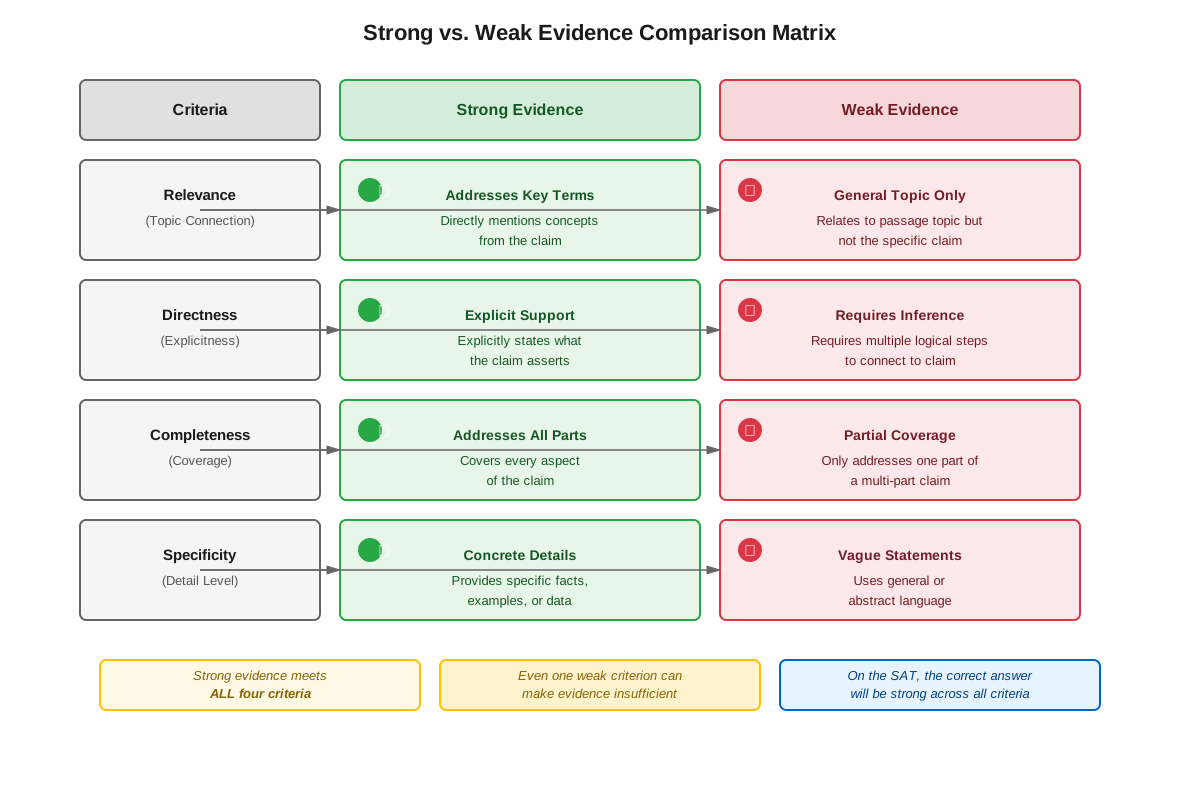
Strong textual evidence possesses three key characteristics:
- Relevance: The evidence directly addresses the specific claim being made, not just the general topic
- Sufficiency: The evidence provides enough information to adequately support the claim
- Directness: The connection between evidence and claim is clear and doesn't require multiple inferential leaps
The Structure of Evidence Selection Questions
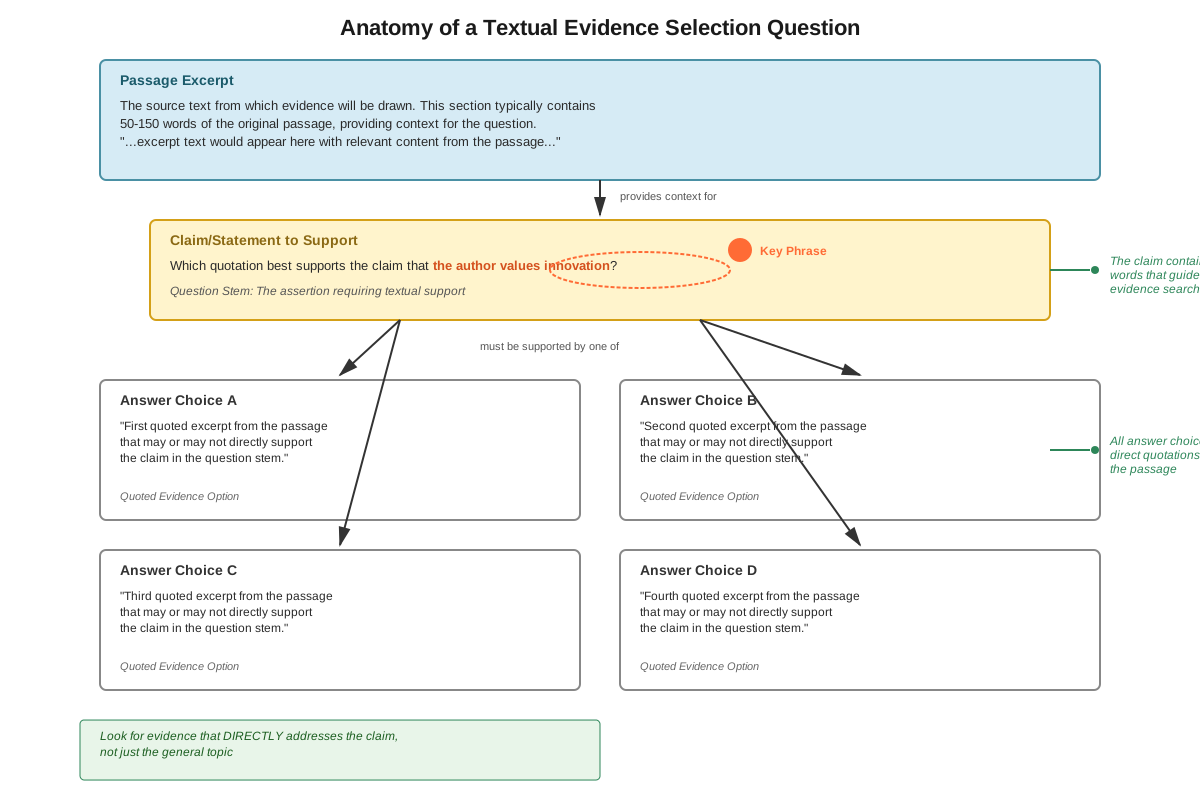
SAT textual evidence selection questions follow a consistent format that students should recognize immediately. The question stem typically includes:
- A brief passage (50-150 words)
- A claim or statement about the passage (often beginning with phrases like "The text suggests that..." or "According to the passage...")
- The question "Which quotation from the text most effectively illustrates the claim?"
- Four answer choices, each presenting a different quotation from the passage
This structure differs from traditional comprehension questions because students aren't generating their own interpretation—they're validating a provided interpretation by finding its best support.
Types of Claims Requiring Evidence
Understanding the type of claim presented helps students identify what kind of evidence would appropriately support it:
| Claim Type | What It Asserts | Evidence Needed |
|---|---|---|
| Factual | A verifiable statement about what exists or occurred | Direct statement or description of the fact |
| Interpretive | An analysis of meaning, motivation, or significance | Details that reveal the interpreted element |
| Causal | A cause-and-effect relationship | Information showing both cause and effect |
| Comparative | A similarity or difference between elements | Details about both elements being compared |
| Evaluative | A judgment about quality, importance, or value | Specific qualities or impacts that justify the judgment |
The Evidence Selection Process
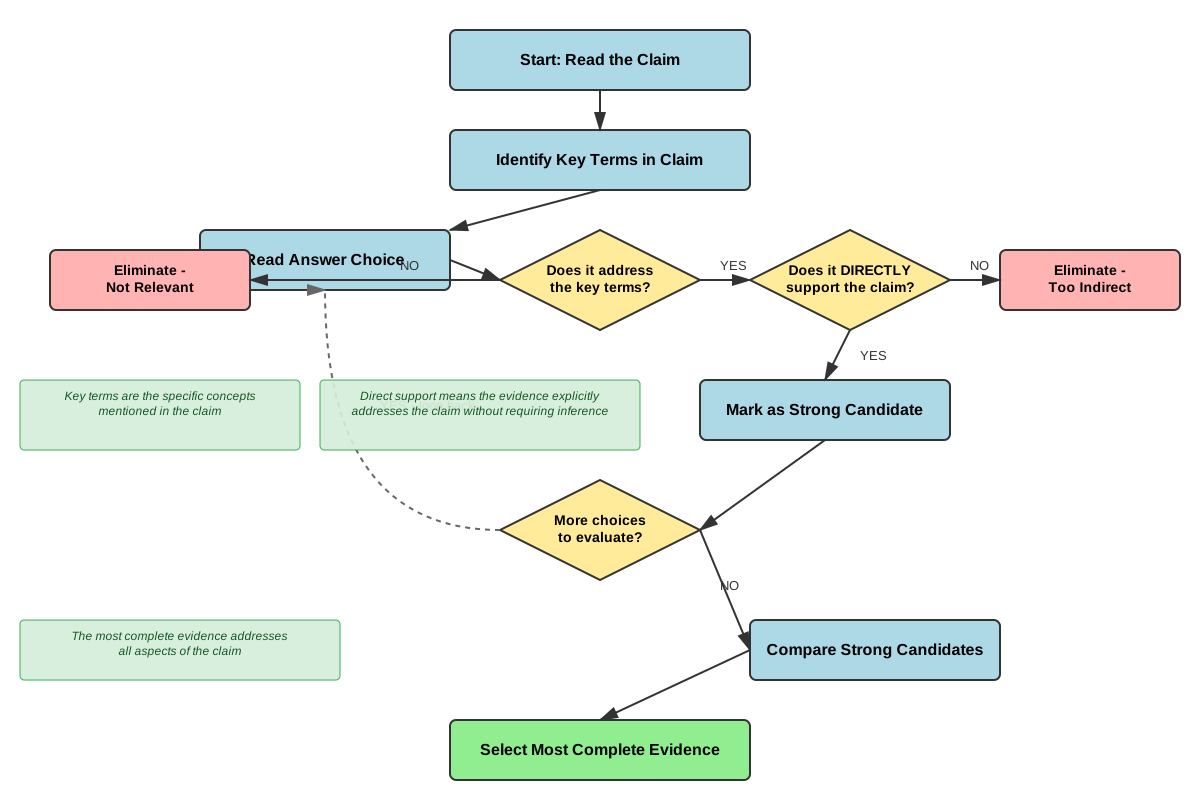
Successful evidence selection follows a systematic approach:
- Read and understand the claim: Before examining answer choices, ensure complete comprehension of what needs to be proven. Identify key terms and the specific assertion being made.
- Predict what evidence would work: Before looking at options, mentally note what type of information would logically support this claim. This prevents premature commitment to weak answers.
- Evaluate each option against the claim: For each quotation, ask: "Does this directly prove or illustrate the specific claim?" Not: "Is this information from the passage?" or "Does this relate to the topic?"
- Eliminate weak connections: Remove options that are factually accurate but don't address the specific claim, or that require additional assumptions to connect to the claim.
- Select the most direct and complete support: Among remaining options, choose the evidence that most explicitly and thoroughly supports the claim without requiring inferential leaps.
Strong vs. Weak Evidence
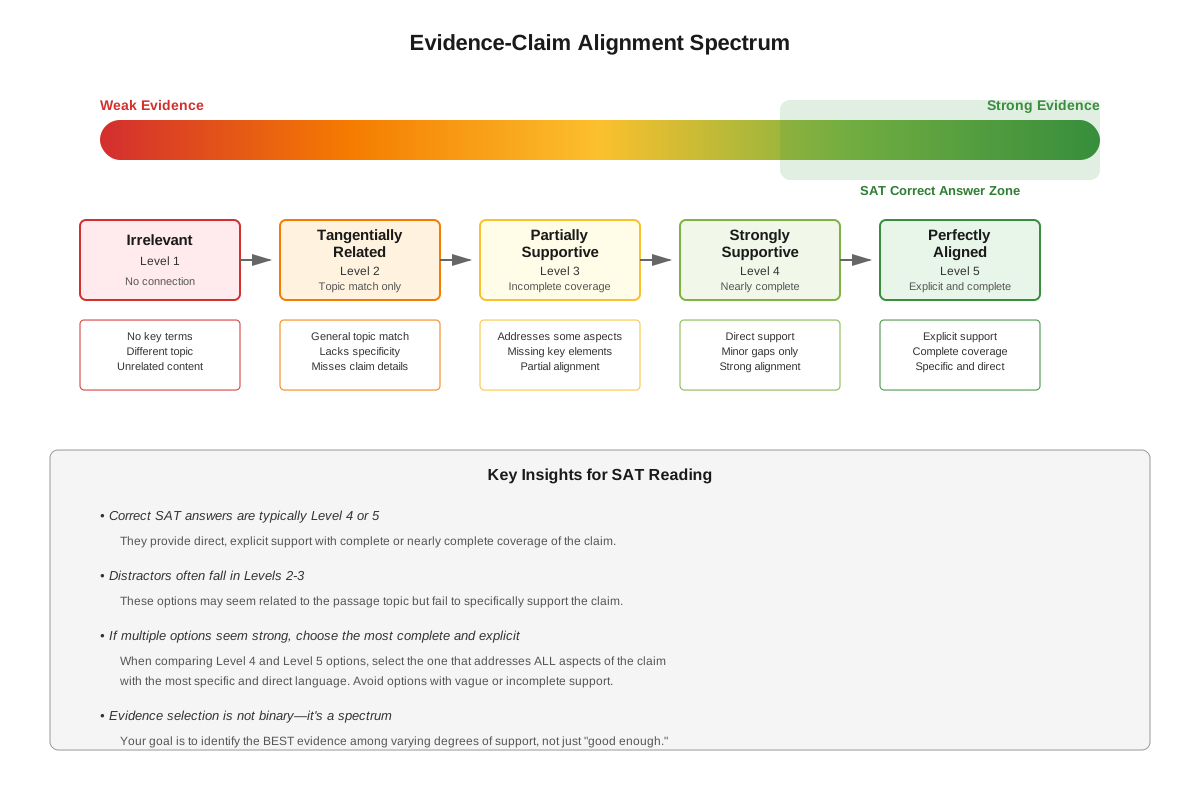
The distinction between strong and weak evidence is crucial for SAT success. Strong evidence creates an immediate, obvious connection to the claim. When students read strong evidence, they think, "Yes, this clearly shows that the claim is true." Weak evidence might be related to the topic or even true, but it doesn't directly prove the specific claim.
Consider this example:
- Claim: "The author believes that urban gardens provide significant community benefits."
- Strong evidence: "Urban gardens create spaces where neighbors collaborate, share resources, and build lasting relationships that strengthen community bonds."
- Weak evidence: "Many cities have established urban gardens in recent years."
The weak evidence confirms that urban gardens exist but says nothing about community benefits. The strong evidence explicitly describes community benefits, directly supporting the claim.
Common Distractor Patterns
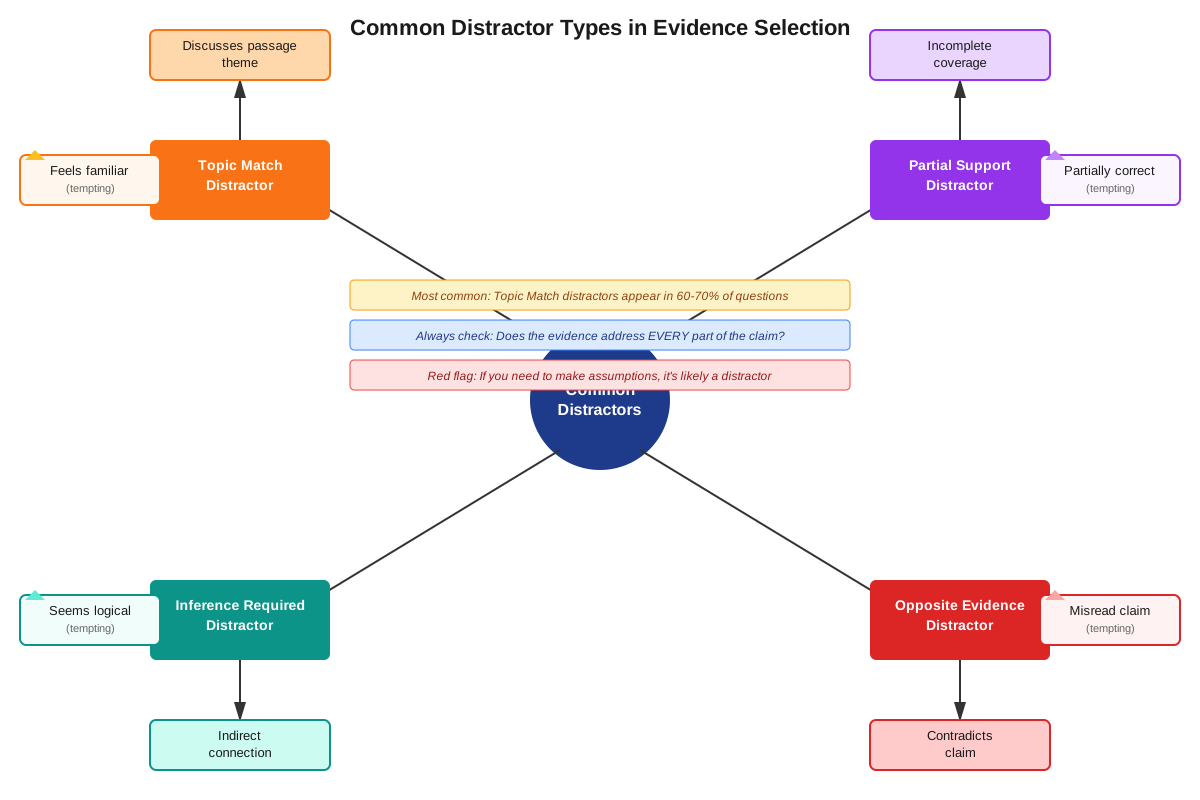
The SAT uses predictable distractor types in evidence selection questions:
- Topic match without claim support: The quotation discusses the same general subject but doesn't address the specific claim
- Partial evidence: The quotation supports part of the claim but omits crucial elements
- Opposite evidence: The quotation actually contradicts the claim (tests careful reading)
- Inference required: The quotation could support the claim but only through additional reasoning not present in the text
- Extreme language mismatch: The claim uses moderate language while the quotation uses extreme language, or vice versa
Concept Relationships
Textual evidence selection serves as a foundational skill that connects to virtually every other aspect of SAT Reading and Writing. The relationship flows in multiple directions:
Evidence Selection → Main Ideas: Identifying main ideas requires recognizing which details in a passage serve as evidence for central claims. Students who excel at evidence selection can more easily distinguish between main ideas (claims) and supporting details (evidence).
Evidence Selection → Inference Questions: While inference questions ask students to draw conclusions, evidence selection asks them to validate conclusions. Both require understanding the logical relationship between stated information and broader meanings. Mastery of evidence selection strengthens inference skills by teaching students to ground interpretations in textual support.
Evidence Selection → Author's Purpose: Determining an author's purpose involves identifying what claim the author is making and recognizing how various passage elements serve as evidence for that purpose. Evidence selection provides the analytical framework for this connection.
Evidence Selection → Argument Analysis: In passages presenting arguments, evidence selection skills help students identify premises (evidence) and conclusions (claims), understand how arguments are constructed, and evaluate argument strength.
The relationship map flows as follows:
Reading Comprehension → enables → Claim Identification → requires → Evidence Evaluation → produces → Evidence Selection → strengthens → Critical Analysis → enhances → Overall SAT Performance
High-Yield Facts
⭐ Evidence selection questions appear 3-5 times per SAT Reading and Writing section, making them one of the most frequent question types.
⭐ The correct answer must directly support the specific claim, not just relate to the general topic of the passage.
⭐ Strong evidence requires minimal inference—the connection between evidence and claim should be immediately apparent.
⭐ All four answer choices typically contain accurate quotations from the passage; the task is selecting the most relevant one.
⭐ Evidence that supports part of a claim but omits crucial elements is a common wrong answer type.
- Evidence selection questions always provide the claim; students never need to generate their own interpretation.
- The correct evidence may come from any part of the passage—beginning, middle, or end.
- Quotations that use extreme language (always, never, only) rarely serve as correct evidence for moderate claims.
- Evidence that requires additional assumptions or outside knowledge to connect to the claim is incorrect.
- The longest or most detailed quotation is not necessarily the correct answer; relevance matters more than length.
- Correct evidence often contains specific details, examples, or descriptions rather than general statements.
- If two answer choices seem equally strong, the one that more completely addresses all aspects of the claim is correct.
- Evidence selection questions test reading comprehension, not prior knowledge about the passage topic.
Quick check — test yourself on Textual evidence selection so far.
Try Flashcards →Common Misconceptions
Misconception: Any quotation that relates to the passage topic is acceptable evidence. → Correction: Evidence must specifically support the particular claim being made, not just discuss the same general subject. A passage about climate change might contain many accurate statements, but only one will directly support a claim about a specific cause or effect.
Misconception: The correct answer is always the longest or most detailed quotation. → Correction: Length and detail don't determine correctness; relevance and directness do. A brief, focused quotation that directly addresses the claim is superior to a lengthy quotation that only tangentially relates to it.
Misconception: Evidence selection requires making inferences or drawing conclusions. → Correction: Unlike inference questions, evidence selection requires finding explicit support. If connecting the evidence to the claim requires additional reasoning or assumptions, that evidence is incorrect.
Misconception: The correct evidence must use the same exact words as the claim. → Correction: Evidence and claims often use different vocabulary while expressing the same idea. Students must recognize synonyms and parallel concepts. A claim about "financial difficulties" might be supported by evidence mentioning "economic hardship" or "monetary struggles."
Misconception: Evidence that appears early in the passage is more likely to be correct. → Correction: Correct evidence can appear anywhere in the passage. The SAT deliberately places correct answers throughout passages to ensure students read completely and carefully.
Misconception: If evidence contradicts the claim, it must be wrong and should be eliminated. → Correction: While contradictory evidence is usually incorrect, students should read carefully—sometimes the claim itself involves a contrast or exception, and the "contradictory" evidence actually supports that nuanced claim.
Misconception: Personal agreement with the claim determines which evidence is correct. → Correction: Students' opinions about the claim's validity are irrelevant. The task is identifying which quotation the passage provides as support, regardless of whether students personally agree with the claim or evidence.
Worked Examples
Example 1: Literary Analysis
Passage:
"Marcus had always considered himself a practical person, someone who made decisions based on logic rather than emotion. Yet as he stood before the old family home, scheduled for demolition the following week, he found himself overwhelmed by memories. The rational arguments for selling—the maintenance costs, the distance from his current life, the impracticality of keeping it—seemed suddenly hollow. He realized that some decisions couldn't be reduced to spreadsheets and cost-benefit analyses."
Claim: The text suggests that Marcus's self-perception as a purely logical decision-maker is being challenged by his emotional response to the family home.
Answer Choices:
A) "Marcus had always considered himself a practical person, someone who made decisions based on logic rather than emotion."
B) "Yet as he stood before the old family home, scheduled for demolition the following week, he found himself overwhelmed by memories."
C) "The rational arguments for selling—the maintenance costs, the distance from his current life, the impracticality of keeping it—seemed suddenly hollow."
D) "He realized that some decisions couldn't be reduced to spreadsheets and cost-benefit analyses."
Analysis:
First, identify what the claim asserts: Marcus's self-perception (logical decision-maker) is being challenged (contradicted or questioned) by his emotional response.
Option A describes Marcus's self-perception but doesn't show it being challenged—it's just stating his belief about himself. This is background information, not evidence of challenge.
Option B shows Marcus experiencing an emotional response ("overwhelmed by memories"), which contradicts his self-image as emotion-free. This directly illustrates the challenge to his self-perception.
Option C describes his rational arguments seeming "hollow," which suggests his logical approach isn't working, but it doesn't explicitly connect this to his emotional response challenging his self-perception.
Option D shows Marcus reaching a realization, which is actually the result of the challenge rather than evidence of the challenge itself.
Correct Answer: B
This quotation most effectively illustrates the claim because it explicitly shows Marcus experiencing the emotional response that challenges his self-perception as someone who decides based on logic rather than emotion. The word "overwhelmed" emphasizes the strength of the emotional response, and the context (standing before the family home) directly connects to the situation challenging his self-image.
Example 2: Scientific Explanation
Passage:
"Researchers studying coral reef ecosystems have discovered that parrotfish play a crucial role in reef health beyond their well-known function of controlling algae growth. By consuming coral and excreting it as fine sand, parrotfish contribute significantly to beach formation in tropical regions. A single large parrotfish can produce up to 200 pounds of sand annually. Additionally, their grazing patterns create spaces where new coral polyps can establish themselves, promoting reef regeneration. Without adequate parrotfish populations, reefs become overgrown with algae and lack the physical structure necessary for diverse marine life."
Claim: The text indicates that parrotfish contribute to coral reef ecosystems in multiple distinct ways.
Answer Choices:
A) "Researchers studying coral reef ecosystems have discovered that parrotfish play a crucial role in reef health."
B) "By consuming coral and excreting it as fine sand, parrotfish contribute significantly to beach formation in tropical regions."
C) "Additionally, their grazing patterns create spaces where new coral polyps can establish themselves, promoting reef regeneration."
D) "Without adequate parrotfish populations, reefs become overgrown with algae and lack the physical structure necessary for diverse marine life."
Analysis:
The claim asserts that parrotfish contribute in "multiple distinct ways"—so we need evidence showing more than one type of contribution.
Option A states that parrotfish play a crucial role but doesn't specify what those roles are or indicate that there are multiple roles. This is too general.
Option B describes one specific contribution (sand/beach formation) but doesn't indicate multiple contributions.
Option C describes a different specific contribution (creating spaces for coral regeneration) and uses the word "Additionally," which signals that this is another contribution beyond those already mentioned. This word explicitly indicates multiple contributions.
Option D describes negative consequences of lacking parrotfish but doesn't directly state the multiple positive contributions parrotfish make.
Correct Answer: C
The word "Additionally" is the key to this answer. It explicitly signals that the grazing pattern contribution is separate from and in addition to other contributions already discussed (algae control and sand production). This directly supports the claim about "multiple distinct ways" by indicating that the passage is listing separate contributions.
Exam Strategy
Approaching Evidence Selection Questions
When encountering a textual evidence selection question, follow this strategic sequence:
- Read the passage first, then the claim: Understanding the full context before examining the claim prevents misinterpretation and helps students recognize which passage elements are most relevant.
- Underline key terms in the claim: Identify the specific assertion being made. If the claim states "The author suggests that urban development threatens biodiversity," underline "urban development," "threatens," and "biodiversity"—the evidence must address all three elements.
- Predict before looking at choices: Ask yourself, "What from the passage would prove this?" This mental prediction prevents being swayed by attractive but incorrect options.
- Eliminate systematically: Remove options that fail the relevance test first, then evaluate remaining options for directness and completeness.
Trigger Words and Phrases
Certain words in claims signal what type of evidence is needed:
- "suggests," "indicates," "implies": Look for evidence that directly states or clearly shows the suggested idea
- "primarily," "mainly," "most importantly": Evidence must address the central or dominant element, not a minor detail
- "challenges," "contradicts," "questions": Evidence must show opposition or contrast
- "supports," "reinforces," "strengthens": Evidence must align with and validate the idea
- "multiple," "various," "several": Evidence must show more than one instance or type
- "specific," "particular," "certain": Evidence must provide concrete details, not generalizations
Process of Elimination Tips
Use these specific elimination strategies:
- The "So What?" test: After reading a quotation, ask "So what does this prove?" If the answer doesn't match the claim, eliminate it.
- The "Says vs. Shows" distinction: Claims about what a text "suggests" or "indicates" need evidence that shows the idea, not just evidence that says something related.
- The "All Elements" check: Verify that the evidence addresses every component of the claim. If the claim mentions two things and the evidence only addresses one, eliminate it.
- The "Inference Gap" measure: If you need to add your own reasoning to connect the evidence to the claim, the gap is too large—eliminate it.
Time Allocation
Evidence selection questions should take approximately 45-60 seconds each. Allocate time as follows:
- 15 seconds: Read passage and claim
- 10 seconds: Predict appropriate evidence
- 25 seconds: Evaluate all four options
- 5-10 seconds: Verify selection
If a question exceeds 75 seconds, make your best selection and move forward. These questions reward careful reading but don't require extensive analysis—the right answer should become apparent with systematic evaluation.
Memory Techniques
The DIRECT Acronym
Remember what makes evidence strong using DIRECT:
- Directly addresses the claim (not just the topic)
- Immediately apparent connection (minimal inference)
- Relevant to all claim components
- Explicit in the text (not implied)
- Complete support (not partial)
- Textually grounded (from the passage, not outside knowledge)
The "Prove It in Court" Visualization
Imagine the claim is an accusation in court and the evidence must convince a jury. Would the quotation make the jury say "That proves it!" or "That's interesting but doesn't prove the claim"? This mental framework helps students distinguish between relevant information and actual proof.
The Three-Question Filter
Before selecting an answer, mentally ask these three questions in order:
- Does it match? (Does the evidence address the same specific idea as the claim?)
- Does it prove? (Does the evidence actually support the claim or just relate to it?)
- Does it complete? (Does the evidence address all parts of the claim?)
Only if the answer to all three is "yes" should the option be selected.
The Synonym Web
Create mental connections between common claim language and evidence language:
- "Challenges" = contradicts, questions, opposes, undermines
- "Supports" = validates, confirms, demonstrates, illustrates
- "Suggests" = indicates, implies, shows, reveals
- "Multiple" = various, several, different, diverse
Recognizing these synonym relationships helps students identify evidence that expresses the same idea using different vocabulary.
Summary
Textual evidence selection is a high-frequency, high-impact skill on the SAT Reading and Writing section that tests students' ability to match specific quotations to claims they support. Success requires understanding that evidence must directly, explicitly, and completely support the particular claim being made—not just relate to the general topic. The systematic approach involves reading the claim carefully, predicting what evidence would work, evaluating each option against the specific claim, and selecting the quotation with the most immediate and obvious connection. Common pitfalls include selecting evidence that only partially supports the claim, choosing quotations that require additional inference, or picking options that discuss the topic without proving the specific assertion. Students who master the DIRECT criteria (Directly addresses, Immediately apparent, Relevant, Explicit, Complete, Textually grounded) and apply systematic elimination strategies can consistently identify correct evidence, significantly improving their overall SAT Reading and Writing scores.
Key Takeaways
- Evidence selection questions appear 3-5 times per SAT section and test the ability to match quotations to claims they support
- Correct evidence must directly support the specific claim, not just relate to the passage topic
- Strong evidence requires minimal inference—the connection should be immediately apparent
- All answer choices typically contain accurate quotations; the challenge is identifying the most relevant one
- Systematic evaluation using the DIRECT criteria prevents common errors and improves accuracy
- Evidence that supports only part of a claim or requires additional assumptions is incorrect
- Predicting appropriate evidence before examining answer choices prevents premature commitment to weak options
Related Topics
Main Idea Identification: Understanding how to distinguish between central claims and supporting details builds directly on evidence selection skills, as main ideas are essentially claims that the passage's details serve as evidence for.
Inference and Interpretation: While evidence selection validates provided claims, inference questions require generating claims from evidence—the inverse relationship that deepens understanding of the claim-evidence connection.
Author's Purpose and Tone: Analyzing why authors include specific details requires recognizing how those details serve as evidence for the author's broader purpose or attitude.
Argument Analysis: Evaluating the strength of arguments involves assessing whether provided evidence adequately supports claims—a direct application of evidence selection principles to persuasive writing.
Rhetorical Synthesis: Advanced questions asking students to combine information from multiple sources require identifying which evidence from each source supports a synthesized claim.
Practice CTA
Now that you understand the principles and strategies of textual evidence selection, it's time to apply these skills to authentic SAT-style questions. The practice questions and flashcards will reinforce your ability to quickly identify strong evidence, eliminate common distractors, and build the confidence needed for test day success. Remember: evidence selection is a learnable skill that improves dramatically with focused practice. Each question you work through strengthens your analytical reading abilities and brings you closer to your target score. Start practicing now to transform this high-yield topic into one of your greatest strengths on the SAT!
Sign up free to keep reading
Create a free AnvayaPrep account to finish this SAT guide on Textual evidence selection — plus flashcards and practice questions.