Overview
The SAT Reading and Writing section tests a student's ability to comprehend passages and answer questions based solely on the information provided within those passages. Avoiding outside knowledge is a fundamental skill that distinguishes successful test-takers from those who struggle with the exam. This principle requires students to resist the temptation to answer questions based on what they already know about a topic and instead focus exclusively on what the passage explicitly states or directly implies.
Many students encounter difficulty with SAT avoiding outside knowledge because they bring their personal experiences, classroom learning, or general knowledge to bear on questions when the test specifically demands text-based evidence. The SAT is designed to assess reading comprehension and analytical skills, not subject-matter expertise. A student might know extensive facts about climate change, historical events, or scientific principles, but if that information doesn't appear in the passage, it's irrelevant to answering the question correctly. This creates a unique challenge: students must temporarily set aside their broader knowledge base and operate within the confined universe of the passage.
Within the broader RW (Reading and Writing) framework, avoiding outside knowledge connects directly to Command of Evidence skills, which require students to identify textual support for claims, distinguish between stated and unstated information, and recognize the boundaries of what a passage actually communicates. This skill underpins nearly every question type on the Reading and Writing section, from main idea questions to inference questions to vocabulary-in-context items. Mastering this concept is not optional—it's the foundation upon which all other SAT reading strategies are built.
Learning Objectives
- [ ] Identify key features of avoiding outside knowledge
- [ ] Explain how avoiding outside knowledge appears on the SAT
- [ ] Apply avoiding outside knowledge to answer SAT-style questions
- [ ] Distinguish between information explicitly stated in a passage and external knowledge
- [ ] Recognize when answer choices introduce information not supported by the text
- [ ] Evaluate whether an inference is warranted based solely on passage content
- [ ] Develop systematic approaches to verify that answers are text-based rather than knowledge-based
Prerequisites
- Basic reading comprehension skills: Students must be able to understand grade-level passages and identify main ideas, as avoiding outside knowledge builds on the ability to extract meaning from text.
- Understanding of evidence-based reasoning: Familiarity with the concept that claims require textual support is essential, since this topic extends that principle to every answer choice.
- Awareness of inference versus assumption: Students should recognize the difference between logical conclusions drawn from text and unsupported assumptions, as this distinction is central to avoiding outside knowledge.
Why This Topic Matters
In real-world contexts, avoiding outside knowledge teaches critical thinking skills that extend far beyond standardized testing. Legal professionals must base arguments on case law and evidence rather than personal opinion. Scientists must distinguish between what their data shows and what they hope or believe to be true. Journalists must report what sources say rather than what they personally know about a topic. This skill of disciplined, text-based reasoning is fundamental to academic and professional success.
On the SAT specifically, avoiding outside knowledge is tested in virtually every Reading and Writing question. The College Board explicitly designs passages and questions to trap students who rely on external information. Exam statistics show that this is one of the most common reasons students miss questions they should get correct—they choose answers that are factually true in the real world but unsupported by the passage. Questions testing this skill appear across all passage types: literature, history/social studies, and science. The frequency is essentially 100% because every question requires students to base their answer on passage content.
Common manifestations include questions where answer choices contain accurate real-world information that seems relevant but isn't mentioned in the passage, questions where students must choose between what the passage says and what they know to be true, and questions where the passage presents an outdated or controversial viewpoint that students must analyze objectively rather than correct based on current knowledge. The SAT deliberately includes passages with perspectives that may differ from contemporary understanding specifically to test whether students can set aside their own knowledge and work within the passage's framework.
Core Concepts
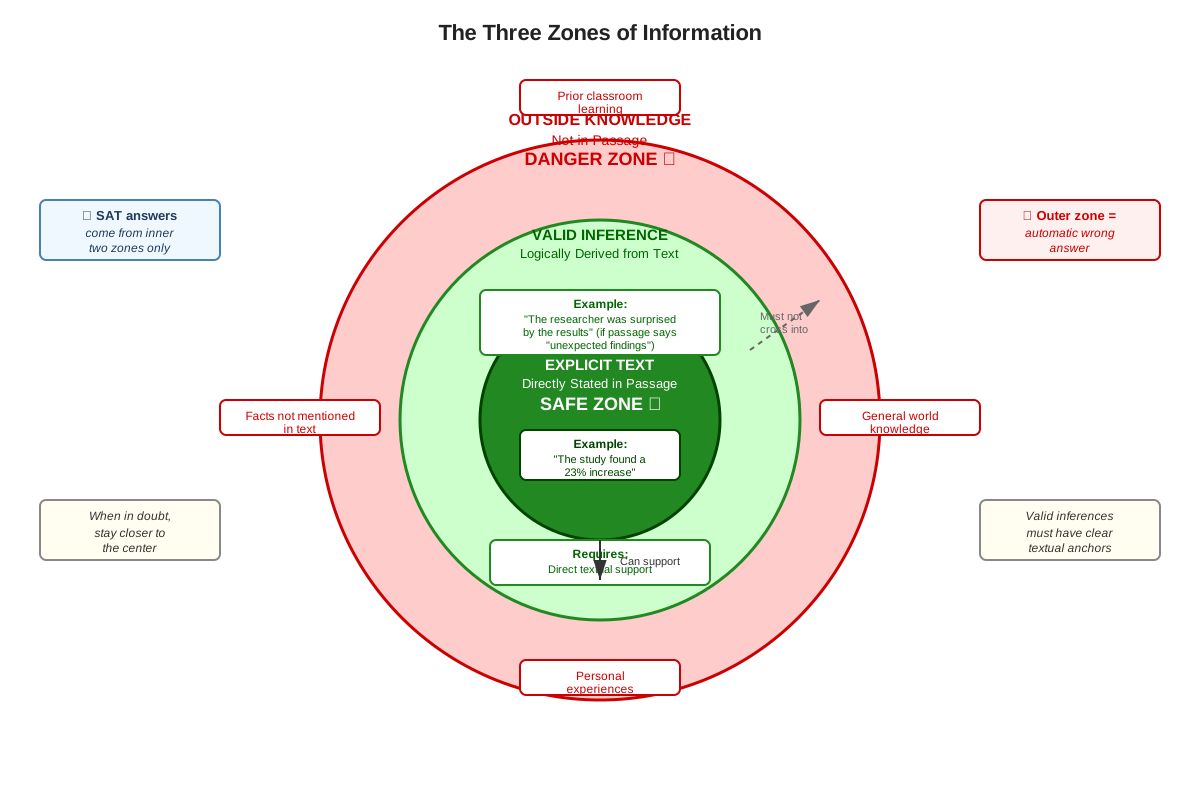
The Fundamental Principle: The Passage Is Your Universe
Avoiding outside knowledge means treating each passage as a self-contained universe where only the information presented exists for the purpose of answering questions. When approaching any SAT Reading and Writing question, students must adopt a mindset that their prior knowledge, no matter how extensive or accurate, is irrelevant unless it appears in the passage itself. This requires a deliberate mental shift from "What do I know about this topic?" to "What does this specific passage tell me?"
The passage serves as the sole authority for all questions. If a passage discusses photosynthesis but omits mention of chlorophyll, then chlorophyll doesn't exist in that passage's universe, even though every student knows it's essential to photosynthesis in reality. If a historical passage presents a particular interpretation of an event, students must work within that interpretation rather than correcting it based on what they learned in history class.
Types of Outside Knowledge That Interfere
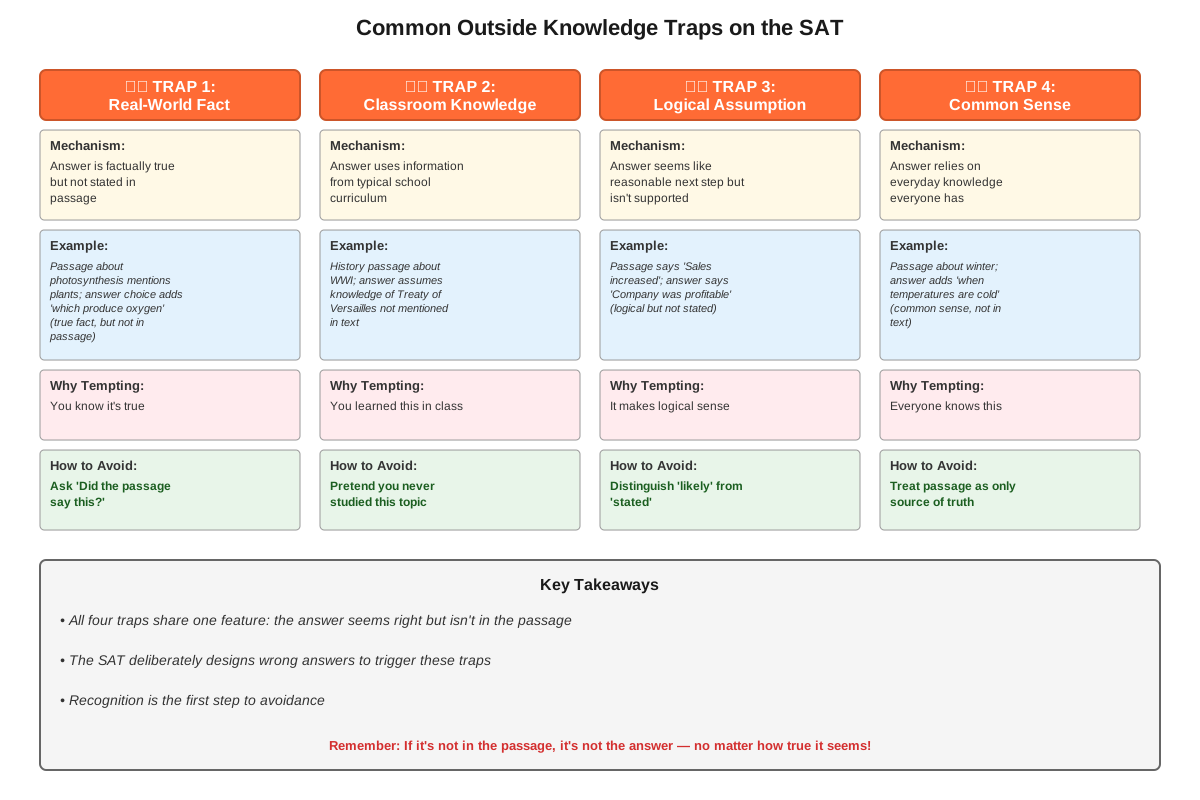
Students bring several categories of external knowledge that can interfere with accurate passage-based reasoning:
Subject-matter expertise: Students who have studied a topic extensively may know facts, theories, or details not mentioned in the passage and incorrectly assume these are relevant to answering questions.
Current events and contemporary perspectives: Modern understanding of historical events, scientific discoveries, or social issues may differ from how a passage presents them, especially in older texts or passages presenting specific viewpoints.
Personal experience: Individual experiences with topics discussed in passages can create strong associations that feel relevant but aren't supported by the text.
Common sense assumptions: What seems logical or obvious in real life may not be what the passage supports or implies.
Distinguishing Stated Information from Implied Information
The SAT requires students to work with two types of passage-based information:
| Information Type | Definition | Example |
|---|---|---|
| Explicitly Stated | Information directly written in the passage | "The experiment was conducted in 2019." |
| Directly Implied | Information that logically follows from what's stated | If a passage says "All participants completed the survey," it's implied that no participants failed to complete it. |
| Outside Knowledge | Information not stated or implied by the passage | Knowing that 2019 preceded the COVID-19 pandemic (unless the passage mentions this) |
Valid inferences must be supported by specific textual evidence. They represent conclusions that must be true based on what the passage states, not conclusions that could be true or are likely true based on general knowledge.
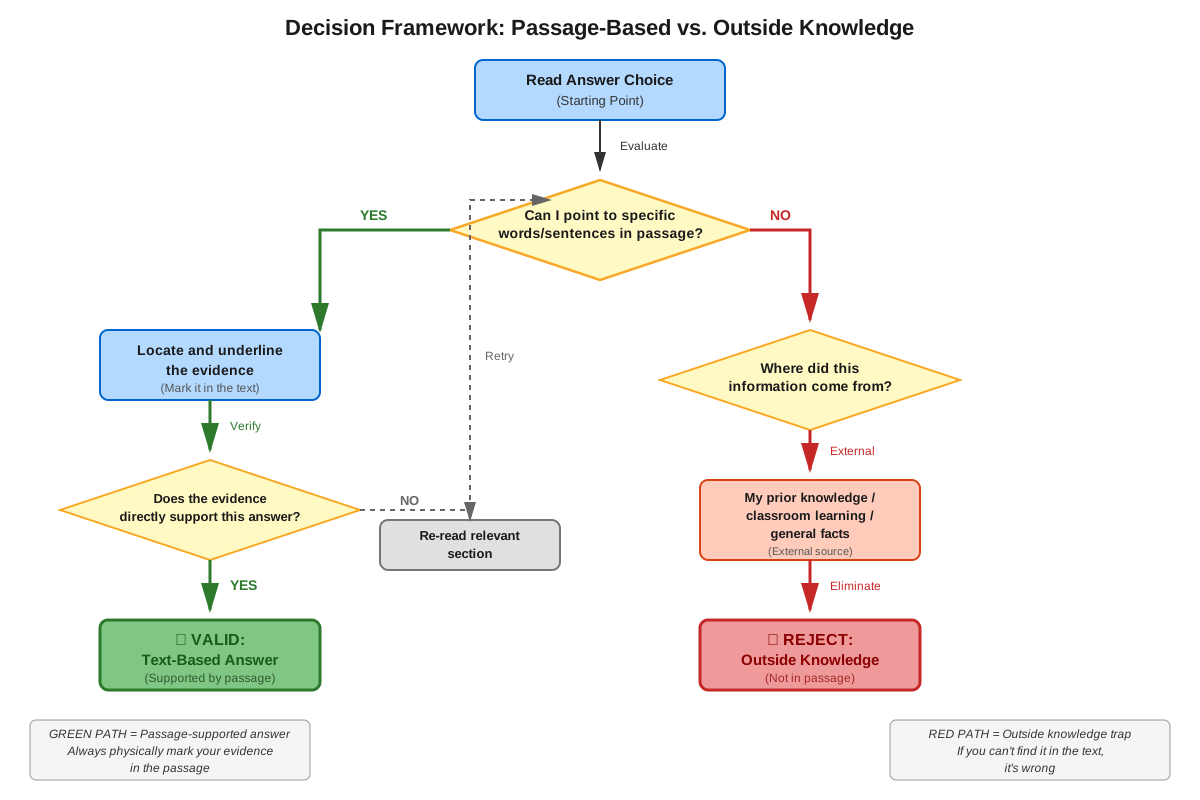
The Evidence-Based Answer Selection Process
Every correct answer on the SAT Reading and Writing section can be defended by pointing to specific words, phrases, or sentences in the passage. This creates a systematic approach:
- Read the question carefully to understand exactly what it asks
- Predict an answer based solely on passage content before looking at choices
- Evaluate each answer choice by asking: "Where in the passage does it say or directly imply this?"
- Eliminate choices that introduce new information, contradict the passage, or require outside knowledge
- Verify the remaining choice by identifying the specific textual evidence that supports it
When Passages Present Incomplete or Controversial Information
The SAT frequently includes passages that present partial information, historical perspectives that have since been revised, or viewpoints that students might disagree with. This is intentional. The test assesses whether students can analyze what a text says rather than what they wish it said or what they know to be more accurate.
For example, a historical passage might present a 19th-century perspective on an event without including modern historical consensus. Students must answer questions based on the 19th-century perspective presented, not based on what they learned in their history class. A science passage might describe an early theory that has since been superseded. Questions must be answered based on that early theory as presented, not based on current scientific understanding.
The Role of Context Clues and Passage Structure
While students must avoid outside knowledge, they should fully utilize everything the passage provides, including context clues, structural elements, and rhetorical patterns. The passage itself often contains sufficient information to answer questions that might initially seem to require external knowledge. Careful attention to:
- Definitions or explanations provided within the passage
- Examples that illustrate concepts
- Comparisons and contrasts that clarify meaning
- Cause-and-effect relationships explicitly stated
- Author's tone and purpose as revealed through word choice
These passage-based elements provide the foundation for answering questions without importing external information.
Concept Relationships
The core concepts within avoiding outside knowledge form an interconnected system. The fundamental principle (treating the passage as a self-contained universe) → establishes the framework for → distinguishing stated from implied information → which enables → the evidence-based answer selection process → which helps students → handle passages with incomplete or controversial information → while → utilizing context clues and passage structure to maximize passage-based information.
This topic connects to prerequisite knowledge of basic reading comprehension by extending it: students move from understanding what a passage says to rigorously limiting themselves to only what it says. The skill of distinguishing inference from assumption becomes operationalized through the systematic process of verifying that every answer choice has textual support.
Avoiding outside knowledge also connects forward to other Command of Evidence skills, particularly identifying textual evidence and analyzing arguments. When students master the discipline of passage-based reasoning, they're better equipped to evaluate whether evidence supports a claim, recognize gaps in arguments, and assess the strength of textual support—all skills tested extensively on the SAT.
High-Yield Facts
- ⭐ Every correct SAT Reading and Writing answer can be defended by pointing to specific passage content; if you can't find textual support, the answer is wrong
- ⭐ The SAT deliberately includes answer choices that are factually accurate in the real world but unsupported by the passage to trap students who use outside knowledge
- ⭐ When a passage presents an outdated or controversial viewpoint, answer questions based on that viewpoint as presented, not based on current understanding
- ⭐ Valid inferences must be directly supported by passage content; "could be true" based on general knowledge is not the same as "must be true" based on the passage
- ⭐ If you find yourself thinking "I know this from class" or "This is common sense," you're likely using outside knowledge inappropriately
- The passage is the sole authority for all questions; treat it as a self-contained universe
- Explicitly stated information and directly implied information are both valid; outside knowledge is never valid
- Answer choices that introduce new concepts, facts, or ideas not mentioned in the passage are incorrect
- Personal experience and subject-matter expertise can interfere with accurate passage-based reasoning
- The evidence-based answer selection process requires identifying specific textual support for every answer choice
- Context clues within the passage often provide sufficient information to answer questions that initially seem to require external knowledge
Quick check — test yourself on Avoiding outside knowledge so far.
Try Flashcards →Common Misconceptions
Misconception: If an answer choice is factually accurate in the real world, it must be correct. → Correction: An answer choice must be supported by the passage, regardless of its real-world accuracy. The SAT tests reading comprehension, not general knowledge. A factually true statement that isn't supported by passage content is incorrect.
Misconception: Using background knowledge about a topic helps answer questions more accurately. → Correction: Background knowledge often leads students astray by introducing information the passage doesn't contain. The most successful approach is to temporarily set aside external knowledge and work exclusively within the passage's framework.
Misconception: If the passage doesn't explicitly state something, it can't be the right answer. → Correction: Valid inferences that must be true based on passage content are acceptable. The key distinction is between what the passage directly implies (acceptable) and what outside knowledge suggests (unacceptable).
Misconception: When a passage presents information that contradicts what you learned in school, the passage must be wrong, so you should answer based on what you know. → Correction: The SAT sometimes includes passages with historical perspectives, outdated theories, or specific viewpoints that differ from current understanding. Questions must be answered based on what the passage presents, not based on external knowledge of what's "really" true.
Misconception: Common sense reasoning is always appropriate for answering SAT questions. → Correction: Common sense assumptions often introduce outside knowledge. What seems obvious or logical in real life may not be what the passage supports. Every answer must be grounded in specific textual evidence.
Misconception: If you're familiar with the topic, you can skim the passage and rely on what you already know. → Correction: Familiarity with a topic makes it even more important to read carefully, as you're more likely to unconsciously import external information. The passage may present the topic differently than you expect.
Worked Examples
Example 1: Science Passage
Passage excerpt: "The researchers observed that plants exposed to blue light grew faster than those exposed to red light during the three-week study period. The blue-light group showed a 23% increase in height compared to the control group."
Question: Based on the passage, which statement about the plants is supported?
Answer Choices:
- A) Blue light contains more energy than red light, causing faster growth
- B) Plants exposed to blue light grew faster than those exposed to red light
- C) Chlorophyll absorbs blue light more efficiently than red light
- D) The plants would continue growing faster indefinitely under blue light
Analysis:
Choice A introduces outside knowledge about light energy. While it's scientifically accurate that blue light has higher energy than red light, the passage doesn't mention this. Students with physics knowledge might be tempted by this choice, but it requires information not in the passage.
Choice B directly restates information explicitly provided in the passage: "plants exposed to blue light grew faster than those exposed to red light." This can be defended by pointing to specific passage content.
Choice C introduces the concept of chlorophyll, which doesn't appear in the passage. Even though chlorophyll is central to plant biology, it's outside knowledge in this context.
Choice D makes a claim about indefinite growth that extends beyond the passage's scope. The passage only describes a three-week study period and makes no claims about long-term effects.
Correct Answer: B
Key Lesson: Even when you know extensive information about a topic (plant biology, light physics), the correct answer is the one that directly reflects passage content without importing external facts.
Example 2: Historical Passage
Passage excerpt: "In his 1848 address, Senator Williams argued that westward expansion would bring prosperity to the nation by providing new agricultural opportunities. He emphasized that the vast territories offered unlimited potential for settlement and economic growth."
Question: According to the passage, Senator Williams believed westward expansion would benefit the nation primarily through:
Answer Choices:
- A) The displacement of indigenous populations and acquisition of their lands
- B) The discovery of gold and other valuable minerals in western territories
- C) New agricultural opportunities in vast territories
- D) The fulfillment of America's manifest destiny
Analysis:
Choice A introduces information about indigenous populations that, while historically accurate and relevant to westward expansion, doesn't appear in this passage excerpt. Students who know about the negative impacts of westward expansion might be drawn to this choice, but it requires outside knowledge.
Choice B mentions gold and minerals, which aren't discussed in the passage. Even though gold discoveries were historically significant to westward expansion (California Gold Rush, etc.), this passage focuses on agricultural opportunities.
Choice C directly reflects what the passage states: Senator Williams "argued that westward expansion would bring prosperity to the nation by providing new agricultural opportunities." This can be defended with specific textual evidence.
Choice D introduces the concept of "manifest destiny," a historically important ideology associated with westward expansion. However, this term doesn't appear in the passage, and the passage doesn't describe this concept. This is outside knowledge.
Correct Answer: C
Key Lesson: Historical passages often discuss topics students have studied in school. The temptation to use classroom knowledge is strong, but questions must be answered based solely on what this specific passage says, not on general historical knowledge.
Exam Strategy
Approaching Questions Systematically
When encountering any SAT Reading and Writing question, follow this process:
- Read the question stem carefully before looking at answer choices to understand exactly what's being asked
- Return to the passage and locate relevant information (use line references if provided)
- Formulate your own answer based on passage content before examining choices
- Evaluate each choice by asking: "Can I point to specific words in the passage that support this?"
- Eliminate choices that introduce new information or require outside knowledge
- Verify your selection by confirming textual support
Trigger Words and Phrases
Watch for these question stems that specifically test avoiding outside knowledge:
- "According to the passage..." (demands passage-based answer)
- "Based on the text..." (requires textual support)
- "The passage suggests..." (must be directly implied, not assumed)
- "As presented in the passage..." (emphasizes passage-specific information)
- "The author indicates..." (must come from author's actual words)
Be cautious when you notice yourself thinking:
- "I learned in class that..."
- "Everyone knows that..."
- "It's obvious that..."
- "Common sense tells us..."
- "Based on my experience..."
These thought patterns signal that you may be importing outside knowledge.
Process of Elimination Tips
Eliminate answer choices that:
- Introduce concepts, terms, or facts not mentioned in the passage
- Make claims that extend beyond the passage's scope
- Contradict passage content (unless the question asks for this)
- Require specialized knowledge to understand or evaluate
- Sound sophisticated or technical but lack passage support
Keep answer choices that:
- Paraphrase or directly restate passage content
- Make claims you can defend by pointing to specific sentences
- Stay within the boundaries of what the passage discusses
- Align with the passage's tone and perspective
Time Allocation
Don't rush through passages to save time. Spending an extra 30 seconds carefully reading ensures you understand what the passage actually says, which prevents costly mistakes from using outside knowledge. When evaluating answer choices, invest 5-10 seconds per choice to verify textual support rather than selecting the first choice that "sounds right" based on your general knowledge.
Exam Tip: If you're torn between two answer choices, the one that requires less interpretation and stays closer to the passage's actual words is usually correct. The SAT rewards conservative, text-based reasoning over creative or knowledge-based interpretation.
Memory Techniques
The "Point to It" Rule
Mnemonic: P.O.I.N.T. - Passage Only, Ignore Non-Textual information
Before selecting any answer, physically point to (or mentally identify) the specific sentence or phrase in the passage that supports it. If you can't point to it, don't pick it.
The Universe Visualization
Visualize each passage as a bubble or sphere—a complete universe. Everything inside the bubble exists for the purpose of answering questions. Everything outside the bubble (your knowledge, experiences, education) doesn't exist. When answering questions, imagine yourself inside that bubble, unable to access anything external.
The "Says vs. Knows" Check
Create a mental checklist:
- Says: What the passage explicitly states
- Implies: What the passage directly suggests
- Knows: What I know from outside (AVOID)
Before selecting an answer, categorize it as S, I, or K. Only S and I are acceptable.
The Evidence Anchor
Acronym: A.N.C.H.O.R. your answers in the text
- Analyze the question
- Note relevant passage sections
- Consider only passage content
- Highlight textual support
- Omit outside knowledge
- Review your evidence
Summary
Avoiding outside knowledge is the foundational skill for success on the SAT Reading and Writing section. It requires students to treat each passage as a self-contained universe and answer questions based exclusively on what the passage explicitly states or directly implies, regardless of their personal knowledge, educational background, or real-world understanding of the topic. The SAT deliberately includes answer choices that are factually accurate but unsupported by passage content to test whether students can maintain this discipline. Success requires a systematic approach: carefully reading passages, predicting answers before examining choices, evaluating each option by identifying specific textual support, and eliminating choices that introduce information not present in the passage. This skill connects to all other Command of Evidence competencies and appears in virtually every Reading and Writing question. Students must distinguish between valid inferences (conclusions that must be true based on passage content) and outside knowledge (information that could be true but isn't supported by the text). Mastering this concept transforms SAT performance by eliminating a primary source of errors.
Key Takeaways
- The passage is the sole authority for all questions; treat it as a complete, self-contained universe
- Every correct answer can be defended by pointing to specific textual evidence; if you can't find passage support, the answer is wrong
- Factually accurate information from the real world is incorrect if the passage doesn't support it
- Valid inferences must be directly implied by passage content, not based on general knowledge or common sense
- Watch for trigger phrases like "according to the passage" and "based on the text" that emphasize passage-based reasoning
- Use the systematic evidence-based answer selection process: read carefully, predict, evaluate with textual support, eliminate unsupported choices
- Be especially vigilant when you're familiar with a passage topic, as expertise increases the risk of importing outside knowledge
Related Topics
Command of Evidence - Textual Evidence: After mastering avoiding outside knowledge, students progress to explicitly identifying which passage sentences support specific claims, a skill that builds directly on the foundation of passage-based reasoning.
Command of Evidence - Analyzing Arguments: Understanding how to evaluate arguments based solely on presented evidence requires the discipline of avoiding outside knowledge, as students must assess argument strength using only the information provided.
Inference Questions: These questions test the ability to draw conclusions that must be true based on passage content, requiring students to distinguish between valid passage-based inferences and assumptions based on outside knowledge.
Vocabulary in Context: Determining word meaning from context requires ignoring the word's common definition if the passage uses it differently, another application of avoiding outside knowledge.
Rhetorical Synthesis: Combining information from multiple sources requires tracking what each source actually says rather than what students know about the topic, extending the avoiding outside knowledge principle to multi-text scenarios.
Practice CTA
Now that you understand the critical skill of avoiding outside knowledge, it's time to put this knowledge into practice. The practice questions and flashcards have been specifically designed to test your ability to distinguish between passage-based reasoning and outside knowledge. As you work through them, consciously apply the "Point to It" rule and the systematic evidence-based approach. Remember: every question is an opportunity to strengthen this foundational skill. The more you practice identifying textual support and eliminating knowledge-based distractions, the more automatic this process becomes. You're building the disciplined reading habits that lead to top SAT scores—stay focused on the passage, trust the process, and watch your accuracy improve!
Sign up free to keep reading
Create a free AnvayaPrep account to finish this SAT guide on Avoiding outside knowledge — plus flashcards and practice questions.