Overview
Claims and support is one of the most fundamental and frequently tested concepts in the SAT Reading and Writing (RW) section, appearing in the Command of Evidence unit. This topic tests a student's ability to evaluate whether evidence effectively supports, weakens, or relates to a given claim. On the SAT, students must demonstrate critical thinking by analyzing the logical relationship between statements and the data, examples, or reasoning provided to back them up.
Understanding claims and support is essential because it forms the backbone of analytical reading and evidence-based reasoning—skills that permeate nearly every question type in the SAT claims and support domain. Questions in this category typically present a claim (a statement or conclusion) followed by several pieces of potential evidence, asking students to identify which piece best supports or illustrates the claim. These questions assess whether students can distinguish between relevant and irrelevant information, strong and weak evidence, and direct versus tangential support.
This topic connects directly to other Reading and Writing concepts such as textual evidence, inference, main idea identification, and argument analysis. Mastering claims and support provides the foundation for understanding how authors construct arguments, how researchers present findings, and how effective communication relies on the strategic pairing of assertions with substantiation. Success with this topic translates to improved performance across multiple question types and prepares students for the evidence-based reasoning required in college-level academic work.
Learning Objectives
- [ ] Identify key features of claims and support
- [ ] Explain how claims and support appears on the SAT
- [ ] Apply claims and support to answer SAT-style questions
- [ ] Distinguish between strong and weak evidence for a given claim
- [ ] Evaluate whether evidence directly supports, indirectly supports, or contradicts a claim
- [ ] Analyze the logical relationship between multiple pieces of evidence and a central assertion
- [ ] Recognize common patterns in how SAT questions present claims and supporting evidence
Prerequisites
- Basic reading comprehension: Understanding main ideas and details in passages is necessary to identify what constitutes a claim versus supporting evidence
- Vocabulary knowledge: Recognizing transition words and logical connectors helps identify relationships between claims and evidence
- Paragraph structure awareness: Understanding how sentences relate within a paragraph aids in distinguishing thesis statements from supporting details
- Cause-and-effect reasoning: Recognizing causal relationships helps evaluate whether evidence logically supports a claim
Why This Topic Matters
Claims and support questions appear with remarkable frequency on the SAT, typically comprising 10-15% of all Reading and Writing questions. This translates to approximately 5-8 questions per test, making it one of the highest-yield topics for focused study. The College Board has consistently emphasized evidence-based reasoning in recent test iterations, reflecting the academic skills students need for college success.
In real-world applications, the ability to evaluate claims and support is fundamental to critical thinking across all disciplines. Scientists must assess whether experimental data supports hypotheses, historians evaluate whether primary sources substantiate interpretations, and professionals in every field must distinguish between well-supported conclusions and unsupported assertions. This skill protects against misinformation, enables informed decision-making, and forms the basis of persuasive communication.
On the SAT, claims and support questions typically appear in several formats: students might see a research finding followed by four potential pieces of supporting evidence, a historical claim with various examples, or a scientific conclusion with different data sets. Passages span diverse subjects including social sciences, natural sciences, humanities, and literature. The questions test not just whether students can identify evidence, but whether they can evaluate the strength, relevance, and directness of that evidence in relation to the specific claim presented.
Core Concepts
Understanding Claims
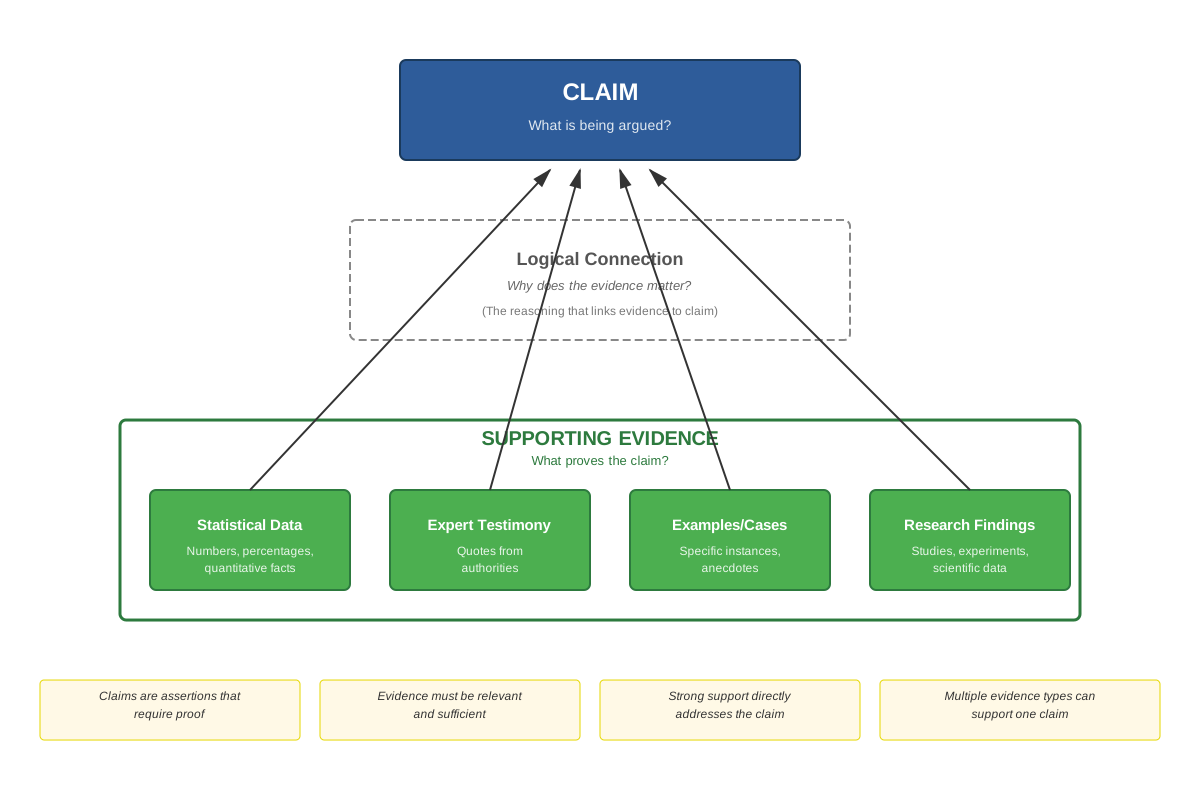
A claim is an assertion, statement, or conclusion that requires evidence to be credible. Claims can be factual statements, interpretations, arguments, hypotheses, or generalizations. On the SAT, claims are typically presented as complete statements that express a specific idea, finding, or position. For example: "Urban green spaces significantly improve mental health outcomes in city residents" is a claim that makes a specific assertion requiring supporting evidence.
Claims vary in scope and specificity. Broad claims make sweeping generalizations ("Technology has transformed modern communication"), while narrow claims focus on specific phenomena ("The introduction of smartphones in 2007 increased average daily screen time by 3.2 hours among teenagers"). The SAT typically presents claims that are specific enough to be supported by concrete evidence but broad enough to require careful evaluation of which evidence is most relevant.
Understanding Support
Support refers to evidence, examples, data, reasoning, or illustrations that substantiate a claim. Effective support must be relevant (directly related to the claim), sufficient (adequate in quantity and quality), and credible (from reliable sources or logical reasoning). On the SAT, support can take many forms:
- Statistical data: Numerical information from studies or surveys
- Expert testimony: Statements from authorities in a field
- Examples: Specific instances that illustrate a general claim
- Experimental results: Findings from controlled studies
- Historical evidence: Events or records from the past
- Logical reasoning: Cause-and-effect relationships or deductive arguments
The Relationship Between Claims and Support
The connection between claims and support operates on a spectrum of strength and directness:
| Relationship Type | Description | Example |
|---|---|---|
| Direct Support | Evidence explicitly proves or demonstrates the claim | Claim: "The program increased graduation rates." Support: "Graduation rates rose from 65% to 82% after program implementation." |
| Indirect Support | Evidence suggests or implies the claim is true | Claim: "The program improved student outcomes." Support: "Student attendance increased by 15%." |
| Weak Support | Evidence is tangentially related but doesn't strongly substantiate | Claim: "The program was effective." Support: "Teachers reported feeling more satisfied." |
| Irrelevant Information | Evidence doesn't connect to the claim | Claim: "The program improved math scores." Support: "The program cost $50,000." |
| Contradictory Evidence | Evidence undermines or opposes the claim | Claim: "The program was successful." Support: "Test scores declined during the program period." |
Evaluating Evidence Quality
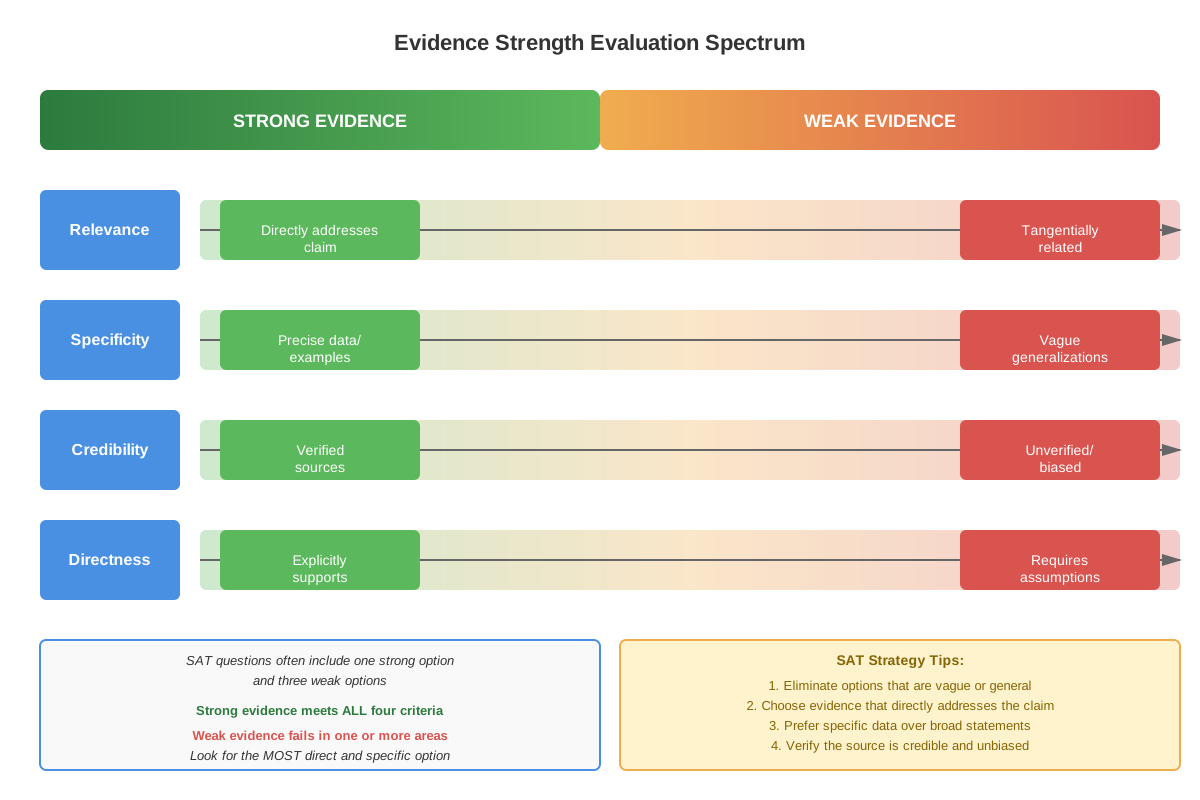
Not all evidence carries equal weight. The SAT tests whether students can distinguish between strong and weak support. Strong evidence is:
- Specific rather than vague: "Temperatures increased by 1.2°C" is stronger than "Temperatures got warmer"
- Quantified when possible: Numbers, percentages, and measurements provide concrete support
- Directly relevant: The evidence addresses the exact phenomenon mentioned in the claim
- From credible sources: Research studies, expert analysis, and documented observations carry more weight than anecdotes
- Sufficient in scope: The evidence covers an appropriate sample size or time period
Common Question Formats
SAT claims and support questions typically follow these patterns:
Format 1: Best Supporting Evidence
Students receive a claim followed by four options, each presenting different evidence. The task is identifying which option best supports the claim.
Format 2: Completing a Claim
Students see evidence first, then must select which claim is best supported by that evidence.
Format 3: Evaluating Multiple Sources
Students analyze how different pieces of evidence relate to a central claim, determining which provides the strongest support.
The Role of Specificity
Specificity is crucial in claims and support relationships. A specific claim requires specific support. For instance, if a claim states "Monarch butterfly populations declined by 80% between 1996 and 2014," the best support would provide data about monarch populations during that specific timeframe, not general information about butterfly conservation or data from different years.
Concept Relationships
The concepts within claims and support form an interconnected system. Understanding claims serves as the foundation—students must first identify what assertion is being made before they can evaluate evidence. This leads directly to understanding support, which involves recognizing different types of evidence. These two concepts merge in evaluating the relationship between claims and support, where students assess strength, relevance, and directness.
Evaluating evidence quality builds upon the relationship concept by introducing criteria for distinguishing strong from weak support. This connects to specificity, which acts as a key metric for evidence quality. Finally, common question formats represent the practical application of all previous concepts, showing how the SAT tests these skills in various configurations.
The relationship map flows as follows:
Identify Claim → Recognize Support Types → Evaluate Relationship Strength → Apply Quality Criteria → Assess Specificity → Answer Question Formats
This topic connects to prerequisite knowledge of reading comprehension (identifying main ideas helps distinguish claims from details) and cause-and-effect reasoning (understanding logical relationships aids in evaluating support). It also relates to broader RW skills including inference (sometimes support implies rather than explicitly states), argument analysis (claims and support form the building blocks of arguments), and textual evidence (locating specific passages that substantiate interpretations).
High-Yield Facts
⭐ Claims and support questions comprise approximately 10-15% of SAT Reading and Writing questions, making them one of the most frequently tested topics
⭐ The best supporting evidence is always directly relevant to the specific claim, not just generally related to the topic
⭐ Quantitative data (numbers, percentages, measurements) typically provides stronger support than qualitative descriptions
⭐ Evidence that addresses the exact time period, location, or population mentioned in the claim is stronger than evidence from different contexts
⭐ The correct answer will support the claim as written, not a modified or related version of the claim
- Evidence can support a claim without proving it absolutely; the SAT asks for "best" support, not "perfect" support
- Irrelevant information, even if true and interesting, does not constitute support for a claim
- Multiple pieces of weak evidence do not equal one piece of strong evidence in SAT questions
- The presence of specific examples strengthens support for general claims
- Evidence that contradicts part of a claim cannot be considered supporting evidence, even if it relates to the topic
Quick check — test yourself on Claims and support so far.
Try Flashcards →Common Misconceptions
Misconception: Any information related to the topic of the claim counts as supporting evidence → Correction: Evidence must specifically support the particular assertion made in the claim, not just relate to the general subject matter. If a claim states "Solar energy costs decreased by 50% from 2010-2020," evidence about solar energy's environmental benefits doesn't support that specific claim about cost reduction.
Misconception: Longer or more detailed evidence is always stronger support → Correction: The strength of evidence depends on relevance and directness, not length. A single precise statistic often provides stronger support than a lengthy description that only tangentially relates to the claim.
Misconception: Evidence must prove a claim completely to be considered supporting evidence → Correction: On the SAT, students select the "best" supporting evidence from available options. Evidence can support a claim by making it more credible or likely, even without providing absolute proof.
Misconception: If evidence mentions the same keywords as the claim, it must be good support → Correction: Keyword matching doesn't guarantee relevance. Evidence must address the specific relationship or phenomenon described in the claim, not just mention the same subjects. A claim about "increased rainfall in coastal regions" isn't supported by evidence about "decreased rainfall in coastal regions" despite sharing keywords.
Misconception: Expert opinions always provide the strongest support → Correction: While expert testimony can be valuable, specific data or examples that directly demonstrate the claim often provide stronger support than general expert statements. The SAT values evidence that directly shows the phenomenon described in the claim.
Misconception: Evidence from a prestigious source automatically supports any related claim → Correction: The content of the evidence matters more than its source. Even information from a respected institution must directly address the specific claim to serve as effective support.
Worked Examples
Example 1: Scientific Research Claim
Claim: Researchers concluded that regular meditation practice reduces cortisol levels in adults experiencing chronic stress.
Evidence Options:
A) A study found that adults who meditated for 20 minutes daily for eight weeks showed a 25% decrease in cortisol levels compared to a control group.
B) Meditation has been practiced for thousands of years in various cultures around the world.
C) Many adults report feeling less stressed after beginning a meditation practice.
D) Cortisol is a hormone released by the adrenal glands in response to stress.
Analysis:
First, identify the specific claim: meditation practice reduces cortisol levels in stressed adults. The claim makes a specific physiological assertion about a measurable outcome (cortisol reduction) in a specific population (stressed adults) from a specific intervention (meditation).
Evaluate each option:
- Option A provides quantitative data (25% decrease) from a controlled study comparing meditation practitioners to a control group, directly measuring cortisol levels. This directly supports the specific claim.
- Option B offers historical context about meditation but doesn't address cortisol levels or stress reduction at all.
- Option C mentions stress reduction but relies on subjective reports ("feeling less stressed") rather than measuring cortisol levels, which is what the claim specifically addresses.
- Option D defines cortisol but doesn't provide evidence about meditation's effect on it.
Answer: A is the best support because it provides specific, quantitative evidence directly demonstrating the relationship between meditation and cortisol reduction in the population mentioned in the claim.
Example 2: Historical Claim
Claim: The introduction of the printing press in Europe during the 15th century significantly accelerated the spread of scientific knowledge.
Evidence Options:
A) Johannes Gutenberg invented the movable-type printing press around 1440 in Mainz, Germany.
B) Between 1450 and 1500, the number of scientific texts in circulation increased from approximately 30,000 to over 200,000 copies.
C) The printing press also facilitated the spread of religious texts, including the Bible.
D) Before the printing press, monks copied manuscripts by hand in monasteries.
Analysis:
The claim asserts that the printing press "significantly accelerated" the spread of "scientific knowledge" specifically. The key elements are: acceleration (increased speed/quantity), scientific knowledge (not just any information), and the causal relationship to the printing press.
Evaluate each option:
- Option A provides information about the invention itself but doesn't demonstrate acceleration of knowledge spread.
- Option B offers quantitative evidence showing a dramatic increase (30,000 to 200,000) in scientific texts specifically during the period after the printing press introduction, directly demonstrating accelerated spread.
- Option C discusses religious texts, which doesn't support a claim specifically about scientific knowledge.
- Option D describes the previous method but doesn't demonstrate the acceleration that occurred after the printing press.
Answer: B provides the best support because it quantifies the increase in scientific text circulation during the relevant time period, directly demonstrating the "significant acceleration" claimed.
Exam Strategy
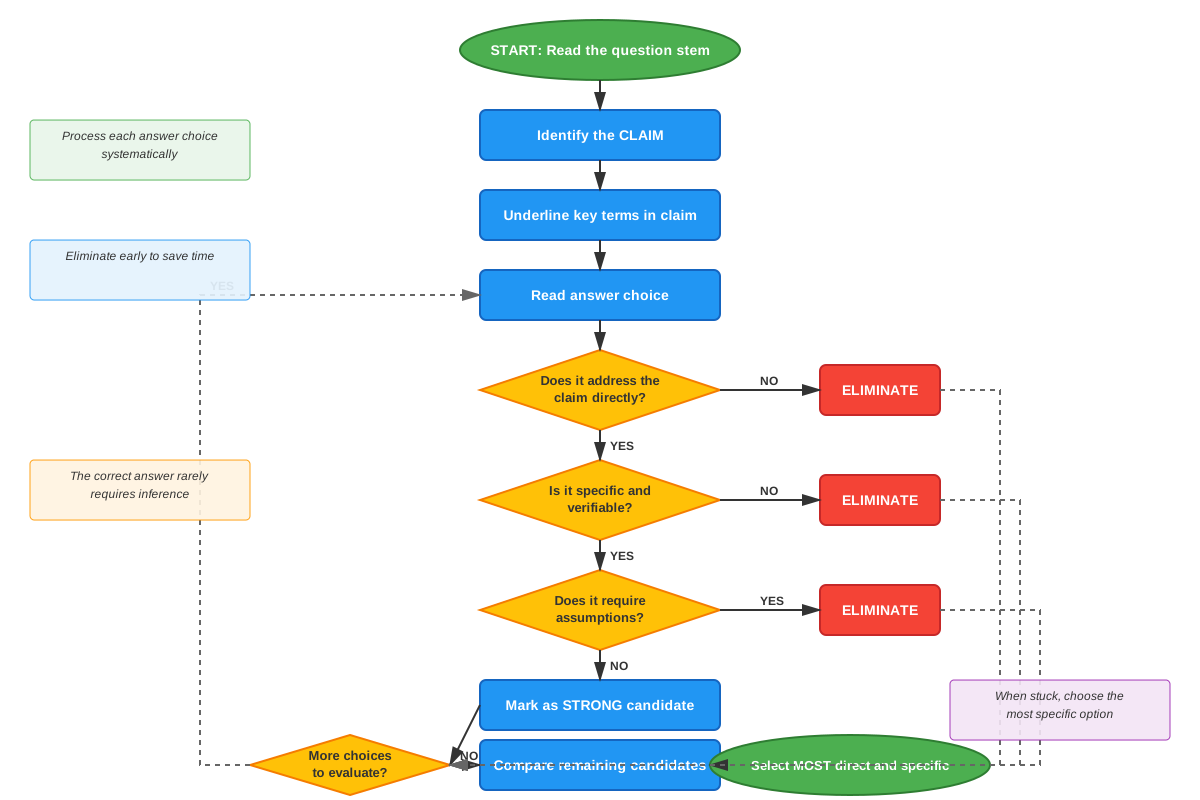
When approaching sat claims and support questions, follow this systematic process:
Step 1: Identify and Underline Key Elements of the Claim
Mark specific details including: what is being claimed, about whom/what, when, where, and any quantitative elements. These specifics guide your evaluation of evidence.
Step 2: Predict What Good Support Would Look Like
Before reading the options, mentally note what type of evidence would directly demonstrate this claim. If the claim is about a 30% increase, good support should mention that percentage or similar data.
Step 3: Eliminate Clearly Irrelevant Options
Remove choices that discuss different subjects, time periods, or populations than those specified in the claim. This typically eliminates 1-2 options immediately.
Step 4: Compare Remaining Options for Directness and Specificity
Choose the option that most directly addresses the claim's specific assertion with concrete evidence rather than general statements.
Exam Tip: Watch for trigger phrases in claims such as "significantly increased," "primarily caused by," "most effective," or "directly resulted in." These specific assertions require evidence that addresses that exact relationship or degree.
Trigger Words to Watch For:
- Quantitative terms: "increased by," "decreased to," "doubled," "majority" (require numerical evidence)
- Causal language: "caused," "resulted in," "led to," "because of" (require evidence showing the causal relationship)
- Temporal markers: "during," "between," "after," "before" (require evidence from the specified time period)
- Scope indicators: "primarily," "mainly," "most," "significantly" (require evidence demonstrating that degree or scope)
Time Allocation: Spend 45-60 seconds per claims and support question. These questions reward careful reading but don't require extensive analysis once you've identified the claim's key elements.
Process of Elimination Tips:
- Eliminate options that are true statements but don't support the specific claim
- Remove options that support a related but different claim
- Discard options that provide background information rather than evidence
- Eliminate options with vague language when the claim is specific
Memory Techniques
DIRECT Acronym for Evaluating Evidence:
- Directly addresses the claim's specific assertion
- Includes relevant details (time, place, population)
- Relevant to the exact phenomenon described
- Explicit rather than implied connection
- Concrete data or examples
- Targeted to the claim's scope and specificity
Visualization Strategy: Picture the claim as a target's bullseye. Evidence that hits the center (directly supports with specific data) scores highest. Evidence in outer rings (related but not specific, or general information) scores lower. Evidence completely off the target (irrelevant information) scores zero.
The "Specificity Match" Technique: Create a mental checklist matching the claim's specific elements:
- If claim mentions a percentage → look for that percentage in evidence
- If claim mentions a time period → look for data from that period
- If claim mentions a population → look for evidence about that population
- If claim mentions a location → look for evidence from that location
The "So What?" Test: After reading potential evidence, ask "So what does this tell me about the claim?" If you can't draw a direct line from the evidence to the claim without making assumptions, it's probably not the best support.
Summary
Claims and support represents a cornerstone skill in SAT Reading and Writing, testing students' ability to evaluate whether evidence effectively substantiates assertions. Success requires understanding that claims are specific statements requiring substantiation, while support consists of evidence, data, examples, or reasoning that makes claims more credible. The critical skill lies in evaluating the relationship between claims and support—assessing whether evidence is directly relevant, sufficiently specific, and appropriately targeted to the exact assertion being made. Strong evidence addresses the precise phenomenon, population, time period, and scope mentioned in the claim, typically providing quantitative data or concrete examples rather than general statements or tangential information. Students must distinguish between information that is merely related to a topic and evidence that specifically supports the particular claim presented. Mastering this topic requires careful attention to the specific wording of claims, systematic evaluation of how directly each piece of evidence addresses that claim, and recognition that the best support always matches the claim's specificity and scope.
Key Takeaways
- Claims and support questions test whether evidence directly substantiates specific assertions, not just whether information relates to the general topic
- The best supporting evidence matches the claim's specificity in terms of time period, population, location, and scope
- Quantitative data (percentages, measurements, numbers) typically provides stronger support than qualitative descriptions
- Evidence must address the exact relationship or phenomenon described in the claim, not a related or modified version
- Eliminate options that provide background information, definitions, or context rather than evidence demonstrating the claim
- Watch for trigger words in claims (significantly, primarily, caused by) that indicate what type of evidence is required
- The "best" support is the most direct and specific, even if other options are true statements about the topic
Related Topics
Textual Evidence: Building on claims and support, textual evidence questions ask students to locate specific passages that support interpretations or conclusions about literary and informational texts. Mastering claims and support provides the foundation for evaluating which textual excerpts best substantiate analytical assertions.
Argument Analysis: Understanding claims and support enables deeper analysis of how authors construct arguments, including identifying premises, conclusions, and the logical connections between them. This progression moves from evaluating single claim-evidence pairs to analyzing complex argumentative structures.
Inference Questions: While claims and support focuses on explicit evidence, inference questions require students to draw conclusions from implicit information. The skills of evaluating relevance and strength transfer directly to assessing which inferences are best supported by textual details.
Data Interpretation: Many claims and support questions involve interpreting graphs, charts, or statistical information. Developing comfort with quantitative evidence in this context prepares students for questions requiring data analysis and synthesis.
Practice CTA
Now that you've mastered the core concepts of claims and support, it's time to apply these skills to authentic SAT-style questions. The practice questions and flashcards will reinforce your ability to quickly identify claims, evaluate evidence quality, and select the best supporting information under timed conditions. Remember: consistent practice with immediate feedback is the most effective way to transform understanding into test-day performance. Each practice question you complete strengthens your pattern recognition and builds the confidence you need to excel on this high-yield topic. Start practicing now to solidify your mastery!
Sign up free to keep reading
Create a free AnvayaPrep account to finish this SAT guide on Claims and support — plus flashcards and practice questions.