Overview
The SAT Reading and Writing section frequently presents questions that require students to synthesize information from multiple sources—specifically, comparing textual and numerical evidence. These questions assess a student's ability to evaluate whether data presented in tables, graphs, or charts supports, contradicts, or relates to claims made in accompanying passages. This skill represents a critical intersection of reading comprehension and quantitative reasoning, reflecting the College Board's emphasis on cross-disciplinary thinking and evidence-based analysis.
Mastering SAT comparing textual and numerical evidence questions is essential because they appear consistently throughout the exam and carry significant weight in the Command of Evidence domain. Students must demonstrate not only that they can read and understand written arguments, but also that they can interpret numerical data and determine the relationship between these two forms of evidence. This requires careful attention to specific details in both the text and the data presentation, as well as the ability to identify when numerical evidence strengthens, weakens, or is irrelevant to a textual claim.
Within the broader RW (Reading and Writing) framework, this topic builds upon foundational skills in textual evidence analysis while adding the complexity of quantitative literacy. It connects directly to other Command of Evidence skills, such as identifying supporting details and evaluating the strength of arguments, but distinguishes itself by requiring students to move fluidly between verbal and numerical reasoning modes. Success on these questions demonstrates college readiness by showing that students can engage with the kind of evidence-based reasoning required in academic research, scientific writing, and data-driven decision-making across disciplines.
Learning Objectives
- [ ] Identify key features of comparing textual and numerical evidence
- [ ] Explain how comparing textual and numerical evidence appears on the SAT
- [ ] Apply comparing textual and numerical evidence to answer SAT-style questions
- [ ] Distinguish between numerical evidence that supports, contradicts, or is irrelevant to textual claims
- [ ] Analyze the specific relationship between quantitative data points and written assertions
- [ ] Evaluate the strength of evidence by synthesizing information from multiple representational formats
- [ ] Recognize common patterns in how the SAT presents textual-numerical comparison questions
Prerequisites
- Basic graph and table interpretation: Students must be able to read bar graphs, line graphs, pie charts, and data tables to extract specific numerical values and identify trends.
- Understanding of textual claims and assertions: Recognizing the difference between factual statements, opinions, and evidence-based conclusions in written passages is essential for comparison.
- Fundamental statistical concepts: Basic familiarity with percentages, ratios, increases/decreases, and comparative relationships helps students interpret numerical data accurately.
- Reading comprehension skills: The ability to identify main ideas, supporting details, and the author's purpose in a passage provides the foundation for evaluating how numerical evidence relates to textual content.
Why This Topic Matters
In academic and professional contexts, the ability to integrate textual and numerical evidence is fundamental to critical thinking and informed decision-making. Scientists must reconcile experimental data with theoretical predictions, historians must evaluate statistical records alongside narrative accounts, and business professionals must align quantitative metrics with strategic narratives. The SAT tests this skill because it represents authentic intellectual work that students will encounter throughout their college careers and beyond.
On the SAT, comparing textual and numerical evidence questions appear with high frequency—typically 2-4 questions per test across the Reading and Writing modules. These questions are particularly important because they often appear in the second, more difficult module of the adaptive test, making them crucial for students aiming for top scores. The College Board has increased emphasis on these questions in recent years, reflecting educational standards that prioritize data literacy and evidence-based reasoning.
These questions commonly appear in passages about scientific research, social science studies, historical trends, or economic analyses. The passage will present a claim, hypothesis, or conclusion, while an accompanying table, graph, or chart provides numerical data. Students must determine which answer choice accurately describes the relationship between the textual claim and the numerical evidence. The data might confirm the claim, contradict it, provide partial support, or address a different aspect of the topic entirely. Understanding these nuanced relationships is essential for success on this high-yield question type.
Core Concepts
Understanding Textual Claims
A textual claim is an assertion, conclusion, or hypothesis presented in written form within a passage. On the SAT, these claims vary in specificity and strength. Some claims make absolute statements ("X always causes Y"), while others are more qualified ("X tends to increase Y under certain conditions"). Recognizing the precise scope and limitations of a textual claim is the first step in comparing it to numerical evidence.
When analyzing textual claims, students should identify:
- The specific variables or phenomena being discussed
- The nature of the relationship being asserted (causal, correlational, comparative)
- Any qualifying language that limits the claim's scope (e.g., "in most cases," "among certain populations")
- The time period or context to which the claim applies
Interpreting Numerical Evidence
Numerical evidence on the SAT appears in various formats: tables with rows and columns of data, bar graphs comparing categories, line graphs showing trends over time, scatter plots displaying relationships between variables, or pie charts illustrating proportions. Each format requires specific interpretation skills.
Key aspects of numerical evidence interpretation include:
- Identifying the units of measurement and scale
- Reading axis labels, column headers, and legends accurately
- Extracting specific data points relevant to the textual claim
- Recognizing trends, patterns, increases, decreases, or stability in the data
- Understanding what the data does and does not show (avoiding overinterpretation)
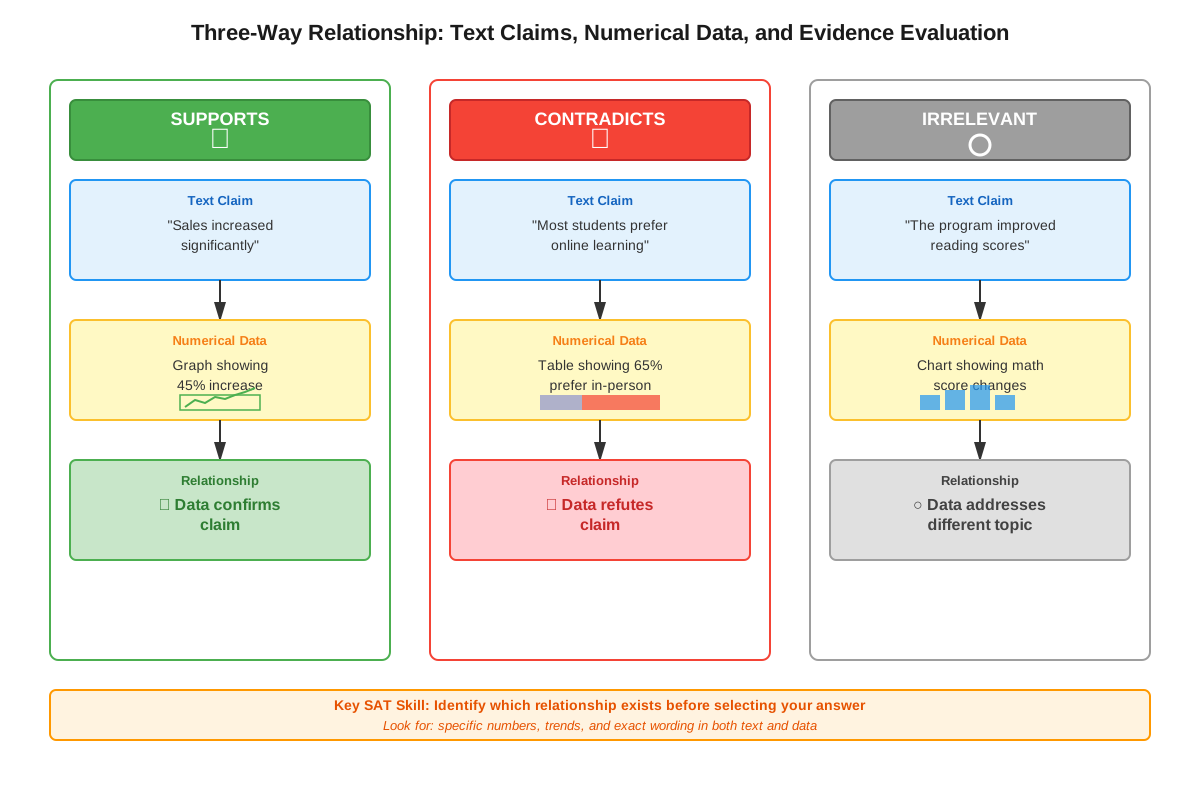
Types of Relationships Between Text and Data
The relationship between textual claims and numerical evidence falls into several categories that appear repeatedly on the SAT:
| Relationship Type | Description | Example |
|---|---|---|
| Direct Support | Data confirms the claim with specific evidence | Text: "Sales increased in Q3." Data: Q3 shows 25% sales growth |
| Contradiction | Data directly opposes the claim | Text: "Temperature decreased." Data: Temperature rose from 20°C to 25°C |
| Partial Support | Data supports some but not all aspects of the claim | Text: "All regions grew." Data: 3 of 4 regions show growth |
| Irrelevance | Data addresses different variables or time periods | Text: "Profits rose in 2020." Data: Shows employee count, not profits |
| Nuanced Relationship | Data requires careful interpretation to relate to claim | Text: "Method A is more effective." Data: Shows higher initial results but lower long-term outcomes |
The Comparison Process
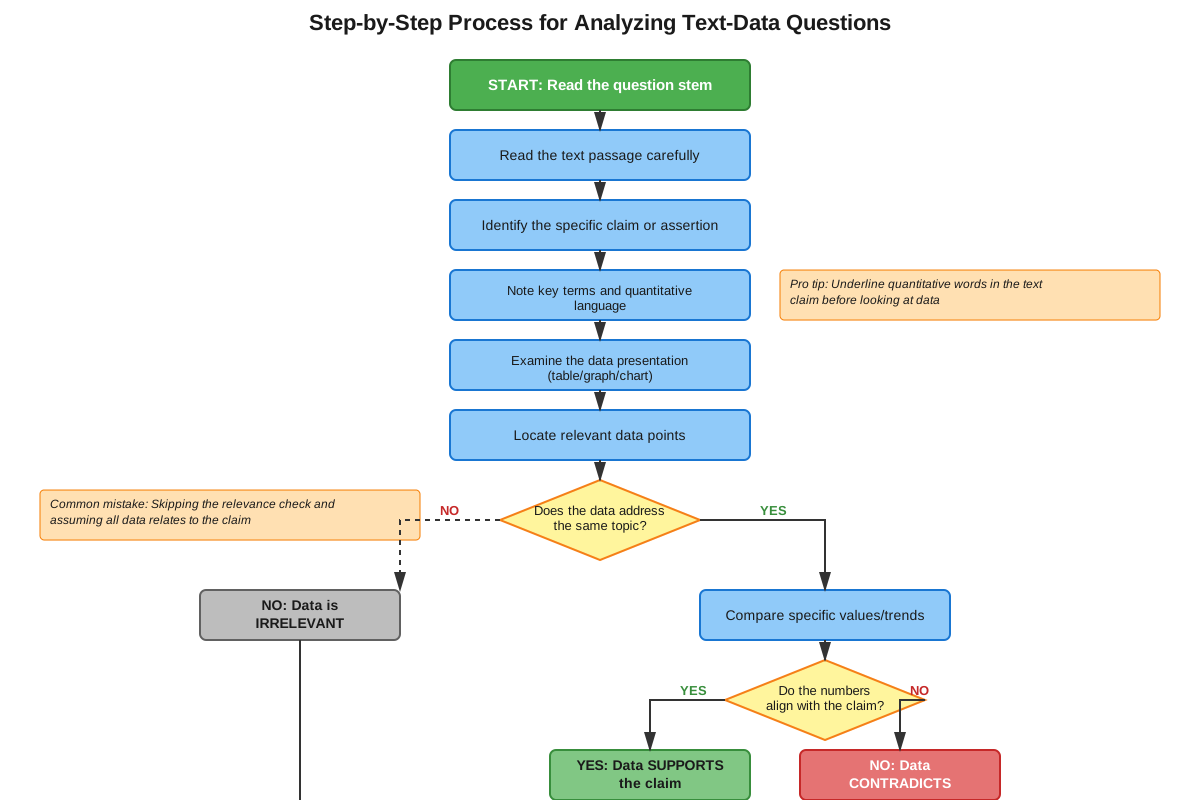
Successfully comparing textual and numerical evidence requires a systematic approach:
- Read the textual claim carefully: Identify exactly what is being asserted, including all qualifiers and specific details
- Examine the data presentation: Understand what variables are shown, the time period covered, and the units of measurement
- Locate relevant data points: Find the specific numbers, trends, or patterns that relate to the claim
- Evaluate the match: Determine whether the data supports, contradicts, or is unrelated to the claim
- Check for precision: Ensure that the relationship you've identified accounts for all important details in both the text and data
Common Data Presentation Formats
The SAT uses several standard formats for presenting numerical evidence:
Tables: Organize data in rows and columns, often showing multiple variables across different categories or time periods. Students must read both row and column headers to locate specific values.
Bar Graphs: Compare quantities across categories using rectangular bars. The height or length of each bar represents the value. Students should note whether bars represent raw numbers or percentages.
Line Graphs: Display trends over time or continuous variables. The slope of the line indicates increase, decrease, or stability. Multiple lines on one graph allow comparison between different groups or variables.
Scatter Plots: Show the relationship between two variables, with each point representing one observation. Patterns in the points suggest correlation or lack thereof.
Precision in Language
SAT answer choices use precise language to describe relationships between textual and numerical evidence. Understanding these distinctions is crucial:
- "Supports the claim" vs. "Proves the claim" (data can support without definitively proving)
- "Contradicts" vs. "Fails to support" (contradiction is active opposition; failure to support may indicate irrelevance)
- "Suggests" vs. "Demonstrates" (different levels of evidential strength)
- "Consistent with" vs. "Confirms" (consistency is weaker than confirmation)
Concept Relationships
The skill of comparing textual and numerical evidence builds directly on prerequisite abilities in reading comprehension and data interpretation. Reading comprehension provides the foundation for understanding textual claims → this understanding enables claim analysis (identifying scope, qualifiers, and specific assertions) → simultaneously, data literacy allows students to extract relevant information from numerical presentations → these two streams converge in evidence comparison, where students evaluate relationships → finally, answer choice evaluation requires applying precise language to describe these relationships accurately.
Within the broader Command of Evidence domain, this topic connects to identifying supporting details (but adds the complexity of cross-format synthesis), evaluating argument strength (using quantitative rather than purely textual evidence), and inference questions (where numerical data may support or contradict implied conclusions). The skill also relates to the Information and Ideas domain when passages present research findings or data-driven conclusions.
The relationship between concepts within this topic follows a hierarchical structure: understanding individual components (textual claims and numerical evidence separately) → recognizing relationship types → applying systematic comparison processes → evaluating answer choices with precision. Mastery requires not just understanding each component but developing fluency in moving between textual and numerical reasoning modes.
High-Yield Facts
⭐ Most SAT questions ask which answer choice is "best supported by" or "most consistent with" the data, requiring precise matching between claim and evidence
⭐ The correct answer will account for specific numerical values or trends, not just general themes
⭐ Wrong answers often describe relationships that are plausible but not actually shown in the data provided
⭐ When a textual claim includes qualifiers like "most," "some," or "in certain cases," the data must match that level of specificity
⭐ Data that shows correlation does not necessarily support claims about causation
- Tables and graphs on the SAT always include clear labels; if you cannot find the relevant data, reread the claim to identify what you should be looking for
- Percentages and raw numbers can tell different stories; a small percentage of a large number may exceed a large percentage of a small number
- Time periods matter: data from 2015-2020 cannot support claims about 2021
- The SAT often includes distractors that use numbers from the data but describe incorrect relationships
- When multiple data points are relevant, the correct answer must account for all of them, not just cherry-pick favorable evidence
Quick check — test yourself on Comparing textual and numerical evidence so far.
Try Flashcards →Common Misconceptions
Misconception: If the data and text discuss the same general topic, they must support each other.
Correction: Topical similarity does not equal evidential support. The data must specifically confirm the claim's assertions about relationships, trends, or comparisons. Data about related but different variables does not provide support.
Misconception: Larger numbers in the data always indicate stronger support for claims about "increase" or "more."
Correction: Context matters critically. An increase from 2 to 4 is a 100% increase, while an increase from 100 to 102 is only 2%. Additionally, "more" might refer to absolute values, percentages, rates, or other measures—students must match the claim's specific meaning.
Misconception: If the data doesn't contradict the claim, it supports the claim.
Correction: Data can be irrelevant to a claim without contradicting it. For example, if a claim discusses temperature changes but the data shows precipitation, the data neither supports nor contradicts—it simply doesn't address the claim.
Misconception: Complex or detailed data presentations are always harder to interpret than simple ones.
Correction: Sometimes more detailed data makes relationships clearer by providing additional context. Simple presentations can be tricky if they require careful attention to units, scales, or what is not shown.
Misconception: The correct answer will use the same words as the passage.
Correction: SAT answer choices often paraphrase both the textual claim and the data relationship. Students must understand concepts, not just match vocabulary. The correct answer might describe "a decline" where the passage says "decreased" or use "greater than" where the text says "exceeded."
Misconception: All data points in a table or graph are equally relevant to the textual claim.
Correction: Often, only specific rows, columns, or data points relate to the claim being evaluated. Part of the skill is identifying which data is relevant and ignoring distracting information.
Worked Examples
Example 1: Scientific Research Context
Passage: A researcher hypothesizes that increased exposure to natural sunlight improves sleep quality in adults. The study measured average sleep quality scores (on a scale of 1-10) for participants who spent different amounts of time outdoors daily.
Data Table:
| Daily Outdoor Time | Average Sleep Quality Score |
|---|---|
| Less than 30 min | 5.2 |
| 30-60 min | 6.8 |
| 60-90 min | 7.1 |
| More than 90 min | 7.3 |
Question: Which statement is best supported by the data?
A) Spending any amount of time outdoors maximizes sleep quality.
B) Sleep quality scores increase consistently as outdoor time increases.
C) Participants who spent more than 90 minutes outdoors had sleep quality scores approximately 40% higher than those who spent less than 30 minutes outdoors.
D) The relationship between outdoor time and sleep quality is strongest for participants spending 30-60 minutes outdoors.
Solution Process:
Step 1: Identify the textual claim—the hypothesis states that increased sunlight exposure improves sleep quality.
Step 2: Examine the data structure—the table shows four categories of outdoor time with corresponding sleep quality scores.
Step 3: Evaluate each answer choice against the data:
Choice A: "Maximizes" suggests reaching the highest possible level. While all outdoor time correlates with some sleep quality, the scores range from 5.2 to 7.3, not all reaching maximum. Incorrect.
Choice B: Check if scores increase consistently. 5.2 → 6.8 → 7.1 → 7.3 shows a consistent upward trend across all categories. This matches the data precisely.
Choice C: Calculate the percentage: (7.3 - 5.2) / 5.2 = 2.1 / 5.2 ≈ 40.4%. While mathematically close, the answer says "approximately 40% higher," which is accurate. However, let's verify B first as it seems more straightforward. Actually, both B and C could be correct, but B more directly addresses the hypothesis about the relationship between increased exposure and improved sleep.
Choice D: "Strongest relationship" would require comparing the rate of increase between categories. From <30 to 30-60: increase of 1.6. From 30-60 to 60-90: increase of 0.3. From 60-90 to >90: increase of 0.2. The largest increase is in the first interval, not the 30-60 minute category itself. Incorrect.
Answer: B — The data shows a consistent increase in sleep quality scores as outdoor time increases, directly supporting the researcher's hypothesis.
Example 2: Historical/Social Science Context
Passage: Historians have argued that urbanization in Country X during the 1950s led to a decline in agricultural employment as workers moved to cities for industrial jobs.
Data Graph: (described textually)
A line graph showing two lines from 1950-1960:
- Agricultural employment: starts at 65% in 1950, decreases to 58% in 1955, then to 52% in 1960
- Urban population percentage: starts at 35% in 1950, increases to 42% in 1955, then to 48% in 1960
Question: Which statement about the data best evaluates the historians' argument?
A) The data proves that urbanization caused the decline in agricultural employment.
B) The data shows that agricultural employment and urban population changed in opposite directions during this period, consistent with the historians' argument.
C) The data contradicts the historians' argument because agricultural employment remained above 50% throughout the period.
D) The data is irrelevant to the historians' argument because it does not show industrial employment figures.
Solution Process:
Step 1: Identify the claim—urbanization led to declining agricultural employment.
Step 2: Identify what the data shows—two trends moving in opposite directions (urban population up, agricultural employment down) during the same time period.
Step 3: Evaluate the relationship:
Choice A: The data shows correlation (both trends occurring together) but cannot prove causation. The SAT frequently tests this distinction. Incorrect—overstates what data can show.
Choice B: "Changed in opposite directions" accurately describes the data. "Consistent with" appropriately indicates that the data supports without proving the argument. This is precise language. Strong candidate.
Choice C: The argument is about a decline occurring, not about whether agricultural employment fell below a specific threshold. The data does show a decline from 65% to 52%. Incorrect—misinterprets the claim.
Choice D: While industrial employment data would provide additional support, the data showing urbanization increasing while agricultural employment decreases is directly relevant to the claim. Incorrect—the data is relevant even if not comprehensive.
Answer: B — This choice accurately describes the data pattern and appropriately characterizes the relationship as "consistent with" rather than "proving" the causal claim.
Exam Strategy
When approaching SAT comparing textual and numerical evidence questions, follow this strategic process:
Step 1: Read the question stem first to understand what relationship you need to evaluate. Look for key phrases like "best supported by," "most consistent with," "contradicts," or "fails to support."
Step 2: Identify the specific textual claim you need to evaluate. Underline or mentally note qualifiers (most, some, all, typically), specific variables mentioned, and the nature of the relationship being asserted (increase, decrease, comparison, causation, correlation).
Step 3: Examine the data presentation systematically. Read all labels, headers, legends, and units before looking at specific numbers. Understand what is being measured and over what range or categories.
Step 4: Locate the relevant data points. Ignore distracting information that doesn't relate to the claim. If the claim discusses "participants aged 18-25," find that specific row or data series.
Step 5: Evaluate the match between claim and data before looking at answer choices. Decide for yourself whether the data supports, contradicts, or is irrelevant to the claim.
Exam Tip: Wrong answers often describe relationships that sound plausible or use numbers from the data but mischaracterize the actual relationship. Always verify that the answer choice accurately describes what the data shows.
Trigger words to watch for:
- "Best supported by": Look for the answer that most precisely matches specific data points
- "Consistent with": Data doesn't have to prove the claim, just align with it
- "Contradicts": Data must actively oppose the claim, not just fail to support it
- "According to": The answer must come directly from the data, not from outside knowledge
- "Suggests" vs. "proves": Different levels of evidential strength
Process of elimination tips:
- Eliminate answers that reference data points not shown in the table/graph
- Eliminate answers that confuse percentages with raw numbers or vice versa
- Eliminate answers that describe the correct numbers but the wrong relationship
- Eliminate answers that make claims about causation when data only shows correlation
- Eliminate answers that ignore important qualifiers in the original claim
Time allocation: These questions typically require 60-90 seconds. Spend 20-30 seconds understanding the claim and data, 20-30 seconds locating relevant information, and 20-30 seconds evaluating answer choices. If you're spending more than 90 seconds, make your best educated guess and move on—these questions are worth the same as easier ones.
Memory Techniques
MATCH Acronym for systematic comparison:
- Mark the claim's specific details and qualifiers
- Analyze the data presentation (labels, units, scale)
- Target relevant data points
- Compare claim to data systematically
- Heed precise language in answer choices
Visualization Strategy: Picture the textual claim as a prediction or hypothesis, and the data as evidence in a trial. Ask yourself: "Does this evidence prove, support, contradict, or have nothing to do with the claim?" This courtroom metaphor helps maintain appropriate skepticism about overstated relationships.
The "Three Checks" Method:
- Check the variables: Does the data measure what the claim discusses?
- Check the direction: If the claim says "increase," does the data show increase?
- Check the magnitude: If the claim says "doubled," did the value actually double?
Relationship Spectrum: Visualize a spectrum from "Strong Support" → "Weak Support" → "Irrelevant" → "Weak Contradiction" → "Strong Contradiction." Place the data-claim relationship on this spectrum before looking at answer choices.
"Same Topic ≠ Support" Reminder: Create a mental image of two puzzle pieces that look similar but don't actually fit together. This reminds you that data and text can discuss related topics without the data supporting the specific claim.
Summary
Comparing textual and numerical evidence is a high-yield SAT skill that requires students to synthesize information across different representational formats. Success depends on precisely identifying what a textual claim asserts, accurately interpreting numerical data from tables and graphs, and evaluating the specific relationship between them. The most common question format asks which statement is "best supported by" or "most consistent with" the data, requiring careful attention to whether evidence supports, contradicts, or is irrelevant to claims. Students must distinguish between correlation and causation, recognize the importance of qualifiers and specific details, and avoid the trap of assuming topical similarity equals evidential support. The systematic approach—reading claims carefully, examining data presentations thoroughly, locating relevant information, and evaluating relationships before considering answer choices—provides a reliable framework for these questions. Mastery requires understanding that data can support claims without proving them, that precise language matters in describing relationships, and that wrong answers often use correct numbers to describe incorrect relationships.
Key Takeaways
- Comparing textual and numerical evidence questions appear 2-4 times per SAT test and are crucial for top scores in the Command of Evidence domain
- The correct answer must account for specific data points and trends, not just general thematic alignment between text and numbers
- Data showing correlation does not support claims about causation—this distinction appears frequently in wrong answer choices
- Qualifiers in textual claims ("most," "some," "typically") must be matched by corresponding patterns in the data
- Systematic comparison requires understanding the claim, interpreting the data presentation, locating relevant information, and evaluating relationships with precision
- Wrong answers often use numbers from the data but mischaracterize the relationship, or describe plausible relationships not actually shown
- Time management is essential—spend no more than 90 seconds per question using the MATCH framework
Related Topics
Identifying Textual Evidence: This foundational skill focuses on locating supporting details within passages without the added complexity of numerical data. Mastering textual-numerical comparison builds on this skill by adding cross-format synthesis.
Analyzing Quantitative Information: A broader skill involving interpretation of graphs, tables, and charts in isolation. Understanding how to extract and interpret numerical data is prerequisite to comparing it with textual claims.
Evaluating Arguments and Claims: This skill involves assessing the logical structure and evidential support for arguments. Textual-numerical comparison represents a specific application where evidence comes in numerical rather than purely textual form.
Drawing Inferences from Multiple Sources: Advanced questions may require synthesizing information from multiple passages or data sources. Mastering two-source comparison (text and data) prepares students for these more complex synthesis tasks.
Scientific and Social Science Passage Analysis: These passage types frequently include data presentations, making textual-numerical comparison skills particularly important for success in these content areas.
Practice CTA
Now that you understand the key concepts and strategies for comparing textual and numerical evidence, it's time to apply this knowledge! Work through the practice questions to reinforce your systematic approach and build confidence with this high-yield question type. Pay special attention to how answer choices use precise language to describe relationships, and practice the MATCH framework until it becomes second nature. The flashcards will help you internalize the key distinctions between support, contradiction, and irrelevance. Remember: these questions are highly learnable—consistent practice with the systematic approach outlined in this guide will significantly improve your accuracy and speed. You've got this!
Sign up free to keep reading
Create a free AnvayaPrep account to finish this SAT guide on Comparing textual and numerical evidence — plus flashcards and practice questions.