Overview
Data interpretation in reading is a critical skill tested extensively on the digital SAT, requiring students to analyze quantitative information presented in graphs, tables, charts, and other visual formats within the context of reading passages. Unlike traditional reading comprehension that focuses solely on textual analysis, this skill demands that test-takers synthesize information from both written passages and accompanying data visualizations to draw accurate conclusions. The SAT's Reading and Writing (RW) section now integrates data interpretation questions that assess whether students can identify trends, compare values, recognize patterns, and evaluate how data supports or contradicts claims made in accompanying text.
This topic represents a significant evolution in standardized testing, reflecting the modern academic and professional landscape where literacy extends beyond traditional text to include numerical and visual information. On the digital SAT, approximately 10-15% of Reading and Writing questions involve some form of sat data interpretation in reading, making it a high-yield area for score improvement. These questions typically appear in the "Command of Evidence" category, where students must demonstrate their ability to use quantitative information to support or refute textual claims.
Mastering data interpretation connects directly to broader Reading and Writing competencies, particularly evidence-based reasoning, analytical thinking, and the ability to synthesize multiple information sources. This skill builds upon foundational reading comprehension while adding a quantitative dimension that mirrors real-world academic tasks across disciplines—from analyzing scientific research findings to evaluating economic trends in social studies. Students who excel at data interpretation questions demonstrate college-readiness by showing they can navigate the increasingly data-rich information environment of higher education.
Learning Objectives
- [ ] Identify key features of data interpretation in reading, including graph types, data trends, and visual-textual relationships
- [ ] Explain how data interpretation in reading appears on the SAT, including question formats and common testing patterns
- [ ] Apply data interpretation in reading to answer SAT-style questions accurately and efficiently
- [ ] Analyze the relationship between textual claims and supporting quantitative evidence in integrated passages
- [ ] Evaluate whether data presented in visual formats supports, contradicts, or is irrelevant to statements in accompanying text
- [ ] Synthesize information from multiple data sources (text + visuals) to draw valid conclusions
- [ ] Distinguish between accurate and inaccurate interpretations of the same data set
Prerequisites
- Basic graph literacy: Understanding how to read bar graphs, line graphs, pie charts, and tables is essential because SAT data interpretation questions assume students can extract basic information from standard visual formats
- Fundamental mathematical reasoning: Ability to compare quantities, calculate percentages, and identify trends enables students to analyze the quantitative relationships presented in data visualizations
- Reading comprehension skills: Proficiency in understanding main ideas, supporting details, and author's purpose provides the foundation for connecting textual claims with data evidence
- Vocabulary for data description: Familiarity with terms like "increase," "decrease," "correlation," "trend," and "proportion" allows students to understand both questions and answer choices accurately
Why This Topic Matters
In academic and professional contexts, the ability to interpret data within reading materials is indispensable. Scientific journals present research findings through graphs and tables; news articles incorporate charts to illustrate economic trends; policy documents use data visualizations to support recommendations. Students who master data interpretation in reading develop critical thinking skills that extend far beyond test-taking, enabling them to evaluate claims critically, identify misleading uses of statistics, and make informed decisions based on evidence.
On the SAT specifically, data interpretation questions appear with high frequency and predictability. The College Board reports that the Command of Evidence domain—which includes data interpretation—comprises approximately 12-14 questions per test, with roughly 4-6 questions directly involving quantitative information. These questions typically appear in passages from natural sciences, social sciences, and occasionally humanities contexts where research findings are discussed. The question types include: identifying which statement is supported by data, selecting data that supports a given claim, recognizing accurate descriptions of trends, and evaluating the relationship between textual assertions and quantitative evidence.
Common manifestations include passages about scientific studies with accompanying graphs showing experimental results, social science texts with demographic tables, economic discussions with trend lines, and environmental science passages with data comparing different conditions or time periods. The integration of text and data is intentional—students cannot answer correctly by looking at only one source; they must synthesize both to demonstrate true comprehension.
Core Concepts
Understanding Data Visualization Types
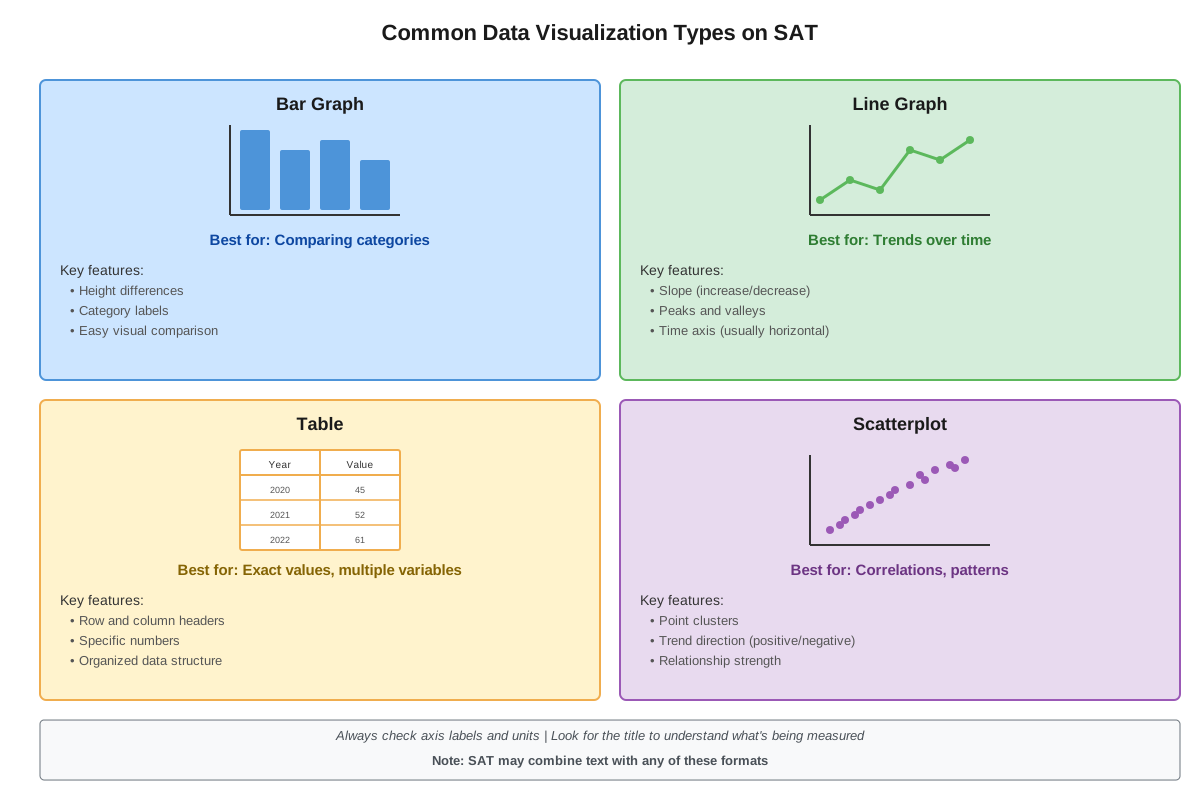
The SAT presents data through several standard formats, each with distinct characteristics. Bar graphs display categorical data using rectangular bars whose lengths represent values, making them ideal for comparing discrete categories. Line graphs show continuous data over time or across a spectrum, with points connected to illustrate trends and patterns. Scatter plots display relationships between two variables, with each point representing a paired observation. Tables organize data in rows and columns, allowing for precise value lookup and comparison. Pie charts show proportional relationships within a whole, though these appear less frequently on the SAT.
Understanding the purpose of each visualization type helps students quickly orient themselves to what the data represents. Bar graphs answer "how much" questions across categories; line graphs reveal "how does this change" patterns; scatter plots explore "is there a relationship" questions; tables provide "what is the exact value" information.
Identifying Key Features in Data
When approaching any data visualization, students must systematically identify several key features. The title indicates what the data represents overall. Axis labels (for graphs) or column/row headers (for tables) specify what variables are being measured and in what units. The scale determines the magnitude of differences—a graph ranging from 0-100 shows different proportional relationships than one ranging from 90-100, even if the visual appearance is similar. Legends explain symbols, colors, or line styles when multiple data series appear together. Data points or values represent the actual quantitative information being conveyed.
A critical skill involves recognizing the difference between absolute values and relative changes. A line rising from 10 to 20 represents a 100% increase, while a line rising from 100 to 110 represents only a 10% increase, despite both showing a 10-unit absolute change. SAT questions frequently test whether students can distinguish these concepts.
Connecting Data to Textual Claims
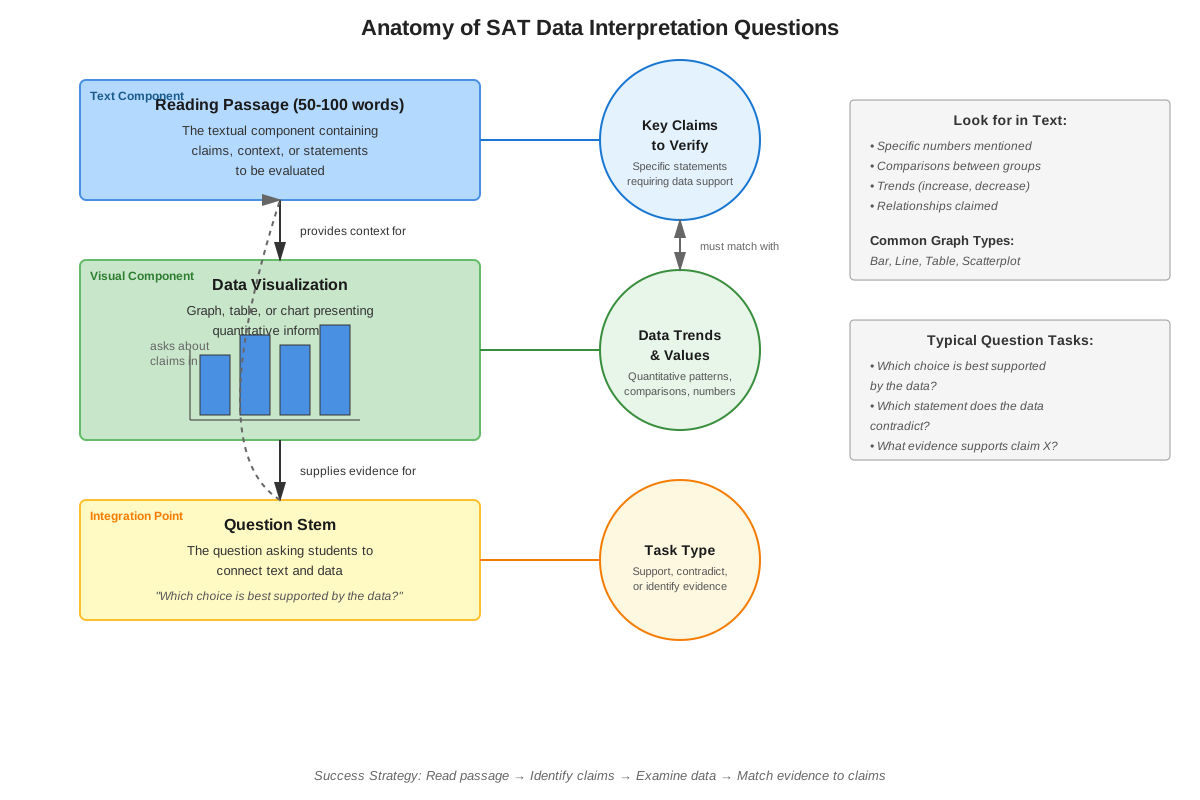
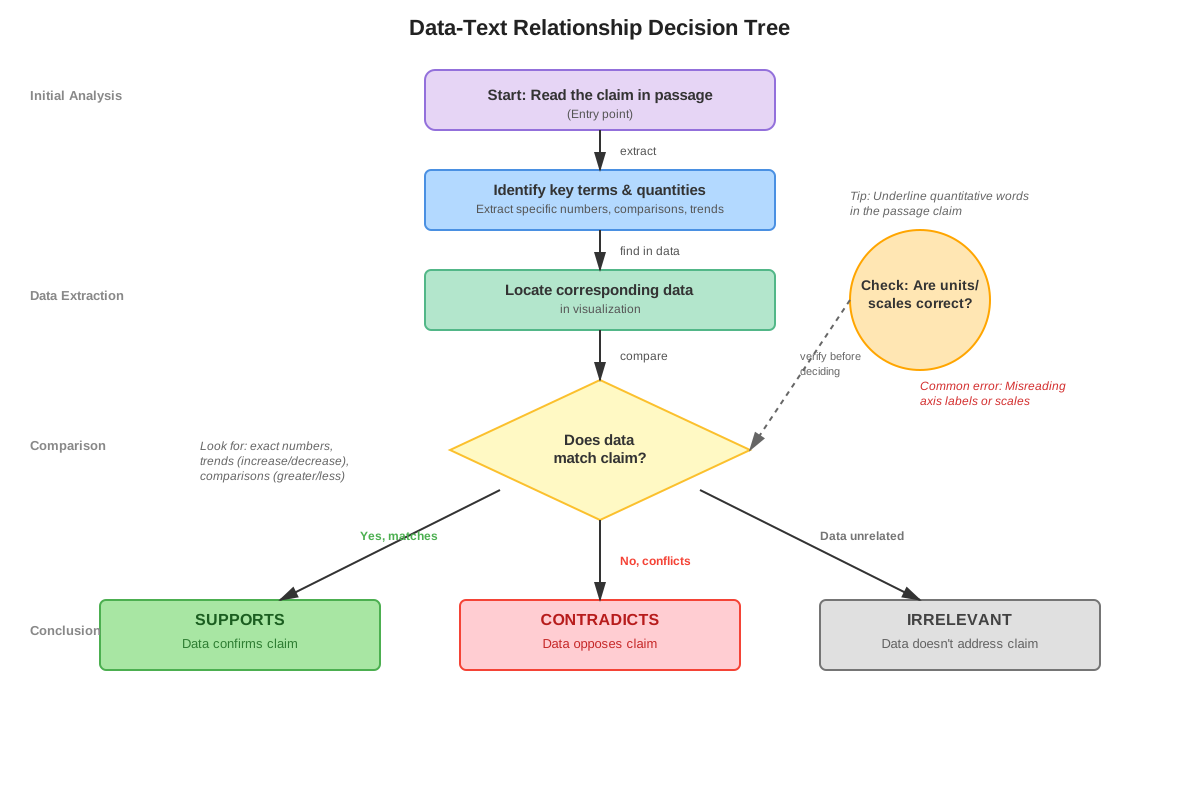
The hallmark of SAT data interpretation questions is the requirement to synthesize information from both text and visuals. Students must evaluate whether quantitative evidence supports, contradicts, or is irrelevant to claims made in the passage. A statement is supported when data provides confirming evidence; contradicted when data shows the opposite pattern; and irrelevant when data addresses a different variable or population than the claim discusses.
Consider this relationship: A passage states "Renewable energy production increased steadily from 2010 to 2020." Supporting data would show an upward trend across that decade. Contradicting data might show fluctuations or decline. Irrelevant data might show renewable energy costs rather than production, or data from a different time period.
Analyzing Trends and Patterns
Trends represent general directions in data over time or across categories. An increasing trend shows values rising; a decreasing trend shows values falling; a stable trend shows relatively constant values; a fluctuating pattern shows alternating increases and decreases. Students must distinguish between short-term variations and long-term trends—a single data point that deviates doesn't necessarily contradict an overall trend.
Patterns include relationships between variables: positive correlation (both variables increase together), negative correlation (one increases as the other decreases), or no correlation (no consistent relationship). The SAT tests whether students can accurately describe these relationships without overstating causation—correlation does not imply causation, and careful answer choices will use language like "associated with" rather than "caused by."
Comparing Data Points and Categories
Many SAT questions require comparing specific values or categories within a dataset. Students must identify which category has the highest or lowest value, determine differences between values, or recognize rankings. This requires careful attention to scales and units—comparing percentages to raw numbers, or values measured in different units, represents a common trap.
| Comparison Type | What to Look For | Common Pitfall |
|---|---|---|
| Absolute difference | Subtract values directly | Confusing with percentage change |
| Percentage change | (New - Old) / Old × 100 | Using wrong baseline |
| Ranking | Order from highest to lowest | Misreading scale or axis |
| Proportional relationship | Ratio between values | Ignoring different totals |
Evaluating Data Accuracy and Precision
The SAT occasionally tests whether students recognize limitations in data interpretation. Precision refers to the level of detail in measurements—data rounded to whole numbers cannot support claims about decimal-level differences. Range indicates the span of data collected—conclusions about "all years" cannot be drawn from data covering only three years. Sample representation matters—data from one region cannot necessarily be generalized to all regions.
Concept Relationships
The core concepts in data interpretation form an interconnected system where each skill builds upon and reinforces others. Understanding data visualization types serves as the foundation, enabling students to quickly orient themselves to any data presentation → this foundational knowledge leads to → Identifying key features in data, where students extract specific information from the visualization → which enables → Analyzing trends and patterns, as students move from reading individual values to recognizing broader relationships → these analytical skills support → Comparing data points and categories, allowing for more sophisticated quantitative reasoning → all of these skills converge in → Connecting data to textual claims, the ultimate synthesis skill that the SAT tests most frequently.
This topic connects to prerequisite knowledge of basic reading comprehension by adding a quantitative dimension—students apply the same evidence-evaluation skills they use for textual evidence, but now with numerical data. The relationship to broader Command of Evidence skills is direct: data interpretation represents one form of evidence that supports or refutes claims, parallel to how quotations from text serve as evidence in traditional reading questions.
The progression from simpler to more complex skills mirrors the SAT's question difficulty range: easier questions might ask students to identify a single value from a table, while harder questions require synthesizing multiple data points with complex textual claims to evaluate nuanced relationships.
High-Yield Facts
⭐ The SAT never requires complex calculations—all necessary mathematical reasoning involves basic arithmetic, comparison, and pattern recognition that can be completed mentally or with simple calculations
⭐ Data interpretation questions always have one objectively correct answer based on the information provided; if an answer requires outside knowledge or assumptions beyond the given data, it's incorrect
⭐ The correct answer will be directly supported by specific data points or clear trends—vague or partially supported answers are incorrect even if they seem plausible
⭐ When a question asks what data "supports" a claim, the data must provide confirming evidence, not merely be consistent with or fail to contradict the claim
⭐ Axis labels and units are crucial—many incorrect answers exploit misreadings of what variables are actually being measured or in what units
- Approximately 4-6 questions per SAT test directly involve data interpretation integrated with reading passages
- Data interpretation questions appear most frequently in science and social science passages, rarely in literature or humanities passages
- The digital SAT presents data visualizations clearly on screen, allowing students to reference them while reading questions
- Correct answers use precise language that matches the data exactly—words like "always," "never," "only," or "all" in answer choices should trigger careful verification against the data
- When multiple data visualizations appear with a passage, questions typically address each visualization separately rather than requiring synthesis across multiple graphs
Quick check — test yourself on Data interpretation in reading so far.
Try Flashcards →Common Misconceptions
Misconception: Data interpretation questions require advanced mathematical or statistical knowledge → Correction: The SAT tests only basic data literacy—reading values, identifying trends, and making simple comparisons. No knowledge of statistical concepts like standard deviation, regression analysis, or hypothesis testing is required.
Misconception: If data shows a correlation between two variables, the passage is claiming one causes the other → Correction: Correlation and causation are distinct concepts. SAT passages and correct answers carefully distinguish between "associated with," "correlated with," or "related to" (correlation) versus "caused by" or "resulted from" (causation). Data showing two variables changing together does not prove causation.
Misconception: The correct answer will be the one that sounds most scientific or uses the most technical language → Correction: Correct answers are determined solely by whether they accurately represent the data and text, not by how sophisticated they sound. In fact, overly complex or technical-sounding answers are often incorrect because they go beyond what the data actually shows.
Misconception: Small differences in data values are not significant and can be ignored → Correction: On the SAT, all differences shown in data are potentially meaningful. A question asking which category had the "highest" value has one correct answer even if the difference between the top two categories is small. Students must read data precisely, not approximately.
Misconception: Data interpretation questions can be answered by looking only at the graph or table without reading the passage → Correction: While some questions focus primarily on data, most require synthesizing information from both the passage and the visualization. The passage provides context, definitions, and claims that are essential for correctly interpreting what the data means and how it relates to the question being asked.
Misconception: If a trend generally increases, any statement about increasing is correct → Correction: The SAT tests precise reading of trends, including specific time periods, magnitudes of change, and consistency of patterns. A trend that increases from 2010-2015 but decreases from 2015-2020 does not support a claim about "steady increase throughout the decade," even though there was some increase.
Worked Examples
Example 1: Evaluating Data Support for a Textual Claim
Passage excerpt: "The implementation of the new agricultural technique resulted in substantially higher crop yields across all three growing seasons studied."
Data presented: A bar graph showing crop yields (in tons per hectare) for three seasons:
- Season 1: Traditional method = 4.2, New method = 4.8
- Season 2: Traditional method = 3.9, New method = 5.1
- Season 3: Traditional method = 4.5, New method = 5.3
Question: Which statement is best supported by the data?
Answer choices:
A) The new method produced higher yields in two of the three seasons
B) The new method produced higher yields in all three seasons
C) The new method produced substantially higher yields in all three seasons
D) The traditional method was more consistent across seasons
Solution process:
Step 1: Identify what the passage claims—"substantially higher crop yields across all three growing seasons"
Step 2: Examine the data for each season:
- Season 1: New method (4.8) > Traditional (4.2) ✓ Higher, but difference is 0.6
- Season 2: New method (5.1) > Traditional (3.9) ✓ Higher, difference is 1.2
- Season 3: New method (5.3) > Traditional (4.5) ✓ Higher, difference is 0.8
Step 3: Evaluate each answer choice:
- Choice A: Incorrect—the new method was higher in all three seasons, not just two
- Choice B: Correct—the data shows the new method produced higher yields in all three seasons
- Choice C: Tempting but requires judgment about whether the differences are "substantial"—while the new method was consistently higher, the term "substantially" is subjective and the differences range from modest (0.6) to more notable (1.2)
- Choice D: Incorrect—this addresses consistency rather than the comparison between methods
Correct answer: B
Key reasoning: The question asks what is "best supported" by the data. Choice B is objectively verifiable from the data without requiring interpretation of subjective terms like "substantially." This example illustrates how the SAT rewards precise reading—the passage may use language like "substantially," but the data-supported answer sticks to what can be definitively confirmed.
Example 2: Identifying Trends Across Time
Passage excerpt: "Researchers monitored the population of a native bird species in a protected habitat over a five-year period following the removal of an invasive predator."
Data presented: A line graph showing bird population (y-axis, ranging from 0-500) across years 2015-2019 (x-axis):
- 2015: 150
- 2016: 180
- 2017: 240
- 2018: 310
- 2019: 350
Question: Based on the data, which statement about the bird population is accurate?
Answer choices:
A) The population increased by the same amount each year
B) The population more than doubled over the five-year period
C) The population showed the greatest increase between 2016 and 2017
D) The population increased most rapidly in the final year
Solution process:
Step 1: Calculate year-to-year changes:
- 2015-2016: 180 - 150 = 30 increase
- 2016-2017: 240 - 180 = 60 increase
- 2017-2018: 310 - 240 = 70 increase
- 2018-2019: 350 - 310 = 40 increase
Step 2: Evaluate each answer choice:
- Choice A: Incorrect—the increases varied (30, 60, 70, 40), not constant
- Choice B: Correct—the population went from 150 to 350; 150 × 2 = 300, and 350 > 300, so it more than doubled
- Choice C: Incorrect—the greatest increase was 70 (between 2017-2018), not 60 (between 2016-2017)
- Choice D: Incorrect—the final year showed an increase of 40, which was less than the 70 increase in the previous year
Correct answer: B
Key reasoning: This example demonstrates the importance of distinguishing between absolute changes (the amount of increase each year) and relative changes (comparing initial to final values). It also shows how the SAT tests careful reading of comparative language—"greatest increase" requires identifying the largest year-to-year change, while "more than doubled" requires comparing the final value to twice the initial value.
Exam Strategy
When approaching rw data interpretation questions on the SAT, employ a systematic process that minimizes errors and maximizes efficiency. Begin by reading the question first to understand what specific information you need to extract—this focused approach prevents wasting time analyzing irrelevant aspects of the data. Then examine the data visualization, noting the title, axis labels, units, and scale before looking at specific values.
Trigger words and phrases that signal data interpretation questions include: "according to the graph/table/chart," "the data supports/indicates/shows," "based on the information in the figure," "which statement is consistent with," and "the data best supports which conclusion." When you see these phrases, immediately shift into data-analysis mode, knowing you'll need to reference specific quantitative information.
For process of elimination, systematically evaluate each answer choice against the data:
- Eliminate choices that contradict specific data points
- Eliminate choices that require information not provided in the data
- Eliminate choices that overstate or understate what the data shows (watch for absolute language like "always," "never," "only")
- Eliminate choices that confuse correlation with causation
- Select the remaining choice that is directly and completely supported by the data
Time allocation: Data interpretation questions typically require 45-75 seconds each—slightly more than pure reading comprehension questions because you must reference both text and visuals. If a question requires comparing multiple data points or synthesizing complex information, allocate up to 90 seconds, but if you're spending more than that, mark it for review and move on.
A critical strategy involves matching the precision of your answer to the precision of the data. If data is presented in whole numbers, don't select answers that make claims about decimal-level differences. If data covers 2015-2020, don't select answers that make claims about "the past decade" or other time periods not represented.
Exam Tip: Always verify that your selected answer addresses the specific question asked. A statement might be true based on the data but still be incorrect if it doesn't answer the actual question. For example, if asked "What does the data suggest about 2019?" an answer about 2018 trends, even if accurate, would be incorrect.
Memory Techniques
SCALE - A mnemonic for systematically analyzing any data visualization:
- Source: What is the title/what does this data represent?
- Categories: What variables are being compared?
- Axis/Headers: What are the labels and units?
- Levels: What is the range and scale of values?
- Evidence: What specific data points answer the question?
The "Three T's" of Trend Analysis:
- Time: Does the trend occur over time or across categories?
- Trajectory: Is it increasing, decreasing, stable, or fluctuating?
- Tightness: Is the trend consistent or are there exceptions?
Visualization Strategy: When encountering a complex data visualization, mentally convert it to a simple statement: "This graph shows [variable Y] across [variable X], and the main pattern is [trend description]." This translation forces you to identify the essential information and creates a mental framework for answering questions.
The "Support vs. Consistent" Distinction: Remember that "supports" requires positive confirming evidence, while "consistent with" merely means "doesn't contradict." Visualize "supports" as an arrow pointing from data to claim (→), showing active confirmation, while "consistent with" is just two parallel lines (||) that don't conflict.
Summary
Data interpretation in reading represents a crucial SAT skill that combines quantitative literacy with reading comprehension, requiring students to synthesize information from both textual passages and visual data presentations. Success depends on systematically analyzing data visualizations by identifying their key features (titles, labels, scales, units), accurately reading specific values and trends, and evaluating how quantitative evidence relates to textual claims. The SAT tests whether students can distinguish between data that supports, contradicts, or is irrelevant to passage statements, requiring precise reading of both numbers and language. Questions never require advanced mathematics but do demand careful attention to detail, particularly regarding units, scales, time periods, and the distinction between correlation and causation. The most effective approach involves reading questions first to focus analysis, systematically eliminating incorrect answers that contradict data or overstate conclusions, and selecting answers that are directly and completely supported by the information provided. Mastering this skill requires practice in moving fluidly between text and visuals, recognizing common question patterns, and avoiding misconceptions about what data can and cannot prove.
Key Takeaways
- Data interpretation questions comprise approximately 10-15% of SAT Reading and Writing questions, making them high-yield for score improvement
- Success requires synthesizing information from both passages and data visualizations—neither source alone is sufficient
- The SAT tests only basic data literacy (reading values, identifying trends, making comparisons), never advanced statistics or complex calculations
- Correct answers are always directly and objectively supported by the data; partially supported or plausible-sounding answers are incorrect
- Critical skills include distinguishing absolute from relative changes, recognizing the difference between correlation and causation, and matching answer precision to data precision
- Systematic analysis using frameworks like SCALE (Source, Categories, Axis, Levels, Evidence) prevents careless errors and improves efficiency
- Common traps include misreading scales or units, confusing "supports" with "consistent with," and selecting answers that address the wrong time period or variable
Related Topics
Command of Evidence - Textual Evidence: While this guide focuses on quantitative evidence, the parallel skill of identifying textual evidence that supports claims is equally important on the SAT. Mastering data interpretation provides a foundation for understanding how different types of evidence function in academic writing.
Quantitative Information in Science Passages: Many data interpretation questions appear in science contexts where understanding experimental design, control groups, and variables enhances comprehension. Further study of how scientific research is presented will deepen data interpretation skills.
Rhetorical Synthesis: Advanced SAT questions sometimes require evaluating whether an author's use of data effectively supports their rhetorical purpose. Understanding data interpretation enables more sophisticated analysis of argumentative strategies.
Cross-Text Connections: Some SAT questions present two related passages with different data sets, requiring students to synthesize information across multiple sources. Mastering single-source data interpretation is essential before progressing to these more complex synthesis tasks.
Practice CTA
Now that you've mastered the core concepts of data interpretation in reading, it's time to apply these skills to authentic SAT-style questions. The practice questions and flashcards have been specifically designed to reinforce the strategies and concepts covered in this guide, giving you the opportunity to build confidence and speed. Remember, data interpretation is one of the most predictable and high-yield areas on the SAT—consistent practice with these question types can significantly boost your Reading and Writing score. Approach each practice question systematically, using the SCALE framework and elimination strategies you've learned. You've got this!
Sign up free to keep reading
Create a free AnvayaPrep account to finish this SAT guide on Data interpretation in reading — plus flashcards and practice questions.