Overview
Distinguishing fact from interpretation is a critical analytical skill tested extensively in the SAT Reading and Writing (RW) section. This competency requires students to differentiate between objective, verifiable statements (facts) and subjective judgments, opinions, or conclusions drawn from those facts (interpretations). On the SAT, this skill appears in questions that ask students to identify which statement is best supported by evidence in a passage, which claim requires additional support, or which conclusion goes beyond what the text explicitly states.
Mastering this distinction is essential because the SAT frequently presents passages where authors blend factual information with their own analysis, commentary, or conclusions. Students must recognize when a statement can be directly verified by the passage versus when it represents the author's perspective, inference, or evaluation. This skill directly impacts performance on Command of Evidence questions, which constitute a significant portion of the Reading and Writing section and often determine the difference between a good score and an excellent one.
The ability to distinguish fact from interpretation connects to broader critical reading skills including identifying textual evidence, evaluating argument strength, and understanding authorial purpose. This foundational skill supports success across multiple question types in the SAT, including those focused on main ideas, supporting details, and rhetorical analysis. Students who excel at sat distinguishing fact from interpretation demonstrate sophisticated reading comprehension and are better equipped to handle complex academic texts in college and beyond.
Learning Objectives
- [ ] Identify key features of distinguishing fact from interpretation
- [ ] Explain how distinguishing fact from interpretation appears on the SAT
- [ ] Apply distinguishing fact from interpretation to answer SAT-style questions
- [ ] Analyze passages to separate objective statements from subjective claims
- [ ] Evaluate whether a given statement requires additional evidence or is directly supported by the text
- [ ] Recognize common language patterns that signal interpretation versus factual reporting
Prerequisites
- Basic reading comprehension: Understanding literal meaning of sentences and paragraphs is necessary before analyzing whether statements are factual or interpretive
- Vocabulary knowledge: Recognizing words that signal opinion (e.g., "suggests," "implies," "likely") versus certainty helps identify interpretations
- Understanding of evidence: Knowing what constitutes textual support enables students to verify whether statements are factual or require inference
- Passage structure awareness: Recognizing how authors organize information helps locate where facts end and interpretation begins
Why This Topic Matters
In academic and professional contexts, the ability to distinguish fact from interpretation is fundamental to critical thinking. Scientists must separate experimental observations from theoretical conclusions. Historians differentiate between documented events and their significance. Journalists distinguish between reporting facts and providing analysis. This skill protects against misinformation and enables informed decision-making in an era of abundant but variable-quality information.
On the SAT, questions testing this skill appear with high frequency—typically 2-4 questions per test form in the Reading and Writing section. These questions often appear in the Command of Evidence domain, which represents approximately 12-14 questions per test. The College Board emphasizes this skill because it reflects college-readiness: successful college students must evaluate sources, distinguish between primary evidence and secondary interpretation, and construct arguments based on verifiable information rather than unsupported claims.
Common question formats include: asking which statement is "most directly supported" by the passage; identifying which claim "best reflects" information in the text; determining which conclusion "can be reasonably drawn"; or selecting which statement requires "additional evidence beyond what the passage provides." These questions appear across all passage types—literary fiction, historical documents, scientific reports, and social science analyses—making this a universally applicable skill within the rw section.
Core Concepts
Defining Facts
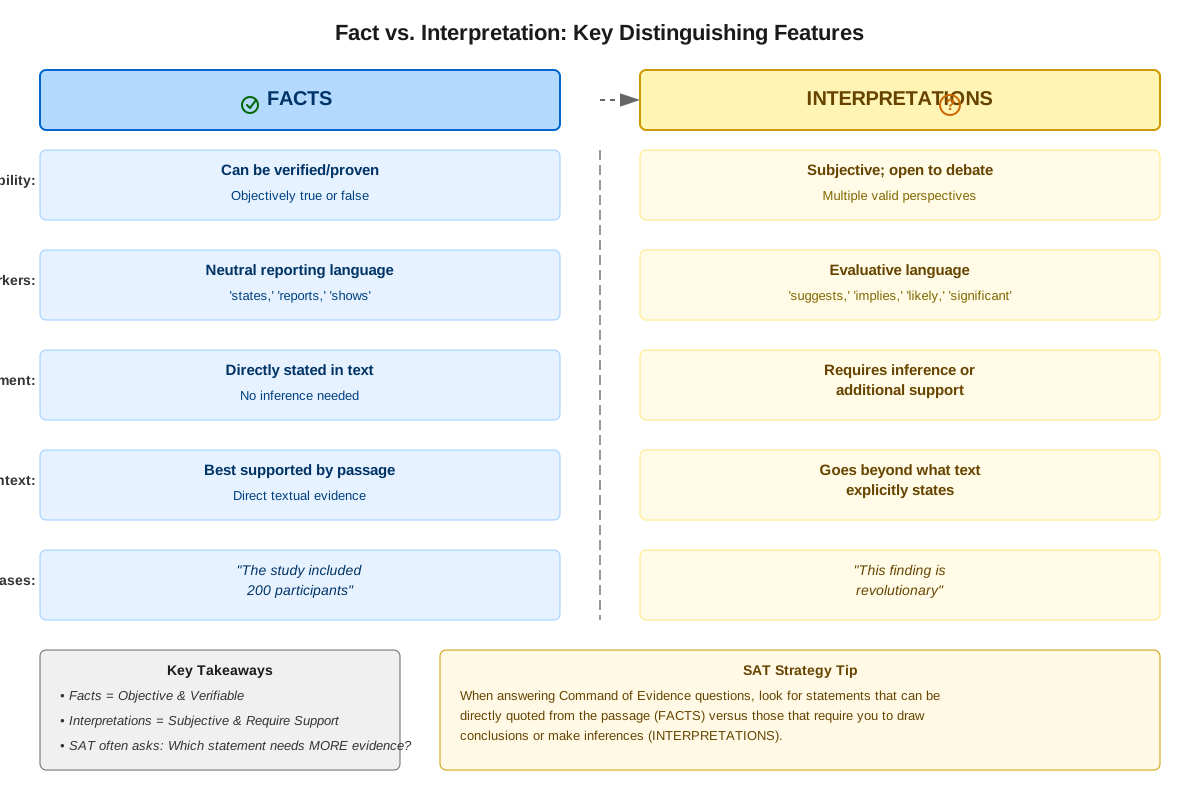
A fact is an objective statement that can be verified through direct observation, measurement, or documentation. Facts exist independently of personal beliefs or interpretations. On the SAT, factual statements typically describe:
- Specific events that occurred ("The experiment was conducted in 2019")
- Measurable quantities ("The temperature increased by 15 degrees")
- Direct quotations from sources ("According to the author, '...'")
- Observable characteristics ("The painting measures 6 feet by 4 feet")
- Documented historical events ("The treaty was signed on June 28, 1919")
Facts can be verified by checking the passage itself or, in real-world contexts, by consulting reliable sources. The key characteristic of a fact is that reasonable observers examining the same evidence would agree on its accuracy. Facts answer questions like "what happened?" "when?" "where?" "who?" and "how many?"
Defining Interpretations
An interpretation is a subjective statement that represents someone's understanding, analysis, judgment, or conclusion about facts. Interpretations involve:
- Explanations of why something occurred ("The policy failed because of inadequate funding")
- Evaluations of significance ("This discovery represents a major breakthrough")
- Predictions about future outcomes ("This trend will likely continue")
- Comparisons involving judgment ("This approach is more effective than alternatives")
- Inferences about meaning or intention ("The author implies that...")
Interpretations are not necessarily wrong or unreliable—they may be well-supported and persuasive. However, they represent conclusions drawn from facts rather than facts themselves. Different reasonable observers might offer different interpretations of the same factual information. Interpretations answer questions like "why?" "what does this mean?" "how important is this?" and "what might happen next?"
Language Signals for Facts vs. Interpretations
| Factual Language | Interpretive Language |
|---|---|
| "The study found..." | "The study suggests..." |
| "According to the data..." | "The data implies..." |
| "X stated that..." | "X believes that..." |
| "The temperature was..." | "The temperature was unusually high..." |
| "Sales increased by 20%" | "Sales increased significantly" |
| "The event occurred in..." | "The event was important because..." |
| "The text states..." | "The text reveals..." |
Recognizing these linguistic markers helps students quickly identify whether a statement presents verifiable information or someone's interpretation. Words like "suggests," "implies," "reveals," "demonstrates," "proves," "shows," and "indicates" often signal interpretation, especially when they describe what evidence means rather than what it literally says.
The Spectrum from Fact to Interpretation
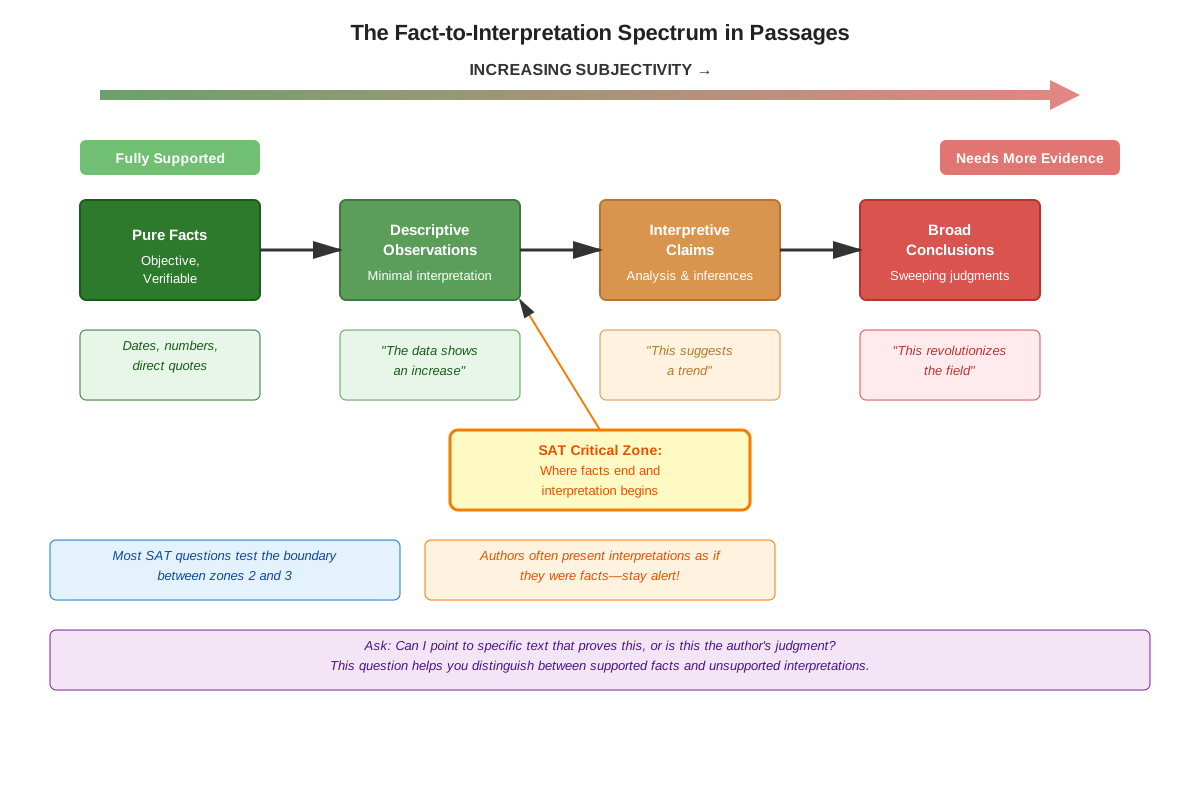
Not all statements fall neatly into "pure fact" or "pure interpretation" categories. Consider this spectrum:
- Direct fact: "The population was 50,000 in 2010"
- Fact with context: "The population increased from 40,000 to 50,000 between 2000 and 2010"
- Fact with evaluative language: "The population grew substantially to 50,000"
- Interpretation with factual basis: "The 25% population increase suggests economic growth"
- Pure interpretation: "The city's prosperity attracted new residents"
On the SAT, questions typically ask students to distinguish between statements that are directly supported by the passage (categories 1-2) versus those that require additional inference or represent the author's conclusions (categories 4-5). Understanding this spectrum helps students recognize that some statements contain both factual elements and interpretive elements.
Context-Dependent Verification
Whether a statement qualifies as fact or interpretation can depend on context. Consider: "Shakespeare was the greatest playwright in English literature." In a passage arguing this position, it's an interpretation. However, in a passage stating "Many scholars consider Shakespeare the greatest playwright in English literature," the fact is that many scholars hold this view—the interpretation is the judgment about Shakespeare's greatness.
This distinction is crucial for SAT success. Students must ask: "What exactly can I verify from this passage?" versus "What conclusion is being drawn?" A statement like "The author describes the policy as ineffective" presents a fact about what the author said, while "The policy was ineffective" presents the author's interpretation as if it were objective truth.
Concept Relationships
The skill of distinguishing fact from interpretation serves as a foundation for multiple other competencies in the SAT Reading and Writing section. This skill directly enables identifying textual evidence, since students must recognize which statements are actually supported by the passage versus which require additional support. When a question asks "Which quotation best supports the previous claim?", students must identify factual evidence rather than additional interpretations.
This concept connects to analyzing arguments because effective argument analysis requires separating an author's premises (often factual) from their conclusions (interpretive). The relationship flows: Facts → serve as evidence for → Interpretations → which form → Arguments. Understanding this progression helps students evaluate argument strength and identify logical gaps.
The skill also relates to understanding authorial purpose and tone. Authors who primarily present facts without interpretation aim to inform objectively, while those who blend facts with extensive interpretation often aim to persuade or analyze. Recognizing this distinction helps students answer questions about the author's purpose or perspective.
Relationship map:
Distinguishing Fact from Interpretation → enables → Identifying Textual Evidence → supports → Evaluating Argument Strength → contributes to → Understanding Authorial Purpose → collectively form → Command of Evidence mastery
High-Yield Facts
⭐ Facts can be verified directly from the passage without requiring inference or additional reasoning
⭐ Interpretations involve judgment, analysis, or conclusions drawn from facts
⭐ Words like "suggests," "implies," "likely," and "probably" typically signal interpretation rather than fact
⭐ A statement can be factual about someone's interpretation (e.g., "The author argues that..." is a fact about what the author said)
⭐ Quantitative data without evaluative language (e.g., "increased by 15%") is typically factual, while qualitative assessments (e.g., "increased significantly") involve interpretation
- Statements about causation ("X caused Y") are almost always interpretations unless the passage explicitly establishes the causal relationship
- Direct quotations present facts about what was said, but the content of the quotation may itself be interpretive
- Historical events and dates are typically factual, but their significance or impact represents interpretation
- Comparative statements involving judgment ("better," "more important," "superior") represent interpretations
- The phrase "according to the passage" or "the text states" typically introduces factual information, while "the passage suggests" introduces interpretation
Quick check — test yourself on Distinguishing fact from interpretation so far.
Try Flashcards →Common Misconceptions
Misconception: All statements in a passage are either completely factual or completely interpretive → Correction: Many statements blend factual elements with interpretive elements. For example, "The 40% increase in sales demonstrates the strategy's effectiveness" contains a fact (40% increase) embedded within an interpretation (this demonstrates effectiveness). Students must identify which part can be verified versus which part represents a conclusion.
Misconception: Interpretations are wrong or unreliable → Correction: Interpretations can be well-supported, logical, and valuable. The distinction isn't about correctness but about whether a statement can be directly verified or represents a conclusion drawn from evidence. A well-supported interpretation is still an interpretation, not a fact.
Misconception: If a statement appears in a published passage, it must be factual → Correction: Published passages frequently contain the author's interpretations, opinions, and conclusions alongside factual information. The SAT specifically tests whether students can distinguish between these elements. Authors often present their interpretations persuasively, but this doesn't transform them into facts.
Misconception: Numbers and statistics are always factual → Correction: While raw data is typically factual, how that data is characterized can involve interpretation. "Sales increased by 20%" is factual, but "sales increased dramatically" or "the 20% increase proves the strategy worked" involves interpretive language or conclusions.
Misconception: The correct answer will use the exact same words as the passage → Correction: Factual statements can be paraphrased while remaining factual. The key is whether the meaning can be verified from the passage, not whether the exact wording matches. However, students should be cautious of answer choices that add interpretive elements not present in the original passage.
Worked Examples
Example 1: Scientific Passage
Passage excerpt: "Researchers observed that plants exposed to 12 hours of light daily grew an average of 8 centimeters over four weeks, while plants exposed to 8 hours of light grew an average of 5 centimeters during the same period. The team concluded that increased light exposure promotes faster growth in this species."
Question: Which statement is most directly supported by the passage?
A) Extended light exposure is essential for plant health
B) Plants receiving 12 hours of light grew more than those receiving 8 hours
C) The optimal light exposure for this species is 12 hours daily
D) Insufficient light causes plants to grow slowly
Analysis:
Choice A ("essential for plant health"): This represents an interpretation that goes beyond what the passage states. The passage discusses growth rates but doesn't address overall health or whether extended light is "essential." This requires additional inference. Eliminate.
Choice B ("Plants receiving 12 hours of light grew more"): This directly restates the factual observation from the passage. The passage explicitly states that 12-hour plants grew 8 cm while 8-hour plants grew 5 cm. This can be verified without interpretation. Strong candidate.
Choice C ("optimal light exposure is 12 hours"): This represents an interpretation. While 12 hours produced more growth than 8 hours in this study, the passage doesn't test other durations or establish that 12 hours is "optimal." This conclusion requires information beyond what's provided. Eliminate.
Choice D ("Insufficient light causes plants to grow slowly"): This involves interpretation about causation and uses the evaluative term "insufficient." The passage shows correlation but doesn't definitively establish causation, and "insufficient" represents a judgment. Eliminate.
Answer: B — This choice presents a fact directly verifiable from the passage without requiring interpretation or additional inference.
Example 2: Historical Passage
Passage excerpt: "The 1920 census recorded that for the first time, more Americans lived in urban areas than in rural areas. This demographic shift reflected the profound economic and social transformations of the early twentieth century, as industrialization drew workers to cities and fundamentally altered American life."
Question: Based on the passage, which statement represents a fact rather than an interpretation?
A) Industrialization fundamentally altered American life
B) The 1920 census showed more urban than rural residents
C) Economic transformations drew workers to cities
D) The demographic shift reflected profound social changes
Analysis:
Choice A ("fundamentally altered American life"): The phrase "fundamentally altered" represents an evaluative interpretation about the significance and impact of industrialization. While this may be a well-supported historical interpretation, it involves judgment about what constitutes "fundamental" change. Interpretation.
Choice B ("1920 census showed more urban than rural residents"): This directly restates the factual information from the passage. The census data represents verifiable, documented information that can be confirmed. This is an objective statement about what the census recorded. Fact.
Choice C ("Economic transformations drew workers to cities"): This presents a causal explanation ("drew workers") that represents historical interpretation. While plausible, this explains why urbanization occurred rather than simply stating that it occurred. Interpretation.
Choice D ("demographic shift reflected profound social changes"): The word "reflected" signals interpretation about the relationship between demographic data and social changes, and "profound" represents an evaluative judgment. Interpretation.
Answer: B — This is the only choice that presents verifiable information without interpretive language or causal claims.
Exam Strategy
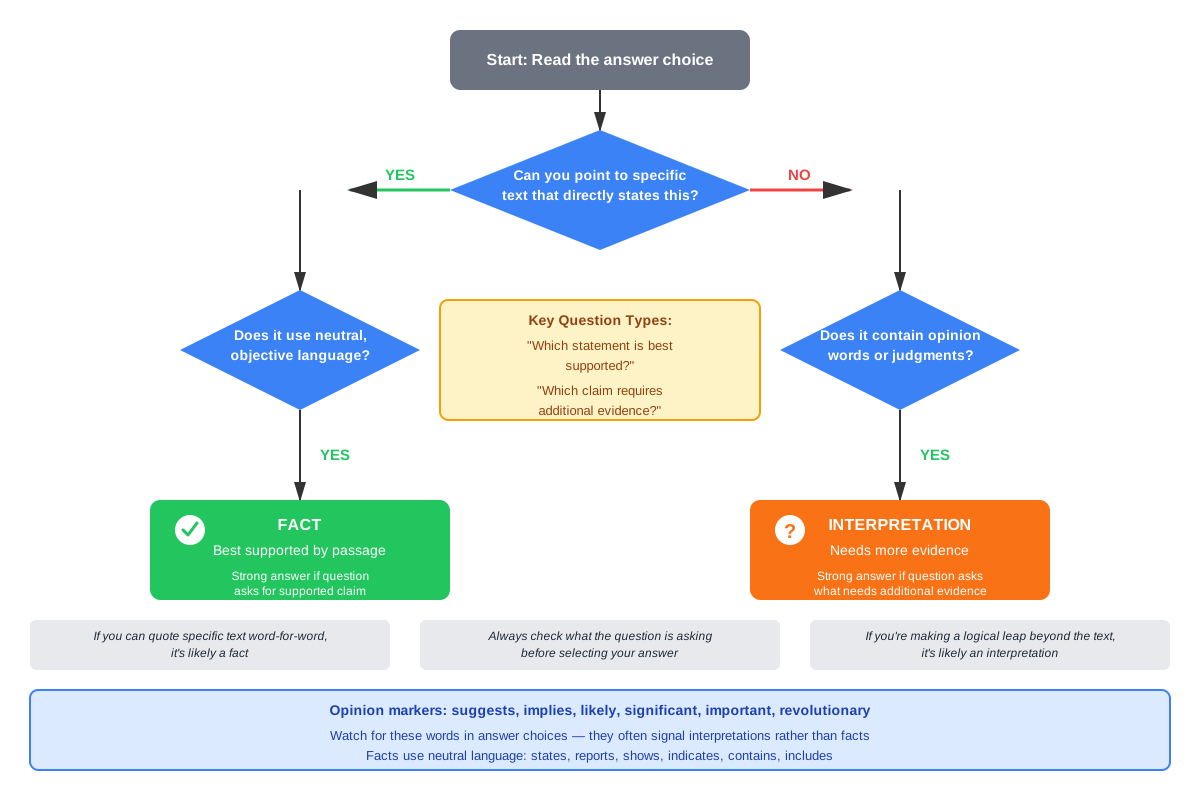
When approaching SAT questions testing this skill, follow this systematic process:
Step 1: Identify the question type. Look for phrases like "most directly supported," "best reflects information in the passage," "can be verified," or "requires additional evidence." These signal that you must distinguish fact from interpretation.
Step 2: Return to the passage. Don't rely on memory. Locate the relevant section and read it carefully, noting what is explicitly stated versus what is implied or concluded.
Step 3: Apply the verification test. For each answer choice, ask: "Can I point to specific words in the passage that confirm this statement without requiring me to make any logical leaps or inferences?" If yes, it's likely factual. If you need to think "well, if X is true, then Y probably follows," it's likely interpretive.
Step 4: Watch for trigger words. Eliminate choices containing interpretive language like "suggests," "demonstrates," "proves," "reveals," "significant," "important," "effective," or "successful" unless the passage itself uses these exact terms. Be especially cautious of causal language ("caused," "led to," "resulted in") and comparative judgments ("better," "worse," "more important").
Step 5: Beware of extreme language. Words like "always," "never," "essential," "impossible," "proves," or "definitively" often signal interpretation unless the passage explicitly uses such absolute terms. Facts tend to be more measured and specific.
Exam Tip: If you're choosing between two answers and both seem partially supported, select the one that requires less inference. The SAT rewards answers that stick closest to what the passage explicitly states.
Time allocation: Spend 30-45 seconds locating the relevant passage section, then 45-60 seconds evaluating answer choices. Don't rush this question type—accuracy matters more than speed, and these questions are highly scorable when approached systematically.
Memory Techniques
VIDS Mnemonic for identifying facts:
- Verifiable: Can you check it against the passage?
- Independent: Does it exist regardless of opinion?
- Direct: Is it explicitly stated rather than implied?
- Specific: Does it provide concrete details rather than judgments?
The "Says vs. Means" Framework: When reading a passage, mentally label information as either what the text says (facts) or what the text means (interpretations). This active reading strategy trains your brain to automatically distinguish between the two.
Visualization Strategy: Picture facts as building blocks—solid, concrete, stackable objects. Picture interpretations as the structures built from those blocks—they depend on the blocks but represent something beyond them. This metaphor helps students remember that interpretations are built from facts but aren't facts themselves.
The Quotation Test: Ask yourself, "Could I put quotation marks around this exact statement and find it in the passage?" If yes, it's likely factual. If you'd need to paraphrase or combine multiple sentences, check whether you're adding interpretation.
Summary
Distinguishing fact from interpretation is a foundational skill for SAT Reading and Writing success, requiring students to separate objective, verifiable statements from subjective judgments and conclusions. Facts can be directly confirmed through the passage and exist independently of opinion, while interpretations represent analysis, evaluation, or conclusions drawn from facts. The SAT tests this skill through questions asking which statements are "most directly supported" or which claims require additional evidence. Success requires careful attention to language signals—words like "suggests," "implies," and evaluative terms typically indicate interpretation, while specific, measurable statements without judgment typically represent facts. Students must return to the passage, apply the verification test to each answer choice, and select statements that require minimal inference. This skill connects to broader competencies including identifying textual evidence, analyzing arguments, and understanding authorial purpose, making it essential for achieving high scores in the Command of Evidence domain.
Key Takeaways
- Facts are objective and verifiable directly from the passage; interpretations involve judgment, analysis, or conclusions drawn from facts
- Language signals matter: "suggests," "implies," "likely," and evaluative terms typically indicate interpretation rather than fact
- A statement can be factual about someone's interpretation (e.g., "The author argues..." is a fact about what was said)
- The verification test is crucial: if you can point to specific passage words confirming a statement without inference, it's likely factual
- Interpretations aren't wrong—they're simply conclusions drawn from evidence rather than evidence itself
- SAT questions reward answers that stick closest to what the passage explicitly states rather than what can be inferred
- This skill appears frequently (2-4 questions per test) and is highly scorable when approached systematically
Related Topics
Identifying Textual Evidence: Once students can distinguish facts from interpretations, they're better equipped to select quotations that support claims, a closely related SAT skill that asks which passage excerpt best supports a given statement.
Analyzing Arguments: Understanding the distinction between factual premises and interpretive conclusions enables students to evaluate argument structure and identify logical gaps or unsupported claims.
Understanding Purpose and Tone: Recognizing whether an author primarily presents facts or interpretations helps students determine whether the purpose is to inform objectively or to persuade through analysis.
Evaluating Source Credibility: In paired-passage questions, distinguishing fact from interpretation helps students assess which source provides objective information versus which presents a particular perspective.
Practice CTA
Now that you've mastered the core concepts of distinguishing fact from interpretation, it's time to apply this knowledge! Work through the practice questions to test your ability to identify factual statements versus interpretive claims in various passage types. Use the flashcards to reinforce key concepts and language signals. Remember: this skill is highly scorable when you approach it systematically, and mastering it will boost your performance across multiple question types in the Reading and Writing section. You've built the foundation—now strengthen it through deliberate practice!
Sign up free to keep reading
Create a free AnvayaPrep account to finish this SAT guide on Distinguishing fact from interpretation — plus flashcards and practice questions.