Overview
Evidence consistency is a critical skill tested in the SAT Reading and Writing section that requires students to evaluate whether textual evidence logically supports a given claim or conclusion. This concept forms the backbone of the Command of Evidence question type, where test-takers must determine if cited information actually proves what an author or researcher asserts. Unlike simple reading comprehension, evidence consistency questions demand analytical thinking: students must assess the logical relationship between a statement and its supporting details, identifying when evidence genuinely backs up a claim versus when it's irrelevant, insufficient, or contradictory.
On the SAT, sat evidence consistency questions typically present a brief passage containing a claim followed by potential supporting evidence, or they ask students to identify which piece of evidence best supports a conclusion drawn from research or observation. These questions assess whether students can distinguish between strong, relevant evidence and weak or tangential information. The ability to evaluate evidence consistency is fundamental not only for standardized testing but for academic success across disciplines, where constructing and evaluating arguments based on textual support is essential.
Within the broader RW (Reading and Writing) framework, evidence consistency connects directly to other critical reading skills including main idea identification, inference-making, and rhetorical analysis. While comprehension questions ask "what does the text say," evidence consistency questions probe deeper: "does this evidence actually prove what's being claimed?" This analytical layer represents a higher-order thinking skill that separates strong readers from those who merely understand surface-level content. Mastering evidence consistency enables students to approach all reading passages more critically, evaluating not just what authors say but whether their supporting details logically substantiate their arguments.
Learning Objectives
- [ ] Identify key features of evidence consistency in SAT passages
- [ ] Explain how evidence consistency appears on the SAT Reading and Writing section
- [ ] Apply evidence consistency principles to answer SAT-style questions accurately
- [ ] Distinguish between strong, relevant evidence and weak or irrelevant supporting details
- [ ] Evaluate whether textual evidence logically supports specific claims or conclusions
- [ ] Recognize common patterns of evidence-claim mismatches in test questions
- [ ] Analyze multiple pieces of evidence to determine which best supports a given statement
Prerequisites
- Basic reading comprehension: Understanding literal meaning of passages is necessary before evaluating evidence quality
- Claim identification: Recognizing the main assertion or conclusion in a passage enables comparison with supporting evidence
- Paraphrasing skills: Evidence may be presented in different words than the claim, requiring recognition of equivalent meanings
- Logical reasoning fundamentals: Understanding cause-effect relationships and basic argumentation helps assess whether evidence truly supports claims
Why This Topic Matters
Evidence consistency represents one of the most frequently tested skills in the SAT Reading and Writing section, appearing in approximately 15-20% of all questions. The College Board emphasizes this skill because it reflects authentic academic work: college students must constantly evaluate whether sources support their thesis statements, whether research findings back up scientific claims, and whether historical evidence substantiates interpretations. Beyond academics, critical evaluation of evidence is essential for informed citizenship, as individuals encounter claims daily in news media, advertising, and public discourse that require verification against actual supporting information.
On the SAT, evidence consistency questions appear in several distinct formats. The most common presents a short passage (50-150 words) describing research findings or making an argument, followed by a question asking which quotation or detail best supports a specific claim from the passage. Another format provides a claim and asks students to identify which piece of evidence, if added to the passage, would most effectively support that claim. A third variation presents evidence and asks what conclusion it best supports. These questions span all content areas—literature, history, social science, and natural science—making evidence consistency a universal skill rather than domain-specific knowledge.
In exam passages, evidence consistency typically appears when authors cite studies, quote experts, reference data, or provide examples to support broader assertions. Students must evaluate whether the cited information actually proves the point being made or whether there's a logical gap between claim and evidence. The SAT specifically tests whether students can identify when evidence is relevant but insufficient, when it addresses a different aspect of the topic, or when it genuinely substantiates the claim with appropriate specificity and logical connection.
Core Concepts
What Constitutes Evidence Consistency
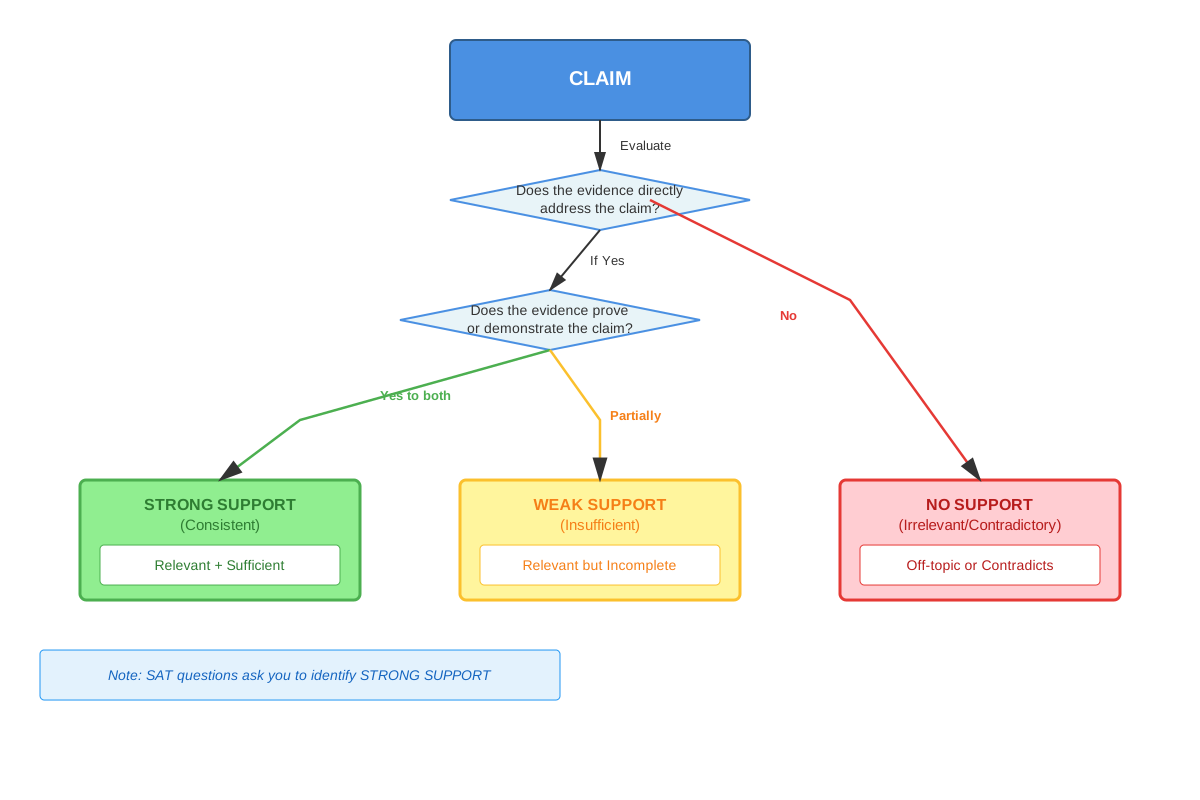
Evidence consistency refers to the logical alignment between a claim (an assertion, conclusion, or argument) and the supporting details provided to substantiate it. Consistent evidence directly addresses the specific claim being made, provides relevant information that logically supports the conclusion, and maintains appropriate scope—neither too broad nor too narrow for the assertion it's meant to prove. When evidence is consistent with a claim, a clear logical pathway exists from the supporting details to the conclusion, without requiring additional unstated assumptions or leaps in reasoning.
Three essential criteria determine evidence consistency:
- Relevance: The evidence must address the same topic and aspect as the claim
- Sufficiency: The evidence must provide adequate support, not merely tangential information
- Logical connection: The evidence must lead to the claim through valid reasoning
Types of Evidence-Claim Relationships
Understanding the relationship between evidence and claims helps identify consistency or inconsistency. Strong evidence-claim relationships exhibit clear logical connections:
| Relationship Type | Description | Example |
|---|---|---|
| Direct support | Evidence explicitly proves the claim | Claim: "The experiment succeeded." Evidence: "All trials produced the predicted results." |
| Statistical support | Numerical data substantiates a quantitative claim | Claim: "Most students prefer online learning." Evidence: "72% of surveyed students chose online formats." |
| Expert testimony | Authoritative source validates the claim | Claim: "Climate patterns are shifting." Evidence: "Dr. Smith, a climatologist, documented temperature changes." |
| Example-based | Specific instances illustrate a general claim | Claim: "The policy affected rural areas." Evidence: "Three rural counties saw population decline." |
| Comparative | Contrasting information supports a relative claim | Claim: "Method A works better than B." Evidence: "Method A produced 40% higher yields than Method B." |
Identifying Inconsistent Evidence
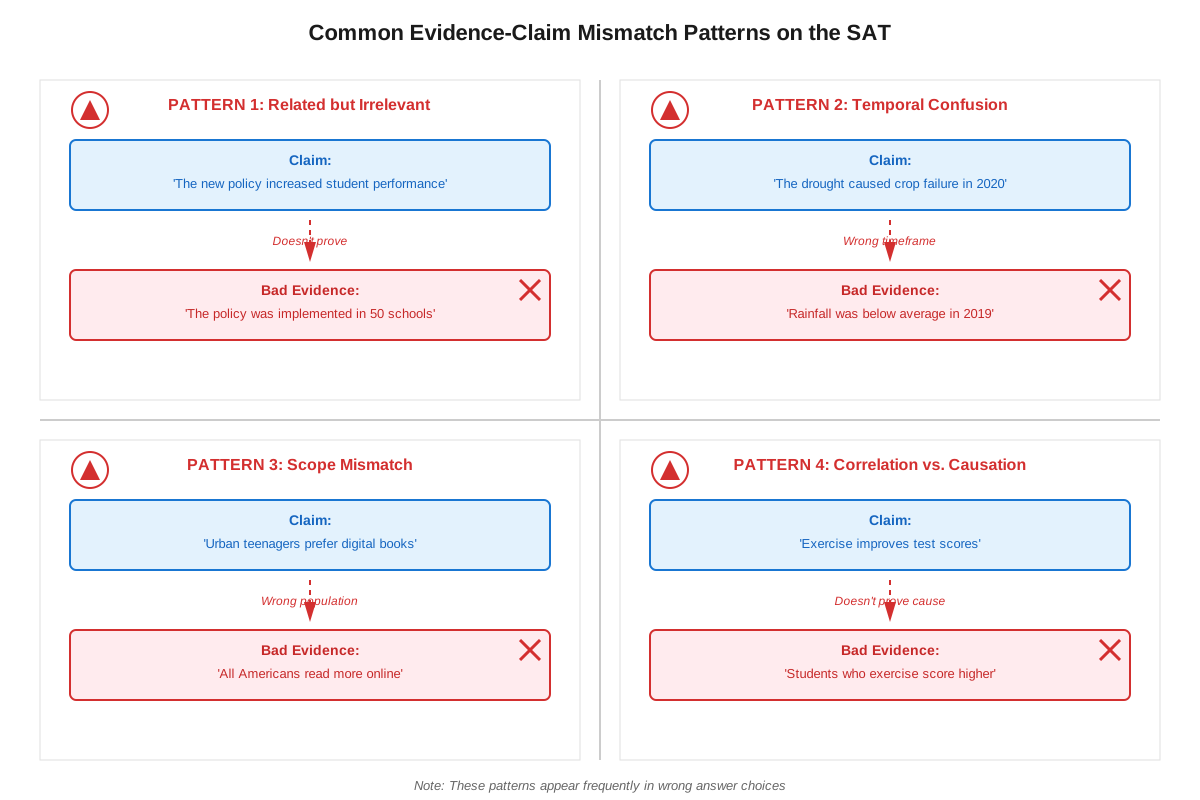
Inconsistent evidence fails to support claims for specific, identifiable reasons. Recognizing these patterns is crucial for SAT success:
Scope mismatch occurs when evidence addresses a broader or narrower topic than the claim. If a claim states "Shakespeare's tragedies influenced modern drama," evidence about his comedies or about Renaissance drama generally would be inconsistent due to scope differences.
Temporal mismatch happens when evidence from one time period is used to support claims about a different period. A claim about current economic conditions cannot be supported by data from decades earlier without establishing continuity.
Irrelevant correlation presents information related to the topic but not logically connected to the specific claim. If a passage claims "Exercise improves cardiovascular health," evidence that "gym memberships increased 20%" is inconsistent—more memberships doesn't prove health improvements.
Insufficient specificity provides evidence too vague to support a precise claim. A claim that "the novel's protagonist undergoes significant character development" requires specific textual evidence showing change, not merely a statement that "the character faces challenges."
The Evidence Evaluation Process
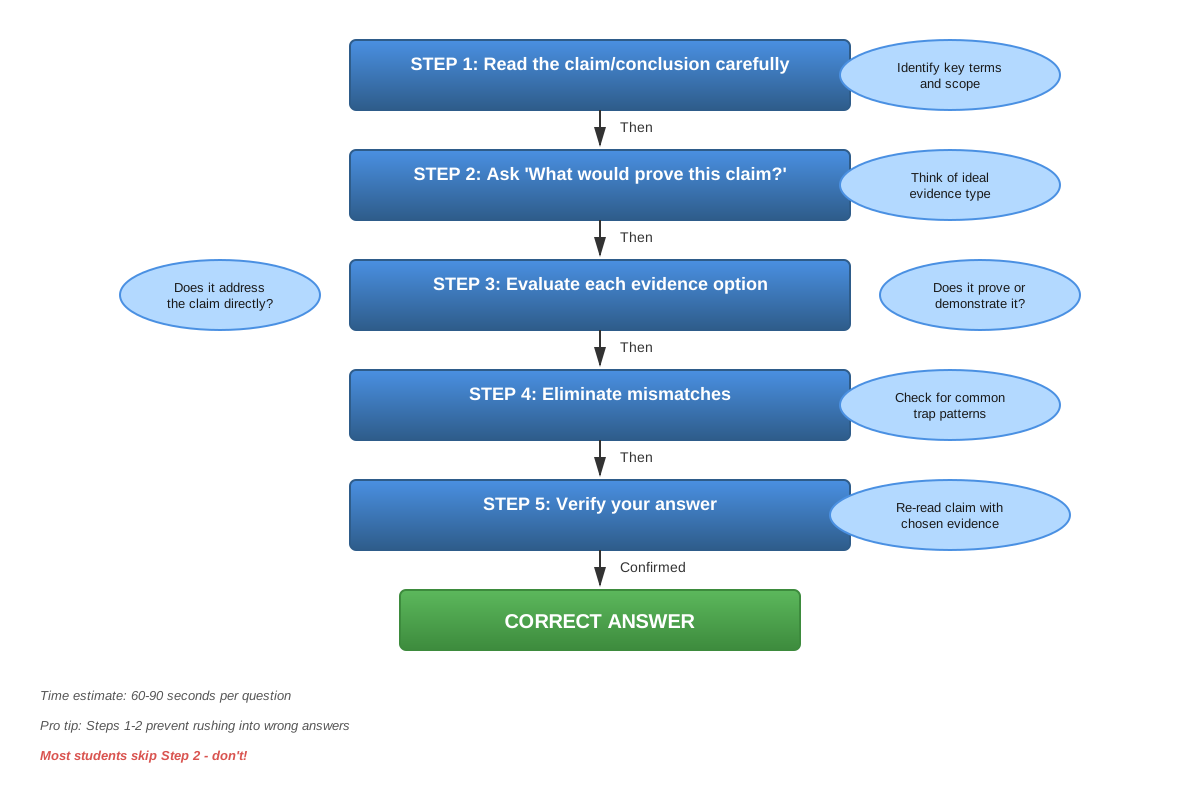
When assessing evidence consistency on the SAT, follow this systematic approach:
- Identify the exact claim: Determine precisely what assertion needs support, noting key terms and scope
- Analyze the evidence: Understand what information the evidence actually provides
- Trace the logical connection: Ask "Does this evidence directly lead to this conclusion?"
- Check for gaps: Identify any unstated assumptions required to connect evidence to claim
- Compare alternatives: When multiple evidence options exist, determine which provides the strongest, most direct support
Context and Interpretation
Evidence consistency depends partly on context. The same piece of evidence might support one claim while failing to support another. Consider this evidence: "The city's population increased from 100,000 to 150,000 between 2010 and 2020."
This evidence consistently supports: "The city experienced population growth in the 2010s."
This evidence inconsistently supports: "The city's economy improved during the 2010s." (Population growth doesn't necessarily indicate economic improvement—people might have moved for other reasons.)
This evidence inconsistently supports: "The city became more diverse in the 2010s." (Population increase doesn't specify demographic composition changes.)
Quantitative vs. Qualitative Evidence
The SAT tests both quantitative (numerical, statistical) and qualitative (descriptive, observational) evidence. Each type has distinct characteristics:
Quantitative evidence provides measurable support through numbers, percentages, or statistical findings. It's particularly strong for claims involving magnitude, frequency, or comparison. However, students must verify that the numbers actually measure what the claim asserts—a common trap involves presenting impressive statistics that don't directly address the claim's focus.
Qualitative evidence includes descriptions, observations, expert opinions, and textual examples. This evidence type supports claims about characteristics, qualities, or interpretations. Strong qualitative evidence provides specific, relevant details rather than vague generalizations. On the SAT, students must distinguish between qualitative evidence that genuinely illustrates a claim versus evidence that merely relates to the general topic.
Concept Relationships
Evidence consistency serves as the foundation for multiple interconnected reading skills. The evaluation process begins with claim identification → which enables → evidence analysis → which requires → logical reasoning → which produces → consistency determination. This linear progression shows how each skill builds upon the previous one, creating a comprehensive analytical framework.
Within the broader Command of Evidence unit, evidence consistency connects directly to textual evidence questions, where students must locate supporting details within passages. While textual evidence questions ask "where is the support," evidence consistency questions ask "is this actually support?" This represents a progression from location skills to evaluation skills, with consistency requiring deeper analytical thinking.
Evidence consistency also relates to inference questions, though the relationship is inverse. Inference questions ask students to draw conclusions from provided evidence, while evidence consistency questions ask students to evaluate whether evidence supports a given conclusion. Both require understanding the logical relationship between details and claims, but from opposite directions. Mastering evidence consistency strengthens inference skills by developing the logical reasoning that connects evidence to conclusions.
The relationship to argument analysis is particularly strong. Evaluating evidence consistency is essentially evaluating argument quality—determining whether an author's reasoning is sound. This connects evidence consistency to rhetorical analysis, where students examine how authors construct persuasive arguments. Understanding what makes evidence consistent or inconsistent enables deeper analysis of argumentative strategies and effectiveness.
High-Yield Facts
⭐ Evidence must directly address the specific claim being made, not just relate to the general topic—this is the most common trap in SAT evidence consistency questions.
⭐ Quantitative evidence only supports quantitative claims—numbers about one measurement don't prove claims about different measurements.
⭐ The strongest evidence provides specific, relevant details rather than general statements—specificity is key to consistency.
⭐ Evidence from one time period, location, or context doesn't automatically support claims about different circumstances—scope must match.
⭐ Expert opinions constitute evidence only when the expert's field matches the claim's subject matter—authority must be relevant.
- Evidence can be factually accurate but still inconsistent with a claim if it doesn't logically support that specific assertion.
- Multiple pieces of weak evidence don't necessarily equal one piece of strong evidence—quantity doesn't replace quality.
- Evidence that supports a related claim isn't automatically consistent with the actual claim being made.
- Correlation presented in evidence doesn't prove causation claimed in assertions—this logical gap creates inconsistency.
- The most detailed or longest piece of evidence isn't necessarily the most consistent—relevance matters more than length.
- Evidence must be sufficient in scope—a single example may not adequately support a broad generalization.
- Temporal sequence in evidence (A happened before B) doesn't prove causal claims (A caused B) without additional support.
Quick check — test yourself on Evidence consistency so far.
Try Flashcards →Common Misconceptions
Misconception: If evidence relates to the same topic as the claim, it must be consistent support.
Correction: Evidence must do more than relate to the topic—it must specifically address the exact assertion being made. Evidence about Shakespeare's life doesn't support claims about his writing style, even though both concern Shakespeare.
Misconception: Longer or more detailed evidence is always better support than brief evidence.
Correction: Evidence quality depends on relevance and logical connection, not length. A single precise statistic often provides stronger support than a lengthy description that doesn't directly address the claim.
Misconception: If evidence is factually true, it must support any claim in the same passage.
Correction: True evidence can still be inconsistent with specific claims if it doesn't logically support those particular assertions. All evidence in a passage might be accurate, but only some will support each individual claim.
Misconception: Evidence that proves part of a claim automatically supports the entire claim.
Correction: Claims often contain multiple components, and evidence must address all essential elements. Evidence supporting "the population increased" doesn't support "the population increased due to economic growth" unless it also addresses causation.
Misconception: Expert testimony always provides consistent evidence regardless of the expert's field.
Correction: Expert evidence is only consistent when the expert's area of expertise matches the claim's subject. A physicist's opinion about historical events doesn't constitute strong evidence for historical claims.
Misconception: Evidence showing correlation between two factors supports claims of causation between those factors.
Correction: Correlation and causation are distinct logical relationships. Evidence must specifically demonstrate causal mechanisms, not merely show that two things occur together, to support causal claims.
Worked Examples
Example 1: Scientific Research Claim
Passage: Researchers studying sleep patterns in adolescents concluded that later school start times improve academic performance. The study tracked 500 high school students over one academic year. Schools that shifted start times from 7:30 AM to 8:30 AM saw average GPAs increase from 2.8 to 3.1, while schools maintaining 7:30 AM starts showed no significant GPA changes.
Question: Which finding, if true, would most strengthen the researchers' conclusion?
A) Students at schools with later start times reported feeling more rested.
B) Schools with later start times also implemented new tutoring programs.
C) Students' standardized test scores improved proportionally to GPA increases at later-start schools.
D) Teachers at later-start schools reported improved classroom attention.
Analysis:
First, identify the exact claim: "Later school start times improve academic performance."
Now evaluate each option's consistency:
Option A provides evidence about how students felt, which relates to sleep but doesn't directly measure academic performance. While feeling rested might contribute to better performance, this evidence doesn't prove the academic improvement claim. This is inconsistent due to insufficient directness.
Option B introduces a confounding variable—if schools with later starts also added tutoring, we cannot determine whether start times or tutoring caused the improvement. This evidence actually weakens the claim by suggesting an alternative explanation, making it inconsistent.
Option C provides additional academic performance data (standardized tests) that corroborates the GPA findings. This strengthens the claim by showing improvement across multiple academic measures, not just one. The proportional relationship further supports that the start time change drove the improvement. This is strongly consistent.
Option D offers observational evidence from teachers about attention, which relates to the mechanism (better attention → better performance) but doesn't directly measure academic outcomes. While supportive, it's less direct than actual performance data.
Answer: C
This example demonstrates that the strongest evidence directly measures what the claim asserts (academic performance) rather than related factors (feelings, attention) or introduces complications (additional programs).
Example 2: Historical Interpretation
Passage: Historian Dr. Martinez argues that the construction of the transcontinental railroad fundamentally transformed the American economy in the late 19th century. She notes that the railroad connected previously isolated markets, enabling goods to move across the continent in days rather than months.
Question: Which quotation from Dr. Martinez's research would best support her argument?
A) "Railroad construction employed thousands of workers, including many Chinese immigrants who faced harsh conditions."
B) "Between 1870 and 1890, the volume of goods shipped between East and West coasts increased by 400%, while shipping costs decreased by 60%."
C) "The railroad companies received substantial land grants from the federal government to incentivize construction."
D) "Completion of the railroad was celebrated with a golden spike ceremony at Promontory Summit, Utah, in 1869."
Analysis:
The claim focuses on "fundamental transformation of the American economy," which requires evidence of significant economic change.
Option A addresses the social history of railroad construction (employment, immigration, working conditions) but doesn't demonstrate economic transformation. While employment is an economic factor, this evidence doesn't show fundamental change to the economy's structure or scale. Inconsistent due to scope mismatch.
Option B provides quantitative evidence of dramatic economic change: massive increase in trade volume and significant cost reduction. These metrics directly demonstrate economic transformation—the railroad enabled more trade at lower cost, fundamentally changing how the economy functioned. This evidence specifically supports "transformed the economy." Strongly consistent.
Option C discusses how the railroad was financed (government land grants) but doesn't demonstrate the economic impact or transformation that resulted. This is about the railroad's construction, not its economic effects. Inconsistent due to addressing a different aspect.
Option D describes a ceremonial event marking completion but provides no information about economic impact. Historical significance doesn't equal economic transformation. Inconsistent due to irrelevance to the economic claim.
Answer: B
This example illustrates that evidence must address the specific aspect of the topic mentioned in the claim. All options relate to the transcontinental railroad, but only one addresses economic transformation with relevant data.
Exam Strategy
When approaching SAT evidence consistency questions, begin by carefully reading the claim or conclusion that needs support. Underline or mentally note the key terms that specify exactly what needs to be proven—these terms define what consistent evidence must address. Pay particular attention to qualifiers like "most," "significantly," "primarily," or "fundamentally," as evidence must match the claim's scope and intensity.
Exam Tip: Before looking at answer choices, predict what type of evidence would logically support the claim. Ask yourself: "What would I need to know to prove this statement?" This prediction helps you recognize strong evidence when you see it.
Trigger words that signal evidence consistency questions include:
- "Which finding best supports..."
- "Which quotation most effectively illustrates..."
- "Which statement, if true, would strengthen..."
- "Which detail provides the strongest evidence for..."
- "Which example best demonstrates..."
When these phrases appear, immediately shift into evidence evaluation mode, focusing on logical connections rather than mere topic relevance.
For process of elimination, systematically eliminate options that:
- Address different aspects of the topic than the claim specifies
- Provide insufficient specificity to prove the precise claim
- Introduce confounding factors that complicate rather than support the claim
- Show correlation when causation is claimed (or vice versa)
- Come from irrelevant sources or time periods
The most common wrong answers are "topic-related but claim-irrelevant"—they discuss the same general subject but don't address the specific assertion. Train yourself to ask "Does this prove THIS claim?" rather than "Does this relate to the topic?"
Time allocation: Evidence consistency questions typically require 45-60 seconds. Spend 15 seconds fully understanding the claim, 20-30 seconds evaluating each option's logical connection to the claim, and 10-15 seconds confirming your answer. Don't rush the claim analysis—misunderstanding what needs to be proven leads to selecting evidence that seems relevant but doesn't actually support the specific assertion.
When two options seem equally strong, look for the one that requires fewer assumptions to connect to the claim. The best evidence creates a direct, obvious logical pathway from the supporting detail to the conclusion without requiring readers to infer additional information.
Memory Techniques
PROVES Acronym for evaluating evidence consistency:
- Precise: Does the evidence address the exact claim, not just the general topic?
- Relevant: Does it relate directly to what needs to be proven?
- Objective: Is it factual information rather than unsupported opinion?
- Verifiable: Does it provide specific, concrete details?
- Enough: Is it sufficient in scope to support the claim's breadth?
- Source-appropriate: Does it come from a credible, relevant source?
The Bridge Visualization: Picture the claim as one side of a river and the evidence as the other side. Consistent evidence builds a solid bridge directly connecting both sides. Inconsistent evidence either builds a bridge to the wrong location (irrelevant), builds only halfway (insufficient), or requires you to jump gaps (requires unstated assumptions). When evaluating options, visualize which builds the strongest, most direct bridge.
The Spotlight Technique: Imagine the claim as a spotlight illuminating a specific area. Consistent evidence must fall within that spotlight's beam. Evidence outside the spotlight—even if nearby—doesn't support the claim. This helps distinguish between topic-related evidence (near the spotlight) and claim-supporting evidence (in the spotlight).
Three-Question Check: Before selecting evidence, ask:
- "What exactly does the claim say?" (Identify the assertion)
- "What does this evidence actually prove?" (Understand the evidence)
- "Do these match?" (Evaluate consistency)
If you can't answer "yes" to question 3 with confidence, the evidence is likely inconsistent.
Summary
Evidence consistency represents a fundamental analytical skill tested extensively on the SAT Reading and Writing section, requiring students to evaluate whether supporting details logically substantiate specific claims. Mastery involves understanding that consistent evidence must be relevant to the exact assertion being made, sufficient in scope and specificity, and logically connected to the conclusion without requiring unstated assumptions. The most common challenge students face is distinguishing between evidence that relates to the general topic versus evidence that specifically proves the particular claim—many wrong answers exploit this confusion by presenting topic-relevant but claim-irrelevant information. Success requires systematic evaluation: precisely identifying what the claim asserts, analyzing what each piece of evidence actually proves, and tracing the logical pathway between them. Strong evidence directly addresses the claim's key terms, matches its scope and timeframe, and provides concrete, specific support rather than vague generalities. By applying the PROVES framework and consistently asking "Does this evidence prove THIS specific claim?" students can reliably identify consistent evidence and avoid the trap of selecting merely related information.
Key Takeaways
- Evidence consistency requires logical alignment between claims and supporting details, not merely topical relationship
- The strongest evidence directly addresses the specific assertion being made with appropriate scope and specificity
- Common traps include evidence that relates to the topic but doesn't prove the particular claim, or evidence that addresses only part of a multi-component claim
- Quantitative evidence must measure what the claim asserts; qualitative evidence must illustrate the specific characteristic claimed
- Systematic evaluation using the PROVES framework (Precise, Relevant, Objective, Verifiable, Enough, Source-appropriate) ensures accurate consistency assessment
- Evidence from different contexts, time periods, or scopes than the claim typically fails to provide consistent support
- The best evidence creates a direct logical pathway to the conclusion without requiring additional unstated assumptions
Related Topics
Textual Evidence Location: Building on evidence consistency, this skill involves efficiently finding supporting details within longer passages. Mastering consistency evaluation makes locating relevant evidence more efficient, as students better understand what type of support to seek.
Inference and Conclusion Drawing: The inverse of evidence consistency—using provided evidence to draw valid conclusions. Understanding what makes evidence consistent with claims strengthens the ability to infer appropriate conclusions from given details.
Argument Analysis and Evaluation: Evidence consistency forms the foundation for analyzing complete arguments, evaluating their logical structure, and identifying strengths and weaknesses in reasoning. This advanced skill applies consistency principles to multi-step arguments.
Rhetorical Strategy Analysis: Understanding how authors use evidence to support claims enables deeper analysis of persuasive techniques and argumentative effectiveness, connecting evidence evaluation to rhetorical purpose.
Research and Citation Skills: Beyond the SAT, evidence consistency principles directly apply to academic writing, where students must select and present evidence that genuinely supports their thesis statements and arguments.
Practice CTA
Now that you've mastered the principles of evidence consistency, it's time to apply these skills to authentic SAT-style questions. The practice questions and flashcards will reinforce your ability to quickly identify consistent evidence and avoid common traps. Remember: evidence consistency questions are highly predictable once you understand the patterns—consistent practice transforms this challenging skill into a reliable source of points. Approach each practice question systematically using the PROVES framework, and you'll develop the analytical instincts that lead to confident, accurate answers on test day. Your investment in mastering this high-yield topic will pay dividends across the entire Reading and Writing section!
Sign up free to keep reading
Create a free AnvayaPrep account to finish this SAT guide on Evidence consistency — plus flashcards and practice questions.