Overview
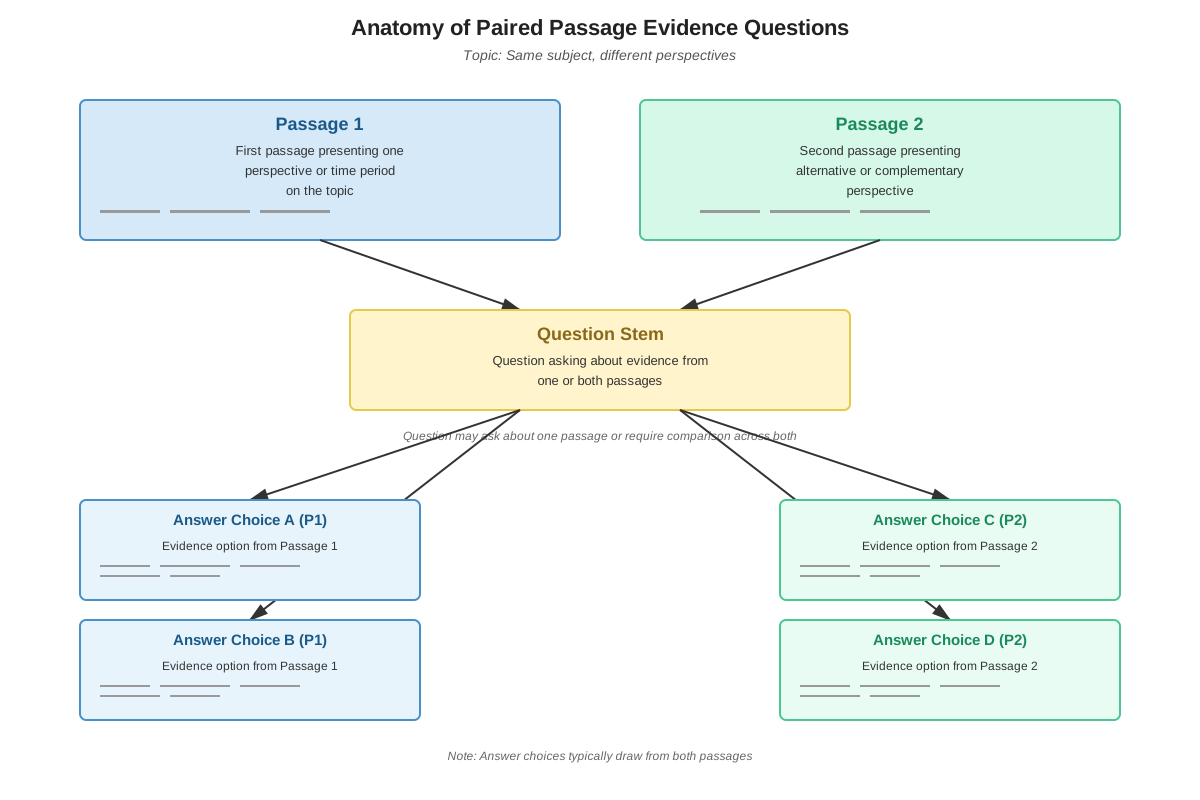
The SAT Reading and Writing section frequently presents students with paired passages—two distinct texts that address the same topic from different perspectives, time periods, or argumentative stances. Within these paired passages, the ability to analyze and compare evidence in paired passages becomes a critical skill that directly impacts test performance. Unlike single-passage questions that require students to identify supporting evidence within one text, paired passage questions demand that students navigate between two sources, distinguish between different types of evidence, and understand how authors use evidence to support contrasting or complementary claims.
Mastering evidence in paired passages is essential for SAT success because these questions appear consistently throughout the exam and test multiple competencies simultaneously: reading comprehension, analytical reasoning, and the ability to synthesize information across sources. Students must not only locate relevant textual evidence but also evaluate its purpose, strength, and relationship to claims made in either or both passages. This skill extends beyond simple comprehension to require critical thinking about how different authors construct arguments and support their positions with varying types of evidence.
Within the broader RW (Reading and Writing) framework, evidence-based questions in paired passages represent an advanced application of fundamental reading skills. They build upon single-passage evidence identification while adding layers of complexity through comparison and contrast. This topic connects directly to other Command of Evidence skills, including identifying textual support for claims, understanding authorial purpose, and evaluating the effectiveness of argumentative strategies. Success with paired passage evidence questions demonstrates college-readiness in analyzing multiple perspectives—a skill essential for academic research and critical discourse.
Learning Objectives
- [ ] Identify key features of evidence in paired passages
- [ ] Explain how evidence in paired passages appears on the SAT
- [ ] Apply evidence in paired passages to answer SAT-style questions
- [ ] Compare and contrast how different authors use evidence to support similar or opposing claims
- [ ] Evaluate the relative strength and relevance of evidence across two related texts
- [ ] Synthesize information from both passages to answer questions requiring cross-textual analysis
- [ ] Distinguish between different types of evidence (empirical data, expert testimony, logical reasoning, anecdotal examples) across paired texts
Prerequisites
- Single-passage evidence identification: Understanding how to locate textual support for claims within one passage is foundational before comparing evidence across two passages
- Basic reading comprehension: The ability to understand main ideas, supporting details, and authorial purpose in individual texts is necessary for analyzing relationships between paired texts
- Claim and evidence relationship: Recognizing how evidence functions to support, illustrate, or prove claims provides the framework for evaluating evidence quality across passages
- Comparative analysis skills: Basic ability to identify similarities and differences between texts helps students navigate the additional complexity of paired passages
Why This Topic Matters
In academic and professional contexts, the ability to analyze multiple sources on the same topic represents a fundamental research and critical thinking skill. Students regularly encounter situations requiring them to evaluate competing perspectives, synthesize information from multiple sources, and determine which evidence most effectively supports various positions. The SAT evidence in paired passages questions directly assess this real-world competency, preparing students for college-level research papers, debates, and analytical writing.
On the SAT, paired passage questions constitute approximately 15-20% of the Reading and Writing section, making them a high-frequency question type that significantly impacts overall scores. These questions typically appear in sets of 10-11 questions per paired passage set, with 3-5 questions specifically focused on evidence comparison, cross-textual analysis, or how authors use evidence differently. The College Board consistently includes at least one paired passage set per test, often in the humanities, social sciences, or science domains.
Common manifestations of this topic on the exam include questions asking students to identify which lines from Passage 2 respond to a claim in Passage 1, determine how evidence in one passage relates to arguments in another, or evaluate which passage provides stronger support for a particular position. Questions may also ask students to identify shared evidence, contrasting evidence, or how authors interpret the same evidence differently. The complexity increases when passages present subtle differences in perspective rather than direct opposition, requiring careful attention to nuance and authorial intent.
Core Concepts
Understanding Paired Passage Structure
Paired passages on the SAT consist of two separate texts (Passage 1 and Passage 2) that address a common theme, topic, or question from different angles. These passages typically range from 50-75 lines each and may present complementary perspectives, contrasting viewpoints, or chronologically separated treatments of the same subject. The fundamental structure requires students to read both passages before answering questions, as many questions explicitly reference both texts or require synthesis across sources.
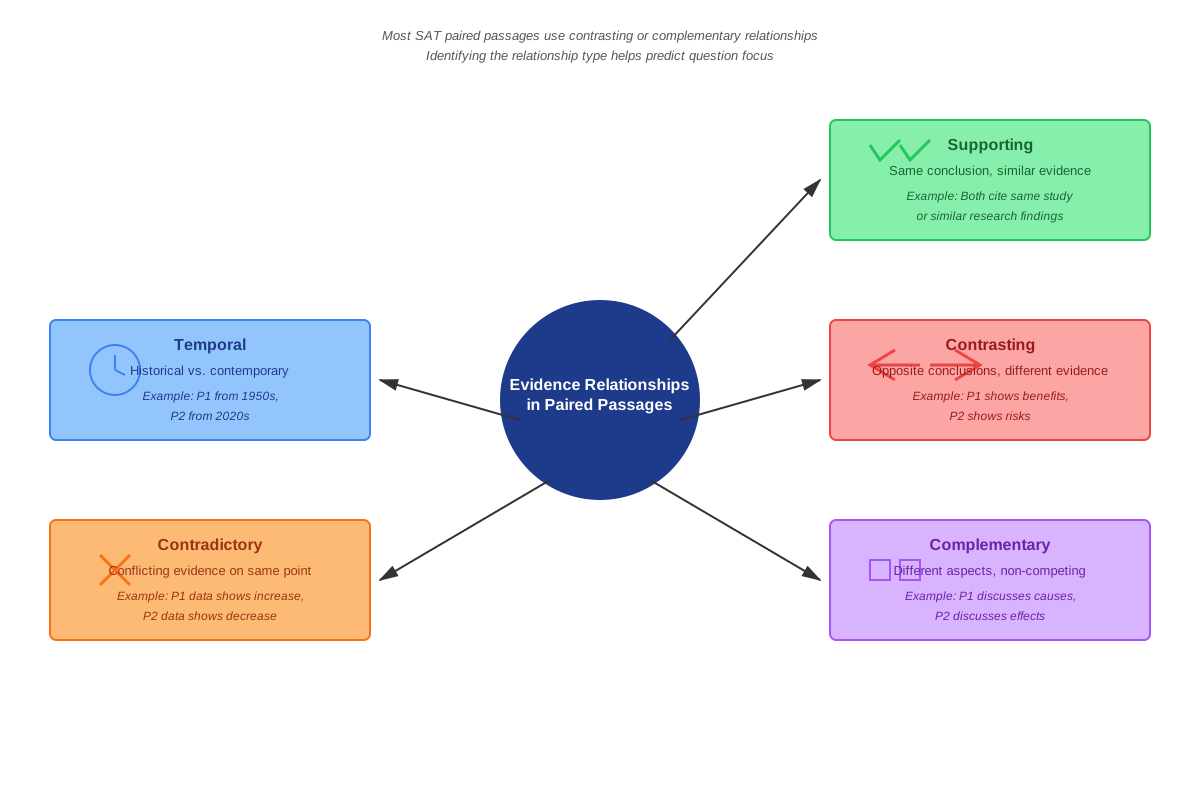
The relationship between paired passages falls into several categories: complementary (both passages support similar conclusions using different evidence), contrasting (passages present opposing viewpoints or interpretations), chronological (earlier and later perspectives on the same topic), or general-to-specific (one passage provides broad overview while the other examines a particular case). Recognizing the relationship type helps students anticipate how evidence will function differently across the texts.
Types of Evidence in Paired Passages
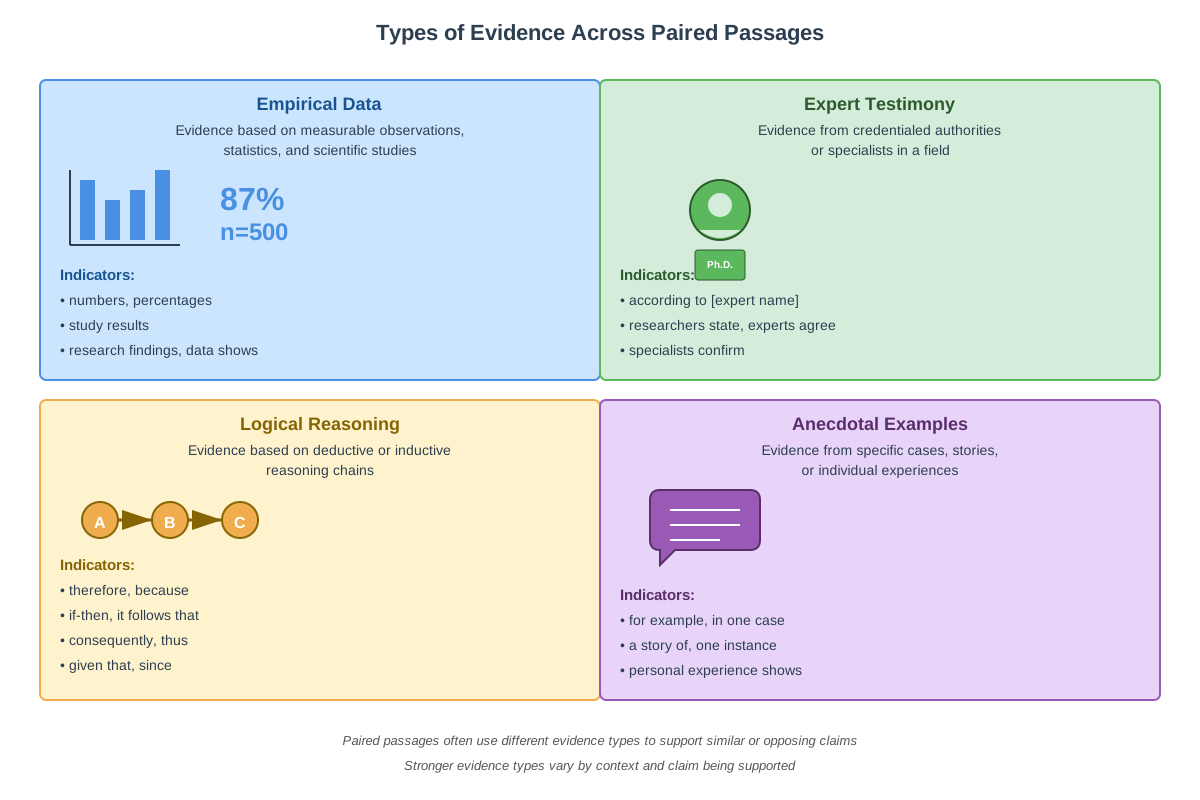
Evidence appears in multiple forms across paired passages, and understanding these categories enables more effective analysis:
| Evidence Type | Description | Common Function in Paired Passages |
|---|---|---|
| Empirical Data | Statistical information, experimental results, measurements | Often used to support scientific or social science claims; passages may present different data sets or interpret the same data differently |
| Expert Testimony | Quotes or citations from authorities in a field | May feature different experts supporting opposing views or the same expert interpreted differently |
| Historical Examples | Specific events, cases, or precedents from the past | Frequently used to illustrate broader principles; passages may draw different lessons from the same events |
| Logical Reasoning | Deductive or inductive arguments, cause-effect relationships | Authors may use different logical frameworks to reach contrasting conclusions |
| Anecdotal Evidence | Personal stories, individual cases, or illustrative scenarios | Often used to humanize abstract concepts; passages may use different anecdotes to support similar or opposing points |
Identifying Evidence Function Across Passages
When analyzing evidence in paired passages, students must determine not just what evidence appears but how each author deploys that evidence strategically. The same piece of information may serve different rhetorical purposes in different passages. For example, one author might present a statistical trend as evidence of progress, while another interprets the same trend as evidence of insufficient change.
Key questions for evidence analysis include:
- What specific claim does this evidence support in each passage?
- Does the evidence appear in both passages, and if so, how is it interpreted differently?
- What type of evidence does each author prioritize (quantitative vs. qualitative, expert opinion vs. logical reasoning)?
- How does the evidence relate to the author's overall argument or purpose?
- Which passage provides more direct, relevant, or compelling evidence for a particular claim?
Cross-Textual Evidence Comparison
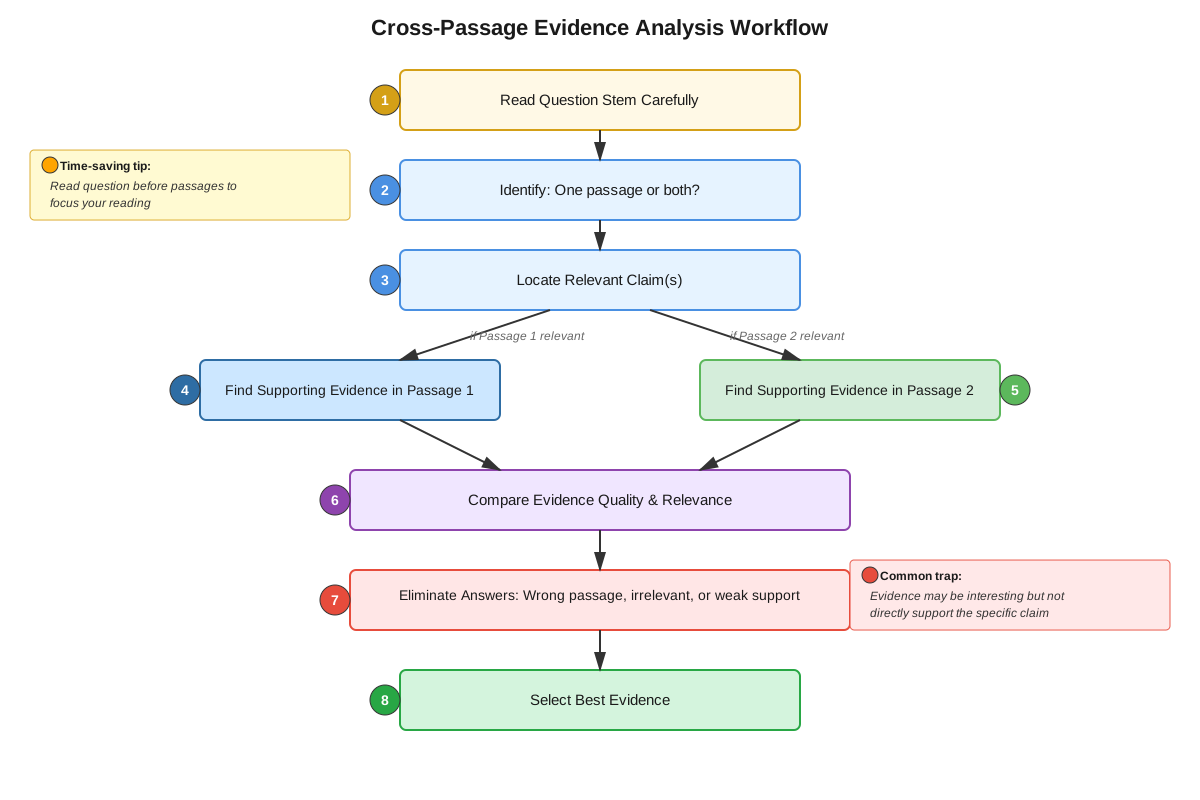
The most challenging aspect of SAT evidence in paired passages involves comparing how evidence functions across both texts. Students must develop the ability to hold information from both passages in working memory while evaluating relationships between them. This requires systematic reading strategies:
First-pass reading should focus on understanding each passage independently—identifying the main argument, key evidence, and authorial tone. Second-pass analysis involves actively comparing and contrasting: marking where passages agree or disagree, noting different evidence types, and identifying gaps where one passage provides evidence the other lacks.
Questions requiring cross-textual evidence analysis often ask students to:
- Identify which lines from Passage 2 most directly respond to or refute a claim in Passage 1
- Determine what evidence from Passage 1 would strengthen or weaken an argument in Passage 2
- Recognize which passage provides better support for a statement that could apply to both
- Evaluate how authors would likely respond to each other's evidence
Evidence Strength and Relevance Evaluation
Not all evidence carries equal weight, and the SAT frequently tests students' ability to evaluate evidence quality. Strong evidence is specific, relevant, directly connected to the claim, and comes from credible sources. Weak evidence may be vague, tangentially related, based on questionable sources, or insufficient in scope.
In paired passages, students must often determine which passage provides stronger support for a particular position. This requires considering:
- Specificity: Does the evidence provide concrete details or remain abstract?
- Relevance: How directly does the evidence connect to the claim being evaluated?
- Sufficiency: Is there enough evidence to support the claim adequately?
- Credibility: Does the evidence come from reliable, authoritative sources?
- Recency: For time-sensitive topics, is the evidence current and applicable?
Concept Relationships
The core concepts within evidence in paired passages build upon each other in a hierarchical structure. Understanding paired passage structure serves as the foundation, enabling students to navigate the basic format and relationship between texts. This foundational knowledge leads directly to identifying types of evidence, as students must recognize what forms evidence takes before analyzing its function.
Evidence function analysis builds on type identification by adding the layer of purpose—moving from "what is this evidence?" to "what does this evidence accomplish?" This analytical skill then enables cross-textual evidence comparison, which represents the synthesis level where students actively compare and contrast evidence across both passages. Finally, evidence strength evaluation sits at the apex, requiring students to make judgments about quality and effectiveness after understanding structure, type, function, and cross-textual relationships.
The relationship map flows as follows:
Paired Passage Structure Recognition → Evidence Type Identification → Evidence Function Analysis → Cross-Textual Comparison → Evidence Strength Evaluation
These concepts connect to prerequisite knowledge by extending single-passage evidence skills into the more complex domain of multiple sources. They also relate to other Command of Evidence topics, particularly understanding authorial purpose, evaluating argument effectiveness, and synthesizing information—skills that appear throughout the RW section.
High-Yield Facts
⭐ Paired passage questions constitute 15-20% of the SAT Reading and Writing section, making them high-frequency and high-impact for overall scores
⭐ The most common question types ask students to identify evidence from one passage that responds to or relates to claims in the other passage
⭐ Evidence in paired passages may be identical in content but interpreted differently by each author, requiring careful attention to context and purpose
⭐ Strong evidence is specific, relevant, directly connected to claims, and comes from credible sources—these criteria apply across both passages
⭐ Questions often ask which passage provides better support for a particular statement, requiring comparative evaluation of evidence strength
- Paired passages typically present either complementary, contrasting, chronological, or general-to-specific relationships
- Evidence types include empirical data, expert testimony, historical examples, logical reasoning, and anecdotal evidence
- Cross-textual analysis questions require holding information from both passages in working memory simultaneously
- Authors may use the same evidence to support opposing conclusions by emphasizing different aspects or implications
- The SAT never requires outside knowledge to answer paired passage questions—all necessary information appears within the texts
- Evidence relevance matters more than evidence quantity; one highly relevant example outweighs multiple tangential references
- Chronological paired passages often show how evidence or interpretations have evolved over time
- Questions may ask how an author of one passage would likely respond to evidence presented in the other passage
- Effective paired passage reading involves annotating relationships between passages during the initial reading
- The answer to evidence-based questions must be supported by explicit textual references, not inference alone
Quick check — test yourself on Evidence in paired passages so far.
Try Flashcards →Common Misconceptions
Misconception: Both passages in a paired set must present completely opposing viewpoints.
Correction: Paired passages often present nuanced differences rather than direct opposition. They may agree on basic facts while disagreeing on interpretation, emphasis, or implications. Some paired passages are complementary, with both supporting similar conclusions through different evidence or approaches.
Misconception: Evidence that appears in both passages must be interpreted identically by both authors.
Correction: Authors frequently cite the same evidence while drawing different conclusions or emphasizing different aspects. The SAT specifically tests the ability to recognize how identical information can support different arguments depending on context, framing, and authorial purpose.
Misconception: Longer or more detailed evidence is always stronger evidence.
Correction: Evidence strength depends on relevance, specificity, and direct connection to the claim—not length. A single, highly relevant sentence may provide stronger support than a lengthy but tangential paragraph. The SAT rewards students who can identify the most directly applicable evidence regardless of length.
Misconception: Students should answer all questions about Passage 1 before reading Passage 2.
Correction: Many questions explicitly require information from both passages, and attempting to answer questions before reading both texts leads to incomplete analysis. The most effective strategy involves reading both passages completely before attempting any questions, allowing for full understanding of the relationship between texts.
Misconception: If evidence appears in Passage 2, it must be responding to or refuting something in Passage 1.
Correction: While some evidence in Passage 2 does respond to Passage 1, much of it simply develops the second author's independent argument. Not every piece of evidence has a direct cross-textual relationship. Questions will explicitly indicate when cross-textual analysis is required.
Misconception: Personal opinion about which passage is more convincing should guide answer selection.
Correction: The SAT tests objective analysis of textual evidence, not subjective preference. Even if a student personally finds one passage more persuasive, answers must be based on what the text explicitly states and supports, not personal agreement with the author's position.
Misconception: Evidence from earlier in a passage is more important than evidence appearing later.
Correction: Evidence location does not determine importance. Key supporting evidence may appear anywhere in a passage. The SAT specifically tests whether students can identify the most relevant evidence regardless of its position in the text.
Worked Examples
Example 1: Identifying Cross-Textual Evidence Relationships
Passage 1 Excerpt: "The introduction of automated systems in manufacturing has led to a 40% increase in production efficiency over the past decade. Companies that have embraced automation report significant cost savings and improved product consistency."
Passage 2 Excerpt: "While automation undeniably increases production speed, this technological shift has displaced thousands of skilled workers who lack opportunities for retraining. The social costs of rapid automation—including increased unemployment in manufacturing communities—must be weighed against productivity gains."
Question: Which statement best describes the relationship between the evidence presented in the two passages?
Analysis Process:
Step 1: Identify the evidence in each passage
- Passage 1 evidence: 40% efficiency increase, cost savings, improved consistency
- Passage 2 evidence: worker displacement, lack of retraining opportunities, unemployment in manufacturing communities
Step 2: Determine what claim each piece of evidence supports
- Passage 1 uses evidence to support the claim that automation benefits companies and production
- Passage 2 uses evidence to support the claim that automation creates social problems
Step 3: Analyze the relationship between the evidence sets
- Both passages acknowledge automation's impact on manufacturing
- Passage 1 focuses on economic/productivity benefits with quantitative evidence
- Passage 2 focuses on social costs with qualitative evidence about human impact
- The passages present complementary evidence about different dimensions of the same phenomenon
Step 4: Evaluate how the evidence functions cross-textually
- Passage 2 does not refute Passage 1's evidence about efficiency
- Instead, Passage 2 introduces a different category of evidence (social impact) that Passage 1 does not address
- The relationship is one of expansion rather than contradiction—Passage 2 broadens the scope of analysis
Answer: The passages present different types of evidence addressing different dimensions of automation's impact—Passage 1 provides quantitative economic evidence while Passage 2 provides qualitative social evidence, creating a more complete picture when considered together.
Connection to Learning Objectives: This example demonstrates how to identify evidence types across passages, analyze evidence function, and understand cross-textual relationships without assuming passages must be in direct opposition.
Example 2: Evaluating Evidence Strength Across Passages
Passage 1 Excerpt: "Marine biologists have documented coral bleaching events in 93% of surveyed reef systems across the Pacific Ocean between 2015 and 2020. Temperature data from these sites shows water temperatures consistently 2-3°C above historical averages during bleaching periods."
Passage 2 Excerpt: "Coral reefs face numerous environmental challenges in the modern era. Many scientists believe that changing ocean conditions may be affecting coral health, though the exact mechanisms remain under investigation. Some reef systems appear more resilient than others, suggesting that multiple factors influence coral survival."
Question: Which passage provides stronger evidence for the claim that elevated ocean temperatures cause coral bleaching?
Analysis Process:
Step 1: Identify the specific claim being evaluated
- Claim: Elevated ocean temperatures cause coral bleaching
- This requires evidence showing a connection between temperature and bleaching
Step 2: Extract relevant evidence from Passage 1
- Specific data: 93% of surveyed reefs experienced bleaching
- Temperature correlation: 2-3°C above historical averages during bleaching
- Time frame: 2015-2020 (recent, specific period)
- Source: Marine biologists (credible experts)
- The evidence directly links temperature elevation with bleaching events
Step 3: Extract relevant evidence from Passage 2
- General statement: "changing ocean conditions may be affecting coral health"
- Qualification: "exact mechanisms remain under investigation"
- Observation: "some reef systems appear more resilient"
- The evidence is vague, qualified, and does not specifically link temperature to bleaching
Step 4: Compare evidence strength using evaluation criteria
- Specificity: Passage 1 provides precise percentages and temperature measurements; Passage 2 uses general terms like "may be affecting"
- Relevance: Passage 1 directly addresses the temperature-bleaching relationship; Passage 2 mentions "changing conditions" without specifying temperature
- Credibility: Both cite scientific sources, but Passage 1 provides documented data while Passage 2 reports beliefs and ongoing investigation
- Directness: Passage 1 establishes a clear correlation; Passage 2 acknowledges uncertainty
Answer: Passage 1 provides significantly stronger evidence for the temperature-bleaching connection through specific quantitative data showing correlation between elevated temperatures and bleaching events, while Passage 2 offers only general statements about possible environmental factors without establishing a clear causal relationship.
Connection to Learning Objectives: This example demonstrates evidence strength evaluation, comparison of evidence types (quantitative vs. qualitative), and the application of specific criteria to determine which passage better supports a particular claim.
Exam Strategy
Systematic Reading Approach
When encountering paired passages on the SAT, implement a three-phase reading strategy. Phase 1: Read Passage 1 completely, noting the main argument, key evidence, and authorial tone. Phase 2: Read Passage 2 completely, actively comparing it to Passage 1 by noting agreements, disagreements, and different evidence types. Phase 3: Review the relationship between passages before attempting questions—identify whether they are complementary, contrasting, or chronologically related.
During reading, use efficient annotation: mark main claims with "C," evidence with "E," and note relationships between passages with arrows or symbols. This visual mapping helps during question-answering when you need to quickly locate relevant sections.
Trigger Words and Phrases
Questions about evidence in paired passages contain specific trigger language that signals the type of analysis required:
- "Both passages" or "both authors": Requires identifying shared evidence, common ground, or parallel arguments
- "Unlike Passage 1" or "in contrast to": Signals need to identify differences in evidence or interpretation
- "The author of Passage 2 would most likely respond": Requires inferring how evidence or arguments from one passage relate to claims in the other
- "Which passage provides stronger support": Demands comparative evaluation of evidence strength
- "Lines X-Y in Passage 1 relate to Passage 2 by": Tests understanding of cross-textual evidence relationships
- "Both passages use evidence to": Focuses on shared rhetorical strategies or evidence functions
Process of Elimination Strategies
For evidence-based questions in paired passages, eliminate answers that:
- Reference only one passage when the question asks about both
- Mischaracterize the relationship between passages (e.g., claiming direct opposition when passages are actually complementary)
- Cite evidence that doesn't directly support the claim being evaluated, even if the evidence appears in the passage
- Overstate or understate the degree of agreement or disagreement between passages
- Introduce information not present in either passage or require outside knowledge
Correct answers will always have explicit textual support in the relevant passage(s) and accurately characterize the relationship between evidence and claims.
Time Allocation
Paired passage sets typically include 10-11 questions and should take approximately 13-15 minutes total. Allocate 5-6 minutes for reading both passages (2.5-3 minutes per passage), leaving 7-9 minutes for questions (approximately 45 seconds per question). This pacing allows time for referring back to passages when needed.
If a question requires extensive cross-textual comparison and takes longer than 60 seconds, mark it and return after completing more straightforward questions. The SAT does not penalize for wrong answers, so always select your best answer even if uncertain.
Exam Tip: When questions ask which lines from one passage relate to the other, read all answer choices while keeping the relevant section of the other passage in mind. The correct answer will have a clear, logical connection—not just a superficial similarity in topic.
Memory Techniques
PAIRED Acronym for Analysis Steps
Purpose: Identify each author's main purpose or argument
Agreement: Note where passages agree or present similar evidence
Interpretation: Recognize how authors interpret evidence differently
Relationship: Determine the overall relationship type (complementary, contrasting, chronological)
Evidence types: Identify what kinds of evidence each author prioritizes
Differences: Mark key points of disagreement or divergent evidence
Evidence Strength Evaluation: SRDC
Specific: Is the evidence concrete and detailed?
Relevant: Does it directly connect to the claim?
Direct: Does it clearly support the conclusion without requiring multiple inferential leaps?
Credible: Does it come from reliable, authoritative sources?
Use SRDC as a mental checklist when questions ask which passage provides stronger support for a claim.
Visualization Strategy
Picture paired passages as two overlapping circles (Venn diagram). The overlapping section contains shared evidence, common ground, or agreed-upon facts. The non-overlapping sections contain unique evidence, different interpretations, or contrasting claims. When reading, mentally populate this diagram to visualize relationships.
Relationship Type Mnemonic: "CCGS"
Complementary: Both support similar conclusions with different evidence
Contrasting: Passages present opposing viewpoints
General-to-specific: One provides overview, the other examines a case
Sequential: Chronologically separated perspectives (earlier and later)
Quickly categorizing the relationship type using CCGS helps predict how evidence will function across passages.
Summary
Evidence in paired passages represents a high-frequency, high-impact question type on the SAT Reading and Writing section, requiring students to analyze how two different authors use evidence to support their respective arguments about a common topic. Success demands mastery of multiple interconnected skills: identifying various evidence types (empirical data, expert testimony, historical examples, logical reasoning, and anecdotal evidence), understanding how evidence functions to support claims within each passage, comparing and contrasting evidence across texts, and evaluating the relative strength and relevance of evidence when passages present different perspectives. The key to excellence lies in systematic reading that actively notes relationships between passages, recognition of whether passages are complementary or contrasting, and the ability to hold information from both texts in working memory while answering questions. Students must evaluate evidence using specific criteria—specificity, relevance, directness, and credibility—rather than relying on subjective preferences or assumptions about passage relationships. All answers must be grounded in explicit textual support, and the most effective approach involves reading both passages completely before attempting questions, allowing for full comprehension of how the texts relate to each other and how each author deploys evidence strategically.
Key Takeaways
- Evidence in paired passages questions constitute 15-20% of the SAT RW section and require comparing how two authors use evidence to support claims about a common topic
- The five main evidence types—empirical data, expert testimony, historical examples, logical reasoning, and anecdotal evidence—may appear in different combinations across paired passages
- Strong evidence is specific, relevant, directly connected to claims, and credible; these criteria apply when evaluating which passage better supports a particular position
- Paired passages may present complementary, contrasting, chronological, or general-to-specific relationships, and identifying the relationship type helps predict how evidence will function
- Effective strategy involves reading both passages completely before answering questions, actively annotating relationships, and using systematic evaluation criteria rather than personal preference
- The same evidence may appear in both passages but be interpreted differently by each author, requiring careful attention to context and purpose
- All answers must be supported by explicit textual references; the SAT never requires outside knowledge or subjective judgment about which author is "more correct"
Related Topics
Single-Passage Evidence Questions: Mastering evidence identification in individual passages provides the foundation for paired passage analysis. Students who excel at paired passages can apply these skills to more straightforward single-passage evidence questions with greater efficiency.
Authorial Purpose and Tone: Understanding why authors choose particular evidence types and how they present that evidence connects directly to analyzing authorial purpose. Paired passages often differ in tone and purpose, which influences evidence selection.
Argument Analysis and Evaluation: Evidence in paired passages extends into broader argument analysis skills, including identifying claims, evaluating logical reasoning, and recognizing rhetorical strategies. These skills are essential for the SAT Writing section and college-level analytical writing.
Synthesis and Integration: The ability to synthesize information from multiple sources, demonstrated in paired passage questions, prepares students for research-based writing tasks and the SAT Essay (when offered), where multiple perspectives must be integrated.
Comparative Reading in Science and History: Paired passage skills transfer directly to reading primary sources in history courses and comparing research studies in science classes, making this topic valuable beyond test preparation.
Practice CTA
Now that you've mastered the core concepts of evidence in paired passages, it's time to apply these skills to authentic SAT-style questions. The practice questions and flashcards will reinforce your ability to identify evidence types, compare evidence across passages, evaluate evidence strength, and answer questions efficiently under timed conditions. Each practice question is designed to target the specific skills covered in this guide, helping you build confidence and automaticity with this high-yield question type. Remember: consistent practice with immediate feedback is the most effective way to transform understanding into test-day performance. Challenge yourself to apply the PAIRED analysis framework and SRDC evaluation criteria as you work through the practice materials—these systematic approaches will become second nature with repetition, enabling you to tackle even the most complex paired passage questions with confidence!
Sign up free to keep reading
Create a free AnvayaPrep account to finish this SAT guide on Evidence in paired passages — plus flashcards and practice questions.