Overview
Evidence precision is a critical skill tested in the SAT Reading and Writing section that requires students to evaluate how well textual evidence supports a given claim or conclusion. Unlike simply identifying relevant evidence, precision demands that students distinguish between evidence that is merely related to a topic and evidence that directly, specifically, and accurately supports a particular statement. This skill reflects the type of analytical thinking required in college-level reading and research, where the quality and specificity of supporting evidence determines the strength of an argument.
On the SAT, sat evidence precision questions typically present a claim followed by four different pieces of textual evidence, asking students to identify which quotation or finding most effectively supports the stated claim. These questions assess whether students can recognize the difference between tangential information, general support, and precise, targeted evidence. The College Board has significantly increased the emphasis on evidence-based reasoning in recent SAT redesigns, making this one of the highest-yield topics in the RW (Reading and Writing) section.
Understanding evidence precision connects directly to broader Command of Evidence skills, including identifying textual support, synthesizing information across sources, and evaluating the strength of arguments. Mastery of this topic enhances performance not only on dedicated evidence questions but also on inference questions, main idea questions, and even some vocabulary-in-context items where understanding the precise relationship between claims and support proves essential. Students who excel at evidence precision demonstrate the analytical sophistication that colleges seek in incoming freshmen.
Learning Objectives
- [ ] Identify key features of Evidence precision
- [ ] Explain how Evidence precision appears on the SAT
- [ ] Apply Evidence precision to answer SAT-style questions
- [ ] Distinguish between general relevance and precise support in textual evidence
- [ ] Evaluate multiple pieces of evidence to determine which provides the most specific support for a claim
- [ ] Recognize common distractors in evidence precision questions, including overly broad or tangentially related evidence
Prerequisites
- Basic reading comprehension: Understanding main ideas, supporting details, and paragraph structure is essential because evidence precision builds on the ability to extract meaning from complex texts
- Claim identification: Recognizing what statement needs support helps determine what type of evidence would be most appropriate
- Logical reasoning fundamentals: Understanding cause-and-effect relationships and how conclusions follow from premises enables evaluation of evidence quality
- Vocabulary in context: Precise evidence often hinges on specific word meanings, so understanding nuanced vocabulary helps identify the best support
Why This Topic Matters
Evidence precision represents a fundamental academic skill that extends far beyond standardized testing. In college coursework, students must constantly evaluate sources, select appropriate quotations for research papers, and distinguish between weak and strong support for their arguments. In professional contexts, the ability to cite precise evidence underpins effective business proposals, legal arguments, scientific papers, and policy recommendations. This skill reflects critical thinking at its most practical level.
On the SAT, evidence precision questions appear with high frequency, typically comprising 3-5 questions per test administration in the Reading and Writing section. These questions carry significant weight because they directly assess the Command of Evidence domain, which represents approximately 13-15% of the total RW score. The College Board considers evidence-based reasoning so important that it appears across multiple question types, not just in dedicated "Which quotation best supports" formats.
Evidence precision commonly appears in passages drawn from natural sciences, social sciences, humanities, and literature. Students might encounter a claim about a scientific finding followed by data from a study, a historical interpretation supported by primary source quotations, or a literary analysis backed by specific textual details. The passages range from 25 to 150 words, with evidence options typically presented as direct quotations, paraphrased findings, or data points. Understanding how to evaluate precision across these diverse contexts makes this topic particularly high-yield for score improvement.
Core Concepts
Defining Evidence Precision
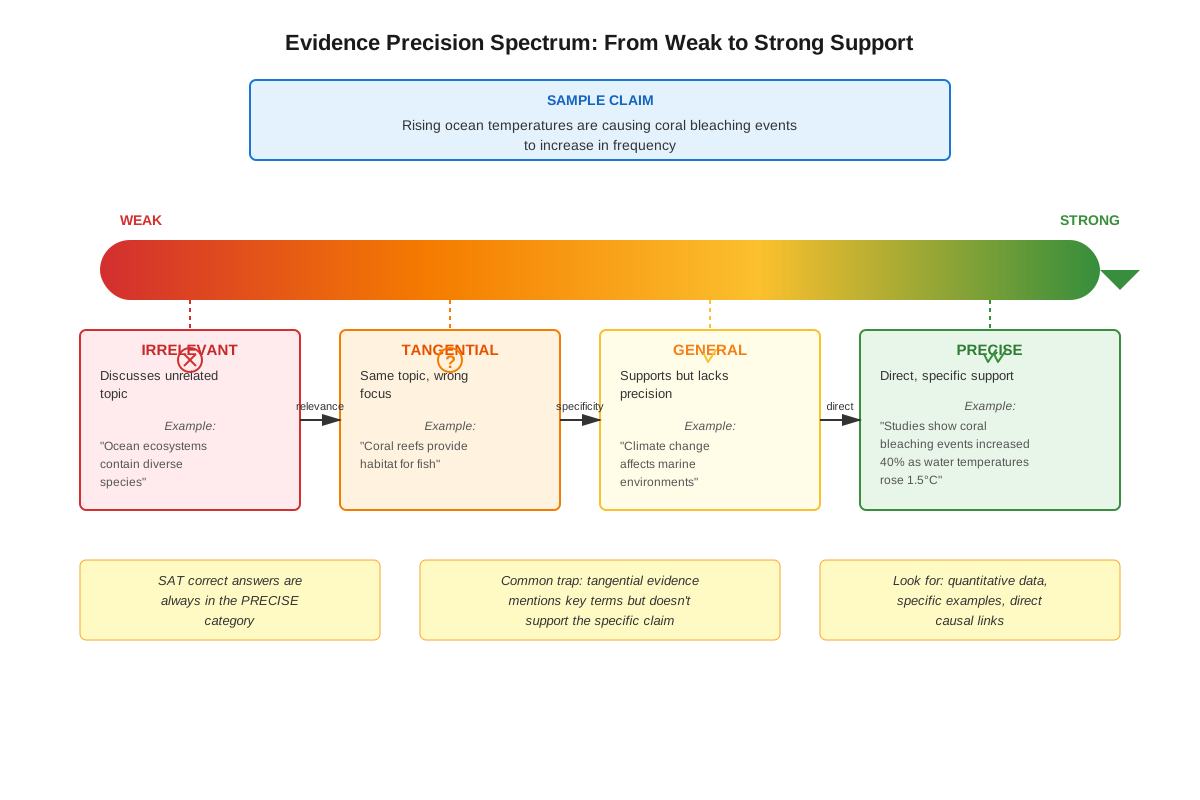
Evidence precision refers to the degree to which a piece of supporting information directly, specifically, and accurately addresses the exact claim being made. Precise evidence contains the specific details, measurements, examples, or quotations that align with all key elements of the claim without introducing irrelevant information or requiring inferential leaps. The precision of evidence exists on a spectrum: some evidence might be tangentially related, other evidence might be generally supportive, while the most precise evidence targets the exact scope and specifics of the claim.
Three key characteristics define precise evidence:
- Specificity: The evidence addresses the particular aspect mentioned in the claim rather than a broader or related concept
- Directness: The connection between evidence and claim is explicit rather than requiring multiple inferential steps
- Completeness: The evidence addresses all critical components of the claim without leaving gaps
The Precision Hierarchy
Not all supporting evidence functions equally well. Understanding the hierarchy of evidence quality helps students identify the most precise option:
| Evidence Quality Level | Characteristics | Example Context |
|---|---|---|
| Precise/Optimal | Directly addresses all claim elements; contains specific details matching claim scope | Claim about "increased efficiency in solar panels" supported by "efficiency rose from 15% to 22%" |
| General/Adequate | Supports the claim but lacks specificity or addresses only part of the claim | Same claim supported by "solar technology has improved significantly" |
| Tangential/Weak | Related to the topic but doesn't directly support the specific claim | Same claim supported by "solar panels are becoming more affordable" |
| Irrelevant | Discusses the general topic but has no bearing on the claim | Same claim supported by "wind energy also shows promise" |
Matching Evidence Scope to Claim Scope
A critical aspect of evidence precision involves matching the scope of the evidence to the scope of the claim. If a claim makes a statement about "some species," evidence about "all species" or "one specific species" may not provide precise support. Similarly, if a claim specifies a time period, location, or particular condition, the most precise evidence will reference those same parameters.
Consider these scope-matching principles:
- Quantitative claims require quantitative evidence (numbers, percentages, measurements)
- Causal claims require evidence showing the cause-effect relationship, not just correlation
- Comparative claims require evidence that includes both elements being compared
- Qualified claims (using words like "some," "often," "may") require evidence that matches that level of certainty
Identifying Claim Components
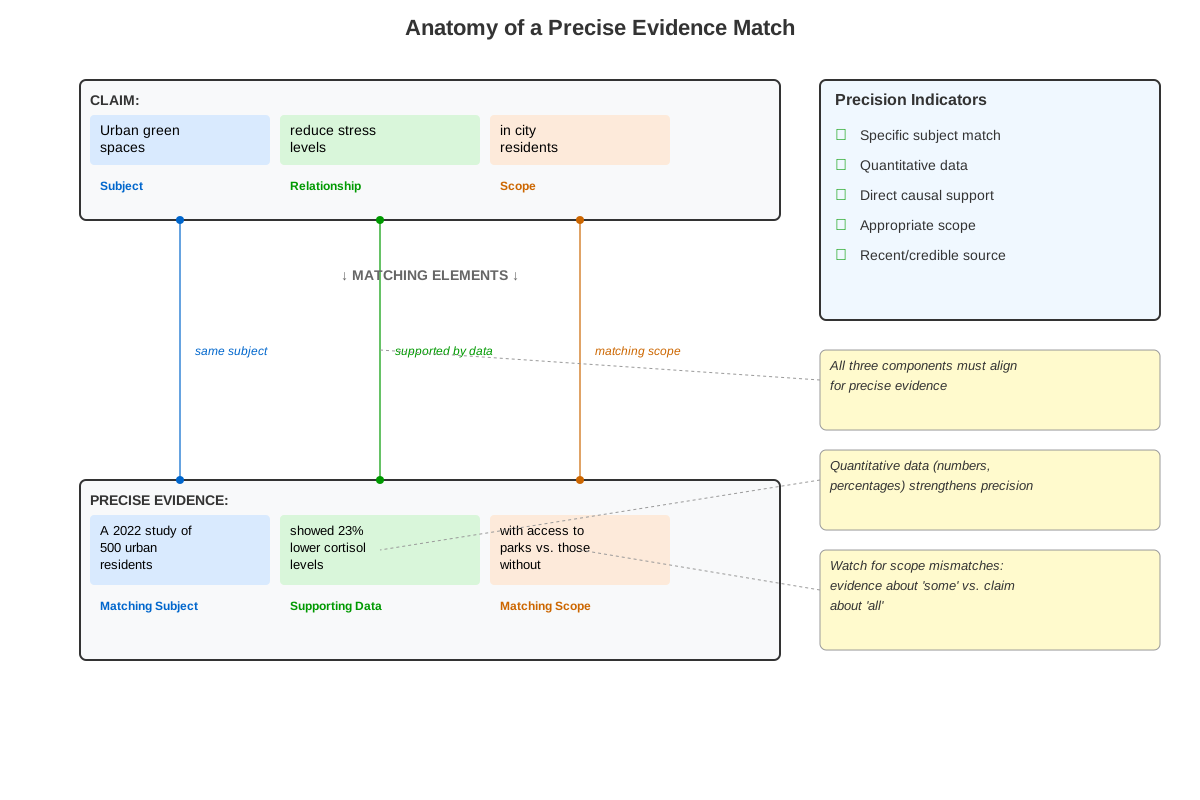
Before evaluating evidence, students must break down the claim into its essential components. A claim typically contains:
- Subject: Who or what the claim is about
- Action/State: What the subject does or what condition it's in
- Qualifiers: Limiting words that narrow the scope (sometimes, likely, primarily)
- Context: When, where, or under what conditions the claim applies
For example, in the claim "Recent studies suggest that moderate exercise may improve cognitive function in older adults," the components are:
- Subject: older adults
- Action: improve cognitive function
- Qualifiers: "may" (possibility, not certainty), "moderate" (not intense)
- Context: recent studies, exercise
The most precise evidence would address all these components: it would come from recent research, involve moderate (not intense) exercise, measure cognitive function specifically, focus on older adults, and indicate possibility rather than certainty.
Common Evidence Types on the SAT
The SAT presents evidence in several standard formats, each requiring slightly different evaluation approaches:
Direct quotations: Excerpts from the passage that students must evaluate for how well they support the claim. These require careful attention to every word, as a single qualifier or specification can determine precision.
Research findings: Paraphrased or quoted results from studies, often including data, percentages, or measurements. These require matching the study parameters to the claim parameters.
Examples and illustrations: Specific instances that demonstrate a broader principle. These work best when the claim is about patterns or general tendencies.
Expert statements: Opinions or conclusions from authorities in a field. These provide precise support for claims about what experts believe or recommend, but not necessarily for factual claims about reality.
The Distractor Patterns
SAT evidence precision questions include three incorrect options (distractors) that follow predictable patterns:
Too broad: Evidence that addresses a general category when the claim specifies a subcategory (e.g., evidence about "animals" when the claim is about "marine mammals")
Too narrow: Evidence that addresses only one specific example when the claim makes a broader statement requiring multiple examples or general support
Related but off-topic: Evidence from the same general subject area that doesn't actually address the specific claim (the most common distractor type)
Reversed relationship: Evidence that shows the opposite relationship or addresses a different aspect of the topic
Concept Relationships
Evidence precision connects to other Command of Evidence skills through a hierarchical relationship. At the foundation lies basic textual evidence identification—simply locating information in a passage. Building on this, evidence precision adds the evaluative layer of determining which evidence best supports a specific claim. This skill then enables synthesis across multiple texts, where students must select and combine precise evidence from different sources.
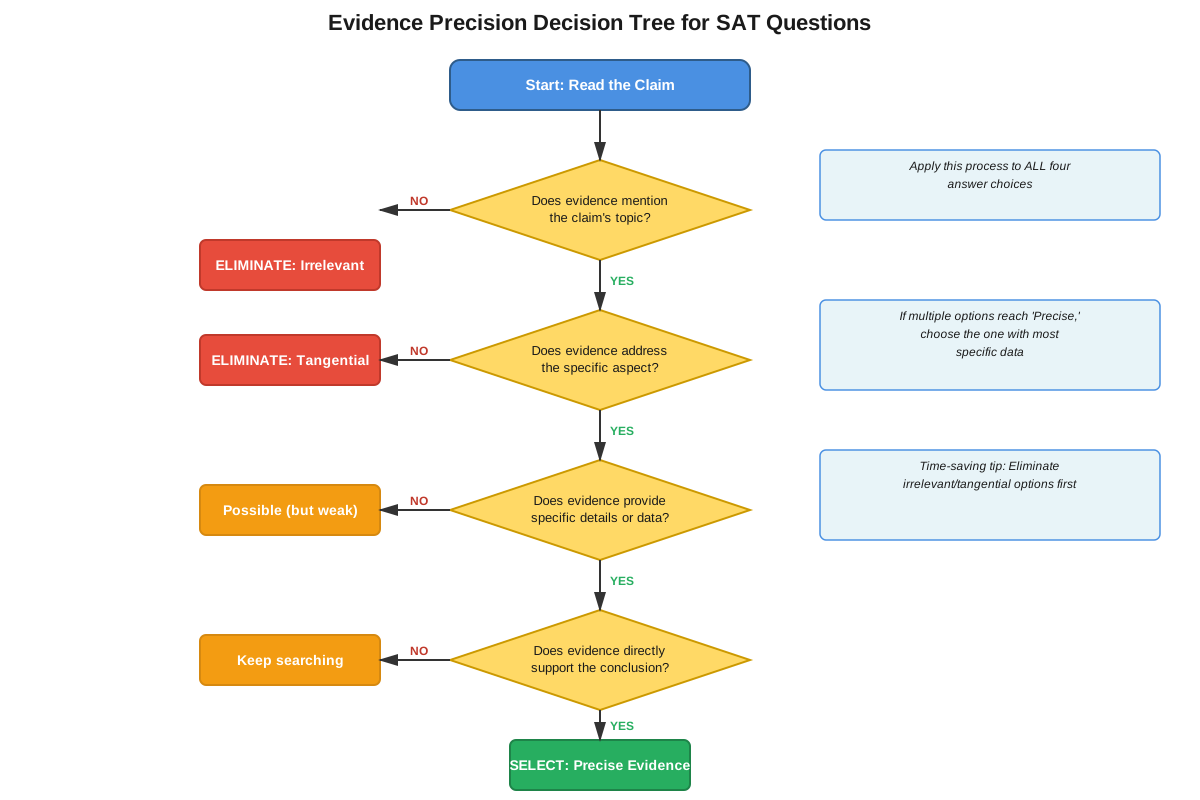
Within evidence precision itself, the concepts form a logical sequence: Claim analysis (breaking down what needs to be supported) → Evidence scope evaluation (determining if evidence matches claim scope) → Precision ranking (comparing multiple evidence options) → Selection (choosing the most precise support). Each step depends on the previous one; students cannot effectively rank evidence precision without first understanding the claim's components.
Evidence precision also connects to inference questions in an inverse relationship. While inference questions ask students to determine what a passage suggests beyond its explicit statements, evidence precision questions ask students to identify what explicitly supports a given statement. Both skills require understanding the relationship between claims and support, but they move in opposite directions: inference moves from evidence to claim, while evidence precision moves from claim to evidence.
The relationship map looks like this:
Basic Comprehension → Textual Evidence Location → Evidence Precision Evaluation → Multi-Source Synthesis → Argument Analysis
High-Yield Facts
⭐ Evidence precision questions always provide the claim first, then ask which option best supports it—never evaluate evidence before fully understanding the claim
⭐ The most precise evidence addresses all key components of the claim without introducing irrelevant information
⭐ Quantitative claims (with numbers, percentages, or measurements) require quantitative evidence for precise support
⭐ Evidence that is merely related to the topic is the most common distractor type on SAT evidence precision questions
⭐ Scope matching is critical: evidence about "some" cannot precisely support a claim about "all," and vice versa
- Evidence precision questions typically appear 3-5 times per SAT administration in the Reading and Writing section
- The word "best" in the question stem signals that multiple options may provide some support, but only one provides the most precise support
- Causal claims require evidence showing the cause-effect relationship, not just correlation or temporal sequence
- When a claim includes qualifiers like "may," "often," or "some," the most precise evidence will match that level of certainty
- Evidence from expert opinion precisely supports claims about what experts believe, but not necessarily claims about objective facts
- Direct quotations that include context or explanation often provide more precise support than isolated facts
- Evidence that addresses only part of a multi-component claim is a common distractor, even if it strongly supports that one component
Quick check — test yourself on Evidence precision so far.
Try Flashcards →Common Misconceptions
Misconception: The longest or most detailed evidence option is always the most precise.
Correction: Precision depends on relevance and specificity to the claim, not length. Longer options often include irrelevant details that actually make them less precise. The most precise evidence contains exactly what's needed—no more, no less.
Misconception: If evidence is true and related to the topic, it provides precise support for any claim about that topic.
Correction: Evidence can be accurate and topically related while still failing to precisely support a specific claim. For example, true information about solar panel costs doesn't precisely support a claim about solar panel efficiency, even though both relate to solar panels.
Misconception: Evidence that strongly supports a related claim must also support the given claim.
Correction: Evidence precision is claim-specific. Evidence might perfectly support one claim while providing no support for a slightly different claim. Always evaluate evidence against the exact claim provided, not against what seems like a reasonable related claim.
Misconception: General evidence is better because it's more comprehensive and covers more ground.
Correction: For evidence precision, specificity trumps comprehensiveness. A specific detail that directly addresses the claim provides more precise support than a broad statement that encompasses the claim along with many other ideas.
Misconception: If you can infer the claim from the evidence, that evidence provides precise support.
Correction: Precise evidence supports the claim directly and explicitly, requiring minimal inference. Evidence that requires multiple inferential steps or assumptions to connect to the claim is less precise than evidence with a direct, explicit connection.
Misconception: Evidence from an authoritative source is automatically more precise than evidence from other sources.
Correction: The authority of the source doesn't determine precision; the specificity and directness of the connection to the claim does. A specific measurement from a basic study can provide more precise support than a general statement from a leading expert, depending on the claim.
Misconception: Emotional or vivid evidence is more precise because it's more memorable and impactful.
Correction: Precision is about logical fit between evidence and claim, not emotional impact. Vivid examples can be powerful rhetorically while being imprecise support for a specific claim if they don't address all the claim's components.
Worked Examples
Example 1: Scientific Research Claim
Claim: Recent research indicates that regular meditation practice may reduce symptoms of anxiety in college students.
Evidence Options:
A) "Meditation has been practiced for thousands of years across many cultures and is associated with various health benefits."
B) "A 2022 study of 200 college students found that those who meditated for 20 minutes daily reported a 35% reduction in anxiety symptoms after eight weeks."
C) "Many college students experience high levels of stress and anxiety due to academic pressures and social challenges."
D) "Mindfulness practices, including meditation, yoga, and breathing exercises, have gained popularity on college campuses nationwide."
Analysis:
First, identify the claim components:
- Subject: college students
- Action: reduce anxiety symptoms
- Qualifier: "may" (indicates possibility, not certainty)
- Context: regular meditation practice, recent research
Now evaluate each option:
Option A discusses meditation's history and general health benefits. While related to meditation, it doesn't address anxiety specifically, doesn't mention college students, and doesn't reference recent research. This is too broad and tangentially related.
Option B provides specific data from a recent study (2022), focuses on college students specifically, measures anxiety symptoms with a quantitative reduction (35%), and describes regular practice (20 minutes daily for eight weeks). This addresses all claim components with precise specificity.
Option C describes the problem (anxiety in college students) but provides no evidence about meditation's effects. This is related but off-topic—it sets up why the claim matters but doesn't support the claim itself.
Option D mentions meditation among other practices and notes popularity but provides no evidence about effectiveness in reducing anxiety. This is too broad (includes practices beyond meditation) and doesn't address the outcome (anxiety reduction).
Answer: B provides the most precise support because it matches every component of the claim with specific, measurable evidence.
Example 2: Historical Interpretation Claim
Claim: Historians argue that economic factors were more influential than ideological factors in driving European colonization of Africa during the late 19th century.
Evidence Options:
A) "European powers competed intensely for African territories between 1880 and 1914, a period known as the Scramble for Africa."
B) "Colonial administrators often justified expansion using ideological arguments about spreading civilization and Christianity to African peoples."
C) "British colonial records from the 1890s show that 78% of policy decisions regarding African territories explicitly referenced trade opportunities, mineral resources, or economic advantages, while only 22% mentioned ideological justifications."
D) "The Berlin Conference of 1884-1885 established rules for European claims to African territory and sought to prevent conflicts among European powers."
Analysis:
Claim components:
- Subject: European colonization of Africa, late 19th century
- Action: being driven/influenced by factors
- Comparison: economic factors MORE than ideological factors
- Context: historians' argument (interpretation, not just fact)
Evaluate each option:
Option A confirms that colonization occurred during the specified time period but provides no evidence about the relative importance of economic versus ideological factors. This is too general—it establishes context but doesn't support the specific claim about motivations.
Option B actually seems to contradict the claim by emphasizing ideological justifications. However, note that it says administrators "justified" expansion this way, which could be consistent with economic motivations being primary. Still, this evidence doesn't demonstrate that economic factors were more influential. This is potentially contradictory or at best ambiguous.
Option C provides quantitative evidence (78% vs. 22%) from the relevant time period (1890s) that directly compares economic and ideological factors in policy decisions. This precisely supports the claim's comparative structure and matches the time period. This is precise and complete.
Option D describes a conference that regulated colonization but doesn't address whether economic or ideological factors were more influential in driving it. This is related but off-topic.
Answer: C provides the most precise support because it offers specific, quantitative evidence that directly addresses the comparative claim about economic versus ideological factors during the specified time period.
Exam Strategy
When approaching SAT evidence precision questions, follow this systematic process:
Step 1: Read and analyze the claim first (before looking at evidence options). Underline or mentally note the key components: subject, action, qualifiers, and context. Pay special attention to limiting words like "some," "may," "primarily," or "recent."
Step 2: Predict what type of evidence would precisely support this claim. Ask yourself: "What specific information would I need to prove this claim?" This prediction helps you recognize the correct answer more quickly and avoid attractive distractors.
Step 3: Evaluate each evidence option against ALL claim components. Use a mental checklist: Does this evidence address the right subject? The right action or outcome? The right scope (some vs. all, may vs. will)? The right context (time period, location, conditions)?
Step 4: Eliminate options systematically:
- First, eliminate clearly irrelevant options (wrong topic entirely)
- Second, eliminate options that are too broad or too narrow
- Third, eliminate options that address only part of the claim
- Finally, choose between remaining options based on which addresses claim components most completely and specifically
Exam Tip: If two options both seem to support the claim, the more precise one will match the claim's scope and specificity more closely. Look for the option that requires the fewest inferential leaps.
Trigger words and phrases to watch for:
In claims:
- "May," "might," "could": Evidence should indicate possibility, not certainty
- "Some," "many," "most": Evidence scope must match these quantifiers
- "Recent," "historically," "traditionally": Time-specific evidence required
- "Primarily," "mainly," "largely": Evidence should show this factor is dominant
- Comparative words ("more than," "less than," "rather than"): Evidence must include comparison
In evidence options:
- "For example," "such as": Often introduces specific support (good sign)
- "Generally," "overall," "broadly": May indicate evidence is too general
- "Related," "associated," "connected": May indicate correlation without causation
- Specific numbers, percentages, measurements: Usually indicate precise evidence for quantitative claims
Time allocation: Spend 45-60 seconds per evidence precision question. These questions reward careful analysis more than speed. If you're rushing and making errors on these high-value questions, slow down—the time investment pays off.
Process of elimination tip specific to evidence precision: The most common wrong answer is evidence that's related to the topic but doesn't actually support the specific claim. When in doubt between two options, ask: "Does this evidence require me to make assumptions or inferences to connect it to the claim?" If yes, it's probably not the most precise option.
Memory Techniques
SCOPE Acronym for evaluating evidence precision:
- Subject match: Does the evidence address the same subject as the claim?
- Completeness: Does the evidence address all components of the claim?
- Outcome/action match: Does the evidence show the same outcome or action mentioned in the claim?
- Precision of details: Does the evidence provide specific details rather than generalities?
- Exact scope: Does the evidence match qualifiers (some/all, may/will, recent/historical)?
The "Spotlight" Visualization: Imagine the claim as a spotlight illuminating a specific spot on a stage. Precise evidence stands exactly in that spotlight—not in the shadows nearby (related but off-topic), not flooding the whole stage (too broad), and not illuminating just one corner of the spotlight (too narrow). The most precise evidence fits perfectly within the spotlight's boundaries.
The Three-Question Filter: Before selecting evidence, ask:
- "Does it match?" (subject, action, context)
- "Is it specific?" (details vs. generalities)
- "Is it complete?" (addresses all claim components)
If you answer "yes" to all three, you've found precise evidence.
Mnemonic for common distractors: "BORN"
- Broad (too general)
- Off-topic (related but doesn't support the claim)
- Reversed (opposite relationship)
- Narrow (too specific, only one example when broader support needed)
When you eliminate an option, identify which BORN category it falls into. This helps you avoid similar distractors on future questions.
Summary
Evidence precision is the ability to identify which piece of textual support most directly, specifically, and completely addresses a given claim. On the SAT Reading and Writing section, this skill appears in questions that present a claim followed by four evidence options, requiring students to select the option that provides the most precise support. Mastery requires understanding that precision depends on three factors: specificity (addressing the particular aspect mentioned in the claim), directness (explicit connection without requiring inferential leaps), and completeness (addressing all critical components of the claim). The most common challenge students face is distinguishing between evidence that is merely related to the topic and evidence that precisely supports the specific claim. Success on these high-frequency, high-value questions demands systematic analysis: first breaking down the claim into its essential components (subject, action, qualifiers, context), then evaluating each evidence option against all these components, and finally selecting the option that matches most completely without introducing irrelevant information. Students must recognize common distractor patterns—evidence that's too broad, too narrow, related but off-topic, or addressing only part of the claim—and develop the discipline to eliminate options that don't address every aspect of what the claim states.
Key Takeaways
- Evidence precision requires matching evidence to all components of a claim: subject, action, qualifiers, and context—not just the general topic
- The most precise evidence is specific, direct, and complete, requiring minimal inference to connect to the claim
- Related evidence is the most common distractor; information can be true and topically relevant while still failing to precisely support a specific claim
- Quantitative claims require quantitative evidence; comparative claims require evidence that includes both elements being compared
- Scope matching is critical: evidence about "some" cannot precisely support claims about "all," and qualifiers like "may" or "often" must be reflected in the evidence
- Always analyze the claim thoroughly before evaluating evidence options—understanding what needs to be supported is half the battle
- Evidence precision questions are high-value and high-frequency on the SAT, making this topic essential for score improvement in the Reading and Writing section
Related Topics
Textual Evidence Identification: The foundational skill of locating relevant information in passages. Mastering evidence precision builds directly on this skill by adding the evaluative component of determining which evidence is most precise.
Synthesis Across Multiple Texts: Advanced evidence skills where students must combine precise evidence from two different sources to support a claim. Evidence precision mastery is essential before tackling synthesis questions.
Argument Analysis and Reasoning: Evaluating the logical structure of arguments, including how well evidence supports conclusions. Evidence precision provides the foundation for understanding argument strength.
Inference and Implication Questions: While evidence precision moves from claim to support, inference questions move from evidence to claim. Understanding the relationship between claims and evidence helps with both question types.
Data Interpretation in Science Passages: Many evidence precision questions involve scientific data, graphs, or study results. Strong evidence precision skills enhance performance on quantitative reasoning questions in science passages.
Practice CTA
Now that you understand the principles of evidence precision, it's time to apply these concepts to actual SAT-style questions. The practice questions and flashcards will help you internalize the systematic approach to evaluating evidence and develop the quick recognition skills needed for test day. Remember: evidence precision is one of the most teachable and improvable skills on the SAT. Students who master the SCOPE framework and learn to recognize common distractor patterns often see dramatic score improvements in the Reading and Writing section. Approach each practice question methodically, and you'll build the confidence and competence to tackle any evidence precision question the SAT presents. Your investment in mastering this high-yield topic will pay dividends across multiple question types and passages!
Sign up free to keep reading
Create a free AnvayaPrep account to finish this SAT guide on Evidence precision — plus flashcards and practice questions.