Overview
Evidence scope is a critical concept within the SAT Reading and Writing section that tests a student's ability to evaluate whether a piece of evidence appropriately supports a specific claim. Unlike questions that simply ask students to identify relevant evidence, sat evidence scope questions require deeper analytical thinking: students must determine if the evidence is sufficiently focused, appropriately broad, and directly aligned with the boundaries of the claim being made. This skill represents a sophisticated level of reading comprehension that goes beyond surface-level understanding.
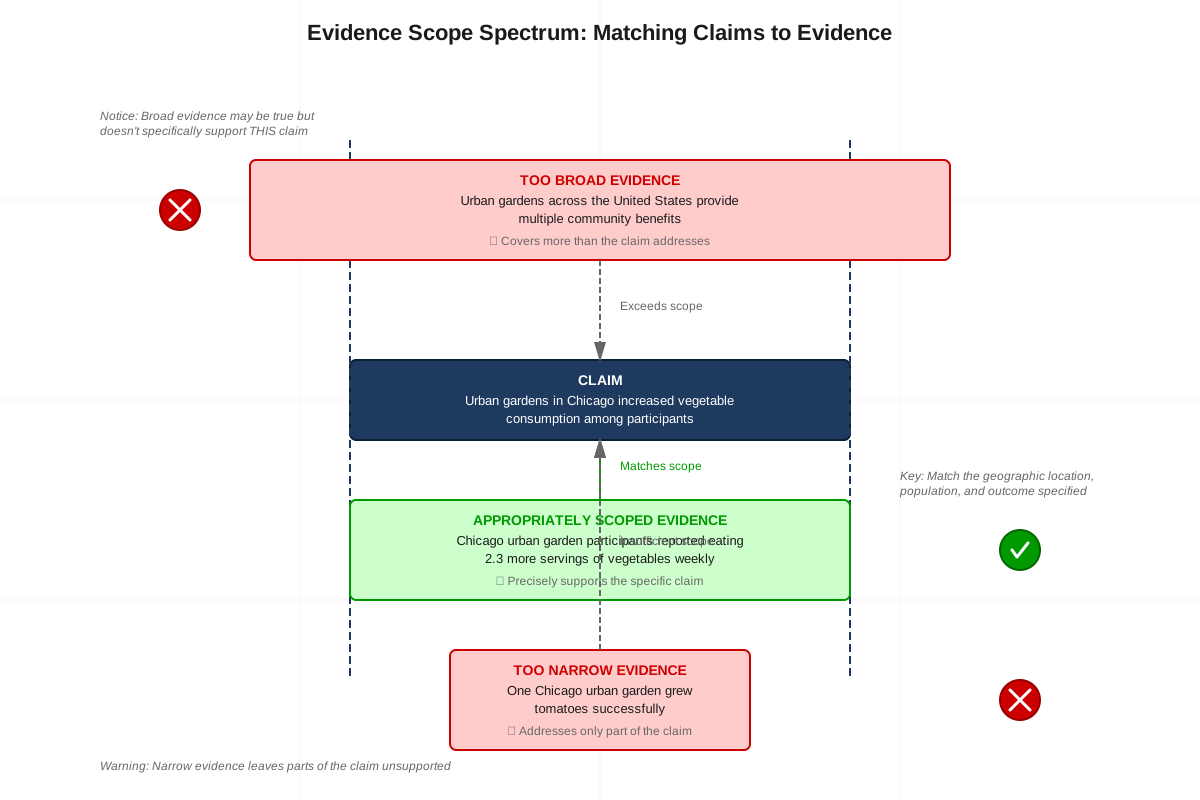
On the SAT, evidence scope questions typically present a passage containing a claim followed by several potential pieces of supporting evidence. The challenge lies in recognizing that while multiple options might be factually accurate and somewhat related to the topic, only one will have the precise scope needed to support the specific claim. A piece of evidence might be too broad (covering more territory than the claim addresses), too narrow (addressing only a small part of the claim), or misaligned (relevant to the general topic but not the specific assertion). Mastering this distinction is essential for success in the Command of Evidence domain.
Understanding evidence scope connects directly to other RW skills tested on the SAT, including identifying main ideas, analyzing argumentative structure, and evaluating the strength of reasoning. This topic builds upon fundamental reading comprehension skills while preparing students for the type of critical analysis required in college-level academic work. Evidence scope questions appear frequently throughout the digital SAT, making this a high-yield topic that deserves focused attention and practice.
Learning Objectives
- [ ] Identify key features of Evidence scope
- [ ] Explain how Evidence scope appears on the SAT
- [ ] Apply Evidence scope to answer SAT-style questions
- [ ] Distinguish between evidence that is too broad, too narrow, or appropriately scoped for a given claim
- [ ] Evaluate multiple pieces of evidence to determine which best matches the specificity of a claim
- [ ] Recognize common distractors in evidence scope questions and explain why they fail to support the claim
Prerequisites
- Basic reading comprehension: Understanding main ideas and supporting details is essential because evidence scope requires distinguishing between general topics and specific claims.
- Claim identification: Recognizing what a claim specifically asserts (versus what it implies or relates to) is necessary to match evidence to that precise assertion.
- Logical reasoning fundamentals: Understanding how evidence supports conclusions enables students to evaluate whether the scope of support is appropriate.
- Vocabulary in context: Interpreting precise language helps students recognize subtle differences in scope between claims and evidence.
Why This Topic Matters
Evidence scope represents one of the most sophisticated reading skills tested on the SAT because it mirrors the analytical thinking required in academic and professional contexts. In college courses, students must constantly evaluate whether sources adequately support their thesis statements—not just whether sources are related to the topic. In professional settings, making well-supported arguments requires matching evidence precisely to claims, avoiding both overgeneralization and insufficient support.
On the SAT, evidence scope questions appear with high frequency in the Command of Evidence domain, typically comprising 12-15% of all Reading and Writing questions. These questions appear across all four modules of the digital SAT and span various content areas including science, social studies, humanities, and literature. The question format usually presents a brief passage (50-100 words) containing a claim, followed by four potential pieces of evidence drawn from research findings, quotations, or data. Students must select which evidence best supports the specific claim made.
Common manifestations of this topic include questions about scientific research (where students must match findings to specific hypotheses), historical arguments (where students must identify evidence that supports particular interpretations), literary analysis (where students must find textual evidence for specific character or thematic claims), and social science research (where students must match statistical findings to precise conclusions). The consistent challenge across all these contexts is ensuring that the evidence neither exceeds nor falls short of what the claim actually asserts.
Core Concepts
Understanding Evidence Scope
Evidence scope refers to the range, breadth, and specificity of information that a piece of evidence addresses. When evidence has appropriate scope for a claim, it covers exactly what the claim asserts—no more and no less. The scope encompasses both the subject matter (what is being discussed) and the degree of specificity (how precisely the evidence addresses that subject).
Consider scope as a spotlight: the claim illuminates a specific area, and appropriate evidence must shine on that same area. If the evidence spotlight is too wide, it illuminates areas beyond the claim. If too narrow, it leaves parts of the claim in darkness. Perfect scope alignment means the evidence and claim illuminate the same territory.
Types of Scope Misalignment
| Scope Issue | Definition | Example Claim | Inappropriate Evidence |
|---|---|---|---|
| Too Broad | Evidence addresses a wider category than the claim specifies | "Monarch butterflies migrate to Mexico" | "Many butterfly species undertake long migrations" |
| Too Narrow | Evidence addresses only part of what the claim asserts | "Exercise improves both physical and mental health" | "Exercise reduces cardiovascular disease risk" |
| Misaligned | Evidence relates to the topic but addresses a different aspect | "Social media increases anxiety in teenagers" | "Teenagers spend an average of 4 hours daily on social media" |
| Appropriate | Evidence matches the claim's exact scope | "Urban trees reduce air pollution" | "A study found that trees in cities decreased particulate matter by 15%" |
Identifying Claim Boundaries
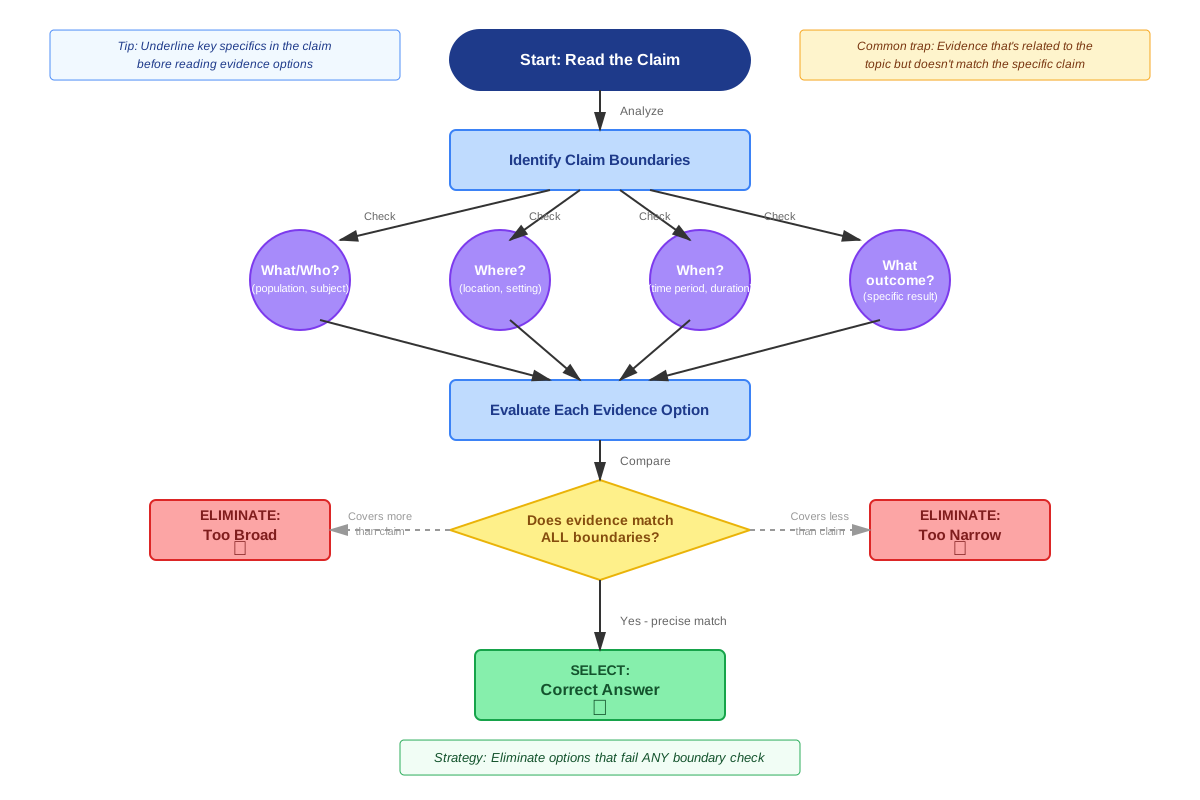
Every claim has implicit boundaries that define what it does and does not assert. Successful evidence scope analysis begins with precisely identifying these boundaries. Claims contain several key elements that define their scope:
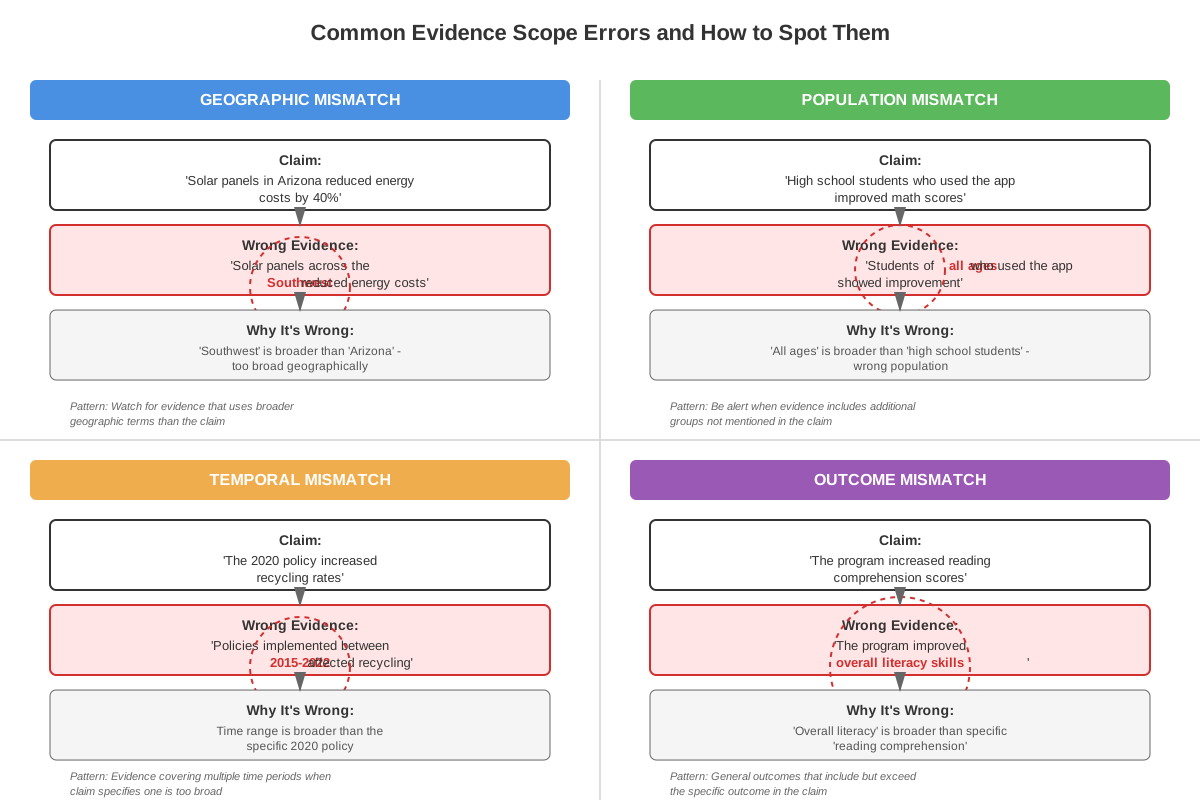
Subject specificity: Does the claim refer to "all mammals," "most primates," or "chimpanzees specifically"? The evidence must match this level of specificity. A claim about chimpanzees cannot be supported by evidence about primates in general, even though chimpanzees are primates.
Action or characteristic specificity: Does the claim assert that something "causes," "correlates with," "influences," or merely "relates to" an outcome? These verbs have different scopes. Evidence showing correlation cannot support a claim about causation.
Temporal scope: Does the claim refer to a specific time period, or is it timeless? A claim about "19th-century literature" requires evidence from that period, not from literature generally.
Quantitative scope: Does the claim use words like "all," "most," "some," "many," or specific percentages? Evidence must match this quantitative boundary. A claim about "most" requires evidence showing a majority, not just "some" examples.
Evaluating Evidence Against Claims
The process of matching evidence to claims involves systematic comparison. First, identify the precise assertion the claim makes by underlining key limiting words (specific subjects, qualifiers, action verbs). Second, examine each piece of potential evidence to determine its scope by asking: What exactly does this evidence demonstrate? Third, compare the evidence scope to the claim scope, looking for perfect alignment.
Appropriate evidence demonstrates exactly what the claim asserts. If the claim states "Renewable energy costs have decreased over the past decade," appropriate evidence would show cost reductions for renewable energy specifically during that ten-year period. Evidence about energy costs generally, or renewable energy benefits beyond cost, would have misaligned scope.
Common Scope Indicators
Certain words and phrases signal the scope of both claims and evidence. Quantifiers like "all," "most," "some," "many," "few" define how broadly a claim applies. Specificity markers like "particularly," "especially," "specifically," "in particular" narrow scope. Temporal markers like "recently," "historically," "during," "since" define time boundaries. Causal language like "causes," "leads to," "results in" versus correlational language like "is associated with," "relates to," "corresponds with" define the type of relationship claimed.
Recognizing these indicators helps students quickly assess whether evidence matches claim scope. A claim using "some" cannot be supported by evidence about "all," and vice versa. A claim using "causes" requires experimental or causal evidence, not merely correlational data.
The Role of Context
Context surrounding both claims and evidence affects scope interpretation. A claim appearing in a passage about marine biology should be interpreted within that context—terms have specific meanings within disciplines. Similarly, evidence drawn from research must be understood within its original context. A study about "exercise" might specifically examine aerobic exercise, making it inappropriate for claims about exercise generally.
Students must read carefully to understand the full context of both claims and evidence, avoiding assumptions based on general knowledge. The SAT tests precise reading, not background knowledge, so all necessary context appears in the passage.
Concept Relationships
Evidence scope connects directly to claim analysis: before evaluating evidence scope, students must precisely understand what the claim asserts. This relationship flows in one direction—claim analysis → evidence scope evaluation. Without accurate claim interpretation, evidence scope assessment becomes impossible.
Within evidence scope itself, the concepts form a hierarchical relationship: Understanding scope definition → Identifying scope boundaries → Recognizing scope misalignment types → Evaluating evidence against claims → Selecting appropriately scoped evidence. Each step builds upon the previous one, creating a systematic approach to these questions.
Evidence scope also connects to broader Command of Evidence skills. While some evidence questions ask "Which quotation best supports the claim?" (focusing on relevance), evidence scope questions ask "Which evidence has the appropriate scope?" (focusing on precision of match). Both question types require identifying relevant evidence, but scope questions add an additional layer of analysis about the degree and specificity of support.
The relationship to other RW skills includes: Main idea identification (claims are often main ideas requiring support) → Evidence scope evaluation → Argument analysis (evaluating overall argument strength). Strong evidence scope skills enhance performance on inference questions, as both require precise reading and attention to what is actually stated versus implied.
High-Yield Facts
⭐ Evidence scope refers to whether evidence is appropriately broad, narrow, and aligned to support a specific claim's exact assertion.
⭐ Evidence can be factually accurate and topically relevant but still have inappropriate scope if it doesn't match the claim's specificity.
⭐ Claims contain boundary markers (quantifiers, temporal indicators, specificity markers) that define what evidence scope is appropriate.
⭐ Too-broad evidence addresses a wider category than the claim specifies, while too-narrow evidence addresses only part of the claim.
⭐ Misaligned evidence relates to the general topic but addresses a different specific aspect than the claim asserts.
- Evidence scope questions typically present one claim followed by four potential pieces of supporting evidence.
- Appropriate evidence demonstrates exactly what the claim asserts—no more, no less.
- Quantifiers like "all," "most," "some" in claims require evidence matching that quantitative scope.
- Causal claims ("causes," "leads to") require causal evidence, not merely correlational data.
- Temporal markers in claims ("during the 1990s," "recently") require evidence from matching time periods.
- Subject specificity matters: evidence about a general category cannot support claims about specific members of that category.
- The correct answer in evidence scope questions often contains the same key terms or close synonyms as the claim.
- Distractors frequently include evidence that is too broad, addressing the general topic rather than the specific claim.
- Reading the claim carefully before examining evidence options improves accuracy and efficiency.
- Evidence scope questions test precise reading comprehension, not background knowledge about the topic.
Quick check — test yourself on Evidence scope so far.
Try Flashcards →Common Misconceptions
Misconception: If evidence relates to the same general topic as the claim, it must be appropriate support.
Correction: Evidence must match the specific scope of the claim, not just the general topic. Evidence about "birds" doesn't support a claim specifically about "migratory songbirds," even though both involve birds.
Misconception: Longer or more detailed evidence is better support than shorter evidence.
Correction: Evidence quality depends on scope alignment, not length. A brief, precisely scoped piece of evidence supports a claim better than a lengthy but too-broad piece of evidence.
Misconception: Evidence that proves something related to the claim is sufficient support.
Correction: Evidence must prove what the claim specifically asserts. Proving a related point doesn't support the actual claim. If the claim is about health benefits, evidence about popularity doesn't support it, even though both relate to the general topic.
Misconception: If evidence contains some of the same words as the claim, it must be the correct answer.
Correction: While appropriate evidence often shares key terms with the claim, word overlap alone doesn't guarantee appropriate scope. The evidence must address the same specific assertion, not just use similar vocabulary.
Misconception: Evidence from a credible source or prestigious study is automatically appropriate support.
Correction: Source credibility doesn't determine scope appropriateness. Even highly credible evidence can have misaligned scope if it addresses a different aspect of the topic than the claim specifies.
Misconception: Evidence that provides an example of what the claim discusses is always sufficient support.
Correction: A single example might be too narrow if the claim makes a broader assertion about "most" or "many" cases. The evidence scope must match the claim's quantitative scope.
Misconception: If you can infer a connection between evidence and claim, that evidence is appropriate.
Correction: SAT evidence scope questions test direct support, not inferential connections. Evidence must directly address what the claim asserts, not require additional reasoning steps to connect.
Worked Examples
Example 1: Scientific Research Claim
Passage and Claim:
"Researchers studying urban wildlife have concluded that artificial lighting in cities disrupts the nocturnal hunting behavior of owls specifically, making it more difficult for these birds to locate prey."
Evidence Options:
A) A study found that many nocturnal animals, including owls, bats, and rodents, show altered behavior patterns in urban environments compared to rural areas.
B) Research demonstrated that barn owls in well-lit urban areas caught 30% fewer mice per night than barn owls in darker rural areas.
C) Scientists observed that light pollution affects various aspects of urban ecosystems, including plant growth cycles and animal migration patterns.
D) Data showed that owl populations in cities have declined over the past two decades as urbanization has increased.
Analysis:
First, identify the claim's scope boundaries:
- Subject: Owls specifically (not nocturnal animals generally)
- Location: Cities/urban areas
- Specific effect: Disrupts nocturnal hunting behavior, making prey location more difficult
- Mechanism: Artificial lighting causes this disruption
Now evaluate each option:
Option A is too broad. It addresses "many nocturnal animals" including owls, but the claim is specifically about owls. Additionally, it mentions "altered behavior patterns" generally, not specifically hunting behavior or prey location difficulty.
Option B has appropriate scope. It addresses owls specifically (barn owls), in urban areas (well-lit urban areas), regarding hunting success (caught fewer mice), with the lighting connection clear (well-lit versus darker areas). This directly supports the claim's assertion about lighting disrupting hunting effectiveness.
Option C is too broad and misaligned. It addresses light pollution effects generally across ecosystems, not specifically owl hunting behavior. While topically related, it doesn't support the specific claim.
Option D is misaligned. It addresses owl populations declining, not hunting behavior being disrupted. Population decline could have many causes; this evidence doesn't specifically support the claim about hunting disruption.
Answer: B — This evidence has the appropriate scope, matching the claim's specificity about owls, urban lighting, and hunting effectiveness.
Example 2: Historical Argument Claim
Passage and Claim:
"Historian Maria Gonzalez argues that the introduction of the printing press in 15th-century Europe specifically accelerated the spread of scientific knowledge by making technical texts more widely available to scholars."
Evidence Options:
A) Records show that book production in Europe increased dramatically after 1450, with thousands of titles printed in the following decades.
B) Analysis of 15th-century publications reveals that scientific and technical works comprised 35% of printed materials and reached scholars across Europe who previously lacked access to such texts.
C) The printing press revolutionized European society by making information more accessible, contributing to religious reformation, increased literacy, and cultural changes.
D) Before the printing press, scientific manuscripts were copied by hand, making them expensive and rare.
Analysis:
Identify claim boundaries:
- Time period: 15th-century Europe
- Subject: Printing press introduction
- Specific effect: Accelerated spread of scientific knowledge specifically
- Mechanism: Made technical texts more widely available to scholars
Evaluate options:
Option A is too broad. It shows increased book production generally but doesn't specify scientific/technical texts or their availability to scholars. The scope is too general—all books, not scientific knowledge specifically.
Option B has appropriate scope. It addresses 15th-century publications (time period), specifically scientific and technical works (subject matter), reaching scholars (audience), who previously lacked access (mechanism of increased availability). This directly supports all elements of the claim.
Option C is too broad. It addresses the printing press's effects generally across society, including religious, literacy, and cultural impacts. While accurate, it doesn't specifically support the claim about scientific knowledge spread.
Option D is misaligned temporally and doesn't prove the claim. It describes the situation before the printing press but doesn't demonstrate that the printing press actually accelerated scientific knowledge spread. It provides context but not supporting evidence for the specific claim.
Answer: B — This evidence precisely matches the claim's scope regarding scientific knowledge, scholar access, and the 15th-century timeframe.
Exam Strategy
When approaching evidence scope questions on the SAT, follow this systematic process:
Step 1: Read and annotate the claim first (before looking at evidence options). Underline or mentally note:
- Specific subjects (not general categories)
- Quantifiers (all, most, some, many)
- Action verbs (causes, correlates, influences)
- Temporal markers (when, during what period)
- Any limiting or specifying language
Step 2: Mentally summarize what evidence would need to show to support this specific claim. Ask yourself: "What would I need to prove to support this exact assertion?"
Step 3: Evaluate each evidence option by asking:
- Does this address the specific subject of the claim (not a broader category)?
- Does this match the quantitative scope (all/most/some)?
- Does this address the specific effect or relationship claimed?
- Does this match any temporal boundaries?
Step 4: Eliminate options systematically:
- First, eliminate obviously too-broad options (addressing general topics rather than specific claims)
- Second, eliminate misaligned options (related to the topic but addressing different aspects)
- Third, eliminate too-narrow options (addressing only part of what the claim asserts)
Exam Tip: The correct answer often contains the same key nouns and verbs as the claim, or close synonyms. If the claim mentions "adolescents," look for evidence about "teenagers" or "adolescents," not "people" generally.
Trigger words to watch for:
- In claims: "specifically," "particularly," "especially" signal narrow scope requiring precise evidence
- In claims: "generally," "broadly," "overall" signal wider scope allowing broader evidence
- In evidence: "some," "certain," "particular" may indicate too-narrow scope
- In evidence: "various," "multiple," "many types" may indicate too-broad scope
Time allocation: Evidence scope questions should take 45-60 seconds each. Spend 15 seconds reading and understanding the claim, then 30-45 seconds evaluating options. If you're spending more than 75 seconds, make your best elimination-based choice and move forward.
Process of elimination strategy: Evidence scope questions typically include one too-broad option, one misaligned option, one too-narrow option, and one appropriately scoped option. Identifying which type of distractor each wrong answer represents helps confirm your choice.
Memory Techniques
SCOPE Acronym for evaluating evidence:
- Subject match: Does evidence address the specific subject of the claim?
- Coverage complete: Does evidence cover everything the claim asserts?
- Overwhelm avoided: Does evidence avoid going beyond the claim's boundaries?
- Precision present: Does evidence match the claim's level of specificity?
- Exact alignment: Does evidence prove exactly what the claim states?
The Spotlight Visualization: Picture the claim as a spotlight illuminating a specific area on a stage. Appropriate evidence is another spotlight shining on exactly the same area. Too-broad evidence is a floodlight illuminating the whole stage. Too-narrow evidence is a laser pointer illuminating just one small spot. Misaligned evidence is a spotlight pointing at a different part of the stage entirely.
The Three Bears Principle: Like Goldilocks finding the right porridge, evidence can be too broad (too hot), too narrow (too cold), or just right (appropriate scope). When evaluating options, categorize each as "too broad," "too narrow," "misaligned," or "just right."
Question Stem Recognition: Evidence scope questions typically use phrases like:
- "Which finding, if true, would best support the claim?"
- "Which quotation from the passage best illustrates the claim?"
- "Which statement, if accurate, would most directly support the researcher's conclusion?"
Recognizing these stems immediately activates your scope-evaluation process.
Summary
Evidence scope represents a sophisticated reading skill that requires students to evaluate whether evidence appropriately matches the specific boundaries of a claim. Success on evidence scope questions depends on precisely identifying what a claim asserts—including its subject specificity, quantitative scope, temporal boundaries, and the exact relationship or effect claimed. Evidence can be factually accurate and topically relevant while still having inappropriate scope if it's too broad (addressing a wider category than the claim specifies), too narrow (addressing only part of the claim), or misaligned (addressing a different aspect of the topic). The key to mastering evidence scope questions is systematic analysis: first, carefully identify the claim's boundaries by noting limiting language, quantifiers, and specific subjects; second, evaluate each evidence option against these boundaries; third, eliminate options that don't precisely match the claim's scope. This skill appears frequently on the SAT and directly mirrors the analytical thinking required in academic writing, where supporting evidence must precisely match thesis statements rather than merely relating to general topics.
Key Takeaways
- Evidence scope questions test whether evidence precisely matches a claim's specific assertion, not just whether evidence relates to the general topic
- Claims contain boundary markers (quantifiers, temporal indicators, subject specificity) that define what evidence scope is appropriate
- Too-broad evidence addresses wider categories than the claim specifies; too-narrow evidence addresses only part of the claim; misaligned evidence addresses different aspects
- Systematic evaluation involves: identify claim boundaries → evaluate each evidence option → eliminate scope mismatches → select precisely aligned evidence
- The correct answer typically shares key terms with the claim and addresses exactly what the claim asserts—no more, no less
- Evidence scope questions appear frequently on the SAT (12-15% of RW questions) and span all content areas
- Reading the claim carefully before examining evidence options significantly improves accuracy and efficiency
Related Topics
Textual Evidence Questions: After mastering evidence scope, students should explore questions that ask them to identify which quotation from a passage best supports a given interpretation. These questions build on scope skills by requiring students to locate appropriately scoped evidence within longer texts.
Argument Analysis: Understanding evidence scope enables deeper analysis of argumentative structure, including evaluating whether authors provide sufficient and appropriately scoped support for their claims throughout passages.
Data Interpretation Questions: Evidence scope skills transfer directly to questions involving graphs, tables, and charts, where students must determine which data points support specific claims about trends or relationships.
Inference Questions: Mastering evidence scope strengthens inference skills by training students to distinguish between what is directly stated (appropriate scope) and what must be inferred (potentially beyond scope).
Practice CTA
Now that you understand the principles of evidence scope, it's time to apply these skills to practice questions. The concepts you've learned—identifying claim boundaries, recognizing scope misalignment types, and systematically evaluating evidence—will become automatic with practice. Challenge yourself with the practice questions and flashcards to reinforce your mastery. Remember: evidence scope questions reward careful, precise reading. Take your time to identify exactly what each claim asserts, and you'll find that selecting appropriately scoped evidence becomes a reliable strength in your SAT performance. You've got this!
Sign up free to keep reading
Create a free AnvayaPrep account to finish this SAT guide on Evidence scope — plus flashcards and practice questions.