Overview
Graph-supported claims represent a critical skill tested in the SAT Reading and Writing section, requiring students to analyze visual data presentations and determine which textual statements are accurately supported by the information displayed. This question type appears consistently on every SAT administration, making it one of the most predictable and high-yield areas for focused preparation. Students encounter graphs, tables, charts, and other data visualizations paired with written passages, then must evaluate whether specific claims align with what the data actually shows.
The SAT rw (Reading and Writing) section tests graph-supported claims to assess a student's ability to integrate information across multiple formats—a fundamental academic and professional skill. These questions measure whether students can read data accurately, identify trends and patterns, make valid comparisons, and recognize when a statement oversteps what the evidence demonstrates. Unlike pure reading comprehension, these questions require precise attention to numerical values, scales, units of measurement, and the exact scope of what data can and cannot prove.
Mastering sat graph-supported claims connects directly to broader Command of Evidence skills, including textual evidence evaluation, logical reasoning, and critical analysis. Students who excel at these questions demonstrate the ability to distinguish between what data explicitly shows versus what it merely suggests, recognize appropriate versus inappropriate generalizations, and identify when qualifiers like "approximately," "generally," or "in most cases" are necessary for accuracy. This skill set extends beyond standardized testing into college coursework, research evaluation, and informed citizenship in an increasingly data-driven world.
Learning Objectives
- [ ] Identify key features of graph-supported claims questions on the SAT
- [ ] Explain how graph-supported claims appears on the SAT and what makes these questions distinct
- [ ] Apply graph-supported claims analysis to answer SAT-style questions accurately
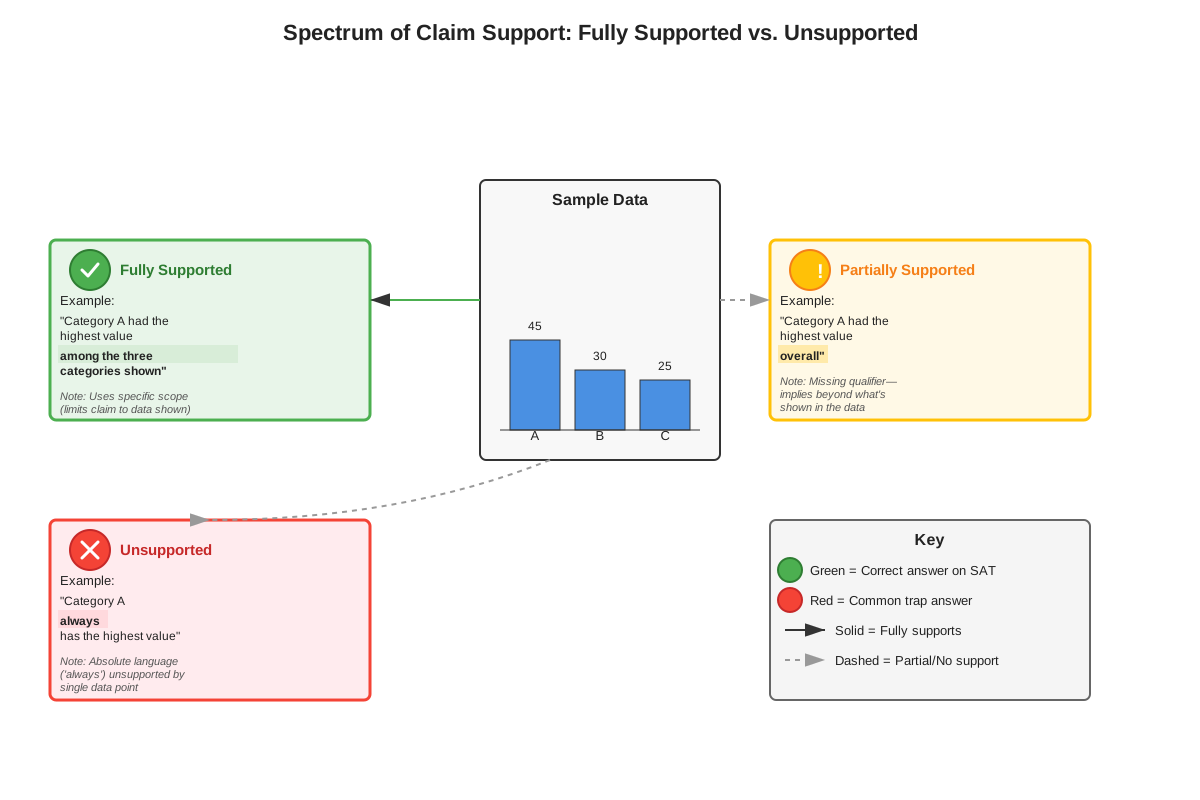
- [ ] Distinguish between claims that are fully supported, partially supported, and unsupported by graphical data
- [ ] Recognize common traps and distractors in graph-supported claims answer choices
- [ ] Evaluate the appropriate scope and limitations of conclusions drawn from visual data
- [ ] Integrate information from both textual passages and visual elements to select the best-supported answer
Prerequisites
- Basic graph literacy: Understanding how to read bar graphs, line graphs, pie charts, and tables is essential because SAT questions assume students can extract information from standard data visualizations without instruction.
- Numerical comparison skills: The ability to compare values, identify larger/smaller quantities, and recognize trends matters because many claims involve relative comparisons rather than absolute statements.
- Reading comprehension fundamentals: Understanding sentence structure and identifying the specific claim being made is necessary because students must parse exactly what each answer choice asserts before checking it against data.
- Understanding of qualifiers and scope: Recognizing words like "all," "some," "most," "never," and "always" is critical because the presence or absence of these qualifiers often determines whether a claim is supported.
Why This Topic Matters
Graph-supported claims questions appear with remarkable consistency on the SAT, typically comprising 2-3 questions per test administration in the Reading and Writing section. This predictability makes them exceptionally high-yield for preparation—students who master this skill can reliably secure these points on test day. The questions appear in the Command of Evidence domain, which accounts for approximately 13-15% of the total Reading and Writing score, making it one of the most heavily weighted categories.
In real-world contexts, the ability to evaluate data-supported claims is fundamental to academic success across disciplines. Science courses require students to interpret experimental results, social science classes demand analysis of demographic and statistical data, and even humanities courses increasingly incorporate data visualization. Beyond academics, informed citizens must evaluate claims made by media, advertisers, and public figures who frequently cite data to support their positions. The skill of checking whether evidence actually supports a claim protects against misinformation and enables evidence-based decision-making.
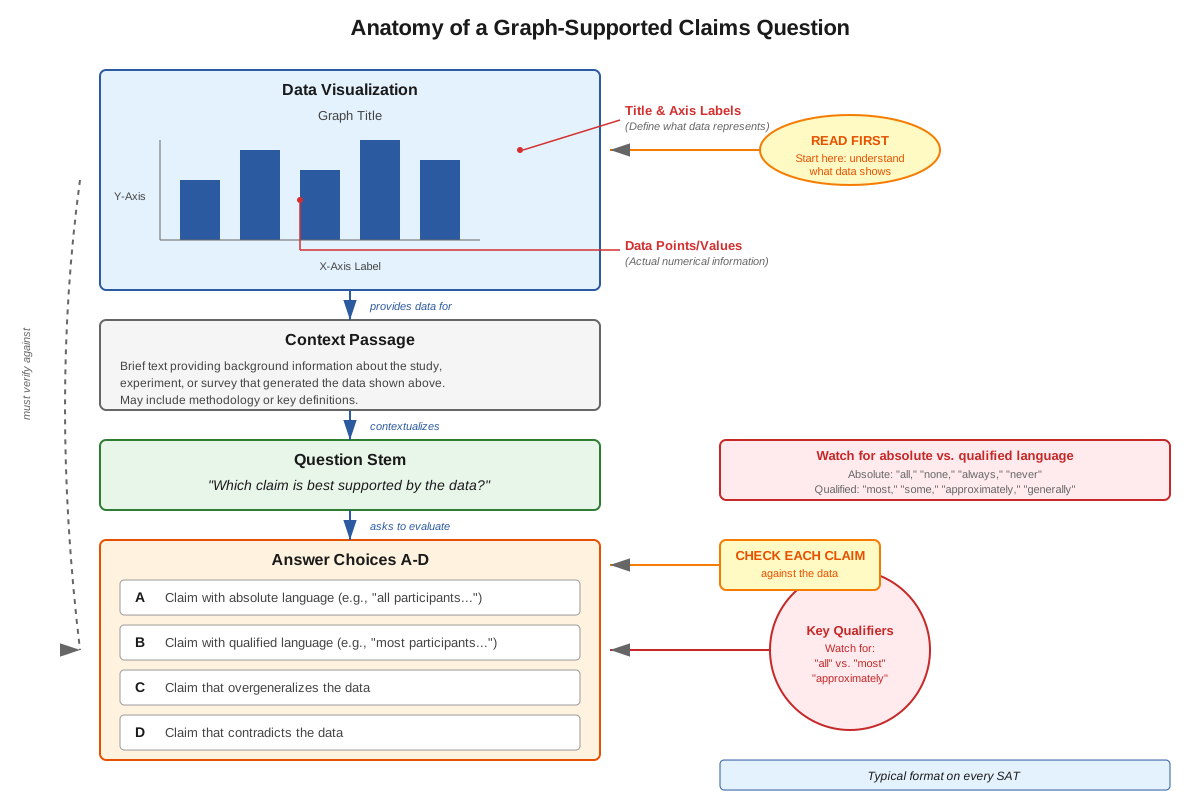
On the SAT specifically, graph-supported claims questions typically present a short passage (1-3 sentences) that provides context, followed by a data visualization (graph, table, or chart), and then a question asking which statement is best supported by the data. The answer choices usually present four different claims, only one of which is fully and accurately supported by the visual information. Common graph types include bar graphs showing comparisons across categories, line graphs displaying trends over time, scatter plots revealing relationships between variables, and tables presenting numerical data in rows and columns.
Core Concepts
Understanding Graph-Supported Claims Structure
A graph-supported claims question presents students with a data visualization and asks them to identify which statement among the answer choices is most accurately supported by the information shown. The fundamental skill involves matching textual assertions to visual evidence with precision. Unlike inference questions that reward reading between the lines, these questions demand strict adherence to what the data explicitly demonstrates. Students must verify every component of a claim—the subjects being compared, the direction of relationships, the magnitude of differences, and any qualifying language—against the actual data presented.
The typical question stem follows patterns like: "Which statement is best supported by the data?" or "Which claim about [topic] is supported by the graph?" or "Based on the table, which conclusion is most accurate?" These stems signal that students should evaluate each answer choice as a testable hypothesis, checking it systematically against the visual evidence rather than relying on prior knowledge or assumptions about the topic.
Types of Data Visualizations
Bar graphs display categorical data using rectangular bars whose lengths correspond to values. On the SAT, bar graphs commonly show comparisons across groups, time periods, or conditions. Students must read both axes carefully—the category axis (usually horizontal) and the value axis (usually vertical)—and note the scale and units. A common error involves misreading which bar corresponds to which category or failing to notice that the value axis doesn't start at zero, which can exaggerate visual differences.
Line graphs illustrate trends over continuous variables, most often time. These graphs reveal patterns like increases, decreases, stability, or cyclical changes. SAT questions may ask about overall trends ("increased throughout the period"), specific comparisons ("was higher in Year X than Year Y"), or turning points ("reached its maximum in Year Z"). Students must distinguish between the rate of change (steepness of the line) and the actual values at specific points.
Tables organize data in rows and columns, requiring students to locate specific values by cross-referencing categories. Tables often present more precise numerical information than graphs, making them ideal for questions about exact values or calculations. Students must read row and column headers carefully and ensure they're extracting data from the correct cell.
Scatter plots show relationships between two variables, with each point representing a single observation. SAT questions typically focus on overall patterns (positive correlation, negative correlation, or no correlation) rather than individual data points. Students should recognize that correlation doesn't imply causation—a claim that one variable causes changes in another is rarely supported by scatter plot data alone.
Evaluating Claims Against Data
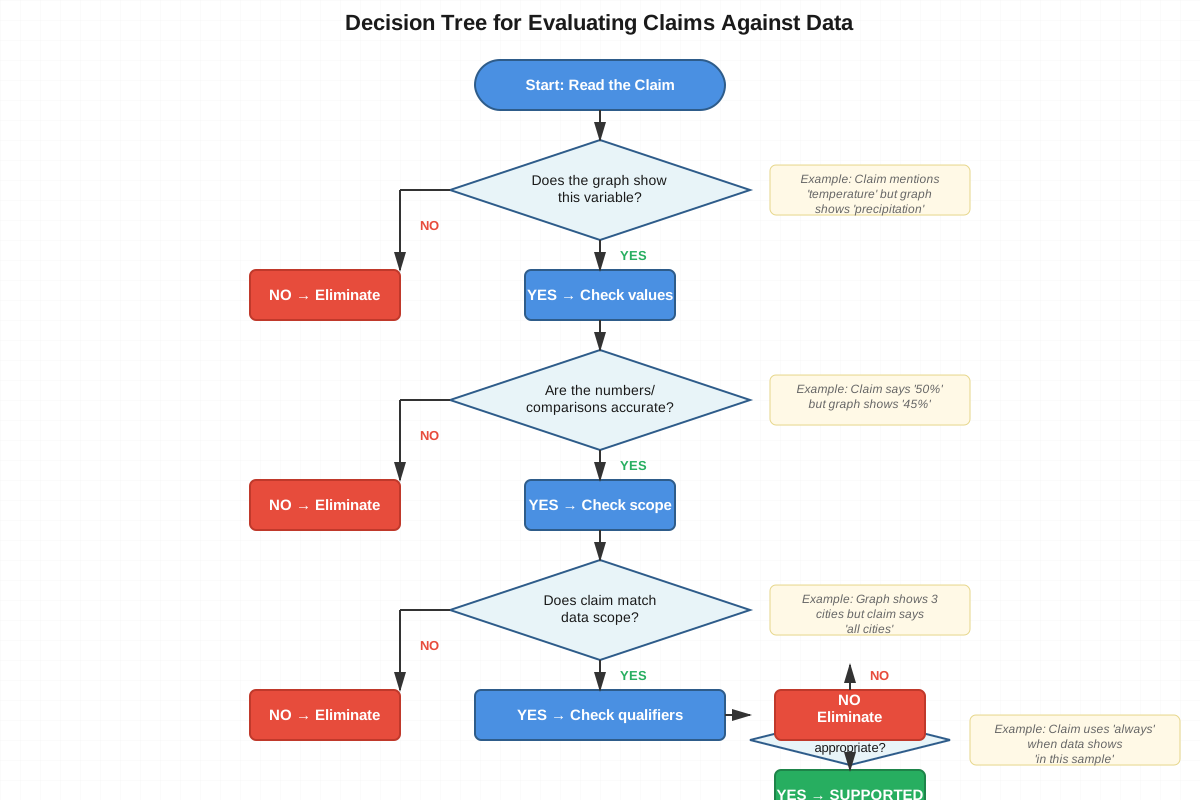
The core analytical process involves four systematic steps:
- Read the claim completely: Identify every assertion the statement makes, including subjects, comparisons, qualifiers, and scope
- Locate relevant data: Find the specific data points, bars, lines, or table cells needed to verify the claim
- Check for exact alignment: Verify that the data supports every component of the claim without exception
- Assess qualifiers: Ensure that words like "approximately," "generally," or "in most cases" match the precision and scope of the data
Common Claim Types and Verification Methods
| Claim Type | What to Verify | Example |
|---|---|---|
| Comparative | Which value is larger/smaller; magnitude of difference | "Group A showed higher rates than Group B" |
| Trend | Direction of change over time or across categories | "Values increased consistently from 2010 to 2020" |
| Superlative | Whether something is truly the maximum/minimum | "Species X had the greatest population decline" |
| Proportional | Relative sizes or percentages | "Category A represented more than half of the total" |
| Absolute | Specific numerical values or ranges | "The value exceeded 500 in Year 3" |
Recognizing Unsupported Claims
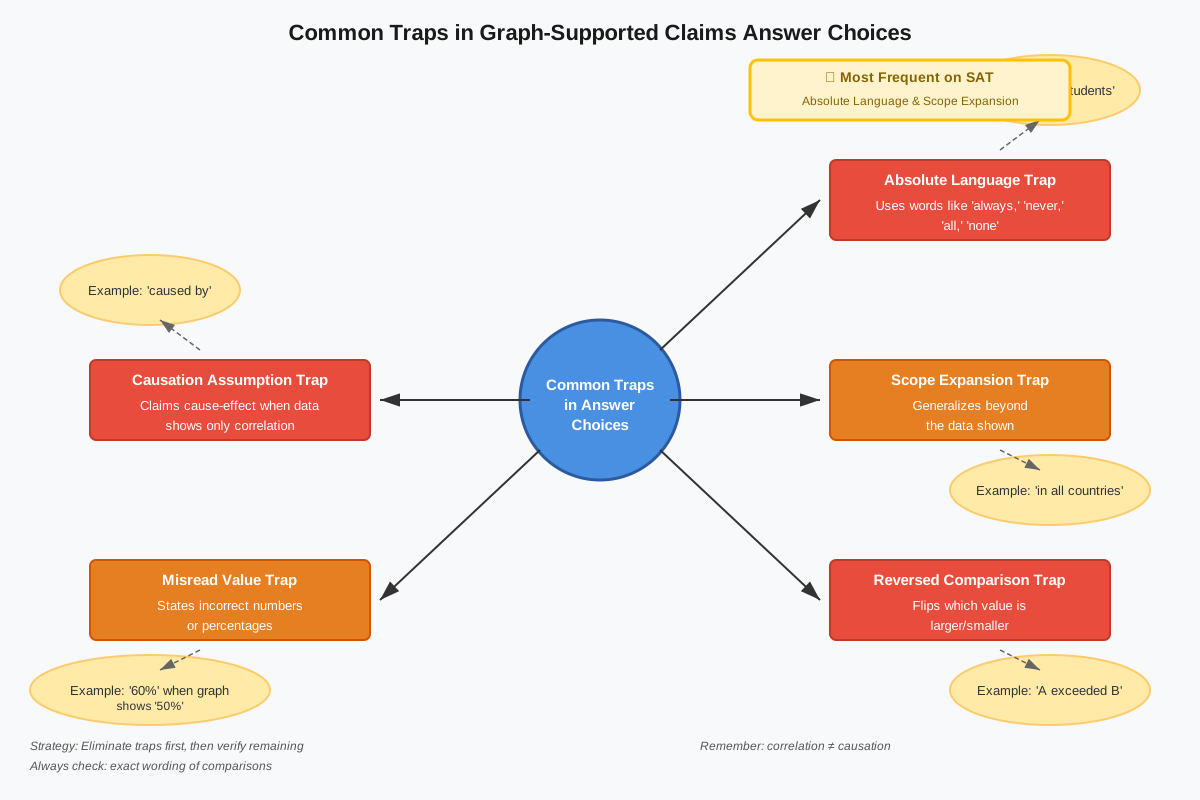
Claims become unsupported through several mechanisms. Overgeneralization occurs when a statement makes a broader claim than the data justifies—for example, claiming "all" when data shows "most," or asserting a pattern holds "always" when it's only demonstrated in specific cases. Misreading values happens when answer choices cite numbers that don't match the actual data, often using values that appear elsewhere in the graph or are close to but not exactly the correct numbers.
Reversed relationships present comparisons backward, stating that A exceeds B when the data shows B exceeds A. These distractors are particularly tempting when students read quickly or rely on visual impressions rather than careful verification. Unsupported causation claims that one variable causes another when the data only shows correlation or co-occurrence. Out-of-scope claims make assertions about topics, time periods, or populations not represented in the data at all.
The Role of Context Passages
The brief passage preceding the graph provides essential context—defining terms, explaining what was measured, describing the study or data source, and establishing the scope of the information. Students must integrate this textual information with the visual data. For example, if the passage states that data was collected from "urban areas in the northeastern United States," a claim about "all American cities" would exceed the scope of the evidence, even if the numerical comparison is accurate for the data shown.
Concept Relationships
Graph-supported claims questions integrate multiple analytical skills into a unified assessment. The foundation begins with basic graph literacy (reading axes, scales, and labels) → which enables accurate data extraction (locating specific values and comparisons) → which supports claim verification (checking whether statements align with evidence) → which culminates in answer selection (choosing the fully supported option while eliminating distractors).
This topic connects directly to other Command of Evidence skills tested on the SAT. Textual evidence questions require similar verification processes, but with quotations instead of graphs—both demand that students match claims to evidence precisely. Inference questions build on graph-supported claims by asking what the data suggests beyond what it explicitly shows, requiring students to first understand what is directly supported before making reasonable extensions.
The relationship to quantitative reasoning is bidirectional: mathematical skills enable more sophisticated data analysis, while practice with graph-supported claims reinforces numerical comparison and proportional reasoning. Students who struggle with these questions often need to strengthen either their graph literacy (a visual-spatial skill), their attention to detail (a metacognitive skill), or their understanding of logical scope and qualifiers (a verbal reasoning skill).
Within a single question, the concepts form a verification chain: Context passage → defines scope and terms → Graph structure → determines what data is available → Claim components → specify what needs verification → Data points → provide evidence → Qualifiers and scope → determine whether the match is exact → Answer selection → requires elimination of partially supported or unsupported options.
High-Yield Facts
⭐ Graph-supported claims questions appear 2-3 times per SAT test, making them one of the most predictable question types in the Reading and Writing section.
⭐ The correct answer must be supported by the data shown without requiring any outside knowledge—if you need to know facts beyond what's presented, you're overthinking.
⭐ Wrong answers typically fall into four categories: overgeneralizations, reversed comparisons, misread values, and out-of-scope claims.
⭐ Qualifiers like "approximately," "generally," and "in most cases" are often necessary for correct answers because data rarely supports absolute statements.
⭐ Always check both axes of graphs carefully—many wrong answers exploit misreading of scales, units, or which axis represents which variable.
- The passage context defines the scope of valid claims—statements that extend beyond the described population, time period, or conditions are unsupported regardless of numerical accuracy.
- Correlation shown in data does not support claims of causation unless the passage explicitly describes an experimental design that establishes cause-and-effect.
- When two answer choices both seem supported, the correct answer is the one that requires no assumptions or inferences beyond what's explicitly shown.
- Tables require careful cross-referencing of row and column headers—wrong answers often cite values from incorrect cells.
- Line graphs show trends over continuous variables, but claims about specific values require checking the exact points, not just the general direction of the line.
- Bar graphs can be misleading if the value axis doesn't start at zero—visual impressions of relative size may not match actual proportional differences.
- Scatter plots support claims about overall patterns and correlations but rarely support claims about individual data points unless specifically asked.
- The word "best" in "best supported by the data" means you should eliminate answers that are partially supported in favor of the one that is fully and precisely supported.
- Time-based graphs support claims about when maximums, minimums, or changes occurred, but be precise about whether the claim matches the exact year or period shown.
- Percentage claims require verification that the proportional relationship stated matches what the data shows—a common trap involves confusing absolute values with percentages.
Quick check — test yourself on Graph-supported claims so far.
Try Flashcards →Common Misconceptions
Misconception: If a claim seems reasonable or matches general knowledge about the topic, it's probably the right answer.
Correction: Graph-supported claims questions test only what the specific data shows, not general knowledge. A claim can be true in the real world but unsupported by the particular graph presented. Always verify against the actual data, not your prior knowledge.
Misconception: The correct answer will use the exact same words as labels or categories in the graph.
Correction: Correct answers often paraphrase or describe data using different terminology than the graph labels. The SAT tests whether you understand the concepts, not just whether you can match words. Focus on whether the meaning aligns, not whether the vocabulary is identical.
Misconception: If most of the data supports a claim, it's close enough to be correct.
Correction: The correct answer must be supported by all relevant data without exceptions. If a claim states "all categories showed increases" but one category decreased, that answer is wrong even if four out of five categories increased. Precision matters—look for answers that are completely accurate.
Misconception: Bigger visual differences in graphs always correspond to bigger numerical differences.
Correction: Visual impressions can be misleading, especially when axes don't start at zero or use logarithmic scales. Always check the actual numerical values rather than relying on how different bars or lines appear. A small visual difference might represent a large numerical gap, or vice versa.
Misconception: You need to perform calculations or mathematical operations to answer graph-supported claims questions.
Correction: While basic numerical comparison is necessary, these questions rarely require actual calculations. If you find yourself doing complex math, you're likely overcomplicating the question. The correct answer should be verifiable through direct observation of the data with at most simple comparisons.
Misconception: Scatter plots with positive correlations support claims that one variable causes the other to increase.
Correction: Correlation does not equal causation. Unless the passage explicitly describes an experimental design where one variable was manipulated to observe effects on another, the data only supports claims about association or correlation, not causal relationships.
Misconception: If the passage discusses a topic in detail, claims about that topic are automatically supported.
Correction: The passage provides context, but the graph provides evidence. A claim is only supported if the visual data demonstrates it, regardless of what the passage discusses. The passage and graph work together—use the passage to understand scope and definitions, but verify claims against the graph.
Worked Examples
Example 1: Bar Graph Analysis
Passage and Graph Context: Researchers surveyed 500 adults about their primary source of news. The bar graph shows the percentage of respondents in each age group who identified social media as their primary news source.
Graph Data:
- Age 18-29: 65%
- Age 30-44: 48%
- Age 45-59: 32%
- Age 60+: 18%
Question: Which statement is best supported by the data?
Answer Choices:
A) Social media is the most popular news source among all age groups surveyed.
B) Younger adults are more likely than older adults to use social media as their primary news source.
C) Adults over 60 never use social media for news.
D) The percentage of 30-44 year-olds using social media for news is approximately twice that of 60+ year-olds.
Step-by-Step Solution:
Evaluating Choice A: This claims social media is "most popular" among "all age groups." For this to be true, social media would need to exceed 50% in every age group (to be the majority choice). While 18-29 (65%) and 30-44 (48%) show high percentages, 48% is not a majority, and the older groups show even lower percentages. Additionally, we don't see data about other news sources to confirm social media is #1 in each group. Unsupported.
Evaluating Choice B: This makes a comparative claim about younger versus older adults. Checking the data: 18-29 (65%) > 30-44 (48%) > 45-59 (32%) > 60+ (18%). There's a clear, consistent pattern where each younger age group shows a higher percentage than each older age group. The claim uses "more likely," which appropriately matches the percentage data. This is fully supported.
Evaluating Choice C: This claims adults over 60 "never" use social media for news. The graph shows 18% of 60+ respondents identified social media as their primary source. While this is the lowest percentage, 18% is definitely not zero—this means some adults over 60 do use social media for news. The word "never" makes this claim too absolute. Unsupported.
Evaluating Choice D: This requires checking whether 30-44 year-olds (48%) is approximately twice the 60+ percentage (18%). Calculating: 18% × 2 = 36%. The actual value is 48%, which is notably higher than 36%. While 48% is larger than 18%, it's not approximately double—it's more than 2.5 times larger. Unsupported due to inaccurate proportional claim.
Correct Answer: B
Key Takeaway: This example demonstrates how qualifiers matter. Choice B succeeds because "more likely" appropriately describes the pattern without overstating it. Choice C fails because "never" is too absolute. Choice D fails because "approximately twice" doesn't match the actual proportional relationship.
Example 2: Line Graph with Trend Analysis
Passage and Graph Context: A study tracked the population of a butterfly species in a protected habitat from 2015 to 2023. The line graph shows the estimated population each year.
Graph Data (approximate values from line graph):
- 2015: 1,200
- 2016: 1,400
- 2017: 1,800
- 2018: 2,100
- 2019: 2,000
- 2020: 1,700
- 2021: 1,500
- 2022: 1,600
- 2023: 1,800
Question: Which statement about the butterfly population is best supported by the data?
Answer Choices:
A) The population increased steadily throughout the study period.
B) The population reached its maximum in 2018 and then declined for the remainder of the study.
C) The population was higher in 2023 than in 2015.
D) Climate change caused the population fluctuations observed in the data.
Step-by-Step Solution:
Evaluating Choice A: "Increased steadily throughout" means continuous growth with no decreases. Checking year-to-year: 2015→2016 (increase), 2016→2017 (increase), 2017→2018 (increase), 2018→2019 (decrease!). The population decreased from 2018 to 2019, and again from 2019 to 2020 and 2020 to 2021. The word "steadily" and "throughout" make this claim too strong. Unsupported.
Evaluating Choice B: First part: "reached its maximum in 2018"—checking all years, 2018 (2,100) is indeed the highest value. Second part: "then declined for the remainder of the study"—checking post-2018 values: 2019 (2,000) is lower, 2020 (1,700) is lower, 2021 (1,500) is lower, but then 2022 (1,600) is higher than 2021, and 2023 (1,800) is higher than 2022. The population didn't decline for the entire remainder—it declined for several years but then increased again. Unsupported due to the second part being inaccurate.
Evaluating Choice C: Simple comparison: 2023 (1,800) versus 2015 (1,200). 1,800 > 1,200, so the population was indeed higher in 2023 than in 2015. This is a straightforward, verifiable claim that requires no assumptions. Fully supported.
Evaluating Choice D: This makes a causal claim about climate change causing the fluctuations. While the graph shows fluctuations occurred, it provides no information about causes. The passage mentions only that the habitat was protected and the population was tracked—nothing about climate or other causal factors. Correlation or temporal patterns don't establish causation without additional evidence. Unsupported—out of scope.
Correct Answer: C
Key Takeaway: This example shows the importance of checking entire claims, not just parts. Choice B's first part is accurate, but the second part fails, making the whole answer wrong. Choice C succeeds by making a simple, verifiable comparison without overreaching. Choice D illustrates that causation claims require explicit evidence beyond mere observation of changes.
Exam Strategy
Systematic Verification Process: Approach each answer choice as a hypothesis to be tested. Read the claim completely, identify every assertion it makes, then systematically check each component against the data. Don't stop at the first part that seems right—verify the entire statement. Use your finger or pencil to track specific data points as you verify, reducing the chance of misreading values or comparing the wrong elements.
Trigger Words to Watch: Pay special attention to absolute qualifiers like "all," "none," "never," "always," "every," and "only"—these make claims very restrictive and are often present in wrong answers because data rarely supports such absolute statements. Conversely, moderate qualifiers like "generally," "most," "typically," "approximately," and "in most cases" often appear in correct answers because they appropriately acknowledge the limitations of data. Comparative terms like "more than," "less than," "higher," "lower," "increased," and "decreased" require precise verification of which values are being compared and in which direction.
Elimination Strategy: Start by eliminating answers that are clearly out of scope—claims about topics, populations, or time periods not represented in the data. Next, eliminate answers with misread values by checking specific numbers against the graph. Then eliminate reversed comparisons by carefully verifying the direction of relationships. Finally, if multiple answers remain, choose the one that requires the fewest assumptions and is most precisely supported by the data shown.
Time Management: Graph-supported claims questions typically take 45-60 seconds when approached systematically. Don't rush the initial reading of the graph—spend 10-15 seconds understanding the axes, labels, scale, and what's being measured. This upfront investment prevents errors and actually saves time by making verification faster. If you find yourself spending more than 90 seconds on one question, mark it and return later—you may be overcomplicating or missing something obvious.
Common Traps to Avoid: Don't select answers based on real-world knowledge or what "makes sense" about the topic—only what the data shows. Don't be fooled by answers that use technical vocabulary from the passage or graph labels—paraphrasing is common in correct answers. Don't assume visual differences in graph elements (bar heights, line slopes) correspond proportionally to numerical differences without checking actual values. Don't confuse correlation with causation—data showing two variables change together doesn't prove one causes the other.
Double-Check Protocol: Before finalizing your answer, perform this quick verification: (1) Does my chosen answer match every data point it references? (2) Does it stay within the scope defined by the passage? (3) Are the qualifiers appropriate for the precision of the data? (4) Could I defend this answer by pointing to specific evidence in the graph? If you answer "yes" to all four, you've likely found the correct answer.
Memory Techniques
SCOPE Acronym for evaluating claims:
- Specific values match exactly
- Comparisons go the right direction
- Out-of-bounds claims eliminated
- Population/period matches data
- Every part of claim verified
The "Point and Prove" Method: Visualize yourself explaining your answer to a skeptical friend. For each component of your chosen answer, imagine pointing to the specific data that proves it. If you can't point to concrete evidence for any part of the claim, it's not fully supported.
Qualifier Spectrum Visualization: Picture a spectrum from "absolute" to "moderate" to "vague":
- Absolute (rarely supported): all, none, never, always, every, only
- Moderate (often supported): most, generally, typically, approximately, in many cases
- Vague (sometimes supported): some, certain, various, several
Correct answers usually fall in the moderate range because data rarely proves absolute statements but should be more specific than vague generalities.
The "Three-Check Rule": For any claim involving comparison, check three things:
- What is being compared (verify you're looking at the right categories/variables)
- Which direction (greater than, less than, increased, decreased)
- How much (if the claim specifies magnitude, verify it matches)
Causation Red Flag: Whenever you see words like "caused," "led to," "resulted in," "because of," or "due to," mentally add a red flag. Ask: "Does the passage describe an experiment or mechanism, or am I just seeing correlation?" If it's just correlation, causation claims are unsupported.
Summary
Graph-supported claims questions assess the ability to verify textual statements against visual data presentations, appearing 2-3 times per SAT test in the Reading and Writing section. Success requires systematic verification of every component of a claim against the specific data shown, careful attention to qualifiers that determine scope, and recognition of common traps including overgeneralizations, reversed comparisons, misread values, and unsupported causation. The correct answer must be fully supported by the data without requiring outside knowledge or assumptions, while wrong answers typically fail by extending beyond what the evidence demonstrates, misreading values, or making claims about causation when only correlation is shown. Students should integrate information from both the context passage (which defines scope and terms) and the graph (which provides evidence), checking that comparisons go the correct direction, numerical values match exactly, and the population or time period referenced aligns with what was actually measured. Mastery comes from practicing the systematic verification process, learning to recognize trigger words that signal absolute versus moderate claims, and developing the discipline to check entire statements rather than stopping at partially correct answers.
Key Takeaways
- Graph-supported claims questions require verifying that every component of a statement aligns with the data shown, not just that the claim seems reasonable or matches general knowledge
- The correct answer is fully supported by the specific data presented, while wrong answers typically overgeneralize, reverse comparisons, misread values, or extend beyond the scope of evidence
- Qualifiers like "approximately," "generally," and "most" often appear in correct answers because data rarely supports absolute statements with words like "all," "never," or "always"
- Correlation shown in data does not support causation claims unless the passage explicitly describes experimental evidence of cause-and-effect relationships
- Systematic verification—reading the entire claim, locating relevant data, checking exact alignment, and assessing appropriate qualifiers—prevents the most common errors
- Visual impressions from graphs can be misleading; always verify actual numerical values rather than relying on how different bars, lines, or points appear
- The passage context defines the valid scope of claims regarding population, time period, and conditions—statements extending beyond this scope are unsupported regardless of numerical accuracy
Related Topics
Textual Evidence Questions: These questions ask students to identify which quotation from a passage best supports a given claim, using similar verification skills but with text instead of graphs. Mastering graph-supported claims builds the systematic checking approach needed for textual evidence questions.
Inference and Conclusion Questions: Building on graph-supported claims, these questions ask what the data suggests beyond what it explicitly shows, requiring students to first understand what is directly supported before making reasonable extensions.
Quantitative Information in Context: This broader category includes questions about interpreting data in scientific passages, understanding experimental design, and evaluating the strength of evidence—all skills that build on the foundation of accurately reading and interpreting visual data.
Rhetorical Synthesis: Some advanced questions ask students to determine which statement best combines information from multiple sources, including both text and graphs, requiring integration of the verification skills developed through graph-supported claims practice.
Practice CTA
Now that you understand the systematic approach to graph-supported claims questions, it's time to apply these strategies to actual SAT-style practice questions. Work through the practice set carefully, using the verification process outlined in this guide. Pay special attention to questions you get wrong—analyze whether you misread data, overlooked qualifiers, or fell for a common trap. Each practice question you complete strengthens your pattern recognition and builds the confidence you need to secure these high-yield points on test day. Remember: graph-supported claims questions are among the most predictable on the SAT, making them an excellent opportunity to demonstrate your analytical skills and boost your score. You've got this!
Sign up free to keep reading
Create a free AnvayaPrep account to finish this SAT guide on Graph-supported claims — plus flashcards and practice questions.