Overview
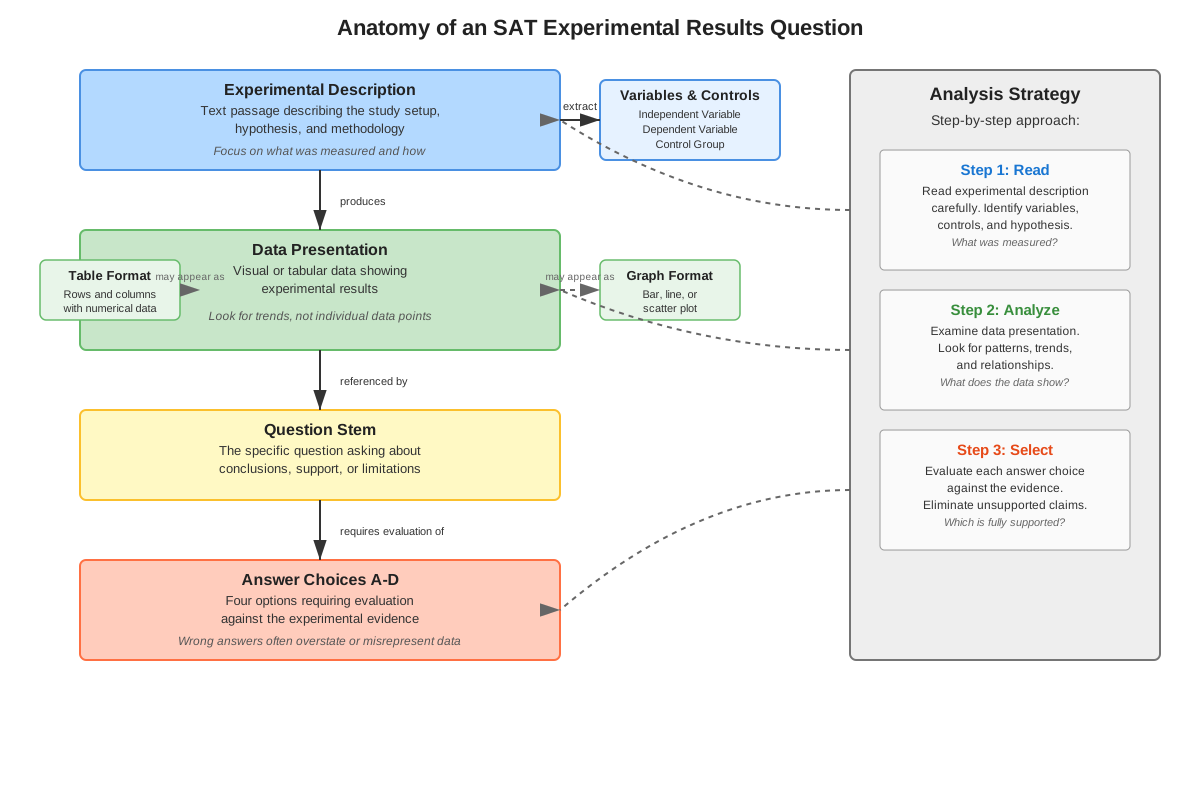
Interpreting experimental results is a critical skill tested in the SAT Reading and Writing section, specifically within the Command of Evidence domain. This topic requires students to analyze scientific data, understand experimental design, draw logical conclusions from evidence, and evaluate whether claims are supported by the results presented. On the SAT, students encounter passages describing experiments from various scientific disciplines—biology, chemistry, physics, psychology, and social sciences—and must demonstrate their ability to read data tables, graphs, and experimental descriptions with precision.
The SAT places significant emphasis on evidence-based reasoning, making this topic essential for achieving competitive scores. Questions on sat interpreting experimental results typically present a brief description of a study or experiment followed by data in various formats (tables, bar graphs, line graphs, or textual summaries). Students must then select answer choices that accurately reflect what the data shows, identify limitations of the study, or determine which conclusion is most strongly supported by the evidence. These questions test not just reading comprehension but also analytical thinking and the ability to distinguish between what data actually demonstrates versus what it merely suggests.
Within the broader rw (Reading and Writing) framework, interpreting experimental results connects directly to other evidence-based skills such as identifying textual evidence, understanding author's purpose, and evaluating argumentative claims. This topic bridges scientific literacy with critical reading, requiring students to approach passages with both skepticism and precision. Mastery of this skill enhances performance across multiple question types and prepares students for the evidence-based reasoning demanded in college-level coursework.
Learning Objectives
- [ ] Identify key features of interpreting experimental results, including variables, controls, and data presentation formats
- [ ] Explain how interpreting experimental results appears on the SAT, including question formats and common passage structures
- [ ] Apply interpreting experimental results to answer SAT-style questions with accuracy and efficiency
- [ ] Distinguish between correlation and causation in experimental contexts
- [ ] Evaluate whether experimental data supports, contradicts, or is insufficient to support a given claim
- [ ] Recognize common experimental design elements such as sample size, randomization, and control groups
- [ ] Identify limitations and potential confounding variables in experimental studies
Prerequisites
- Basic graph reading skills: Understanding axes, scales, and data points is essential for interpreting visual data presentations in experimental passages
- Fundamental scientific vocabulary: Terms like hypothesis, variable, control group, and sample size appear frequently in experimental result questions
- Reading comprehension fundamentals: The ability to extract main ideas and supporting details from complex passages forms the foundation for analyzing experimental descriptions
- Basic statistical concepts: Understanding concepts like averages, percentages, and trends helps students accurately interpret numerical data
Why This Topic Matters
Interpreting experimental results represents one of the most practical applications of reading comprehension skills. In academic, professional, and civic contexts, individuals constantly encounter claims supported (or unsupported) by data—from medical studies informing health decisions to social science research shaping public policy. The ability to critically evaluate evidence distinguishes informed decision-makers from those who accept claims uncritically.
On the SAT, questions involving experimental results appear with high frequency, typically comprising 15-20% of the Reading and Writing section. These questions appear in both the "Information and Ideas" and "Command of Evidence" categories, making them among the most heavily weighted question types. Students can expect to encounter 3-5 questions per test that directly assess their ability to interpret experimental data, with additional questions that indirectly require these skills.
Common manifestations in exam passages include: brief descriptions of scientific studies followed by data tables showing results across different conditions; passages presenting conflicting experimental findings that students must reconcile; scenarios where students must identify which conclusion is most strongly supported by presented evidence; and questions asking students to identify what additional information would be needed to support a particular claim. The SAT favors experiments with clear independent and dependent variables, straightforward data presentations, and results that require careful reading rather than complex calculations.
Core Concepts
Understanding Experimental Design Elements
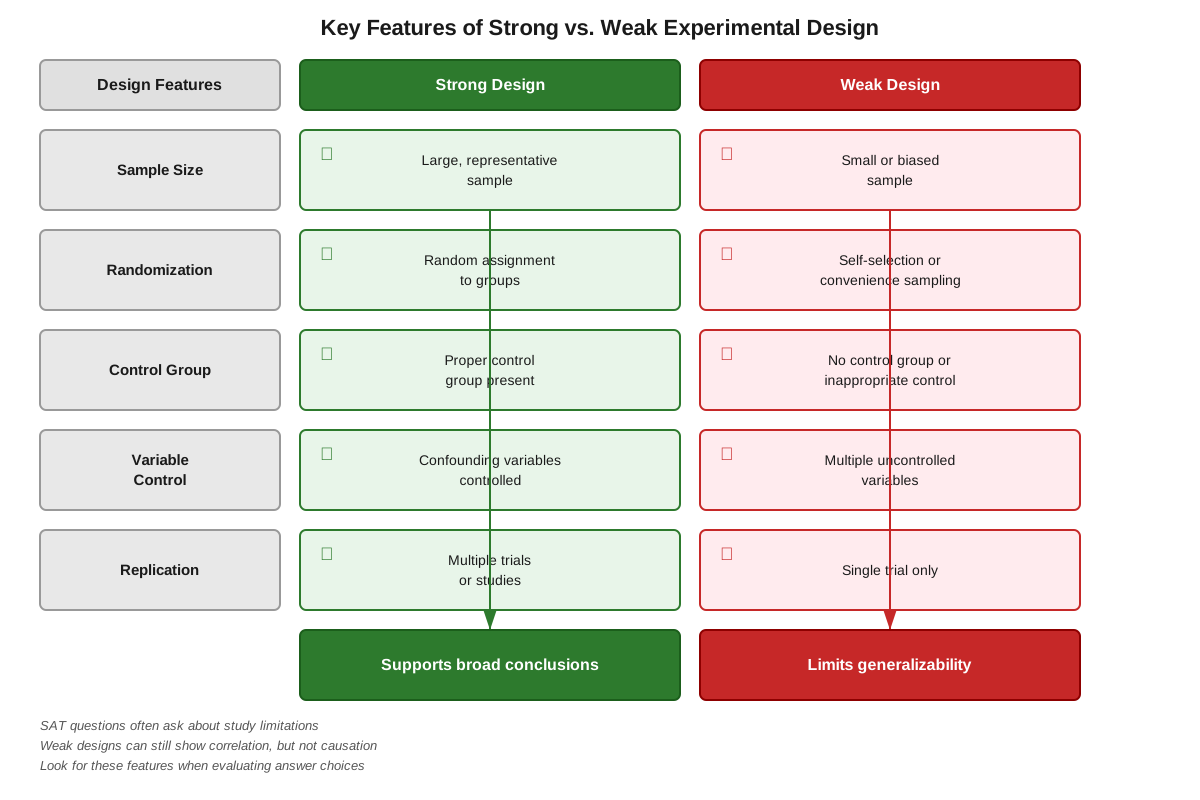
Experimental design refers to the structure and methodology researchers use to test hypotheses and gather data. On the SAT, recognizing key design elements helps students understand what conclusions can legitimately be drawn from results. The independent variable is the factor researchers deliberately manipulate or change, while the dependent variable is what researchers measure to see the effect of that manipulation. For example, in a study testing whether different fertilizers affect plant growth, fertilizer type is the independent variable and plant height is the dependent variable.
Control groups serve as baselines for comparison, receiving no treatment or a standard treatment against which experimental groups are measured. Without proper controls, determining whether an observed effect results from the treatment or other factors becomes impossible. Randomization involves randomly assigning subjects to different experimental conditions, reducing bias and ensuring groups are comparable at the study's start. Sample size matters significantly—larger samples generally provide more reliable results and reduce the impact of outliers or chance variations.
Reading Data Tables and Graphs
SAT passages present experimental results through various formats, each requiring specific reading strategies. Data tables organize information in rows and columns, typically showing how the dependent variable changes across different levels of the independent variable. When reading tables, students should first identify what each column and row represents, note the units of measurement, and look for patterns or trends across conditions.
Bar graphs display categorical data using rectangular bars whose heights or lengths represent values. These work well for comparing discrete groups or conditions. Line graphs show continuous data and are particularly useful for displaying trends over time or across a range of values. When interpreting line graphs, students should examine the slope (rate of change), identify maximum and minimum points, and note whether relationships appear linear or non-linear.
Scatter plots display individual data points showing the relationship between two variables, helping visualize correlations. The pattern of points reveals whether variables are positively correlated (both increase together), negatively correlated (one increases as the other decreases), or uncorrelated (no clear pattern).
Correlation Versus Causation
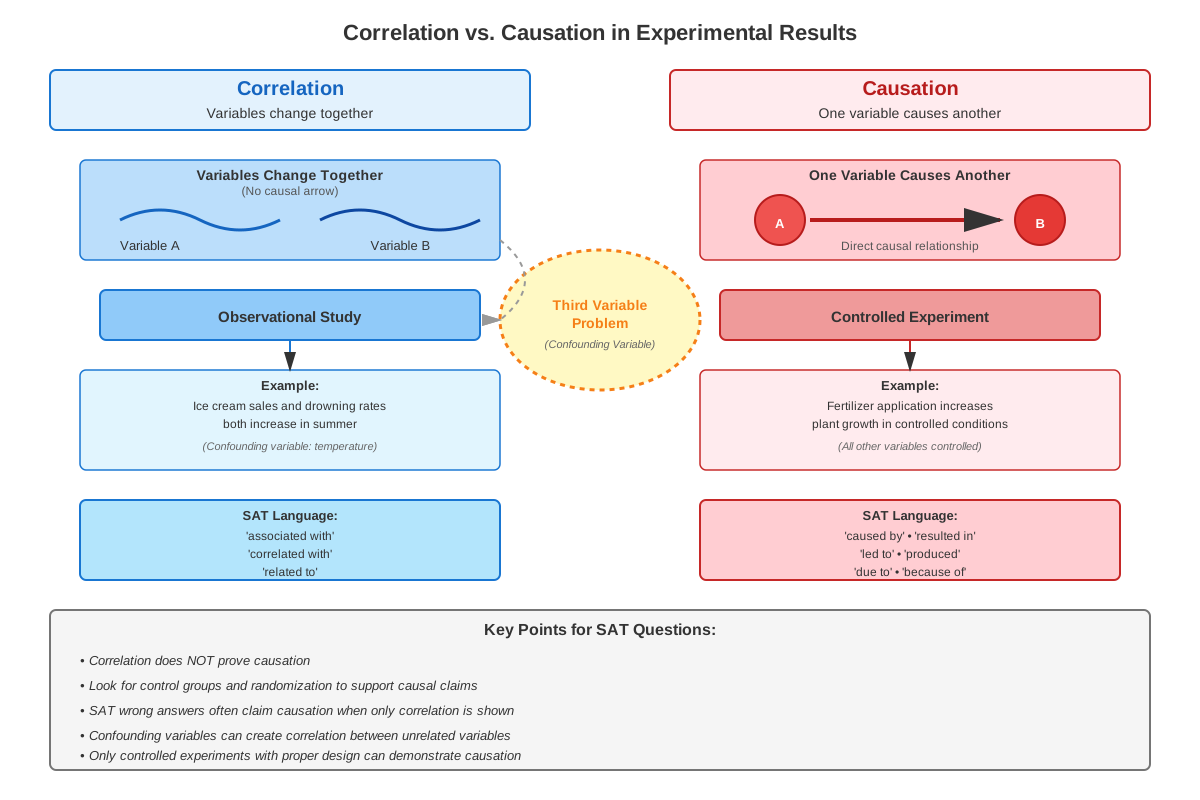
One of the most critical distinctions in interpreting experimental results involves understanding that correlation (two variables changing together) does not necessarily indicate causation (one variable directly causing changes in another). The SAT frequently tests whether students can recognize this distinction. A study might show that ice cream sales and drowning deaths both increase during summer months—these variables are correlated, but ice cream consumption doesn't cause drowning. Instead, a third variable (warm weather) influences both.
Establishing causation requires specific experimental conditions: temporal precedence (the cause must precede the effect), covariation (changes in the cause must correspond with changes in the effect), and elimination of alternative explanations (ruling out confounding variables). Observational studies, which simply observe and measure variables without manipulation, can establish correlation but rarely prove causation. Controlled experiments, where researchers manipulate variables and control for confounds, provide stronger evidence for causal relationships.
Evaluating Claims Against Evidence
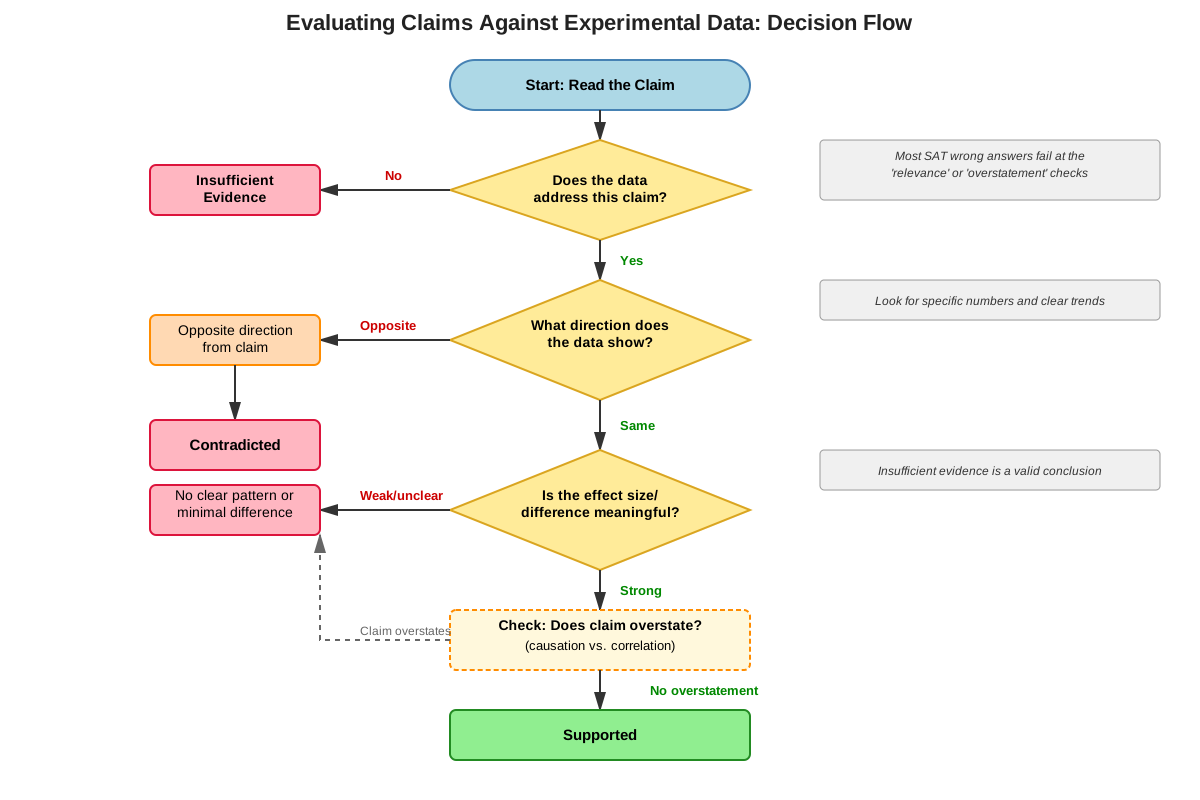
SAT questions frequently present a claim and ask students to determine whether experimental results support it. This requires careful matching between what the claim states and what the data actually shows. Students must distinguish between:
- Strongly supported claims: The data directly demonstrates the claim with clear, consistent evidence
- Weakly supported claims: The data suggests the claim might be true but doesn't provide definitive proof
- Unsupported claims: The data neither supports nor contradicts the claim (insufficient evidence)
- Contradicted claims: The data directly opposes what the claim states
Identifying Limitations and Confounding Variables
No experiment is perfect, and the SAT tests whether students can recognize study limitations. Confounding variables are factors other than the independent variable that might influence the dependent variable, potentially leading to incorrect conclusions. For example, a study comparing test scores between students who eat breakfast versus those who don't might be confounded by socioeconomic status if wealthier families are more likely to provide breakfast and also provide other educational advantages.
Common limitations include: small sample sizes that may not represent larger populations; lack of randomization leading to systematic differences between groups; short study duration that might miss long-term effects; self-reported data that may be inaccurate; and failure to control for relevant variables. Recognizing these limitations helps students evaluate how confidently researchers can draw conclusions from their results.
Statistical Significance and Practical Significance
While the SAT doesn't require complex statistical calculations, understanding basic concepts helps interpret results. Statistical significance indicates that observed differences between groups are unlikely to have occurred by chance alone. However, statistically significant results aren't always practically meaningful. A study might find a statistically significant 0.5% improvement in test scores from an intervention, but this tiny effect may not matter in real-world applications. Conversely, small studies might show large, practically important effects that don't reach statistical significance due to limited sample size.
Concept Relationships
The concepts within interpreting experimental results form an interconnected framework. Understanding experimental design elements (variables, controls, randomization) provides the foundation for evaluating whether studies can support causal claims. This connects directly to the correlation versus causation distinction—only well-designed experiments with proper controls can establish causation, while observational studies typically reveal only correlations.
The ability to read data tables and graphs serves as the technical skill enabling students to extract information from results, which then feeds into evaluating claims against evidence. Students must first accurately read what the data shows before determining whether it supports particular conclusions. Identifying limitations and confounding variables represents the critical thinking layer applied to both experimental design and results interpretation—recognizing what might undermine the validity of conclusions drawn from data.
This topic builds on prerequisite reading comprehension skills by adding quantitative reasoning and scientific thinking. It connects forward to broader critical thinking applications: evaluating arguments in persuasive passages, assessing the strength of evidence in historical documents, and analyzing how authors use data to support claims. The relationship map flows: Experimental Design → Data Collection → Data Presentation → Data Interpretation → Claim Evaluation → Limitation Recognition.
High-Yield Facts
- ⭐ The independent variable is what researchers manipulate; the dependent variable is what they measure as the outcome
- ⭐ Correlation between two variables does not prove that one causes the other—confounding variables may explain the relationship
- ⭐ Control groups provide the baseline for comparison and are essential for determining whether treatments have effects
- ⭐ When evaluating claims, students must match what the data actually shows, not what seems logical or what they expect
- ⭐ Larger sample sizes generally produce more reliable results and better represent populations
- Randomization reduces bias by ensuring experimental groups are comparable before treatment
- Observational studies can establish correlation but rarely prove causation
- Statistical significance indicates results are unlikely due to chance, but doesn't guarantee practical importance
- Confounding variables are factors other than the independent variable that might influence results
- Line graphs best display trends over time or continuous relationships between variables
- When data shows a trend in one direction, conclusions should not claim effects in the opposite direction
- "Suggests" or "indicates" represents weaker language than "proves" or "demonstrates" when describing what data shows
- Extrapolating beyond the range of data collected (e.g., predicting what happens at values not tested) is generally not supported by results
Quick check — test yourself on Interpreting experimental results so far.
Try Flashcards →Common Misconceptions
Misconception: If two variables are correlated, one must cause the other.
Correction: Correlation indicates variables change together but doesn't establish causation. A third variable might influence both, or the relationship might be coincidental. Only controlled experiments with proper design can establish causal relationships.
Misconception: Larger numbers in data tables always indicate better or more desirable outcomes.
Correction: The meaning of numerical values depends entirely on what's being measured. Higher numbers might indicate worse outcomes (e.g., error rates, disease incidence, pollution levels). Always read what the variable represents before interpreting whether increases are positive or negative.
Misconception: If data supports a claim for one population or condition, it automatically applies to all populations and conditions.
Correction: Results are specific to the populations, conditions, and contexts studied. A medication effective in adults may not work the same way in children; a teaching method successful in small classes may not scale to large lectures. Generalizing beyond the study parameters requires additional evidence.
Misconception: Small differences between experimental groups are always meaningless.
Correction: The importance of differences depends on context, measurement precision, and sample size. In some fields, small percentage changes represent significant effects. Statistical analysis determines whether observed differences are likely real or due to chance.
Misconception: The absence of evidence for an effect is the same as evidence that no effect exists.
Correction: If a study finds no significant difference between groups, this might mean no effect exists, but it could also mean the study lacked sufficient power to detect an effect (too small sample size, too much variability, insufficient duration). "No evidence of effect" differs from "evidence of no effect."
Misconception: Graphs and tables always present complete, unbiased information about experimental results.
Correction: Data presentations can be misleading through selective reporting, manipulated scales, or omission of relevant information. Critical readers should consider what information might be missing, whether axes are appropriately scaled, and whether the presentation format might emphasize or minimize certain patterns.
Worked Examples
Example 1: Evaluating a Plant Growth Experiment
Passage: Researchers investigated whether different light wavelengths affect plant growth. They grew 60 identical seedlings under controlled conditions, randomly assigning 20 plants each to red light, blue light, or white light (control). After 30 days, they measured plant height in centimeters.
| Light Type | Average Height (cm) | Range (cm) |
|---|---|---|
| Red | 18.5 | 16.2-20.8 |
| Blue | 22.3 | 20.1-24.5 |
| White (control) | 19.1 | 17.0-21.2 |
Question: Based on the results, which claim is most strongly supported?
A) Red light causes plants to grow more slowly than blue light in all conditions.
B) Plants exposed to blue light grew taller on average than plants exposed to red or white light.
C) The wavelength of light has no effect on plant growth.
D) Blue light will produce the same growth advantage in all plant species.
Solution:
Step 1: Identify what the data actually shows. The table presents average heights and ranges for three light conditions. Blue light produced the highest average height (22.3 cm), followed by white light (19.1 cm), then red light (18.5 cm).
Step 2: Evaluate each answer choice against the data.
Choice A claims red light "causes" slower growth "in all conditions." The data shows red light plants were shorter on average, but this single experiment doesn't prove causation definitively, and "all conditions" overgeneralizes beyond what was tested. This is too strong.
Choice B states plants exposed to blue light "grew taller on average" than those exposed to red or white light. This directly matches the data: 22.3 > 19.1 > 18.5. The language is appropriately cautious ("on average," specific to what was tested).
Choice C claims wavelength has "no effect." The data shows clear differences in average height between conditions, contradicting this claim.
Choice D extrapolates to "all plant species," but the experiment tested only one type of seedling. This overgeneralizes beyond the study scope.
Answer: B
This example demonstrates the importance of matching claims precisely to data, avoiding overgeneralization, and recognizing appropriate caution in language when describing results.
Example 2: Analyzing a Memory Study
Passage: Psychologists studied whether background music affects memory performance. They recruited 100 college students and randomly assigned them to complete a memory task either in silence or while listening to classical music. Participants studied a list of 40 words for 5 minutes, then recalled as many as possible.
Results showed students in the silence condition recalled an average of 24.3 words (SD = 4.2), while students in the music condition recalled an average of 22.1 words (SD = 4.8). The researchers noted that students who regularly study with music showed smaller differences between conditions than students who typically study in silence.
Question: Which statement about the study's limitations is most accurate?
A) The study proves that music always impairs memory performance.
B) The results cannot be generalized to other types of music or different age groups.
C) The study's findings are invalid because some students performed better with music.
D) The small difference between conditions means the study found no real effect.
Solution:
Step 1: Identify the study's scope and design. The study tested college students, used classical music specifically, and measured recall of word lists. It was a controlled experiment with random assignment.
Step 2: Consider what limitations exist.
Choice A uses the word "proves" and "always"—both too strong. The study shows an average difference in one specific context but doesn't prove music always impairs memory in all situations.
Choice B identifies real limitations: the study tested only classical music (not rock, jazz, etc.) and only college students (not children, older adults, etc.). Results might differ with other music types or age groups. This accurately describes generalization limits.
Choice C claims findings are "invalid" because of individual variation. However, experimental results are based on average differences between groups, and individual variation is expected and normal. Some individuals performing differently doesn't invalidate group-level findings.
Choice D misinterprets the meaning of the difference. A 2.2-word difference (24.3 - 22.1) represents about a 9% reduction in recall, which could be meaningful. Additionally, the passage doesn't provide information about statistical significance, so we can't conclude "no real effect" exists.
Answer: B
This example illustrates how to identify legitimate study limitations (scope of generalization) while avoiding common errors like dismissing results due to individual variation or misunderstanding what makes findings "invalid."
Exam Strategy
When approaching SAT questions on interpreting experimental results, begin by carefully reading the passage to identify the study's purpose, design, and key variables. Note what was manipulated (independent variable), what was measured (dependent variable), and what controls were used. Before looking at answer choices, form your own understanding of what the data shows—this prevents answer choices from biasing your interpretation.
Trigger words that signal these questions include: "Based on the results," "The data supports," "According to the table/graph," "Which conclusion is most strongly supported," "A limitation of the study," and "The results suggest." These phrases indicate you must match claims precisely to evidence rather than relying on outside knowledge or assumptions.
For process of elimination, immediately eliminate answer choices that:
- Use absolute language ("always," "never," "all," "none") when data shows averages or trends
- Claim causation when the study design only supports correlation
- Generalize beyond the specific population, conditions, or variables tested
- Contradict what the data actually shows
- Require information not provided in the passage or data
Pay special attention to the strength of language in answer choices. "Suggests" and "indicates" are weaker than "proves" and "demonstrates." Data from a single study typically "suggests" rather than "proves." Similarly, "may" and "might" are more appropriate than "will" and "must" when describing potential implications.
Time allocation for these questions should be approximately 60-75 seconds each. Spend 30-40 seconds reading and understanding the passage and data, then 20-30 seconds evaluating answer choices. If a question requires comparing multiple data points or complex reasoning, allow up to 90 seconds, but avoid spending more than 2 minutes on any single question.
Exam Tip: When data is presented in a table or graph, quickly scan for the highest and lowest values, overall trends, and any notable outliers before reading the question. This preview helps you process answer choices more efficiently.
Memory Techniques
VCDL - Remember the key elements to identify in any experiment:
- Variables (independent and dependent)
- Controls (what's held constant or used as baseline)
- Data (what format, what patterns)
- Limitations (what might undermine conclusions)
"Correlation is NOT Causation" - Create a vivid mental image: Picture two people walking in the same direction (correlated movement) but not holding hands (no causal connection). They might both be heading toward the same destination (confounding variable) without one causing the other to move.
The MATCH Strategy for evaluating claims:
- Measure what the data actually shows
- Avoid overgeneralization beyond study scope
- Test each answer against evidence
- Check language strength (proves vs. suggests)
- Highlight limitations and confounds
Graph Reading Acronym - TAILS:
- Title: What is being displayed?
- Axes: What does each axis represent?
- Increase/Decrease: What are the trends?
- Labels: What are the units?
- Scale: Is it linear, logarithmic, or potentially misleading?
Visualize experimental design as a recipe: The independent variable is the ingredient you change, the dependent variable is the taste you measure, control groups are batches made with the standard recipe, and confounding variables are other factors (oven temperature, humidity) that might affect the outcome if not controlled.
Summary
Interpreting experimental results on the SAT requires students to analyze scientific studies, understand experimental design, accurately read data presentations, and evaluate whether evidence supports specific claims. Success depends on distinguishing between correlation and causation, recognizing the limitations of different study designs, and matching claims precisely to what data actually demonstrates rather than what seems logical or expected. Students must identify independent and dependent variables, understand the role of control groups and randomization, and recognize how confounding variables might undermine conclusions. The SAT tests these skills through passages describing experiments followed by data tables or graphs, asking students to select conclusions most strongly supported by results, identify study limitations, or determine what additional information would strengthen claims. Mastery requires both technical skills (reading graphs and tables accurately) and critical thinking (evaluating the strength of evidence and recognizing overgeneralization). The key to success lies in careful, literal reading of both passages and data, avoiding assumptions based on outside knowledge, and selecting answer choices that match the scope and strength of evidence provided.
Key Takeaways
- Always identify the independent variable (what's manipulated) and dependent variable (what's measured) before interpreting results
- Correlation between variables does not prove causation—look for controlled experimental design and elimination of confounding variables
- Match claims precisely to data: avoid answer choices that overgeneralize, use overly strong language, or extend beyond what was actually tested
- Control groups and randomization are essential for drawing valid conclusions about cause-and-effect relationships
- Read data tables and graphs carefully, noting units, scales, and trends before evaluating answer choices
- Recognize that absence of evidence for an effect differs from evidence that no effect exists
- Study limitations often involve scope of generalization—results apply specifically to the populations, conditions, and variables tested
Related Topics
Analyzing Textual Evidence: Building on experimental result interpretation, this topic focuses on identifying and evaluating evidence from non-scientific passages, including how authors use examples, quotations, and reasoning to support claims in argumentative and informational texts.
Understanding Statistical Concepts: Deeper exploration of statistical significance, confidence intervals, and probability helps students interpret more complex experimental results and understand the mathematical foundations underlying research conclusions.
Scientific Method and Hypothesis Testing: Understanding the broader framework of how scientists formulate hypotheses, design experiments, and draw conclusions provides context for interpreting individual experimental results.
Evaluating Arguments and Claims: This topic extends evidence evaluation beyond scientific contexts to persuasive writing, examining how authors construct arguments, use rhetorical strategies, and support positions with various types of evidence.
Mastering interpreting experimental results provides the analytical foundation for these related topics, as the skills of careful evidence evaluation, logical reasoning, and distinguishing between strong and weak support apply across all evidence-based reading tasks.
Practice CTA
Now that you've mastered the core concepts of interpreting experimental results, it's time to apply these skills to SAT-style practice questions. Work through the practice problems systematically, using the MATCH strategy and VCDL framework to analyze each experimental scenario. Review the flashcards to reinforce key terminology and concepts, particularly the distinction between correlation and causation, the role of control groups, and how to identify study limitations. Remember that consistent practice with these question types builds both speed and accuracy—two essential components of SAT success. Each practice question you complete strengthens your ability to read data critically and evaluate claims precisely, skills that will serve you not only on test day but throughout your academic career.
Sign up free to keep reading
Create a free AnvayaPrep account to finish this SAT guide on Interpreting experimental results — plus flashcards and practice questions.