Overview
Quantitative evidence questions represent a critical question type on the SAT Reading and Writing section that tests students' ability to interpret, analyze, and draw conclusions from numerical data presented in tables, graphs, charts, and other visual formats. Unlike traditional reading comprehension questions that focus solely on textual analysis, these questions require students to synthesize information from both written passages and quantitative displays, making them a unique bridge between verbal and mathematical reasoning skills.
On the digital SAT, quantitative evidence questions appear regularly throughout the Reading and Writing section, typically presenting students with a brief passage accompanied by a table, graph, or chart. Students must then select the answer choice that most accurately reflects, supports, or completes a claim based on the data provided. These questions assess whether students can identify trends, compare values, recognize patterns, and determine which numerical evidence best supports a given statement. The ability to quickly and accurately interpret quantitative information is essential not only for SAT success but also for college-level coursework across disciplines.
Understanding sat quantitative evidence questions is fundamental to achieving a competitive score in the rw (Reading and Writing) section. These questions connect directly to the broader "Command of Evidence" skill domain, which evaluates how well students can locate, interpret, and use evidence to support claims. Mastering quantitative evidence questions strengthens overall analytical skills and prepares students for the increasingly data-driven nature of academic and professional communication in the 21st century.
Learning Objectives
- [ ] Identify key features of Quantitative evidence questions
- [ ] Explain how Quantitative evidence questions appears on the SAT
- [ ] Apply Quantitative evidence questions to answer SAT-style questions
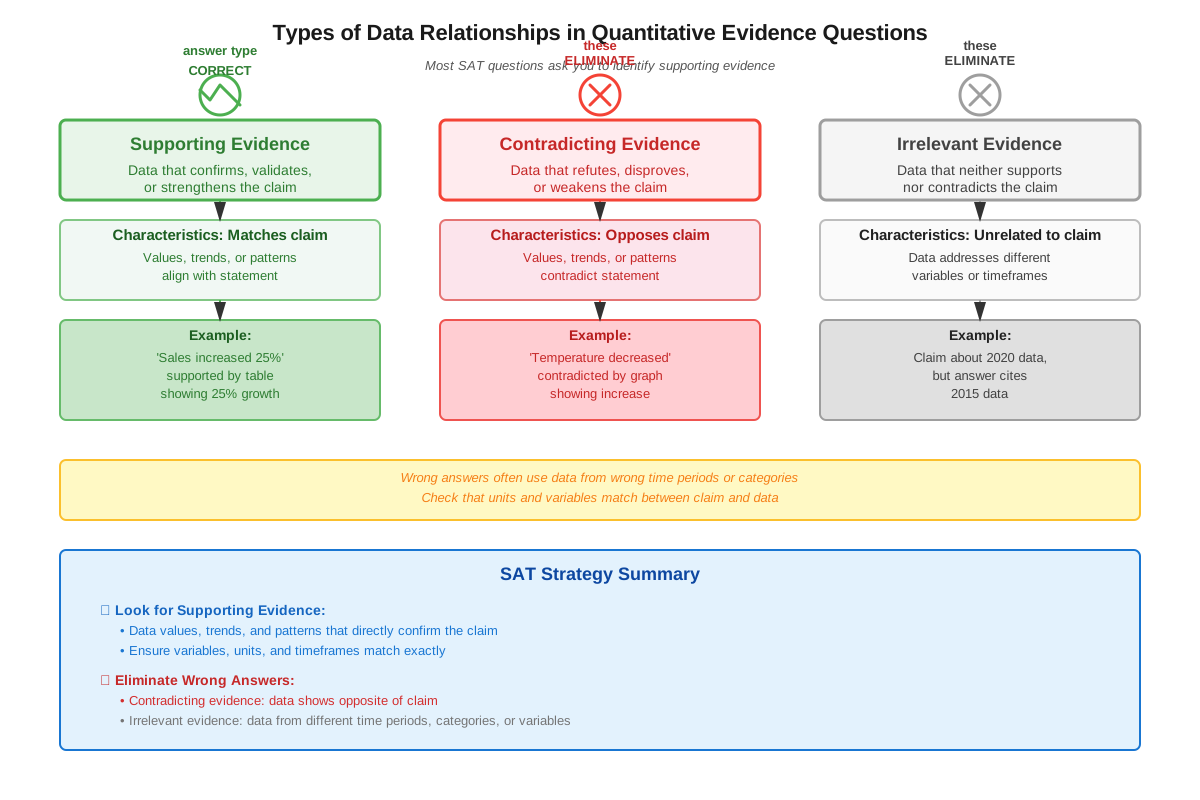
- [ ] Distinguish between data that supports, contradicts, or is irrelevant to a given claim
- [ ] Analyze tables and graphs to extract specific numerical values and trends
- [ ] Evaluate multiple answer choices to determine which most accurately represents quantitative data
- [ ] Synthesize information from both textual passages and visual data displays within time constraints
Prerequisites
- Basic graph and table reading skills: Students must be able to identify axes, labels, units, and data points in common visual formats, as quantitative evidence questions require immediate comprehension of data displays.
- Understanding of percentages, ratios, and basic statistics: These mathematical concepts frequently appear in the data presented, and students need to interpret them correctly.
- Familiarity with the SAT Reading and Writing format: Knowledge of the digital SAT structure helps students manage time and expectations when encountering these integrated question types.
- Command of textual evidence questions: Since quantitative evidence questions build on the same evidence-based reasoning skills, understanding how to support claims with textual evidence provides a foundation for working with numerical evidence.
Why This Topic Matters
Quantitative evidence questions reflect the real-world necessity of interpreting data in academic, professional, and civic contexts. In college courses across disciplines—from social sciences to natural sciences, from business to humanities—students regularly encounter research findings presented through tables, graphs, and statistical summaries. The ability to quickly assess whether data supports a claim, identify trends, and draw accurate conclusions is essential for academic success and informed citizenship.
On the SAT, quantitative evidence questions typically appear 2-3 times per Reading and Writing module, making them a consistent and predictable component of the exam. Given that each module contains approximately 27 questions, these questions represent roughly 7-11% of the Reading and Writing section. Because they are highly formulaic and teachable, they represent an excellent opportunity for score improvement—students who master the systematic approach to these questions can reliably earn these points.
These questions commonly appear in passages discussing scientific research, social science studies, economic trends, or historical data. The data displays range from simple two-column tables to more complex bar graphs, line graphs, and scatter plots. The passages are typically 25-75 words long and present a claim or observation that students must connect to the quantitative information provided. Understanding the predictable structure of these questions allows students to develop efficient strategies that save time and increase accuracy.
Core Concepts
Structure of Quantitative Evidence Questions
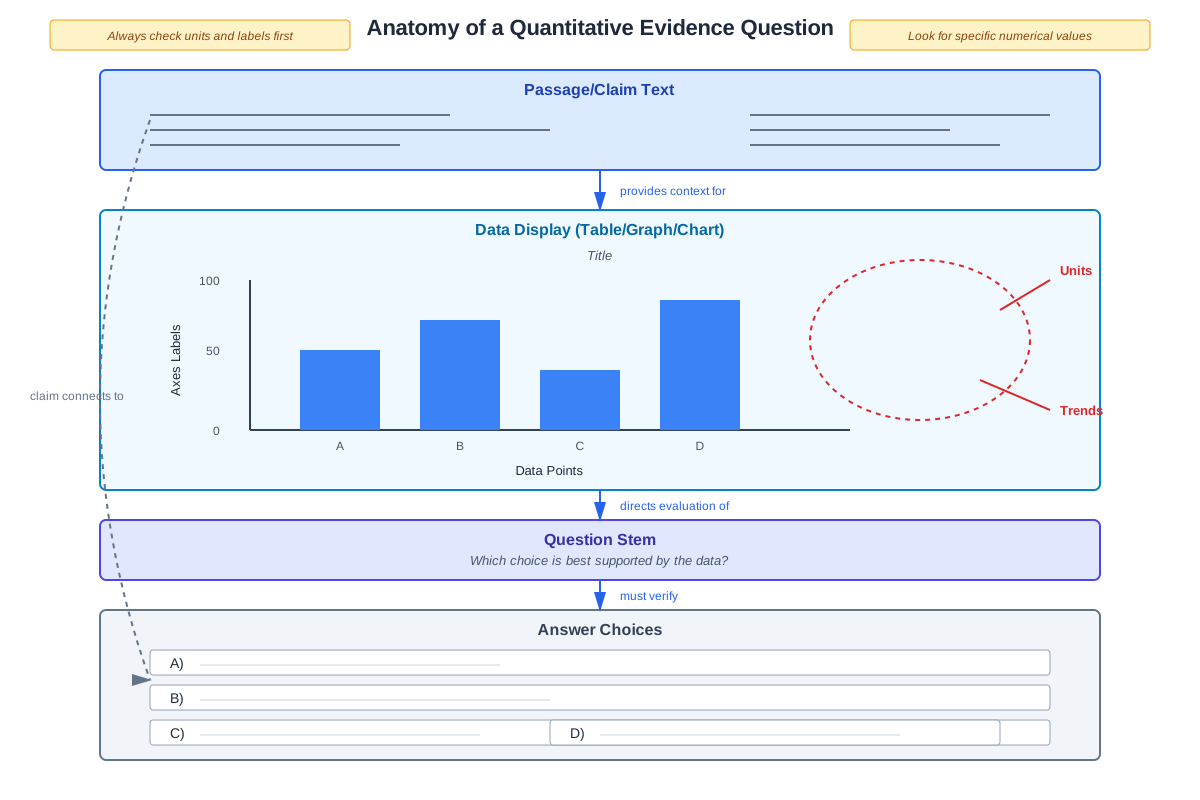
Quantitative evidence questions follow a consistent format that students can learn to recognize immediately. Each question presents three components: a brief passage (usually 1-3 sentences), a data display (table, graph, or chart), and a question stem that asks students to identify which answer choice best uses the data to support, illustrate, or complete a claim from the passage.
The passage typically introduces a topic and makes a claim or presents an incomplete statement. For example, it might state: "Researchers studied the relationship between study time and test scores. According to the data, which statement is most accurate?" The data display then provides the numerical evidence needed to evaluate potential answers.
Types of Data Displays
Students encounter several standard formats for quantitative information on the SAT:
Tables present data in rows and columns, often comparing multiple categories or time periods. Students must locate specific values, compare numbers across rows or columns, and identify the highest, lowest, or most changed values.
Bar graphs display categorical data using rectangular bars of varying heights or lengths. Students need to compare bar heights, identify trends across categories, and determine which category shows the greatest or least value.
Line graphs show changes over time or relationships between continuous variables. Students must identify upward or downward trends, locate maximum and minimum points, and describe the relationship between variables.
Scatter plots display the relationship between two variables using individual data points. Students may need to identify positive or negative correlations, outliers, or general patterns in the data.
Question Types and Tasks
Quantitative evidence questions ask students to perform several distinct tasks:
Supporting a claim: The passage makes a statement, and students must select the answer choice that provides numerical evidence supporting that claim. For example, if the passage states "City A experienced more growth than City B," students must find the answer that accurately presents data showing this relationship.
Completing a claim: The passage presents an incomplete statement, and students must choose the answer that accurately completes it based on the data. The passage might read: "The data indicate that _____," followed by four different conclusions.
Identifying trends: Students must recognize patterns in the data, such as increases, decreases, stability, or cyclical changes, and select the answer that accurately describes these patterns.
Making comparisons: Questions require students to compare values across categories, time periods, or conditions and identify which answer choice correctly represents the comparison.
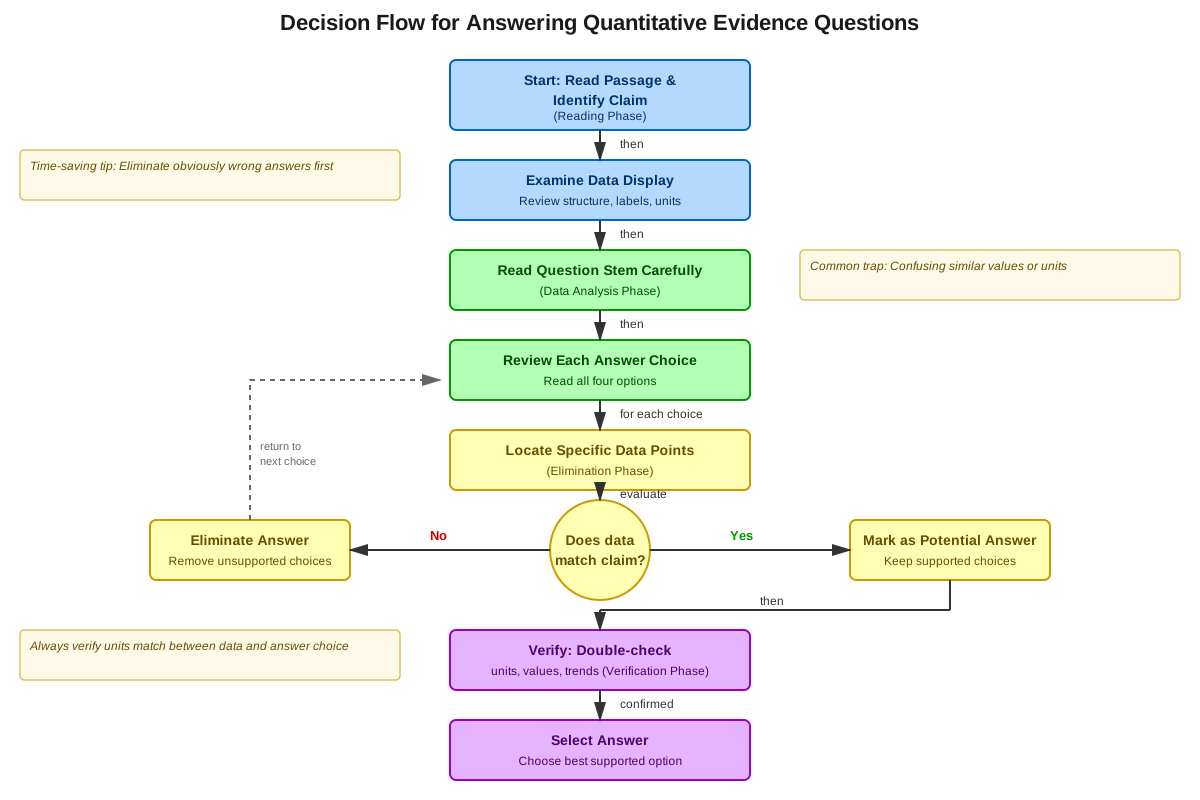
The Four-Step Approach
Successful students develop a systematic approach to quantitative evidence questions:
- Read the passage carefully to understand the claim being made or the information being sought
- Examine the data display to understand what variables are being measured, what units are used, and how the information is organized
- Predict the answer based on the data before looking at the choices
- Evaluate each answer choice against the data, eliminating those that are inaccurate, unsupported, or only partially correct
Common Data Relationships
Students must recognize several types of relationships in quantitative data:
Direct relationships: As one variable increases, another increases proportionally (positive correlation)
Inverse relationships: As one variable increases, another decreases (negative correlation)
No relationship: Changes in one variable show no consistent pattern with changes in another variable
Threshold effects: A relationship exists only above or below a certain value
Categorical differences: Different groups or categories show distinct values or patterns
Precision in Language
The SAT tests whether students can match precise language to precise data. Answer choices often differ in subtle but important ways:
| Imprecise Language | Precise Language |
|---|---|
| "increased significantly" | "increased from 45% to 67%" |
| "was the highest" | "exceeded all other categories by at least 15 points" |
| "showed a trend" | "increased consistently across all five time periods" |
| "were similar" | "differed by less than 3 percentage points" |
Students must select answers that accurately reflect not just the general pattern but the specific numerical relationships shown in the data.
Concept Relationships
Quantitative evidence questions build directly on the foundational skill of textual evidence analysis. Just as students must locate specific sentences or phrases that support claims in traditional reading comprehension questions, they must now locate specific numerical values or patterns that support claims. The core reasoning process—identifying what needs to be proven, finding evidence that proves it, and eliminating evidence that doesn't—remains consistent across both question types.
The relationship flows as follows: Understanding claims → Identifying what evidence would support those claims → Locating that evidence in text OR data → Evaluating whether the evidence truly supports the claim → Selecting the most accurate representation of that evidence.
These questions also connect to data interpretation skills from the SAT Math section, though they require less calculation and more direct reading of values. Students who struggle with quantitative evidence questions in Reading and Writing often benefit from strengthening their graph and table reading skills through math practice, creating a beneficial cross-section synergy.
Within the Command of Evidence unit, quantitative evidence questions represent the intersection of analytical reading and numerical literacy. They prepare students for the synthesis questions that appear later in the test, where multiple sources of information must be integrated to reach conclusions.
High-Yield Facts
- ⭐ Quantitative evidence questions always have one objectively correct answer based solely on the data provided—no interpretation or outside knowledge is required
- ⭐ The correct answer must be supported by specific numerical values or clear patterns visible in the data display
- ⭐ Wrong answers typically make claims that are too broad, too narrow, or directly contradicted by the data
- ⭐ Students should verify every number and comparison in their selected answer against the actual data before confirming their choice
- ⭐ Time management is crucial—these questions should take 45-60 seconds each, as they require careful checking but minimal reading
- Answer choices often differ by a single word or number, requiring precise attention to detail
- The data display always contains all information needed to answer the question—no calculations beyond simple comparisons are required
- Passages are deliberately brief (typically 25-75 words) to focus attention on data interpretation rather than reading comprehension
- Questions never require students to extrapolate beyond the data shown or make predictions about future trends
- The SAT uses standard, clearly labeled data displays—no specialized knowledge of advanced graph types is needed
- Correct answers often mirror the language structure of the passage while inserting specific numerical evidence
- When comparing values, students must pay attention to units (percentages vs. raw numbers, thousands vs. millions)
- The phrase "according to the data" or similar language signals that the answer must be directly verifiable in the display
- Extreme language in answer choices ("always," "never," "only") is often incorrect unless the data shows absolute patterns
Quick check — test yourself on Quantitative evidence questions so far.
Try Flashcards →Common Misconceptions
Misconception: Quantitative evidence questions require complex mathematical calculations.
Correction: These questions require only direct reading of values and simple comparisons. If a student finds themselves performing multi-step calculations, they have likely misunderstood the question. The SAT Reading and Writing section tests data interpretation, not mathematical computation.
Misconception: The correct answer is the one that sounds most sophisticated or uses the most impressive vocabulary.
Correction: The correct answer is the one that most accurately reflects the specific numerical relationships shown in the data, regardless of how it's worded. Simple, precise language that matches the data exactly is better than complex language that overstates or misstates the evidence.
Misconception: If an answer choice is partially correct, it might be the right answer.
Correction: The correct answer must be entirely accurate. If any part of an answer choice is unsupported by or contradicted by the data, the entire choice is wrong. Students must verify every claim in their selected answer.
Misconception: Students should read all answer choices before looking at the data.
Correction: The most efficient approach is to understand the passage, examine the data, predict what the answer should say, and then evaluate the choices. Reading choices first can create confusion and waste time.
Misconception: Trends that appear visually obvious don't need to be verified with specific numbers.
Correction: Visual impressions can be misleading, especially with manipulated axes or scales. Students must always verify their observations with actual numerical values from the data display before selecting an answer.
Worked Examples
Example 1: Table Analysis
Passage: Researchers compared the effectiveness of four different study techniques by measuring student test scores. The results suggest that active recall produced better outcomes than the other methods tested.
Data Display:
| Study Technique | Average Test Score |
|---|---|
| Active Recall | 87 |
| Highlighting | 76 |
| Re-reading | 74 |
| Summarizing | 82 |
Question: Which choice most effectively uses data from the table to support the researchers' conclusion?
Answer Choices:
A) Active recall resulted in an average score of 87, which was higher than all other techniques.
B) Active recall was the most effective technique, with students scoring well above average.
C) Students using active recall scored 87, while those using highlighting scored 76.
D) The data show that active recall is superior to passive study methods.
Solution Process:
Step 1: Identify what needs to be proven—that active recall produced better outcomes than the other methods.
Step 2: Examine the data—Active recall: 87, Highlighting: 76, Re-reading: 74, Summarizing: 82.
Step 3: Predict the answer—The correct choice should state that active recall (87) was higher than all other techniques.
Step 4: Evaluate choices:
- Choice A: States that 87 was higher than all other techniques—this is accurate and complete. ✓
- Choice B: Says "well above average" but doesn't provide specific numbers or comparisons to the other three techniques—too vague.
- Choice C: Only compares active recall to highlighting, ignoring the other two techniques—incomplete.
- Choice D: Introduces the concept of "passive" methods not mentioned in the data and makes a broader claim than the data supports—overgeneralization.
Correct Answer: A
Connection to Learning Objectives: This example demonstrates how to identify the key features of quantitative evidence questions (specific numerical support for claims) and apply systematic analysis to select the most accurate answer.
Example 2: Line Graph Interpretation
Passage: A study tracked the population of monarch butterflies in a nature preserve over five years. According to the data, the population showed a consistent pattern during the study period.
Data Display: [Line graph showing: Year 1: 2,400; Year 2: 2,800; Year 3: 3,100; Year 4: 3,600; Year 5: 4,000]
Question: Which choice most accurately describes the pattern shown in the data?
Answer Choices:
A) The monarch butterfly population remained stable throughout the five-year period.
B) The monarch butterfly population increased each year, reaching 4,000 in Year 5.
C) The monarch butterfly population doubled during the study period.
D) The monarch butterfly population showed the greatest increase between Year 4 and Year 5.
Solution Process:
Step 1: Understand what pattern needs to be described—the overall trend in butterfly population.
Step 2: Examine the data—Year 1: 2,400; Year 2: 2,800 (+400); Year 3: 3,100 (+300); Year 4: 3,600 (+500); Year 5: 4,000 (+400).
Step 3: Identify the pattern—The population increased every single year, starting at 2,400 and ending at 4,000.
Step 4: Evaluate choices:
- Choice A: Claims stability, but the population clearly increased—incorrect.
- Choice B: Accurately states that the population increased each year and reached 4,000 in Year 5—both claims are verifiable. ✓
- Choice C: Claims the population doubled (would need to reach 4,800), but it only increased from 2,400 to 4,000—incorrect.
- Choice D: The greatest increase was actually between Year 3 and Year 4 (+500), not Year 4 and Year 5 (+400)—incorrect.
Correct Answer: B
Connection to Learning Objectives: This example shows how to distinguish between accurate and inaccurate descriptions of trends, demonstrating the importance of verifying every claim against specific data points.
Exam Strategy
Approaching Questions Systematically
When encountering a quantitative evidence question, follow this proven sequence:
- Read the passage first (10 seconds): Understand what claim is being made or what information is being sought.
- Study the data display (15 seconds): Note the title, axes labels, units, and overall structure before looking at specific values.
- Identify the relevant data (10 seconds): Locate the specific numbers, categories, or trends that relate to the passage's claim.
- Predict the answer (5 seconds): Before reading choices, formulate what the correct answer should say.
- Eliminate and verify (20 seconds): Eliminate obviously wrong answers, then carefully verify your selected answer against the data.
Trigger Words and Phrases
Certain language in passages and answer choices provides important clues:
In passages: "According to the data," "The results indicate," "The findings suggest," "Based on the table/graph" all signal that the answer must be directly verifiable in the data display.
In answer choices: Watch for comparative language ("more than," "less than," "higher than," "exceeded"), superlatives ("highest," "lowest," "greatest"), and specific numerical values. The correct answer typically includes precise comparisons or values.
Red flags: Extreme language ("always," "never," "only," "exclusively") should trigger extra scrutiny. While occasionally correct, these words often signal overgeneralization beyond what the data actually shows.
Process of Elimination Tips
Eliminate answer choices that:
- Cite numbers not present in the data: If an answer mentions a value that doesn't appear in the table or graph, it's wrong.
- Make comparisons the data doesn't support: If an answer says "X was greater than Y" but the data shows the opposite or shows them equal, eliminate it immediately.
- Are only partially correct: An answer that correctly states one fact but incorrectly states another is entirely wrong.
- Introduce concepts not in the data: If the data shows test scores but an answer discusses "student satisfaction," it's bringing in outside information.
- Use vague language when specific language is available: If other choices provide specific numbers and one choice uses vague terms like "significantly" or "substantially," the vague choice is likely wrong.
Time Allocation
Quantitative evidence questions should take 45-60 seconds each. They require less reading than standard comprehension questions but demand careful verification. Students who spend more than 75 seconds on these questions should practice the systematic approach to increase efficiency. Conversely, students who rush through in under 40 seconds often make careless errors by not verifying every element of their chosen answer.
Exam Tip: If you're uncertain between two answer choices, write down the specific numbers or comparisons each choice claims, then check each one against the data display. The choice where every single claim checks out is correct.
Memory Techniques
The DIVE Acronym
Remember the four-step approach with DIVE:
- Display: Examine the data display carefully
- Identify: Identify what the passage claims or asks
- Verify: Verify specific numbers and relationships
- Eliminate: Eliminate answers that don't match the data exactly
The "Every Word Matters" Mantra
Create a mental habit: Before confirming an answer, repeat "Every word matters" and check each word in your chosen answer against the data. This prevents the common error of selecting answers that are "mostly right."
Visualization Strategy
When examining tables or graphs, use your finger or pencil (on scratch paper, since the SAT is digital) to physically trace the path from labels to values. This kinesthetic reinforcement helps prevent misreading values or confusing rows and columns.
The Comparison Checklist
For questions involving comparisons, mentally check:
- Which values are being compared?
- How much difference exists between them?
- Are the units the same?
- The direction of the comparison (greater/less)?
The acronym WHAT helps ensure complete comparison verification.
Summary
Quantitative evidence questions on the SAT Reading and Writing section assess students' ability to interpret numerical data presented in tables, graphs, and charts, then select answer choices that accurately represent that data in support of written claims. These questions appear 2-3 times per module and follow a predictable format: a brief passage, a data display, and four answer choices that differ in how accurately they represent the quantitative information. Success requires systematic analysis—reading the passage to understand the claim, examining the data display to locate relevant information, predicting what the correct answer should state, and carefully verifying that the chosen answer matches the data exactly. The most common errors involve selecting answers that are partially correct, that use imprecise language, or that make claims unsupported by the specific numbers shown. Students who master the systematic approach to these questions can reliably earn these points, as quantitative evidence questions have objectively correct answers that require no interpretation or outside knowledge—only careful reading of the data provided.
Key Takeaways
- Quantitative evidence questions test data interpretation skills by requiring students to match numerical evidence to written claims
- These questions always have one objectively correct answer that can be verified directly from the data display
- The systematic approach—understand the claim, examine the data, predict the answer, verify carefully—maximizes accuracy and efficiency
- Correct answers must be entirely accurate; partially correct answers are completely wrong
- Common wrong answers include those that are too vague, make unsupported comparisons, cite incorrect numbers, or overgeneralize beyond the data
- Time management is crucial—aim for 45-60 seconds per question by following the systematic approach
- Every word in the chosen answer must be verifiable against the data; precision in language matching precision in data is essential
Related Topics
Textual Evidence Questions: The foundation for quantitative evidence questions, these questions require students to identify which quotation from a passage best supports a given claim. Mastering textual evidence analysis strengthens the core skill of matching evidence to claims.
Data Interpretation in SAT Math: While the Math section requires more calculation, the fundamental skill of reading graphs and tables accurately applies across both sections. Students struggling with quantitative evidence questions benefit from additional graph-reading practice.
Synthesis Questions: Advanced questions that require integrating information from multiple sources, including both textual and quantitative evidence. Mastering basic quantitative evidence questions prepares students for these more complex synthesis tasks.
Scientific Passage Analysis: Many quantitative evidence questions appear in scientific contexts. Understanding how scientific studies present data and draw conclusions enhances performance on these questions.
Statistical Literacy: While not directly tested through calculation, understanding basic statistical concepts (means, trends, correlations) helps students interpret data displays more effectively and avoid common misinterpretations.
Practice CTA
Now that you understand the structure, strategy, and common patterns of quantitative evidence questions, it's time to apply these skills! Work through the practice questions to reinforce your systematic approach and build confidence. Pay special attention to verifying every element of your chosen answers against the data—this habit will serve you well on test day. Use the flashcards to memorize key strategies and common error patterns. Remember: these questions are highly teachable and predictable, making them an excellent opportunity to improve your score through focused practice. You've got this!
Sign up free to keep reading
Create a free AnvayaPrep account to finish this SAT guide on Quantitative evidence questions — plus flashcards and practice questions.