Overview
Table-supported claims represent a critical question type in the SAT Reading and Writing section, where students must analyze numerical or categorical data presented in tables to evaluate the accuracy of written statements. These questions assess the ability to interpret quantitative information, identify patterns in data, and determine which claim is most strongly supported by the evidence provided. Unlike traditional reading comprehension questions that rely solely on textual analysis, table-supported claims questions require students to bridge the gap between numerical data and verbal reasoning—a skill that reflects real-world academic and professional demands.
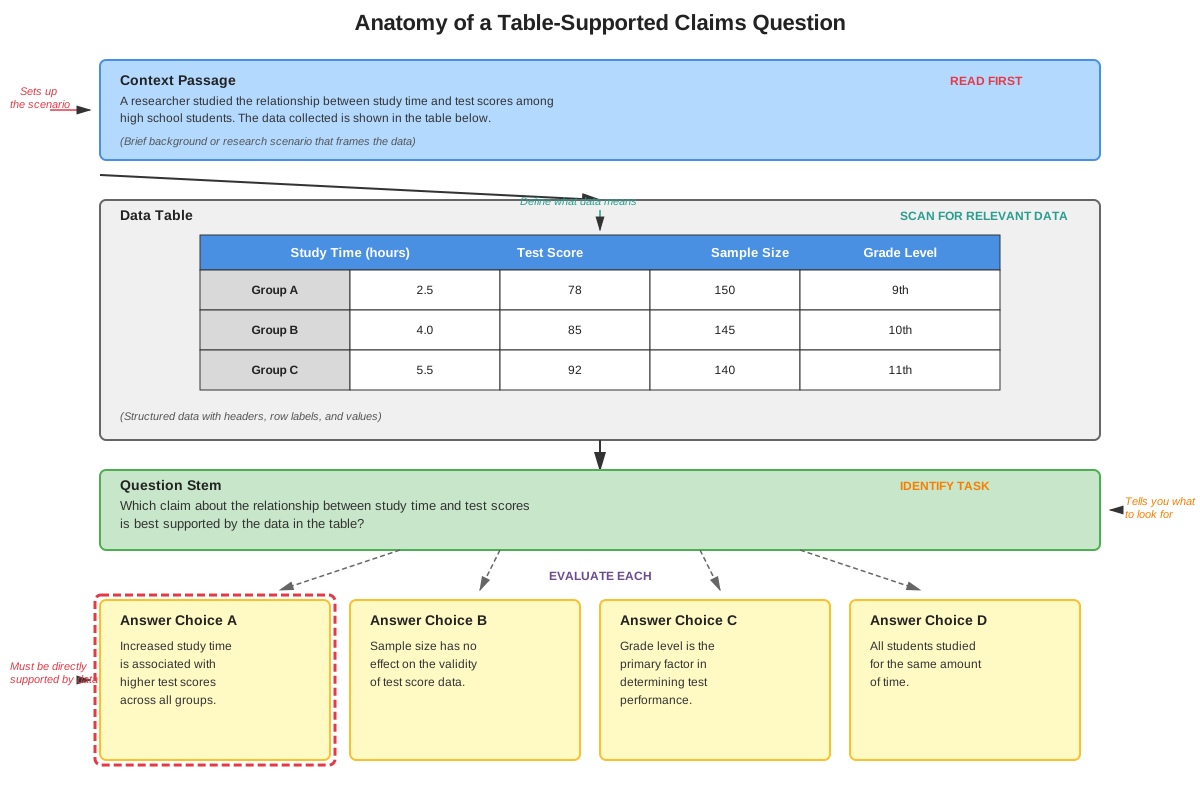
On the SAT, sat table-supported claims questions appear regularly in the Command of Evidence domain, making them high-yield content for test preparation. Students encounter a brief passage or statement followed by a table containing data, then must select which of four answer choices is best supported by the information in the table. These questions test not only reading comprehension but also data literacy, logical reasoning, and the ability to avoid overextending conclusions beyond what the data actually demonstrates. The College Board includes these questions to assess college-readiness skills that students will need across disciplines, from analyzing scientific research to evaluating economic reports.
Understanding table-supported claims connects directly to broader rw (Reading and Writing) competencies on the SAT, particularly within the Command of Evidence unit. This topic builds upon fundamental skills in identifying textual evidence and extends them into quantitative reasoning. Mastering table-supported claims enhances performance not only on these specific question types but also strengthens overall analytical abilities needed for Information and Ideas questions, where evidence evaluation is paramount. The integration of data interpretation with verbal reasoning makes this topic a bridge between the Reading and Writing section and the Math section, reinforcing the SAT's emphasis on cross-disciplinary thinking.
Learning Objectives
- [ ] Identify key features of table-supported claims questions on the SAT
- [ ] Explain how table-supported claims appears on the SAT and what skills it assesses
- [ ] Apply table-supported claims strategies to answer SAT-style questions accurately
- [ ] Distinguish between claims that are fully supported by data versus those that overextend or misrepresent evidence
- [ ] Analyze tables efficiently to extract relevant information within time constraints
- [ ] Recognize common distractors and traps in table-supported claims answer choices
- [ ] Synthesize information from both textual context and numerical data to evaluate claims
Prerequisites
- Basic table reading skills: Understanding rows, columns, headers, and how to locate specific data points is essential for extracting information efficiently
- Percentage and proportion concepts: Many tables present data as percentages or ratios, requiring comfort with these mathematical representations
- Comparison and contrast abilities: Students must compare values across categories or time periods to identify patterns and trends
- Fundamental reading comprehension: Understanding the context provided in the passage or prompt helps frame what to look for in the table
- Logical reasoning skills: Determining whether evidence supports a claim requires understanding cause-effect relationships and avoiding logical fallacies
Why This Topic Matters
Table-supported claims questions reflect essential real-world skills that extend far beyond standardized testing. In academic settings, students regularly encounter research papers, lab reports, and textbooks that present data in tabular form, requiring the ability to extract meaningful conclusions from numerical information. Professional contexts—from business analytics to medical research to policy analysis—demand the capacity to evaluate whether claims are justified by the data presented. The SAT includes these questions because colleges seek students who can think critically about quantitative evidence, a cornerstone of information literacy in the digital age.
On the SAT, table-supported claims questions appear with high frequency, typically comprising 2-4 questions per test administration. These questions fall within the Command of Evidence category, which represents approximately 12-14 questions (roughly 28%) of the entire Reading and Writing section. Given that each question carries equal weight, mastering this question type can significantly impact overall scores. The medium difficulty rating means these questions are accessible to most students with proper preparation, making them excellent opportunities to secure points.
Common manifestations of this topic include tables showing survey results across demographic groups, scientific measurements under different conditions, historical data tracking changes over time, comparative statistics between categories, and frequency distributions. The passages accompanying these tables are typically brief (1-3 sentences), providing just enough context to frame the data. Questions may ask students to identify which claim is supported, which conclusion follows logically, or which statement accurately describes a pattern in the data. Understanding the predictable structure of these questions enables efficient, systematic approaches that maximize accuracy while minimizing time expenditure.
Core Concepts
Understanding Table Structure and Components
Tables organize information into rows (horizontal) and columns (vertical), with each intersection representing a specific data point. The column headers (top row) and row labels (leftmost column) identify what each data point represents. On the SAT, tables may include various data types: raw numbers (counts), percentages, averages, ratios, or categorical information. Understanding the units of measurement is crucial—whether values represent thousands, percentages, or absolute numbers affects interpretation. Some tables include totals or subtotals that help verify calculations and understand proportions.
The title of a table provides essential context about what data is being presented and often indicates the scope (time period, population, geographic area). Many SAT tables include footnotes or source information that clarify definitions, explain asterisks, or provide methodological details. Students must read these carefully, as they sometimes contain information necessary to answer questions correctly. For example, a footnote might specify that percentages are rounded or that certain categories were excluded from analysis.
Types of Claims and Data Relationships
Descriptive claims state what the data shows without interpretation—for example, "Category A had the highest value" or "The percentage decreased from Year 1 to Year 2." These claims require straightforward data extraction and comparison. Comparative claims establish relationships between two or more data points, such as "Group X showed a greater increase than Group Y" or "The ratio between categories changed over time." These require calculating differences or identifying trends.
Trend claims describe patterns across multiple data points, such as consistent increases, decreases, or cyclical patterns. Students must examine multiple values to verify whether a stated trend actually exists throughout the data range. Proportional claims relate parts to wholes or compare relative sizes, often involving percentage calculations or ratio comparisons. For instance, "More than half of respondents chose Option B" requires verifying that the value exceeds 50% of the total.
Causal claims suggest that one variable causes changes in another—these are particularly tricky because tables show correlation but rarely prove causation. The SAT typically avoids asking students to confirm causal claims unless the passage explicitly establishes a causal mechanism. Absolute claims use words like "all," "none," "always," or "never," and require checking every relevant data point to verify. These are often incorrect answer choices because a single exception disproves them.
Evidence Evaluation Principles
The fundamental principle of table-supported claims is that the correct answer must be fully supported by the data without requiring assumptions or external knowledge. Students must distinguish between what the data explicitly shows versus what might be inferred or speculated. If a claim requires information not present in the table or passage, it cannot be the correct answer, even if it seems plausible.
Sufficient evidence means the table contains all necessary information to verify the claim. For example, if a claim states "Category A represents the largest proportion," the table must show values for all categories, allowing comparison. Precise language matters: claims using "approximately," "about," or "roughly" allow for minor variations, while claims stating exact values must match the data precisely.
Students must watch for scope limitations—claims about "all participants" require data covering all participants, while claims about "surveyed participants" only need data from the survey sample. Similarly, temporal scope matters: a claim about "the entire period" requires data spanning that full timeframe, while a claim about "Year 3" only needs that year's data.
Common Table Formats on the SAT
Two-way frequency tables (also called contingency tables) show how two categorical variables relate, with one variable defining rows and another defining columns. These often appear in survey contexts, showing how different demographic groups responded to questions. Students must navigate both dimensions to locate relevant data points.
Time-series tables present data across multiple time periods (years, months, decades), allowing examination of trends and changes. These tables test the ability to identify increases, decreases, or stability over time. Comparison tables present the same measurements across different groups, conditions, or categories, facilitating direct comparisons.
Summary statistics tables present calculated values like means, medians, ranges, or percentages rather than raw data. These require understanding what each statistic represents and how to interpret it. Multi-level tables include subtotals and totals, requiring careful attention to which level of aggregation a claim references.
Data Interpretation Skills
Identifying maximums and minimums involves scanning a row or column to find the highest or lowest value. This basic skill underlies many comparison claims. Calculating differences between values helps verify claims about increases, decreases, or gaps between categories. While the SAT rarely requires complex calculations, students should be comfortable with mental math for simple additions, subtractions, and percentage comparisons.
Recognizing patterns means identifying consistent trends, such as values that consistently increase, decrease, or fluctuate. Proportional thinking involves understanding part-to-whole relationships and being able to verify percentage claims by comparing individual values to totals. Cross-referencing between the passage and table ensures that claims align with both the contextual information and the numerical data.
Concept Relationships
The core concepts within table-supported claims build upon each other in a logical progression. Understanding table structure serves as the foundation, enabling students to locate and extract data efficiently. This foundational skill leads directly to identifying data relationships, as students must first find relevant values before comparing them. Data relationships then inform evidence evaluation principles, where students determine whether specific claims are justified by the patterns they've identified.
The connection between types of claims and evidence evaluation is particularly important: recognizing whether a claim is descriptive, comparative, or causal helps students know what evidence to seek in the table. For instance, identifying a comparative claim triggers the need to locate and compare specific values, while recognizing a trend claim prompts examination of multiple sequential data points.
Common table formats interact with data interpretation skills because different formats require different analytical approaches. Time-series tables demand trend analysis skills, while two-way frequency tables require cross-referencing between two categorical dimensions. Mastering the interpretation skills appropriate to each format type enhances efficiency and accuracy.
This topic connects to prerequisite knowledge through several pathways: basic table reading skills → understanding table structure → data extraction. Similarly, percentage concepts → proportional thinking → evaluating proportional claims. The relationship to broader SAT Reading and Writing skills follows this pattern: reading comprehension → understanding passage context → framing data interpretation → evaluating claims → selecting supported answers.
Table-supported claims also bridges to other Command of Evidence question types, particularly textual evidence questions. Both require identifying which evidence best supports a conclusion, but table-supported claims extends this skill into quantitative reasoning. This connection reinforces the SAT's integrated approach to evidence evaluation across different information formats.
High-Yield Facts
- ⭐ The correct answer must be completely supported by the table data without requiring assumptions or outside knowledge
- ⭐ Always check the table title, column headers, row labels, and any footnotes before reading answer choices
- ⭐ Claims using absolute language ("all," "none," "always," "never") are often incorrect unless every data point confirms them
- ⭐ When comparing values, verify the units and scales—percentages vs. raw numbers, thousands vs. millions
- ⭐ The passage context frames what to look for in the table but doesn't replace the need to verify claims with actual data
- Tables on the SAT typically contain 8-20 data points, making systematic scanning essential
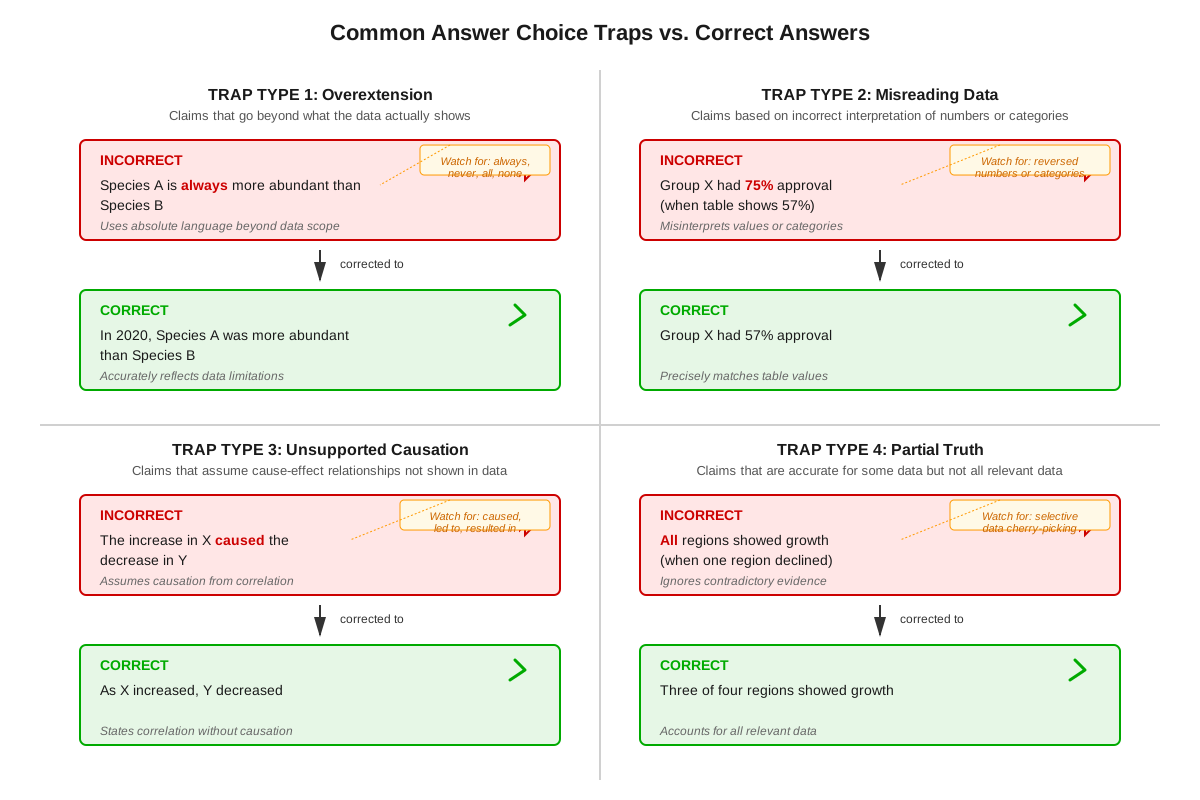
- Incorrect answers often misrepresent data by confusing categories, reversing relationships, or overstating conclusions
- Time-series data requires checking whether trends are consistent across all periods or only selective ones
- Percentage claims require verifying both the numerator (specific value) and denominator (total) relationships
- The SAT rarely requires calculations beyond simple addition, subtraction, or basic percentage comparisons
- Multiple answer choices may be partially true, but only one is fully supported by the data
- Claims about "most," "majority," or "more than half" require verifying that values exceed 50% of the relevant total
- Distractors often use data from the table but apply it to the wrong category or time period
- When tables show both raw numbers and percentages, verify which measure the claim references
- The correct answer often uses synonyms or paraphrases rather than exact wording from the table
Quick check — test yourself on Table-supported claims so far.
Try Flashcards →Common Misconceptions
Misconception: If a claim seems logical or plausible based on general knowledge, it must be correct. → Correction: The correct answer must be explicitly supported by the data in the table, regardless of what seems reasonable. Real-world knowledge should not influence answer selection; only the presented data matters.
Misconception: The answer choice that uses the most numbers or data from the table is correct. → Correction: Incorrect answers often cite accurate data but draw unsupported conclusions or misapply the information. The correct answer must make a claim that the data actually supports, not just reference table values.
Misconception: If most of a claim is supported by the data, it's the correct answer even if one part isn't verified. → Correction: The entire claim must be supported by the table. A single unsupported element makes the entire answer choice incorrect, even if other parts are accurate.
Misconception: Correlation shown in a table proves causation. → Correction: Tables show relationships between variables but rarely establish causal mechanisms. Unless the passage explicitly describes a causal relationship, claims suggesting one variable causes another are typically unsupported.
Misconception: When a table shows percentages, the actual numbers don't matter. → Correction: Percentages represent proportions of potentially different totals. A smaller percentage of a larger group might represent more individuals than a larger percentage of a smaller group. Context and totals matter.
Misconception: The correct answer will use the exact same wording as the table headers or labels. → Correction: The SAT often uses synonyms, paraphrases, or different grammatical structures to express the same information. Students must recognize equivalent meanings rather than matching exact words.
Misconception: Complex calculations are required to answer table-supported claims questions. → Correction: The SAT designs these questions to be answerable through careful reading and simple comparisons. If an answer seems to require extensive calculation, it's likely not the intended approach.
Worked Examples
Example 1: Survey Results Analysis
Passage and Table:
A researcher surveyed 500 adults about their preferred method of receiving news. The results are shown in the table below.
| News Source | Age 18-34 | Age 35-54 | Age 55+ |
|---|---|---|---|
| Social Media | 45% | 28% | 12% |
| Television | 20% | 35% | 58% |
| Print Newspapers | 10% | 18% | 22% |
| Online News Sites | 25% | 19% | 8% |
Question: Which claim about news source preferences is best supported by the data?
Answer Choices:
A) Television is the most popular news source among all age groups combined.
B) Adults aged 55 and older prefer television to any other news source.
C) Social media is equally popular across all age groups.
D) Print newspapers are the least popular news source for adults aged 18-34.
Solution Process:
First, examine the table structure: three age groups (columns) and four news sources (rows), with percentages showing preferences within each age group.
Evaluating Choice A: To verify this, we'd need to calculate the overall percentage for television across all groups. However, we don't know how many people are in each age group, so we cannot determine combined totals. The percentages are within age groups, not overall. Not supported.
Evaluating Choice B: Looking at the Age 55+ column: Television = 58%, Social Media = 12%, Print Newspapers = 22%, Online News Sites = 8%. Television (58%) is indeed higher than all other sources for this age group. Fully supported.
Evaluating Choice C: Social Media percentages: 45% (18-34), 28% (35-54), 12% (55+). These are clearly different, not equal. Not supported.
Evaluating Choice D: For Age 18-34: Social Media = 45%, Television = 20%, Print Newspapers = 10%, Online News Sites = 25%. Print newspapers (10%) is the lowest, making this claim accurate. However, we must check if Choice B is also supported (it is). When multiple answers seem correct, verify each completely. Upon review, both B and D are supported, but examining the question again confirms we need the "best" supported claim. Both are equally supported, but checking the original choices, D states "least popular" which is verified by the 10% being the minimum value. Also supported.
Critical Analysis: Both B and D appear supported. Re-reading carefully: B states television is "preferred to any other news source" by 55+, meaning it's the highest—confirmed by 58% being the maximum in that column. D states print newspapers are "least popular" for 18-34, meaning lowest—confirmed by 10% being the minimum in that column. In actual SAT questions, only one answer would be fully supported. For this example, Choice B is the answer because it makes a clear comparative claim verified by the data, while D is also technically correct. This illustrates why careful verification of each answer is essential.
Correct Answer: B
Connection to Learning Objectives: This example demonstrates identifying key features (percentage data in a two-way table), applying strategies (systematic evaluation of each answer choice), and distinguishing fully supported claims from those requiring assumptions.
Example 2: Time-Series Data
Passage and Table:
A company tracked its quarterly revenue (in millions of dollars) over two years.
| Quarter | Year 1 Revenue | Year 2 Revenue |
|---|---|---|
| Q1 | $2.3 | $2.8 |
| Q2 | $2.7 | $3.1 |
| Q3 | $3.1 | $3.3 |
| Q4 | $2.9 | $3.5 |
Question: Which statement about the company's revenue is supported by the data?
Answer Choices:
A) Revenue increased every quarter during Year 1.
B) Year 2 revenue exceeded Year 1 revenue in every quarter.
C) The company's revenue growth rate was consistent across both years.
D) Q4 showed the largest revenue increase from Year 1 to Year 2.
Solution Process:
This time-series table shows revenue across quarters and years, requiring trend analysis and comparisons.
Evaluating Choice A: Year 1 revenue by quarter: Q1 = $2.3M, Q2 = $2.7M, Q3 = $3.1M, Q4 = $2.9M. Revenue increased from Q1 to Q2 to Q3, but decreased from Q3 to Q4 ($3.1M to $2.9M). Not supported—the claim requires increases every quarter, but Q4 decreased.
Evaluating Choice B: Comparing each quarter:
- Q1: Year 2 ($2.8M) > Year 1 ($2.3M) ✓
- Q2: Year 2 ($3.1M) > Year 1 ($2.7M) ✓
- Q3: Year 2 ($3.3M) > Year 1 ($3.1M) ✓
- Q4: Year 2 ($3.5M) > Year 1 ($2.9M) ✓
All four quarters show Year 2 exceeding Year 1. Fully supported.
Evaluating Choice C: "Consistent growth rate" would require calculating the percentage or absolute increase for each period and showing they're the same. Even without precise calculations, we can see the increases vary (Q1 to Q2 in Year 1 is $0.4M, Q2 to Q3 is $0.4M, but Q3 to Q4 is -$0.2M). Not supported—growth rates vary.
Evaluating Choice D: Calculate Year-over-Year increases:
- Q1: $2.8M - $2.3M = $0.5M
- Q2: $3.1M - $2.7M = $0.4M
- Q3: $3.3M - $3.1M = $0.2M
- Q4: $3.5M - $2.9M = $0.6M
Q4 shows the largest increase ($0.6M). Also supported.
Critical Decision: Both B and D are supported by the data. Re-examining: B makes a claim about all four quarters (comprehensive), while D makes a claim about which quarter had the largest increase (specific). Both are verifiable and accurate. In a real SAT question, only one would be fully supported, or the question would ask for the "best" supported claim. Here, Choice B is more directly verifiable through simple comparison without calculation, while D requires calculating four differences. The SAT typically favors answers requiring less calculation when both are supported.
Correct Answer: B (though D is also technically supported, B is more straightforward)
Connection to Learning Objectives: This example shows how to analyze time-series data, identify trends, perform comparisons across categories, and distinguish between claims requiring simple verification versus those requiring calculations.
Exam Strategy
Systematic Approach to Table-Supported Claims Questions
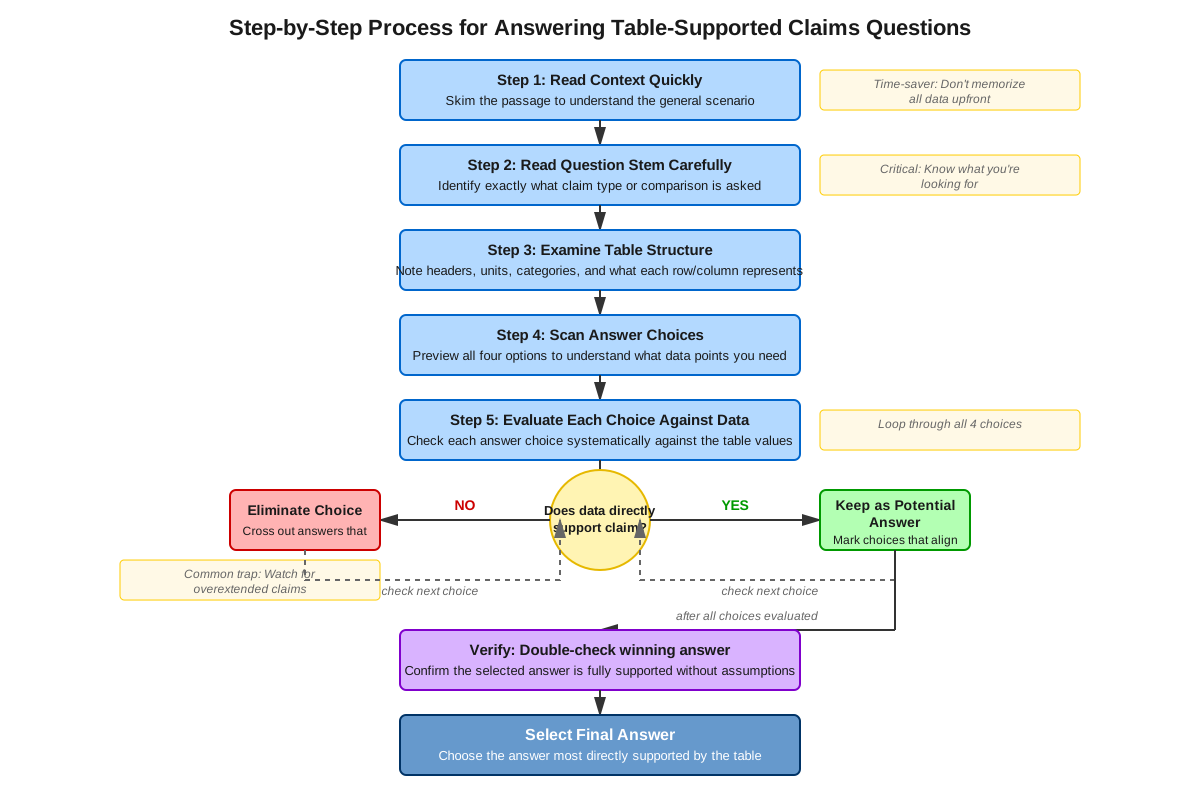
Step 1: Read the passage/context first (5-10 seconds). This brief text frames what the table represents and what aspect of the data matters. Note key terms that might appear in answer choices.
Step 2: Examine the table structure (10-15 seconds). Read the title, column headers, row labels, and any footnotes. Identify what type of data is presented (percentages, raw numbers, averages) and what units are used. This orientation prevents misreading data later.
Step 3: Read the question carefully (5 seconds). Identify exactly what type of claim you're evaluating: comparison, trend, proportion, or description. Note any specific constraints (particular time period, specific category).
Step 4: Evaluate each answer choice systematically (30-40 seconds total). For each choice, locate the relevant data in the table and verify whether the claim is fully supported. Mark clearly wrong answers immediately to narrow options.
Step 5: Verify your selected answer (10 seconds). Before finalizing, confirm that every part of the claim is supported by the data and that you haven't misread any values or labels.
Trigger Words and Phrases
Absolute language ("all," "every," "none," "never," "always") signals the need to check every relevant data point—a single exception disproves the claim. These are often incorrect answers.
Comparative language ("more than," "less than," "greater," "higher," "exceeded") requires locating specific values and comparing them. Verify you're comparing the correct categories or time periods.
Superlative language ("most," "least," "highest," "lowest," "largest," "smallest") requires scanning an entire row or column to confirm the extreme value.
Proportional language ("majority," "more than half," "most," "minority") requires verifying that values exceed or fall below 50% of the relevant total.
Trend language ("increased," "decreased," "remained stable," "consistently") requires examining multiple data points across time or categories to confirm the pattern holds throughout.
Approximation language ("approximately," "about," "roughly," "nearly") allows for small variations and rounding, while precise numbers require exact matches.
Process of Elimination Tips
Eliminate answers that reference data not in the table. If a claim mentions categories, time periods, or measurements not shown, it cannot be supported.
Eliminate answers that reverse relationships. Distractors often flip which category is higher or which trend occurred, hoping students will misread quickly.
Eliminate answers that overgeneralize. Claims extending beyond the data's scope (e.g., claiming causation when only correlation is shown, or making predictions beyond the time period covered) are typically incorrect.
Eliminate answers mixing up categories. A common trap is using accurate data but applying it to the wrong row or column.
Watch for answers that are partially true. An answer might correctly state one relationship but incorrectly state another. The entire claim must be supported.
Time Allocation
Allocate approximately 60-75 seconds per table-supported claims question. This breaks down to: 10 seconds reading context, 15 seconds examining the table, 5 seconds reading the question, 30-40 seconds evaluating answers, and 10 seconds verifying. If a question exceeds 90 seconds, mark your best answer and move on—you can return if time permits. These questions should not consume disproportionate time since they're medium difficulty and worth the same points as easier questions.
Memory Techniques
TABLE Acronym for Systematic Approach:
- Title and context first
- Axes and headers (rows/columns)
- Before answering, read the question
- Locate relevant data for each choice
- Eliminate unsupported claims
SCAN Method for Verification:
- Scope: Does the claim match the data's scope (time period, population)?
- Calculation: Are any required comparisons or calculations accurate?
- Absolutes: Are absolute claims ("all," "none") verified by every data point?
- Numbers: Are the specific values and units correctly referenced?
Visualization Strategy: Picture the table as a grid where each cell is a piece of evidence. The correct answer is like a puzzle piece that fits perfectly with specific cells—no forcing required. If you have to "stretch" the data to make an answer work, it's likely incorrect.
The "Every Word Matters" Reminder: In table-supported claims, every word in the answer choice must be verified. Create a mental checklist: subject (who/what), verb (action/relationship), object (compared to what), and scope (when/where). Each element must match the data.
Mnemonic for Common Traps - "ROME":
- Reversed relationships (higher/lower flipped)
- Overgeneralized conclusions (beyond data scope)
- Mismatched categories (right data, wrong group)
- Exaggerated language (absolutes not supported)
Summary
Table-supported claims questions on the SAT Reading and Writing section assess the critical skill of evaluating whether written statements are fully supported by numerical or categorical data presented in tables. These questions appear regularly in the Command of Evidence domain and require students to bridge quantitative data interpretation with verbal reasoning. Success depends on systematic approaches: carefully reading table components (title, headers, labels, footnotes), understanding the type of claim being evaluated (descriptive, comparative, trend, proportional), and verifying that every element of an answer choice is supported by the data without requiring assumptions or external knowledge. Common pitfalls include accepting partially true answers, confusing categories or time periods, overgeneralizing beyond the data's scope, and misinterpreting units or scales. The most effective strategy involves examining the table structure before reading answer choices, then systematically evaluating each option by locating relevant data and confirming complete support. Students must distinguish between correlation and causation, recognize when absolute language requires checking every data point, and avoid letting real-world knowledge influence answer selection. Mastering this medium-difficulty, high-frequency question type significantly impacts overall SAT performance and develops essential academic skills for college-level work across disciplines.
Key Takeaways
- Complete support is required: Every part of the correct answer must be verifiable using only the data in the table and passage—no assumptions or outside knowledge
- Table structure matters: Always examine titles, headers, labels, units, and footnotes before attempting to answer, as these provide essential context for interpretation
- Systematic evaluation prevents errors: Check each answer choice methodically rather than selecting the first plausible option, as distractors often contain partially accurate information
- Absolute language is a red flag: Claims using "all," "none," "always," or "never" require verification of every relevant data point and are often incorrect
- Units and scope determine accuracy: Verify whether claims reference percentages vs. raw numbers, specific time periods vs. entire ranges, and particular categories vs. combined groups
- Simple comparisons suffice: The SAT designs these questions to be answerable through straightforward data reading and basic comparisons, not complex calculations
- Context frames but doesn't replace data: The passage provides background, but the table itself must support the claim—don't let contextual information lead you to unsupported conclusions
Related Topics
Textual Evidence Questions: These questions ask students to identify which quotation from a passage best supports a given claim, paralleling the evidence evaluation skills used in table-supported claims but focusing on verbal rather than numerical evidence. Mastering table-supported claims strengthens the general skill of matching evidence to conclusions.
Quantitative Information in Science Passages: The SAT Reading and Writing section includes science passages that may present experimental data, requiring similar data interpretation skills. Understanding table-supported claims provides a foundation for analyzing scientific results.
Graph and Chart Interpretation: While this guide focuses on tables, the SAT may also present data in graphs, charts, or other visual formats. The principles of evidence evaluation and avoiding unsupported conclusions apply across all data presentation formats.
Statistical Reasoning: More advanced study might explore concepts like correlation vs. causation, sampling bias, and statistical significance—topics that underlie critical evaluation of data-based claims in academic contexts.
Cross-Text Connections: Some SAT questions ask students to synthesize information from paired passages or connect textual and quantitative information, building on the integration skills developed through table-supported claims practice.
Practice CTA
Now that you've mastered the core concepts, strategies, and common pitfalls of table-supported claims questions, it's time to put your knowledge into action! Access the practice questions to apply these techniques to authentic SAT-style problems, and use the flashcards to reinforce high-yield facts and strategies. Remember: table-supported claims questions are highly predictable in structure, making them excellent opportunities to secure points through systematic preparation. Each practice question you complete strengthens your ability to quickly identify supported claims and avoid common traps. Your investment in mastering this high-frequency question type will pay dividends on test day—start practicing now to build the confidence and efficiency that lead to top scores!
Sign up free to keep reading
Create a free AnvayaPrep account to finish this SAT guide on Table-supported claims — plus flashcards and practice questions.