Overview
Comparing purpose is a critical skill tested in the SAT Reading and Writing section, specifically within the Cross-Text Connections domain. This question type requires students to analyze two related passages and determine how the authors' purposes differ or align. Unlike single-passage questions that focus on comprehension within one text, comparing purpose questions assess the ability to synthesize information across multiple sources and recognize distinct authorial intentions.
On the SAT, sat comparing purpose questions typically present two short passages (50-150 words each) on related topics, followed by a question asking students to identify the relationship between the authors' goals, approaches, or intended effects. These questions test sophisticated reading skills: recognizing rhetorical strategies, understanding implicit purposes, and distinguishing between similar but distinct communicative intentions. Success requires moving beyond surface-level content comprehension to analyze why each author wrote their text and what they hoped to accomplish.
This topic is essential for the RW (Reading and Writing) section because it represents approximately 5-8% of all questions and directly assesses college-readiness skills like critical comparison, analytical thinking, and rhetorical awareness. Mastering comparing purpose questions strengthens overall reading comprehension, enhances the ability to evaluate sources in academic contexts, and builds foundational skills for college-level research and writing. These questions connect to broader SAT concepts including main idea identification, tone analysis, and evidence evaluation, making them a high-yield area for score improvement.
Learning Objectives
- [ ] Identify key features of Comparing purpose
- [ ] Explain how Comparing purpose appears on the SAT
- [ ] Apply Comparing purpose to answer SAT-style questions
- [ ] Distinguish between different types of authorial purposes (inform, persuade, entertain, analyze, critique)
- [ ] Recognize textual evidence that reveals an author's underlying purpose
- [ ] Evaluate answer choices by eliminating options that mischaracterize either passage's purpose
- [ ] Synthesize information from two passages to determine their relationship
Prerequisites
- Main idea identification: Understanding an author's central claim is foundational to determining their broader purpose for writing
- Tone and attitude recognition: Recognizing whether an author is neutral, critical, enthusiastic, or skeptical helps reveal their communicative intent
- Evidence evaluation: The ability to identify which details support specific claims enables students to distinguish purpose from mere content
- Basic rhetorical awareness: Understanding that authors make deliberate choices about structure, language, and emphasis to achieve specific goals
Why This Topic Matters
Real-World Significance
The ability to compare purposes across texts is fundamental to information literacy in the modern world. Students encounter multiple perspectives on the same topic daily—in news articles, social media posts, academic sources, and opinion pieces. Distinguishing whether a source aims to inform objectively, persuade readers to a viewpoint, entertain, or critique existing ideas is essential for making informed decisions, conducting research, and participating meaningfully in civic discourse. This skill transfers directly to college coursework, where students must synthesize multiple sources with different purposes in research papers and analytical essays.
Exam Statistics and Frequency
Comparing purpose questions appear consistently on every SAT administration, typically comprising 2-3 questions per test. These questions fall within the "Cross-Text Connections" category, which represents approximately 13-15% of the Reading and Writing section. The medium difficulty rating reflects that while the passages themselves are accessible, the analytical thinking required to compare purposes accurately challenges many test-takers. Students who master this question type gain a significant competitive advantage, as these questions often separate mid-range scorers from high achievers.
Common Exam Appearances
On the SAT, comparing purpose questions typically present passages that:
- Address the same general topic but from different angles (e.g., one describes a scientific phenomenon while the other argues for policy changes based on that phenomenon)
- Use different rhetorical modes (narrative vs. analytical, descriptive vs. argumentative)
- Represent different genres or contexts (historical document vs. modern commentary, scientific report vs. popular science article)
- Reflect different authorial stances (supportive vs. critical, optimistic vs. cautionary)
Core Concepts
Understanding Authorial Purpose
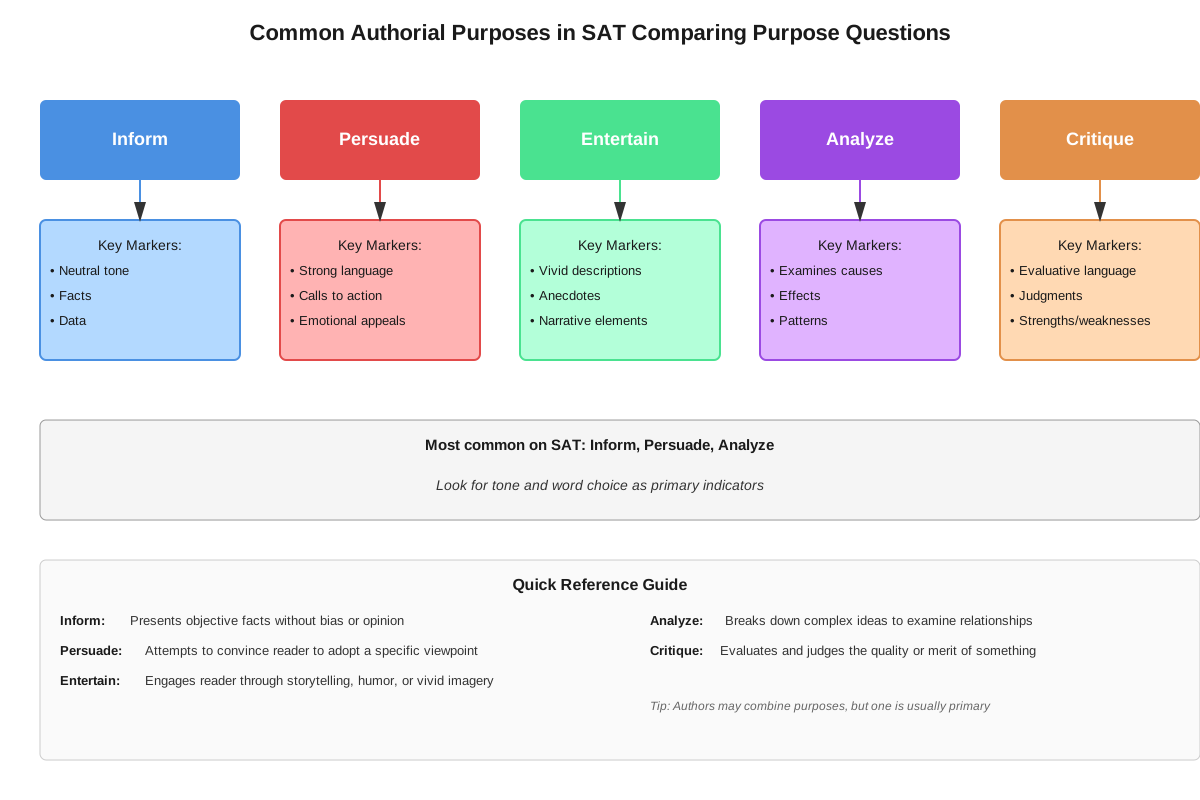
Authorial purpose refers to the reason an author creates a text—the goal they hope to achieve through their writing. On the SAT, recognizing purpose requires looking beyond what a passage says to consider why the author chose to write it. The most common purposes tested include:
- To inform/explain: Presenting factual information, describing processes, or clarifying concepts without advocating for a particular position
- To persuade/argue: Convincing readers to adopt a viewpoint, take action, or change their thinking
- To analyze/evaluate: Examining evidence, breaking down complex ideas, or assessing the merits of different positions
- To critique/challenge: Questioning existing assumptions, identifying flaws in reasoning, or offering alternative perspectives
- To describe/illustrate: Providing detailed observations or examples to help readers visualize or understand something
Distinguishing Purpose from Topic and Main Idea
A critical skill for comparing purpose questions is differentiating between three related but distinct concepts:
| Concept | Definition | Example |
|---|---|---|
| Topic | The general subject matter | "Climate change" |
| Main Idea | The specific point the author makes about the topic | "Climate change is accelerating faster than previous models predicted" |
| Purpose | Why the author is communicating this idea | "To inform readers about recent scientific findings" OR "To persuade policymakers to take immediate action" |
Two passages can share the same topic and even similar main ideas while having fundamentally different purposes. For example, one author might describe climate change impacts to inform readers objectively, while another uses similar information to persuade readers to support specific legislation.
Textual Evidence of Purpose
Authors reveal their purposes through specific textual features:
Language choices:
- Neutral, technical vocabulary suggests an informative purpose
- Emotionally charged language, imperatives, and value judgments indicate persuasive intent
- Questioning phrases and conditional language often signal analytical or evaluative purposes
Structural elements:
- Thesis statements followed by supporting evidence typically indicate argumentative purpose
- Chronological or process-oriented organization suggests explanatory purpose
- Problem-solution structure often reveals persuasive intent
Rhetorical strategies:
- Use of statistics and expert citations without interpretation suggests informative purpose
- Appeals to emotion, ethics, or logic combined with calls to action indicate persuasive purpose
- Presentation of multiple perspectives with comparative analysis suggests evaluative purpose
Types of Purpose Relationships
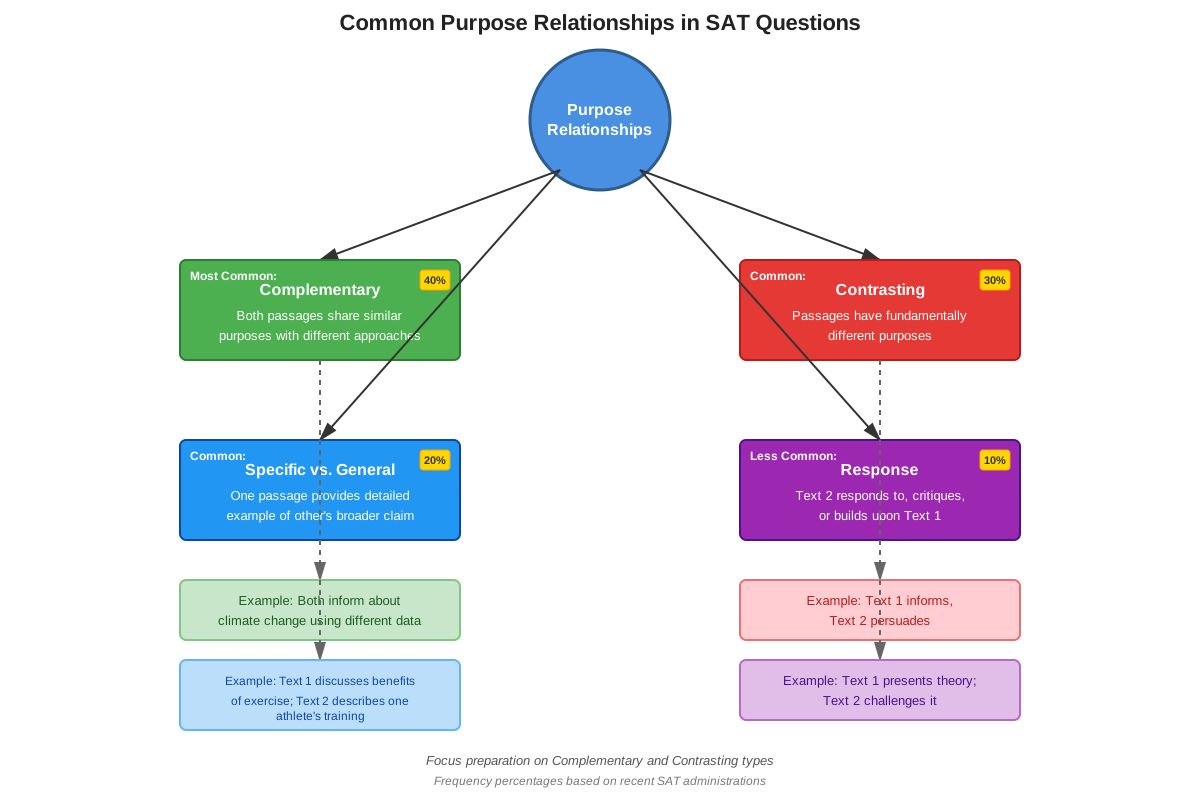
When comparing purposes across two passages, several relationship patterns commonly appear on the SAT:
- Complementary purposes: Both passages share the same general purpose but focus on different aspects (e.g., both inform, but one explains causes while the other describes effects)
- Contrasting purposes: The passages have fundamentally different goals (e.g., Passage 1 informs objectively while Passage 2 argues for a specific position)
- Sequential purposes: One passage provides foundational information while the other builds upon it with analysis or argument (e.g., Passage 1 describes a phenomenon; Passage 2 evaluates its implications)
- Oppositional purposes: Both passages argue, but for different or opposing positions (e.g., both persuade, but advocate for different solutions)
Analyzing Purpose in Cross-Text Questions
The SAT typically frames comparing purpose questions in several ways:
- "The author of Passage 1 would most likely respond to the claim in Passage 2 by..."
- "Unlike Passage 1, Passage 2 primarily serves to..."
- "Both passages share which purpose?"
- "How does the purpose of Passage 2 differ from that of Passage 1?"
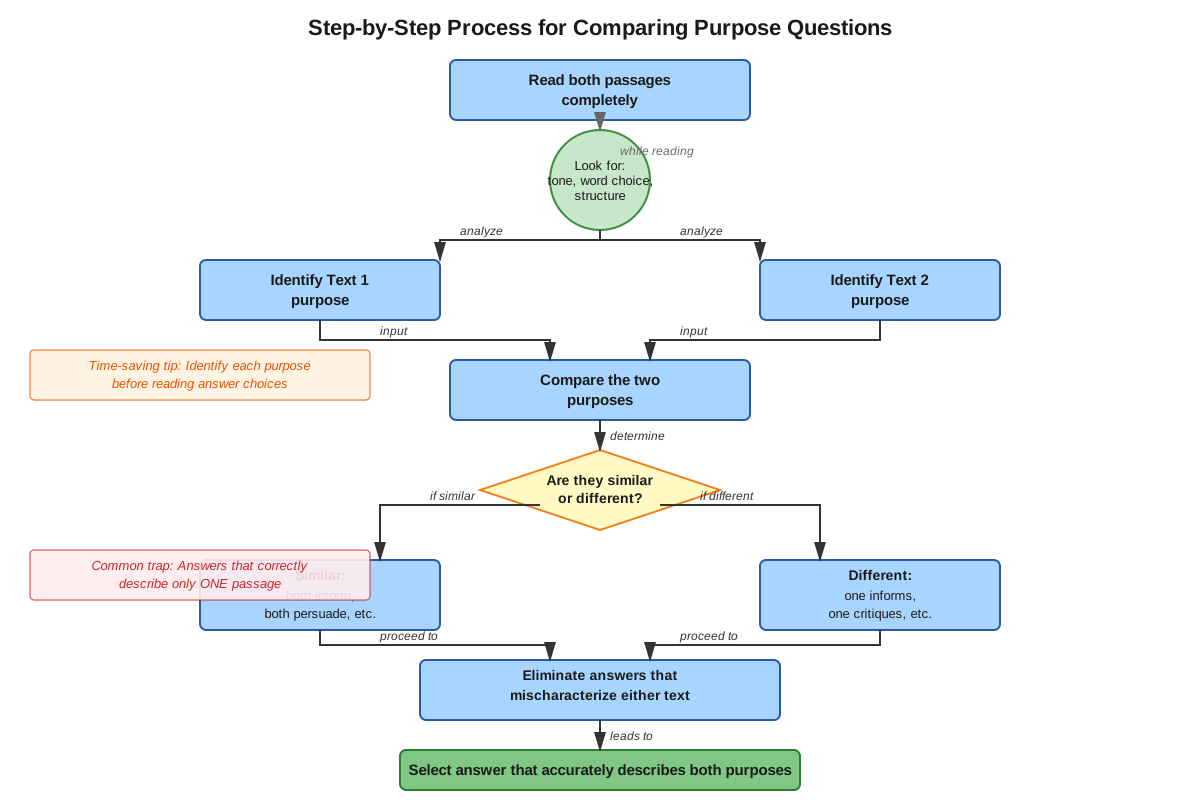
These questions require a two-step process:
- Identify each passage's individual purpose by examining its content, structure, and rhetorical features
- Determine the relationship between these purposes by considering how they complement, contrast, or build upon each other
Common Purpose Indicators
Certain phrases and structural patterns serve as reliable indicators of authorial purpose:
Informative purpose indicators:
- "Research shows...", "Studies indicate...", "The process involves..."
- Definitions, classifications, and explanations
- Neutral presentation of facts without evaluation
Persuasive purpose indicators:
- "We must...", "It is essential that...", "The evidence clearly demonstrates..."
- Rhetorical questions, appeals to values, calls to action
- Emphasis on consequences and urgency
Analytical purpose indicators:
- "When examining...", "Analysis reveals...", "Comparing these approaches..."
- Presentation of multiple perspectives
- Evaluation of strengths and weaknesses
Critical purpose indicators:
- "However, this view overlooks...", "A closer examination reveals flaws..."
- Identification of limitations, contradictions, or oversimplifications
- Proposal of alternative interpretations
Concept Relationships
The skill of comparing purpose builds directly on several foundational reading comprehension abilities. Main idea identification serves as the starting point—students must first understand what each passage says before determining why the author wrote it. This leads to purpose recognition, which requires analyzing how the author presents their main idea. Tone analysis connects closely to purpose, as an author's attitude (objective, passionate, skeptical) often reveals their intent (to inform, persuade, or critique).
Within comparing purpose questions specifically, the concepts flow as follows:
Individual passage analysis → Purpose identification → Cross-text comparison → Relationship determination
Each passage must first be understood independently before meaningful comparison can occur. Students identify textual evidence of purpose in each passage, then synthesize these findings to determine how the purposes relate. This synthesis requires rhetorical awareness—understanding that authors make deliberate choices to achieve specific effects.
The skill also connects forward to more advanced analytical tasks. Mastering comparing purpose strengthens the ability to evaluate sources in research contexts, recognize bias and perspective in media literacy, and construct multi-source arguments in academic writing. These connections make comparing purpose a high-leverage skill that extends well beyond the SAT.
High-Yield Facts
⭐ Comparing purpose questions always require analyzing both passages—never base your answer solely on one passage
⭐ Purpose is about why the author wrote the text, not what the text is about (that's the topic)
⭐ Two passages can discuss the same topic with similar main ideas but have completely different purposes
⭐ Neutral, objective language typically indicates informative purpose; emotionally charged language suggests persuasive purpose
⭐ The presence of a clear argument or thesis statement usually signals persuasive or analytical purpose
- Passages that present problems followed by solutions typically have persuasive purposes
- Descriptive passages that provide detailed observations without evaluation usually aim to inform
- Passages that question existing views or identify limitations typically have critical or analytical purposes
- The structure of a passage (chronological, compare-contrast, problem-solution) provides clues about purpose
- Answer choices that describe only one passage's purpose are always incorrect for comparing purpose questions
- Words like "primarily," "mainly," and "chiefly" in questions signal that you should focus on the dominant purpose, not minor elements
- If one passage presents information and another evaluates that information, their purposes differ even if they agree on facts
- Passages written for different audiences (specialists vs. general public) often have different purposes even on the same topic
Quick check — test yourself on Comparing purpose so far.
Try Flashcards →Common Misconceptions
Misconception: If two passages discuss the same topic, they must have the same purpose.
Correction: Topic and purpose are distinct. Two passages about climate change might have completely different purposes—one could inform readers about scientific findings while another persuades them to support specific policies. Always analyze why each author wrote their text, not just what they wrote about.
Misconception: The passage with more emotional language is always trying to persuade.
Correction: While persuasive passages often use emotional language, some informative passages (particularly narratives or descriptions) may include vivid, emotionally resonant language to help readers understand experiences or phenomena. Evaluate the overall structure and whether the author is making an argument or presenting information.
Misconception: If a passage includes facts and data, its purpose must be to inform.
Correction: Authors use facts and data for multiple purposes. A persuasive passage might cite statistics to support an argument, while an analytical passage might examine data to evaluate competing claims. Consider how the author uses evidence, not just whether evidence is present.
Misconception: The correct answer must mention both passages explicitly.
Correction: While comparing purpose questions require considering both passages, correct answers often describe the relationship implicitly. For example, "Unlike Passage 1, Passage 2 primarily serves to critique..." describes both passages (one doesn't critique; the other does) without explicitly stating both purposes.
Misconception: If passages reach different conclusions, they must have different purposes.
Correction: Two analytical or persuasive passages can have the same type of purpose while reaching different conclusions. The purpose describes the author's goal (to analyze, to persuade), not the specific position they take. Focus on what the author is trying to accomplish, not the content of their conclusion.
Misconception: Longer passages always have more complex purposes than shorter ones.
Correction: On the SAT, passage length doesn't correlate with purpose complexity. A brief passage can have a sophisticated analytical purpose, while a longer passage might simply inform. Evaluate purpose based on textual evidence, not length.
Worked Examples
Example 1: Informative vs. Persuasive Purpose
Passage 1:
The monarch butterfly undergoes a remarkable multi-generational migration spanning up to 3,000 miles. Each fall, monarchs travel from breeding grounds in the United States and Canada to overwintering sites in Mexico. The journey requires multiple generations, with individual butterflies living only 2-6 weeks during the breeding season. However, the final generation of the year, known as the "super generation," can live up to 8 months, enabling them to complete the southward migration and return north the following spring.
Passage 2:
The monarch butterfly's extraordinary migration is under severe threat, and immediate action is required to prevent catastrophic population collapse. Habitat loss has eliminated critical milkweed plants that monarchs depend on for reproduction, while climate change disrupts the precise timing their migration requires. We must establish protected corridors along migration routes and incentivize landowners to plant native milkweed. Without swift intervention, future generations may never witness this natural wonder.
Question: Unlike Passage 1, Passage 2 primarily serves to:
Analysis:
Step 1: Identify Passage 1's purpose
- Uses neutral, descriptive language ("undergoes," "requires," "can live")
- Presents factual information about migration patterns and butterfly lifespans
- No evaluation, argument, or call to action
- Purpose: To inform readers about monarch butterfly migration
Step 2: Identify Passage 2's purpose
- Uses urgent, evaluative language ("severe threat," "catastrophic," "required")
- Presents a problem (threats to monarchs) and solutions (protected corridors, planting milkweed)
- Includes imperatives ("We must") and appeals to values ("natural wonder")
- Purpose: To persuade readers to support conservation efforts
Step 3: Determine the relationship
- Both passages discuss monarch butterflies (same topic)
- Both acknowledge the migration (similar content)
- However, Passage 1 explains the phenomenon objectively while Passage 2 argues for specific actions
- The key difference is purpose: inform vs. persuade
Correct answer: "advocate for conservation measures to protect monarch butterflies"
Connection to learning objectives: This example demonstrates how to identify key features of comparing purpose (neutral vs. urgent language, descriptive vs. argumentative structure) and apply this understanding to distinguish between informative and persuasive purposes.
Example 2: Complementary Analytical Purposes
Passage 1:
Recent studies of ancient Roman concrete reveal why structures like the Pantheon have survived for millennia while modern concrete often deteriorates within decades. Roman concrete incorporated volcanic ash, which reacts with seawater to form rare aluminum-tobermorite crystals. These crystals strengthen the concrete over time, creating a self-healing material. Analysis of samples from Roman harbors shows this crystallization process continuing even after 2,000 years.
Passage 2:
While Roman concrete's durability is impressive, its widespread adoption faces significant practical limitations. The volcanic ash Romans used came from specific Italian deposits, making authentic reproduction geographically constrained. Additionally, Roman concrete requires decades to achieve full strength, whereas modern construction demands materials that cure within days. The economic and logistical challenges of implementing ancient techniques in contemporary large-scale projects may outweigh the longevity benefits.
Question: Both passages primarily serve to:
Analysis:
Step 1: Identify Passage 1's purpose
- Explains a scientific phenomenon (why Roman concrete lasts)
- Presents research findings and mechanisms
- Focuses on describing the process and evidence
- Purpose: To inform readers about the scientific basis of Roman concrete's durability
Step 2: Identify Passage 2's purpose
- Acknowledges the information from Passage 1 ("durability is impressive")
- Identifies limitations and challenges ("significant practical limitations")
- Evaluates feasibility ("may outweigh the longevity benefits")
- Purpose: To analyze the practical applicability of Roman concrete techniques
Step 3: Determine the relationship
- Both passages address Roman concrete (same topic)
- Passage 1 provides foundational information; Passage 2 builds on it with evaluation
- Neither passage simply informs or simply persuades—both engage in analysis
- Passage 1 analyzes how Roman concrete works; Passage 2 analyzes whether it's practical today
- The purposes are complementary: both analytical but focusing on different questions
Correct answer: "examine different aspects of Roman concrete's properties and applications"
Connection to learning objectives: This example shows how two passages can have similar purposes (both analytical) while focusing on different dimensions of the same topic, demonstrating the importance of recognizing nuanced relationships between purposes.
Exam Strategy
Systematic Approach to Comparing Purpose Questions
- Read both passages actively, noting the author's tone, language choices, and structural patterns
- Identify each passage's purpose independently before looking at answer choices
- Ask yourself: "Why did this author write this text? What did they hope to accomplish?"
- Look for purpose indicators: thesis statements, calls to action, neutral vs. evaluative language
- Eliminate answer choices that mischaracterize either passage's purpose
- Verify your answer by confirming it accurately describes both passages' purposes and their relationship
Trigger Words and Phrases
Watch for these question stems that signal comparing purpose questions:
- "Unlike Passage 1, Passage 2..."
- "Both passages primarily serve to..."
- "The author of Passage 1 would most likely respond to Passage 2 by..."
- "How does the purpose of Passage 2 differ from that of Passage 1?"
- "Which statement best describes the relationship between the passages?"
In answer choices, pay attention to purpose verbs:
- Informative: explain, describe, inform, present, illustrate, clarify
- Persuasive: argue, advocate, urge, convince, recommend, propose
- Analytical: analyze, evaluate, examine, assess, compare, investigate
- Critical: critique, challenge, question, refute, dispute
Process of Elimination Tips
Eliminate answers that:
- Describe only one passage's purpose while ignoring the other
- Confuse topic with purpose (e.g., "Both passages discuss climate change" describes topic, not purpose)
- Mischaracterize the tone or intent of either passage
- Focus on minor details rather than the primary purpose
- Use extreme language that doesn't match the passage's tone
Favor answers that:
- Accurately capture the dominant purpose of each passage
- Use purpose-specific verbs that match the textual evidence
- Describe the relationship between purposes, not just the purposes themselves
- Account for the overall structure and rhetorical approach of both passages
Time Allocation
Comparing purpose questions typically require 60-90 seconds:
- 20-30 seconds: Read both passages actively
- 15-20 seconds: Identify each passage's purpose
- 15-20 seconds: Read and evaluate answer choices
- 10-15 seconds: Verify your answer and move on
Don't spend excessive time on these questions—if you've correctly identified each passage's purpose, the answer should become clear quickly. If you're struggling, mark the question and return to it after completing easier questions.
Memory Techniques
The PURPOSE Acronym
Use PURPOSE to remember the analytical steps:
- Passage 1: What's the goal?
- Understand the tone and language
- Recognize structural patterns
- Passage 2: What's the goal?
- Observe how purposes relate
- Select answer matching both
- Eliminate mischaracterizations
The "Why Not What" Reminder
Create a mental association: "Why did they write it, not what did they write about?"
Visualize a signpost with two arrows:
- One pointing to "TOPIC/CONTENT" (what)
- One pointing to "PURPOSE/GOAL" (why)
Always follow the "why" arrow for comparing purpose questions.
Purpose Categories Mnemonic: IPAC
Remember the four main purpose categories with IPAC:
- Inform/Explain
- Persuade/Argue
- Analyze/Evaluate
- Critique/Challenge
When reading each passage, quickly categorize it using IPAC to clarify your thinking.
Visualization Strategy
Picture each author as a person with a specific job:
- Informative author = Teacher presenting facts
- Persuasive author = Lawyer making a case
- Analytical author = Scientist examining data
- Critical author = Reviewer identifying flaws
This personification helps distinguish purposes quickly and intuitively.
Summary
Comparing purpose is a high-yield SAT skill that requires analyzing why authors write texts rather than simply what they write about. Success depends on distinguishing purpose from topic and main idea, recognizing textual evidence that reveals authorial intent, and accurately characterizing the relationship between two passages' purposes. The most common purposes tested include informing, persuading, analyzing, and critiquing, each identifiable through specific language choices, structural patterns, and rhetorical strategies. Effective approach involves independently identifying each passage's purpose before determining their relationship, using purpose-specific vocabulary to evaluate answer choices, and eliminating options that mischaracterize either passage or confuse content with intent. Students who master this skill gain significant advantages on the SAT while developing critical reading abilities essential for college-level work and informed citizenship.
Key Takeaways
- Purpose answers "why" the author wrote the text, not "what" the text is about—this distinction is fundamental to all comparing purpose questions
- Always analyze both passages independently before determining their relationship; never base your answer on just one passage
- Textual evidence of purpose includes language choices (neutral vs. evaluative), structural patterns (descriptive vs. argumentative), and rhetorical strategies (presenting facts vs. making appeals)
- Two passages can share the same topic and similar content while having completely different purposes (e.g., one informs objectively while the other persuades readers to act)
- The four main purpose categories—inform, persuade, analyze, and critique—can be identified through specific indicators in vocabulary, structure, and tone
- Correct answers accurately describe both passages' purposes and their relationship; eliminate options that mischaracterize either passage or focus only on one
- Comparing purpose questions appear 2-3 times per SAT test and represent a high-yield opportunity for score improvement through systematic practice
Related Topics
Main Idea and Central Claims: Understanding how to identify an author's main point provides the foundation for determining their purpose. Mastering comparing purpose enhances the ability to distinguish between what an author says and why they say it.
Rhetorical Analysis: Examining how authors use language, structure, and appeals to achieve their goals deepens understanding of purpose. Students who excel at comparing purpose are well-prepared for more advanced rhetorical analysis.
Evidence and Support: Analyzing how authors use evidence differently (to inform, persuade, or analyze) connects directly to purpose recognition. This skill builds on comparing purpose by examining the relationship between claims and support.
Tone and Attitude: Recognizing an author's tone (objective, passionate, skeptical) often reveals their purpose. These skills reinforce each other, with tone analysis supporting purpose identification.
Cross-Text Synthesis: Comparing purpose is one type of cross-text connection; others include comparing arguments, evaluating evidence across passages, and synthesizing information from multiple sources. Mastering this topic prepares students for all cross-text question types.
Practice CTA
Now that you've mastered the core concepts of comparing purpose, it's time to apply your knowledge! Work through the practice questions to reinforce your understanding and build confidence with SAT-style questions. Use the flashcards to memorize key purpose indicators and relationship patterns. Remember: comparing purpose questions are high-yield opportunities—students who practice systematically see significant score improvements. Each practice question you complete strengthens your ability to analyze authorial intent quickly and accurately, bringing you closer to your target score. You've built the foundation; now practice will make these skills automatic on test day!
Sign up free to keep reading
Create a free AnvayaPrep account to finish this SAT guide on Comparing purpose — plus flashcards and practice questions.