Overview
Comparing tone is a critical skill tested in the SAT Reading and Writing section, particularly within Cross-Text Connections questions. This question type requires students to analyze and contrast the attitudes, perspectives, or emotional qualities conveyed by two different texts on related subjects. Unlike single-passage tone questions, sat comparing tone questions demand that students simultaneously evaluate multiple authors' viewpoints and articulate the relationship between them with precision.
Mastering tone comparison is essential for SAT success because these questions appear consistently on every test administration and require sophisticated reading comprehension skills. Students must move beyond simply identifying what each text says to understanding how each author feels about their subject matter. This involves recognizing subtle linguistic cues—word choice, sentence structure, figurative language, and rhetorical devices—that reveal an author's attitude. The ability to compare tones accurately demonstrates advanced critical reading skills that colleges value highly.
Within the broader RW (Reading and Writing) section, comparing tone connects to multiple competencies: understanding authorial purpose, analyzing rhetorical choices, interpreting connotation and diction, and synthesizing information across texts. These cross-text questions typically appear in the later portions of the Reading and Writing modules, reflecting their higher difficulty level. Success with tone comparison questions builds upon foundational skills in vocabulary, context analysis, and single-text comprehension while requiring the additional cognitive load of holding two distinct perspectives in mind simultaneously and articulating their relationship precisely.
Learning Objectives
- [ ] Identify key features of comparing tone
- [ ] Explain how comparing tone appears on the SAT
- [ ] Apply comparing tone to answer SAT-style questions
- [ ] Distinguish between similar tones using precise vocabulary
- [ ] Recognize linguistic markers that signal specific tones in paired passages
- [ ] Evaluate answer choices for accuracy in describing tonal relationships
- [ ] Synthesize evidence from both texts to support tone comparisons
Prerequisites
- Understanding of basic tone vocabulary: Students must know common tone words (optimistic, critical, objective, enthusiastic, skeptical) to identify and compare authorial attitudes accurately.
- Single-text tone identification: The ability to determine one author's tone provides the foundation for comparing two authors' tones.
- Connotation and denotation: Recognizing the emotional associations of words helps students detect subtle tonal differences between texts.
- Main idea comprehension: Understanding what each text argues or describes is necessary before analyzing how the author feels about that content.
- Context clue analysis: Students need to infer meaning from surrounding text to catch tonal nuances that aren't explicitly stated.
Why This Topic Matters
Comparing tone questions represent a significant portion of Cross-Text Connections items on the SAT, appearing in approximately 10-15% of Reading and Writing questions. These questions carry the same weight as other question types, making them crucial for achieving competitive scores. The College Board specifically designs these questions to assess college-readiness skills: the ability to engage with multiple perspectives, recognize rhetorical sophistication, and synthesize complex information—all skills essential for academic success.
In real-world contexts, the ability to compare tones translates directly to critical media literacy. Students who can distinguish between an enthusiastic product review and a cautiously optimistic one, or between genuinely objective reporting and subtly biased coverage, become more discerning consumers of information. This skill proves invaluable in academic research, where evaluating sources requires understanding not just what scholars say but how they position themselves relative to their subjects and each other.
On the SAT, tone comparison questions typically present two brief passages (50-150 words each) on related topics—perhaps two scientists discussing the same discovery, two historians evaluating the same event, or two critics reviewing the same artistic work. The question stem usually follows a predictable format: "Based on the texts, how would the author of Text 2 most likely respond to the claim in Text 1?" or "Which choice best describes a difference in how the authors of Text 1 and Text 2 view [topic]?" Understanding these patterns helps students approach these questions strategically and efficiently.
Core Concepts
Understanding Tone in Academic Writing
Tone refers to the author's attitude toward their subject matter, revealed through word choice, sentence structure, and rhetorical approach. Unlike mood (which describes the emotional atmosphere created for the reader), tone specifically captures the author's stance. In SAT passages, tones range from highly positive (enthusiastic, admiring, celebratory) to neutral (objective, informative, analytical) to negative (critical, dismissive, skeptical). Recognizing tone requires attention to both explicit statements and implicit signals embedded in language choices.
Academic and informational texts—the primary genres on the SAT—typically employ more restrained tones than creative writing. An author might express strong disagreement through measured language like "this interpretation overlooks crucial evidence" rather than "this idea is completely wrong." Students must develop sensitivity to these subtle gradations, distinguishing between "cautiously optimistic" and "enthusiastically supportive," or between "mildly critical" and "thoroughly dismissive."
Key Linguistic Markers of Tone
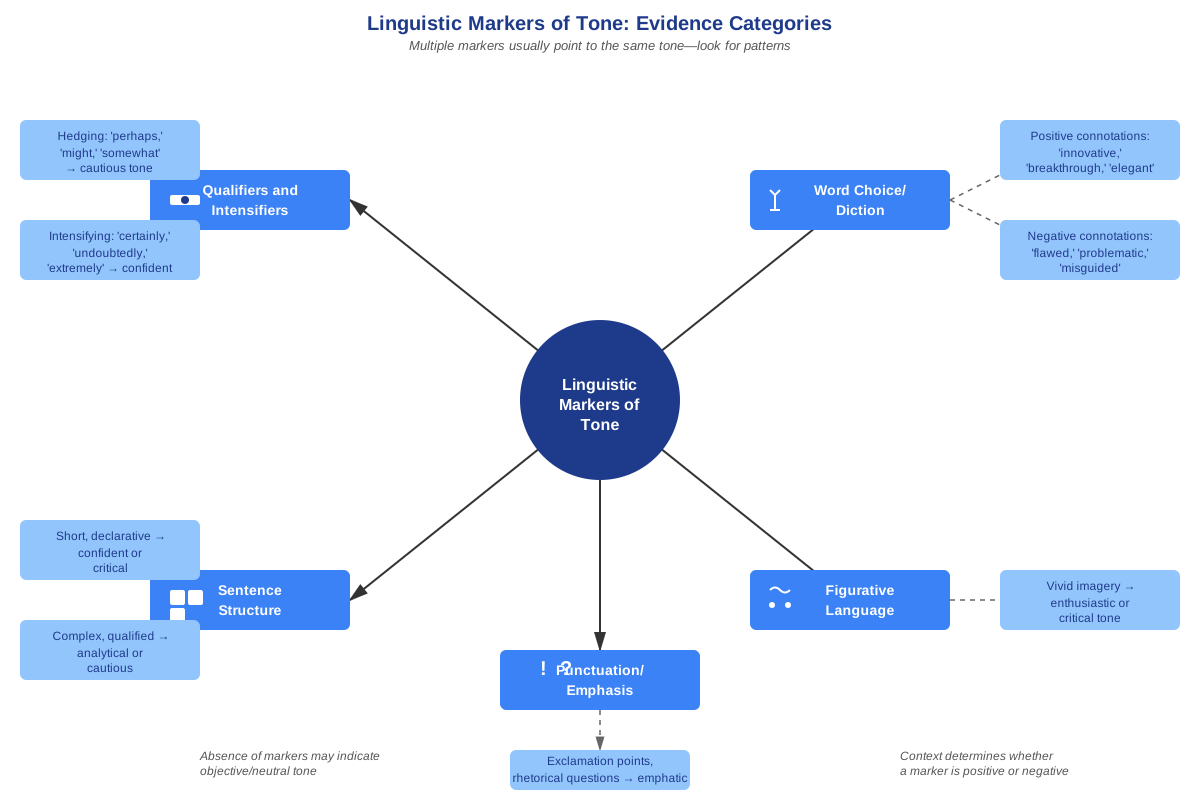
Several linguistic features reliably signal an author's tone:
Diction and word choice: The specific vocabulary an author selects reveals attitude. Compare "the researcher claims" (neutral) versus "the researcher demonstrates" (supportive) versus "the researcher merely asserts" (skeptical). Adjectives and adverbs particularly carry tonal weight: "significant findings" versus "modest findings" versus "groundbreaking findings."
Qualifiers and hedging language: Words like "perhaps," "might," "seems to suggest," and "could indicate" signal caution or uncertainty. Their presence or absence affects tone substantially. An author who writes "this definitively proves" conveys more confidence than one who writes "this tentatively suggests."
Evaluative language: Explicit judgments ("unfortunately," "impressively," "problematically") directly communicate the author's assessment. Even seemingly neutral transitions can carry tonal implications—"however" and "nevertheless" often introduce contrasting or critical perspectives.
Evidence presentation: How authors handle evidence reveals tone. Phrases like "compelling evidence," "overwhelming data," or "conclusive research" indicate strong support, while "limited studies," "preliminary findings," or "anecdotal reports" suggest reservation.
The Comparison Process
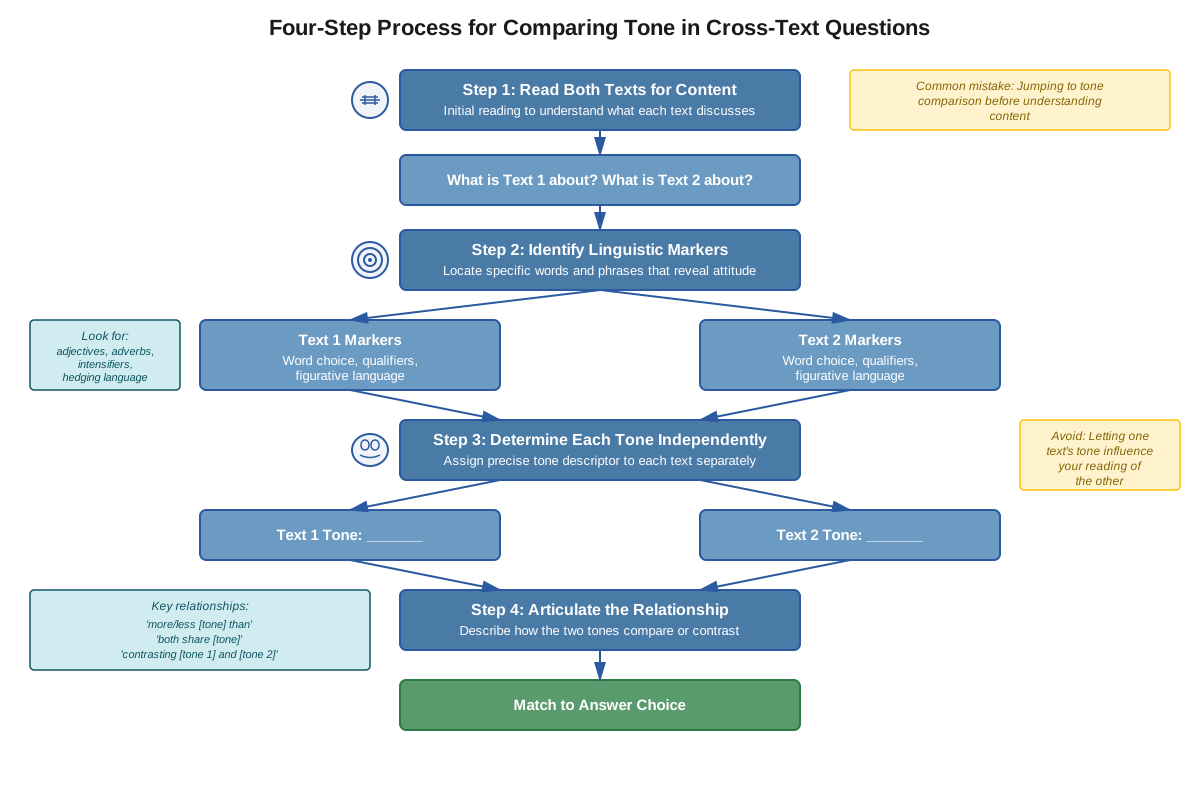
Comparing tones requires a systematic approach:
- Identify each tone independently: Before comparing, determine each author's individual tone using the linguistic markers above
- Locate the specific point of comparison: Identify what aspect both authors address—this might be a shared topic, a specific claim, or a methodological approach
- Determine the relationship: Classify how the tones relate—do they contrast (one positive, one negative), differ in degree (both positive but one more enthusiastic), or align while emphasizing different aspects?
- Match to precise vocabulary: Select answer choices that accurately capture both the individual tones and their relationship
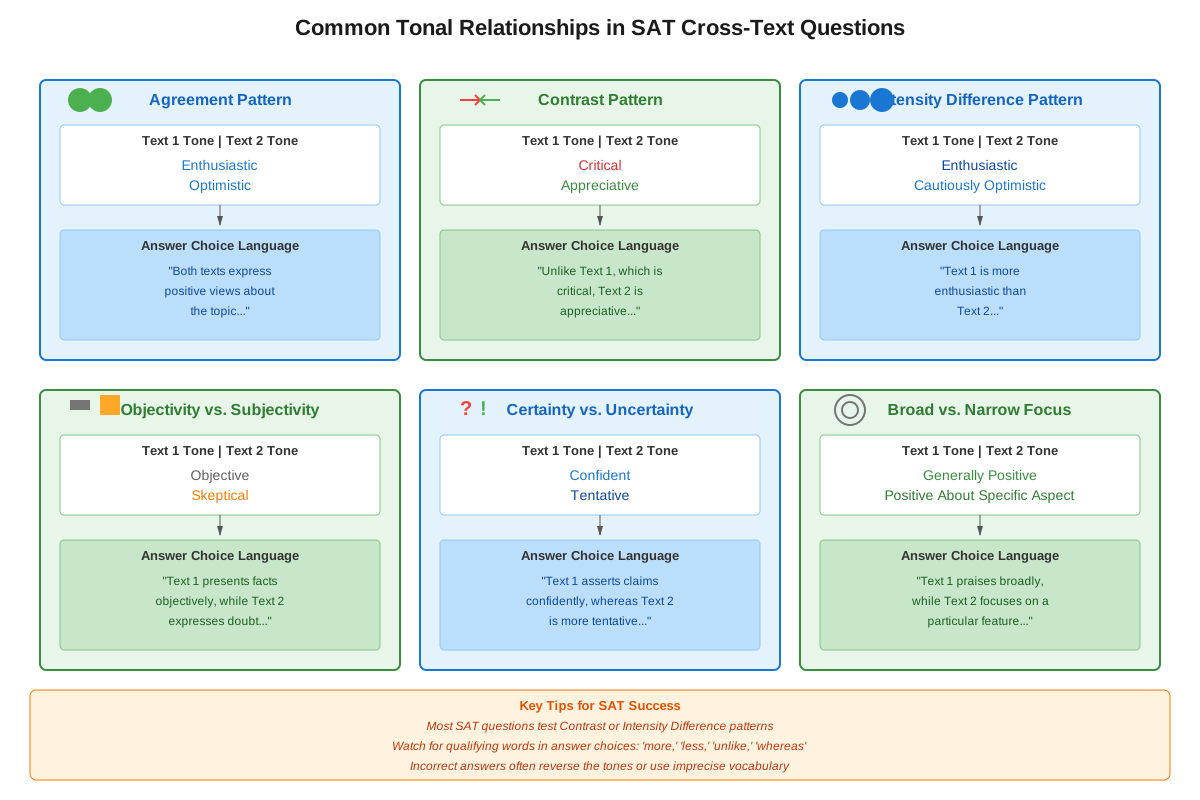
Common Tonal Relationships on the SAT
| Relationship Type | Description | Example Scenario |
|---|---|---|
| Direct contrast | Authors hold opposite attitudes | Text 1 celebrates a policy; Text 2 criticizes it |
| Degree difference | Both share general attitude but differ in intensity | Both support a theory, but Text 1 is cautiously optimistic while Text 2 is enthusiastically supportive |
| Focus difference | Similar overall tone but emphasizing different aspects | Both are analytical, but Text 1 focuses on benefits while Text 2 examines limitations |
| Certainty difference | Authors differ in confidence level | Text 1 presents findings as definitive; Text 2 treats them as preliminary |
| Scope difference | Authors agree on specifics but differ on broader implications | Text 1 acknowledges a discovery's importance; Text 2 considers it revolutionary |
Precision in Tone Vocabulary
The SAT rewards precise tone identification. Understanding nuanced distinctions between similar tone words proves essential:
- Skeptical (doubting claims, questioning validity) versus critical (identifying flaws, offering negative evaluation) versus dismissive (rejecting outright, treating as unworthy of serious consideration)
- Objective (presenting facts without judgment) versus neutral (balanced presentation of multiple views) versus detached (emotionally distant, clinical)
- Enthusiastic (showing excitement and strong support) versus optimistic (hopeful about positive outcomes) versus approving (expressing agreement or endorsement)
- Cautious (proceeding carefully, expressing reservation) versus tentative (uncertain, provisional) versus ambivalent (holding mixed feelings)
Context-Dependent Tone Analysis
Tone doesn't exist in isolation—it emerges from the interaction between content and expression. The same words might convey different tones depending on context. "Interesting findings" could be genuinely appreciative in one context or subtly dismissive (damning with faint praise) in another. Students must consider:
- The author's overall argument and purpose
- The specific claim being discussed
- The broader conversation or debate the text enters
- The genre and expected conventions (scientific writing versus opinion pieces)
Concept Relationships
The core concepts within comparing tone build upon each other hierarchically. Understanding tone in academic writing provides the foundation—students must grasp what tone is and how it differs from related concepts before attempting comparisons. This understanding enables recognizing linguistic markers, the practical skill of identifying specific textual evidence that reveals tone. These markers serve as the raw data for the comparison process, which systematically transforms observations about individual texts into insights about their relationship.
Common tonal relationships and precision in tone vocabulary work together as complementary concepts. Knowing the typical patterns of how tones relate (contrast, degree difference, focus difference) helps students anticipate answer choices and organize their analysis, while precise vocabulary ensures they can articulate these relationships accurately. Both concepts depend on context-dependent tone analysis, which reminds students that tone emerges from the interaction of multiple textual features rather than from isolated words.
These concepts connect to prerequisite knowledge in specific ways: single-text tone identification → comparing tone (applying the same analytical skills to two texts simultaneously); connotation and denotation → linguistic markers of tone (understanding how word choice carries emotional weight); main idea comprehension → context-dependent tone analysis (recognizing how tone serves the author's broader purpose).
The progression flows: Foundational understanding → Evidence identification → Systematic comparison → Precise articulation → Context-aware refinement
High-Yield Facts
⭐ Comparing tone questions always require analyzing TWO texts simultaneously—students must identify each tone independently before determining their relationship.
⭐ The SAT favors subtle tonal differences over extreme contrasts—expect to distinguish between "cautiously optimistic" and "enthusiastically supportive" rather than "positive" versus "negative."
⭐ Qualifiers and hedging language (perhaps, might, seems, could) reliably signal cautious or tentative tones and often distinguish between answer choices.
⭐ Answer choices typically describe relationships using comparative language—watch for "more skeptical than," "less enthusiastic than," or "similarly objective to."
⭐ The correct answer must accurately describe BOTH texts—eliminate choices that correctly characterize one text but misrepresent the other.
- Tone comparison questions typically appear in the Cross-Text Connections portion of the Reading and Writing section, usually in the second half of each module.
- Authors can share the same general attitude (both positive) while differing significantly in degree or focus—these nuanced differences frequently appear in correct answers.
- Evaluative adjectives and adverbs ("unfortunately," "impressively," "merely," "significantly") provide strong evidence for tone and should be noted during reading.
⭐ Objective or neutral tones are characterized by absence of evaluative language—look for purely descriptive or informational content without judgment words.
- The relationship between tones matters more than the absolute tone of each text—focus on how they compare rather than labeling each in isolation.
- Evidence presentation style (how authors discuss research, data, or claims) reveals confidence level and thus tone—"demonstrates" versus "suggests" signals different attitudes.
- Incorrect answer choices often describe plausible tones that don't actually appear in the texts—always verify against specific textual evidence.
- Time markers and verb tenses can signal tone—"will revolutionize" (confident, forward-looking) versus "might eventually contribute" (cautious, uncertain).
- Rhetorical questions in passages often signal skepticism or criticism—authors use them to challenge ideas rather than neutrally present them.
- Parallel structure and repetition can intensify tone—repeated positive or negative terms amplify the author's attitude.
Quick check — test yourself on Comparing tone so far.
Try Flashcards →Common Misconceptions
Misconception: Tone and main idea are the same thing—if two texts discuss the same topic, they have the same tone.
Correction: Tone refers to the author's attitude toward the subject, not the subject itself. Two authors can discuss identical topics with completely different tones (one enthusiastic, one skeptical). Focus on how authors feel about what they're discussing, not just what they're discussing.
Misconception: Longer or more complex vocabulary automatically indicates a more sophisticated or positive tone.
Correction: Vocabulary complexity relates to reading level, not tone. An author can use simple language to express enthusiasm or complex language to express skepticism. Evaluate the connotations and evaluative weight of words, not their length or sophistication.
Misconception: If a text presents both positive and negative information, its tone must be "balanced" or "neutral."
Correction: Presenting multiple perspectives doesn't automatically create neutrality. Examine how the author presents each perspective—do they give equal weight? Do evaluative words favor one side? An author might mention counterarguments only to dismiss them, maintaining a strongly opinionated tone throughout.
Misconception: The author's tone toward their subject is the same as their tone toward other researchers or perspectives mentioned in the text.
Correction: Authors often hold different attitudes toward their own claims versus others' work. An author might be enthusiastic about their research while skeptical of competing theories. Always identify whose perspective or what specific claim the question asks about.
Misconception: Objective writing contains no tone—only opinionated writing has tone.
Correction: "Objective" is itself a type of tone, characterized by neutral, fact-based presentation without evaluative language. All writing has tone; the question is whether that tone is neutral/objective or conveys a particular attitude. Even seemingly neutral texts reveal authorial choices about what to emphasize and how to frame information.
Misconception: If two texts reach the same conclusion, they must have similar tones.
Correction: Authors can agree on conclusions while differing significantly in tone. One might cautiously accept a finding based on limited evidence (tentative tone) while another enthusiastically embraces it as definitive (confident tone). Focus on the certainty level, enthusiasm, and qualifications each author expresses, not just their ultimate position.
Worked Examples
Example 1: Degree Difference in Positive Tone
Text 1:
Recent studies on urban green spaces suggest potential benefits for mental health. Researchers observed modest improvements in reported well-being among participants with regular park access. While these findings are encouraging, the limited sample size and short study duration mean we should interpret results cautiously. Further research could help clarify whether these effects persist over time.
Text 2:
The connection between urban green spaces and mental health represents one of the most significant discoveries in public health research. Compelling evidence demonstrates that park access dramatically improves psychological well-being. These findings should immediately inform urban planning policies worldwide, as green spaces offer a powerful, accessible intervention for mental health challenges.
Question: Based on the texts, how would the author of Text 2 most likely respond to Text 1's characterization of the research findings?
Analysis Process:
Step 1: Identify Text 1's tone independently
- Key phrases: "suggest potential benefits" (tentative), "modest improvements" (qualified), "encouraging" (mildly positive), "should interpret results cautiously" (reserved), "could help clarify" (uncertain)
- Tone: Cautiously optimistic—the author sees promise but emphasizes limitations and uncertainty
Step 2: Identify Text 2's tone independently
- Key phrases: "most significant discoveries" (superlative), "compelling evidence demonstrates" (confident), "dramatically improves" (strong positive), "should immediately inform" (urgent, definitive), "powerful, accessible intervention" (enthusiastic)
- Tone: Enthusiastically supportive—the author expresses strong confidence and excitement
Step 3: Determine the relationship
- Both authors view the research positively (not a direct contrast)
- They differ significantly in degree: Text 1 is reserved and cautious; Text 2 is confident and enthusiastic
- Text 2 would likely view Text 1's caution as excessive given what Text 2 sees as "compelling evidence"
Step 4: Predict answer choice language
The correct answer should indicate that Text 2's author would find Text 1's caution unwarranted or would emphasize the strength of evidence that Text 1 downplays.
Correct answer type: "The author of Text 2 would likely argue that Text 1 understates the significance of the findings" or "Text 2's author would view Text 1's cautious interpretation as overly conservative given the strength of the evidence."
Key takeaway: Both texts are positive, but the dramatic difference in certainty and enthusiasm creates a meaningful contrast that the SAT tests.
Example 2: Focus Difference with Similar Overall Tone
Text 1:
The archaeological discovery at the coastal site has revealed remarkably preserved artifacts from the Bronze Age. The pottery fragments, in particular, display sophisticated decorative techniques that challenge previous assumptions about the technological capabilities of the period. This finding contributes valuable data to our understanding of ancient craftsmanship.
Text 2:
While the coastal site's Bronze Age artifacts are undeniably well-preserved, their discovery raises important questions about site protection and archaeological methodology. The excavation's rushed timeline and limited documentation may have resulted in lost contextual information. Future projects must prioritize systematic recording procedures to maximize the scientific value of such discoveries.
Question: Which choice best describes a difference in how the authors of Text 1 and Text 2 view the archaeological discovery?
Analysis Process:
Step 1: Identify Text 1's tone independently
- Key phrases: "remarkably preserved" (appreciative), "sophisticated decorative techniques" (admiring), "challenge previous assumptions" (intellectually engaged), "valuable data" (positive assessment)
- Tone: Appreciative and intellectually engaged—focuses on the artifacts' significance and what they reveal
Step 2: Identify Text 2's tone independently
- Key phrases: "undeniably well-preserved" (acknowledges positive), "raises important questions" (critical), "rushed timeline" (negative assessment), "may have resulted in lost" (concerned), "must prioritize" (prescriptive, critical)
- Tone: Critical and concerned—acknowledges value but emphasizes methodological problems
Step 3: Determine the relationship
- Both authors recognize the artifacts' quality (both use "preserved")
- Text 1 focuses exclusively on positive aspects: what the artifacts reveal
- Text 2 shifts focus to negative aspects: how the excavation was conducted
- This is a focus difference—Text 1 emphasizes discovery's contributions; Text 2 emphasizes procedural shortcomings
Step 4: Predict answer choice language
The correct answer should indicate that Text 1 focuses on the artifacts' significance while Text 2 focuses on methodological concerns, or that Text 2 is more critical of the excavation process than Text 1.
Correct answer type: "Text 1 emphasizes the discovery's contribution to archaeological knowledge, while Text 2 focuses on concerns about excavation methodology" or "Unlike Text 1, which highlights the artifacts' significance, Text 2 expresses concern about the excavation's procedural limitations."
Key takeaway: Authors can acknowledge the same basic facts while adopting different tones by choosing to emphasize different aspects—one focusing on benefits, the other on limitations.
Exam Strategy
Systematic Approach to Tone Comparison Questions
Step 1: Read both texts actively, marking evaluative language, qualifiers, and strong adjectives/adverbs. Don't try to compare while reading—first understand each text independently.
Step 2: Identify each tone separately using a mental checklist: Is this author positive, negative, or neutral? How strong is their position? What specific words reveal their attitude?
Step 3: Locate the specific comparison point mentioned in the question stem. Are you comparing attitudes toward the same topic, toward each other's claims, or toward different aspects of a shared subject?
Step 4: Predict the relationship before looking at answer choices. Use simple language: "Text 1 is more cautious than Text 2" or "Text 1 focuses on benefits while Text 2 focuses on risks."
Step 5: Eliminate systematically:
- First, eliminate choices that mischaracterize either individual text
- Then, eliminate choices that accurately describe both texts but incorrectly state their relationship
- Finally, select the choice that precisely captures both the individual tones and their relationship
Trigger Words and Phrases
Question stem triggers that signal tone comparison:
- "How would the author of Text 2 most likely respond to..."
- "Which choice best describes a difference in how the authors view..."
- "Based on the texts, the author of Text 1 would most likely consider Text 2's claim to be..."
- "The relationship between Text 1 and Text 2 is best described as..."
Textual triggers for specific tones:
- Skeptical/Critical: "however," "merely," "overlooks," "fails to consider," "questionable," "limited"
- Enthusiastic/Supportive: "remarkable," "significant," "demonstrates," "clearly," "compelling," "breakthrough"
- Cautious/Tentative: "suggests," "might," "could," "preliminary," "potential," "appears to"
- Objective/Neutral: absence of evaluative language, "indicates," "shows," "according to," "the data reveal"
Process of Elimination Tips
Red flag #1: Answer choices using extreme language ("completely dismisses," "entirely agrees," "totally contradicts") are usually incorrect—SAT passages feature nuanced academic tones, not extreme positions.
Red flag #2: Choices that accurately describe one text but use vague or inaccurate language for the other ("Text 1 is skeptical while Text 2 discusses the topic") often appear as distractors—both halves must be precise.
Red flag #3: Choices describing tones that sound plausible but lack textual support ("sarcastic," "humorous," "angry") can be eliminated immediately—verify every tone claim against specific evidence.
Verification strategy: For your selected answer, identify the specific words or phrases in each text that support both the individual tone descriptions and their stated relationship. If you can't find clear evidence, reconsider.
Time Allocation
Spend approximately 90 seconds on tone comparison questions:
- 30 seconds: Read both texts actively, marking key language
- 20 seconds: Identify each tone and their relationship
- 30 seconds: Evaluate answer choices systematically
- 10 seconds: Verify your selection against textual evidence
These questions reward careful analysis more than speed—rushing leads to misreading subtle tonal differences. If you're uncertain, mark the question and return after completing easier items, but don't skip the analysis process.
Memory Techniques
The COMPARE Acronym
Consider each text independently first
Observe evaluative language and qualifiers
Mark the specific comparison point
Predict the relationship before reading choices
Analyze answer choices systematically
Review textual evidence for your selection
Eliminate choices that mischaracterize either text
Tone Spectrum Visualization
Visualize tones on a spectrum from negative to positive, with neutral in the middle:
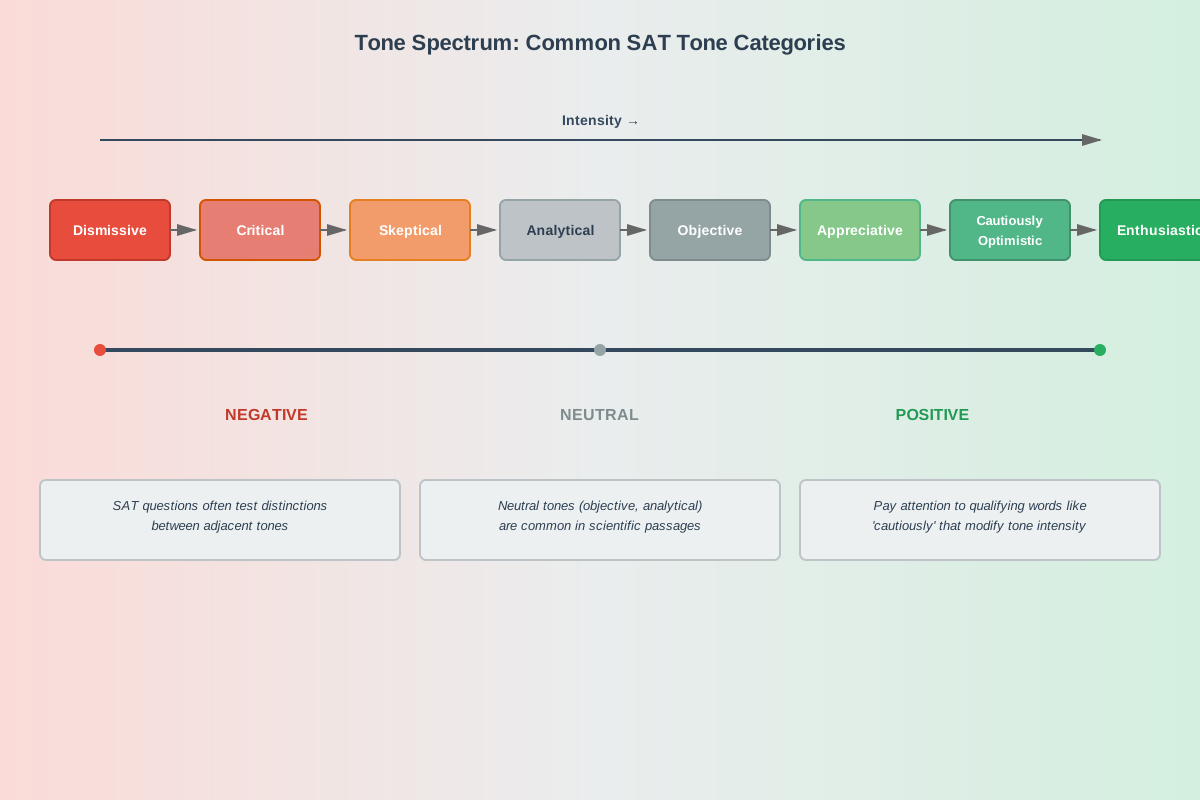
Dismissive → Critical → Skeptical → Cautious → Neutral → Approving → Optimistic → EnthusiasticWhen comparing tones, mentally place each text on this spectrum. The distance between them indicates the degree of difference, while their positions indicate the nature of the difference.
The "Two-Column" Mental Framework
Create a mental two-column chart while reading:
| Text 1 Evidence | Text 2 Evidence |
|---|---|
| [Key evaluative words] | [Key evaluative words] |
| [Qualifiers/hedging] | [Qualifiers/hedging] |
| [Overall attitude] | [Overall attitude] |
This organization prevents confusion between the texts and makes comparison systematic.
The "But Test" for Tone Shifts
When a text contains both positive and negative elements, identify which comes after "but" or "however"—this typically receives the author's emphasis and determines overall tone. "The findings are interesting, but the methodology is flawed" = critical tone. "The methodology has limitations, but the findings are significant" = appreciative tone.
Qualifier Intensity Scale
Remember that qualifiers exist on a scale of certainty:
High certainty: demonstrates, proves, clearly, definitively, establishes
Medium certainty: indicates, shows, supports, suggests strongly
Low certainty: might, could, appears to, seems to, tentatively suggests
Comparing where each text falls on this scale quickly reveals tone differences.
Summary
Comparing tone on the SAT requires students to analyze two texts simultaneously, identifying each author's attitude toward their subject matter and articulating the relationship between these attitudes with precision. Success depends on recognizing linguistic markers—evaluative language, qualifiers, word choice, and evidence presentation style—that reveal tone. The SAT typically tests subtle distinctions: authors who share general attitudes but differ in degree (both positive but one more enthusiastic), focus (one emphasizing benefits, another limitations), or certainty (one confident, another tentative). Students must read each text independently first, identify specific textual evidence for each tone, determine how the tones relate, and then match this relationship to precise vocabulary in answer choices. The systematic approach involves marking evaluative language while reading, predicting relationships before viewing choices, and eliminating answers that mischaracterize either text or inaccurately describe their relationship. Mastering tone comparison demonstrates sophisticated reading comprehension—the ability to move beyond content to analyze how authors position themselves relative to their subjects and each other.
Key Takeaways
- Comparing tone requires analyzing two texts simultaneously—identify each tone independently before determining their relationship
- Focus on linguistic markers: evaluative language, qualifiers, word choice, and evidence presentation reveal authorial attitude more reliably than content alone
- The SAT favors nuanced distinctions—expect to differentiate between similar tones (cautiously optimistic versus enthusiastically supportive) rather than obvious contrasts
- Common relationships include degree differences, focus differences, and certainty differences—authors can agree on conclusions while differing significantly in tone
- Systematic elimination is essential—verify that answer choices accurately describe both individual texts and their relationship, using specific textual evidence
- Precision in tone vocabulary matters—understand subtle distinctions between skeptical, critical, and dismissive, or between objective, neutral, and detached
- Context determines tone—the same words can convey different attitudes depending on the author's broader purpose and the specific claim being discussed
Related Topics
Single-Text Tone Analysis: Before comparing tones across texts, students must master identifying tone within individual passages. This foundational skill involves recognizing the same linguistic markers but without the added complexity of comparison.
Authorial Purpose and Rhetoric: Understanding why authors adopt specific tones connects to broader questions about rhetorical strategy—how tone serves persuasive, informative, or analytical purposes.
Synthesis and Integration: Tone comparison is one type of cross-text connection; mastering it enables progression to other synthesis skills like identifying agreements, disagreements, and complementary information across sources.
Advanced Vocabulary in Context: Precise tone identification requires sophisticated vocabulary knowledge, particularly understanding connotative differences between similar words—a skill that transfers to vocabulary-in-context questions.
Evidence-Based Reading: Tone comparison exemplifies evidence-based reading—making claims about texts that must be supported by specific textual features, a skill central to all SAT Reading and Writing questions.
Practice CTA
Now that you've mastered the concepts behind comparing tone, it's time to apply this knowledge! Work through the practice questions to test your ability to identify linguistic markers, distinguish between subtle tonal differences, and accurately describe relationships between texts. The flashcards will help reinforce key vocabulary and common tonal relationships. Remember: tone comparison rewards careful, systematic analysis—take your time to mark evaluative language, consider each text independently, and verify your answers against specific evidence. Each practice question you complete strengthens your pattern recognition and builds the confidence you need to tackle these questions efficiently on test day. You've got this!
Sign up free to keep reading
Create a free AnvayaPrep account to finish this SAT guide on Comparing tone — plus flashcards and practice questions.