Overview
Complementary claims represent a critical skill tested in the SAT Reading and Writing section, specifically within the Cross-Text Connections question type. These questions require students to analyze two short passages and determine how the information, arguments, or findings in one text relate to those in another. Unlike questions that ask about contradictions or conflicts between texts, complementary claims questions focus on how two passages work together—how one text supports, extends, illustrates, or provides additional context for the other.
Understanding complementary claims is essential for SAT success because these questions appear regularly in the RW (Reading and Writing) section and test multiple skills simultaneously: reading comprehension, analytical reasoning, and the ability to synthesize information across sources. Students must not only understand each passage independently but also recognize the specific relationship between them. This skill mirrors real-world academic work, where scholars build upon previous research, provide supporting evidence for existing theories, or offer concrete examples of abstract principles.
The concept of sat complementary claims connects to broader reading comprehension skills including main idea identification, evidence evaluation, and logical reasoning. Mastering this topic strengthens a student's ability to work with multiple sources—a skill that appears throughout the SAT and is fundamental to college-level academic work. These questions typically appear in the later portions of each Reading and Writing module, where they serve as medium-to-high difficulty items that help differentiate between good and excellent test-takers.
Learning Objectives
- [ ] Identify key features of complementary claims in paired passages
- [ ] Explain how complementary claims appears on the SAT and recognize question formats
- [ ] Apply complementary claims concepts to answer SAT-style questions accurately
- [ ] Distinguish between complementary relationships and other cross-text relationships (contradictory, neutral)
- [ ] Analyze how specific evidence in one text supports or extends claims in another text
- [ ] Evaluate answer choices to identify the most precise description of the complementary relationship
Prerequisites
- Basic reading comprehension: Understanding main ideas, supporting details, and author's purpose in individual passages is necessary before comparing multiple texts
- Argument structure recognition: Identifying claims, evidence, and reasoning within a single text provides the foundation for recognizing how texts complement each other
- Vocabulary in context: Understanding academic and domain-specific vocabulary ensures accurate interpretation of both passages before analyzing their relationship
- Logical reasoning fundamentals: Recognizing cause-effect relationships, examples, and supporting evidence within one text prepares students to see these relationships across texts
Why This Topic Matters
In academic and professional contexts, complementary claims represent how knowledge builds cumulatively. Scientists cite previous studies that support their hypotheses, historians reference primary sources that illustrate broader trends, and policy analysts combine statistical data with case studies. The SAT tests this skill because it's fundamental to college success, where students must synthesize information from multiple sources in research papers, lab reports, and analytical essays.
On the SAT, complementary claims questions appear in approximately 15-20% of Cross-Text Connection items, making them one of the most frequent question types in this category. These questions typically carry the same weight as other Reading and Writing questions (one point each), but their medium-to-high difficulty level means they often serve as discriminators between score bands. Students aiming for scores above 650 in Reading and Writing must master this concept to achieve their goals.
These questions commonly appear with paired passages from diverse domains: scientific research findings, historical analyses, literary criticism, social science studies, and argumentative essays. The passages are typically 25-75 words each, making them manageable in length but dense in content. Common complementary relationships include: one passage providing empirical evidence for a theory stated in another, one passage offering a specific example of a general principle described in another, or one passage extending the timeframe or scope of findings presented in another.
Core Concepts
What Are Complementary Claims?
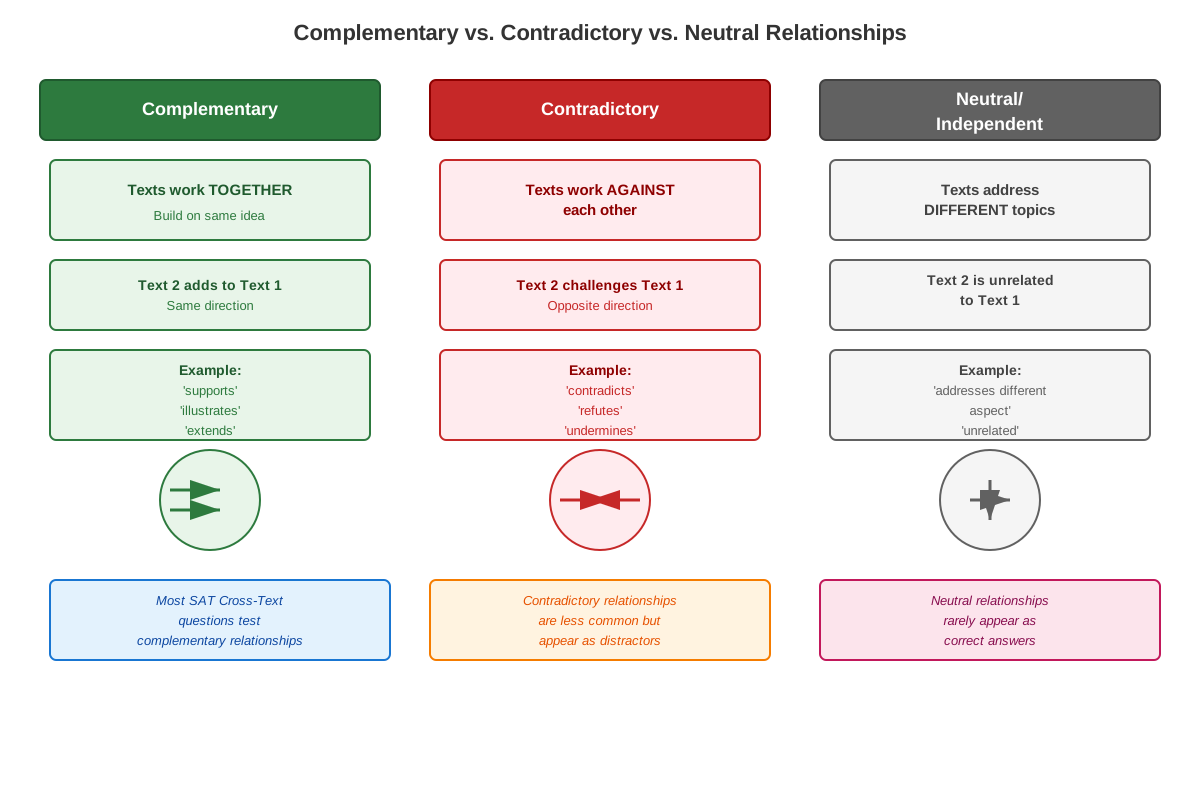
Complementary claims occur when two texts present information, arguments, or findings that work together in a mutually supportive or enhancing way. Rather than contradicting each other or addressing completely separate topics, complementary texts have a relationship where one adds value to the other. The key characteristic is that understanding both texts together provides more insight than understanding either text alone.
In the context of sat complementary claims, the relationship is always constructive and additive. Text 2 might provide evidence that supports a hypothesis in Text 1, offer a concrete example of an abstract concept from Text 1, extend the findings of Text 1 to a new context, or supply additional data that reinforces conclusions in Text 1. The relationship flows in a specific direction—typically from Text 1 (which establishes a claim, theory, or principle) to Text 2 (which supports, illustrates, or extends it).
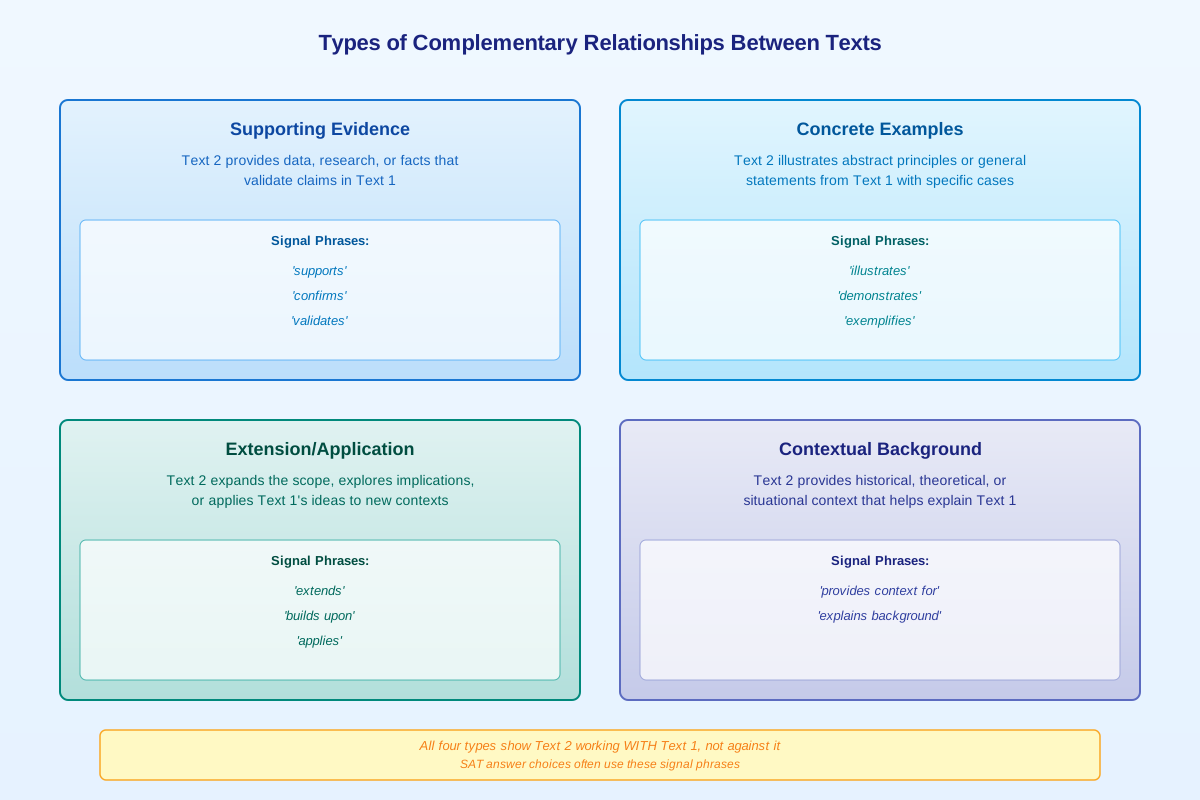
Types of Complementary Relationships
Understanding the specific types of complementary relationships helps students quickly identify the correct answer choice:
| Relationship Type | Description | Example Structure |
|---|---|---|
| Evidence-Claim | Text 2 provides empirical data or observations that support a theoretical claim in Text 1 | Text 1: Theory about plant behavior; Text 2: Experimental results confirming the theory |
| Example-Principle | Text 2 offers a specific, concrete instance of a general principle stated in Text 1 | Text 1: General statement about economic trends; Text 2: Case study illustrating the trend |
| Extension | Text 2 expands the scope, timeframe, or application of findings from Text 1 | Text 1: Study of phenomenon in one region; Text 2: Study showing same phenomenon in different region |
| Mechanism-Observation | Text 2 explains how or why something described in Text 1 occurs | Text 1: Description of an observed effect; Text 2: Explanation of the underlying cause |
| Additional Support | Text 2 provides supplementary evidence using a different methodology or perspective | Text 1: Survey data supporting a conclusion; Text 2: Experimental data supporting the same conclusion |
Identifying Complementary Claims in Passages
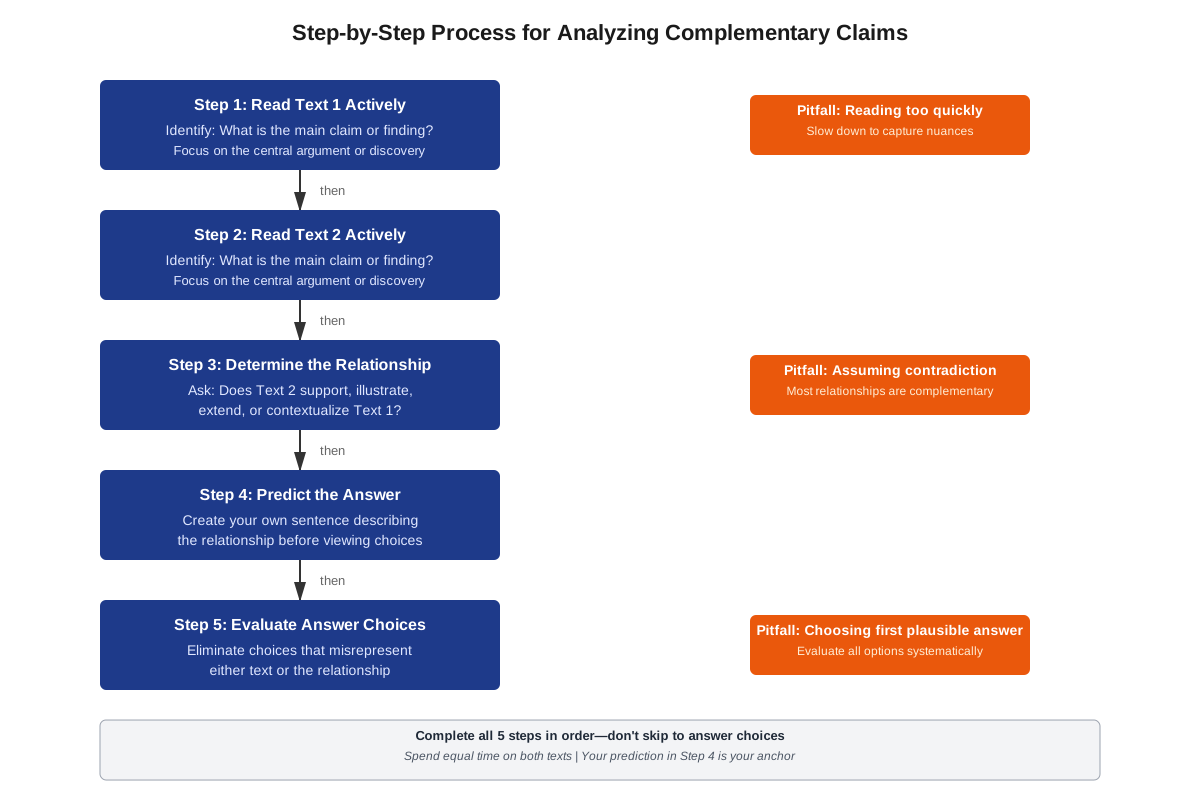
To identify complementary claims, students should follow a systematic approach:
- Read Text 1 carefully and identify its main claim, finding, or principle
- Note the scope and limitations of Text 1 (What does it cover? What doesn't it address?)
- Read Text 2 carefully and identify its main claim, finding, or principle
- Determine the relationship by asking: "How does Text 2 relate to Text 1? Does it support, illustrate, extend, or explain?"
- Look for connecting language such as "similarly," "for example," "additionally," "furthermore," or "this finding"
Question Format and Structure
SAT complementary claims questions follow a predictable format. Students will see two labeled passages (Text 1 and Text 2) followed by a question stem that typically begins with phrases like:
- "Based on the texts, how would the author of Text 2 most likely respond to the claim in Text 1?"
- "Which finding from Text 2, if true, would most directly support the hypothesis in Text 1?"
- "Text 2 most directly provides..."
- "The relationship between Text 1 and Text 2 is best described as..."
The answer choices will describe different types of relationships. Only one will accurately capture the complementary nature of how the texts work together. Wrong answers often describe contradictory relationships, neutral relationships (texts about different topics), or mischaracterize which text provides which type of information.
Key Features to Recognize
Several features signal complementary claims:
- Thematic alignment: Both texts address the same topic, phenomenon, or question
- Consistent conclusions: The texts reach compatible (though not necessarily identical) conclusions
- Additive information: Text 2 adds something valuable to Text 1 rather than merely repeating it
- Logical flow: The relationship makes sense—evidence follows claims, examples follow principles, extensions follow initial findings
- Absence of contradiction: While the texts may emphasize different aspects, they don't present conflicting information
Concept Relationships
The concept of complementary claims builds directly on fundamental reading comprehension skills. Students must first master identifying main ideas in individual passages before they can recognize how main ideas in two passages relate. Similarly, recognizing supporting evidence within a single text prepares students to see when one entire text serves as supporting evidence for another.
Within the Cross-Text Connections unit, complementary claims represent one type of relationship among several. The skill progression typically moves from:
Basic comprehension of individual texts → Identifying relationships between texts → Distinguishing complementary from contradictory relationships → Specifying the exact nature of complementary relationships (evidence vs. example vs. extension)
Complementary claims also connect to argument analysis skills tested elsewhere in the SAT Reading and Writing section. Understanding how authors build arguments with claims and evidence helps students recognize when Text 2 functions as evidence for Text 1's claim. Additionally, this concept relates to synthesis skills that students need for the SAT Essay (when offered) and for college writing assignments.
The relationship map for this topic:
Reading Comprehension → enables → Identifying Individual Claims → enables → Recognizing Cross-Text Relationships → branches into → Complementary Claims (supportive relationships) and Contradictory Claims (conflicting relationships) → Complementary Claims subdivides into → Evidence-Claim, Example-Principle, Extension, and Mechanism-Observation relationships
High-Yield Facts
⭐ Complementary claims questions always involve two passages that work together in a mutually supportive way, never passages that contradict each other or address unrelated topics.
⭐ The most common complementary relationship is Text 2 providing specific evidence or examples that support a general claim or theory stated in Text 1.
⭐ Answer choices that describe contradictions, disagreements, or unrelated topics are always incorrect for complementary claims questions.
⭐ The question stem will explicitly ask about the relationship between texts or how one text relates to the other—this signals a cross-text connection question.
⭐ Students must read both passages completely before attempting to answer; understanding each passage independently is essential before analyzing their relationship.
- Complementary relationships are directional—typically Text 2 complements Text 1, not vice versa, and the question stem will indicate this direction.
- Wrong answers often reverse the relationship (claiming Text 1 provides evidence for Text 2 when it's actually the opposite).
- Time markers and scope indicators (dates, locations, populations studied) often signal extension relationships where Text 2 expands the applicability of Text 1's findings.
- Phrases like "for instance," "for example," or "in one case" in Text 2 signal that it provides a specific example of Text 1's general principle.
- Scientific passages frequently use the evidence-claim relationship, while humanities passages often use example-principle relationships.
- The correct answer will be specific about the type of complementary relationship, not vague (e.g., "provides evidence supporting" is better than "relates to").
- Both passages will be on the same topic, but they'll approach it from different angles—one more general/theoretical, the other more specific/empirical.
Quick check — test yourself on Complementary claims so far.
Try Flashcards →Common Misconceptions
Misconception: Complementary claims mean the two texts say exactly the same thing in different words.
Correction: Complementary texts work together by adding different types of information—one might state a theory while the other provides evidence, or one might describe a principle while the other gives an example. They enhance each other rather than merely repeating the same content.
Misconception: If two texts are about the same topic, they automatically have complementary claims.
Correction: Texts can address the same topic while contradicting each other, presenting neutral/unrelated aspects, or simply providing parallel information without a complementary relationship. True complementary claims require one text to actively support, illustrate, or extend the other.
Misconception: The longer or more detailed passage is always Text 1, and the shorter passage is always Text 2.
Correction: Both passages are typically similar in length (25-75 words each), and the labels "Text 1" and "Text 2" are assigned by the test, not based on length or complexity. Students must read both carefully regardless of length.
Misconception: Complementary claims questions always have answer choices that use the word "support" or "complement."
Correction: Correct answers use various precise terms including "illustrates," "provides evidence for," "extends," "demonstrates," "exemplifies," or "explains." Students must understand the concept, not just look for specific vocabulary.
Misconception: If Text 2 mentions something not discussed in Text 1, the texts cannot be complementary.
Correction: Complementary texts often introduce new information—that's what makes them complementary rather than redundant. Text 2 might provide evidence, examples, or extensions that necessarily include details not in Text 1 while still supporting or illustrating Text 1's main point.
Worked Examples
Example 1: Evidence-Claim Relationship
Text 1
Researchers have hypothesized that regular exposure to natural environments reduces stress levels in urban populations. The theory suggests that natural settings provide psychological restoration by offering a respite from the constant stimulation of city life.
Text 2
A 2022 study tracked cortisol levels (a biological marker of stress) in 200 city residents over six months. Participants who spent at least two hours per week in parks or green spaces showed a 23% reduction in cortisol levels compared to those who did not regularly visit natural environments.
Question: Based on the texts, how does Text 2 relate to Text 1?
Answer Choices:
A) It contradicts the hypothesis by showing that urban environments don't cause stress
B) It provides empirical evidence supporting the hypothesis described in Text 1
C) It extends the hypothesis to include rural populations
D) It explains the biological mechanism behind the hypothesis
Solution:
Step 1: Identify the main point of Text 1
- Text 1 presents a hypothesis: natural environments reduce stress in urban populations
- This is a theoretical claim without empirical data
Step 2: Identify the main point of Text 2
- Text 2 describes a study with specific data: 200 participants, 6 months, 23% cortisol reduction
- This is empirical evidence from actual research
Step 3: Determine the relationship
- Text 2 provides concrete data that confirms what Text 1 hypothesized
- The study results align with the theory (reduction in stress markers)
- Text 2 doesn't contradict, extend to new populations, or explain mechanisms—it validates the original hypothesis with evidence
Step 4: Evaluate answer choices
- A is incorrect: Text 2 confirms, not contradicts, and doesn't address whether cities cause stress
- B is correct: Text 2 provides empirical (study-based) evidence that supports (confirms) the hypothesis in Text 1
- C is incorrect: Text 2 focuses on city residents, not rural populations
- D is incorrect: While cortisol is mentioned, Text 2 doesn't explain how or why nature reduces stress
Answer: B
This exemplifies the most common complementary relationship on the SAT: a theoretical claim followed by supporting empirical evidence.
Example 2: Example-Principle Relationship
Text 1
Economic historians note that technological innovations often face initial resistance from established industries whose business models they threaten. This pattern, called "creative destruction," has repeated throughout industrial history as new technologies displace older ones.
Text 2
When automobiles were introduced in the early 1900s, railroad companies and horse-carriage manufacturers lobbied aggressively for regulations to limit car usage. Some cities passed laws requiring cars to be preceded by someone on foot waving a red flag, effectively making automobile travel impractical.
Question: Text 2 most directly serves to:
Answer Choices:
A) Challenge the concept of creative destruction by showing it doesn't apply to transportation
B) Provide a historical example that illustrates the pattern described in Text 1
C) Explain why creative destruction occurs in economic systems
D) Extend the principle in Text 1 to modern technology companies
Solution:
Step 1: Identify Text 1's main point
- Text 1 describes a general principle: new technologies face resistance from established industries
- This is an abstract, broad pattern across history
Step 2: Identify Text 2's main point
- Text 2 describes a specific historical event: automobile introduction and resistance from railroads/carriage makers
- This is a concrete, particular instance
Step 3: Determine the relationship
- Text 2 provides a specific case that demonstrates the general principle from Text 1
- The automobile example shows exactly what Text 1 describes: established industries (railroads, carriages) resisting new technology (cars)
- This is a classic example-principle relationship
Step 4: Evaluate answer choices
- A is incorrect: Text 2 confirms rather than challenges the concept, and it does apply to transportation
- B is correct: Text 2 gives a historical example (automobiles) that illustrates (demonstrates) the pattern (creative destruction) from Text 1
- C is incorrect: Text 2 describes what happened, not why it happens
- D is incorrect: Text 2 uses a historical example, not a modern one, and doesn't extend the principle to new contexts
Answer: B
This demonstrates how SAT complementary claims questions often pair general principles with specific examples that make the principle concrete and understandable.
Exam Strategy
Approaching Complementary Claims Questions
Step 1: Identify the question type by reading the question stem first. Look for phrases like "how does Text 2 relate to Text 1," "Text 2 most directly provides," or "based on the texts." These signal cross-text connection questions.
Step 2: Read Text 1 actively and summarize its main point in your own words. Ask yourself: "Is this making a claim, stating a theory, describing a principle, or presenting findings?"
Step 3: Read Text 2 actively and summarize its main point. Ask yourself: "Is this providing evidence, giving an example, extending findings, or explaining a mechanism?"
Step 4: Articulate the relationship before looking at answer choices. In one sentence, describe how Text 2 relates to Text 1: "Text 2 provides evidence for Text 1's claim" or "Text 2 gives an example of Text 1's principle."
Step 5: Eliminate wrong answers systematically:
- Eliminate any answer suggesting contradiction or disagreement
- Eliminate answers that reverse the relationship (claiming Text 1 supports Text 2 when it's the opposite)
- Eliminate answers that describe relationships not present in the texts
Trigger Words and Phrases
In question stems, watch for:
- "Based on the texts" (signals you must use both passages)
- "How would the author of Text 2 respond" (signals relationship analysis)
- "Which finding from Text 2" (signals Text 2 provides evidence)
- "Text 2 most directly" (signals the specific function of Text 2)
In passages, watch for:
- Text 2 beginning with "For example," "In one study," "Researchers found" (signals evidence or example)
- Text 1 using "hypothesis," "theory," "principle," "pattern" (signals it's making a general claim)
- Text 2 using "similarly," "additionally," "furthermore" (signals it's adding supportive information)
- Dates, locations, or specific populations in Text 2 (may signal extension of Text 1's findings)
Time Allocation
Spend approximately 60-90 seconds on complementary claims questions:
- 20 seconds: Read question stem and Text 1
- 20 seconds: Read Text 2
- 15 seconds: Determine relationship
- 15-30 seconds: Evaluate answer choices
Don't rush these questions—they require careful analysis of both passages. However, don't overthink them either; the relationship should be relatively clear once you understand both passages.
Process of Elimination Tips
Eliminate answers that:
- Use extreme language ("completely," "entirely," "proves definitively") unless the texts genuinely support such strong claims
- Describe information not present in either text
- Confuse which text does what (reversing the roles of Text 1 and Text 2)
- Describe contradictory relationships when the texts are clearly supportive
- Are too vague ("relates to," "discusses") when more specific options are available
Keep answers that:
- Precisely describe the type of relationship (evidence, example, extension, explanation)
- Match the scope and tone of both passages
- Accurately represent what each text contributes to the relationship
- Use specific, appropriate academic vocabulary
Memory Techniques
The SEES Acronym
Remember the four main types of complementary relationships with SEES:
- Supporting evidence (Text 2 provides data/findings that confirm Text 1's claim)
- Example (Text 2 gives a specific instance of Text 1's general principle)
- Extension (Text 2 expands the scope/timeframe/application of Text 1's findings)
- Specification (Text 2 explains the mechanism or details of Text 1's observation)
The "Building Blocks" Visualization
Visualize complementary claims as building blocks where Text 1 lays the foundation (theory, principle, or initial finding) and Text 2 adds to the structure (evidence, examples, or extensions). The blocks fit together and create something stronger than either block alone. If the blocks don't fit together or knock each other down, the relationship isn't complementary.
The Direction Arrow
Always draw a mental arrow from Text 2 to Text 1 asking "How does this support, illustrate, or extend that?" The arrow represents the flow of the complementary relationship. If you can't draw a clear arrow showing how Text 2 enhances Text 1, reconsider your understanding of the relationship.
Question Stem Patterns
Remember that complementary claims questions almost always ask about how Text 2 relates to Text 1, not the reverse. The question structure itself tells you the direction of the relationship: Text 2 is doing something to complement Text 1.
Summary
Complementary claims represent a crucial skill for SAT Reading and Writing success, requiring students to analyze how two passages work together in mutually supportive ways. These questions test the ability to recognize when one text provides evidence for another's claims, offers specific examples of general principles, extends findings to new contexts, or explains mechanisms behind observations. Success requires reading both passages carefully, identifying each passage's main point and purpose, and determining the specific nature of their relationship before evaluating answer choices. The most common complementary relationships include evidence supporting claims, examples illustrating principles, and extensions expanding the scope of initial findings. Students must avoid common pitfalls such as confusing complementary relationships with contradictory ones, reversing the direction of the relationship, or selecting vague answers when specific ones are available. By systematically analyzing each passage, articulating the relationship, and using process of elimination, students can consistently identify correct answers on these medium-to-high difficulty questions that appear regularly throughout the SAT Reading and Writing section.
Key Takeaways
- Complementary claims questions require analyzing how two passages work together supportively, with Text 2 typically providing evidence, examples, or extensions for Text 1
- The four main complementary relationships are: supporting evidence, specific examples, extensions to new contexts, and mechanism explanations (remember: SEES)
- Always read both passages completely and identify each one's main point before attempting to determine their relationship
- Eliminate answer choices that describe contradictions, reverse the relationship, or are too vague when specific options exist
- Question stems explicitly signal cross-text connections with phrases like "based on the texts" or "how does Text 2 relate to Text 1"
- These questions appear in 15-20% of Cross-Text Connection items and serve as important discriminators between score bands
- Success requires both understanding individual passages and synthesizing information across sources—a fundamental college-readiness skill
Related Topics
Contradictory Claims: After mastering complementary claims, students should study how to identify and analyze passages that present conflicting information or opposing viewpoints. This skill completes the cross-text connection toolkit by covering the full spectrum of text relationships.
Evidence Evaluation: Understanding how to assess the quality and relevance of evidence within a single passage strengthens the ability to recognize when one passage serves as evidence for another, deepening complementary claims analysis.
Main Ideas and Supporting Details: Advanced work with identifying hierarchical relationships within single texts (main ideas supported by details) provides the foundation for recognizing these relationships across multiple texts.
Synthesis and Integration: College-level reading requires combining information from multiple sources, making complementary claims practice essential preparation for academic research and writing tasks beyond the SAT.
Practice CTA
Now that you've mastered the core concepts of complementary claims, it's time to put your knowledge into action! Work through the practice questions to reinforce your understanding and build confidence with this high-yield SAT question type. Each practice question is designed to mirror actual SAT format and difficulty, giving you authentic test preparation. Use the flashcards to memorize key relationships and trigger words that signal complementary claims. Remember: consistent practice with these concepts will not only boost your SAT score but also develop critical thinking skills you'll use throughout college. You've built a strong foundation—now strengthen it through application!
Sign up free to keep reading
Create a free AnvayaPrep account to finish this SAT guide on Complementary claims — plus flashcards and practice questions.