Overview
Contrasting claims questions represent one of the most frequently tested question types in the SAT Reading and Writing (RW) section, appearing in the Cross-Text Connections category. These questions present students with two short passages—typically Text 1 and Text 2—that express different viewpoints, arguments, or findings about the same topic. The student's task is to identify how the second text relates to, responds to, or differs from the first text. This question type assesses critical reading skills essential for college-level work: the ability to synthesize information from multiple sources, recognize different perspectives, and understand how scholars, researchers, or writers engage in academic discourse.
Mastering sat contrasting claims questions is crucial because they appear consistently on every SAT administration, typically comprising 2-3 questions per test. These questions test whether students can move beyond simple comprehension of individual texts to understand the relationship between texts—a higher-order thinking skill. Success requires identifying the central claim in each passage, recognizing the nature of the disagreement or difference, and selecting an answer choice that accurately characterizes this relationship without overstating or understating the contrast.
Within the broader RW section, contrasting claims questions connect to fundamental skills tested throughout the exam: identifying main ideas, understanding authorial purpose, recognizing evidence and reasoning, and making logical inferences. Unlike single-text questions that focus on comprehension within one passage, cross-text questions require students to hold two distinct ideas in mind simultaneously and analyze their interaction. This skill builds directly on the ability to identify claims and evidence in individual texts while preparing students for the synthesis and argumentation skills needed in college writing and research.
Learning Objectives
- [ ] Identify key features of contrasting claims questions on the SAT
- [ ] Explain how contrasting claims appears on the SAT and what makes these questions distinct
- [ ] Apply contrasting claims analysis to answer SAT-style questions accurately
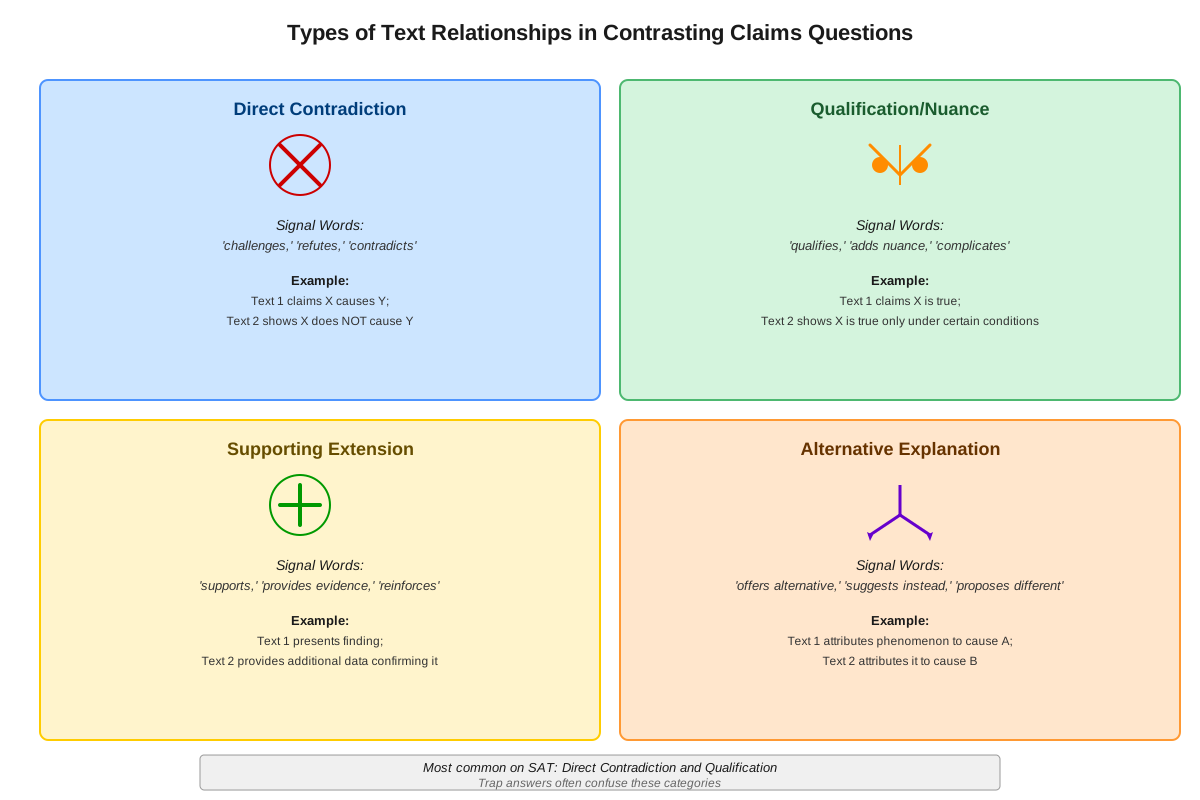
- [ ] Distinguish between different types of relationships between paired texts (contradiction, qualification, support, extension)
- [ ] Recognize common trap answers that mischaracterize the relationship between texts
- [ ] Evaluate answer choices by checking them against specific evidence from both texts
Prerequisites
- Identifying main ideas and claims: Students must be able to determine the central argument or finding in a single passage before comparing two passages.
- Understanding evidence and reasoning: Recognizing how authors support their claims helps identify what exactly is being contrasted between texts.
- Basic reading comprehension: Students need to understand vocabulary, sentence structure, and paragraph organization to grasp each text's meaning.
- Distinguishing fact from opinion: Many contrasting claims involve one text presenting findings while another interprets or challenges those findings.
Why This Topic Matters
In academic and professional contexts, engaging with contrasting viewpoints is fundamental to critical thinking. Researchers must understand how their findings relate to previous studies, writers must acknowledge counterarguments, and informed citizens must evaluate competing claims about important issues. The SAT tests this skill because colleges need students who can read multiple sources, identify areas of agreement and disagreement, and synthesize information to form their own informed conclusions.
On the SAT, contrasting claims questions appear with high frequency—students can expect 2-3 questions per test, making them worth approximately 4-6% of the total Reading and Writing score. These questions typically appear in the later portions of each module, often among the medium-to-hard difficulty questions. The passages used are usually brief (30-60 words each), drawn from various disciplines including science, social studies, humanities, and literature. The time investment is worthwhile: these questions are highly predictable in format, making them excellent candidates for score improvement through targeted practice.
Common manifestations include: scientific studies with conflicting findings, historical interpretations that differ in emphasis or conclusion, literary critics with opposing views on a text's meaning, and researchers who challenge or refine previous theories. The answer choices typically use specific relationship verbs like "challenges," "supports," "qualifies," "extends," or "undermines," requiring precise understanding of how the texts interact.
Core Concepts
Understanding Claims in Academic Discourse
A claim is an assertion that something is true, often requiring evidence or reasoning to support it. In SAT passages, claims can be explicit ("The data suggests that X causes Y") or implicit (presenting findings that imply a conclusion). Before comparing texts, students must identify the specific claim each text makes. This isn't always the topic—two texts can discuss the same topic while making different claims about it.
For example, two texts might both discuss ancient Roman architecture (same topic), but Text 1 might claim that Roman engineering was primarily practical while Text 2 claims it was primarily aesthetic. The topic is shared; the claims contrast.
Types of Contrasting Relationships
Not all contrasts are direct contradictions. Understanding the nuanced ways texts can relate is essential for selecting accurate answer choices.
| Relationship Type | Definition | Example Signal |
|---|---|---|
| Direct Contradiction | Text 2 asserts the opposite of Text 1 | "However, recent findings show the opposite..." |
| Qualification | Text 2 adds conditions or limitations to Text 1's claim | "While this may be true in some cases..." |
| Challenge/Undermining | Text 2 presents evidence that weakens Text 1's claim | "This interpretation overlooks critical evidence..." |
| Alternative Explanation | Text 2 offers a different cause or reason for the same phenomenon | "A more likely explanation is..." |
| Scope Disagreement | Texts agree on specifics but disagree on how broadly claims apply | "This effect, however, is limited to..." |
Identifying the Precise Point of Contrast
Many students struggle because they recognize that texts differ but cannot pinpoint exactly how. The key is to identify the specific element being contrasted:
- Causal claims: Text 1 says X causes Y; Text 2 says Z causes Y
- Evaluative claims: Text 1 views something positively; Text 2 views it negatively
- Factual claims: Text 1 reports one finding; Text 2 reports a different finding
- Interpretive claims: Both texts acknowledge the same facts but interpret their meaning differently
- Methodological claims: Text 1 uses one approach; Text 2 advocates a different approach
Analyzing Answer Choice Language
SAT answer choices use precise academic language to describe relationships. Understanding these terms is crucial:
- Challenges: Text 2 questions or disputes Text 1's claim
- Supports: Text 2 provides evidence for Text 1's claim
- Qualifies: Text 2 adds nuance, conditions, or limitations to Text 1
- Undermines: Text 2 weakens Text 1's argument
- Extends: Text 2 builds upon Text 1's ideas
- Contradicts: Text 2 directly opposes Text 1
- Refines: Text 2 makes Text 1's claim more precise or accurate
- Complicates: Text 2 adds complexity that makes Text 1's simple claim insufficient
The Structure of Contrasting Claims Questions
These questions follow a predictable format that students can learn to navigate efficiently:
- Text 1 presentation: A brief passage (usually 30-60 words) presenting a claim, finding, or perspective
- Text 2 presentation: A second brief passage on the same topic with a different claim or perspective
- Question stem: Usually asks "Based on the texts, how would the author of Text 2 most likely respond to the claim in Text 1?" or "Which choice best describes the relationship between Text 1 and Text 2?"
- Four answer choices: Each describing a different relationship, often using the precise academic vocabulary listed above
Common Patterns in SAT Contrasting Claims
Certain patterns appear repeatedly on the SAT:
The "New Evidence" Pattern: Text 1 presents an established theory or belief; Text 2 presents recent findings that challenge it.
The "Scope Limitation" Pattern: Text 1 makes a broad claim; Text 2 argues the claim only applies in specific circumstances.
The "Alternative Interpretation" Pattern: Both texts acknowledge the same phenomenon but explain it differently.
The "Methodological Critique" Pattern: Text 1 uses one research approach; Text 2 argues for a different approach or critiques Text 1's methodology.
The "Nuance Addition" Pattern: Text 1 presents a straightforward claim; Text 2 adds complexity or conditions.
Concept Relationships
The ability to analyze contrasting claims builds directly on single-text comprehension skills. Students must first identify the main idea and supporting evidence within each text individually (prerequisite skill) before they can compare how the texts relate to each other (contrasting claims skill). This relationship flows: Single-text comprehension → Claim identification → Cross-text comparison → Relationship characterization.
Within the topic itself, concepts connect hierarchically. Understanding what constitutes a claim enables identifying claims in each text. Identifying claims in both texts enables recognizing the point of contrast. Recognizing the point of contrast enables selecting the answer choice with the most accurate relationship verb. This progression can be mapped as: Claim definition → Claim identification → Contrast recognition → Relationship vocabulary → Answer selection.
Contrasting claims questions also connect to other Cross-Text Connections question types. Some questions ask students to synthesize information from both texts rather than contrast them, while others ask how one text might use evidence from another. All these question types require holding multiple texts in mind simultaneously and understanding their interaction—a skill set that transfers across the entire Cross-Text Connections category.
High-Yield Facts
⭐ Contrasting claims questions always present exactly two texts on the same general topic but with different perspectives or findings.
⭐ The correct answer must be supported by specific evidence from both texts—if an answer choice describes something not mentioned in one of the texts, it's wrong.
⭐ Answer choices use precise relationship verbs (challenges, supports, qualifies, etc.) that have distinct meanings—understanding these distinctions is essential.
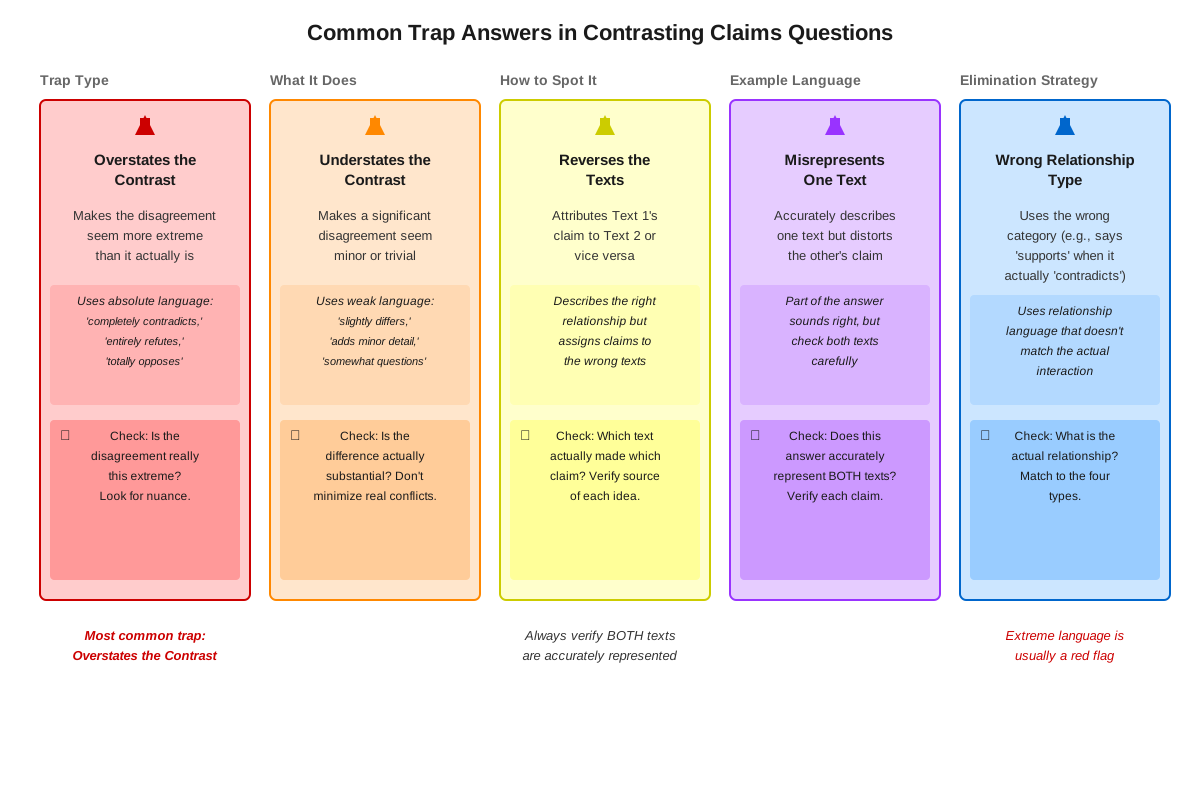
⭐ The most common trap answer overstates the relationship, claiming a complete contradiction when the texts actually differ more subtly.
⭐ Students should identify the specific claim in each text before reading the answer choices to avoid being misled by attractive but inaccurate options.
- Text 1 always appears first and establishes the initial claim or perspective that Text 2 will respond to or differ from.
- The question stem typically asks about the relationship between texts or how one text would respond to the other.
- Correct answers often use qualifying language ("suggests," "indicates," "may") rather than absolute language ("proves," "completely contradicts").
- Both texts are usually brief (30-60 words each), making it feasible to reread them when checking answer choices.
- The contrast may be subtle—texts might agree on most points but differ on one specific aspect.
- Some questions ask specifically about what the author of Text 2 would say about Text 1, requiring students to adopt that author's perspective.
- Wrong answers often describe relationships that are too strong (claiming contradiction when there's only qualification) or too weak (claiming support when there's actually challenge).
Quick check — test yourself on Contrasting claims so far.
Try Flashcards →Common Misconceptions
Misconception: If two texts discuss the same topic, they must be contrasting claims.
Correction: Texts can discuss the same topic while actually supporting each other or addressing different aspects. The question type is "contrasting claims" only when the texts present different perspectives, findings, or arguments about that topic.
Misconception: "Challenges" and "contradicts" mean the same thing.
Correction: "Contradicts" means Text 2 asserts the opposite of Text 1 (if Text 1 says "X is true," Text 2 says "X is false"). "Challenges" is broader—Text 2 might question Text 1's methodology, present complicating evidence, or suggest alternative explanations without directly asserting the opposite.
Misconception: The correct answer will use vocabulary that appears in the texts.
Correction: Correct answers describe the relationship between texts using academic language that often doesn't appear in either passage. Students must understand what the texts mean, not just match words.
Misconception: Text 2 always disagrees with Text 1.
Correction: While these are called "contrasting claims" questions, the relationship might be qualification, refinement, or adding nuance rather than outright disagreement. Some questions in the Cross-Text Connections category even ask about texts that support each other.
Misconception: Longer answer choices are more likely to be correct because they're more detailed.
Correction: Answer length has no correlation with correctness on the SAT. Wrong answers are often longer because they include extra details that make them inaccurate. The correct answer is the one that most precisely describes the relationship, regardless of length.
Misconception: Students should read all answer choices before checking them against the texts.
Correction: More effective is to identify each text's claim first, determine how they relate, and then evaluate answer choices against that understanding. This prevents being swayed by attractive but inaccurate options.
Worked Examples
Example 1: Scientific Research Contrast
Text 1
A 2019 study found that students who took handwritten notes during lectures performed better on conceptual questions than students who typed notes. The researchers concluded that the manual process of writing enhances cognitive processing and learning.
Text 2
However, a 2022 study with a larger sample size found no significant difference in test performance between handwriting and typing when students were instructed to take notes in their own words rather than transcribing verbatim. The key factor appears to be note-taking strategy rather than the medium used.
Question: Based on the texts, how would the author of Text 2 most likely respond to the conclusion in Text 1?
Answer Choices:
A) By arguing that handwriting provides no educational benefits whatsoever
B) By suggesting that note-taking strategy, rather than writing method, better explains the performance differences observed
C) By supporting the conclusion with additional evidence about manual writing
D) By proposing that typing is superior to handwriting for all learning tasks
Step-by-step solution:
- Identify Text 1's claim: Handwriting enhances learning better than typing because the manual process improves cognitive processing.
- Identify Text 2's claim: When note-taking strategy is controlled, the medium (handwriting vs. typing) doesn't matter—strategy is the key factor.
- Determine the relationship: Text 2 doesn't say handwriting has no benefits (eliminating A) or that typing is superior (eliminating D). Text 2 doesn't support Text 1 (eliminating C). Instead, Text 2 offers an alternative explanation for the phenomenon Text 1 observed—it's not about handwriting vs. typing, but about note-taking strategy.
- Select the answer: Choice B accurately captures this relationship. Text 2 suggests a different factor (strategy) better explains what Text 1 attributed to writing method.
Connection to learning objectives: This example demonstrates identifying the specific claims in each text and recognizing that the contrast involves alternative explanations for the same phenomenon, not direct contradiction.
Example 2: Historical Interpretation Contrast
Text 1
Many historians have characterized the Renaissance as a sudden rebirth of classical learning after the "dark" Middle Ages. This view emphasizes the dramatic break between medieval and Renaissance thought, highlighting how Renaissance thinkers rejected medieval scholasticism in favor of classical texts.
Text 2
Recent scholarship has complicated this narrative by demonstrating substantial continuity between medieval and Renaissance intellectual life. Medieval scholars preserved and studied classical texts extensively, and many "Renaissance" ideas had medieval precedents. The Renaissance may be better understood as an evolution rather than a revolution.
Question: Which choice best describes the relationship between Text 1 and Text 2?
Answer Choices:
A) Text 2 contradicts Text 1 by denying that the Renaissance involved any engagement with classical learning
B) Text 2 challenges Text 1 by questioning the extent of the break between medieval and Renaissance thought
C) Text 2 supports Text 1 by providing additional evidence of Renaissance rejection of medieval ideas
D) Text 2 extends Text 1 by discussing a later historical period
Step-by-step solution:
- Identify Text 1's claim: The Renaissance represented a dramatic break from the Middle Ages, with Renaissance thinkers rejecting medieval approaches.
- Identify Text 2's claim: There was substantial continuity between medieval and Renaissance periods; the change was evolutionary, not revolutionary.
- Evaluate each answer:
- A is wrong: Text 2 doesn't deny Renaissance engagement with classical learning; both texts acknowledge this.
- B is correct: Text 2 questions the "dramatic break" narrative, arguing for continuity instead.
- C is wrong: Text 2 doesn't support Text 1; it argues against the "break" interpretation.
- D is wrong: Both texts discuss the same period (Renaissance and its relationship to the Middle Ages).
- Verify the answer: "Challenges" is appropriate because Text 2 questions Text 1's interpretation without completely contradicting every aspect. Text 2 doesn't say there was no Renaissance, just that the break wasn't as dramatic as Text 1 suggests.
Connection to learning objectives: This example shows how to distinguish between different relationship types (challenge vs. contradiction vs. support) and demonstrates that "challenges" often involves questioning the degree or extent of a claim rather than denying it entirely.
Exam Strategy
Systematic Approach to Contrasting Claims Questions
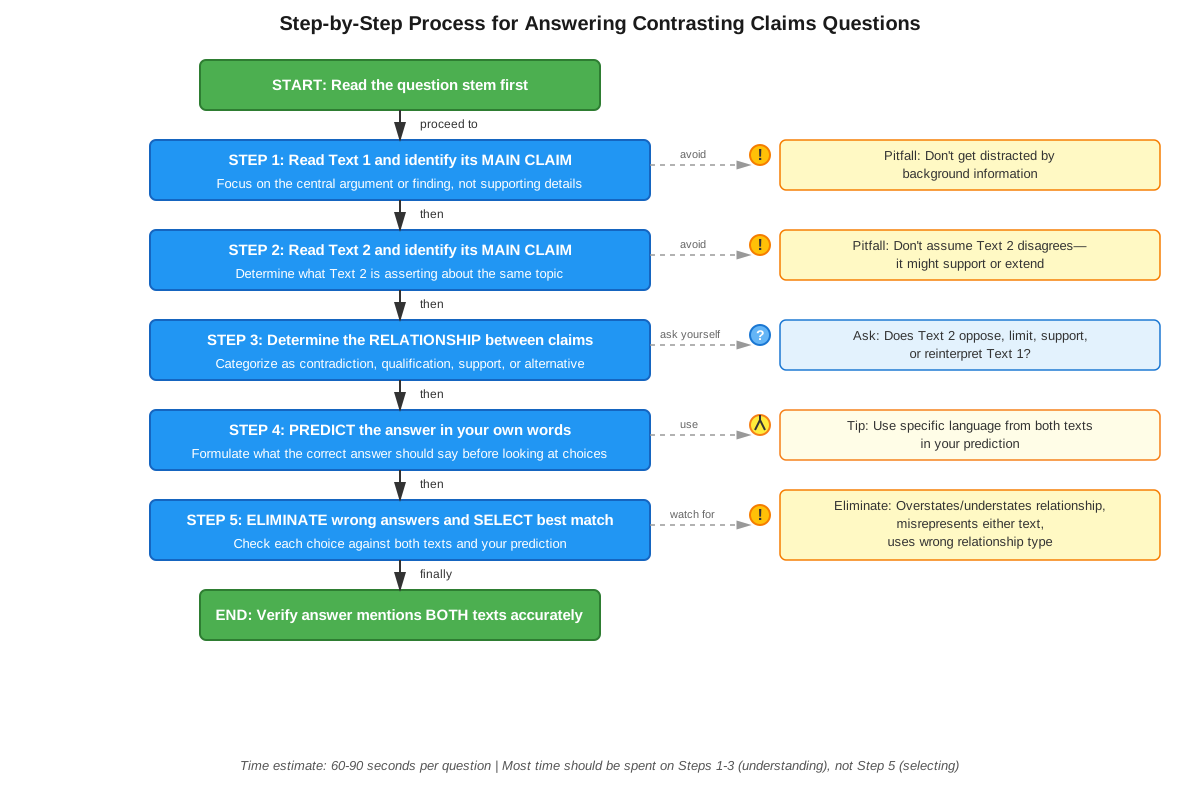
- Read Text 1 carefully and identify its main claim: Before moving to Text 2, be clear about what Text 1 argues. Underline or mentally note the key assertion.
- Read Text 2 and identify its main claim: Determine what Text 2 asserts, keeping Text 1's claim in mind.
- Determine the relationship before looking at answer choices: Ask yourself: "Does Text 2 disagree with Text 1? Support it? Add conditions? Offer an alternative explanation?" Having your own answer prevents being misled by attractive wrong choices.
- Eliminate answers that mischaracterize either text: If an answer choice describes something not mentioned in one of the texts, eliminate it immediately.
- Check the remaining answers against both texts: The correct answer must be supported by specific evidence from both passages.
Trigger Words and Phrases
Watch for these words that signal the relationship between texts:
In Text 2 indicating contrast: "however," "but," "nevertheless," "on the other hand," "in contrast," "alternatively," "recent findings suggest," "this view overlooks"
In Text 2 indicating qualification: "while this may be true," "in some cases," "under certain conditions," "to some extent," "partially"
In answer choices indicating strong relationships: "completely contradicts," "definitively proves," "entirely supports," "wholly rejects"
In answer choices indicating nuanced relationships: "suggests," "indicates," "questions," "complicates," "qualifies," "refines"
Exam Tip: Answers with absolute language ("completely," "entirely," "always," "never") are often wrong in contrasting claims questions because academic discourse typically involves nuanced disagreement rather than total opposition.
Process of Elimination Strategy
- Eliminate answers describing relationships too strong for the evidence: If texts differ on one aspect but agree on others, "completely contradicts" is likely wrong.
- Eliminate answers describing the wrong direction: If the question asks how Text 2 responds to Text 1, an answer describing how Text 1 responds to Text 2 is wrong.
- Eliminate answers that introduce information not in the texts: If an answer mentions a concept, time period, or idea not discussed in either passage, it's incorrect.
- Between two similar answers, choose the more precise one: If one answer says "challenges the methodology" and another says "challenges the conclusion," determine which specific element Text 2 actually addresses.
Time Allocation
Contrasting claims questions typically require 60-90 seconds. The texts are short enough to reread quickly, so don't hesitate to check answer choices against the passages. Spending an extra 15 seconds to verify your answer is worthwhile given the predictable format and the importance of precision in these questions.
Memory Techniques
The CLAIM Acronym for Analysis
Central assertion - What is each text's main point?
Language of relationship - What verbs describe how they relate?
Areas of agreement - What do both texts accept as true?
Identify the contrast - What specific element differs?
Match to evidence - Does the answer fit both texts?
Relationship Verb Spectrum Visualization
Imagine a spectrum from "complete agreement" to "complete disagreement":
Supports → Extends → Qualifies → Complicates → Challenges → Undermines → Contradicts
Visualize where the relationship falls on this spectrum. Most SAT contrasting claims fall in the middle range (qualifies, complicates, challenges) rather than the extremes.
The "Two Claims, One Contrast" Rule
Remember: Two Claims, One Contrast. You need to identify two distinct claims and one specific point where they differ. If you can't articulate all three elements, reread the texts.
Answer Choice Elimination Mnemonic: STOP
Strength - Is the relationship too strong or too weak?
Text evidence - Is this supported by both texts?
Opposite direction - Does this reverse the actual relationship?
Precision - Is there a more precise answer available?
Summary
Contrasting claims questions test the ability to identify and compare the central arguments in two brief passages on the same topic. Success requires three key skills: accurately identifying each text's specific claim, recognizing the precise nature of the relationship between the claims, and selecting an answer choice that uses appropriate academic vocabulary to describe that relationship. The most common challenge students face is distinguishing between similar relationship types—particularly understanding that "challenges" is not the same as "contradicts," and that "qualifies" differs from "supports." The most effective approach involves identifying both claims before reading answer choices, determining the relationship independently, and then systematically eliminating answers that mischaracterize either text or use relationship verbs that are too strong, too weak, or simply inaccurate. These questions appear consistently on every SAT, making them high-value targets for score improvement through focused practice with the systematic strategies outlined in this guide.
Key Takeaways
- Contrasting claims questions present two texts on the same topic with different perspectives, findings, or arguments—identify each text's specific claim before comparing them
- The relationship between texts is often nuanced (qualification, challenge, alternative explanation) rather than complete contradiction
- Answer choices use precise academic vocabulary (challenges, qualifies, undermines, etc.) with distinct meanings that must be understood and applied accurately
- The correct answer must be supported by specific evidence from both texts—eliminate any choice that describes something not mentioned in either passage
- Common trap answers overstate the relationship (claiming contradiction when there's only disagreement on one aspect) or use absolute language inappropriate for academic discourse
- The most effective strategy is to determine the relationship independently before reading answer choices, then systematically verify each choice against both texts
- These questions appear 2-3 times per test and follow a predictable format, making them excellent candidates for score improvement through targeted practice
Related Topics
Single-Text Main Idea Questions: Understanding how to identify the central claim in one passage is foundational for comparing claims across two passages. Mastering contrasting claims builds on and reinforces single-text comprehension skills.
Synthesis Questions in Cross-Text Connections: Some questions ask students to combine information from both texts rather than contrast them. The skill of holding two texts in mind simultaneously transfers between contrasting and synthesis questions.
Evidence-Based Reading: Many contrasting claims involve one text presenting evidence and another interpreting it differently. Understanding how evidence supports claims enhances the ability to identify where texts diverge.
Argument Analysis: Recognizing how authors construct arguments, use reasoning, and support claims with evidence helps students identify the specific elements being contrasted in paired passages.
Academic Vocabulary in Context: The precise relationship verbs used in answer choices (qualifies, undermines, refines, etc.) appear throughout academic writing. Mastering these terms for the SAT builds vocabulary useful in college coursework.
Practice CTA
Now that you understand the key concepts and strategies for contrasting claims questions, it's time to apply this knowledge. Work through the practice questions to reinforce your ability to identify claims, recognize relationships, and select precise answer choices. Use the flashcards to memorize the relationship vocabulary and common patterns. Remember: these questions follow predictable formats, making them excellent opportunities to improve your score through deliberate practice. Each question you practice strengthens your ability to analyze academic discourse—a skill that will serve you well beyond the SAT. Start practicing now to build the confidence and precision needed for test day success!
Sign up free to keep reading
Create a free AnvayaPrep account to finish this SAT guide on Contrasting claims — plus flashcards and practice questions.