Overview
Cross-text applications represent one of the most sophisticated question types in the SAT Reading and Writing section, requiring students to synthesize information from two distinct passages and draw meaningful connections between them. Unlike traditional single-passage questions that test comprehension of isolated texts, cross-text applications challenge test-takers to compare, contrast, evaluate, and integrate ideas across multiple sources—a skill that mirrors real-world academic research and critical thinking.
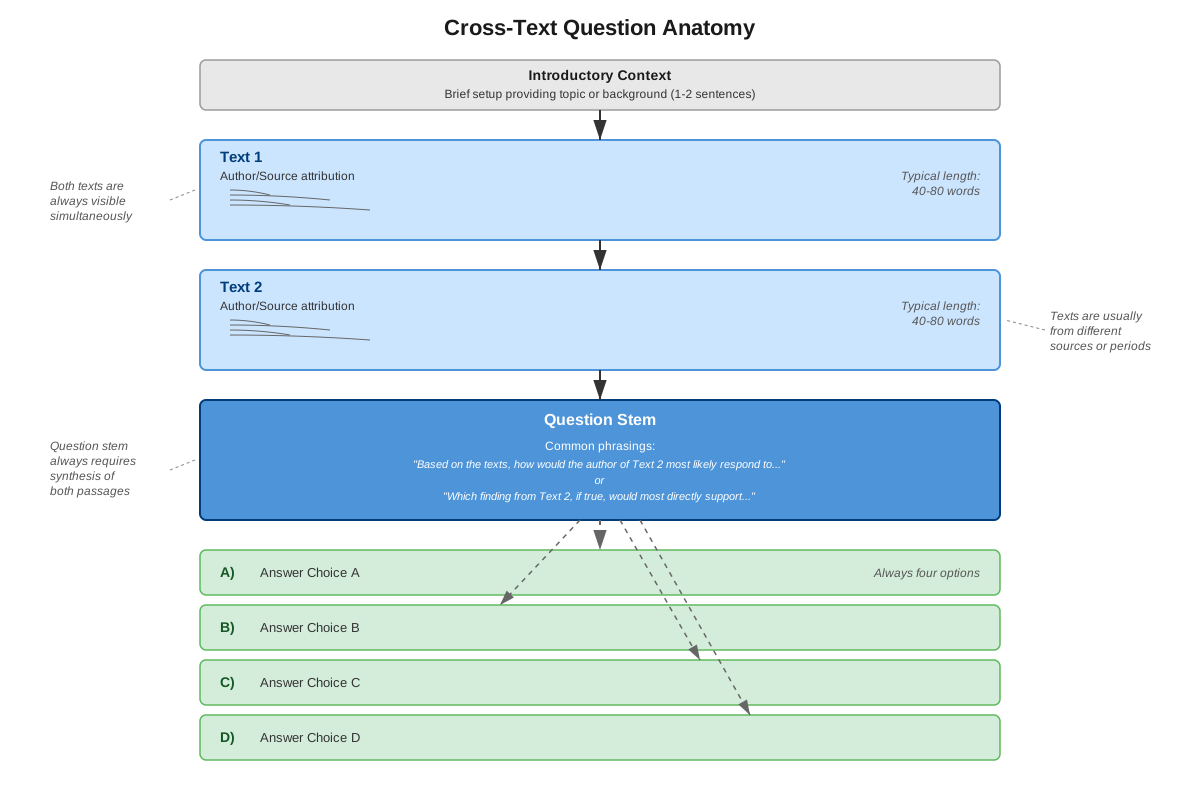
These questions typically present two short passages (Text 1 and Text 2) that relate to the same topic but may offer different perspectives, present complementary information, or provide contrasting evidence. Students must then answer a question that requires understanding both texts and recognizing how they interact. This question type has become increasingly prominent on the digital SAT, appearing in the RW (Reading and Writing) module with significant frequency. Mastering sat cross-text applications is essential because these questions assess higher-order thinking skills that colleges value: the ability to evaluate multiple sources, identify relationships between arguments, and synthesize information to form coherent conclusions.
Within the broader landscape of SAT Reading and Writing concepts, cross-text applications build upon foundational skills like identifying main ideas, understanding author's purpose, analyzing evidence, and recognizing rhetorical strategies. However, they elevate these skills by requiring simultaneous processing of multiple texts and metacognitive awareness of how different authors approach similar subjects. Success with cross-text questions demonstrates readiness for college-level work, where students routinely engage with multiple sources to construct arguments and develop informed perspectives.
Learning Objectives
- [ ] Identify key features of cross-text applications
- [ ] Explain how cross-text applications appears on the SAT
- [ ] Apply cross-text applications to answer SAT-style questions
- [ ] Distinguish between different types of cross-text relationships (supporting, contradicting, expanding, qualifying)
- [ ] Evaluate the strength of connections between paired passages
- [ ] Synthesize information from multiple texts to form accurate conclusions
Prerequisites
- Single-passage comprehension skills: Understanding main ideas, supporting details, and author's purpose in individual texts is foundational before comparing multiple texts
- Evidence identification: Recognizing which specific details support claims is essential for determining how texts relate to each other
- Inference skills: Drawing logical conclusions from textual evidence enables students to identify implicit relationships between passages
- Vocabulary in context: Understanding nuanced word meanings helps distinguish subtle differences in how authors approach similar topics
- Rhetorical awareness: Recognizing tone, purpose, and audience allows students to compare authorial approaches across texts
Why This Topic Matters
Cross-text applications reflect authentic academic and professional literacy demands. In college courses, students constantly engage with multiple sources—comparing research studies, evaluating competing theories, and synthesizing diverse perspectives into coherent arguments. Similarly, professionals in virtually every field must analyze information from various sources to make informed decisions. The SAT's emphasis on cross-text questions acknowledges that modern literacy extends beyond understanding isolated texts to skillfully navigating relationships among multiple sources.
On the digital SAT, cross-text questions appear with high frequency, typically comprising 3-5 questions per test in the Reading and Writing section. These questions carry the same weight as other question types, but their complexity means they often require more time and cognitive effort. According to College Board data, cross-text questions tend to have lower accuracy rates than single-passage questions, making them high-yield targets for score improvement. Students who master this skill can gain a significant competitive advantage.
Cross-text applications commonly appear in several formats on the SAT. Students might encounter paired passages where one text presents a hypothesis and another provides supporting or contradicting evidence. Other questions feature texts that offer different perspectives on historical events, scientific phenomena, or literary themes. Some questions ask students to identify how Text 2 relates to a specific claim in Text 1, while others require determining which statement best describes the relationship between both passages. The passages themselves span diverse subjects—from natural sciences and social studies to humanities and literature—ensuring that cross-text skills apply across all academic domains.
Core Concepts
Understanding Cross-Text Relationships
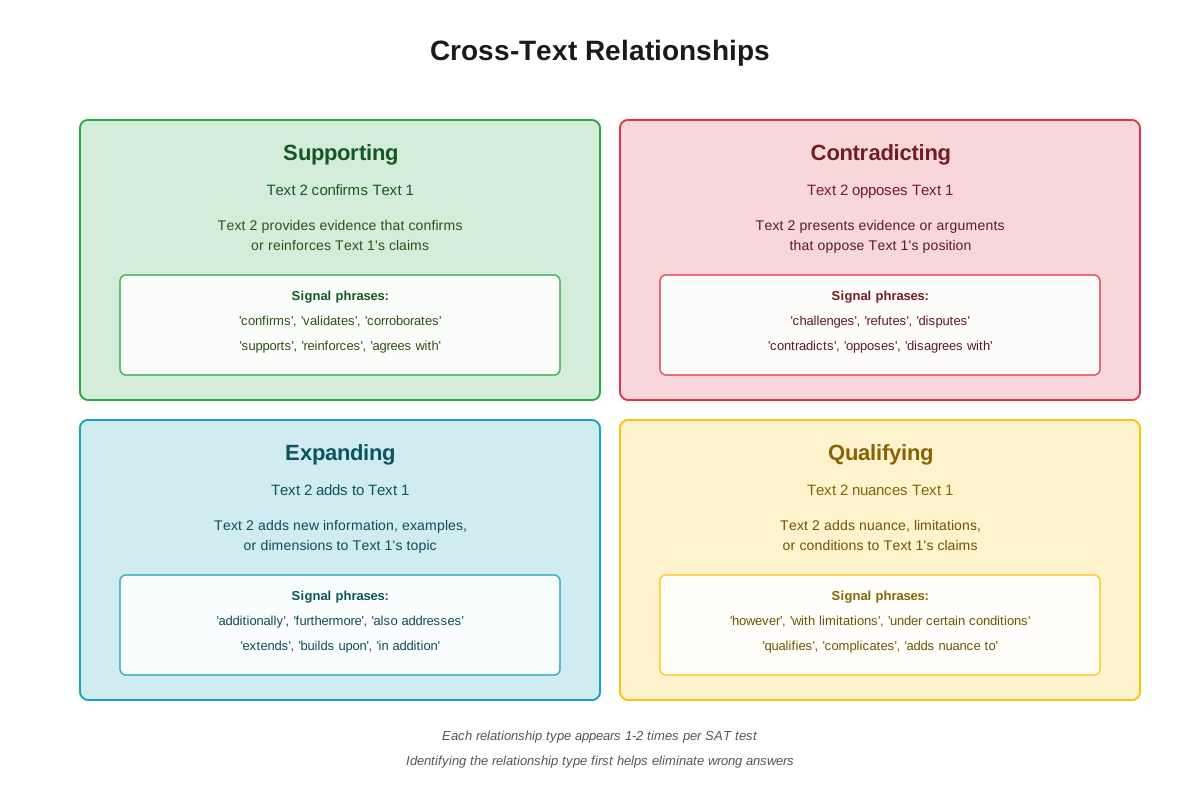
The foundation of cross-text applications lies in recognizing the various ways two passages can relate to each other. Unlike simple comparison, these relationships involve nuanced interactions between ideas, evidence, and arguments. The most common relationship types include:
Supporting relationships occur when Text 2 provides evidence, examples, or elaboration that strengthens claims made in Text 1. For instance, if Text 1 proposes a theory about animal behavior, Text 2 might present experimental data confirming that theory. Contradicting relationships emerge when texts present conflicting information, opposing viewpoints, or evidence that challenges claims. Expanding relationships happen when Text 2 introduces new dimensions, additional contexts, or broader implications related to Text 1's topic without directly supporting or contradicting it. Qualifying relationships involve Text 2 adding nuance, limitations, or conditions to statements in Text 1—neither fully supporting nor contradicting, but refining the original claim.
| Relationship Type | Text 1 Function | Text 2 Function | Key Indicators |
|---|---|---|---|
| Supporting | Makes claim | Provides confirming evidence | "similarly," "furthermore," "consistent with" |
| Contradicting | States position | Presents opposing view | "however," "in contrast," "challenges" |
| Expanding | Introduces concept | Adds new dimension | "additionally," "another aspect," "beyond" |
| Qualifying | Makes broad claim | Adds limitations | "although," "under certain conditions," "except" |
Analyzing Question Stems
SAT cross-text questions employ specific language patterns that signal what type of relationship students must identify. Recognizing these patterns enables efficient question analysis and targeted passage review. Common question stem formats include:
- "Based on the texts, how would the author of Text 2 most likely respond to the claim in Text 1?"
- "Which finding from Text 2, if true, would most directly support the hypothesis presented in Text 1?"
- "Text 1 and Text 2 both discuss [topic]. How do the texts differ in their emphasis?"
- "What does Text 2 suggest about the phenomenon described in Text 1?"
Each stem type requires different analytical approaches. Response-prediction questions demand understanding both authors' perspectives and reasoning about how one would engage with the other's ideas. Evidence-evaluation questions require identifying which specific details create meaningful connections. Emphasis-comparison questions focus on what each author prioritizes rather than whether they agree or disagree.
Strategic Reading for Cross-Text Questions
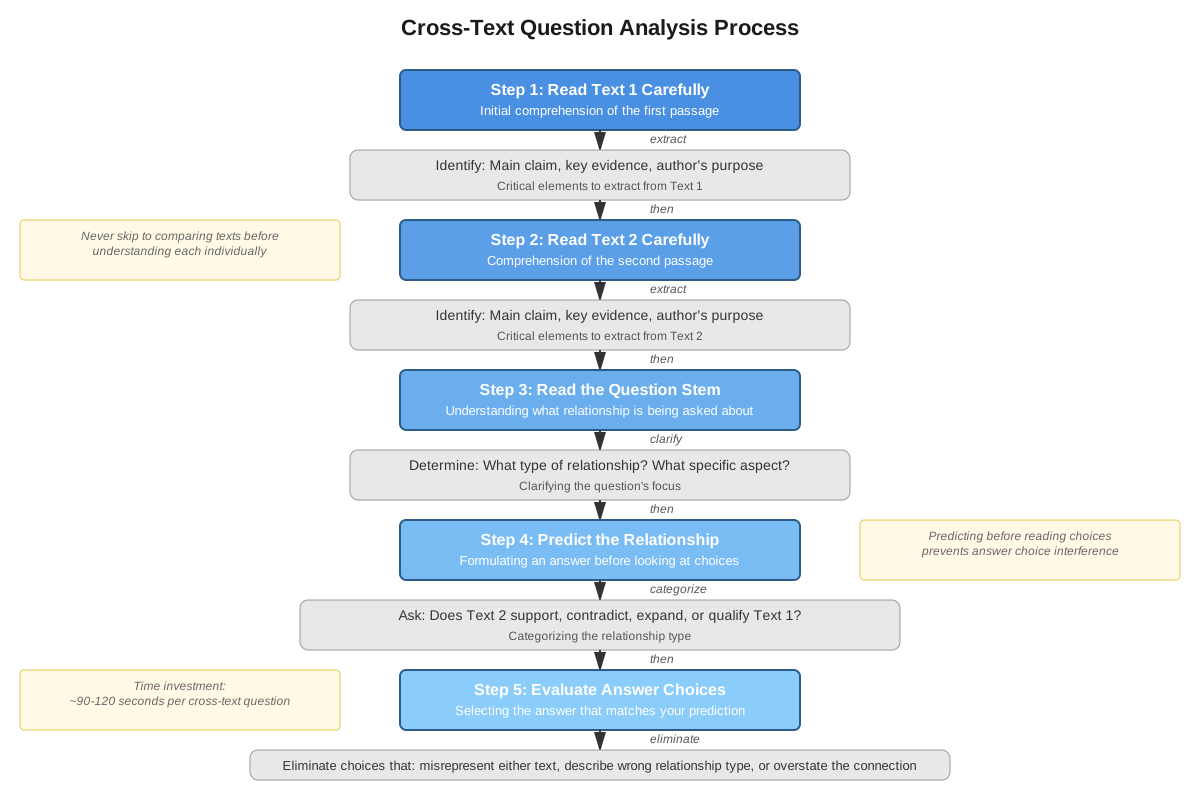
Effective cross-text analysis requires a systematic reading approach that differs from single-passage strategies. Students should first preview the question before reading either text, as knowing what relationship to identify focuses attention on relevant details. When reading Text 1, students should identify the main claim or central idea and note key supporting details, marking them mentally or with brief annotations. The goal is understanding the text's core message and recognizing which elements might connect to another passage.
Reading Text 2 requires active comparison—constantly asking "How does this relate to Text 1?" Students should look for points of agreement, disagreement, elaboration, or qualification. Specific details matter more than general impressions; the SAT rewards precise understanding of how particular claims, evidence, or examples in one text relate to specific elements in the other.
Evidence Mapping
A crucial skill for cross-text applications involves evidence mapping—mentally or physically tracking which details in each passage connect to each other and to the question being asked. Strong evidence mapping prevents common errors like choosing answers based on information from only one text or selecting relationships that seem plausible but lack textual support.
Consider this process: After reading both texts and reviewing the question, identify the specific sentence or claim in Text 1 that the question references. Then, scan Text 2 for information that directly relates to that specific claim. Evaluate whether Text 2's information supports, contradicts, expands, or qualifies the Text 1 claim. Finally, match this relationship to the answer choices, eliminating options that mischaracterize the connection or reference irrelevant details.
Synthesis and Integration
The highest-level cross-text skill involves synthesis—combining information from both passages to form conclusions that neither text explicitly states but both together support. Some SAT questions ask students to identify implications that emerge only when considering both texts together. This requires moving beyond simple comparison to genuine integration of ideas.
Synthesis questions might ask what both texts together suggest about a phenomenon, or which conclusion is supported by considering both passages. Success requires holding both texts' information in working memory simultaneously and recognizing patterns, contradictions, or complementary insights that create new understanding.
Concept Relationships
Cross-text applications build directly upon single-passage comprehension skills, elevating them to comparative analysis. The progression flows: Single-text main idea identification → Cross-text relationship recognition → Multi-text synthesis. Students must first master understanding individual passages before effectively comparing them.
Within cross-text applications themselves, concepts interconnect hierarchically. Understanding relationship types (supporting, contradicting, expanding, qualifying) enables accurate question stem analysis, which guides strategic reading approaches. Strategic reading produces the information necessary for evidence mapping, and evidence mapping provides the foundation for synthesis and integration. Each concept depends on those before it while enabling those that follow.
Cross-text applications also connect forward to college-level academic skills. Mastering these questions prepares students for research paper writing (comparing sources), seminar discussions (engaging with multiple perspectives), and critical thinking across disciplines (evaluating competing claims). The SAT's cross-text questions thus serve as both assessment tool and preparation for authentic academic work.
High-Yield Facts
⭐ Cross-text questions always require information from BOTH passages—answers based solely on one text are incorrect
⭐ The question stem determines which specific relationship to identify—read it carefully before analyzing the texts
⭐ Supporting relationships require Text 2 to provide evidence that confirms Text 1's claims—mere topical similarity is insufficient
⭐ Contradicting relationships involve direct conflict between claims or evidence—different emphasis does not equal contradiction
⭐ Qualifying relationships add nuance without fully supporting or contradicting—watch for conditional language like "under certain circumstances"
- Cross-text passages typically range from 25-75 words each, making them shorter than single-passage texts
- The passages always relate to the same general topic but may approach it from different angles
- Answer choices often include tempting options that accurately describe one text but mischaracterize the relationship
- Expanding relationships introduce new aspects of a topic without addressing the original text's specific claims
- Time management is crucial—cross-text questions require reading two passages but are worth the same points as single-passage questions
- Authors' tones and purposes may differ even when their factual claims align
- The correct answer must be defensible using specific textual evidence from both passages
- Process of elimination is particularly effective because wrong answers typically fail to accurately represent one or both texts
- Cross-text questions may reference specific lines ("the claim in the underlined sentence") or general ideas
- Some questions ask about the relationship between entire passages while others focus on specific claims within them
Quick check — test yourself on Cross-text applications so far.
Try Flashcards →Common Misconceptions
Misconception: If both texts discuss the same topic, they must support each other.
Correction: Texts can discuss the same topic while contradicting each other, emphasizing different aspects, or qualifying each other's claims. Topical similarity does not determine relationship type.
Misconception: A contradicting relationship exists whenever texts present different information.
Correction: Contradiction requires direct conflict between claims. Texts that present different but compatible information about a topic are expanding rather than contradicting each other.
Misconception: The correct answer will use the same vocabulary as the passages.
Correction: SAT answers often paraphrase passage content using different terminology. Students must recognize conceptual matches rather than expecting word-for-word repetition.
Misconception: Cross-text questions are always harder than single-passage questions.
Correction: While cross-text questions require processing two passages, they often feature shorter texts and straightforward relationships. With proper strategy, they can be answered as efficiently as single-passage questions.
Misconception: Reading Text 1 thoroughly before starting Text 2 is most efficient.
Correction: Previewing the question first focuses attention on relevant information in both texts, making reading more efficient and reducing the need to re-read passages.
Misconception: If Text 2 provides an example related to Text 1's topic, it automatically supports Text 1.
Correction: The example must specifically support Text 1's claims to constitute a supporting relationship. An example that illustrates a different point or contradicts Text 1's argument does not support it, even if topically related.
Misconception: Synthesis questions require making inferences beyond what the texts state.
Correction: While synthesis combines information from both texts, the correct answer must still be directly supported by textual evidence. Students should avoid choosing answers that require assumptions not grounded in the passages.
Worked Examples
Example 1: Supporting Relationship
Text 1
Researchers have hypothesized that the decline in bee populations observed in North America may be linked to the widespread use of neonicotinoid pesticides, which affect insects' nervous systems. Laboratory studies show that even low doses of these chemicals impair bees' navigation abilities and foraging efficiency.
Text 2
A recent field study tracked bee colonies in agricultural areas where neonicotinoid use was restricted compared to areas with unrestricted use. Colonies in restricted areas showed 23% higher survival rates and produced significantly more offspring, suggesting that reducing these pesticides benefits bee populations.
Question: Based on the texts, how does Text 2 relate to the hypothesis presented in Text 1?
Analysis:
First, identify Text 1's main claim: neonicotinoid pesticides may cause bee population decline. Text 1 provides laboratory evidence of harm (impaired navigation and foraging).
Next, examine Text 2's content: field study data showing better bee outcomes where neonicotinoid use was restricted. This real-world evidence demonstrates that reducing these pesticides correlates with improved bee survival and reproduction.
The relationship: Text 2 provides field evidence that supports Text 1's hypothesis. The laboratory findings in Text 1 suggested a mechanism (nervous system effects), and Text 2's field data confirms that reducing pesticide exposure produces the predicted outcome (better population health).
Correct answer concept: Text 2 provides field evidence that supports the hypothesis in Text 1 by showing improved bee outcomes when neonicotinoid exposure is reduced.
This example demonstrates a supporting relationship where Text 2 strengthens Text 1's claim with complementary evidence from a different research approach (field study vs. laboratory study).
Example 2: Qualifying Relationship
Text 1
The invention of the printing press in the 15th century revolutionized information dissemination in Europe, making books affordable and accessible to the general population. This technological advancement is widely credited with enabling the Protestant Reformation and the Scientific Revolution by allowing rapid spread of new ideas.
Text 2
While the printing press certainly increased book production, recent historical research reveals that literacy rates in 15th and 16th century Europe remained below 30% in most regions. The press's immediate impact was thus concentrated among educated elites who could read, with broader societal effects developing gradually over subsequent centuries as literacy expanded.
Question: Based on the texts, what does Text 2 suggest about the claim in Text 1 regarding the printing press's impact?
Analysis:
Text 1 makes a broad claim about the printing press revolutionizing information dissemination and enabling major historical movements. The language suggests immediate, widespread impact ("making books affordable and accessible to the general population").
Text 2 introduces an important limitation: low literacy rates meant most people couldn't read printed materials. Text 2 doesn't deny the printing press's significance but qualifies the timeline and scope of its impact—effects were initially limited to educated elites and became broader only gradually.
The relationship: Text 2 qualifies Text 1's claim by adding nuance about who benefited from the printing press and when. It's neither fully supporting (which would confirm the broad, immediate impact) nor contradicting (which would deny the press's importance), but rather refining the claim with additional context.
Correct answer concept: Text 2 suggests that the printing press's impact described in Text 1 was initially more limited in scope than Text 1 implies, affecting primarily literate elites before gradually reaching broader populations.
This example illustrates a qualifying relationship where Text 2 adds important limitations and nuance to Text 1's claim without rejecting its fundamental validity.
Exam Strategy
Approaching cross-text questions strategically maximizes accuracy while managing time effectively. The optimal sequence begins with reading the question first—before reading either passage. This preview reveals what relationship to identify and which specific elements to focus on, making subsequent reading more efficient and purposeful.
When reading the passages, employ active annotation (mental or physical). For Text 1, identify and mark the main claim or central idea. Note key supporting details, especially those that might connect to another text. Maintain awareness of the author's tone and purpose. For Text 2, read with constant comparison in mind, asking "How does this relate to Text 1?" Mark points of connection, whether they support, contradict, expand, or qualify Text 1's content.
Trigger words and phrases provide valuable clues about relationships:
- Supporting: "similarly," "consistent with," "confirms," "evidence shows," "supports the idea"
- Contradicting: "however," "in contrast," "challenges," "disputes," "unlike," "contradicts"
- Expanding: "additionally," "furthermore," "another aspect," "beyond," "also"
- Qualifying: "although," "while," "under certain conditions," "with limitations," "except when"
For process of elimination, systematically evaluate each answer choice against both texts. Eliminate options that:
- Accurately describe only one text while misrepresenting the other
- Describe a relationship not supported by specific textual evidence
- Use extreme language ("always," "never," "completely") unless the texts genuinely support such absolutes
- Reference details from the passages but mischaracterize how they relate to each other
Time allocation for cross-text questions should account for reading two passages but avoid excessive deliberation. Aim for approximately 60-75 seconds total: 15-20 seconds reading the question and each passage, 20-25 seconds analyzing the relationship and evaluating answer choices. If uncertain after this time, make your best choice and move forward—cross-text questions are worth the same points as simpler questions, so spending excessive time on them reduces time available for other questions.
Exam Tip: If stuck between two answer choices, return to the question stem and identify the specific claim or element it references. Then check which answer choice more accurately describes how Text 2 relates to that specific element rather than to Text 1 generally.
Memory Techniques
SCEX Acronym for relationship types:
- Supporting: Text 2 confirms Text 1
- Contradicting: Text 2 conflicts with Text 1
- Expanding: Text 2 adds new dimensions to Text 1
- X-qualifying: Text 2 adds conditions/limitations to Text 1
The Bridge Visualization: Picture Text 1 and Text 2 as two islands. The correct answer is the bridge connecting them. Wrong answers are bridges that connect to only one island, connect to the wrong parts of the islands, or don't actually reach both islands. This mental image reinforces that answers must accurately represent both texts and their relationship.
Question-First Mantra: "Question first, question first, question first." Repeating this before each cross-text question reinforces the strategic habit of previewing the question before reading passages, which consistently improves efficiency and accuracy.
The Two-Check System: Before selecting an answer, physically or mentally check it against Text 1 (Does this accurately represent Text 1's content?) and Text 2 (Does this accurately represent Text 2's content?). Only answers that pass both checks can be correct.
PEAR for Reading Strategy:
- Preview the question
- Examine Text 1 for main claim
- Analyze Text 2 for connections
- Relate the texts to answer the question
Summary
Cross-text applications represent a sophisticated SAT Reading and Writing skill that requires synthesizing information from paired passages to identify relationships between them. These questions assess students' ability to compare, contrast, evaluate, and integrate ideas across multiple sources—skills essential for college-level academic work. The four primary relationship types (supporting, contradicting, expanding, and qualifying) each require recognizing specific patterns in how texts interact. Success depends on strategic reading that begins with previewing the question, continues with active comparison while reading both passages, and concludes with evidence-based evaluation of answer choices. Students must avoid common pitfalls like assuming topical similarity indicates support or mistaking different emphasis for contradiction. By systematically analyzing how Text 2 relates to specific claims in Text 1 and eliminating answers that misrepresent either passage, students can efficiently and accurately answer these high-value questions.
Key Takeaways
- Always read the question before reading the passages to focus attention on relevant relationships
- Cross-text questions require information from both passages—answers based on only one text are incorrect
- The four main relationship types are supporting, contradicting, expanding, and qualifying—each has distinct characteristics
- Trigger words in passages and answer choices provide clues about relationship types
- Eliminate answer choices that accurately describe one text but misrepresent the other or the relationship between them
- Evidence mapping—tracking which specific details in each passage connect to each other—prevents errors and increases confidence
- Time management is crucial since cross-text questions require reading two passages but carry the same point value as single-passage questions
Related Topics
Single-Passage Analysis: Mastering individual passage comprehension provides the foundation for cross-text applications. Strong single-text skills make comparing multiple passages significantly easier.
Rhetorical Analysis: Understanding how authors use language, tone, and structure to achieve purposes helps identify subtle differences in how paired passages approach similar topics.
Evidence-Based Reading: The skill of identifying which textual details support specific claims is essential for determining how passages relate to each other.
Synthesis Writing: The ability to integrate information from multiple sources, developed through cross-text applications, directly supports college-level research and argumentative writing.
Comparative Analysis: Beyond the SAT, cross-text skills enable sophisticated comparison of research studies, historical sources, literary works, and competing theories across all academic disciplines.
Practice CTA
Now that you've mastered the concepts and strategies for cross-text applications, it's time to put your knowledge into action! Complete the practice questions to reinforce these skills and build the confidence you need for test day. Each practice question provides an opportunity to apply the PEAR strategy, identify relationship types, and refine your evidence-mapping abilities. Remember, cross-text questions are high-yield opportunities for score improvement—students who master this skill consistently outperform those who don't. The flashcards will help you internalize key concepts and trigger words, making relationship identification automatic and efficient. You've got this!
Sign up free to keep reading
Create a free AnvayaPrep account to finish this SAT guide on Cross-text applications — plus flashcards and practice questions.