Overview
Cross-text reasoning is a critical skill tested in the SAT Reading and Writing (RW) section that requires students to synthesize information from two related passages and draw conclusions about how they connect. Unlike traditional single-passage questions, cross-text reasoning questions present two brief texts—typically labeled Text 1 and Text 2—and ask students to identify relationships, compare perspectives, evaluate evidence, or determine how one text responds to or builds upon the other. This question type assesses higher-order thinking skills that go beyond simple comprehension, demanding that students actively compare, contrast, and integrate ideas across multiple sources.
The importance of sat cross-text reasoning cannot be overstated for test-takers aiming for competitive scores. These questions appear consistently throughout the digital SAT, representing a significant portion of the Reading and Writing module. Students must quickly identify the relationship between texts—whether one supports, contradicts, qualifies, or extends the other—and select the answer choice that most accurately captures this connection. The ability to perform cross-text analysis efficiently separates high-scoring students from those who struggle with the exam's time constraints.
Within the broader landscape of SAT rw skills, cross-text reasoning represents the culmination of multiple competencies: reading comprehension, critical analysis, logical reasoning, and synthesis. It builds upon foundational skills like identifying main ideas, understanding author's purpose, and recognizing evidence, while adding the complexity of managing multiple perspectives simultaneously. Mastering this topic strengthens overall analytical abilities that prove valuable not only for the SAT but also for college-level academic work where comparing sources is routine.
Learning Objectives
By the end of this study guide, students will be able to:
- [ ] Identify key features of Cross-text reasoning
- [ ] Explain how Cross-text reasoning appears on the SAT
- [ ] Apply Cross-text reasoning to answer SAT-style questions
- [ ] Distinguish between different types of cross-text relationships (support, contradiction, qualification, extension)
- [ ] Evaluate which specific details from each text are most relevant to answering cross-text questions
- [ ] Recognize common question stems and triggers that signal cross-text reasoning tasks
Prerequisites
Students should have mastery of the following concepts before studying cross-text reasoning:
- Reading comprehension fundamentals: Understanding main ideas, supporting details, and author's purpose is essential because cross-text reasoning builds upon these basic comprehension skills applied to multiple passages simultaneously.
- Evidence identification: The ability to locate and evaluate textual evidence is crucial since cross-text questions require comparing specific claims and support from two different sources.
- Logical reasoning: Understanding basic logical relationships (cause-effect, comparison-contrast) provides the foundation for recognizing how two texts relate to each other.
- Vocabulary in context: Strong vocabulary skills enable students to quickly grasp the meaning of both passages, which is necessary before analyzing their relationship.
Why This Topic Matters
Cross-text reasoning reflects authentic academic and professional skills that extend far beyond standardized testing. In college courses, students routinely compare scholarly articles, evaluate competing theories, and synthesize information from multiple sources when writing research papers. In professional contexts, decision-makers must analyze reports from different departments, compare expert opinions, and integrate diverse perspectives to reach informed conclusions. The SAT's emphasis on cross-text reasoning acknowledges that modern literacy demands the ability to navigate multiple information sources simultaneously.
On the digital SAT, cross-text reasoning questions appear with high frequency—typically 3-5 questions per Reading and Writing module, accounting for approximately 10-15% of the total RW score. These questions span diverse content areas including literature, history, science, and social studies, ensuring that all students encounter them regardless of passage selection. The question types vary but commonly include: identifying how Text 2 relates to Text 1, determining what a researcher in Text 2 would say about a claim in Text 1, or recognizing which statement best describes the relationship between the texts.
Common manifestations in exam passages include: paired scientific studies with different findings, historical documents presenting contrasting perspectives, literary excerpts with complementary themes, or social science texts where one qualifies or extends the other's argument. The texts are typically brief (40-80 words each), allowing students to read both passages within 60-90 seconds before analyzing their relationship. This format tests not just comprehension speed but also the cognitive flexibility to hold multiple perspectives in working memory while identifying their connection.
Core Concepts
Understanding Cross-Text Relationships
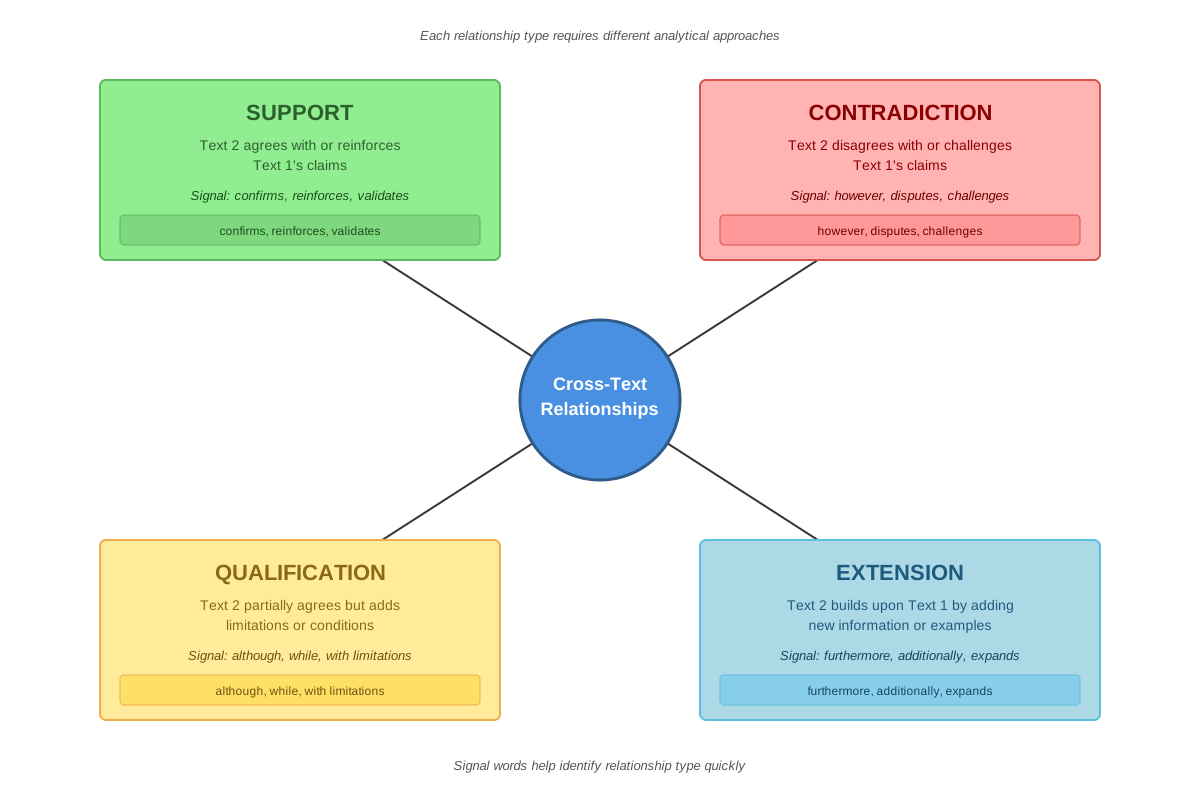
The foundation of cross-text reasoning lies in recognizing the fundamental ways two texts can relate to each other. These relationships fall into several distinct categories that appear repeatedly on the SAT. Support occurs when Text 2 provides evidence, examples, or reasoning that strengthens or confirms a claim made in Text 1. Contradiction happens when Text 2 presents information that challenges, refutes, or undermines the position taken in Text 1. Qualification involves Text 2 adding nuance, limitations, or conditions to Text 1's claims without fully contradicting them. Extension occurs when Text 2 builds upon Text 1 by adding new information, exploring implications, or taking the discussion in a related direction.
Understanding these relationship types requires careful attention to the specific claims each text makes. Students must identify the central assertion or finding in Text 1, then determine whether Text 2 affirms it, disputes it, modifies it, or develops it further. The key is recognizing that both texts address a common topic or question, but their perspectives or findings may differ in significant ways.
Identifying Key Claims and Evidence
Effective cross-text reasoning depends on quickly isolating the most important claim in each passage. The key claim is the main point, finding, or argument that the text advances. In scientific passages, this might be a research finding or hypothesis. In historical texts, it could be an interpretation of events. In literary excerpts, it might be a thematic observation or character insight.
Once the key claims are identified, students must evaluate the evidence each text provides. Evidence includes specific examples, data, quotations, or logical reasoning that supports the claim. Cross-text questions often hinge on how the evidence in one text relates to the claim in another. For instance, Text 2 might present data that contradicts Text 1's hypothesis, or Text 2 might offer an example that illustrates Text 1's abstract principle.
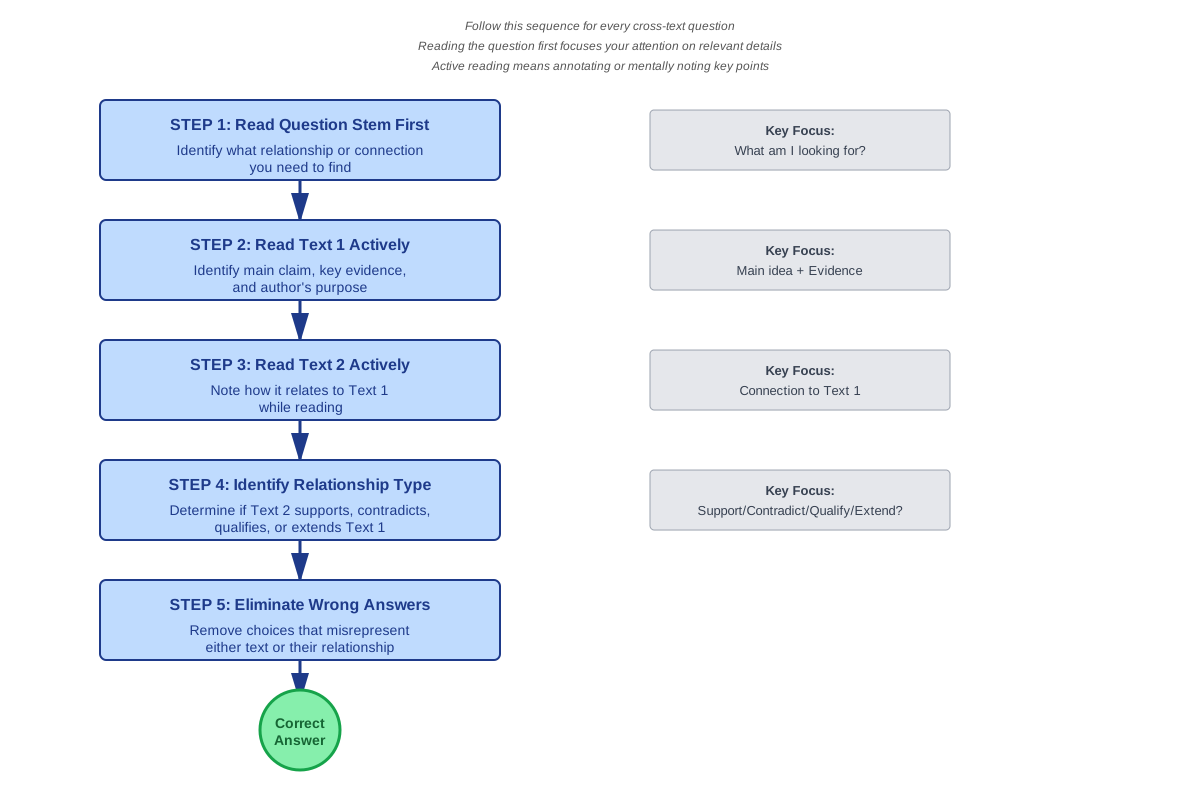
The process follows these steps:
- Read Text 1 and identify its main claim
- Note any significant evidence or reasoning provided
- Read Text 2 and identify its main claim
- Note its evidence or reasoning
- Compare the claims and evidence to determine the relationship
- Eliminate answer choices that misrepresent either text or their connection
Common Question Formats
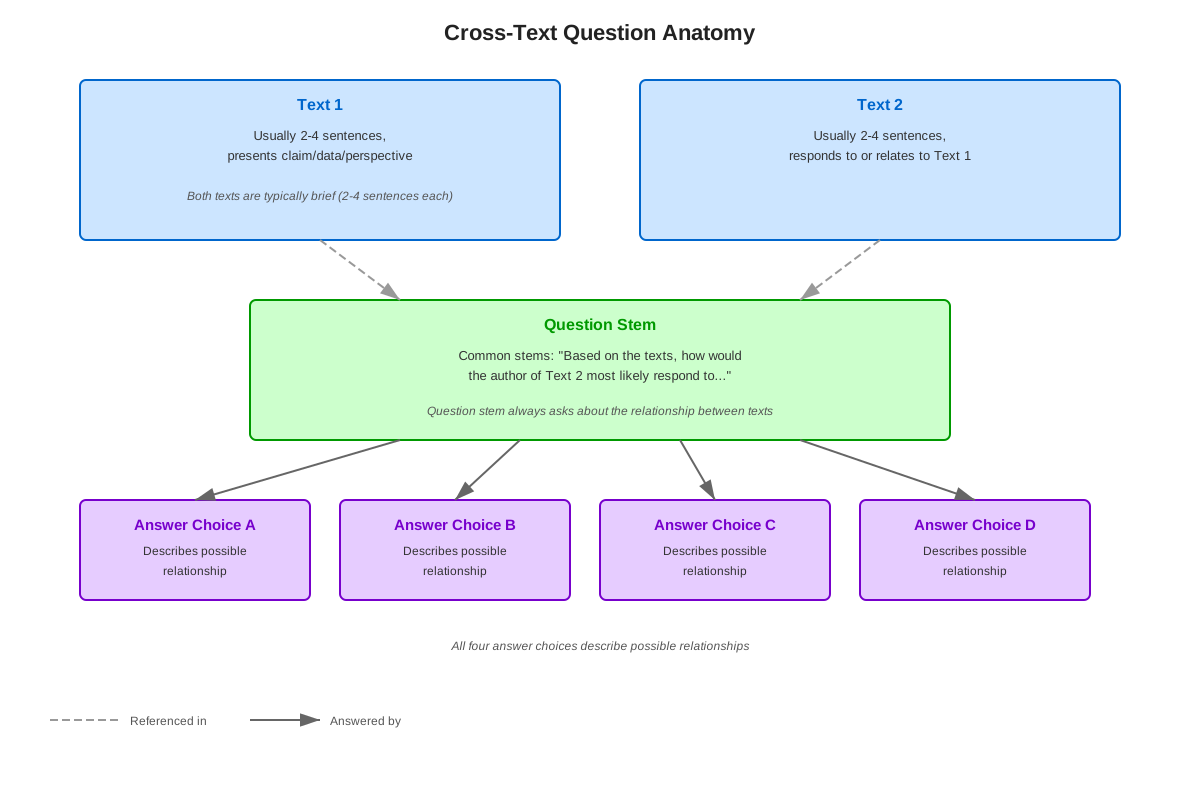
SAT cross-text reasoning questions follow predictable patterns that students can learn to recognize. The most frequent format asks: "Based on the texts, how would the author of Text 2 most likely respond to the claim in Text 1?" This requires students to infer what someone holding Text 2's position would say about Text 1's argument. Another common format states: "Which choice best describes the relationship between Text 1 and Text 2?" This directly tests whether students can categorize the connection (support, contradiction, etc.).
A third format presents a claim and asks: "Which finding from Text 2, if true, would most directly support/challenge the hypothesis in Text 1?" This variation requires students to identify which specific detail creates the relevant relationship. Less common but still important are questions asking students to identify a point of agreement between the texts or to recognize how Text 2 provides an example of a concept introduced in Text 1.
Analyzing Perspective and Tone
Beyond explicit claims, cross-text reasoning sometimes requires attention to perspective and tone. Two texts might discuss the same topic but from different viewpoints—a scientist versus a historian, a critic versus an advocate, a contemporary observer versus a modern analyst. Recognizing these different perspectives helps students understand why the texts might reach different conclusions or emphasize different aspects of the topic.
Tone—the author's attitude toward the subject—can also signal relationships between texts. A skeptical tone in Text 2 might indicate disagreement with Text 1's enthusiastic claims. A cautious tone might suggest qualification rather than outright contradiction. Students should note words that convey attitude: "surprisingly," "unfortunately," "merely," "significantly," "however," and similar markers that reveal the author's stance.
Synthesis and Integration
The ultimate goal of cross-text reasoning is synthesis—combining information from both texts to form a coherent understanding of their relationship. This goes beyond simply reading each text independently; it requires holding both in mind simultaneously and actively comparing them. Strong readers develop a mental model that includes: the topic both texts address, each text's position on that topic, the evidence each provides, and the nature of their agreement or disagreement.
Integration involves recognizing that even when texts disagree, they contribute to a larger conversation about a topic. Text 1 might present a traditional view while Text 2 offers a revisionist perspective. Text 1 might report a correlation while Text 2 explores causation. Understanding how the texts fit together—even in disagreement—demonstrates sophisticated analytical thinking.
| Relationship Type | Text 2's Role | Key Indicators | Example Scenario |
|---|---|---|---|
| Support | Confirms or strengthens Text 1 | "Similarly," "This finding confirms," "Evidence shows" | Text 1 proposes a theory; Text 2 presents data supporting it |
| Contradiction | Challenges or refutes Text 1 | "However," "In contrast," "Contrary to," "Actually" | Text 1 claims X causes Y; Text 2 shows no such relationship |
| Qualification | Adds nuance or limits to Text 1 | "While," "Although," "Under certain conditions" | Text 1 makes broad claim; Text 2 identifies exceptions |
| Extension | Builds upon or develops Text 1 | "Furthermore," "Additionally," "This suggests" | Text 1 describes phenomenon; Text 2 explores implications |
Concept Relationships
Cross-text reasoning integrates multiple foundational reading skills into a unified analytical process. The skill begins with reading comprehension → which enables claim identification → which supports evidence evaluation → which facilitates relationship recognition → which culminates in synthesis and answer selection.
Within the topic itself, understanding relationship types (support, contradiction, qualification, extension) provides the framework for analyzing perspective and tone, since an author's viewpoint often determines which type of relationship exists between texts. Both of these concepts feed into synthesis and integration, the highest-level skill that allows students to see how texts contribute to a broader conversation.
Cross-text reasoning connects to other SAT Reading and Writing topics in important ways. It builds upon textual evidence skills, as students must identify which specific details from each text are relevant. It relates to author's purpose and point of view, since understanding why each author wrote their text helps clarify how the texts relate. It also connects to rhetorical analysis, as recognizing how authors use language to advance their claims aids in comparing those claims across texts.
The progression from prerequisites to mastery follows this path: Basic comprehension → Single-text analysis → Cross-text comparison → Synthesis across multiple sources. Students who struggle with cross-text reasoning often need to strengthen earlier skills in this chain, particularly claim identification and evidence evaluation within single texts before attempting to compare across texts.
High-Yield Facts
⭐ Cross-text reasoning questions always present two related passages that address a common topic or question from different angles.
⭐ The four main relationship types are support, contradiction, qualification, and extension—recognizing which applies is essential to answering correctly.
⭐ The key claim in each text is typically found in the first or last sentence, though not always.
⭐ Answer choices often misrepresent one text's position or the relationship between texts—careful verification against both passages is crucial.
⭐ Transition words and phrases (however, similarly, although, furthermore) often signal the type of relationship between texts.
- Cross-text questions typically require 60-90 seconds to complete, including reading both passages and analyzing answer choices.
- Both texts are usually 40-80 words each, making them manageable to hold in working memory simultaneously.
- Wrong answers frequently include accurate statements about one text that don't address the relationship between texts.
- The correct answer must be supported by both texts—if it contradicts or isn't supported by either passage, it's wrong.
- Questions asking "how would the author of Text 2 respond to Text 1" require inference based on Text 2's position, not speculation beyond what's stated.
Quick check — test yourself on Cross-text reasoning so far.
Try Flashcards →Common Misconceptions
Misconception: Cross-text reasoning questions always involve disagreement between the texts.
Correction: While contradiction is one relationship type, texts can also support, qualify, or extend each other. Many cross-text questions involve texts that agree or complement each other rather than disagree.
Misconception: The correct answer must use information from both texts explicitly.
Correction: The correct answer must accurately describe the relationship between texts, which sometimes means characterizing how Text 2 relates to Text 1 without necessarily quoting both. The relationship itself is what matters.
Misconception: Longer or more complex-sounding answer choices are more likely to be correct.
Correction: The SAT does not reward verbosity. The correct answer is the one that most accurately captures the relationship, regardless of length or complexity. Often, simpler answers are correct.
Misconception: If Text 2 doesn't explicitly mention Text 1's topic, they must be unrelated.
Correction: Texts can address the same underlying question or concept using different examples or terminology. The connection might be implicit rather than explicit, requiring students to recognize the common thread.
Misconception: Personal opinion about which text is more convincing should influence answer selection.
Correction: Cross-text reasoning questions test objective analysis of relationships, not subjective evaluation of quality. The correct answer describes what the texts actually say and how they relate, not which is better argued or more persuasive.
Misconception: All information in both texts is equally important for answering the question.
Correction: Cross-text questions typically hinge on specific claims or pieces of evidence. Students must identify which details are relevant to the relationship being tested and focus on those rather than trying to incorporate every sentence.
Worked Examples
Example 1: Scientific Research Comparison
Text 1
Researchers studying sleep patterns in adolescents have long attributed teenagers' tendency to stay up late to behavioral choices and poor time management. Traditional recommendations emphasize earlier bedtimes and reduced screen time as solutions to adolescent sleep deprivation.
Text 2
Recent neurological studies reveal that adolescent circadian rhythms naturally shift toward later sleep and wake times due to hormonal changes during puberty. This biological shift, called "sleep phase delay," means teenagers' bodies are physiologically programmed to feel alert later in the evening and sleepy later in the morning than adults or younger children.
Question: Based on the texts, how would the researchers described in Text 2 most likely respond to the traditional view presented in Text 1?
Answer Choices:
A) They would agree that behavioral interventions are the most effective approach to adolescent sleep issues.
B) They would argue that the traditional view overlooks biological factors that influence teenage sleep patterns.
C) They would suggest that hormonal changes have no significant impact on sleep schedules.
D) They would recommend that teenagers should try harder to follow adult sleep schedules.
Solution Process:
Step 1: Identify Text 1's key claim
Text 1 presents the traditional view that teenagers stay up late due to "behavioral choices and poor time management," with solutions focused on changing behavior (earlier bedtimes, less screen time).
Step 2: Identify Text 2's key claim
Text 2 presents research showing that teenage sleep patterns result from "biological" factors—specifically, hormonal changes causing "sleep phase delay" that makes teenagers naturally alert later.
Step 3: Determine the relationship
Text 2 contradicts or challenges Text 1 by offering a biological explanation instead of a behavioral one. Text 2 suggests the traditional view is incomplete because it ignores physiological factors.
Step 4: Evaluate answer choices
- A: Incorrect—Text 2 emphasizes biological factors, not behavioral interventions
- B: Correct—This accurately captures that Text 2 identifies biological factors the traditional view "overlooks"
- C: Incorrect—Text 2 explicitly states hormonal changes DO have significant impact
- D: Incorrect—Text 2 suggests teenagers' bodies are "programmed" differently, implying trying harder won't overcome biology
Answer: B
This question demonstrates the contradiction relationship type, where Text 2 challenges Text 1's explanation by offering an alternative based on different evidence.
Example 2: Historical Interpretation
Text 1
The rapid industrialization of the late 19th century transformed American cities, creating unprecedented economic opportunities. Urban populations swelled as workers migrated to manufacturing centers, and new technologies like electric lighting and streetcars modernized daily life. This period represented remarkable progress and innovation.
Text 2
While industrialization brought economic growth, it also created severe social problems in American cities. Overcrowded tenements lacked basic sanitation, factory workers endured dangerous conditions and exploitative wages, and child labor was widespread. The period's progress came at a significant human cost that affected millions of working-class families.
Question: Which choice best describes the relationship between Text 1 and Text 2?
Answer Choices:
A) Text 2 contradicts Text 1 by denying that industrialization created economic opportunities.
B) Text 2 qualifies Text 1 by acknowledging industrialization's benefits while highlighting its negative consequences.
C) Text 2 supports Text 1 by providing additional examples of technological progress.
D) Text 2 extends Text 1 by discussing a later historical period.
Solution Process:
Step 1: Identify Text 1's position
Text 1 presents a positive view of industrialization, emphasizing "economic opportunities," "progress," and "innovation."
Step 2: Identify Text 2's position
Text 2 acknowledges economic growth ("While industrialization brought economic growth") but emphasizes negative consequences: overcrowding, dangerous conditions, exploitation, child labor.
Step 3: Determine the relationship
Text 2 doesn't completely contradict Text 1—it acknowledges the economic growth Text 1 mentions. However, it adds significant nuance by highlighting problems Text 1 ignores. This is qualification—adding complexity and limitations to Text 1's positive assessment.
Step 4: Evaluate answer choices
- A: Incorrect—Text 2 acknowledges economic growth, not denying opportunities
- B: Correct—"Qualifies" accurately describes adding nuance; the answer captures both acknowledgment of benefits and highlighting of costs
- C: Incorrect—Text 2 focuses on problems, not additional examples of progress
- D: Incorrect—Both texts discuss the same period (late 19th century industrialization)
Answer: B
This question illustrates the qualification relationship, where Text 2 doesn't completely disagree with Text 1 but adds important limitations and counterpoints that complicate the initial assessment.
Exam Strategy
When approaching cross-text reasoning questions on the SAT, follow a systematic process to maximize accuracy and efficiency. First, read the question stem before reading the passages to understand what relationship you're looking for. This primes your brain to notice relevant details while reading. Then read Text 1 completely, identifying its main claim in one sentence. Immediately read Text 2, again identifying its main claim. Before looking at answer choices, articulate to yourself in simple terms how the texts relate: "Text 2 disagrees with Text 1" or "Text 2 gives an example of Text 1's idea."
Trigger words to watch for include:
- Support indicators: "similarly," "likewise," "this confirms," "evidence shows," "as predicted"
- Contradiction indicators: "however," "in contrast," "contrary to," "actually," "surprisingly," "challenges"
- Qualification indicators: "while," "although," "under certain conditions," "with some exceptions," "not always"
- Extension indicators: "furthermore," "additionally," "this suggests," "building on," "taking this further"
For process of elimination, systematically check each answer choice against both texts. An answer is wrong if it: (1) misrepresents what either text actually says, (2) accurately describes one text but doesn't address the relationship between them, (3) describes a relationship that doesn't match what the texts show, or (4) goes beyond what can be reasonably inferred from the passages. The correct answer must be defensible using only information from the two texts provided.
Time Management Tip: Allocate 60-90 seconds per cross-text question. If you're spending more than 2 minutes, you're likely overthinking. Make your best choice and move forward—cross-text questions are worth the same points as simpler questions, so don't sacrifice time needed elsewhere.
When stuck between two answer choices, return to the texts and verify each answer against specific sentences. The correct answer will align with concrete details from both passages, while the wrong answer will typically mischaracterize something subtle. Pay special attention to qualifiers like "always," "never," "only," "primarily"—these absolute or limiting words must be precisely accurate to be correct.
Memory Techniques
Use the acronym SCQE to remember the four main relationship types:
- Support: Text 2 strengthens Text 1
- Contradict: Text 2 challenges Text 1
- Qualify: Text 2 adds nuance to Text 1
- Extend: Text 2 builds upon Text 1
For the systematic reading process, remember "CLAIM-COMPARE-CHOOSE":
- CLAIM: Identify the main claim in each text
- COMPARE: Determine how the claims relate
- CHOOSE: Select the answer that matches the relationship
Visualize cross-text relationships as a conversation between two people. Text 1 makes a statement. Does Text 2 say "Yes, and here's more evidence" (support)? "No, actually..." (contradiction)? "Yes, but..." (qualification)? Or "Yes, and furthermore..." (extension)? This conversational framework makes abstract relationships more concrete and memorable.
To remember which details matter most, use the "Main Claim Rule": The sentences that state conclusions, findings, or arguments are almost always more important than background information or minor details. When reading each text, ask "What is this author trying to convince me of?" The answer is the key claim.
Summary
Cross-text reasoning is a high-frequency SAT skill that requires students to analyze relationships between two related passages. Success depends on quickly identifying the main claim in each text, then determining whether the texts support, contradict, qualify, or extend each other. The systematic approach involves reading Text 1 for its key claim, reading Text 2 for its key claim, comparing the claims to identify their relationship, and selecting the answer choice that accurately describes that relationship. Common pitfalls include misreading one text's position, choosing answers that describe only one text without addressing the relationship, and selecting answers that go beyond what the texts actually state. Effective test-takers recognize trigger words that signal relationship types, verify answer choices against specific textual evidence, and manage time efficiently by spending 60-90 seconds per question. Mastering cross-text reasoning requires practice synthesizing information from multiple sources—a skill that proves valuable not only for the SAT but also for academic work and professional contexts where comparing perspectives is essential. The key to consistent success is methodical analysis: identify each text's position clearly, determine how they relate objectively, and choose the answer that most precisely captures that relationship based solely on what the passages state.
Key Takeaways
- Cross-text reasoning questions present two related passages and ask students to identify or characterize the relationship between them
- The four main relationship types are support (Text 2 confirms Text 1), contradiction (Text 2 challenges Text 1), qualification (Text 2 adds nuance to Text 1), and extension (Text 2 builds upon Text 1)
- Success requires identifying the main claim in each text before analyzing how they relate—background details are less important than central arguments
- Correct answers must accurately represent both texts and their relationship; wrong answers often mischaracterize one text or describe only one text without addressing the connection
- Systematic process (read question, identify Text 1's claim, identify Text 2's claim, compare, eliminate wrong answers) maximizes accuracy and efficiency
- Transition words and phrases (however, similarly, although, furthermore) often signal the type of relationship between texts
- Allocate 60-90 seconds per cross-text question and verify answer choices against specific textual evidence rather than relying on general impressions
Related Topics
Textual Evidence and Citation: Cross-text reasoning builds upon the ability to identify and evaluate evidence within passages. Mastering how authors use evidence to support claims in single texts provides the foundation for comparing evidence across multiple texts.
Author's Purpose and Point of View: Understanding why authors write and what perspectives they bring helps clarify why texts might agree or disagree. This topic deepens cross-text analysis by adding awareness of rhetorical context.
Rhetorical Analysis: Examining how authors use language, structure, and persuasive techniques connects to cross-text reasoning when comparing how different authors approach similar topics with different rhetorical strategies.
Synthesis in Research Writing: The academic skill of synthesizing multiple sources in research papers represents the real-world application of cross-text reasoning, making this SAT skill directly transferable to college coursework.
Practice CTA
Now that you've mastered the concepts and strategies for cross-text reasoning, it's time to apply your knowledge! Work through the practice questions to reinforce your understanding and build confidence. Each question you practice strengthens your ability to quickly identify relationships between texts and select correct answers under time pressure. The flashcards will help you internalize key concepts and relationship types so they become automatic on test day. Remember: cross-text reasoning is a learnable skill that improves with deliberate practice. You've got the tools—now put them to work and watch your scores improve!
Sign up free to keep reading
Create a free AnvayaPrep account to finish this SAT guide on Cross-text reasoning — plus flashcards and practice questions.