Overview
Cross-text scope questions represent one of the most sophisticated question types in the SAT Reading and Writing (RW) section. These questions require students to synthesize information from two distinct texts, analyzing how they relate to each other in terms of breadth, focus, and depth of coverage. Unlike traditional reading comprehension questions that focus on a single passage, cross-text scope questions assess a student's ability to compare and contrast the range and specificity of information presented across multiple sources.
Understanding cross-text scope is essential for SAT success because these questions appear consistently throughout the exam and test higher-order thinking skills. Students must not only comprehend each text independently but also evaluate how their scopes differ—whether one text provides a broader overview while another offers detailed analysis, or whether they address the same topic from different angles with varying levels of specificity. This skill mirrors real-world academic and professional tasks where synthesizing multiple sources is crucial for informed decision-making and comprehensive understanding.
Within the broader SAT Reading and Writing framework, cross-text scope questions build upon fundamental reading comprehension skills while introducing comparative analysis. They connect to other cross-text connection question types, including those that ask about relationships between texts, supporting evidence, and conflicting viewpoints. Mastering cross-text scope strengthens overall analytical reading abilities and prepares students for the type of multi-source analysis required in college coursework and research.
Learning Objectives
- [ ] Identify key features of cross-text scope
- [ ] Explain how cross-text scope appears on the SAT
- [ ] Apply cross-text scope to answer SAT-style questions
- [ ] Distinguish between broad and narrow scope in paired passages
- [ ] Evaluate the relative specificity and generality of two texts addressing related topics
- [ ] Recognize common scope relationships (general-to-specific, broad-to-narrow, overview-to-detail)
Prerequisites
- Basic reading comprehension skills: Understanding main ideas, supporting details, and author's purpose in single passages is foundational before comparing multiple texts
- Vocabulary knowledge: Familiarity with terms like "general," "specific," "broad," "narrow," "comprehensive," and "focused" helps interpret scope-related questions
- Ability to identify main ideas: Recognizing the central focus of each text is necessary before comparing their scopes
- Understanding of text structure: Knowing how passages organize information (chronologically, by topic, by level of detail) aids in scope analysis
Why This Topic Matters
Cross-text scope questions assess critical thinking skills that extend far beyond standardized testing. In academic settings, students regularly encounter multiple sources on the same topic and must determine which provides the most appropriate level of detail for their research needs. In professional contexts, evaluating whether a report offers sufficient breadth or depth for decision-making is essential. These real-world applications make cross-text scope analysis a valuable lifelong skill.
On the SAT, cross-text scope questions appear with high frequency in the Reading and Writing section. Typically, students encounter 2-4 of these questions per test, making them a significant component of the overall score. These questions usually present two short texts (50-150 words each) followed by a question asking students to characterize the relationship between their scopes. Common question formats include identifying which text is more general, which provides more specific examples, or how the focus of one text compares to another.
The passages used in cross-text scope questions span diverse subjects—science, history, literature, social studies—and often pair texts that complement each other in predictable ways. One text might provide historical background while another examines a specific case study; one might discuss a broad scientific principle while another details a particular experiment; or one might survey multiple perspectives while another focuses on a single viewpoint. Recognizing these common pairings helps students quickly identify scope relationships during the exam.
Core Concepts
Understanding Scope in Reading Passages
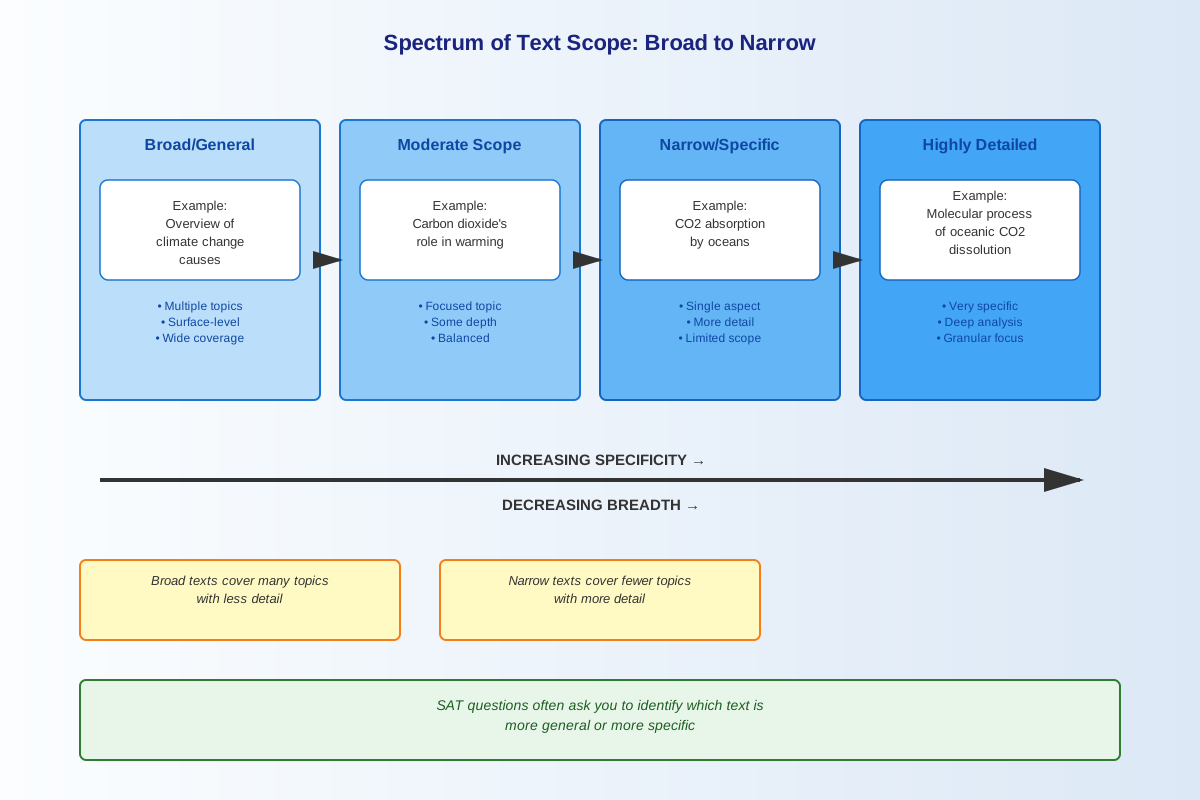
Scope refers to the range, breadth, and level of detail that a text covers regarding its subject matter. When analyzing scope, readers consider both the horizontal dimension (how many different aspects or topics are addressed) and the vertical dimension (how deeply each aspect is explored). A text with broad scope covers many aspects of a topic with less detail about each, while a text with narrow scope focuses intensively on fewer aspects with greater specificity.
The concept of cross-text scope specifically involves comparing the scopes of two related passages to understand their relationship. This comparison requires identifying not just what each text discusses, but how comprehensively or specifically it addresses the subject. Students must recognize that two texts can discuss the same general topic while operating at different levels of generality or focusing on different dimensions of that topic.
Types of Scope Relationships
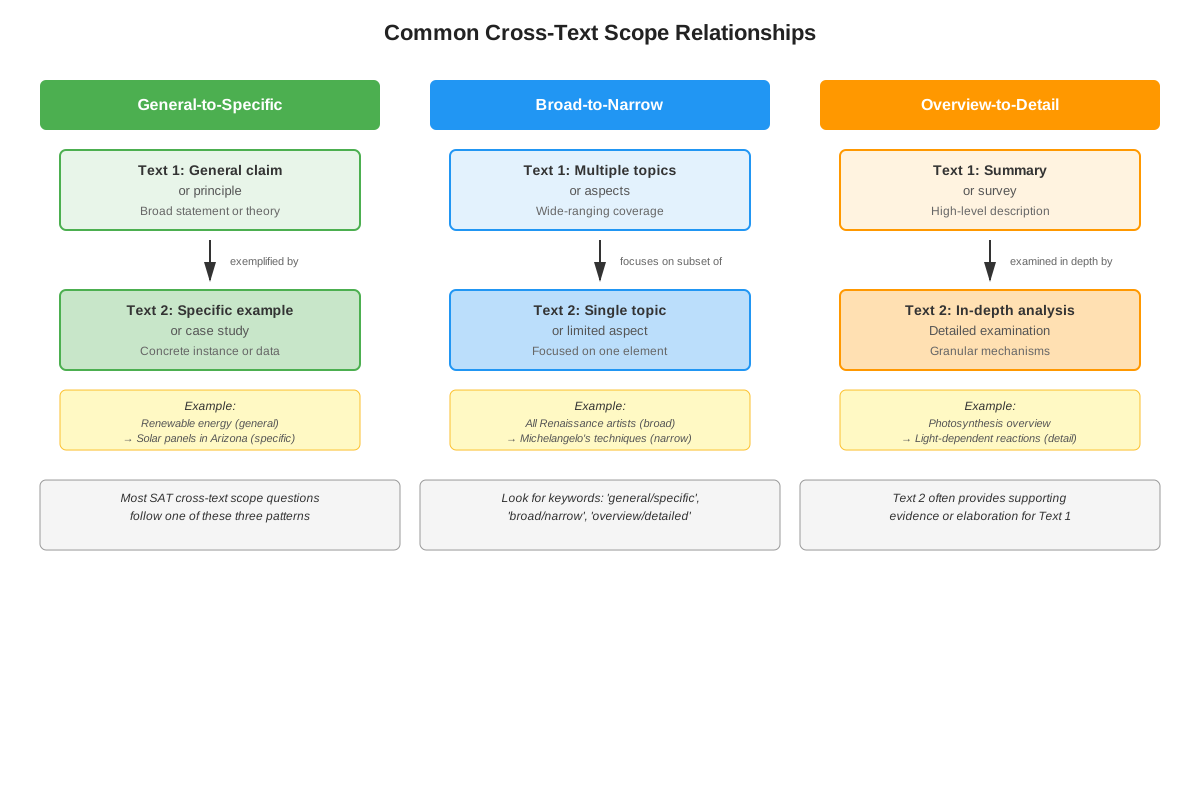
Several common patterns emerge in how paired texts relate to each other in terms of scope:
| Scope Relationship | Text 1 Characteristics | Text 2 Characteristics | Example Pairing |
|---|---|---|---|
| General to Specific | Broad overview, multiple aspects | Detailed examination of one aspect | Climate change overview vs. Arctic ice melt study |
| Broad to Narrow | Wide-ranging survey | Focused analysis | History of medicine vs. development of penicillin |
| Overview to Example | Theoretical or conceptual | Concrete case or illustration | Economic principles vs. 2008 financial crisis |
| Multiple to Single | Several subjects/cases | One subject/case in depth | Various Renaissance artists vs. Michelangelo's techniques |
| Comprehensive to Partial | Complete coverage of topic | Limited aspect of topic | Complete photosynthesis process vs. light-dependent reactions only |
Identifying Scope Indicators
Certain textual features signal the scope of a passage. Scope indicators include:
Breadth indicators (suggesting broader scope):
- Plural nouns and collective terms ("scientists," "methods," "approaches")
- Generalizing language ("typically," "generally," "various," "multiple")
- Survey-style organization covering multiple subtopics
- Absence of specific names, dates, or detailed examples
- Introductory or overview language
Depth indicators (suggesting narrower scope):
- Specific names, dates, locations, and numerical data
- Detailed descriptions and step-by-step explanations
- Technical terminology and specialized vocabulary
- Extended focus on a single case, example, or aspect
- Phrases like "in particular," "specifically," "for instance"
Analyzing Comparative Scope
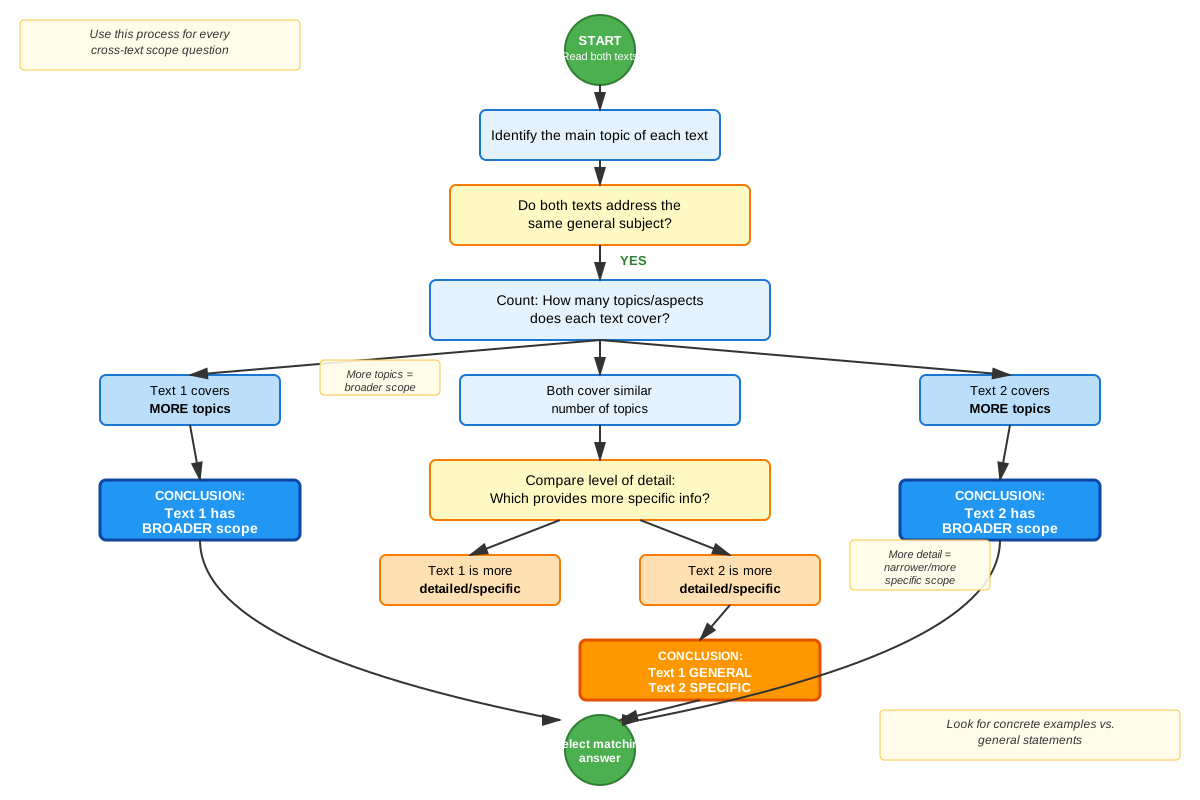
When comparing two texts, students should follow a systematic approach:
- Identify the general topic: Determine what both texts are fundamentally about
- Map the coverage: Note what specific aspects each text addresses
- Assess the detail level: Evaluate how deeply each text explores its aspects
- Recognize the relationship: Determine which text is broader/narrower or how their focuses differ
- Match to answer choices: Select the option that accurately characterizes the scope relationship
The key to success with sat cross-text scope questions lies in recognizing that scope is relative. A text might seem detailed in isolation but appear general when paired with a more specific text. Students must always evaluate scope comparatively rather than absolutely.
Common Scope Patterns in SAT Passages
The SAT frequently employs certain scope patterns that students can learn to recognize quickly:
Historical context + specific event: One text provides background information about a historical period or movement, while the second focuses on a particular event, person, or development within that context.
Scientific principle + application: One text explains a general scientific concept or law, while the second describes a specific experiment, observation, or technological application.
Multiple perspectives + single viewpoint: One text surveys various opinions or approaches to an issue, while the second elaborates on one particular perspective.
Problem overview + solution focus: One text describes a broad problem or challenge, while the second concentrates on a specific solution or response.
Understanding these patterns allows students to anticipate scope relationships and read more strategically during the exam.
Concept Relationships
Cross-text scope analysis builds directly upon single-text reading comprehension skills. Before students can compare scopes, they must accurately identify the main idea and supporting details of each individual passage. This foundational skill → enables → scope identification within each text → which leads to → comparative scope analysis.
The concept connects closely to other cross-text question types in the RW section. Understanding scope relationships helps students answer questions about how texts support, contradict, or complement each other. For instance, recognizing that Text 1 provides general principles while Text 2 offers a specific example helps students understand that Text 2 might serve as evidence supporting claims in Text 1.
Within scope analysis itself, the concepts form a hierarchy: Understanding what scope means → recognizing scope indicators in individual texts → identifying common scope relationships → applying systematic comparison strategies → selecting correct answers efficiently. Each level depends on mastery of the previous one.
Cross-text scope also relates to author's purpose and text structure. Authors who intend to provide an overview naturally create broader scope, while those aiming to present detailed analysis create narrower scope. Recognizing these authorial choices enhances scope analysis accuracy.
High-Yield Facts
⭐ Cross-text scope questions always involve comparing the breadth, depth, or focus of two related passages
⭐ A text with broader scope covers more aspects of a topic with less detail; a text with narrower scope covers fewer aspects with more detail
⭐ The most common scope relationship on the SAT pairs a general overview with a specific example or case study
⭐ Scope is relative—a passage's scope must be evaluated in comparison to the paired text, not in isolation
⭐ Plural nouns, generalizing language, and survey-style organization typically indicate broader scope
- Specific names, dates, numbers, and technical details typically indicate narrower scope
- Two texts can discuss the same topic while having completely different scopes
- The question stem often uses words like "general," "specific," "broad," "narrow," "focused," or "comprehensive"
- Scope differs from tone, purpose, and argument—it specifically concerns range and detail level
- Recognizing scope patterns (historical context + specific event, principle + application) saves time during the exam
- Answer choices for scope questions often present contrasting characterizations of the text relationship
- Incorrect answers frequently reverse the scope relationship or mischaracterize what each text emphasizes
Quick check — test yourself on Cross-text scope so far.
Try Flashcards →Common Misconceptions
Misconception: Longer texts always have broader scope than shorter texts.
Correction: Scope refers to range and depth of coverage, not length. A short text can have broad scope by surveying many topics briefly, while a long text can have narrow scope by examining one topic exhaustively.
Misconception: If both texts discuss the same topic, they have the same scope.
Correction: Two texts can address identical topics while operating at completely different levels of generality or focusing on different aspects. The topic is what they discuss; the scope is how comprehensively or specifically they discuss it.
Misconception: A text with more technical vocabulary automatically has narrower scope.
Correction: Technical vocabulary often indicates depth and specificity, but a text can use specialized terms while still providing a broad overview of multiple concepts within a field.
Misconception: The first text always provides the broader overview while the second provides specific details.
Correction: The SAT varies the order of texts. Sometimes Text 1 is more specific and Text 2 is more general. Students must analyze each pair individually rather than assuming a pattern.
Misconception: Scope questions are asking about the main idea of each text.
Correction: While understanding main ideas helps with scope analysis, scope questions specifically ask about the relationship between the texts' ranges of coverage, not simply what each text is about.
Misconception: If a text mentions multiple examples, it automatically has broader scope.
Correction: Multiple examples might all illustrate the same narrow point, making the overall scope still quite focused. Conversely, a single extended example might represent a narrow scope compared to a text that surveys many different aspects without detailed examples.
Worked Examples
Example 1: Scientific Principle and Application
Text 1:
Photosynthesis is the process by which plants convert light energy into chemical energy. During this process, plants absorb carbon dioxide from the atmosphere and water from the soil, using sunlight to transform these raw materials into glucose and oxygen. This fundamental biological process sustains most life on Earth by producing oxygen and forming the base of food chains. Different plant species have evolved various photosynthetic adaptations to thrive in diverse environments, from tropical rainforests to arid deserts.
Text 2:
Researchers at Stanford University recently studied photosynthesis in the desert plant Agave americana. They discovered that this species opens its stomata exclusively at night to absorb carbon dioxide, minimizing water loss during hot days. The absorbed CO₂ is stored and used for photosynthesis during daylight hours. This adaptation, called CAM photosynthesis, allows the plant to maintain photosynthetic activity while conserving up to 90% more water than plants using conventional photosynthetic pathways.
Question:
Which choice best describes the relationship between Text 1 and Text 2?
A) Text 1 presents a theory that Text 2 challenges with contradictory evidence.
B) Text 1 provides a general overview of a biological process, while Text 2 examines a specific adaptation of that process.
C) Text 1 focuses on a single plant species, while Text 2 discusses multiple species.
D) Text 1 and Text 2 describe the same photosynthetic process with equal levels of detail.
Solution:
Step 1: Identify what each text covers.
- Text 1: General explanation of photosynthesis, its basic mechanism, its importance, and mention that various adaptations exist
- Text 2: Detailed examination of one specific adaptation (CAM photosynthesis) in one specific plant species
Step 2: Assess the scope of each text.
- Text 1 has broader scope: covers the general process, multiple aspects (mechanism, importance, diversity), and applies to plants generally
- Text 2 has narrower scope: focuses specifically on one adaptation in one species with detailed mechanisms
Step 3: Identify the scope relationship.
This is a classic "general overview to specific example" pattern. Text 1 establishes the broad concept; Text 2 provides a detailed case study.
Step 4: Evaluate answer choices.
- A) Incorrect—Text 2 doesn't challenge Text 1; it provides an example
- B) Correct—accurately describes the general-to-specific scope relationship
- C) Incorrect—reverses the relationship; Text 1 discusses plants generally, not a single species
- D) Incorrect—the texts have different levels of detail and focus
Answer: B
This question demonstrates how recognizing the general-to-specific pattern immediately points to the correct answer.
Example 2: Historical Overview and Specific Event
Text 1:
The Harlem Renaissance of the 1920s represented a flourishing of African American cultural expression. Writers like Langston Hughes and Zora Neale Hurston, musicians such as Duke Ellington, and visual artists including Aaron Douglas created works that celebrated Black identity and challenged racial stereotypes. This movement transformed American arts and laid groundwork for the Civil Rights Movement.
Text 2:
In 1925, Alain Locke published "The New Negro," an anthology featuring essays, poetry, and fiction by African American writers. The publication included Langston Hughes's poem "The Weary Blues" and essays examining the social and political dimensions of Black identity. Locke's anthology became a defining document of the Harlem Renaissance, articulating the movement's intellectual foundations and introducing many writers who would shape American literature for decades.
Question:
How does the scope of Text 2 compare to the scope of Text 1?
Solution:
Step 1: Map the coverage of each text.
- Text 1: Surveys the entire Harlem Renaissance movement, mentions multiple artists across different media (literature, music, visual arts), discusses general significance
- Text 2: Focuses exclusively on one publication from 1925, details its contents and contributors, explains its specific role in the movement
Step 2: Identify scope indicators.
- Text 1 indicators of broad scope: "flourishing," "writers like," "musicians such as," multiple names across disciplines, general timeframe ("1920s")
- Text 2 indicators of narrow scope: specific date (1925), single publication title, detailed description of contents, focus on one document's role
Step 3: Characterize the relationship.
Text 1 provides a comprehensive overview of an entire cultural movement spanning a decade and multiple art forms. Text 2 narrows focus to a single publication within that movement, examining it in detail. This represents a "broad survey to focused example" relationship.
Step 4: Formulate the answer.
Text 2 has a narrower scope than Text 1. While Text 1 surveys the Harlem Renaissance broadly across multiple art forms and artists, Text 2 focuses specifically on one anthology and its particular contribution to the movement.
This example shows how recognizing the movement from multiple subjects (writers, musicians, artists) to a single subject (one anthology) signals a scope shift from broad to narrow.
Exam Strategy
When approaching cross-text scope questions on the SAT, employ this systematic strategy:
Step 1: Read both texts actively (60-90 seconds)
As you read, mentally note whether each text seems to provide an overview or detailed analysis. Mark plural terms, generalizing language, specific names, and detailed examples.
Step 2: Identify the common topic (10 seconds)
Determine what both texts are fundamentally about. This helps you understand the basis for comparison.
Step 3: Compare coverage and detail (20 seconds)
Ask yourself:
- Does one text cover more aspects of the topic?
- Does one text provide more specific details, examples, or data?
- Does one text focus on a single case while the other surveys multiple cases?
Step 4: Predict the relationship (10 seconds)
Before looking at answer choices, formulate your own description: "Text 1 is more general; Text 2 focuses on a specific example" or "Text 1 surveys multiple approaches; Text 2 examines one approach in depth."
Step 5: Eliminate and select (20-30 seconds)
Use process of elimination:
- Eliminate choices that reverse the scope relationship
- Eliminate choices that misidentify what each text emphasizes
- Eliminate choices that confuse scope with other elements (tone, purpose, argument)
- Select the choice that matches your prediction
Exam Tip: If you're unsure between two answer choices, look for scope indicator words in the texts. Count how many different aspects each text addresses—this often clarifies which has broader scope.
Trigger words to watch for in questions:
- "General" vs. "specific"
- "Broad" vs. "narrow"
- "Overview" vs. "detailed examination"
- "Focuses on" vs. "surveys"
- "Comprehensive" vs. "limited"
- "Multiple" vs. "single"
Time allocation: Spend approximately 90-120 seconds total on each cross-text scope question. Don't rush the initial reading—accurate comprehension of both texts is essential for correct scope comparison.
Common trap answers:
- Choices that accurately describe one text but mischaracterize the other
- Choices that reverse which text is broader/narrower
- Choices that describe a different relationship (support, contradiction) rather than scope
- Choices that focus on content rather than scope (what is discussed rather than how comprehensively)
Memory Techniques
SCOPE Acronym for Analysis:
- Survey what each text covers
- Count the aspects addressed
- Observe specific details vs. general statements
- Predict the relationship
- Eliminate mismatches
Visualization Strategy:
Picture scope as a camera lens. A text with broad scope is like a wide-angle lens capturing an entire landscape—you see many elements but less detail about each. A text with narrow scope is like a telephoto lens zooming in on one tree—you see intricate detail but a limited view. When comparing texts, visualize adjusting the zoom level.
The "Plural vs. Singular" Quick Check:
Broad scope texts tend to use plural nouns (scientists, methods, events, factors), while narrow scope texts use singular or specific nouns (Dr. Smith, this method, the 1925 event, temperature). Quickly scanning for plural vs. singular can provide an initial scope assessment.
Mnemonic for Common Patterns:
HOPE - The most common scope pairings:
- Historical context + specific event
- Overview + particular example
- Principle + application
- Expansive survey + focused case study
The "Zoom Test":
Ask yourself: "If Text 1 is a chapter in a book, what would Text 2 be?" If Text 2 would be a section within that chapter, it has narrower scope. If Text 2 would be a different chapter covering different ground, they have different focuses rather than different scopes.
Summary
Cross-text scope questions assess students' ability to compare the breadth, depth, and focus of two related passages—a critical skill for the SAT Reading and Writing section. These questions require understanding that scope refers to the range of coverage and level of detail a text provides, not simply its topic or length. The most common scope relationship pairs a general overview with a specific example or case study, though other patterns include broad surveys paired with focused analyses, multiple subjects paired with single subjects, and comprehensive treatments paired with partial examinations. Success requires identifying scope indicators (plural nouns and generalizing language for broad scope; specific names, dates, and details for narrow scope), systematically comparing the texts' coverage, and recognizing that scope is always relative. Students must avoid common misconceptions such as assuming longer texts have broader scope or that texts on the same topic necessarily have the same scope. By employing strategic reading, recognizing common patterns, and using systematic comparison techniques, students can efficiently and accurately answer these high-frequency SAT questions.
Key Takeaways
- Cross-text scope questions compare the breadth and depth of coverage between two related passages, not their topics or arguments
- Broad scope covers many aspects with less detail; narrow scope covers fewer aspects with more detail
- The most common SAT pattern pairs a general overview (Text 1) with a specific example or case study (Text 2)
- Scope indicators include plural nouns and generalizing language (broad) versus specific names, dates, and detailed descriptions (narrow)
- Always evaluate scope comparatively—a text's scope is meaningful only in relation to the paired text
- Systematic analysis (identify topic → map coverage → assess detail → recognize relationship) leads to accurate answers
- Avoid reversing the scope relationship or confusing scope with other textual elements like tone or purpose
Related Topics
Cross-Text Connections - Supporting and Contradicting: After mastering scope analysis, students can explore how texts support or contradict each other's claims, building on the comparative reading skills developed through scope questions.
Cross-Text Connections - Synthesis: Understanding scope relationships prepares students for synthesis questions that require combining information from multiple texts to draw conclusions or identify patterns.
Author's Purpose and Point of View: Recognizing that authors choose scope deliberately based on their purposes deepens both scope analysis and understanding of authorial intent.
Text Structure and Organization: Analyzing how texts organize information (chronologically, topically, by level of detail) enhances the ability to identify scope quickly and accurately.
Evidence and Support: Understanding scope helps students evaluate whether evidence is sufficiently specific or appropriately general for supporting particular claims.
Practice CTA
Now that you've mastered the fundamentals of cross-text scope analysis, it's time to apply these skills! Work through the practice questions to reinforce your understanding of scope relationships and develop the speed and accuracy needed for test day. Each practice question provides an opportunity to apply the systematic approach you've learned and to recognize the common patterns that appear on the SAT. The flashcards will help you internalize key concepts and scope indicators, making your analysis automatic and efficient. Remember, cross-text scope questions are highly predictable once you understand the patterns—consistent practice transforms this question type from challenging to straightforward. You've got this!
Sign up free to keep reading
Create a free AnvayaPrep account to finish this SAT guide on Cross-text scope — plus flashcards and practice questions.