Overview
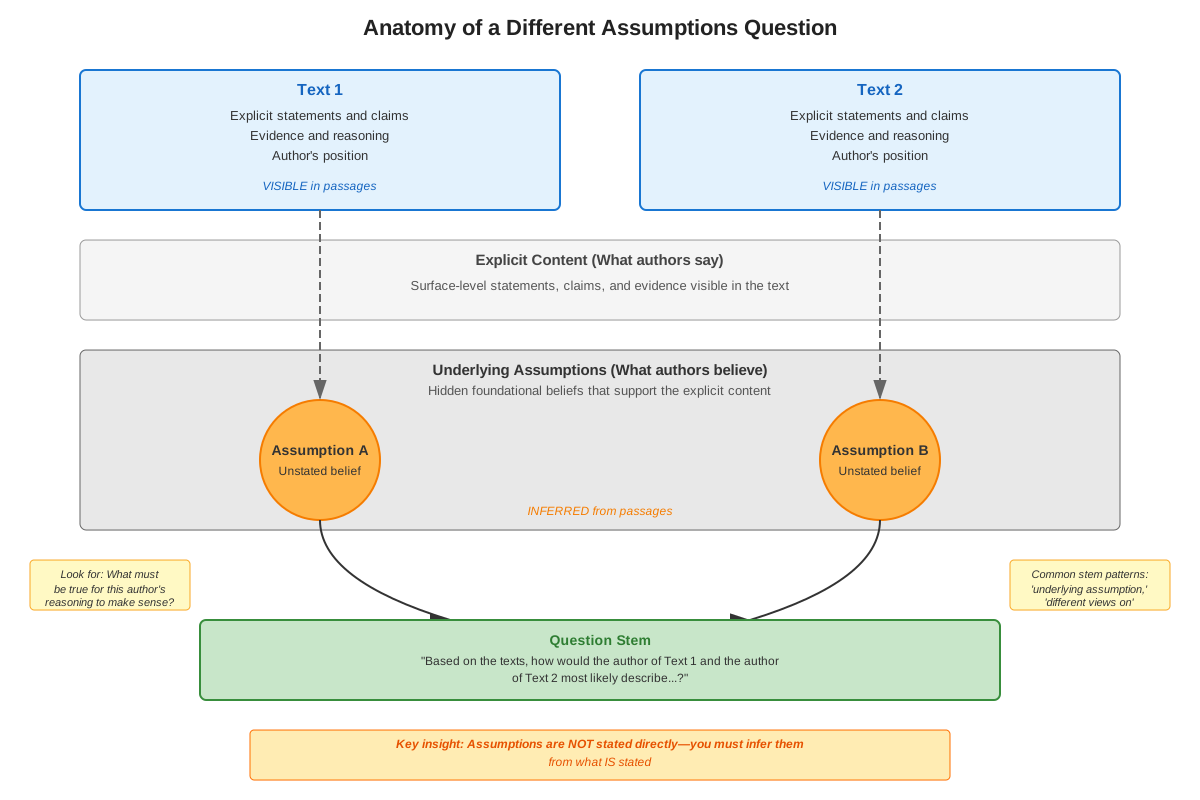
The different assumptions question type is a critical component of the SAT Reading and Writing section, specifically within the Cross-Text Connections domain. These questions require students to analyze two short passages and identify the underlying premises, beliefs, or foundational ideas that distinguish one author's perspective from another's. Unlike questions that ask about explicit disagreements or surface-level differences, different assumptions questions probe deeper into the logical foundations that guide each author's reasoning.
Understanding different assumptions is essential for SAT success because these questions test sophisticated analytical skills that extend beyond simple comprehension. Students must recognize that two authors can discuss the same topic while operating from fundamentally different starting points—different beliefs about how the world works, what evidence matters most, or what principles should guide inquiry. This skill mirrors the critical thinking required in college-level academic work, where evaluating competing frameworks and identifying unstated premises becomes crucial for engaging with scholarly discourse.
Within the broader RW (Reading and Writing) section architecture, different assumptions questions represent one of the most cognitively demanding question types. They connect to other Cross-Text Connection skills like identifying supporting and challenging evidence, but they require an additional layer of inference. Rather than tracking what authors explicitly state, students must deduce what authors implicitly believe to be true. This makes the topic both challenging and high-yield: mastering it demonstrates reading maturity and significantly boosts overall section performance.
Learning Objectives
- [ ] Identify key features of different assumptions questions on the SAT
- [ ] Explain how different assumptions appears on the SAT and what makes it distinct from other question types
- [ ] Apply different assumptions analysis to answer SAT-style questions accurately and efficiently
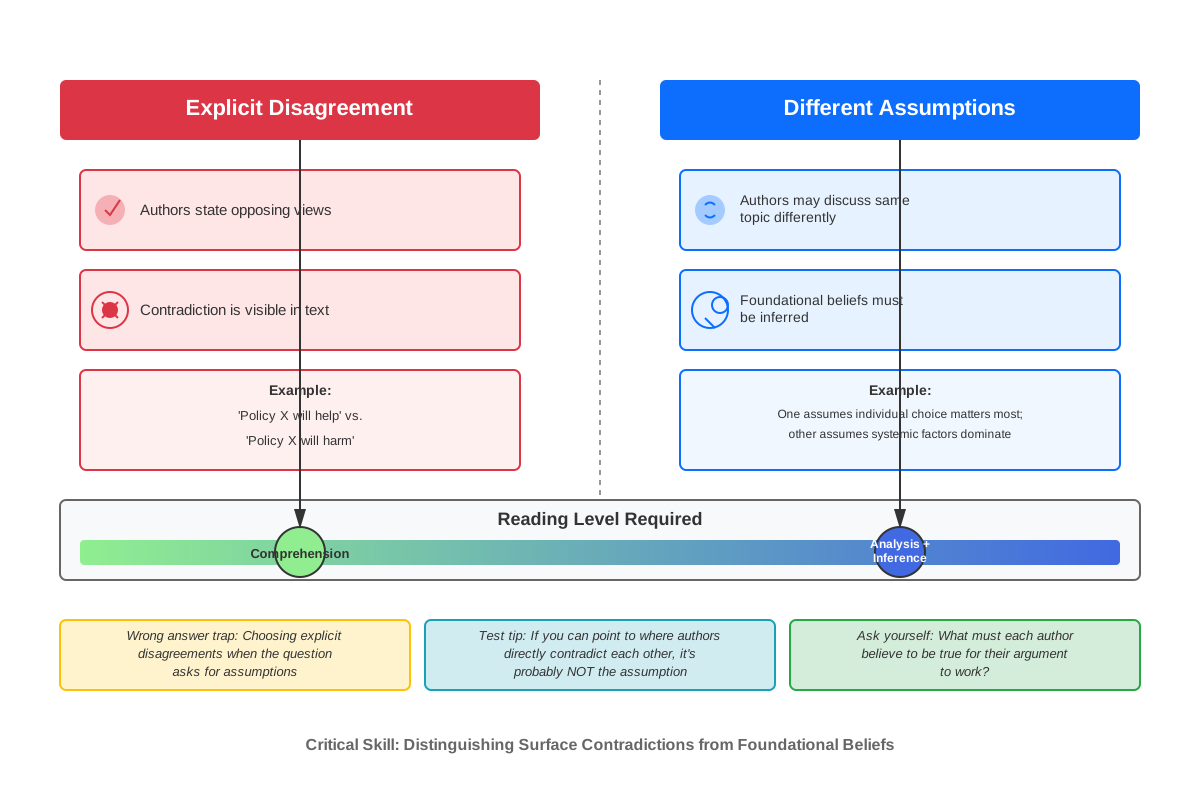
- [ ] Distinguish between explicit disagreements and implicit underlying assumptions in paired passages
- [ ] Evaluate answer choices by testing whether they represent foundational beliefs rather than stated conclusions
- [ ] Recognize common patterns in how the SAT constructs different assumptions scenarios across disciplines
Prerequisites
- Basic reading comprehension: Students must be able to understand the literal meaning of short academic passages, as assumption analysis builds upon accurate comprehension of what authors explicitly state.
- Inference skills: The ability to draw reasonable conclusions from textual evidence is essential, since assumptions are by definition unstated beliefs that must be inferred.
- Understanding of argument structure: Recognizing claims, evidence, and reasoning helps students identify where assumptions function as logical bridges in an author's thinking.
- Familiarity with Cross-Text Connection format: Students should understand that they'll be comparing two brief passages on related topics, as this is the standard presentation format for these questions.
Why This Topic Matters
Different assumptions questions appear with notable frequency on the SAT, typically comprising 2-3 questions per test administration. This represents approximately 5-7% of the Reading and Writing section, making it a high-impact topic that can meaningfully affect overall scores. The College Board has increasingly emphasized these questions in recent test versions, reflecting their alignment with college-readiness standards that prioritize analytical thinking over rote memorization.
In real-world contexts, the ability to identify different assumptions is fundamental to academic success across disciplines. In science, researchers may approach the same phenomenon with different theoretical frameworks. In history, scholars interpret events through different historiographical lenses. In literature, critics apply different critical theories. Students who master this skill develop intellectual flexibility and the capacity to understand why intelligent people can examine the same evidence and reach different conclusions—not because one is wrong, but because they begin with different foundational beliefs.
On the SAT, different assumptions questions typically appear in passages drawn from natural sciences, social sciences, and humanities. Common scenarios include: two scientists proposing different explanations for an observed phenomenon, two historians interpreting the same event differently, two researchers advocating for different methodological approaches, or two theorists applying different frameworks to analyze a cultural practice. The passages are usually 50-75 words each, and the question stem explicitly asks students to identify what one author assumes that the other does not, or what underlying belief distinguishes their perspectives.
Core Concepts
What Are Assumptions?
An assumption is an unstated belief or premise that an author takes for granted as true when constructing an argument or explanation. Assumptions function as the logical foundation upon which reasoning is built. They are not explicitly stated because the author considers them self-evident, uncontroversial within their framework, or simply unnecessary to articulate. On the SAT different assumptions questions, students must identify these implicit beliefs that differentiate one author's perspective from another's.
Assumptions differ from conclusions (what an author argues) and evidence (what an author cites to support their argument). Instead, assumptions are the "invisible bridges" that connect evidence to conclusions. For example, if an author argues that "increasing park funding will improve community health" based on evidence that "parks provide exercise opportunities," the assumption is that "people will use parks more if they are better funded" and that "exercise significantly impacts community health." These beliefs are not stated but are necessary for the argument to hold.
Types of Assumptions in SAT Passages
The SAT tests several categories of assumptions across different academic domains:
Methodological assumptions concern beliefs about the best way to study or approach a topic. One researcher might assume that laboratory experiments provide the most reliable data, while another assumes that field observations better capture real-world complexity. These assumptions shape research design and interpretation.
Causal assumptions involve beliefs about cause-and-effect relationships. One author might assume that correlation implies causation in a particular context, while another assumes that multiple factors must be considered. For instance, one economist might assume that market forces primarily drive economic outcomes, while another assumes that institutional factors play the dominant role.
Definitional assumptions relate to how key terms or concepts should be understood. Two authors discussing "intelligence" might operate from different assumptions about whether intelligence is primarily innate or developed, unitary or multiple, measurable by standardized tests or demonstrated through diverse capabilities.
Value assumptions concern what matters most or what goals should be prioritized. In policy debates, one author might assume that individual liberty is the paramount value, while another assumes that collective welfare takes precedence.
Identifying Different Assumptions: The Process
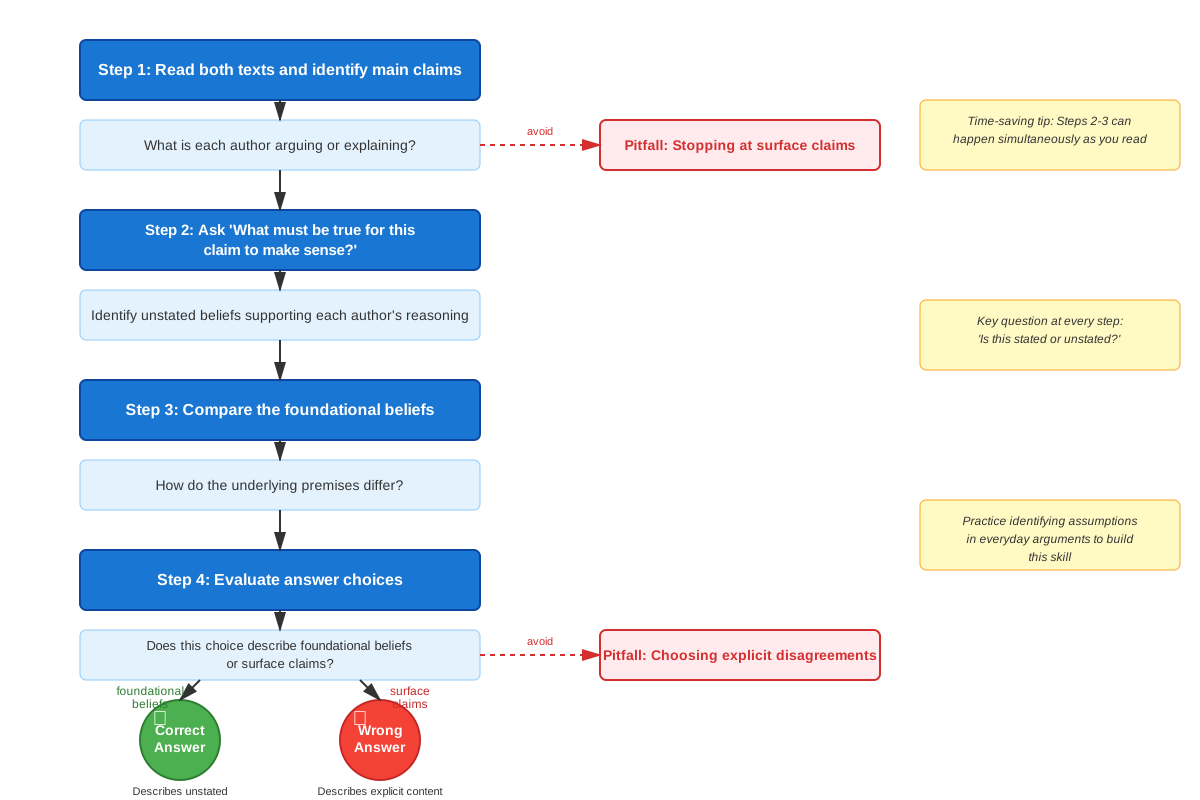
To successfully identify different assumptions on the SAT, students should follow this systematic approach:
- Read both passages carefully and identify the main point or position of each author
- Note areas of apparent disagreement or different conclusions reached
- Ask "What must be true for this author's reasoning to work?" for each passage
- Identify the foundational belief that differs between the authors—not just their conclusions
- Test the assumption by considering whether removing it would undermine the author's reasoning
The key distinction is between what authors state and what they assume. If an author explicitly mentions a belief, it's not an assumption—it's a stated position. Assumptions are the unspoken premises that make the stated argument possible.
Common Patterns in Different Assumptions Questions
SAT different assumptions questions follow recognizable patterns that students can learn to identify:
| Pattern Type | Description | Example Scenario |
|---|---|---|
| Competing Explanations | Two authors explain the same phenomenon differently | Text 1 attributes species extinction to climate change; Text 2 attributes it to human activity |
| Methodological Divide | Authors prefer different research or analytical approaches | Text 1 favors quantitative data analysis; Text 2 favors qualitative case studies |
| Scope Disagreement | Authors assume different scales or boundaries for analysis | Text 1 assumes local factors are decisive; Text 2 assumes global systems determine outcomes |
| Temporal Assumptions | Authors differ in assumptions about change over time | Text 1 assumes current trends will continue; Text 2 assumes disruption is imminent |
| Agency Assumptions | Authors differ on what entities have causal power | Text 1 assumes individuals drive change; Text 2 assumes structures constrain individual action |
Distinguishing Assumptions from Related Concepts
Students often confuse assumptions with other textual elements. Understanding these distinctions is crucial:
Assumptions vs. Conclusions: Conclusions are what authors argue or claim; assumptions are what they take for granted to reach those conclusions. If it's explicitly stated as the author's position, it's a conclusion, not an assumption.
Assumptions vs. Evidence: Evidence consists of facts, data, or observations that authors cite; assumptions are beliefs about how to interpret that evidence or why it matters.
Assumptions vs. Implications: Implications are logical consequences that follow from an argument; assumptions are premises that must be true for the argument to work.
Assumptions vs. Explicit Disagreements: When authors directly contradict each other on a stated point, that's an explicit disagreement. Different assumptions are more subtle—they're the underlying beliefs that lead to different interpretations or approaches, even when authors might agree on surface facts.
Concept Relationships
The different assumptions concept sits at the intersection of several critical reading skills. Inference ability serves as the foundation, since assumptions must be deduced rather than directly observed. This inference skill → enables → assumption identification, which in turn → supports → argument analysis more broadly.
Within the Cross-Text Connections unit, different assumptions questions build upon simpler comparison tasks. Students first learn to identify explicit agreements and disagreements between texts → then progress to → recognizing different types of evidence authors use → which prepares them for → understanding different assumptions that guide evidence selection and interpretation → ultimately leading to → sophisticated evaluation of competing frameworks.
The relationship between assumptions and conclusions is particularly important: underlying assumptions → logically support → intermediate reasoning → which leads to → stated conclusions. When two authors reach different conclusions from similar evidence, the explanation typically lies in their different assumptions. This creates a diagnostic pathway: different conclusions ← trace back to ← different reasoning ← which reveals ← different assumptions.
Different assumptions also connects to broader critical thinking skills tested throughout the SAT. The ability to identify unstated premises relates to logical reasoning in the Writing section, evidence evaluation in data interpretation questions, and perspective analysis in literature passages. Mastering this topic therefore yields benefits across multiple question types.
High-Yield Facts
⭐ Assumptions are never explicitly stated in the passage—if an author directly mentions a belief, it's a stated position, not an assumption.
⭐ The correct answer identifies what ONE author assumes but the OTHER does not—both authors assuming something doesn't make it a "different" assumption.
⭐ Different assumptions questions always involve TWO passages presented together, typically labeled "Text 1" and "Text 2."
⭐ Assumptions are necessary for the author's reasoning to work—removing the assumption would make the argument fall apart.
⭐ The correct answer will be more fundamental than the authors' conclusions—it explains WHY they reach different conclusions, not just WHAT conclusions they reach.
- Different assumptions questions typically use phrases like "unlike Text 1, Text 2 assumes that" or "Text 1 assumes which of the following that Text 2 does not?"
- Assumptions often concern methodology, causation, definitions, scope, or values rather than specific factual claims.
- Wrong answers frequently present explicit statements from one passage rather than unstated assumptions.
- The assumption must be relevant to the specific topic both passages address—general beliefs unrelated to the passage content are incorrect.
- Authors can reach similar conclusions from different assumptions, or different conclusions from similar assumptions—the SAT tests both scenarios.
- Assumptions function as logical bridges between evidence and conclusions in an author's reasoning chain.
- Testing an answer choice by asking "Does this author's argument require this to be true?" helps verify correct assumptions.
Quick check — test yourself on Different assumptions so far.
Try Flashcards →Common Misconceptions
Misconception: Different assumptions are the same as different opinions or conclusions. → Correction: Assumptions are the underlying, unstated beliefs that lead to different opinions or conclusions. The assumption is deeper and more foundational than the conclusion itself. If an author explicitly states their position, that's their conclusion, not their assumption.
Misconception: If both authors could potentially agree with a statement, it can't be a different assumption. → Correction: What matters is whether one author's reasoning requires the assumption while the other's does not. One author might agree with a statement if asked directly, but if their argument doesn't depend on it, they're not assuming it in the context of their passage.
Misconception: The correct answer will be something both passages discuss explicitly. → Correction: Assumptions are by definition unstated. If both passages mention a concept directly, you're looking at explicit content, not underlying assumptions. The correct answer identifies something one author takes for granted without stating it.
Misconception: Longer or more complex answer choices are more likely to be correct. → Correction: The SAT doesn't reward complexity for its own sake. The correct answer might be stated simply and clearly. Focus on logical accuracy rather than sophistication of language.
Misconception: Different assumptions questions are just asking about the main disagreement between passages. → Correction: While assumptions often relate to disagreements, the question specifically asks about unstated premises, not stated disagreements. Two authors might not explicitly disagree at all, yet operate from very different assumptions about their subject matter.
Worked Examples
Example 1: Scientific Methodology
Text 1
Marine biologist Dr. Chen argues that understanding dolphin communication requires long-term observation of wild populations in their natural habitats. She has spent fifteen years documenting dolphin vocalizations in coastal waters, noting how context affects the sounds dolphins produce. Her research reveals patterns that emerge only over extended observation periods.
Text 2
Marine biologist Dr. Patel contends that dolphin communication can best be understood through controlled laboratory experiments. By isolating specific variables and testing dolphins' responses to particular stimuli, his team has identified distinct sound patterns associated with different objects and situations. This experimental approach allows for precise measurement and replication.
Question: Unlike Text 1, Text 2 assumes that:
A) Dolphins use vocalizations to communicate with each other
B) Laboratory conditions can adequately replicate relevant aspects of natural dolphin behavior
C) Understanding dolphin communication is an important scientific goal
D) Dolphins produce different sounds in different contexts
Analysis:
Let's work through this systematically. First, identify what each author explicitly states versus what they must assume:
Text 1 explicitly states: Long-term field observation is necessary; context affects vocalizations; patterns emerge over time.
Text 1 assumes (unstated): Natural settings preserve important variables that affect communication; artificial environments might alter behavior in ways that compromise understanding.
Text 2 explicitly states: Controlled experiments are the best approach; isolation of variables is valuable; precise measurement is achievable in labs.
Text 2 assumes (unstated): Laboratory conditions can capture the essential features of dolphin communication; what's learned in controlled settings applies to natural behavior; the benefits of experimental control outweigh any limitations of artificial environments.
Now evaluate each answer:
Choice A: Both authors would assume dolphins use vocalizations to communicate—this is the foundation of both their research programs. Not a DIFFERENT assumption. ❌
Choice B: This is what Text 2's entire approach requires to be true. If laboratory conditions fundamentally distort dolphin behavior, Dr. Patel's experimental approach wouldn't yield valid insights about natural communication. Text 1, by emphasizing natural habitats, implicitly questions whether lab conditions are adequate. This is the different assumption. ✓
Choice C: Both authors are studying dolphin communication, so both assume it's worth studying. Not different. ❌
Choice D: Text 1 explicitly states this ("context affects the sounds dolphins produce"), so it's not an assumption. Additionally, Text 2's research also found "distinct sound patterns associated with different objects and situations," so both authors would agree. ❌
Correct Answer: B
This example illustrates a methodological assumption—a belief about the best way to study something. Text 2 assumes laboratory conditions are sufficient, while Text 1's emphasis on natural habitats suggests skepticism about this assumption.
Example 2: Historical Interpretation
Text 1
Historian James Morrison argues that the Industrial Revolution's rapid pace resulted primarily from technological innovations like the steam engine and mechanized textile production. These inventions dramatically increased productivity and created new economic possibilities that hadn't existed before. The timeline of industrial growth closely tracks the introduction of key technologies.
Text 2
Historian Sarah Chen contends that the Industrial Revolution's timing and location were determined primarily by social and economic conditions rather than specific inventions. She notes that the necessary technologies had existed in various forms for decades or even centuries before industrialization occurred. What changed was the emergence of capitalist social relations, available labor forces, and capital accumulation that made large-scale industrial production profitable.
Question: Text 1 and Text 2 make different assumptions about:
A) Whether the Industrial Revolution involved significant technological change
B) Whether the Industrial Revolution occurred in the 18th and 19th centuries
C) Whether technological innovations can occur without social and economic changes
D) Whether technological capability or economic conditions are more decisive in driving historical change
Analysis:
This question asks about the different assumptions more generally, rather than specifying what one text assumes that the other doesn't. The approach remains the same: identify the foundational beliefs.
Text 1's core assumption: Technological innovations are the primary drivers of major historical transformations. When new technologies emerge, they create the conditions for economic and social change. Technology → drives → social/economic change.
Text 2's core assumption: Social and economic conditions are the primary drivers of historical change. Technologies only become historically significant when conditions make their application profitable or necessary. Social/economic conditions → enable → technological application.
Evaluate the choices:
Choice A: Both texts acknowledge technological change occurred. Text 2 explicitly mentions "necessary technologies." They don't differ on whether technological change happened. ❌
Choice B: Neither text discusses the specific timing of the Industrial Revolution. This isn't relevant to their different perspectives. ❌
Choice C: This is too extreme and doesn't capture the actual difference. Text 1 doesn't claim technologies emerge in a social vacuum, and Text 2 doesn't claim they can't. ❌
Choice D: This precisely captures the different assumptions. Text 1 assumes technological capability is decisive—once you have the steam engine, industrialization follows. Text 2 assumes economic conditions are decisive—you can have the technology, but without the right economic structures, it won't drive transformation. This is the fundamental difference in their causal assumptions. ✓
Correct Answer: D
This example demonstrates causal assumptions—beliefs about what factors primarily drive outcomes. The authors don't explicitly state "technology is more important than economics" or vice versa, but their entire arguments rest on these different assumptions about causation.
Exam Strategy
When approaching different assumptions questions on the SAT, implement this strategic process:
Step 1: Read the question stem first to understand exactly what you're looking for. Note whether it asks "what does Text 1 assume that Text 2 does not" or "what different assumptions do the texts make" or similar variations. This focuses your reading.
Step 2: Read both passages actively, marking or mentally noting:
- Each author's main point or conclusion
- The type of evidence or reasoning each uses
- Any methodological or conceptual differences
Step 3: Identify the fundamental difference before looking at answer choices. Ask yourself: "What basic belief about the world, the topic, or how to study it differs between these authors?" Formulate this in your own words.
Step 4: Evaluate answer choices systematically using these tests:
- The Explicit Test: If it's directly stated in the passage, eliminate it—assumptions are unstated
- The Necessity Test: Would removing this belief undermine the author's reasoning? If not, it's not an assumption
- The Difference Test: Does one author's reasoning require this while the other's doesn't? If both require it, it's not a DIFFERENT assumption
- The Relevance Test: Does this relate to the specific topic both passages address?
Trigger words and phrases that signal different assumptions questions:
- "assumes that"
- "takes for granted"
- "presupposes"
- "underlying belief"
- "Text 1 assumes which of the following that Text 2 does not"
- "different assumptions about"
Time allocation: Spend approximately 60-75 seconds on different assumptions questions. They require more careful analysis than simple comprehension questions but shouldn't consume excessive time. If you're stuck after eliminating two choices, make an educated guess and move forward.
Process of elimination tips:
- Eliminate any answer that explicitly appears in either passage
- Eliminate answers that both authors would clearly agree with
- Eliminate answers about topics neither passage addresses
- Eliminate answers that state conclusions rather than underlying premises
- Between two remaining choices, select the one that's more foundational and necessary to the author's reasoning
Exam Tip: The correct answer often explains WHY the authors reach different conclusions or use different approaches. It's the "because" that isn't stated—the underlying reason their perspectives differ.
Memory Techniques
The FOUNDATION Acronym for identifying assumptions:
Fundamental belief (not a surface-level claim)
Omitted from text (never explicitly stated)
Underlying the argument (supports the reasoning)
Necessary for logic (argument fails without it)
Different between authors (one assumes it, the other doesn't)
Applicable to topic (relevant to what passages discuss)
Testable by removal (take it away and reasoning collapses)
Implicit premise (the invisible bridge)
One-sided requirement (only one author needs it)
Not a conclusion (it's what leads TO conclusions)
Visualization Strategy: Picture each author's argument as a bridge. The conclusion is the destination on the far side, the evidence is the visible structure you can see, and the assumptions are the underground foundation you can't see but that holds everything up. Different assumptions questions ask you to identify how the underground foundations differ.
The "What Must Be True?" Mantra: When analyzing each passage, repeatedly ask yourself "What must be true for this reasoning to work?" This question naturally leads you to assumptions rather than stated content.
Contrast Mapping: Create a quick mental or written map:
Text 1: [conclusion] ← because ← [stated reasoning] ← based on assumption → [?]
Text 2: [conclusion] ← because ← [stated reasoning] ← based on assumption → [?]
Fill in the question marks with what must be true but isn't stated.
Summary
Different assumptions questions on the SAT Reading and Writing section require students to identify the unstated, foundational beliefs that distinguish one author's perspective from another's. These assumptions are never explicitly mentioned in the passages but are necessary for each author's reasoning to function. Unlike questions about explicit disagreements or stated positions, different assumptions questions probe the deeper logical premises that guide how authors approach their topics, interpret evidence, and construct arguments. Success requires distinguishing between what authors state (conclusions and evidence) and what they take for granted (assumptions). The most common types of assumptions tested involve methodological beliefs (how to study something), causal beliefs (what drives outcomes), definitional beliefs (how to understand key concepts), and value beliefs (what matters most). Students must read both passages carefully, identify each author's reasoning structure, determine what unstated beliefs are necessary for that reasoning to work, and select the answer choice that accurately captures a foundational difference between the authors' implicit premises. This skill is high-yield for the SAT and essential for college-level analytical thinking.
Key Takeaways
- Different assumptions are always unstated—if an author explicitly mentions a belief, it's not an assumption but a stated position
- Assumptions are foundational premises that make arguments work—they're the logical bridges between evidence and conclusions
- The correct answer identifies what ONE author assumes but the OTHER does not—shared beliefs aren't "different" assumptions
- Focus on why authors differ, not just what they conclude—assumptions explain the deeper reasons for different perspectives
- Test answer choices by asking "Is this necessary for the author's reasoning?"—if removing it doesn't affect the argument, it's not an assumption
- Common assumption types include methodological, causal, definitional, and value-based beliefs—recognizing these patterns speeds analysis
- Different assumptions questions appear 2-3 times per SAT—mastering this high-yield topic significantly impacts overall Reading and Writing scores
Related Topics
Supporting and Challenging Evidence: After mastering different assumptions, students can better understand how authors select evidence based on their underlying beliefs. Different assumptions often explain why authors find different types of evidence persuasive.
Argument Structure and Reasoning: Identifying assumptions is a component of broader argument analysis. Students who understand assumptions can more effectively evaluate the logical validity of complex arguments across all SAT Reading and Writing passages.
Author's Purpose and Perspective: Different assumptions often stem from different purposes or perspectives. Understanding what authors assume helps clarify why they write and what they hope to accomplish.
Rhetorical Synthesis: Advanced Cross-Text Connection questions may ask students to synthesize information from multiple texts. Recognizing different assumptions helps students understand how to integrate perspectives that rest on different foundations.
Practice CTA
Now that you've mastered the core concepts of different assumptions, it's time to apply this knowledge! Work through the practice questions to test your ability to identify unstated premises and distinguish between foundational beliefs and stated positions. Use the flashcards to reinforce key concepts and patterns. Remember: different assumptions questions reward careful, systematic analysis rather than quick impressions. Take your time, apply the strategies you've learned, and watch your confidence grow. Each practice question you complete strengthens your analytical skills not just for the SAT, but for the critical thinking you'll need throughout college and beyond. You've got this!
Sign up free to keep reading
Create a free AnvayaPrep account to finish this SAT guide on Different assumptions — plus flashcards and practice questions.