Overview
The SAT Reading and Writing section frequently presents students with paired passages or multiple texts that address the same topic from different perspectives. This question type requires test-takers to synthesize information across texts, identify contrasting viewpoints, and understand how authors with varying positions approach the same subject matter. Rather than simply comprehending a single passage, students must actively compare and contrast the perspectives, arguments, evidence, or conclusions presented by different authors.
Understanding sat different perspectives questions is crucial because they represent a significant portion of the Cross-Text Connections question category in the rw (Reading and Writing) section. These questions assess higher-order thinking skills: students must not only comprehend each text independently but also recognize the relationship between them—whether the authors agree, disagree, complement each other's arguments, or focus on different aspects of the same issue. The ability to navigate between multiple viewpoints is a fundamental academic skill that extends beyond standardized testing into college-level reading and critical analysis.
Mastering different perspectives questions builds directly upon foundational reading comprehension skills while adding an additional layer of complexity. Students must track multiple authors' claims simultaneously, distinguish between subtle variations in viewpoint, and accurately characterize the nature of the relationship between texts. This skill connects to broader Reading and Writing concepts such as identifying main ideas, understanding authorial purpose, analyzing evidence, and recognizing rhetorical strategies—all while managing the cognitive load of comparing multiple sources.
Learning Objectives
- [ ] Identify key features of different perspectives questions on the SAT
- [ ] Explain how different perspectives appears on the SAT Reading and Writing section
- [ ] Apply different perspectives strategies to answer SAT-style questions accurately
- [ ] Distinguish between various types of perspective relationships (agreement, disagreement, complementary focus)
- [ ] Synthesize information from multiple texts to determine the nature of their relationship
- [ ] Evaluate the strength and relevance of evidence used by authors with different perspectives
- [ ] Recognize subtle differences in emphasis, scope, or approach between seemingly similar viewpoints
Prerequisites
- Basic reading comprehension skills: Understanding main ideas, supporting details, and authorial claims in single passages is essential before comparing multiple texts
- Vocabulary knowledge: Recognizing transition words and relationship indicators (however, similarly, in contrast) helps identify how perspectives relate
- Ability to identify claims and evidence: Students must distinguish between an author's position and the support they provide before comparing across texts
- Understanding of text structure: Recognizing how arguments are organized aids in tracking different perspectives efficiently
Why This Topic Matters
Different perspectives questions reflect real-world academic and professional scenarios where individuals must evaluate multiple sources, synthesize competing viewpoints, and form informed conclusions. In college courses, students regularly encounter scholarly debates where researchers disagree on interpretations, methodologies, or conclusions. The ability to navigate these intellectual conversations is fundamental to academic success and informed citizenship in a world filled with competing narratives.
On the SAT, different perspectives questions appear consistently throughout the Reading and Writing section, typically comprising 10-15% of all questions. These questions are considered medium to high difficulty because they require students to manage information from two separate texts simultaneously while maintaining accuracy about each author's specific position. The College Board has increasingly emphasized these cross-text questions in recent SAT iterations, recognizing their value in assessing college-readiness skills.
These questions commonly appear in several formats: students might be asked to identify what one author would say about the other's claim, determine how the texts relate to each other, or recognize which statement both authors would agree with. The passages themselves span all content areas—science, social studies, humanities, and literature—meaning students cannot rely on subject-matter expertise alone. Instead, they must develop transferable skills for tracking and comparing perspectives regardless of topic.
Core Concepts
Understanding What Constitutes a Perspective
A perspective on the SAT refers to an author's particular viewpoint, position, interpretation, or approach to a topic. This encompasses not just whether an author agrees or disagrees with a claim, but also what aspects of a topic they emphasize, what evidence they prioritize, what conclusions they draw, and what implications they consider important. Two authors might both support the same general position while maintaining different perspectives based on their reasoning, scope, or focus.
For example, two scientists might both conclude that a particular species is endangered, but one might emphasize habitat loss while the other focuses on climate change. Their perspectives differ in emphasis and causal explanation, even though their ultimate conclusion aligns. Recognizing these nuanced differences is crucial for SAT success.
Types of Perspective Relationships
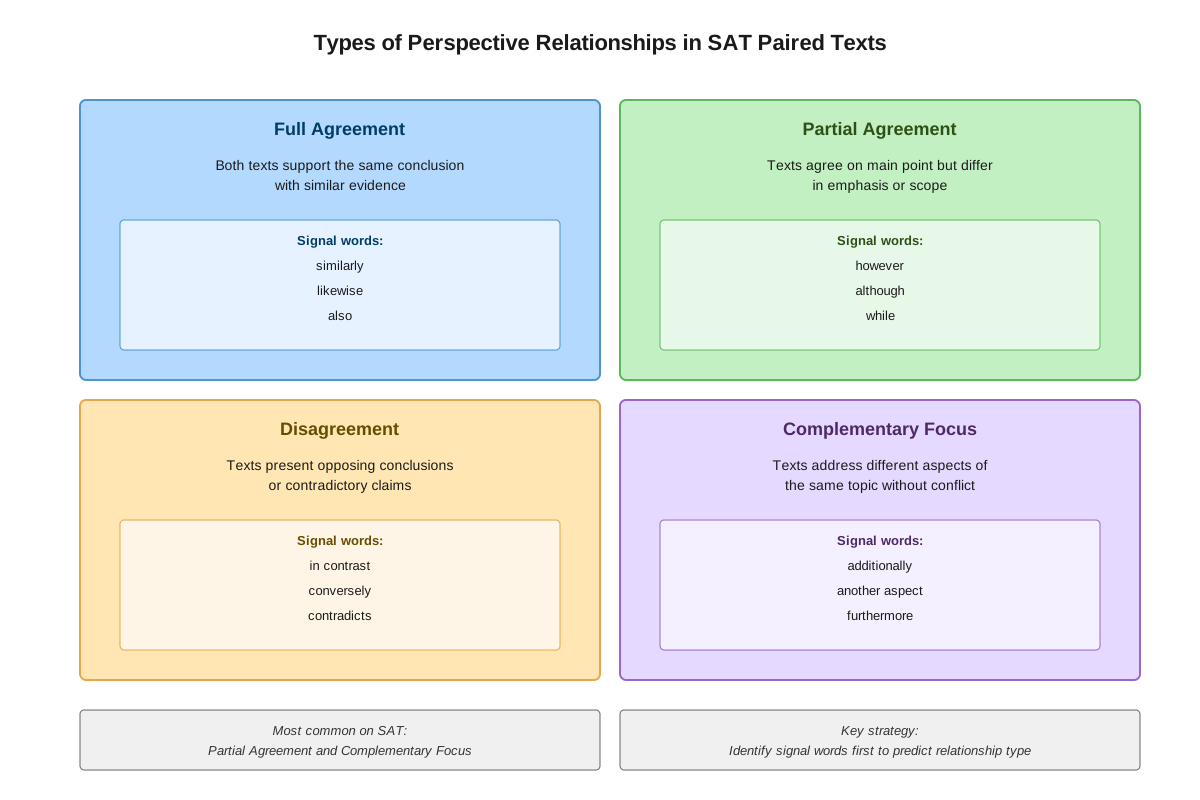
Different perspectives questions present several common relationship patterns between texts:
Direct Opposition: The authors present contradictory claims or conclusions about the same topic. One author argues X while the other argues not-X. These are often the most straightforward to identify because the disagreement is explicit.
Complementary Perspectives: Both authors address the same general topic but focus on different aspects, time periods, or dimensions of the issue. Neither contradicts the other; instead, they provide different pieces of a larger puzzle. For instance, one text might discuss the economic impacts of a policy while another examines its social effects.
Qualified Agreement: The authors generally agree but with important caveats, limitations, or differences in scope. One might support a claim with restrictions that the other doesn't mention, or one might apply a principle more broadly than the other.
Methodological Differences: The authors might reach similar or different conclusions but through different approaches, types of evidence, or analytical frameworks. One might use historical analysis while another employs statistical data.
Scope Variation: The authors address related but differently-scaled versions of a topic—one might discuss a specific case while the other addresses a general principle, or one might focus on short-term effects while the other considers long-term implications.
Key Features of Different Perspectives Questions
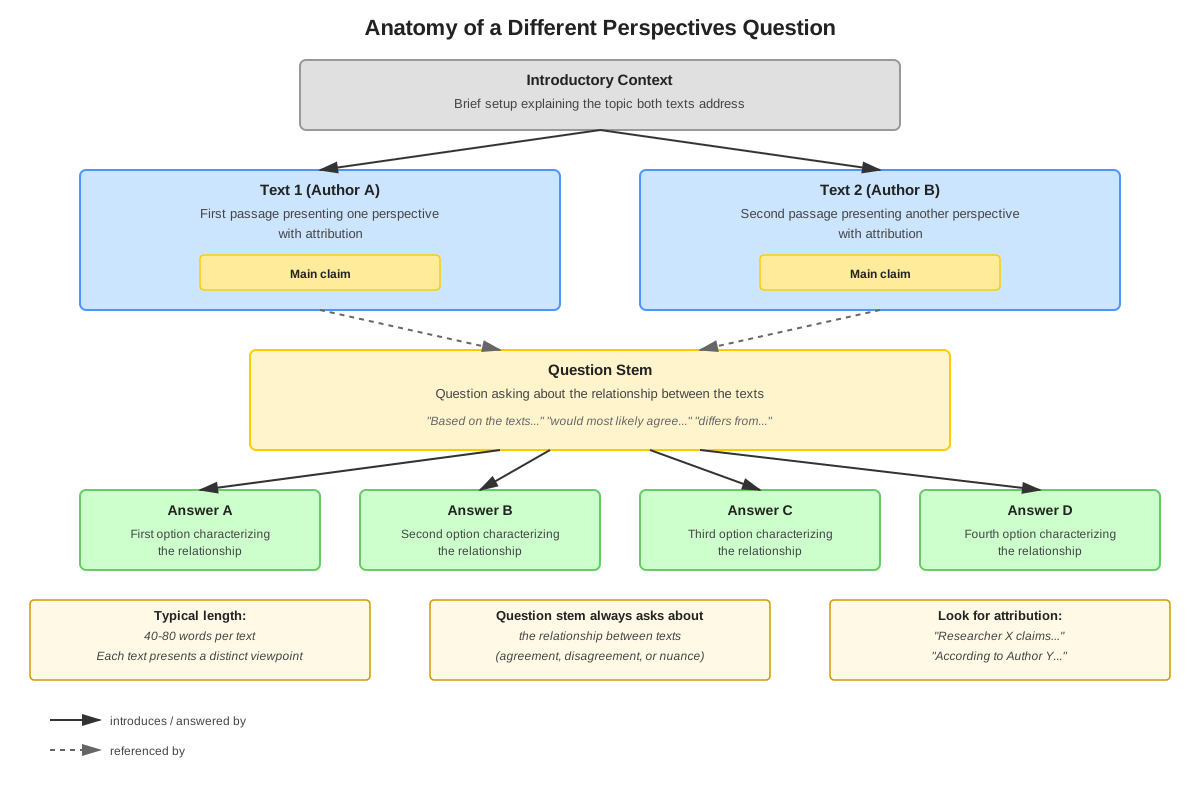
SAT different perspectives questions share several identifying characteristics. First, they always present two separate texts (labeled Text 1 and Text 2), each typically 50-150 words long. These texts are thematically connected but authored by different people or sources. The question stem explicitly asks about the relationship between the texts or what one author would say about the other's position.
Common question stem patterns include:
- "Based on the texts, how would the author of Text 2 most likely respond to the claim in Text 1?"
- "Which finding, if true, would most directly support the perspective in Text 1 and challenge the perspective in Text 2?"
- "Both authors would most likely agree with which statement?"
- "How does the perspective in Text 2 relate to the perspective in Text 1?"
The answer choices typically present characterizations of the relationship or specific claims that one or both authors would support. Incorrect answers often misrepresent one author's position, overstate the degree of agreement or disagreement, or confuse which author holds which view.
Critical Reading Strategies for Multiple Perspectives
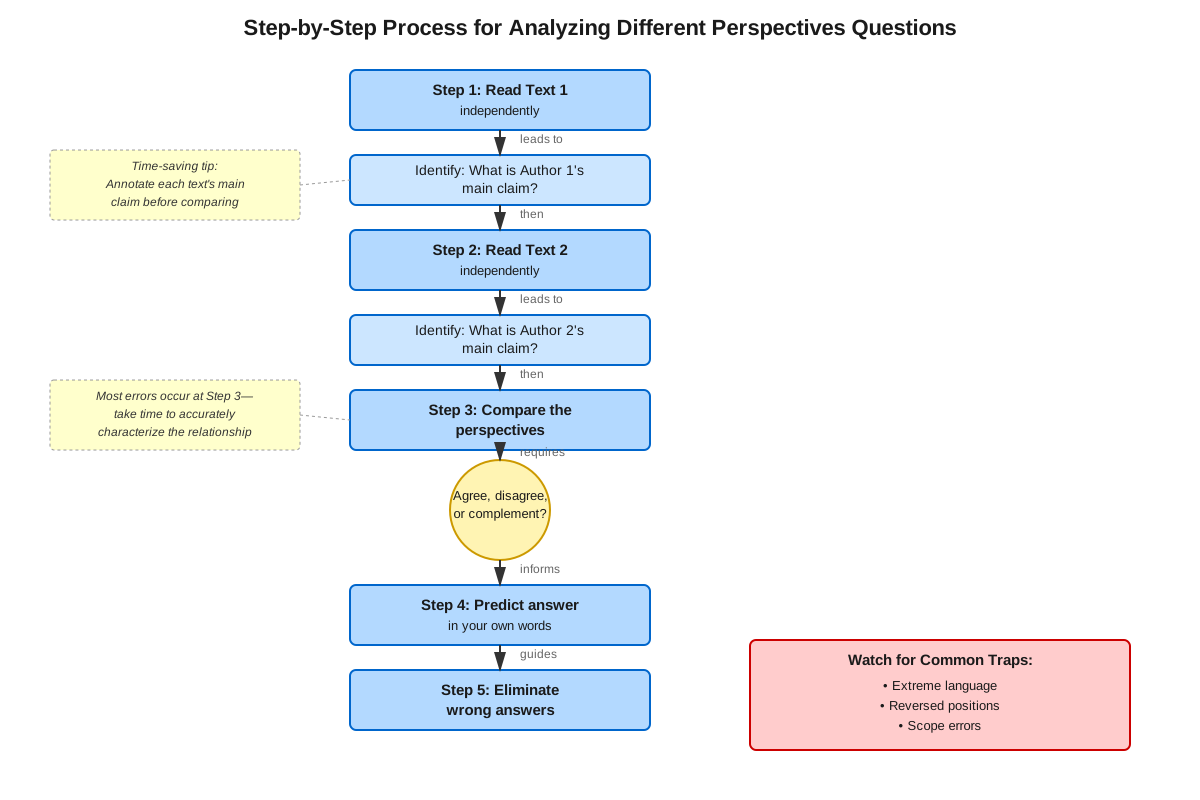
Successfully navigating different perspectives questions requires a systematic approach. Students should read each text independently first, identifying the main claim, key evidence, and overall position before attempting to compare. Creating a mental or physical note of "Text 1 says..." and "Text 2 says..." helps maintain clarity about which author holds which position.
After understanding each text individually, students should actively identify the relationship: Do the authors disagree? About what specifically? Do they agree? On what points? Do they address different aspects of the same issue? This active comparison prevents the common error of assuming texts disagree simply because they discuss different aspects of a topic.
Attention to scope and specificity is crucial. An author making a broad claim about "most cases" holds a different position than one making a specific claim about "this particular instance," even if the general topic is the same. Similarly, an author discussing correlation maintains a different perspective than one claiming causation.
Evidence and Support Across Perspectives
Different perspectives questions often hinge on understanding how authors use evidence differently. Two authors might cite similar types of evidence but interpret it differently, or they might use entirely different evidence to support opposing conclusions. Students must track not just what authors claim but why they claim it—the reasoning and support structure matters as much as the conclusion.
For example, if Text 1 cites experimental data to support a claim while Text 2 relies on theoretical modeling, the perspectives differ in their evidentiary approach even if their conclusions align. Conversely, if both authors cite the same study but draw opposite conclusions, understanding their different interpretations becomes key to answering the question correctly.
Concept Relationships
The core concepts within different perspectives questions form an interconnected system. Understanding what constitutes a perspective (the foundational concept) enables recognition of the various types of perspective relationships. These relationship types then inform the critical reading strategies students employ, which in turn help them analyze how evidence and support function across perspectives.
The progression flows: Individual Perspective Comprehension → Relationship Identification → Strategic Comparison → Evidence Analysis → Accurate Answer Selection
Different perspectives questions build upon prerequisite skills in a hierarchical manner. Basic reading comprehension provides the foundation for understanding each individual text. Vocabulary knowledge enables recognition of relationship indicators and transition words. The ability to identify claims and evidence in single texts scales up to tracking multiple claims across texts. Text structure awareness helps students efficiently locate and compare key information.
This topic also connects forward to more advanced academic skills. Mastering different perspectives on the SAT prepares students for college-level synthesis essays, research paper writing, and participation in scholarly debates. The skill of fairly representing multiple viewpoints while analyzing their relationships is fundamental to academic discourse across disciplines.
High-Yield Facts
⭐ Different perspectives questions always present exactly two texts that are thematically connected but represent different viewpoints or approaches
⭐ The most common error is confusing which author holds which position—always track "Text 1 says" and "Text 2 says" separately
⭐ Authors can address the same topic without disagreeing if they focus on different aspects, time periods, or dimensions of the issue
⭐ Question stems typically ask how the texts relate, what one author would say about the other's claim, or what both authors would agree on
⭐ Incorrect answers often overstate agreement or disagreement, misrepresent one author's position, or confuse the direction of the relationship
- Different perspectives questions appear in all content areas: science, social studies, humanities, and literature
- Authors may reach the same conclusion through different reasoning or evidence, representing different perspectives despite agreement
- Scope matters: an author discussing "some cases" holds a different position than one claiming "all cases"
- The relationship between texts is more important than the specific content of either individual text
- Correct answers must be supported by both texts when the question asks what "both authors would agree" on
- Authors can disagree about interpretation while agreeing on facts, or vice versa
- Complementary perspectives are neither agreements nor disagreements—they're different focuses on related aspects
Quick check — test yourself on Different perspectives so far.
Try Flashcards →Common Misconceptions
Misconception: If two texts discuss the same topic, the authors must disagree with each other.
Correction: Authors frequently address different aspects of the same topic without contradicting each other. Complementary perspectives explore related but distinct dimensions of an issue. Always identify whether the authors are actually making competing claims about the same specific point.
Misconception: If an author doesn't explicitly mention something from the other text, they must disagree with it.
Correction: Absence of mention is not disagreement. An author's silence on a particular point doesn't indicate opposition unless their stated position logically contradicts it. Focus on what authors actually claim, not what they don't address.
Misconception: The longer or more detailed text represents the "correct" perspective.
Correction: Both texts are presented as equally valid perspectives for analysis purposes. The SAT tests your ability to understand and compare viewpoints, not to judge which author is "right." Length and detail don't indicate correctness.
Misconception: Authors who use different types of evidence must disagree with each other.
Correction: Different evidentiary approaches (experimental vs. observational, historical vs. contemporary, quantitative vs. qualitative) can support the same conclusion or complementary perspectives. Methodological differences don't automatically indicate disagreement about conclusions.
Misconception: If one author qualifies their claim with limitations and another doesn't, they hold opposing views.
Correction: Qualified agreement is still agreement. An author who says "X is true in most cases" doesn't necessarily disagree with an author who says "X is true" without qualification—the first author is simply more precise about scope. Look for actual contradictions, not just differences in specificity.
Misconception: The answer to "what would Author 2 say about Author 1's claim" must be explicitly stated in Text 2.
Correction: These questions require inference based on Author 2's stated position. If Author 2's perspective logically implies a response to Author 1's claim, that inference is valid even if Author 2 never directly addresses that specific point.
Worked Examples
Example 1: Complementary Perspectives
Text 1
Archaeologist Maria Santos argues that the decline of the ancient Mayan civilization was primarily driven by prolonged drought conditions between 800 and 1000 CE. Her analysis of sediment cores from lake beds in the Yucatan Peninsula reveals significantly reduced rainfall during this period, which would have devastated the agricultural systems that supported large urban populations.
Text 2
Historian James Chen examines the political fragmentation of Mayan city-states during the same period. He notes that inscriptions from multiple sites document increased warfare between rival kingdoms and the breakdown of trade networks. Chen argues that internal political conflicts weakened the civilization's ability to respond to environmental challenges.
Question: Based on the texts, how would Chen most likely respond to Santos's claim about the Mayan decline?
Answer Choices:
A) He would reject it entirely, arguing that political factors alone explain the decline
B) He would agree that drought was the sole cause of the civilization's collapse
C) He would suggest that political instability may have compounded the effects of environmental stress
D) He would argue that Santos's evidence from sediment cores is methodologically flawed
Solution Process:
Step 1: Identify Text 1's main claim: Santos argues drought was the "primary" driver of Mayan decline, supported by sediment core evidence of reduced rainfall.
Step 2: Identify Text 2's main claim: Chen argues political fragmentation and warfare weakened the civilization, supported by inscription evidence.
Step 3: Determine the relationship: Both authors address the Mayan decline but focus on different factors (environmental vs. political). Neither explicitly contradicts the other. This suggests complementary perspectives rather than direct opposition.
Step 4: Evaluate answer choices:
- Choice A: Too extreme—Chen doesn't reject environmental factors, he just emphasizes political ones
- Choice B: Contradicts Chen's emphasis on political factors
- Choice C: Accurately reflects how Chen's political focus could complement Santos's environmental focus—political instability could have made environmental challenges worse
- Choice D: Chen never questions Santos's methodology
Step 5: Select Choice C as it accurately characterizes how Chen's perspective relates to Santos's without overstating agreement or disagreement.
Connection to Learning Objectives: This example demonstrates identifying complementary perspectives (different aspects of the same issue) and synthesizing information across texts to determine relationship nature.
Example 2: Qualified Disagreement
Text 1
Economist Dr. Patricia Lee's research indicates that increasing the minimum wage to $15 per hour would benefit low-income workers without significantly affecting employment rates. Her analysis of data from cities that have already implemented such increases shows minimal job losses in the service sector, suggesting that businesses can absorb higher labor costs through modest price increases and improved efficiency.
Text 2
Economist Dr. Robert Martinez acknowledges that minimum wage increases in large urban areas with strong economies have not produced substantial job losses. However, his research emphasizes that small businesses in rural areas with weaker economic conditions face different constraints. Martinez argues that a uniform national minimum wage policy fails to account for regional economic variations and could harm employment in economically struggling areas.
Question: Which statement best describes how Martinez's perspective relates to Lee's?
Answer Choices:
A) Martinez completely rejects Lee's findings about minimum wage effects
B) Martinez agrees with Lee's findings but argues they may not apply universally across all economic contexts
C) Martinez and Lee reach identical conclusions about minimum wage policy
D) Martinez focuses on urban areas while Lee examines rural economies
Solution Process:
Step 1: Identify Text 1's position: Lee argues $15 minimum wage benefits workers without significant employment effects, based on data from cities that implemented increases.
Step 2: Identify Text 2's position: Martinez acknowledges Lee's findings are valid for large urban areas with strong economies BUT argues they don't apply to rural areas with weaker economies. He opposes uniform national policy.
Step 3: Recognize the relationship type: This is qualified agreement/disagreement. Martinez doesn't reject Lee's data or findings; he accepts them as valid for specific contexts but argues against generalizing them universally.
Step 4: Evaluate answer choices:
- Choice A: Too extreme—Martinez explicitly acknowledges Lee's findings for urban areas
- Choice B: Accurately captures Martinez's qualified acceptance of Lee's findings with important scope limitations
- Choice C: Too broad—they disagree about policy implications and universal applicability
- Choice D: Reverses their actual focuses—Lee studied cities, Martinez emphasizes rural areas
Step 5: Select Choice B as it precisely characterizes the qualified nature of Martinez's response to Lee's claims.
Connection to Learning Objectives: This example illustrates distinguishing between types of perspective relationships (qualified agreement vs. complete agreement or disagreement) and recognizing subtle differences in scope and applicability.
Exam Strategy
When approaching different perspectives questions on the SAT, employ a systematic three-phase strategy: Separate Understanding → Relationship Identification → Answer Verification.
Phase 1: Separate Understanding
Read Text 1 completely and summarize its main claim in your own words before moving to Text 2. Identify the author's position, key evidence, and any qualifications or limitations. Then repeat this process for Text 2. This prevents the common error of blending the texts together in your mind. Consider jotting brief notes: "T1: [main claim]" and "T2: [main claim]."
Phase 2: Relationship Identification
Before looking at answer choices, actively determine how the texts relate. Ask yourself: Do they directly contradict each other? Do they address different aspects of the same issue? Does one qualify or limit the other's claims? Is one more specific or general than the other? Having a clear sense of the relationship before reading answers prevents you from being swayed by attractive but inaccurate characterizations.
Phase 3: Answer Verification
Check each answer choice against both texts. For "both authors would agree" questions, the correct answer must be supported by both texts—eliminate any choice that contradicts or isn't supported by either text. For "how would Author 2 respond to Author 1" questions, the answer must be consistent with Author 2's stated perspective, even if Author 2 never directly addresses that specific point.
Exam Tip: Watch for trigger words that indicate relationship types: "however," "similarly," "in contrast," "additionally," "although," "while," and "nevertheless" signal how authors position their perspectives relative to others.
Time Management: Allocate approximately 60-75 seconds per different perspectives question. These questions require more time than single-text questions because you must process two passages, but they shouldn't consume more than 90 seconds. If you're struggling to see the relationship after reading both texts once, quickly reread the first sentence of each text (which often contains the main claim) rather than rereading entirely.
Process of Elimination Tips:
- Eliminate answers that misattribute positions (claiming Text 1's position is Text 2's or vice versa)
- Eliminate extreme characterizations ("completely rejects," "entirely agrees") unless the texts explicitly support such strong language
- Eliminate answers that introduce information not present in either text
- For "both authors agree" questions, eliminate any answer that even one author would dispute
- Watch for answers that confuse the direction of the relationship (claiming agreement when there's disagreement or vice versa)
Common Trap Patterns: The SAT frequently includes wrong answers that accurately describe one text but mischaracterize the other, or that correctly identify that the texts differ but mischaracterize how they differ. Always verify that your chosen answer accurately represents both texts and their relationship.
Memory Techniques
COMPARE Acronym for approaching different perspectives questions:
- Claim: Identify each author's main claim
- Opposition or overlap: Determine if they contradict or complement
- Match to question: What specifically is being asked?
- Position tracking: Keep Text 1 and Text 2 positions separate
- Answer verification: Check choice against both texts
- Relationship type: Agreement, disagreement, or complementary?
- Eliminate extremes: Remove overstated characterizations
Visualization Strategy: Picture two people having a conversation about the same topic. Are they arguing (direct opposition)? Are they discussing different aspects while nodding along (complementary)? Is one saying "yes, but..." (qualified agreement)? This mental image helps clarify relationship types.
The "Both-Neither-One" Test: For any answer choice, quickly categorize it as something both authors would support, neither would support, or only one would support. This rapid categorization helps eliminate wrong answers efficiently.
Scope Spectrum: Visualize a spectrum from "specific case" to "general principle." Place each author's claim on this spectrum. Authors at different points on the spectrum may have complementary rather than opposing perspectives.
Summary
Different perspectives questions on the SAT Reading and Writing section require students to synthesize information from two thematically connected texts that present varying viewpoints, approaches, or focuses on the same general topic. Success depends on maintaining clear separation between each author's position while accurately identifying the relationship between them—whether direct opposition, complementary focus, qualified agreement, or methodological difference. The key challenge is avoiding common errors such as confusing which author holds which position, assuming texts disagree simply because they discuss different aspects of a topic, or overstating the degree of agreement or disagreement. Students must read each text independently to understand its main claim and evidence, then actively compare the perspectives before evaluating answer choices. These questions assess higher-order synthesis skills essential for college-level academic work and appear consistently throughout the SAT, making them a high-priority topic for test preparation.
Key Takeaways
- Different perspectives questions always present two texts with related but distinct viewpoints that must be compared and synthesized
- The most critical skill is maintaining clear separation between Text 1's position and Text 2's position throughout the question
- Authors can address the same topic without disagreeing if they focus on different aspects, time periods, or dimensions of the issue
- Question stems typically ask about the relationship between texts, what one author would say about the other's claim, or points of agreement
- Systematic approach is essential: understand each text separately, identify the relationship type, then verify answers against both texts
- Incorrect answers frequently misattribute positions, overstate agreement or disagreement, or confuse complementary perspectives with opposition
- Scope and specificity matter—authors making claims at different levels of generality may hold complementary rather than contradictory perspectives
Related Topics
Single-Text Main Idea Questions: Mastering different perspectives builds upon the ability to identify main ideas in individual passages; strengthening single-text comprehension improves multi-text synthesis skills.
Evidence-Based Reading: Understanding how authors use evidence to support claims in single texts prepares students to compare evidentiary approaches across multiple perspectives.
Rhetorical Analysis: Analyzing how authors construct arguments and position their claims relative to other viewpoints extends the skills developed in different perspectives questions.
Synthesis Essay Writing: The skills developed for SAT different perspectives questions directly transfer to college-level writing tasks requiring synthesis of multiple sources.
Cross-Text Connections - Shared Concepts: Related question type that asks students to identify common themes or ideas across texts rather than contrasting perspectives.
Practice CTA
Now that you've mastered the core concepts and strategies for different perspectives questions, it's time to apply your knowledge! Work through the practice questions to reinforce your understanding and build confidence with this high-yield question type. Each practice question you complete strengthens your ability to quickly identify perspective relationships and avoid common traps. Remember: these skills improve with deliberate practice, and mastering different perspectives questions will significantly boost your Reading and Writing score. Review the flashcards to cement key concepts, then tackle the practice questions to see your progress in action!
Sign up free to keep reading
Create a free AnvayaPrep account to finish this SAT guide on Different perspectives — plus flashcards and practice questions.