Overview
The SAT Reading and Writing section frequently tests students' ability to analyze and compare multiple texts, particularly when those texts present conflicting viewpoints, contradictory evidence, or opposing interpretations of the same phenomenon. Disagreement between texts represents one of the most important question types in the Cross-Text Connections category, requiring students to identify, understand, and articulate how two passages differ in their claims, conclusions, or perspectives.
This skill extends beyond simple reading comprehension—it demands critical thinking, careful attention to nuance, and the ability to distinguish between subtle variations in argument and evidence. When two texts disagree, they may contradict each other directly, present different interpretations of the same data, emphasize different aspects of an issue, or reach opposing conclusions from similar starting points. The SAT disagreement between texts questions assess whether students can recognize these differences and explain them accurately, making this a high-value skill for test performance.
Understanding disagreement between texts connects directly to broader RW (Reading and Writing) competencies including inference, evidence evaluation, and rhetorical analysis. Students who master this topic develop stronger analytical skills that apply across all passage types—from scientific research summaries to literary criticism, from historical documents to contemporary social science. This foundational skill in comparative analysis prepares students not only for SAT success but also for college-level academic work where synthesizing multiple sources is essential.
Learning Objectives
- [ ] Identify key features of disagreement between texts
- [ ] Explain how disagreement between texts appears on the SAT
- [ ] Apply disagreement between texts to answer SAT-style questions
- [ ] Distinguish between direct contradictions and nuanced differences in perspective
- [ ] Analyze the specific evidence or reasoning that creates disagreement between passages
- [ ] Evaluate answer choices to select the most accurate characterization of textual disagreement
- [ ] Recognize common patterns in how SAT passages present conflicting viewpoints
Prerequisites
- Basic reading comprehension: Understanding main ideas, supporting details, and author's purpose in individual passages is essential before comparing multiple texts
- Vocabulary in context: Recognizing how word choice affects meaning helps identify subtle disagreements between authors
- Inference skills: Drawing logical conclusions from textual evidence enables students to recognize implicit disagreements, not just explicit contradictions
- Understanding of argument structure: Recognizing claims, evidence, and conclusions allows students to pinpoint where exactly texts diverge
Why This Topic Matters
In academic and professional contexts, evaluating conflicting sources represents a critical literacy skill. Researchers must reconcile contradictory studies, journalists must present multiple perspectives fairly, and informed citizens must navigate competing claims about important issues. The SAT tests this real-world competency through carefully constructed passage pairs that mirror the kind of source comparison students will encounter throughout their education.
On the SAT, disagreement between texts questions appear with high frequency—typically 2-3 questions per test in the Reading and Writing section. These questions carry significant weight because they assess multiple skills simultaneously: comprehension of both passages, analytical comparison, and precise interpretation of how ideas relate. Students who struggle with these questions often lose points not because they misunderstand individual passages, but because they fail to accurately characterize the nature of the disagreement.
These questions commonly appear in several formats: passages may present competing scientific hypotheses, offer different historical interpretations of the same event, propose alternative solutions to a problem, or emphasize different aspects of a phenomenon while appearing to discuss the same topic. The passages are typically 50-150 words each, drawn from diverse disciplines including natural sciences, social sciences, humanities, and literature. Understanding how to efficiently identify and articulate disagreements saves valuable time and improves accuracy across the entire Reading and Writing section.
Core Concepts
Types of Disagreement
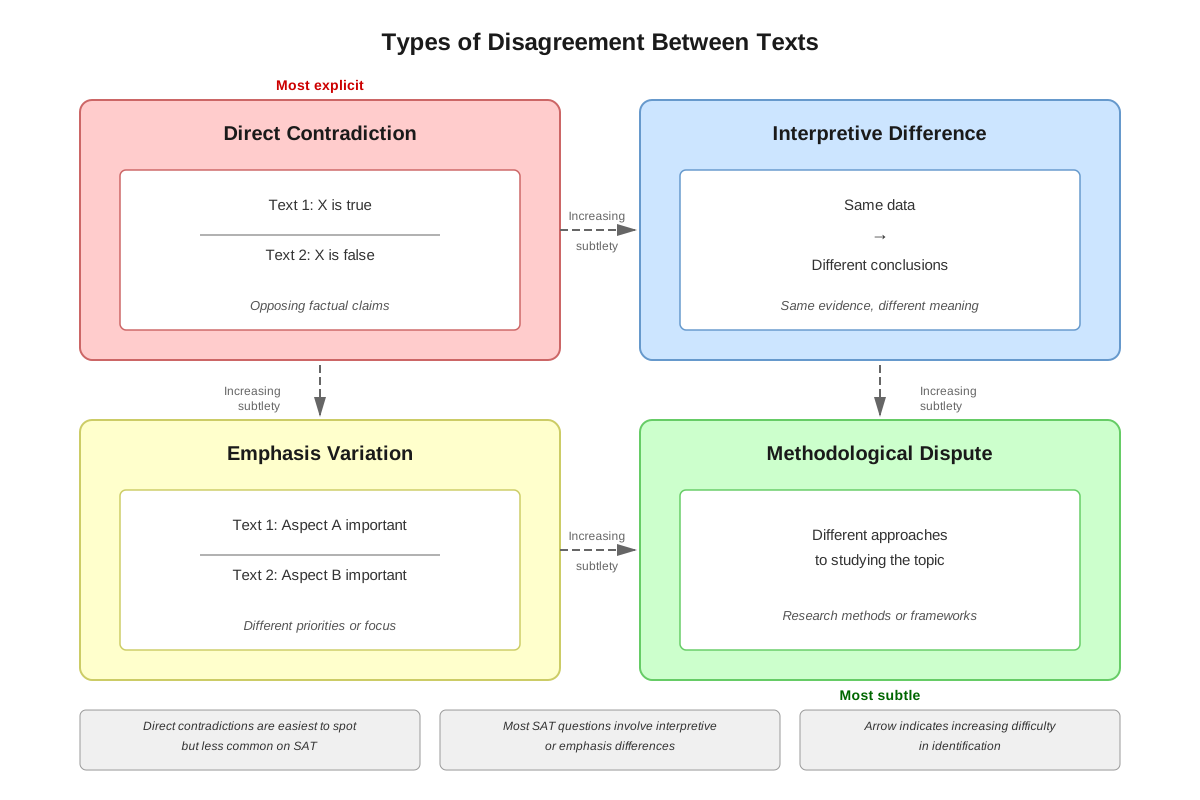
Disagreement between texts manifests in several distinct patterns that students must recognize. The most straightforward type is direct contradiction, where Text 1 makes a claim that Text 2 explicitly denies. For example, one passage might state that a particular species is extinct while another asserts it still exists in remote regions. However, SAT passages more frequently present subtler forms of disagreement.
Interpretive disagreement occurs when both texts accept the same facts but draw different conclusions or emphasize different implications. Two historians might agree on the dates and events of a historical period but disagree about its significance or causes. Two scientists might observe the same experimental results but propose different mechanisms to explain them. These disagreements require students to distinguish between shared factual ground and divergent analysis.
Methodological disagreement involves texts that differ in their approach to a question rather than their answer. One researcher might favor experimental studies while another advocates for observational research. One literary critic might emphasize biographical context while another focuses on textual analysis alone. The disagreement centers on how to investigate a topic, not necessarily what conclusions to reach.
Emphasis disagreement represents the most subtle category, where texts discuss the same general topic but highlight different aspects or consider different factors most important. Both passages might discuss climate change, but one emphasizes technological solutions while the other stresses behavioral change. Recognizing this type requires careful attention to what each author prioritizes.
Identifying the Point of Disagreement
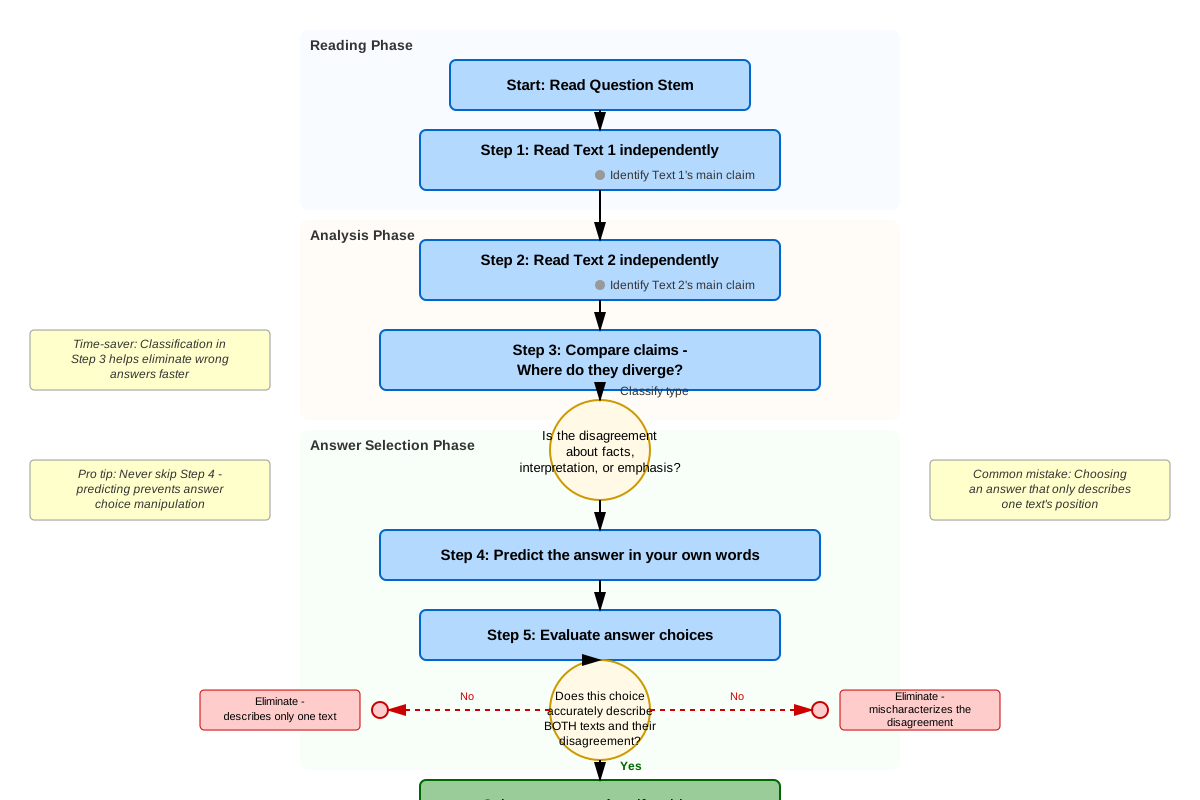
Successful analysis of disagreement between texts requires a systematic approach. First, students must identify the central claim or main point of each passage independently. What is each author fundamentally arguing or explaining? This step prevents the common error of identifying superficial differences while missing the core disagreement.
Next, students should locate the specific evidence or reasoning each text provides. Disagreements often emerge not in abstract claims but in how authors support their positions. One text might cite experimental data while another relies on theoretical models. One might emphasize recent trends while another takes a longer historical view.
The third step involves determining the scope of disagreement. Do the texts contradict each other completely, or do they disagree on one aspect while agreeing on others? Many SAT questions include wrong answers that overstate the disagreement, claiming the texts are completely opposed when they actually differ on a single point.
Common Structural Patterns
SAT passages that disagree typically follow predictable organizational patterns. The thesis-antithesis structure presents Text 1 making a claim and Text 2 challenging or qualifying it. The competing explanations structure offers two different accounts of the same phenomenon. The problem-solution disagreement presents texts that agree a problem exists but propose different solutions.
Understanding these patterns helps students anticipate where disagreement will emerge. In scientific passages, disagreement often centers on causation or mechanism. In historical passages, disagreement frequently involves interpretation of significance or motivation. In literary passages, disagreement typically concerns meaning, authorial intent, or critical approach.
Language Markers of Disagreement
Certain words and phrases signal disagreement between texts. Contrast markers like "however," "in contrast," "on the other hand," and "conversely" often introduce opposing viewpoints. Qualifying language such as "may," "might," "could," and "possibly" can indicate uncertainty or disagreement with stronger claims. Negation words like "not," "never," "fails to," and "rejects" explicitly mark opposition.
However, students must recognize that disagreement can exist even without explicit contrast markers. Two texts can disagree while both using neutral, descriptive language. The disagreement emerges from incompatible claims, not necessarily from argumentative tone.
Evaluating Answer Choices
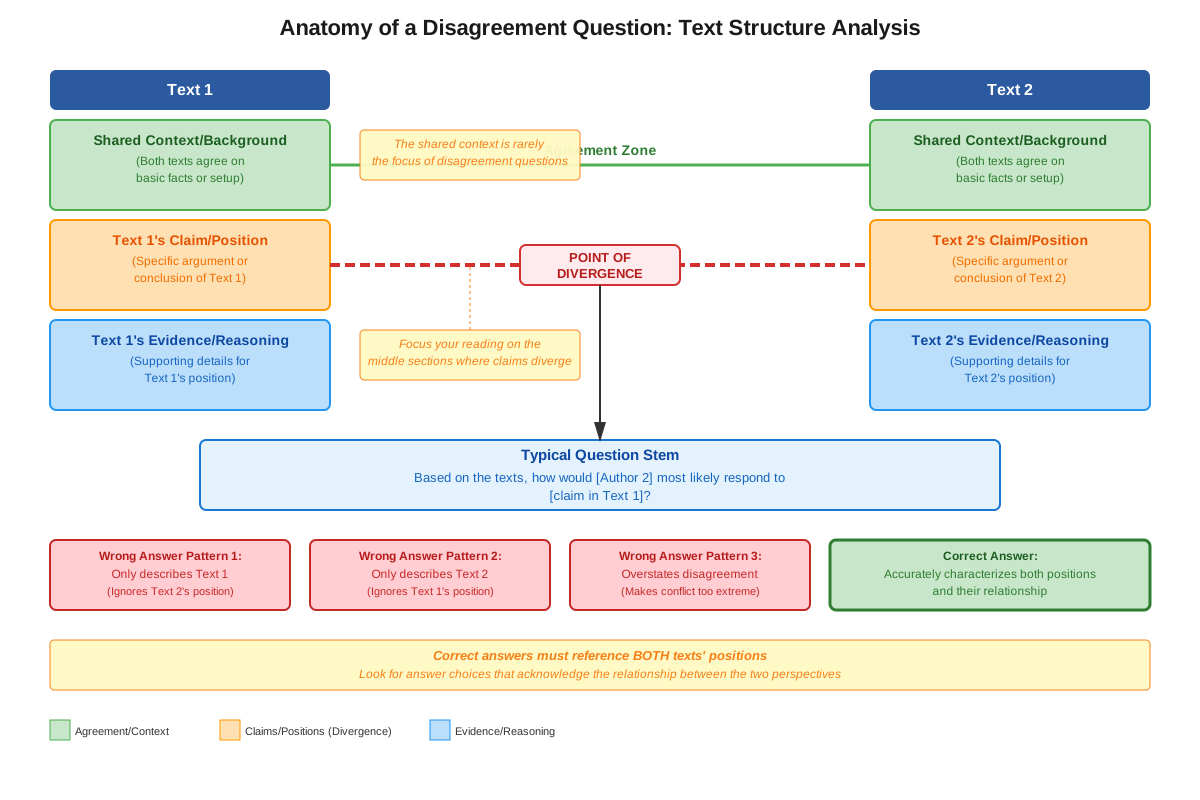
SAT answer choices for disagreement questions require careful evaluation. Correct answers precisely characterize both the nature and scope of the disagreement. They avoid overgeneralization and accurately represent what each text actually claims. Wrong answers typically fall into several categories:
| Wrong Answer Type | Characteristic | Example |
|---|---|---|
| Overgeneralization | Claims texts disagree completely when they differ on one point | "Text 1 and Text 2 have completely opposite views on climate change" (when they only disagree on one solution) |
| Undergeneralization | Identifies a minor difference while missing the main disagreement | Focusing on a small detail rather than the central conflict |
| Misrepresentation | Incorrectly states what one or both texts claim | Attributing a position to a text that doesn't hold it |
| Irrelevant difference | Points out a difference that isn't actually a disagreement | Noting that texts discuss different examples of the same principle |
Concept Relationships
The skill of identifying disagreement between texts builds directly on foundational reading comprehension abilities. Students must first understand each passage individually (main idea, supporting details, author's purpose) before they can meaningfully compare them. This relationship flows as: Individual passage comprehension → Comparative analysis → Identification of disagreement.
Within the topic itself, concepts connect hierarchically. Types of disagreement (direct contradiction, interpretive disagreement, methodological disagreement, emphasis disagreement) represent the conceptual framework. Identifying the point of disagreement provides the analytical method. Language markers and structural patterns offer practical tools for applying that method. Evaluating answer choices represents the final application step where all previous concepts converge.
Disagreement between texts also connects forward to other Cross-Text Connections skills. Understanding disagreement helps students recognize when texts complement each other (by addressing different aspects of a topic) or when one text provides evidence for another's claims. The comparative analysis skills developed here transfer directly to synthesis tasks in college writing.
The relationship map flows: Reading comprehension → Identifying claims and evidence → Recognizing patterns of disagreement → Distinguishing types of disagreement → Evaluating characterizations of disagreement → Selecting accurate answer choices. Each step depends on the previous one, making this a cumulative skill that rewards systematic practice.
High-Yield Facts
⭐ Disagreement between texts questions appear 2-3 times per SAT Reading and Writing section, making them high-frequency question types
⭐ The most common wrong answers overstate the disagreement, claiming complete opposition when texts differ on only one aspect
⭐ Texts can disagree even when they share the same general topic and some factual information—disagreement often concerns interpretation or emphasis
⭐ Direct contradiction is less common on the SAT than nuanced disagreement about interpretation, methodology, or emphasis
⭐ Correct answers precisely characterize both what the texts disagree about AND what aspect they might agree on
- Disagreement questions always involve exactly two texts, labeled Text 1 and Text 2, typically 50-150 words each
- The question stem usually includes phrases like "how would the author of Text 2 most likely respond to Text 1" or "what is the main difference between the two texts"
- Scientific passages often disagree about causation, mechanism, or the interpretation of experimental results
- Historical and social science passages frequently disagree about significance, motivation, or the relative importance of different factors
- Literary passages typically disagree about meaning, interpretation, or critical approach
- Texts that use different examples or focus on different time periods may still agree on their fundamental claims
- The disagreement is always supported by specific textual evidence—students should be able to point to exact words or phrases that create the conflict
- Some questions ask students to identify what would strengthen one text's position against the other, requiring understanding of the disagreement's logical structure
Quick check — test yourself on Disagreement between texts so far.
Try Flashcards →Common Misconceptions
Misconception: If two texts discuss different examples or aspects of a topic, they automatically disagree.
Correction: Texts can complement each other by addressing different facets of the same issue without contradicting each other. Disagreement requires incompatible claims, not merely different focuses. Two texts about renewable energy might discuss solar and wind power respectively without disagreeing about anything.
Misconception: The text that appears second (Text 2) is always responding to or disagreeing with the first text.
Correction: The texts are independent passages that may have been written at different times by different authors. Text 2 doesn't necessarily "respond" to Text 1—the SAT simply presents them together for comparison. The disagreement exists in their incompatible positions, not in a direct dialogue.
Misconception: Disagreement requires strong, argumentative language or explicit contrast markers.
Correction: Texts can disagree while both maintaining neutral, descriptive tones. The disagreement emerges from logically incompatible claims, not from emotional or argumentative language. Two scientific papers can politely present contradictory findings without using any confrontational language.
Misconception: If texts agree on some points, they don't really disagree.
Correction: Texts frequently agree on background information, general principles, or certain facts while disagreeing on specific claims, interpretations, or conclusions. Partial agreement doesn't eliminate disagreement on key points. Two historians might agree on what happened but disagree completely on why it happened.
Misconception: The correct answer will always use the word "disagree" or "contradict."
Correction: Correct answers often describe the disagreement without using these explicit terms, instead characterizing what each text claims and how those claims differ. Phrases like "Text 1 emphasizes X while Text 2 focuses on Y" or "Text 1 attributes the phenomenon to A, but Text 2 suggests B" accurately capture disagreement without using the word "disagree."
Misconception: Longer or more complex passages contain more significant disagreements.
Correction: The length or complexity of passages doesn't correlate with the significance of disagreement. Brief passages can present fundamental contradictions, while longer passages might disagree on relatively minor points. Students should focus on the logical relationship between claims, not passage length.
Worked Examples
Example 1: Scientific Disagreement
Text 1
Recent studies of corvid intelligence have demonstrated that crows can solve complex multi-step puzzles, use tools in novel ways, and even plan for future needs. These findings suggest that corvids possess cognitive abilities previously thought to be unique to primates. The neural density in corvid brains, though structured differently from mammalian brains, may provide computational power equivalent to that of much larger primate brains.
Text 2
While corvids undoubtedly display impressive problem-solving abilities, attributing primate-like cognition to these birds may be premature. The behaviors observed in laboratory settings often involve food rewards and may reflect specialized adaptations for foraging rather than general intelligence. Many corvid "tool use" behaviors appear to be instinctive responses to specific situations rather than evidence of flexible, abstract reasoning.
Question: Based on the texts, how would the author of Text 2 most likely respond to the claim in Text 1 that corvids possess cognitive abilities previously thought unique to primates?
Step 1: Identify Text 1's main claim
Text 1 argues that corvids have primate-like cognitive abilities based on their problem-solving, tool use, and planning capabilities. The passage emphasizes that these abilities were "previously thought to be unique to primates."
Step 2: Identify Text 2's position
Text 2 acknowledges corvid problem-solving but questions whether this represents "primate-like cognition." The author suggests these behaviors might be specialized adaptations or instinctive responses rather than general intelligence.
Step 3: Characterize the disagreement
The texts disagree on interpretation: both accept that corvids solve problems and use tools, but Text 2 disputes that these behaviors demonstrate the same type of cognition found in primates. This is an interpretive disagreement—same facts, different conclusions.
Step 4: Predict the answer
The correct answer should indicate that Text 2's author would question or challenge the interpretation while acknowledging the observed behaviors. It should not claim Text 2 denies corvid abilities entirely.
Correct answer: "By suggesting that the observed behaviors may reflect specialized adaptations rather than general cognitive abilities comparable to those of primates."
Why this is correct: This answer accurately captures Text 2's position—acknowledging the behaviors while disputing their interpretation as primate-like cognition. It identifies the specific nature of the disagreement without overstating it.
Example 2: Historical Interpretation Disagreement
Text 1
The rapid industrialization of the late 19th century fundamentally transformed American society, creating unprecedented economic growth and technological innovation. While working conditions in factories were often harsh, industrialization ultimately improved living standards for most Americans by increasing productivity, lowering consumer prices, and creating new employment opportunities in urban centers.
Text 2
The social costs of rapid industrialization in the late 19th century were severe and long-lasting. Factory workers endured dangerous conditions, child labor was widespread, and the concentration of wealth among industrial magnates created stark economic inequality. The period's economic growth came at an enormous human cost that affected multiple generations of working-class families.
Question: What is the main difference between how Text 1 and Text 2 characterize 19th-century industrialization?
Step 1: Identify what both texts agree on
Both texts acknowledge that industrialization occurred rapidly in the late 19th century and that factory conditions were harsh. They share factual common ground.
Step 2: Identify the key difference
Text 1 emphasizes the positive outcomes (economic growth, innovation, improved living standards) and suggests benefits outweighed costs. Text 2 emphasizes negative consequences (dangerous conditions, child labor, inequality) and suggests costs were severe and lasting.
Step 3: Characterize the type of disagreement
This is an emphasis disagreement combined with interpretive disagreement. Both texts could accept all the facts mentioned by the other, but they emphasize different aspects and reach different overall judgments about whether industrialization was ultimately beneficial or harmful.
Step 4: Evaluate answer choices
Wrong answer: "Text 1 claims industrialization occurred rapidly, while Text 2 claims it was gradual." (Both agree it was rapid—this misrepresents the texts.)
Wrong answer: "Text 1 discusses economic effects while Text 2 discusses social effects." (Both discuss both types of effects—this undergeneralizes the disagreement.)
Correct answer: "Text 1 emphasizes the long-term benefits of industrialization, while Text 2 emphasizes its human costs."
Why this is correct: This answer accurately captures the fundamental difference in perspective—both texts acknowledge multiple aspects of industrialization, but they differ in what they emphasize and in their overall evaluation of whether the changes were ultimately positive or negative.
Exam Strategy
When approaching SAT disagreement between texts questions, follow a systematic process to maximize accuracy and efficiency. First, read both passages completely before looking at the question or answer choices. Trying to identify disagreement before understanding each text fully often leads to superficial or incorrect analysis.
Exam Tip: Spend 60-90 seconds reading both passages carefully. Rushing through the reading to get to the question faster usually costs more time in the end because you'll need to reread to evaluate answer choices.
After reading, identify the main claim or central point of each passage in your own words. Ask yourself: "What is this author fundamentally arguing or explaining?" Write a brief mental summary of each text's position. This step prevents the common error of getting lost in details while missing the core disagreement.
Trigger words and phrases to watch for in question stems include:
- "How would the author of Text 2 most likely respond to..."
- "What is the main difference between..."
- "Based on Text 2, what would the author most likely say about the claim in Text 1..."
- "The two texts disagree about..."
- "Which statement best describes the relationship between..."
These phrases signal that you need to identify and characterize disagreement, not simply comprehend individual passages.
For process of elimination, systematically eliminate answer choices that:
- Misrepresent either text: If an answer claims a text says something it doesn't, eliminate it immediately
- Overstate the disagreement: If texts disagree on one point but an answer claims they're completely opposed, eliminate it
- Identify irrelevant differences: If an answer points out a difference that isn't actually a disagreement (like different examples of the same principle), eliminate it
- Focus on minor details: If an answer identifies a small difference while missing the main disagreement, eliminate it
Time allocation: Spend approximately 90-120 seconds total on disagreement questions—60-90 seconds reading both passages and 30-45 seconds evaluating answer choices. If you find yourself rereading repeatedly, you likely didn't identify the main points clearly enough on your first read.
A powerful strategy is to predict the answer before looking at choices. After reading both texts, articulate to yourself: "Text 1 says X, but Text 2 says Y." Then look for the answer choice that matches your prediction. This approach prevents you from being swayed by plausible-sounding but incorrect answers.
Memory Techniques
DICE - Remember the four main types of disagreement:
- Direct contradiction
- Interpretive disagreement
- Conceptual/methodological disagreement
- Emphasis disagreement
The "Same Facts, Different Story" principle: Visualize two photographers taking pictures of the same scene from different angles. They're both capturing reality, but their photos look different. Similarly, texts often disagree not about facts but about interpretation, emphasis, or significance. This mental image helps remember that disagreement doesn't require factual contradiction.
The Three-Point Check: Before selecting an answer, verify three things:
- Accuracy: Does this answer correctly represent what both texts say?
- Scope: Does this answer match the scope of disagreement (not overstating or understating)?
- Relevance: Does this answer identify the main disagreement, not a minor difference?
Visualize checking three boxes before committing to an answer.
The "But" Test: When summarizing the relationship between texts, try connecting them with "but." For example: "Text 1 says industrialization improved living standards, BUT Text 2 says it created severe social costs." If you can create a meaningful "but" statement, you've identified the disagreement. If you can't, the texts might not actually disagree.
PROVE - Steps for analyzing disagreement:
- Point: Identify the main point of each text
- Read: Look for specific evidence supporting each point
- Opposition: Determine where the texts oppose each other
- Verify: Check that the disagreement is real, not superficial
- Evaluate: Select the answer that accurately characterizes the disagreement
Summary
Disagreement between texts represents a critical skill in the SAT Reading and Writing section, testing students' ability to compare, contrast, and analyze multiple sources presenting conflicting viewpoints. Success requires understanding that disagreement manifests in various forms—from direct contradiction to subtle differences in interpretation, methodology, or emphasis. Students must read both passages carefully, identify each text's main claim and supporting evidence, and then precisely characterize how those claims differ. The most common errors involve overstating disagreement, misrepresenting what texts actually claim, or identifying superficial differences while missing core conflicts. Effective strategy includes reading both passages completely before examining answer choices, predicting the answer based on clear understanding of each text's position, and systematically eliminating choices that misrepresent, overgeneralize, or focus on irrelevant differences. Mastering this skill requires recognizing that texts can share factual common ground while disagreeing about interpretation, that disagreement doesn't require argumentative language, and that correct answers precisely capture both the nature and scope of the conflict between passages.
Key Takeaways
- Disagreement between texts questions appear 2-3 times per SAT, making them high-frequency and high-value question types requiring systematic mastery
- Texts can disagree about interpretation, emphasis, or methodology while agreeing on basic facts—disagreement doesn't require complete opposition
- The four main types of disagreement are direct contradiction, interpretive disagreement, methodological disagreement, and emphasis disagreement
- Correct answers precisely characterize both what texts disagree about AND the scope of that disagreement, avoiding overgeneralization
- Read both passages completely before examining answer choices, identify each text's main claim, then predict how they differ before evaluating options
- The most common wrong answers overstate disagreement, misrepresent what texts claim, or identify irrelevant differences rather than core conflicts
- Success requires distinguishing between texts that genuinely contradict each other and texts that simply address different aspects of the same topic
Related Topics
Agreement between texts: After mastering disagreement, students should study how texts can support, complement, or reinforce each other's claims. This skill involves recognizing when different passages provide converging evidence or when one text supplies support for another's argument.
Synthesis across multiple sources: Building on disagreement and agreement analysis, synthesis requires integrating information from multiple texts to form a comprehensive understanding. This advanced skill is essential for college-level research and writing.
Evaluating evidence and reasoning: Understanding disagreement between texts connects to deeper analysis of how authors support their claims. Students who master disagreement analysis are well-positioned to evaluate the strength of evidence and identify logical fallacies.
Rhetorical analysis: Recognizing how authors use language, structure, and rhetorical devices to present their positions enhances the ability to identify and characterize disagreement. This skill transfers directly to the SAT Writing section.
Practice CTA
Now that you've mastered the core concepts of disagreement between texts, it's time to apply this knowledge! Work through the practice questions to test your ability to identify different types of disagreement, characterize conflicts accurately, and eliminate wrong answers efficiently. Use the flashcards to reinforce key concepts and trigger words. Remember: this skill improves dramatically with deliberate practice. Each question you analyze strengthens your ability to compare texts quickly and accurately—a skill that will serve you not just on test day, but throughout your academic career. You've built the foundation; now build the fluency through consistent practice!
Sign up free to keep reading
Create a free AnvayaPrep account to finish this SAT guide on Disagreement between texts — plus flashcards and practice questions.