Overview
The paired text relationship is a critical question type on the SAT Reading and Writing section that requires students to analyze and synthesize information from two related passages. Unlike traditional single-passage questions, these items test the ability to identify how two texts interact—whether they agree, disagree, complement, or challenge each other. This skill reflects real-world academic and professional scenarios where individuals must evaluate multiple sources, compare perspectives, and draw informed conclusions.
On the digital SAT, sat paired text relationship questions appear consistently in the Cross-Text Connections domain, making them high-stakes items that can significantly impact overall scores. These questions typically present two short passages (Text 1 and Text 2) followed by a prompt asking students to characterize the relationship between them. Success requires careful reading of both texts, identification of each author's main claim or purpose, and precise understanding of how the texts relate to one another.
Mastering paired text relationships strengthens broader RW (Reading and Writing) competencies including inference-making, argument analysis, and evidence evaluation. This topic builds upon fundamental reading comprehension skills while introducing the additional layer of comparative analysis. Students who excel at these questions demonstrate sophisticated critical thinking abilities that extend beyond the SAT to college-level research, essay writing, and any context requiring evaluation of multiple perspectives on a single issue.
Learning Objectives
- [ ] Identify key features of paired text relationship questions on the SAT
- [ ] Explain how paired text relationship appears on the SAT and what makes these questions distinct
- [ ] Apply paired text relationship analysis strategies to answer SAT-style questions accurately
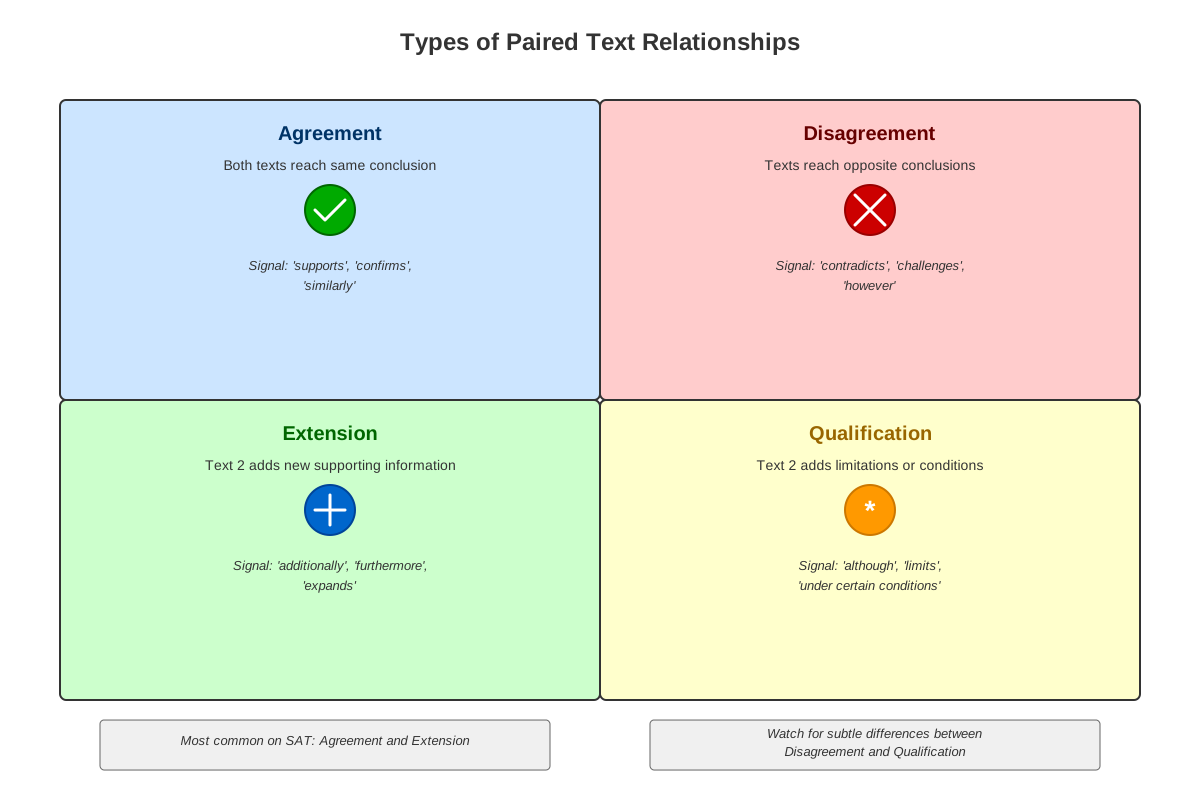
- [ ] Distinguish between different types of text relationships (agreement, disagreement, extension, qualification)
- [ ] Evaluate answer choices by systematically comparing them against both texts
- [ ] Synthesize information from two passages to draw accurate conclusions about their interaction
Prerequisites
- Basic reading comprehension: Understanding main ideas, supporting details, and author's purpose in single passages is essential before comparing two texts
- Argument structure recognition: Identifying claims, evidence, and reasoning helps determine how two arguments relate to each other
- Vocabulary in context: Precise understanding of word meanings prevents misinterpretation of subtle differences between texts
- Inference skills: Drawing logical conclusions from stated information enables recognition of implicit relationships between passages
Why This Topic Matters
In academic and professional contexts, individuals rarely encounter information in isolation. Researchers compare studies, journalists evaluate competing narratives, and students synthesize multiple sources for essays. The paired text relationship skill directly mirrors these real-world demands, making it one of the most practically applicable SAT competencies.
On the SAT, Cross-Text Connections questions appear in every Reading and Writing section, typically comprising 3-4 questions per test. These questions carry the same weight as other item types, but their complexity means they often separate high scorers from average performers. According to College Board data, paired text questions have slightly lower accuracy rates than single-passage items, making them high-yield targets for score improvement.
These questions commonly appear with passages drawn from diverse disciplines—literature, science, social studies, and humanities. The texts might present competing scientific hypotheses, contrasting historical interpretations, different literary analyses, or complementary perspectives on social issues. This variety ensures that students cannot rely on content knowledge alone; they must apply systematic analytical strategies regardless of subject matter. The ability to quickly identify whether Text 2 supports, challenges, extends, or qualifies Text 1 becomes a crucial time-saving skill under exam conditions.
Core Concepts
Understanding Paired Text Structure
Paired text relationship questions on the SAT follow a consistent format: two short passages (typically 50-150 words each) labeled Text 1 and Text 2, followed by a question asking how the texts relate. The passages always address the same topic or theme but may approach it from different angles, time periods, or perspectives. Understanding this structure helps students approach these questions systematically rather than feeling overwhelmed by the dual-passage format.
The texts are deliberately chosen to have a meaningful relationship—they never appear together randomly. The College Board designs these pairs to test specific analytical skills: recognizing agreement, identifying disagreement, understanding how one text extends another's ideas, or seeing how one qualifies or limits another's claims. This intentional pairing means students should always expect to find a clear, definable relationship rather than vague or ambiguous connections.
Types of Text Relationships
The SAT tests several distinct relationship patterns between paired texts. Recognizing these categories helps students predict answer choices and eliminate incorrect options efficiently.
| Relationship Type | Definition | Key Indicators |
|---|---|---|
| Agreement/Support | Text 2 reinforces or confirms Text 1's claims | "similarly," "likewise," "also," parallel evidence |
| Disagreement/Challenge | Text 2 contradicts or disputes Text 1's position | "however," "in contrast," opposing evidence |
| Extension/Elaboration | Text 2 adds new information or examples to Text 1's topic | "additionally," "furthermore," new but compatible details |
| Qualification/Limitation | Text 2 narrows or adds conditions to Text 1's broader claim | "although," "while," "in certain cases" |
| Explanation/Mechanism | Text 2 provides reasons or processes for Text 1's observations | "because," "this occurs when," causal language |
| Application/Example | Text 2 offers specific instances of Text 1's general principle | "for instance," concrete scenarios following abstract claims |
Identifying the Core Claim in Each Text
Before determining the relationship, students must accurately identify what each text actually says. This requires distinguishing between main claims and supporting details. The core claim is the central point the author wants to convey—the "so what?" of the passage. Supporting details provide evidence, examples, or context but aren't the primary message.
A systematic approach involves asking three questions for each text: (1) What is the main topic? (2) What specific point does the author make about this topic? (3) Is this a fact, opinion, hypothesis, or observation? These questions prevent students from fixating on interesting details while missing the overall argument. For example, if Text 1 describes a scientific study's methodology in detail but concludes that the results were inconclusive, the core claim is about the inconclusiveness, not the methodology.
Analyzing How Text 2 Responds to Text 1
The relationship always flows from Text 1 to Text 2—students should think of Text 2 as responding to, commenting on, or building upon Text 1. This directional thinking prevents confusion and aligns with how the questions are phrased. The question stem typically asks "How would the author of Text 2 most likely respond to Text 1?" or "Based on Text 2, what would the author say about the claim in Text 1?"
To analyze this response, students should identify specific points of contact between the texts. Do they discuss the same evidence? Do they reach the same conclusion? Does Text 2 address a limitation or exception to Text 1's claim? Does Text 2 provide a mechanism explaining Text 1's observation? Marking these connection points while reading helps students maintain focus and avoid relying on memory alone.
Evaluating Answer Choices Against Both Texts
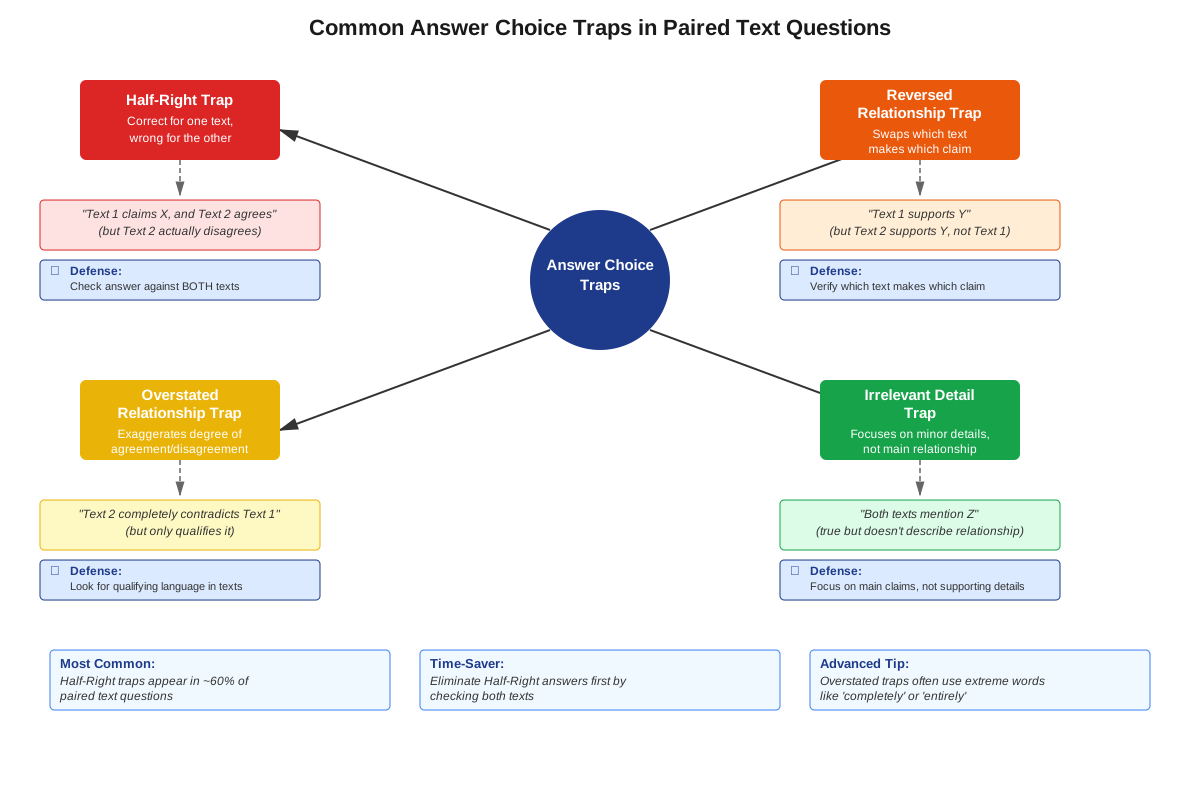
Correct answers must be fully supported by both texts—they cannot introduce information absent from either passage, misrepresent either text's claims, or describe a relationship that only partially fits. This dual-verification requirement makes paired text questions more demanding than single-passage items but also provides a clear elimination strategy.
Students should test each answer choice against Text 1 first: "Does this accurately represent what Text 1 says?" If yes, move to Text 2: "Does this accurately represent what Text 2 says?" If yes, final check: "Does this accurately describe how Text 2 relates to Text 1?" Only answers passing all three tests can be correct. This systematic approach prevents the common error of choosing answers that sound sophisticated but mischaracterize one or both texts.
Concept Relationships
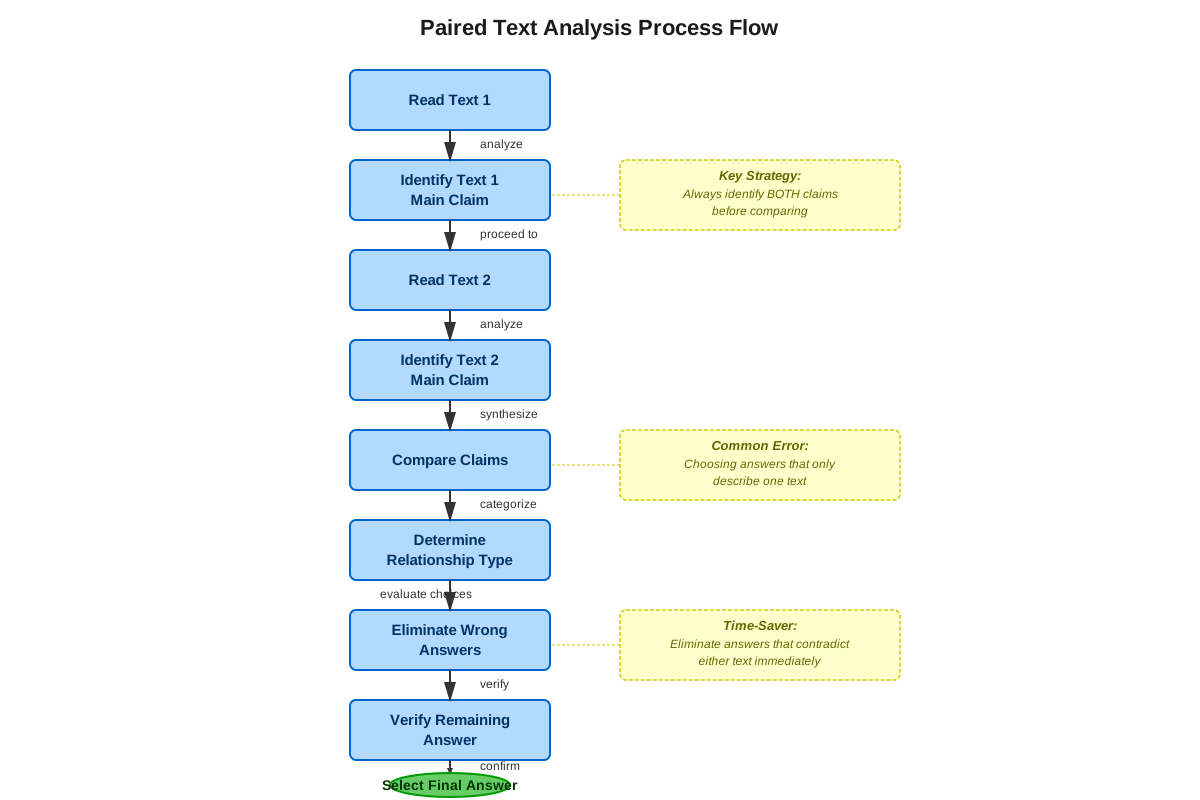
The core concepts within paired text relationship questions form a sequential analytical process: Text Structure Recognition → Individual Claim Identification → Relationship Type Classification → Answer Choice Evaluation. Each step depends on the previous one—students cannot accurately classify the relationship without first identifying each text's core claim, and they cannot evaluate answer choices without understanding the relationship type.
This topic connects directly to prerequisite skills in argument analysis and inference-making. The ability to identify claims and evidence in single passages (prerequisite) extends to comparing claims across passages (current topic). Similarly, making inferences from stated information (prerequisite) enables recognition of implicit relationships between texts (current topic).
Paired text relationship analysis also connects forward to more advanced synthesis skills tested in college writing. Students who master this topic develop the foundation for research papers requiring integration of multiple sources, a critical academic competency. The relationship types learned here (agreement, challenge, qualification, extension) mirror the rhetorical moves scholars make when positioning their work within existing literature.
High-Yield Facts
- ⭐ Paired text questions always present two passages on the same topic with a definable relationship—never random or unrelated texts
- ⭐ The correct answer must be fully supported by both texts; partial support is insufficient
- ⭐ Text 2 is always positioned as responding to or commenting on Text 1, not vice versa
- ⭐ The most common relationship types are agreement, disagreement, extension, and qualification
- ⭐ Core claims appear in conclusions or thesis statements, not in supporting details or examples
- Answer choices often use synonyms or paraphrases rather than exact wording from the passages
- Extreme language in answer choices ("completely refutes," "proves definitively") is usually incorrect
- Time markers ("initially," "later research") often signal extension or qualification relationships
- Conditional language ("may," "in some cases," "under certain conditions") often indicates qualification
- Scientific paired texts frequently present initial observations (Text 1) followed by explanations (Text 2)
- Historical paired texts often contrast different time periods or interpretations of the same event
- Literary paired texts may present different critical perspectives on the same work or author
Quick check — test yourself on Paired text relationship so far.
Try Flashcards →Common Misconceptions
Misconception: If both texts discuss the same topic, they must agree with each other.
Correction: Texts can discuss the same topic while reaching opposite conclusions, presenting different evidence, or emphasizing different aspects. The relationship depends on the specific claims made, not just the shared subject matter.
Misconception: The longer or more detailed text contains the "correct" information.
Correction: Both texts are equally valid sources for the question. Length and detail level don't indicate accuracy or importance. Students must evaluate the relationship between the claims, not judge which text is "better."
Misconception: Text 2 always disagrees with or corrects Text 1.
Correction: While challenge relationships exist, Text 2 frequently supports, extends, or explains Text 1. Students who assume disagreement will miss agreement and extension relationships.
Misconception: The correct answer will use the same words as the passages.
Correction: SAT answer choices typically paraphrase passage content using synonyms and different sentence structures. Students must recognize conceptual matches, not just word matches.
Misconception: If an answer choice sounds sophisticated or uses advanced vocabulary, it's more likely to be correct.
Correction: Answer complexity doesn't correlate with correctness. The SAT includes sophisticated-sounding distractors that misrepresent the text relationship. Students should verify content accuracy, not be swayed by impressive language.
Misconception: Personal knowledge about the topic should influence answer selection.
Correction: Correct answers must be supported exclusively by the provided texts. Outside knowledge, even if accurate, is irrelevant. Students should answer based solely on what the passages state or clearly imply.
Worked Examples
Example 1: Scientific Observation and Explanation
Text 1
Researchers studying coral reefs in the Caribbean have documented a 50% decline in coral coverage over the past three decades. The loss has been particularly severe in shallow waters where human activity is most concentrated, including areas near coastal development and popular diving sites.
Text 2
Recent studies have identified elevated water temperatures as the primary driver of coral bleaching events. When ocean temperatures rise even 1-2 degrees Celsius above normal seasonal maximums, corals expel their symbiotic algae, losing both their color and their primary food source. Repeated bleaching events prevent coral recovery and lead to widespread mortality.
Question: Based on the texts, how would the author of Text 2 most likely respond to the observations in Text 1?
Step 1: Identify Text 1's core claim
Text 1 observes that coral coverage has declined significantly, particularly in areas with human activity. The core claim is descriptive: coral loss has occurred and is associated with human presence.
Step 2: Identify Text 2's core claim
Text 2 explains that elevated water temperatures cause coral bleaching and death through a specific biological mechanism. The core claim is explanatory: temperature increases drive coral mortality.
Step 3: Determine the relationship
Text 2 provides a causal mechanism (temperature-driven bleaching) that could explain Text 1's observation (coral decline). This is an explanation relationship—Text 2 answers the "why" question raised by Text 1's "what" observation.
Step 4: Predict answer characteristics
The correct answer should indicate that Text 2 explains or provides a mechanism for Text 1's observations. It should mention temperature or bleaching as the explanatory factor.
Step 5: Evaluate answer choices (hypothetical options)
- A) "By arguing that Text 1's observations are inaccurate" → Incorrect; Text 2 doesn't dispute the decline
- B) "By providing a biological mechanism that could account for the decline described in Text 1" → Correct; matches explanation relationship
- C) "By suggesting that human activity is irrelevant to coral health" → Incorrect; Text 2 doesn't address human activity directly
- D) "By demonstrating that coral recovery is impossible" → Incorrect; overstates Text 2's claim
Answer: B — Text 2 explains Text 1's observations through the temperature-bleaching mechanism.
Example 2: Historical Interpretation Contrast
Text 1
Historian Maria Chen argues that the rapid industrialization of the late 19th century resulted primarily from technological innovations like the Bessemer steel process and the expansion of railroad networks. These advances, she contends, created the infrastructure necessary for large-scale manufacturing and national markets.
Text 2
In his recent book, historian James Rodriguez emphasizes the role of immigration in fueling industrial growth during the same period. He notes that between 1880 and 1920, over 20 million immigrants provided the labor force that made factory expansion economically viable, working for wages that native-born workers would not accept.
Question: Based on the texts, how does Rodriguez's perspective (Text 2) relate to Chen's argument (Text 1)?
Step 1: Identify Text 1's core claim
Chen attributes industrialization primarily to technological innovations and infrastructure. The core claim emphasizes technology as the driving force.
Step 2: Identify Text 2's core claim
Rodriguez emphasizes immigration and labor supply as the key factor enabling industrial expansion. The core claim prioritizes human capital over technology.
Step 3: Determine the relationship
Both historians address the same phenomenon (industrialization) but emphasize different causal factors. Text 2 doesn't directly contradict Text 1 (technology was important), but it shifts focus to a different explanation. This is a qualification or alternative explanation relationship—Text 2 offers a different emphasis rather than outright disagreement.
Step 4: Predict answer characteristics
The correct answer should indicate that Text 2 presents a different factor or emphasis while not necessarily denying Text 1's claims. It should mention labor/immigration as Rodriguez's focus.
Step 5: Evaluate answer choices (hypothetical options)
- A) "Rodriguez directly contradicts Chen by proving technology was unimportant" → Incorrect; too extreme, Text 2 doesn't disprove technology's role
- B) "Rodriguez extends Chen's argument by providing additional technological examples" → Incorrect; Text 2 focuses on labor, not technology
- C) "Rodriguez emphasizes a different causal factor—immigration and labor—while Chen focuses on technological innovation" → Correct; accurately captures the alternative emphasis
- D) "Rodriguez agrees with Chen that infrastructure was the sole cause of industrialization" → Incorrect; Text 2 doesn't discuss infrastructure
Answer: C — The texts present different but not necessarily contradictory explanations for the same historical phenomenon.
Exam Strategy
When approaching paired text relationship questions, students should follow a systematic four-step process that prevents common errors and maximizes accuracy under time pressure.
Step 1: Read Text 1 actively (30-45 seconds)
Focus on identifying the main claim, not memorizing details. Ask: "What is this author's primary point?" Underline or mentally note the core claim. Resist the urge to form conclusions before reading Text 2.
Step 2: Read Text 2 with Text 1 in mind (30-45 seconds)
Actively compare as you read. Ask: "How does this relate to what Text 1 said? Does it agree, disagree, add to, or limit Text 1's claim?" Note specific points of connection or contrast.
Step 3: Predict the relationship before reading answer choices (10-15 seconds)
Mentally articulate the relationship in simple terms: "Text 2 explains Text 1," "Text 2 disagrees with Text 1," or "Text 2 adds new information to Text 1." This prediction serves as an anchor when evaluating options.
Step 4: Eliminate and verify (30-45 seconds)
Test each answer choice against both texts. Eliminate options that misrepresent either text or describe an inaccurate relationship. Verify the remaining choice against your prediction.
Exam Tip: Watch for trigger words in answer choices that signal relationship types: "challenges" (disagreement), "supports" (agreement), "explains" (mechanism), "qualifies" (limitation), "extends" (addition).
Time allocation: Spend approximately 2 minutes total per paired text question—slightly more than single-passage items due to the dual-reading requirement. If a question exceeds 2.5 minutes, make your best educated guess and move forward to avoid time deficits.
Process of elimination strategies specific to paired texts:
- Eliminate answers that accurately describe one text but not the other
- Eliminate answers that reverse the relationship (describing Text 1 as responding to Text 2)
- Eliminate answers containing information not present in either passage
- Eliminate answers with extreme language unless both texts use equally strong language
Memory Techniques
RACE acronym for systematic analysis:
- Read both texts actively for main claims
- Analyze the relationship type (agree, challenge, extend, qualify)
- Compare answer choices to both texts
- Eliminate options that fail verification
Visualization strategy: Picture Text 1 as a statement and Text 2 as a response in a conversation. Ask yourself: "If these were two people talking, what would Text 2 be doing—agreeing, disagreeing, adding information, or saying 'yes, but...'?" This conversational frame makes abstract relationships more concrete.
The "Both-Test" rule: Before selecting an answer, physically or mentally check it against both texts. Visualize a checklist: "✓ Text 1 accurate? ✓ Text 2 accurate? ✓ Relationship accurate?" Only answers with three checks are correct.
Relationship type mnemonic—ACED:
- Agree (support, confirm)
- Challenge (contradict, dispute)
- Extend (add, elaborate)
- Delimit (qualify, limit)
These four categories cover the vast majority of SAT paired text relationships. When reading Text 2, ask "Is this ACED?" to quickly classify the relationship.
Summary
Paired text relationship questions test the ability to analyze and synthesize information from two related passages, a critical skill for academic success and a high-frequency item type on the SAT Reading and Writing section. These questions require students to identify the core claim in each text, determine how Text 2 responds to or relates to Text 1, and select answer choices that accurately represent both texts and their relationship. The most common relationship types include agreement (Text 2 supports Text 1), disagreement (Text 2 challenges Text 1), extension (Text 2 adds to Text 1), and qualification (Text 2 limits Text 1's claim). Success requires systematic analysis: reading each text for its main point, comparing the texts to identify their relationship, predicting the answer before reviewing choices, and verifying that the selected answer accurately represents both passages. Students must avoid common pitfalls including assuming disagreement, being swayed by sophisticated language, or allowing outside knowledge to influence answers. Mastering this question type strengthens broader analytical skills essential for college-level research and writing.
Key Takeaways
- Paired text relationship questions always present two passages on the same topic with a definable, testable relationship
- The four main relationship types are agreement, disagreement, extension, and qualification—recognizing these patterns accelerates analysis
- Correct answers must accurately represent both texts and their relationship; partial accuracy is insufficient
- A systematic approach (identify each claim → determine relationship → verify answer against both texts) prevents common errors
- Text 2 always responds to Text 1, not vice versa—this directional thinking clarifies the analytical task
- Focus on core claims rather than supporting details; the relationship exists between main points, not peripheral information
- Time management is crucial—allocate approximately 2 minutes per paired text question and move on if stuck
Related Topics
Inference Questions: Paired text mastery builds inference skills by requiring students to draw conclusions about relationships not explicitly stated. Understanding how texts interact implicitly prepares students for single-passage inference items.
Argument Analysis: Identifying claims, evidence, and reasoning in paired texts strengthens the ability to analyze argumentative structure in longer passages, a skill tested throughout the Reading and Writing section.
Synthesis in Writing: The comparative analysis practiced in paired text questions directly transfers to the essay-writing process, where students must integrate multiple sources and acknowledge different perspectives.
Evidence-Based Reading: Paired text questions reinforce the fundamental SAT skill of supporting conclusions with textual evidence, as correct answers must be verifiable in both passages.
Practice CTA
Now that you understand the key strategies for analyzing paired text relationships, it's time to apply these skills to authentic SAT-style questions. The practice questions and flashcards will reinforce your ability to quickly identify relationship types, avoid common traps, and select correct answers with confidence. Remember: paired text questions are high-yield opportunities for score improvement because they follow predictable patterns. Consistent practice with the systematic approach outlined in this guide will transform these questions from challenging to manageable. Start practicing now to build the automaticity that leads to test-day success!
Sign up free to keep reading
Create a free AnvayaPrep account to finish this SAT guide on Paired text relationship — plus flashcards and practice questions.