Overview
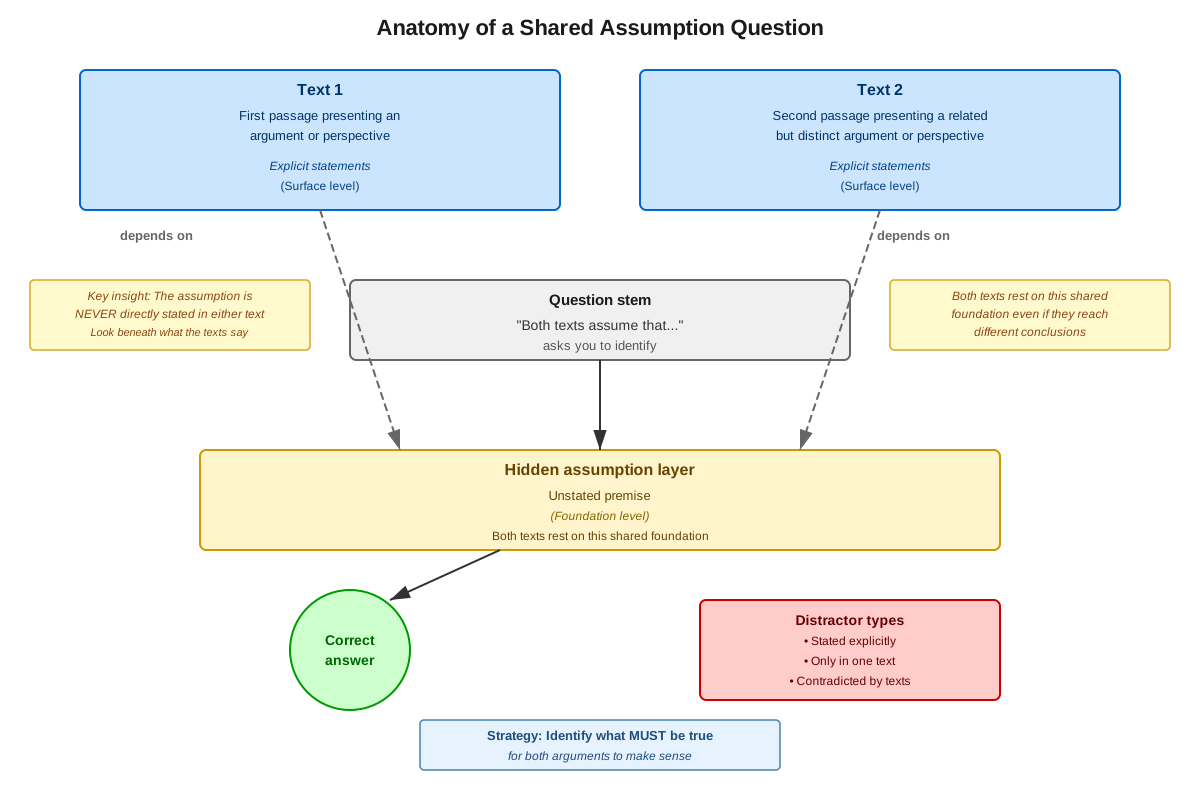
In the SAT Reading and Writing section, shared assumption questions represent a sophisticated category of cross-text connections that require students to identify underlying beliefs or premises that two different texts both take for granted without explicitly stating. These questions assess critical reading skills by asking test-takers to recognize what foundational ideas both authors accept as true, even when the texts discuss different aspects of a topic or reach different conclusions. Unlike questions that ask about explicit agreements or disagreements, shared assumption questions probe the implicit logical foundations that support each author's argument.
Understanding shared assumptions is essential for SAT success because these questions appear regularly in the Cross-Text Connections portion of the exam and demand higher-order thinking skills. Students must move beyond surface-level comprehension to analyze the logical structure underlying each passage. This skill directly connects to the SAT's emphasis on evidence-based reading and the ability to understand how arguments are constructed. Mastering shared assumption questions demonstrates analytical maturity and the capacity to engage with texts at a sophisticated level.
Within the broader landscape of Reading and Writing (RW) concepts, shared assumption questions build upon fundamental skills like identifying main ideas, understanding author's purpose, and recognizing supporting evidence. They also connect to other cross-text question types, including those asking about agreements, disagreements, and how one text relates to another. The ability to identify shared assumptions strengthens overall reading comprehension and prepares students for the analytical demands of college-level coursework, where recognizing unstated premises is crucial for evaluating arguments across multiple sources.
Learning Objectives
- [ ] Identify key features of shared assumption questions on the SAT
- [ ] Explain how shared assumption questions appear on the SAT and what they assess
- [ ] Apply shared assumption recognition strategies to answer SAT-style questions accurately
- [ ] Distinguish between explicit statements and implicit assumptions in paired passages
- [ ] Evaluate answer choices to determine which assumption is truly shared by both texts
- [ ] Analyze the logical foundation of arguments to uncover unstated premises
- [ ] Differentiate between shared assumptions and other cross-text relationships (agreements, disagreements, extensions)
Prerequisites
- Basic reading comprehension: Understanding main ideas, supporting details, and author's purpose is necessary to move beyond surface meaning and identify underlying assumptions
- Argument structure recognition: Familiarity with how claims are supported by evidence helps students identify what premises must be true for an argument to work
- Vocabulary in context: Strong vocabulary skills enable accurate interpretation of nuanced language that may signal assumptions
- Paired passage experience: Prior exposure to comparing and contrasting two texts provides the foundation for identifying what both texts take for granted
Why This Topic Matters
Shared assumption questions test a critical thinking skill that extends far beyond standardized testing. In academic settings, professional environments, and everyday life, the ability to identify what underlying beliefs shape different perspectives enables more productive dialogue and deeper analysis. When evaluating research papers, news articles, or policy debates, recognizing shared assumptions helps readers understand common ground even when conclusions differ. This skill is fundamental to media literacy and informed citizenship.
On the SAT specifically, sat shared assumption questions appear with notable frequency in the Reading and Writing section. Students can expect to encounter 1-2 shared assumption questions per test, typically in the Cross-Text Connections module. These questions carry significant weight because they assess multiple skills simultaneously: close reading, logical reasoning, and the ability to synthesize information across texts. Students who master this question type gain a competitive advantage, as these questions often separate high scorers from those in the mid-range.
Shared assumption questions commonly appear with passages drawn from various domains: scientific research (where both texts might assume a particular methodology is valid), historical analysis (where both authors might assume certain events had specific causes), social science discussions (where both texts might assume human behavior follows certain patterns), or literary criticism (where both authors might assume a text's cultural context matters). The passages are typically brief—50-75 words each—but dense with information, requiring careful attention to what is stated versus what is assumed.
Core Concepts
What Is a Shared Assumption?
A shared assumption is an unstated belief, premise, or principle that two different texts both accept as true without explicitly arguing for it. Unlike explicit agreements where both authors directly state the same position, assumptions operate in the background of arguments, forming the logical foundation upon which claims are built. When two authors share an assumption, they both rely on the same underlying premise even if they discuss different aspects of a topic, use different evidence, or reach different conclusions.
For example, if Text 1 argues that increasing park funding will improve community health, and Text 2 argues that park maintenance quality has declined due to budget cuts, both texts share the assumption that parks play a significant role in community wellbeing—even though neither text explicitly defends this premise. The assumption is what makes each argument coherent and meaningful.
Explicit vs. Implicit Content
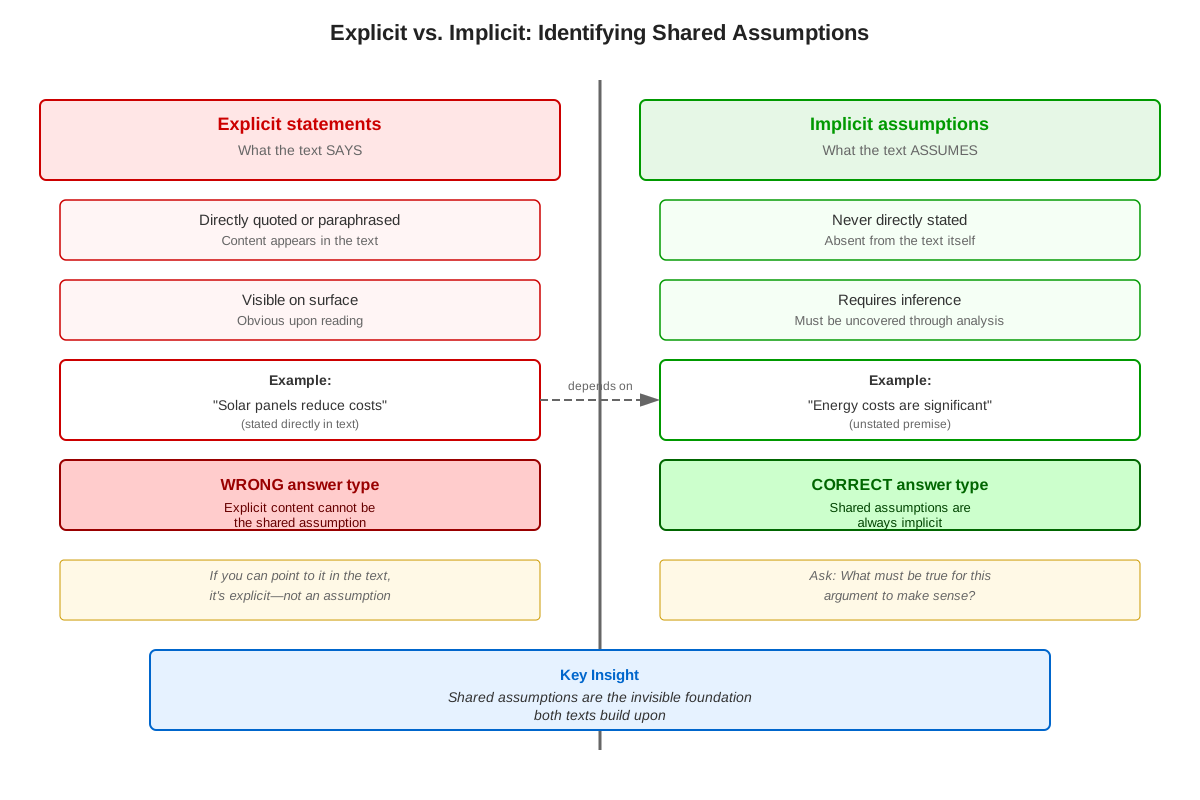
Understanding the distinction between explicit and implicit content is crucial for identifying shared assumptions. Explicit content consists of statements directly made in the text—claims the author openly asserts, evidence presented, and conclusions drawn. Implicit content includes ideas that are suggested, implied, or taken for granted without being directly stated.
| Feature | Explicit Content | Implicit Content (Assumptions) |
|---|---|---|
| Visibility | Directly stated in text | Unstated but necessary for argument |
| Purpose | Main claims and evidence | Logical foundation |
| Recognition | Straightforward reading | Requires inference |
| SAT Testing | Tested in main idea questions | Tested in shared assumption questions |
On the SAT, shared assumption questions specifically target implicit content that both passages rely upon. Students must read "between the lines" to identify what both authors must believe for their arguments to make sense.
The Logical Structure of Arguments
Every argument rests on assumptions—premises that connect evidence to conclusions. Consider this structure:
- Evidence/Observation: Facts or data presented
- Assumption: Unstated belief that links evidence to conclusion
- Conclusion: The claim the author makes
For instance:
- Evidence: "Studies show that students who sleep 8 hours perform better on tests"
- Assumption: Sleep duration directly affects cognitive performance (not stated but necessary)
- Conclusion: "Schools should start later to allow adequate sleep"
In shared assumption questions, both texts will have this structure, and the correct answer identifies an assumption present in both logical chains.
Types of Shared Assumptions
Shared assumptions on the SAT typically fall into several categories:
Causal Assumptions: Both texts assume a particular cause-and-effect relationship exists. For example, both might assume that economic factors influence social behavior, even if one discusses employment and the other discusses consumer spending.
Value Assumptions: Both texts assume something has importance, significance, or worth. Both might assume that preserving historical artifacts matters, even if one discusses museum funding and the other discusses archaeological methods.
Methodological Assumptions: Both texts assume a particular approach or method is valid or reliable. Both might assume that statistical analysis can reveal meaningful patterns, even if they analyze different datasets.
Definitional Assumptions: Both texts assume a particular understanding of a key concept. Both might assume that "success" includes factors beyond financial metrics, even if they discuss different domains.
Identifying Shared Assumptions: The Process
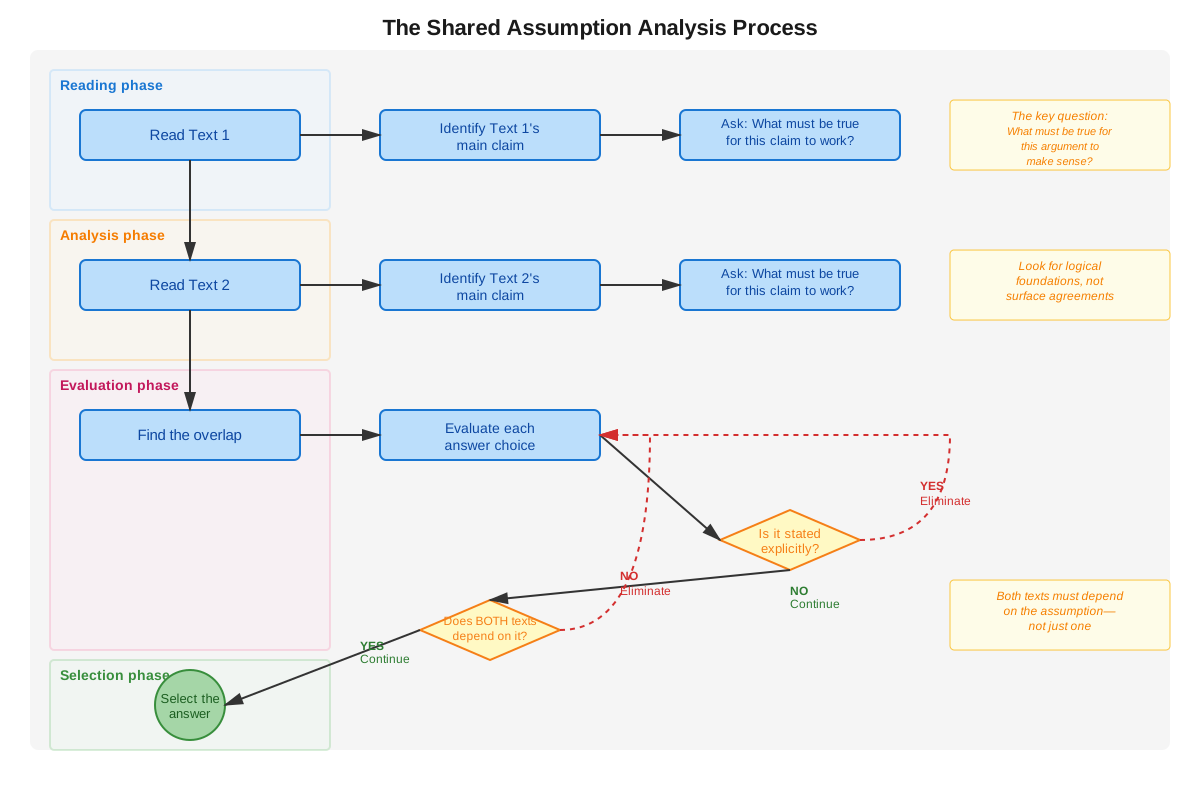
To identify shared assumptions systematically:
- Read each text independently and identify its main claim
- Ask "What must be true for this argument to work?" for each text
- List the unstated premises each argument requires
- Compare the lists to find common ground
- Verify the assumption is truly unstated in both texts
- Confirm the assumption is necessary for both arguments
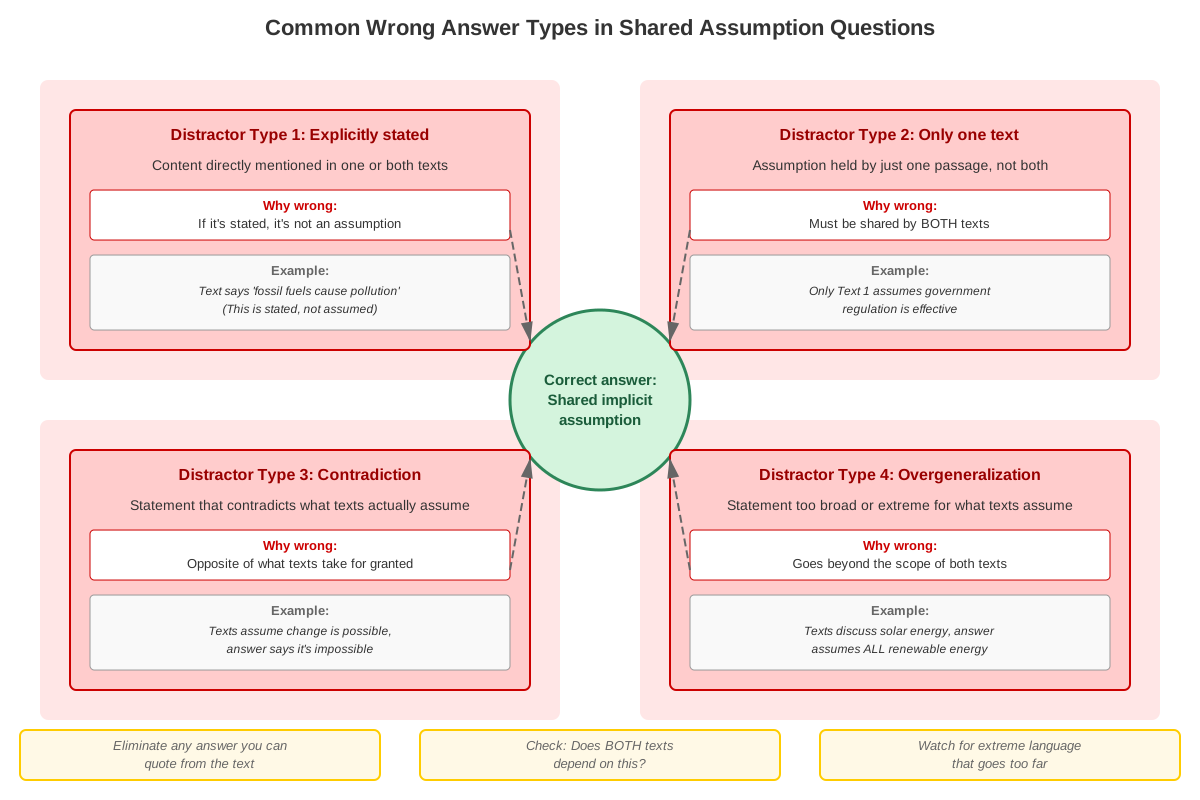
This process helps students avoid common traps, such as selecting explicit agreements (which are stated, not assumed) or selecting assumptions present in only one text.
The Role of Context and Scope
Shared assumptions must be appropriately scoped—neither too broad nor too narrow. An assumption that "language exists" would be too broad to be meaningful, while an assumption about a specific detail mentioned in only one text would be too narrow. The correct answer typically identifies an assumption at the conceptual level that both arguments require.
Context matters significantly. The same statement might be an explicit claim in one text and an assumption in another. Students must evaluate each text independently to determine whether an idea is stated or assumed.
Concept Relationships
The concept of shared assumptions connects directly to fundamental reading comprehension skills. Main idea identification provides the foundation: students must understand what each text explicitly argues before they can determine what it implicitly assumes. This leads to inference skills, which enable readers to recognize unstated ideas. Shared assumption questions represent a specific application of inference—identifying what both texts take for granted.
Within cross-text connections, shared assumptions relate to but differ from other relationship types. Explicit agreements occur when both texts state the same position; shared assumptions occur when both texts rely on the same unstated premise. Disagreements involve conflicting claims; yet texts that disagree on conclusions may still share underlying assumptions. Extensions occur when one text builds upon another; shared assumptions represent common ground rather than building.
The relationship map flows as follows:
Reading Comprehension → enables → Inference Skills → enables → Assumption Recognition → combines with → Cross-Text Analysis → produces → Shared Assumption Identification
Additionally, shared assumption questions connect to argument analysis skills tested elsewhere on the SAT. Understanding how evidence supports claims, recognizing logical fallacies, and evaluating reasoning all reinforce the ability to identify what premises an argument requires. These skills are mutually reinforcing: practice with shared assumptions strengthens overall argument analysis, and strong argument analysis skills make shared assumption questions more manageable.
High-Yield Facts
⭐ Shared assumptions are NEVER explicitly stated in either text—if both texts directly mention an idea, it's an explicit agreement, not a shared assumption
⭐ Both texts must rely on the assumption—if only one text requires the premise for its argument to work, it's not a shared assumption
⭐ Shared assumption questions typically use phrases like "both texts assume," "both authors presuppose," or "which assumption underlies both passages"
⭐ The correct answer often involves a conceptual or theoretical premise rather than a specific factual detail
⭐ Texts can share assumptions while reaching different conclusions or discussing different aspects of a topic
- Shared assumption questions appear 1-2 times per SAT test in the Reading and Writing section
- Wrong answers often include explicit statements from one or both texts, making them tempting but incorrect
- The assumption must be necessary for each argument's logic, not merely consistent with it
- Shared assumptions often relate to causation, value, methodology, or definitions
- Reading both texts before examining answer choices improves accuracy by preventing premature conclusions
- Eliminating answers that are explicitly stated is often the fastest path to the correct answer
- Shared assumptions typically operate at a more abstract level than the specific details discussed in each text
Quick check — test yourself on Shared assumption so far.
Try Flashcards →Common Misconceptions
Misconception: If both texts mention the same topic, they share an assumption about it.
Correction: Merely discussing the same topic doesn't indicate a shared assumption. Both texts must rely on the same unstated premise for their arguments to work. Two texts about climate change might make completely different assumptions about human behavior, economic priorities, or scientific methodology.
Misconception: Shared assumptions are the same as shared conclusions.
Correction: Assumptions are premises that support arguments, while conclusions are the claims arguments make. Two texts can share an assumption while reaching opposite conclusions. For example, both might assume that education affects economic outcomes (assumption) while disagreeing about whether increased funding improves education (conclusion).
Misconception: If an idea appears in only one text, it can't be a shared assumption.
Correction: Shared assumptions are unstated in both texts. An idea might be explicitly mentioned in one text while being an unstated assumption in the other—this would not be a shared assumption. However, an idea unstated in both texts can be a shared assumption even if the texts discuss different aspects of a topic.
Misconception: The correct answer will use the same words or phrases as the passages.
Correction: Shared assumptions are implicit, so they won't be directly quoted from either text. The correct answer will paraphrase or describe the underlying premise in different language. Students should focus on concepts and ideas rather than matching specific wording.
Misconception: Longer or more complex answer choices are more likely to be correct.
Correction: Answer choice length and complexity don't correlate with correctness. The SAT deliberately creates plausible wrong answers that may be detailed and sophisticated. Students should evaluate each choice based on whether both texts actually require that assumption, not on how impressive the answer sounds.
Worked Examples
Example 1: Scientific Research Passages
Text 1: Recent studies indicate that urban green spaces correlate with reduced stress levels among city residents. Researchers measured cortisol levels in participants before and after spending time in parks, finding significant decreases. These findings suggest that city planners should prioritize park development.
Text 2: Budget allocations for park maintenance have declined by 30% over the past decade in major metropolitan areas. This reduction has led to deteriorating facilities and reduced park usage. Reversing these cuts should be a municipal priority.
Question: Both texts assume which of the following?
Answer Choices:
A) Urban residents experience higher stress levels than rural residents
B) Parks provide benefits that justify public investment
C) Cortisol levels are the most accurate measure of stress
D) Budget cuts are the primary cause of reduced park usage
Solution Process:
Step 1: Identify what Text 1 explicitly argues: Parks reduce stress (supported by cortisol study), so cities should develop more parks.
Step 2: Identify what Text 1 assumes: For the recommendation to make sense, Text 1 must assume that reducing stress is valuable and that parks are worth investing in—but this isn't explicitly stated.
Step 3: Identify what Text 2 explicitly argues: Park budgets have been cut, facilities have deteriorated, and these cuts should be reversed.
Step 4: Identify what Text 2 assumes: For the recommendation to reverse cuts to make sense, Text 2 must assume that parks are valuable enough to warrant funding—but this isn't explicitly defended.
Step 5: Evaluate each answer:
- A) Neither text compares urban and rural stress levels; Text 1 only discusses urban residents. Not shared.
- B) Text 1 recommends park development (investment), assuming parks are worth it. Text 2 recommends reversing budget cuts (investment), assuming parks are worth it. Both assume parks justify public spending without explicitly arguing for this premise. This is the answer.
- C) Only Text 1 mentions cortisol; Text 2 doesn't discuss stress measurement at all. Not shared.
- D) Text 2 explicitly states that budget cuts led to reduced usage—this is a claim, not an assumption. Text 1 doesn't discuss budget cuts. Not shared.
Correct Answer: B
Connection to Learning Objectives: This example demonstrates identifying implicit premises (both texts assume parks are valuable) versus explicit claims (Text 2 states that cuts caused deterioration), and distinguishing shared assumptions from ideas present in only one text.
Example 2: Historical Analysis Passages
Text 1: The introduction of the printing press in the 15th century dramatically increased literacy rates across Europe. As books became more affordable and accessible, more people learned to read. This technological innovation fundamentally transformed European society.
Text 2: Historians examining 15th-century Europe note that rising literacy rates coincided with significant social and political changes. The ability to access information independently altered power dynamics between institutions and individuals. Understanding this period requires examining how information access shapes society.
Question: Which assumption do both texts share?
Answer Choices:
A) The printing press was the most important invention of the 15th century
B) Literacy rates increased throughout the 15th century
C) Changes in literacy rates have meaningful social consequences
D) Political institutions resisted increased public literacy
Solution Process:
Step 1: Text 1's explicit argument: Printing press → more affordable books → increased literacy → transformed society.
Step 2: Text 1's assumption: The text assumes that literacy changes matter enough to "transform society," but doesn't explain why literacy is significant—it treats this as self-evident.
Step 3: Text 2's explicit argument: Rising literacy coincided with social/political changes; information access altered power dynamics; this period requires examining how information access shapes society.
Step 4: Text 2's assumption: The text assumes that literacy/information access has important social effects, treating this connection as given rather than something requiring proof.
Step 5: Evaluate answers:
- A) Text 1 discusses the printing press's importance, but Text 2 doesn't mention the printing press at all. Not shared.
- B) Both texts explicitly state that literacy rates increased—this is not an assumption but an explicit claim in both. Not the answer.
- C) Text 1 assumes literacy changes matter (claiming transformation without defending why literacy matters). Text 2 assumes literacy changes matter (examining how information access shapes society without defending this premise). Both take for granted that literacy has social significance. This is the answer.
- D) Neither text discusses institutional resistance. Not shared.
Correct Answer: C
Connection to Learning Objectives: This example illustrates distinguishing between explicit statements (both texts state literacy increased) and shared assumptions (both assume these changes matter), demonstrating why students must identify what's unstated rather than what's directly mentioned.
Exam Strategy
When approaching sat shared assumption questions, employ a systematic strategy to maximize accuracy and efficiency:
Step 1: Read Both Texts Carefully (30-45 seconds)
Focus on understanding each text's main argument and the logic connecting evidence to conclusions. Don't rush to answer choices before comprehending both passages.
Step 2: Identify Each Text's Core Argument (15-20 seconds)
Mentally summarize: "Text 1 argues that _____ because _____" and "Text 2 argues that _____ because _____." This clarifies what each text explicitly claims.
Step 3: Ask "What Must Be True?" (20-30 seconds)
For each text, consider what unstated premises are necessary for the argument to work. What does the author take for granted? What logical connections aren't explicitly defended?
Step 4: Predict the Answer (10-15 seconds)
Before looking at choices, formulate your own answer: "Both texts seem to assume that _____." This prevents answer choices from misleading you.
Step 5: Eliminate Explicit Statements First (20-30 seconds)
Quickly eliminate any answer choice that directly appears in either text. Shared assumptions are never explicitly stated.
Step 6: Test Remaining Choices Against Both Texts (30-45 seconds)
For each remaining choice, ask: "Does Text 1 require this assumption? Does Text 2 require this assumption?" Both answers must be yes.
Exam Tip: If you're unsure between two answers, check whether each is truly necessary for both arguments or merely consistent with them. The correct answer will be essential to both texts' logic, not just compatible with them.
Trigger Words and Phrases to Watch For:
In question stems:
- "Both texts assume"
- "Both authors presuppose"
- "Which assumption underlies both passages"
- "Both texts take for granted"
- "An assumption shared by both"
In wrong answer choices (red flags):
- Specific details mentioned in only one text
- Extreme language ("always," "never," "only") unless both texts truly require such extremity
- Explicit restatements of claims made in the passages
Time Allocation: Allocate approximately 2-2.5 minutes per shared assumption question. These questions require more careful analysis than straightforward comprehension questions, so don't rush. However, if you're stuck after 3 minutes, make your best guess and move on—spending excessive time on one question jeopardizes performance on others.
Process of Elimination Strategy: Shared assumption questions lend themselves well to elimination. Often, 2-3 answer choices can be quickly eliminated because they're explicitly stated or only relevant to one text, leaving a more manageable choice between the remaining options.
Memory Techniques
The UNSTATED Acronym for identifying shared assumptions:
- Understand both arguments completely
- Note what each text explicitly claims
- Separate stated claims from unstated premises
- Test whether each premise is necessary
- Analyze whether the premise appears in both
- Think conceptually, not about specific details
- Eliminate explicit statements first
- Determine which assumption both texts require
The "Foundation Test" Visualization: Picture each text as a building. The explicit claims are the visible structure above ground. The assumptions are the foundation below ground—invisible but essential. Shared assumption questions ask you to identify what foundation material both buildings use. If you can see it above ground (explicitly stated), it's not the foundation (assumption).
The "Both Need It" Mnemonic: When evaluating answer choices, physically or mentally check off each text: "Text 1 needs this assumption? ✓ Text 2 needs this assumption? ✓" Only when both checks are complete is the answer correct.
The Three-Layer Model:
- Surface Layer: Specific details and examples (varies between texts)
- Middle Layer: Explicit claims and conclusions (may differ between texts)
- Deep Layer: Unstated assumptions (where shared assumptions live)
Visualize diving deeper than the surface and middle layers to reach the foundational assumptions both texts share.
Summary
Shared assumption questions on the SAT Reading and Writing section assess the ability to identify unstated premises that two different texts both rely upon for their arguments to function logically. Unlike explicit agreements where both authors directly state the same position, shared assumptions operate implicitly as the logical foundation supporting each text's reasoning. These questions require students to move beyond surface-level comprehension and analyze what both authors must believe to be true, even when the texts discuss different aspects of a topic or reach different conclusions. Success requires distinguishing between explicit content (directly stated) and implicit content (assumed but unstated), understanding argument structure, and systematically evaluating whether a premise is necessary for both texts. The correct answer will never be explicitly mentioned in either passage, will be required by both arguments' logic, and typically operates at a conceptual rather than detail-specific level. Mastering this question type demands careful reading, logical analysis, and the discipline to eliminate tempting wrong answers that represent explicit statements or assumptions present in only one text.
Key Takeaways
- Shared assumptions are always unstated in both texts—if explicitly mentioned, it's not an assumption
- Both texts must require the assumption for their arguments to work—necessity for both is the key criterion
- Distinguish between what texts explicitly claim and what they implicitly assume by asking "What must be true for this argument to make sense?"
- Shared assumptions often involve causal relationships, values, methodologies, or definitions that both authors take for granted
- Eliminate answer choices that appear explicitly in either text first, as these cannot be shared assumptions
- The correct answer typically operates at a conceptual level rather than focusing on specific details mentioned in the passages
- Systematic analysis of each text independently before comparing prevents confusion and improves accuracy
Related Topics
Explicit Agreements in Cross-Text Connections: Understanding how to identify when two texts directly state the same position helps distinguish explicit agreements from implicit shared assumptions. Mastering shared assumptions provides the foundation for recognizing more subtle forms of textual agreement.
Argument Structure and Reasoning: Deeper study of how arguments are constructed, including premises, evidence, and conclusions, strengthens the ability to identify unstated assumptions. This topic extends shared assumption skills to single-text argument analysis.
Inference Questions: While shared assumption questions are a specific type of inference question applied across two texts, general inference skills apply to single passages. Mastering shared assumptions enhances overall inference abilities.
Author's Purpose and Point of View: Understanding why authors write and what perspectives they bring helps identify what assumptions underlie their arguments. These skills complement shared assumption recognition by providing context for what authors take for granted.
Textual Evidence and Support: Analyzing how authors support their claims with evidence reveals gaps where assumptions fill logical spaces. This topic connects to shared assumptions by highlighting what isn't explicitly proven but is necessary for arguments to work.
Practice CTA
Now that you've mastered the core concepts of shared assumptions, it's time to put your knowledge into action! Complete the practice questions to test your ability to identify unstated premises across paired passages. Each question you work through strengthens your analytical skills and builds the confidence you need for test day. The flashcards will help reinforce key concepts and ensure you can quickly recognize shared assumption questions when they appear on the SAT. Remember: these questions reward careful, systematic thinking—and with practice, you'll develop the instincts to spot shared assumptions efficiently and accurately. You've got this!
Sign up free to keep reading
Create a free AnvayaPrep account to finish this SAT guide on Shared assumption — plus flashcards and practice questions.