Overview
Academic style is a critical component of the SAT Reading and Writing (RW) section, appearing consistently across multiple question types in the Expression of Ideas domain. This topic tests a student's ability to recognize and apply the conventions of formal, scholarly writing—the type of prose expected in college coursework, research papers, and professional communication. On the SAT, academic style questions require students to evaluate whether a sentence or phrase maintains appropriate formality, precision, objectivity, and clarity for an academic context.
Understanding academic style is essential because it represents approximately 10-15% of the Expression of Ideas questions on the SAT, making it a high-yield topic that directly impacts scores. These questions assess whether students can distinguish between casual, conversational language and the formal register appropriate for scholarly discourse. Students must identify when informal expressions, colloquialisms, slang, or overly emotional language disrupts the academic tone of a passage, and they must select revisions that maintain consistency with the passage's overall register.
The concept of academic style connects deeply to other Reading and Writing skills, including rhetorical synthesis, transitions, and effective language use. While transitions focus on logical connections between ideas and rhetorical synthesis addresses how to integrate information from multiple sources, academic style governs the overall tone and register that makes writing appropriate for scholarly audiences. Mastering this topic strengthens a student's ability to evaluate writing quality holistically, preparing them not only for SAT success but also for the rigorous writing demands of college-level coursework across all disciplines.
Learning Objectives
- [ ] Identify key features of Academic style
- [ ] Explain how Academic style appears on the SAT
- [ ] Apply Academic style to answer SAT-style questions
- [ ] Distinguish between formal academic language and informal conversational language in context
- [ ] Evaluate multiple revision options to determine which best maintains academic tone
- [ ] Recognize specific linguistic markers that signal inappropriate informality or excessive formality
- [ ] Apply academic style principles consistently across different subject matter contexts (science, history, literature, social sciences)
Prerequisites
- Basic grammar and sentence structure: Understanding subject-verb agreement, proper punctuation, and sentence construction allows students to focus on style rather than mechanical errors
- Reading comprehension skills: The ability to understand passage context and author's purpose is necessary to determine appropriate tone and register
- Vocabulary knowledge: Familiarity with both formal and informal word choices enables recognition of register shifts
- Understanding of audience and purpose: Recognizing that different writing contexts require different approaches helps students grasp why academic style matters
Why This Topic Matters
Academic style proficiency extends far beyond standardized testing into real-world applications that students will encounter throughout their educational and professional careers. College professors expect students to write research papers, lab reports, analytical essays, and thesis statements using formal academic language. Professional fields including law, medicine, business, and scientific research all require clear, objective, and precise communication that adheres to academic conventions. Mastering this skill now prepares students for success in these future endeavors.
On the SAT specifically, academic style questions appear in approximately 3-5 questions per test, typically distributed across the four Reading and Writing modules. These questions carry the same weight as all other RW questions, making each one valuable for score improvement. The College Board reports that academic style questions have moderate difficulty levels, with approximately 60-70% of test-takers answering them correctly—meaning they represent an excellent opportunity for prepared students to gain competitive advantage.
Academic style questions most commonly appear in passages discussing scientific research, historical analysis, social science studies, and literary criticism. The passages themselves are written in formal academic prose, and students must identify which revision option maintains consistency with that established tone. Questions typically present an underlined portion of text and ask students to choose the revision that "maintains the style and tone of the passage" or "best maintains the formal style established in the passage." Understanding the specific markers of academic versus informal language allows students to answer these questions quickly and confidently.
Core Concepts
Defining Academic Style
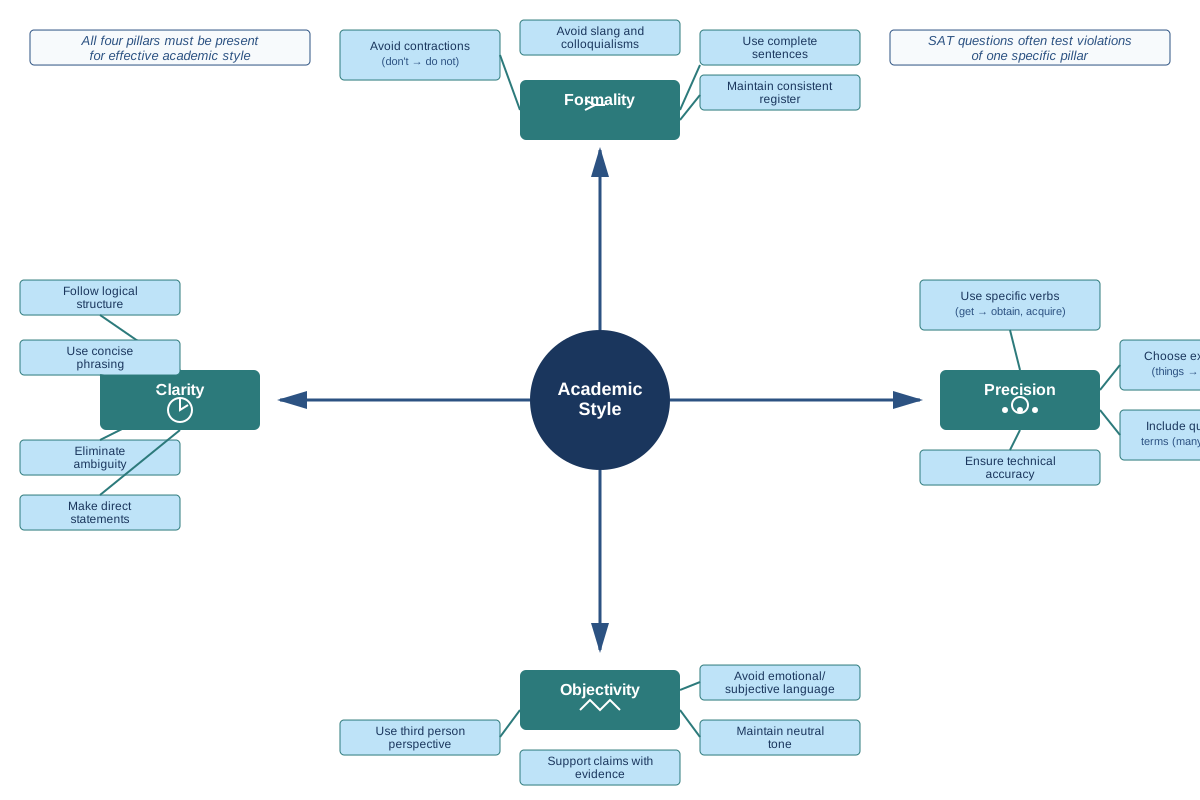
Academic style refers to the formal register of writing used in scholarly contexts, characterized by specific linguistic features that distinguish it from casual conversation or creative writing. This style prioritizes clarity, precision, objectivity, and evidence-based reasoning. On the SAT academic style questions within the RW section, students must recognize when language choices align with or deviate from these scholarly conventions.
The fundamental principle underlying academic style is appropriateness for audience and purpose. Academic writing addresses educated readers who expect logical argumentation, supported claims, and neutral presentation of information. This audience expects writers to avoid personal anecdotes, emotional appeals, colloquial expressions, and informal vocabulary that might appear in text messages, social media posts, or casual conversation.
Key Features of Academic Language
Academic style exhibits several distinctive characteristics that students must recognize:
| Feature | Academic Style | Informal Style |
|---|---|---|
| Vocabulary | Precise, technical, sophisticated | Casual, colloquial, slang |
| Tone | Objective, neutral, measured | Subjective, emotional, personal |
| Sentence Structure | Complex, varied, complete | Simple, fragmented, conversational |
| Contractions | Avoided (do not, cannot) | Common (don't, can't) |
| Personal Pronouns | Limited use of "I" or "you" | Frequent personal references |
| Intensifiers | Moderate, precise qualifiers | Exaggerated (really, totally, super) |
| Idioms/Clichés | Avoided | Common and accepted |
Formal vocabulary in academic writing means selecting words that precisely convey meaning without unnecessary casualness. For example, "demonstrate" is preferred over "show," "utilize" over "use" (when appropriate), and "investigate" over "look into." However, academic style does not mean using unnecessarily complex words when simpler ones suffice—clarity always takes precedence over complexity.
Objectivity and Neutrality
Academic writing maintains objectivity by presenting information without excessive emotional language or personal bias. While authors may argue for specific positions, they do so through logical reasoning and evidence rather than emotional appeals or subjective statements. This means avoiding:
- Emotional intensifiers: "absolutely devastating," "incredibly amazing," "totally unacceptable"
- Personal opinions stated as fact without support: "Everyone knows that..." or "Obviously, this is wrong"
- Rhetorical questions that assume reader agreement: "Who wouldn't agree that...?"
- Exclamation points and other punctuation suggesting strong emotion
Instead, academic writers use measured language with appropriate qualifiers: "The evidence suggests," "Research indicates," "This finding may demonstrate," or "Scholars generally agree."
Precision and Specificity
Precision in academic style requires writers to make exact claims supported by specific evidence rather than vague generalizations. Academic writing avoids:
- Vague quantifiers: "a lot," "tons of," "loads of," "some stuff"
- Imprecise verbs: "things happen," "stuff goes on," "it does things"
- Ambiguous pronouns without clear antecedents
- Generalizations without supporting data
Instead, academic style employs specific terminology, exact measurements, and clear references: "The study examined 347 participants," "Temperature increased by 3.2 degrees Celsius," or "Researchers identified three distinct factors."
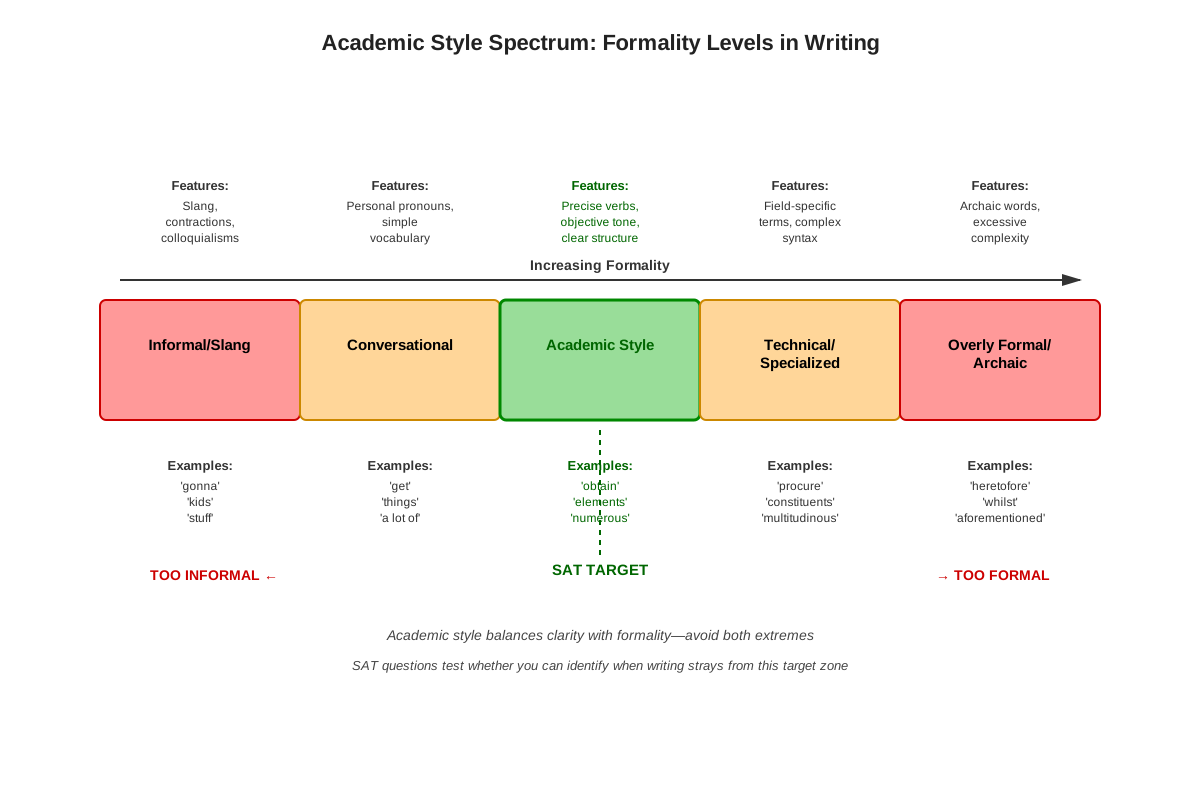
Formality Levels
Understanding that formality exists on a spectrum helps students recognize inappropriate informality. Academic writing occupies the formal end of this spectrum but should not become so formal that it sounds archaic or pretentious. The goal is professional formality, not stilted or overly complex prose.
Inappropriate informality includes:
- Slang: "cool," "awesome," "freaked out," "bummed"
- Colloquialisms: "kind of," "sort of," "a bunch of," "pretty much"
- Conversational fillers: "well," "you know," "like," "basically"
- Casual phrasal verbs: "figure out" (instead of "determine"), "come up with" (instead of "develop")
Excessive formality (also inappropriate) includes:
- Archaic language: "heretofore," "aforementioned," "whilst"
- Unnecessarily complex constructions when simpler ones work better
- Overly technical jargon when addressing general academic audiences
Consistency of Register
Perhaps the most important principle for SAT questions is consistency of register—maintaining the same level of formality throughout a passage. When a passage establishes a formal academic tone, any sentence that shifts to informal language disrupts coherence and should be revised. Students must read enough of the passage to understand the established tone before selecting their answer.
Concept Relationships
Academic style serves as the overarching framework that governs how all other Expression of Ideas concepts are executed. The relationship flows as follows:
Academic Style → Rhetorical Synthesis: When integrating information from multiple sources, writers must maintain academic tone while combining evidence. The style determines how sources are introduced, cited, and discussed.
Academic Style → Transitions: While transitions create logical connections between ideas, the specific transition words chosen must match the passage's formality level. "Furthermore" and "moreover" fit academic contexts better than "plus" or "also."
Academic Style ↔ Effective Language Use: These concepts work bidirectionally. Academic style requires effective language (precise word choice, clear expression), while effective language use must operate within the constraints of academic conventions.
Passage Context → Academic Style Determination: Students must first comprehend the passage's subject matter, purpose, and established tone before they can evaluate whether a particular phrase maintains appropriate academic style.
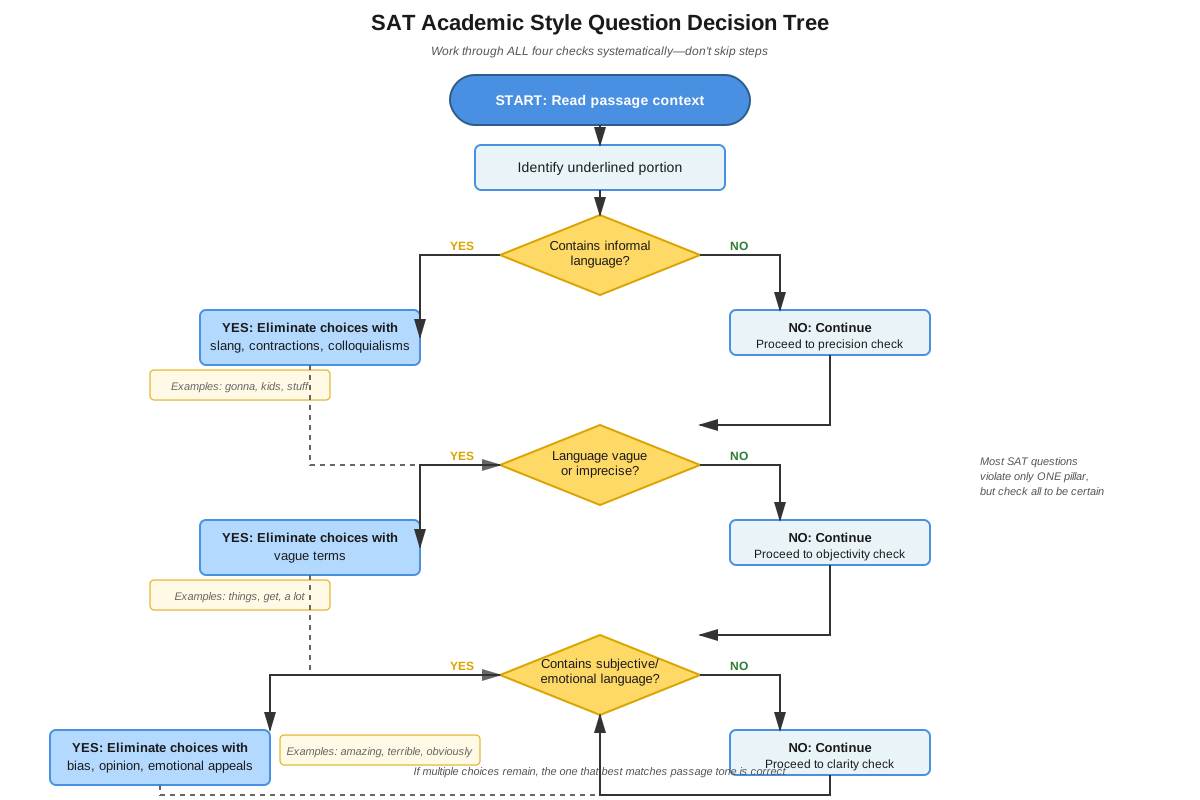
The relationship map for approaching SAT questions follows this sequence:
- Read passage context → 2. Identify established tone/register → 3. Examine underlined portion → 4. Evaluate each answer choice for consistency → 5. Eliminate options with register violations → 6. Select the choice that maintains academic style
High-Yield Facts
⭐ Academic style questions ask students to maintain consistency with the passage's established formal tone, not to make the writing as complex as possible.
⭐ Contractions (don't, can't, won't) are almost always incorrect in academic writing contexts on the SAT.
⭐ Slang, colloquialisms, and conversational expressions are the most common violations of academic style tested on the SAT.
⭐ Personal pronouns like "you" addressing the reader directly typically violate academic style conventions.
⭐ Emotional intensifiers (really, very, totally, absolutely) usually signal inappropriate informality for academic contexts.
- Academic style prioritizes clarity and precision over complexity; unnecessarily complicated language is not more academic.
- Rhetorical questions that assume reader agreement generally violate academic objectivity.
- Exclamation points rarely appear in formal academic writing and signal inappropriate emotional tone.
- Vague quantifiers ("a lot," "tons," "loads") should be replaced with specific measurements or qualified statements.
- Phrasal verbs (two-word verbs like "figure out" or "come up with") are often more informal than single-word alternatives ("determine," "develop").
- Academic writing uses "that" rather than "which" for restrictive clauses, though both can be grammatically correct.
- The passive voice, while sometimes criticized, is acceptable in academic writing when the actor is unknown or unimportant.
- Academic style allows for first-person pronouns in specific contexts (describing research methodology) but avoids them in general argumentation.
- Idioms and clichés ("at the end of the day," "think outside the box") disrupt academic tone and should be avoided.
Quick check — test yourself on Academic style so far.
Try Flashcards →Common Misconceptions
Misconception: Academic style means using the longest, most complex words possible to sound intelligent.
Correction: Academic style prioritizes clarity and precision. Using unnecessarily complex vocabulary when simpler words communicate meaning more effectively actually violates good academic writing principles. "Use" is often better than "utilize," and "help" is often clearer than "facilitate."
Misconception: All contractions are grammatically incorrect.
Correction: Contractions are grammatically correct but stylistically inappropriate for formal academic writing. They represent informal register and should be avoided in scholarly contexts, but they're perfectly acceptable in casual writing, dialogue, and conversational contexts.
Misconception: Academic writing should never use first-person pronouns like "I" or "we."
Correction: While academic writing limits personal pronouns, they are acceptable in specific contexts, particularly when describing research methodology ("We conducted three trials") or in reflective academic writing. The key is avoiding unsupported personal opinions ("I think this is wrong") rather than eliminating all first-person references.
Misconception: Passive voice is always wrong in academic writing.
Correction: Passive voice is acceptable and sometimes preferred in academic contexts, particularly in scientific writing when the actor is unknown or when emphasizing the action rather than the actor ("The samples were analyzed" rather than "We analyzed the samples"). The issue is overuse, not the construction itself.
Misconception: If a word appears in the dictionary, it's appropriate for academic writing.
Correction: Many words are legitimate English words but inappropriate for academic contexts due to their informal register. "Freaked out," "bummed," and "cool" are all real words but violate academic style conventions. Context and register matter more than dictionary inclusion.
Misconception: Academic style questions have subjective answers based on personal preference.
Correction: While style involves some judgment, SAT academic style questions have objectively correct answers based on consistency with the passage's established register. The correct answer maintains the formal tone already present in the passage, while incorrect answers introduce register violations that can be identified through specific linguistic markers.
Worked Examples
Example 1: Identifying Register Violations
Passage Context: "Researchers investigating climate patterns in the Arctic have documented significant changes in ice sheet thickness over the past three decades. These observations, collected through satellite imagery and ground-based measurements, provide crucial data for understanding global climate systems."
Question: "The findings are pretty important for scientists trying to figure out what's happening with Earth's temperature."
Which choice best maintains the style and tone of the passage?
A) NO CHANGE
B) The findings are really significant for scientists attempting to determine what's going on with Earth's temperature.
C) The findings provide essential insights for scientists investigating changes in Earth's temperature.
D) The findings are totally crucial for scientists who want to know about Earth's temperature stuff.
Analysis:
First, identify the established tone: The passage uses formal academic language with precise vocabulary ("documented," "observations," "crucial data"), complex sentence structures, and objective presentation. There are no contractions, colloquialisms, or casual expressions.
Now examine each choice:
Choice A (NO CHANGE): Contains multiple register violations:
- "pretty important" - casual intensifier and vague qualifier
- "trying to figure out" - informal phrasal verb instead of "attempting to determine"
- "what's happening" - contraction violates academic style
Overall assessment: Too informal; multiple violations
Choice B: Improvements and remaining issues:
- "really significant" - still uses casual intensifier "really"
- "attempting to determine" - better than "trying to figure out"
- "what's going on" - still informal phrasing
Overall assessment: Better than A but still too casual
Choice C: Analysis:
- "provide essential insights" - formal, precise vocabulary matching passage tone
- "investigating" - matches the academic verb used earlier in passage
- "changes in Earth's temperature" - specific and formal
- No contractions, colloquialisms, or casual expressions
Overall assessment: Maintains consistent academic register
Choice D: Contains severe violations:
- "totally crucial" - extremely casual intensifier
- "want to know" - very informal compared to "seek to understand"
- "temperature stuff" - "stuff" is highly informal and imprecise
Overall assessment: Most informal option; clearly incorrect
Correct Answer: C
This choice maintains the formal academic style established in the passage through precise vocabulary, formal verb choices, and absence of colloquial expressions.
Example 2: Evaluating Objectivity
Passage Context: "The archaeological excavation at the site revealed artifacts dating to the Bronze Age, including pottery fragments, metal tools, and structural foundations. Analysis of these materials has enabled researchers to reconstruct aspects of daily life in this ancient settlement."
Question: "Obviously, everyone can see that these discoveries are absolutely amazing and totally change everything we thought we knew about ancient civilizations."
Which choice best maintains the style and tone of the passage?
A) NO CHANGE
B) These discoveries are really important and significantly alter our understanding of ancient civilizations.
C) These discoveries provide valuable evidence that refines scholarly understanding of ancient civilizations.
D) These discoveries are super interesting and definitely make us rethink ancient civilizations.
Analysis:
Established tone: The passage maintains objective, measured academic language. It presents findings without emotional language or exaggerated claims. Verbs like "revealed" and "enabled" are neutral and precise.
Choice A (NO CHANGE): Multiple severe violations:
- "Obviously, everyone can see" - assumes reader agreement; not objective
- "absolutely amazing" - emotional language with intensifier
- "totally change everything" - exaggerated claim; "totally" is informal intensifier
- "we thought we knew" - casual phrasing with contraction
Overall assessment: Completely inappropriate for academic context
Choice B: Partial improvements:
- "really important" - "really" is still a casual intensifier
- "significantly alter" - more measured than "totally change everything"
- "our understanding" - acceptable but less formal than alternatives
Overall assessment: Better but still contains informality
Choice C: Analysis:
- "provide valuable evidence" - objective, precise language
- "refines scholarly understanding" - measured claim (not exaggerated)
- "ancient civilizations" - maintains formal vocabulary
- No emotional language, intensifiers, or exaggeration
- Maintains objectivity throughout
Overall assessment: Matches passage's academic register perfectly
Choice D: Violations:
- "super interesting" - highly informal intensifier
- "definitely make us rethink" - "definitely" is too absolute; "make us" is casual
Overall assessment: Too informal
Correct Answer: C
This choice maintains the objective, measured tone of the passage by avoiding emotional language, casual intensifiers, and exaggerated claims while using precise academic vocabulary.
Exam Strategy
When approaching SAT academic style questions, follow this systematic process:
Step 1: Read for Context (15-20 seconds)
Read at least 2-3 sentences before and after the underlined portion to establish the passage's tone, subject matter, and formality level. Note the vocabulary choices, sentence complexity, and overall register the author has established.
Step 2: Identify the Question Type (5 seconds)
Look for trigger phrases in the question stem:
- "maintains the style and tone"
- "best maintains the formal style"
- "is most consistent with the passage's style"
- "preserves the academic tone"
These phrases signal that you're evaluating register consistency, not grammar or logic.
Step 3: Scan for Red Flags (10 seconds)
Quickly eliminate answer choices containing obvious violations:
- Contractions (don't, can't, won't, it's, what's)
- Slang or colloquialisms (cool, awesome, freaked out, bummed)
- Casual intensifiers (really, very, totally, super, pretty)
- Vague language (stuff, things, a lot, tons)
- Emotional language or exclamation points
- Rhetorical questions or "you" addressing the reader
Step 4: Compare Remaining Choices (15-20 seconds)
Among choices without obvious violations, select the one that:
- Uses vocabulary matching the passage's sophistication level
- Maintains the same sentence complexity
- Preserves objectivity and measured tone
- Provides precision rather than vagueness
Step 5: Verify Consistency (5-10 seconds)
Before finalizing your answer, mentally insert your choice into the passage and confirm it sounds consistent with surrounding sentences.
Exam Tip: When two choices seem similarly formal, choose the one that's more specific and precise. Academic writing values exactness over generalization.
Time Management: Allocate approximately 60-75 seconds per academic style question. These questions require more contextual reading than pure grammar questions but less analysis than rhetorical synthesis questions.
Process of Elimination Strategy: Academic style questions typically follow a pattern where one choice is clearly too informal, one is moderately informal, one is correct, and one might be overly complex or slightly off in tone. Eliminate the obviously informal choices first, then evaluate the remaining options for precision and consistency.
Memory Techniques
FORMAL Acronym for identifying academic style violations:
- Fillers (you know, like, basically, well)
- Overly emotional language (amazing, terrible, awesome)
- Rhetorical questions and "you" addressing reader
- Misplaced casualness (slang, colloquialisms)
- Amplifiers that are informal (really, totally, super, pretty)
- Language that's vague (stuff, things, a lot)
The "Professor Test": When evaluating whether language is appropriately academic, imagine reading it aloud in a college lecture or seeing it in a research paper. If it would sound out of place in those contexts, it's likely too informal for the SAT passage.
Contraction Elimination Rule: On the SAT, if you see a contraction in an answer choice for an academic style question, it's almost certainly wrong. This simple rule eliminates approximately 25% of incorrect answers immediately.
The Specificity Principle: Remember "VAGUE = WRONG" for academic writing:
- Vague quantifiers (a lot, tons, loads) → Specific measurements
- Ambiguous pronouns (it, this, that without clear reference) → Named subjects
- General claims (everyone knows, obviously) → Qualified statements
- Undefined terms (stuff, things) → Precise nouns
Visualization Strategy: Picture academic writing as wearing professional business attire to an important meeting. Just as you wouldn't wear pajamas or overly formal Victorian clothing, academic writing avoids both casual slang and archaic pretentiousness. The goal is professional appropriateness.
Summary
Academic style represents the formal register of writing appropriate for scholarly contexts, characterized by precise vocabulary, objective tone, complex sentence structures, and absence of colloquialisms or casual expressions. On the SAT Reading and Writing section, academic style questions test students' ability to maintain consistency with a passage's established formal tone by identifying and eliminating language that introduces inappropriate informality. Success requires recognizing specific markers of register violations including contractions, slang, casual intensifiers, vague quantifiers, emotional language, and conversational expressions. The key principle is consistency—students must read enough context to understand the passage's established tone, then select the revision that maintains that same level of formality without introducing either excessive casualness or unnecessary complexity. Academic style questions appear regularly on the SAT, making them high-yield opportunities for score improvement when students master the distinction between formal scholarly prose and informal conversational language.
Key Takeaways
- Academic style questions test consistency with a passage's established formal register, not grammatical correctness or complexity for its own sake
- Contractions, slang, colloquialisms, and casual intensifiers (really, totally, super) are the most common violations of academic style on the SAT
- Effective academic writing balances formality with clarity—unnecessarily complex language is not more academic
- Always read sufficient context (2-3 sentences) before and after the underlined portion to establish the passage's tone
- Objectivity and precision are hallmarks of academic style; avoid emotional language, exaggerated claims, and vague expressions
- The "Professor Test" helps evaluate appropriateness: if language wouldn't fit in a college lecture or research paper, it's too informal
- Process of elimination works efficiently for these questions—identify and remove obvious register violations first, then compare remaining choices for consistency
Related Topics
Rhetorical Synthesis: Building on academic style mastery, rhetorical synthesis questions require students to integrate information from multiple sources while maintaining appropriate formal tone throughout the combined text.
Transitions and Cohesion: Understanding academic style enhances transition selection, as students must choose connecting words that match the passage's formality level while creating logical flow.
Effective Language Use: This broader category encompasses academic style along with concision, precision, and word choice, requiring students to evaluate whether language serves its purpose effectively within scholarly contexts.
Standard English Conventions: While academic style focuses on register and tone, conventions address grammatical correctness; mastering both enables comprehensive evaluation of writing quality.
Rhetorical Purpose and Claims: Academic style provides the appropriate register for presenting arguments and evidence, making it foundational for understanding how authors construct persuasive scholarly discourse.
Practice CTA
Now that you've mastered the core concepts of academic style, it's time to apply this knowledge through targeted practice. Complete the practice questions to test your ability to identify register violations, maintain formal tone, and select revisions that preserve academic consistency. Use the flashcards to reinforce key terminology and common violations. Remember: academic style questions represent high-yield opportunities for score improvement because they follow predictable patterns once you understand the distinction between formal and informal language. With focused practice, you'll quickly develop the instinct to spot inappropriate casualness and select the most academically appropriate revision. Your investment in mastering this topic will pay dividends not only on test day but throughout your college career!
Sign up free to keep reading
Create a free AnvayaPrep account to finish this SAT guide on Academic style — plus flashcards and practice questions.