Overview
Logical order is a critical skill tested in the SAT Reading and Writing (RW) section, specifically within the Expression of Ideas domain. This concept assesses a student's ability to recognize and establish the most effective sequence for sentences within a paragraph or ideas within a passage. Unlike grammar-focused questions, logical order questions evaluate how well students understand the flow of information, the relationships between ideas, and the principles of coherent writing.
On the SAT, logical order questions typically present a paragraph with numbered sentences and ask students to determine where a particular sentence should be placed, or which sequence of sentences creates the most logical progression. These questions test whether students can identify transitional cues, recognize chronological sequences, understand cause-and-effect relationships, and follow the natural development of an argument or narrative. Mastering this skill is essential because it appears consistently on every SAT administration and directly impacts a student's ability to score in the higher percentiles.
The ability to recognize logical order connects deeply to other Reading and Writing concepts, including transitions, cohesion, and rhetorical synthesis. When students understand how ideas should flow within a text, they simultaneously strengthen their comprehension skills, their ability to analyze author's purpose, and their capacity to construct well-organized essays. This topic serves as a bridge between sentence-level grammar skills and passage-level comprehension, making it foundational for overall success in the SAT RW section.
Learning Objectives
- [ ] Identify key features of logical order in SAT passages
- [ ] Explain how logical order appears on the SAT and recognize question formats
- [ ] Apply logical order principles to answer SAT-style questions accurately
- [ ] Analyze transitional words and phrases that signal logical relationships between sentences
- [ ] Evaluate multiple sentence sequences to determine the most coherent arrangement
- [ ] Distinguish between chronological, spatial, and conceptual ordering patterns
- [ ] Recognize when a sentence disrupts the logical flow of a paragraph
Prerequisites
- Basic sentence structure understanding: Students must recognize subjects, predicates, and complete thoughts to evaluate whether sentences connect logically.
- Familiarity with transition words: Knowledge of words like "however," "therefore," and "additionally" helps identify relationships between ideas.
- Reading comprehension fundamentals: The ability to understand main ideas and supporting details is essential for determining appropriate sentence placement.
- Paragraph structure awareness: Understanding topic sentences, supporting sentences, and concluding sentences provides the framework for evaluating logical order.
Why This Topic Matters
Logical order questions appear with high frequency on the SAT, typically comprising 2-4 questions per test administration. These questions are considered "high-yield" because they test a fundamental writing skill that extends beyond standardized testing into academic and professional communication. Students who master logical order demonstrate sophisticated thinking about how information should be presented to maximize clarity and persuasiveness.
In real-world applications, the ability to organize information logically is essential for writing effective emails, reports, research papers, and presentations. Professionals in every field must sequence information so that audiences can follow arguments, understand processes, and retain key points. The SAT tests this skill because colleges value students who can think clearly about information architecture and communication strategy.
On the exam, logical order questions most commonly appear in passages about scientific processes, historical narratives, argumentative essays, and descriptive texts. The SAT typically presents these questions in two formats: asking where a specific sentence should be placed within a paragraph (with four possible positions), or asking students to evaluate whether the current order is logical or should be revised. These questions often include numbered sentences in brackets [1], [2], [3], [4] to facilitate discussion of placement options.
Core Concepts
Understanding Logical Order Fundamentals
Logical order refers to the arrangement of sentences and ideas in a sequence that creates clear, coherent, and effective communication. In the context of SAT logical order questions, this means organizing information so that each sentence builds naturally on the previous one, creating a smooth flow of ideas that readers can easily follow. The principle underlying all logical order is that information should be presented in a way that minimizes confusion and maximizes comprehension.
The foundation of logical order rests on three key principles: coherence (ideas connect clearly to one another), progression (information moves forward rather than circling back unnecessarily), and emphasis (important ideas receive appropriate positioning). When sentences follow logical order, readers can predict what comes next, understand relationships between ideas, and grasp the author's intended meaning without re-reading.
Types of Logical Ordering Patterns
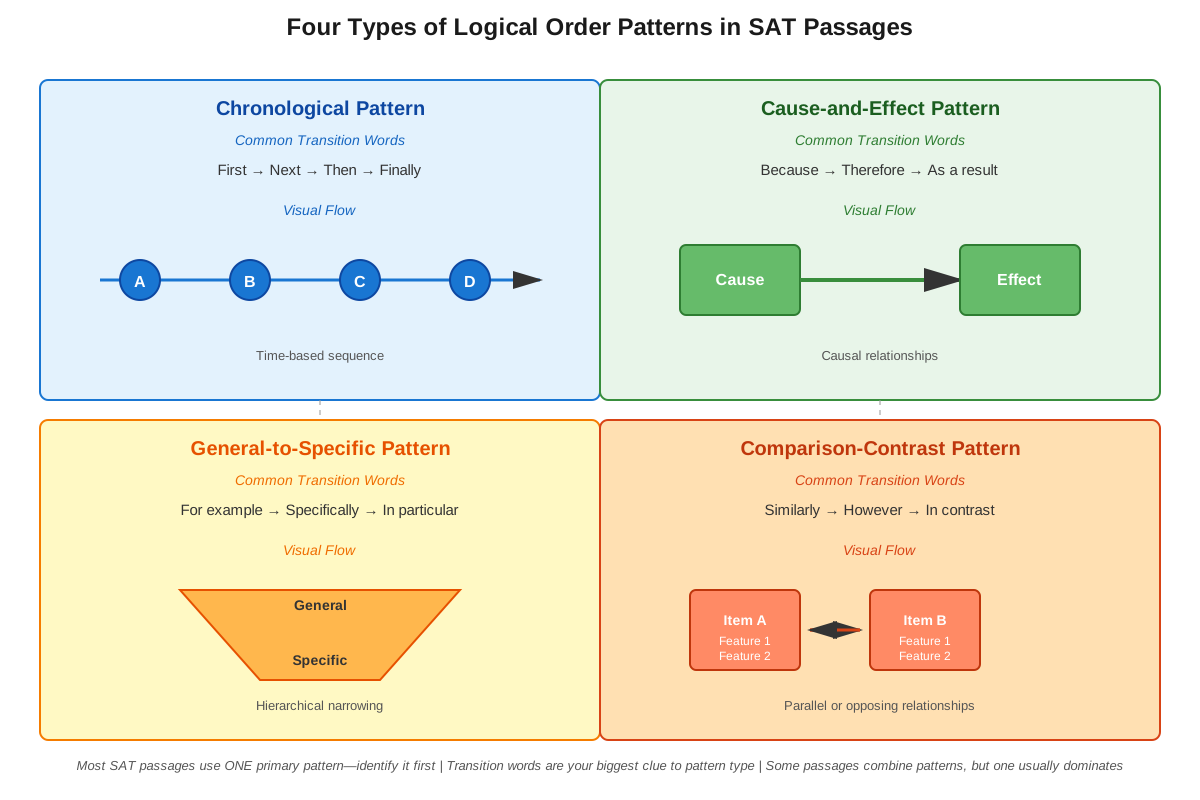
Different types of content require different organizational patterns. Understanding these patterns helps students quickly identify the most appropriate sequence for any given paragraph.
Chronological order arranges events or steps in the sequence they occur in time. This pattern is essential for narratives, historical accounts, process descriptions, and cause-and-effect explanations. Signal words include "first," "then," "next," "subsequently," "finally," "before," "after," and specific time markers like dates or time periods.
Spatial order organizes information according to physical location or position. This pattern appears in descriptive passages, particularly those describing places, objects, or visual scenes. Signal words include "above," "below," "nearby," "in the distance," "to the left," "adjacent to," and other directional or positional terms.
Order of importance arranges ideas from most to least important (or vice versa). This pattern is common in argumentative and persuasive writing, where authors may present their strongest evidence first to capture attention, or build toward their strongest point for dramatic effect. Signal words include "most importantly," "primarily," "significantly," "additionally," and "finally."
General to specific order (or specific to general) moves from broad statements to detailed examples, or from particular instances to broader conclusions. This pattern is fundamental to academic writing and appears frequently in SAT passages. Topic sentences typically present general claims, followed by specific evidence, examples, or explanations.
Problem-solution order presents a problem or challenge followed by proposed solutions or resolutions. This pattern is common in passages about scientific research, social issues, or technological innovations.
Transitional Cues and Connective Language
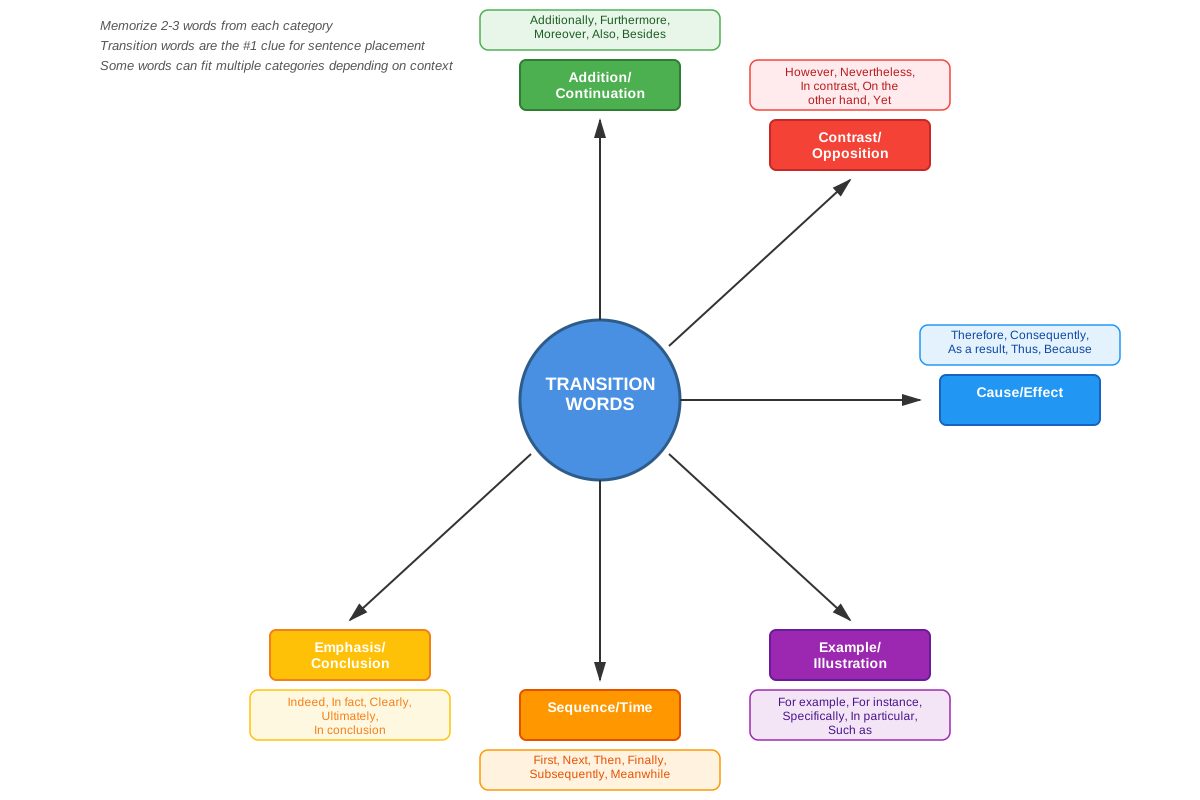
Transitional words and phrases serve as signposts that indicate logical relationships between sentences. Recognizing these cues is essential for determining correct sentence placement.
| Transition Type | Function | Examples |
|---|---|---|
| Addition | Introduces supporting information | furthermore, moreover, additionally, also, in addition |
| Contrast | Signals opposing or different ideas | however, nevertheless, conversely, on the other hand, yet |
| Cause-Effect | Shows causal relationships | therefore, consequently, as a result, thus, because |
| Example | Introduces specific instances | for example, for instance, specifically, such as |
| Sequence | Indicates order or steps | first, second, next, then, finally, subsequently |
| Emphasis | Highlights important points | indeed, in fact, notably, especially, particularly |
Pronoun Reference and Logical Flow
Pronouns create cohesion by referring back to previously mentioned nouns (antecedents). A sentence containing pronouns like "this," "these," "it," "they," or "such" typically cannot appear first in a paragraph because readers need the antecedent for context. When evaluating sentence placement, students should trace pronoun references to ensure each pronoun has a clear antecedent that appears earlier in the sequence.
Topic Sentences and Supporting Details
Most well-organized paragraphs follow a predictable structure: a topic sentence introduces the main idea, supporting sentences provide evidence or elaboration, and a concluding sentence may synthesize or transition to the next idea. When determining logical order, students should identify which sentence states the paragraph's main claim (this typically comes first) and which sentences provide examples, explanations, or evidence (these follow the topic sentence).
Continuity of Subject and Focus
Effective paragraphs maintain focus on a central subject or theme. When evaluating sentence order, students should consider whether each sentence maintains this focus or introduces unrelated information. Sentences that shift abruptly to new topics often indicate incorrect placement. The principle of cohesion requires that consecutive sentences share clear connections in subject matter, even as they develop or complicate the main idea.
Concept Relationships
The concepts within logical order are deeply interconnected. Transitional cues signal the ordering patterns (chronological, spatial, importance) that structure information. These patterns, in turn, determine where topic sentences and supporting details should appear. Pronoun reference depends on logical order because pronouns must follow their antecedents, creating a dependency chain that helps students identify correct placement.
Logical order connects to prerequisite knowledge of paragraph structure by applying those structural principles to sequencing decisions. It builds on transition word knowledge by using those transitions as diagnostic tools for determining relationships between sentences. The skill also relates to reading comprehension because students must understand content before they can evaluate its organization.
Looking forward, mastering logical order enables progression to more advanced rhetorical synthesis skills, where students must integrate information from multiple sources in coherent ways. It also supports essay writing by providing organizational frameworks that students can apply in their own compositions.
Relationship map: Paragraph structure knowledge → Recognition of topic sentences and supporting details → Identification of transitional cues → Determination of ordering pattern → Evaluation of pronoun reference chains → Selection of logical sequence → Application to rhetorical synthesis
High-Yield Facts
⭐ Sentences containing pronouns without clear antecedents cannot logically appear first in a paragraph.
⭐ Chronological order questions often include time markers (dates, "first," "then," "finally") that reveal the correct sequence.
⭐ Topic sentences that introduce the main idea of a paragraph typically appear at the beginning, not in the middle.
⭐ Transitional words like "however" and "nevertheless" signal contrast and must follow the idea they're contrasting with.
⭐ Specific examples and evidence should follow general claims, not precede them.
- Sentences beginning with "This process" or "These findings" must follow sentences that describe a process or present findings.
- Cause-and-effect relationships require causes to appear before effects unless the passage explicitly uses flashback structure.
- Sentences that introduce new concepts or terms should precede sentences that use those concepts or terms.
- Concluding sentences that synthesize information must follow the information they're synthesizing.
- Spatial descriptions typically follow a consistent directional pattern (left to right, top to bottom, near to far).
- Questions asking "where should sentence X be placed" typically have four options corresponding to four positions in the paragraph.
- The phrase "for example" signals that the sentence provides a specific instance of a previously stated general principle.
Quick check — test yourself on Logical order so far.
Try Flashcards →Common Misconceptions
Misconception: The longest or most complex sentence should always come first in a paragraph. → Correction: Sentence length and complexity don't determine placement; logical relationships and content do. A short, clear topic sentence often works better at the beginning than a long, detailed example.
Misconception: Sentences can be arranged in any order as long as they're all about the same topic. → Correction: Sentences about the same topic must still follow logical progression. A paragraph about photosynthesis must present concepts in an order that builds understanding, not randomly.
Misconception: Transition words always indicate the correct placement for a sentence. → Correction: While transitions provide important clues, they must be evaluated in context. A sentence beginning with "however" could potentially follow multiple different sentences, so students must consider content, not just transitions.
Misconception: The sentence that sounds best when read aloud should come first. → Correction: Aesthetic preference doesn't determine logical order. Organization should be based on how ideas relate to each other and how information builds, not on subjective sound preferences.
Misconception: If a sentence makes grammatical sense in a position, it's logically correct there. → Correction: Grammatical correctness and logical order are separate issues. A sentence can be grammatically correct in multiple positions but logically correct in only one.
Misconception: Chronological order always means earliest to latest. → Correction: While chronological order typically proceeds forward in time, some passages use reverse chronological order or flashback structures. Students must identify the pattern the passage is following.
Worked Examples
Example 1: Scientific Process Description
Passage: [1] The researchers then analyzed the collected samples using spectroscopy. [2] This process revealed unexpected concentrations of rare earth elements. [3] Scientists first gathered soil samples from various depths at the excavation site. [4] The findings suggest that ancient civilizations may have had access to these materials.
Question: To make the paragraph most logical, sentence 3 should be placed:
A) where it is now
B) before sentence 1
C) before sentence 2
D) after sentence 4
Solution Process:
Step 1: Identify the ordering pattern. This paragraph describes a scientific research process, suggesting chronological order.
Step 2: Look for sequence indicators. "First" in sentence 3 signals the beginning of the process. "Then" in sentence 1 indicates a subsequent step.
Step 3: Trace the logical flow. The research process follows this sequence:
- Gathering samples (sentence 3 - "first gathered")
- Analyzing samples (sentence 1 - "then analyzed")
- Discovering results (sentence 2 - "This process revealed")
- Interpreting findings (sentence 4 - "The findings suggest")
Step 4: Check pronoun references. "This process" in sentence 2 refers to the analysis mentioned in sentence 1, so sentence 2 must follow sentence 1.
Step 5: Determine correct placement. Sentence 3 contains "first gathered," indicating it should begin the sequence. Currently, it's in position 3, but it should be in position 1 (before the current sentence 1).
Answer: B) before sentence 1
Connection to learning objectives: This example demonstrates how to identify chronological ordering patterns and use transitional cues ("first," "then") to determine logical sequence.
Example 2: Argumentative Paragraph
Passage: [1] Urban gardens provide numerous environmental benefits to cities. [2] For instance, a study in Philadelphia found that community gardens reduced local temperatures by up to 5 degrees Fahrenheit during summer months. [3] They reduce urban heat island effects through increased vegetation. [4] Additionally, these gardens improve air quality by absorbing carbon dioxide and releasing oxygen.
Question: To make the paragraph most logical, sentence 2 should be placed:
A) where it is now
B) before sentence 1
C) after sentence 3
D) after sentence 4
Solution Process:
Step 1: Identify the paragraph structure. Sentence 1 is a clear topic sentence making a general claim about urban gardens. The other sentences should provide supporting evidence.
Step 2: Analyze sentence 2. It begins with "For instance," which signals a specific example. This transition requires a general statement to precede it.
Step 3: Evaluate current placement. Sentence 2 currently follows sentence 1 (general claim) but provides a specific example of reducing heat island effects. However, the heat island effect isn't mentioned until sentence 3.
Step 4: Check logical progression. The paragraph should flow: general claim (sentence 1) → specific benefit (sentence 3 about heat) → specific example of that benefit (sentence 2 with Philadelphia study) → additional benefit (sentence 4 about air quality).
Step 5: Determine correct placement. Sentence 2 provides a specific example of the heat reduction mentioned in sentence 3, so it should follow sentence 3.
Answer: C) after sentence 3
Connection to learning objectives: This example shows how to recognize general-to-specific ordering and how "for instance" signals that a sentence provides a specific example of a previously stated concept.
Exam Strategy
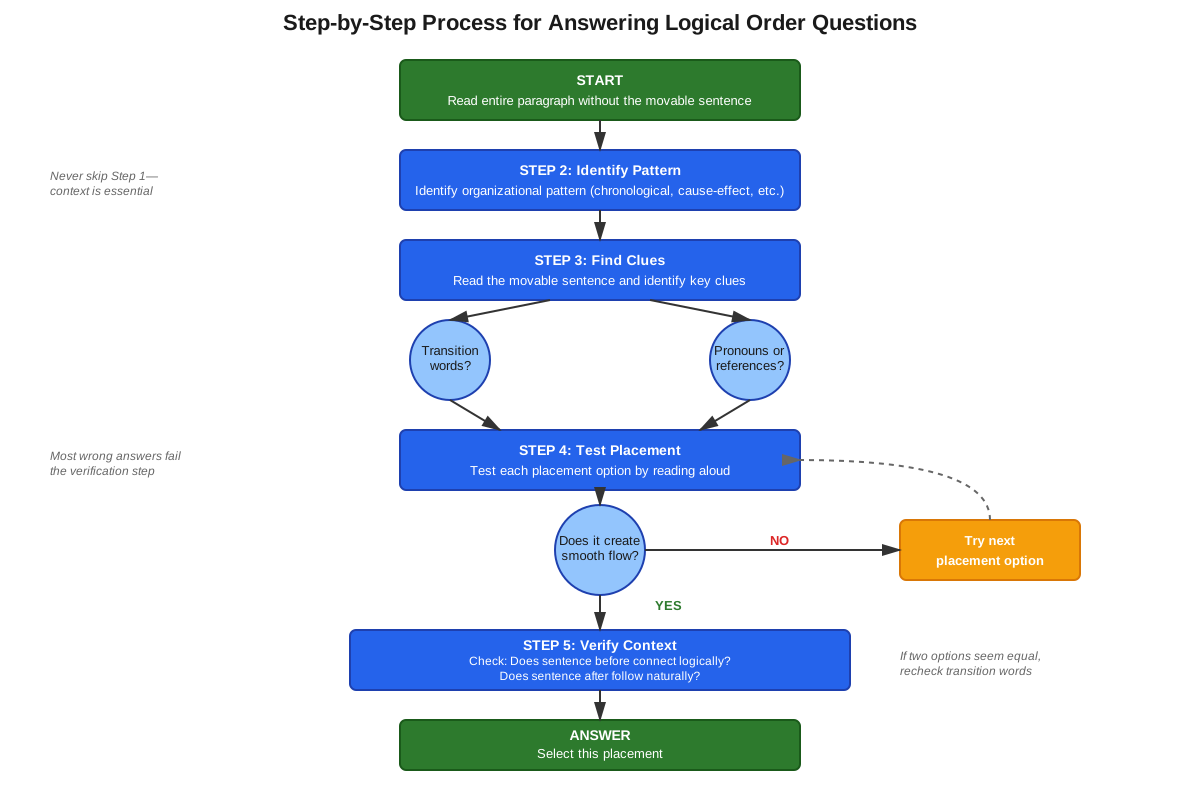
When approaching SAT logical order questions in the RW section, follow this systematic process:
Step 1: Read the entire paragraph first before looking at the question. Understanding the overall content and purpose helps you recognize the intended organizational pattern.
Step 2: Identify the paragraph's organizational pattern (chronological, spatial, importance, general-to-specific, problem-solution). Look for signal words that indicate the pattern type.
Step 3: Locate the topic sentence that states the main idea. This usually belongs at or near the beginning unless the paragraph uses an unconventional structure.
Step 4: Trace pronoun references and demonstrative adjectives ("this," "these," "such," "that"). Any sentence containing these words must follow a sentence that provides the antecedent or referent.
Step 5: Map transitional words to their logical functions. "However" must follow something it contrasts with. "For example" must follow a general statement. "Therefore" must follow premises that lead to a conclusion.
Step 6: Check for time markers and sequence words in chronological passages. Arrange sentences according to temporal order unless the passage explicitly uses flashback.
Step 7: Eliminate obviously incorrect answers by identifying placements that would create pronoun reference errors, break chronological sequence, or separate examples from the claims they support.
Exam Tip: If a sentence begins with "This method," "These results," or similar phrases, immediately look for what "this" or "these" refers to. The sentence must follow its referent.
Time allocation: Spend approximately 45-60 seconds per logical order question. These questions require careful reading but shouldn't consume excessive time. If you're uncertain, use process of elimination to narrow to two choices, then select the option that creates the smoothest flow.
Trigger phrases to watch for:
- "For example" / "For instance" → must follow general statement
- "However" / "Nevertheless" / "On the other hand" → must follow contrasting idea
- "Therefore" / "Thus" / "Consequently" → must follow cause or premise
- "This process" / "These findings" / "Such methods" → must follow referent
- "First" / "Then" / "Finally" → indicates chronological position
- "Additionally" / "Furthermore" / "Moreover" → adds to previous point
Memory Techniques
TOPIC Mnemonic for evaluating sentence placement:
- Transitions: Check what transitions signal about relationships
- Order pattern: Identify chronological, spatial, or importance pattern
- Pronouns: Trace references to ensure antecedents come first
- Introduction: Locate the topic sentence that introduces the main idea
- Connections: Verify each sentence connects logically to surrounding sentences
The "Pronoun Rule": Visualize pronouns as arrows pointing backward to their antecedents. If an arrow points to nothing, the sentence is in the wrong position.
The "Example Sandwich": Remember that specific examples are always the "filling" that comes after the "bread" of general statements. General claim → Specific example → Additional support.
Chronological Clue Words - Remember "FIRST THEN FINALLY":
- First, Initially, Originally
- Immediately after, In the meantime
- Recently, Right after
- Subsequently, Soon
- Then, Thereafter
- Henceforth, Hereafter
- Eventually, Ending with
- Next, Now
- Finally, Following
- In conclusion, In the end
- Next, Nowadays
- Afterward, At last
- Lastly, Later
- Long after, Lately
- Yet, Years later
The "Flow Test": When uncertain between two placements, read the paragraph aloud with each option. The correct placement will sound natural and require no mental backtracking to understand.
Summary
Logical order is a high-yield SAT Reading and Writing skill that tests students' ability to recognize and establish effective sequences for sentences within paragraphs. Success on these questions requires understanding multiple organizational patterns (chronological, spatial, general-to-specific, order of importance), recognizing transitional cues that signal relationships between ideas, and tracing pronoun references to ensure coherence. The key to mastering logical order questions is systematic analysis: identify the paragraph's organizational pattern, locate the topic sentence, trace pronouns to their antecedents, map transitional words to their functions, and verify that specific examples follow general claims. Students should eliminate answer choices that create pronoun reference errors, violate chronological sequence, or separate examples from the claims they support. With practice, students can quickly recognize the structural patterns that appear repeatedly on the SAT and apply a consistent process to achieve accuracy on these questions.
Key Takeaways
- Logical order questions test the ability to sequence sentences coherently, appearing 2-4 times per SAT administration
- Pronouns and demonstrative adjectives ("this," "these") must follow their antecedents, never precede them
- Transitional words reveal relationships: "however" signals contrast, "for example" signals a specific instance, "therefore" signals a conclusion
- Topic sentences introducing main ideas typically appear first; specific examples and evidence follow general claims
- Chronological passages use time markers ("first," "then," "finally") that indicate correct sequence
- The TOPIC mnemonic (Transitions, Order pattern, Pronouns, Introduction, Connections) provides a systematic approach to these questions
- Process of elimination is highly effective—incorrect placements often create obvious pronoun errors or break logical flow
Related Topics
Transitions and Cohesion: After mastering logical order, students should study how transitional words and phrases create connections between sentences and paragraphs. This skill builds directly on logical order by focusing on the specific language that signals relationships.
Rhetorical Synthesis: This advanced skill requires students to integrate information from multiple sources or text elements in a logical, coherent way. Logical order provides the foundation for determining how to sequence synthesized information.
Purpose and Function Questions: Understanding why sentences appear in specific positions helps students analyze author's purpose and the function of specific sentences within passages.
Essay Organization: The principles of logical order apply directly to SAT essay writing (if taking the optional essay) and to college application essays, where clear organization significantly impacts effectiveness.
Practice CTA
Now that you've mastered the core concepts of logical order, it's time to apply these skills to authentic SAT-style practice questions. The practice questions and flashcards will reinforce your understanding of organizational patterns, transitional cues, and pronoun reference chains. Remember: logical order questions are highly learnable—with focused practice, you can achieve near-perfect accuracy on this question type. Each practice question you complete strengthens your pattern recognition and speeds up your analysis process. Start practicing now to transform this high-yield topic into a consistent source of points on test day!
Sign up free to keep reading
Create a free AnvayaPrep account to finish this SAT guide on Logical order — plus flashcards and practice questions.