Overview
Style consistency is a critical concept tested in the SAT Reading and Writing (RW) section that evaluates a student's ability to recognize and maintain appropriate tone, formality, and linguistic patterns throughout a passage. This skill requires students to identify when a sentence or phrase disrupts the established stylistic conventions of a text and select the revision that best aligns with the surrounding context. The SAT frequently presents questions where one portion of a passage contains language that clashes with the overall register, vocabulary level, or rhetorical approach used elsewhere in the text.
Understanding sat style consistency is essential because these questions appear regularly on the exam and test a sophisticated awareness of how writers craft cohesive, purposeful prose. The College Board includes style consistency questions to assess whether students can distinguish between formal academic writing, conversational language, technical discourse, and other registers. Success on these questions demonstrates that a student can recognize subtle shifts in diction, sentence structure, and tone—skills that are fundamental to effective communication in college and professional settings.
Within the broader Expression of Ideas domain of SAT rw, style consistency connects closely to other rhetorical skills such as transitions, precision, and concision. While transitions ensure logical flow between ideas, and precision ensures accurate word choice, style consistency ensures that the entire passage maintains a unified voice and approach. Mastering this topic strengthens overall reading comprehension and writing ability, as students learn to evaluate not just what a text says, but how it says it and whether that approach remains consistent throughout.
Learning Objectives
- [ ] Identify key features of style consistency in SAT passages
- [ ] Explain how style consistency appears on the SAT and what question formats to expect
- [ ] Apply style consistency principles to answer SAT-style questions accurately
- [ ] Distinguish between different levels of formality and register in written texts
- [ ] Evaluate multiple revision options to determine which best maintains stylistic coherence
- [ ] Recognize common stylistic disruptions including tone shifts, vocabulary mismatches, and structural inconsistencies
Prerequisites
- Basic understanding of tone and diction: Recognizing whether language is formal, informal, technical, or conversational is fundamental to identifying style inconsistencies
- Familiarity with context clues: Students must be able to use surrounding sentences to determine the appropriate style for a passage
- Reading comprehension skills: Understanding the main idea and purpose of a passage helps identify which stylistic choices align with the author's intent
- Vocabulary knowledge: Distinguishing between synonyms with different connotations and formality levels requires a solid vocabulary foundation
Why This Topic Matters
Style consistency questions appear with high frequency on the SAT, typically comprising 2-4 questions per test administration. These questions are strategically important because they assess a student's rhetorical awareness—the ability to recognize how language choices affect meaning and impact. In real-world applications, maintaining style consistency is crucial for academic papers, professional communications, and any writing where credibility and clarity matter. A research paper that suddenly shifts to casual slang undermines its authority, just as a personal narrative that adopts overly technical jargon distances readers from the emotional content.
On the SAT, style consistency questions most commonly appear in passages about scientific topics, historical events, social sciences, and humanities subjects. The test makers deliberately insert sentences or phrases that clash with the established tone, forcing students to identify the disruption and select an appropriate revision. These questions test whether students can recognize that a passage discussing climate research using precise scientific terminology should not suddenly include phrases like "totally crazy weather patterns" or "scientists were like, super surprised."
The practical significance extends beyond test performance. College writing demands consistent academic style, and professional environments require appropriate register for different audiences and purposes. Students who master style consistency develop a sophisticated ear for language that serves them throughout their academic and professional careers. This skill also enhances critical reading ability, as students become more attuned to how authors craft their messages and maintain credibility through consistent stylistic choices.
Core Concepts
Understanding Style and Register
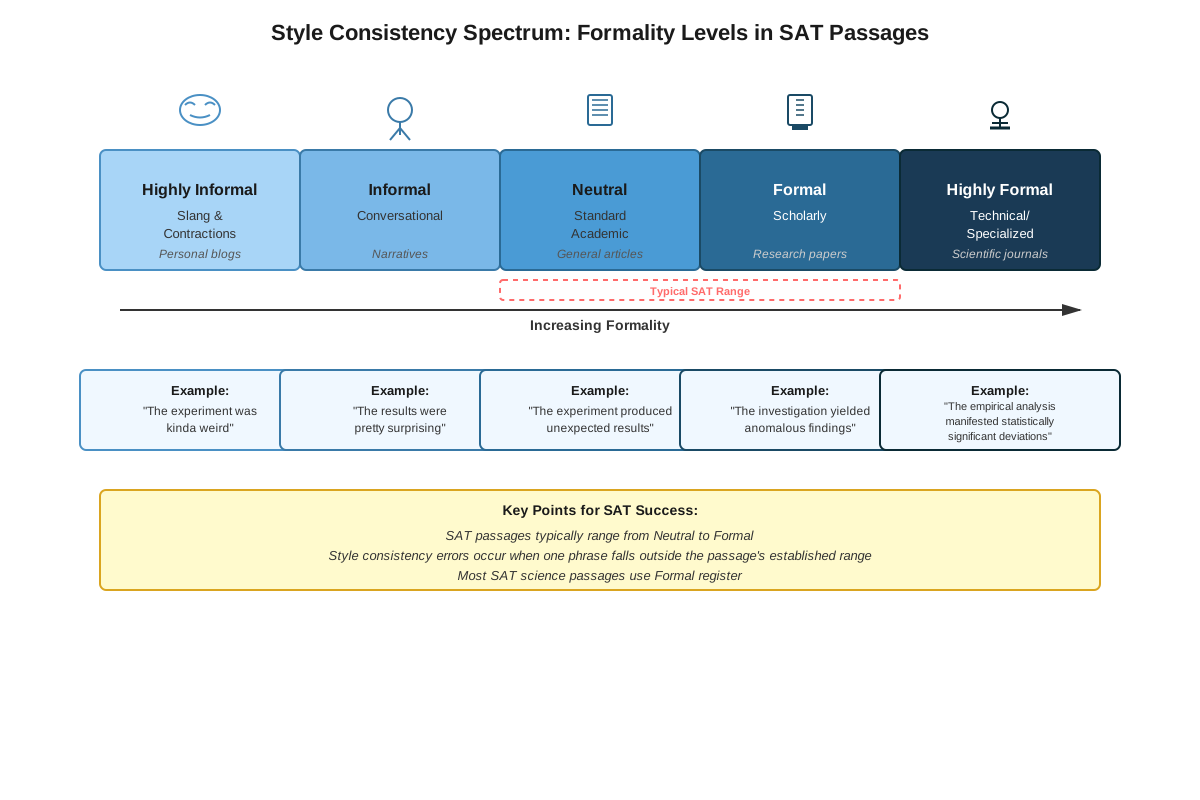
Style refers to the distinctive manner in which a writer uses language, encompassing word choice, sentence structure, tone, and overall approach to conveying information. Register is the level of formality appropriate to a particular context, ranging from highly formal academic or technical writing to casual conversational language. On the SAT, style consistency questions require students to identify when a passage maintains or violates its established register.
The key registers students encounter include:
| Register Type | Characteristics | Example Context |
|---|---|---|
| Formal Academic | Precise terminology, complex sentences, objective tone, third person | Research papers, scholarly articles |
| Technical/Scientific | Specialized vocabulary, precise definitions, methodical explanations | Scientific studies, technical reports |
| Informal/Conversational | Colloquialisms, contractions, personal pronouns, casual expressions | Personal essays, blogs, dialogue |
| Journalistic | Clear, direct language, balanced tone, accessible vocabulary | News articles, feature stories |
| Literary/Descriptive | Figurative language, varied sentence structures, evocative imagery | Creative nonfiction, literary analysis |
Identifying Stylistic Disruptions
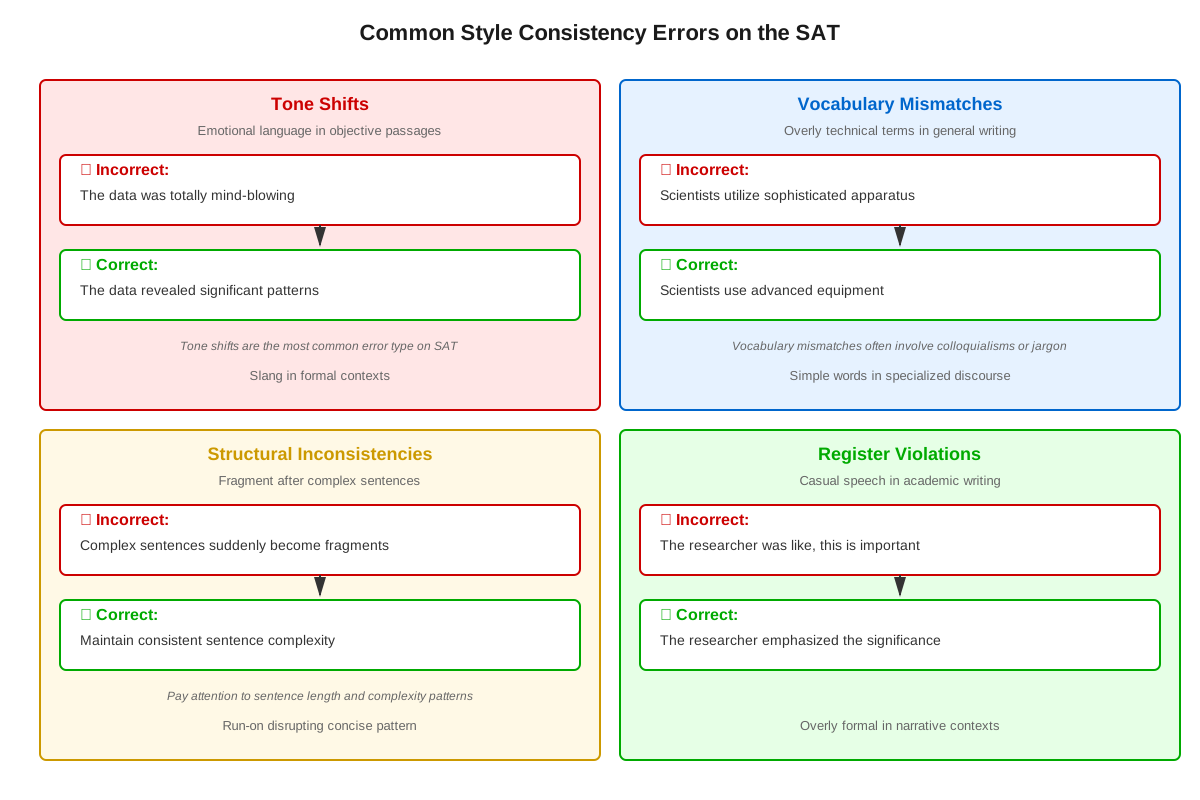
A stylistic disruption occurs when a word, phrase, or sentence deviates from the established pattern of language use in a passage. These disruptions manifest in several ways:
Tone shifts represent the most common type of disruption, where the emotional quality or attitude suddenly changes. A passage maintaining an objective, analytical tone about economic policy should not suddenly include emotionally charged language like "outrageous" or "absolutely ridiculous" unless the context specifically calls for such evaluation.
Vocabulary mismatches occur when word choice clashes with the passage's established level of formality or technicality. If a passage about neuroscience consistently uses terms like "neural pathways," "synaptic transmission," and "cortical regions," inserting "brain stuff" or "thinking parts" would create a jarring inconsistency.
Structural inconsistencies involve sentence patterns that don't align with the passage's established rhythm and complexity. A passage using predominantly complex, multi-clause sentences should not suddenly include a series of choppy, elementary-level sentences unless there's a rhetorical purpose.
Evaluating Context for Appropriate Style
Determining appropriate style requires careful analysis of multiple contextual factors. The subject matter heavily influences appropriate style—scientific topics typically demand precise, technical language, while personal narratives allow for more expressive, subjective language. The intended audience also shapes style; writing for specialists permits technical jargon, while writing for general readers requires accessible language.
The purpose of the passage guides stylistic choices as well. Informative writing prioritizes clarity and objectivity, persuasive writing may incorporate more evaluative language, and narrative writing often includes descriptive and emotional elements. Students must read enough of the passage to understand these contextual factors before evaluating whether a particular sentence maintains consistency.
Recognizing Appropriate Revisions
When presented with revision options, students must evaluate each choice against the established style. The correct answer will match the passage's formality level, vocabulary sophistication, tone, and structural patterns. Incorrect options typically fall into predictable categories:
- Too informal: Uses slang, colloquialisms, or conversational expressions in a formal passage
- Too formal: Employs unnecessarily complex or stilted language in an accessible passage
- Too technical: Introduces specialized jargon in a general-audience passage
- Too casual: Lacks the precision or seriousness appropriate to the subject matter
- Tonally inconsistent: Introduces subjective evaluation in an objective passage or vice versa
Concept Relationships
Style consistency functions as a unifying principle that connects multiple aspects of effective writing. The relationship begins with vocabulary choice → which determines → tone establishment → which creates → reader expectations → which must be maintained through → consistent stylistic choices → which produce → coherent, credible writing.
This topic builds directly on prerequisite knowledge of tone and diction, as students must first recognize different registers before they can identify inconsistencies. Style consistency also connects to the broader Expression of Ideas category by working alongside transitions (which ensure logical flow) and precision (which ensures accurate word choice). While transitions connect ideas and precision clarifies meaning, style consistency ensures the entire passage speaks with a unified voice.
The relationship to other SAT RW skills is hierarchical: students must first comprehend the passage's content and purpose (reading comprehension), then evaluate whether specific language choices serve that purpose effectively (style consistency), and finally determine whether those choices maintain coherence throughout (rhetorical synthesis). Mastering style consistency also prepares students for more advanced rhetorical analysis, where they evaluate not just consistency but effectiveness of stylistic choices.
High-Yield Facts
- ⭐ Style consistency questions always require reading enough context to understand the passage's established tone and register before evaluating the underlined portion
- ⭐ The correct answer will match the formality level, vocabulary sophistication, and tone of the surrounding sentences
- ⭐ Scientific and technical passages on the SAT typically maintain objective, precise language without casual expressions or emotional evaluation
- ⭐ Informal language (slang, colloquialisms, contractions) is almost always incorrect in formal academic or scientific passages
- ⭐ Overly complex or pretentious language is incorrect when the passage uses clear, accessible vocabulary for a general audience
- Style consistency questions often appear with underlined portions that include phrases like "really," "totally," "kind of," or other casual intensifiers in formal contexts
- The SAT frequently tests whether students can recognize when subjective evaluation (words like "amazing," "terrible," "wonderful") disrupts objective analysis
- Passages about historical events, scientific research, and social science topics typically require formal, measured language
- Personal narratives and some humanities passages may appropriately include more subjective, expressive language
- The correct revision often involves replacing casual or imprecise language with more specific, formal alternatives that convey the same basic meaning
Quick check — test yourself on Style consistency so far.
Try Flashcards →Common Misconceptions
Misconception: Longer, more complex words are always more appropriate in formal writing → Correction: Appropriate style matches the passage's established level of sophistication; unnecessarily complex language can be as disruptive as overly casual language. The goal is consistency, not maximum complexity.
Misconception: Scientific passages should always use the most technical terminology possible → Correction: Scientific passages written for general audiences appropriately balance technical accuracy with accessibility. The key is maintaining whatever level of technicality the passage establishes, not maximizing jargon.
Misconception: Any subjective language is inappropriate in informative passages → Correction: While objective analysis is common in informative writing, some passages appropriately include measured evaluation or interpretation. The question is whether the tone remains consistent, not whether it's purely objective.
Misconception: Contractions are always wrong in formal writing → Correction: While contractions are typically avoided in highly formal academic writing, some passages maintain a professional yet accessible tone that appropriately includes contractions. Evaluate the passage's established style rather than applying rigid rules.
Misconception: The shortest or simplest option is usually correct → Correction: Style consistency questions test appropriateness to context, not brevity. Sometimes the correct answer is longer or more complex because it matches the passage's established sophistication level.
Misconception: If a word is technically accurate, it's stylistically appropriate → Correction: A word can be factually correct but stylistically inconsistent. "Brainy" and "intelligent" both describe high cognitive ability, but they belong to different registers and aren't interchangeable in all contexts.
Worked Examples
Example 1: Scientific Passage
Passage Context: A passage discusses research on coral reef ecosystems, using precise scientific terminology and maintaining an objective, informative tone throughout. The surrounding sentences include phrases like "marine biologists have documented," "the symbiotic relationship between," and "data indicate significant changes."
Question: The researchers found that rising ocean temperatures were totally messing up the coral's ability to survive.
Which choice best maintains the style and tone of the passage?
A) totally messing up
B) seriously disrupting
C) really hurting
D) significantly impairing
Analysis:
First, identify the established style by examining the surrounding context. The passage uses formal scientific language ("marine biologists," "symbiotic relationship," "data indicate") and maintains an objective, analytical tone. The underlined phrase "totally messing up" is clearly inconsistent—it uses casual intensifier "totally" and informal phrasal verb "messing up."
Evaluate each option:
- Option A maintains the problematic casual language
- Option B ("seriously disrupting") is better but "seriously" still carries a somewhat informal quality
- Option C ("really hurting") uses another casual intensifier "really" and the imprecise verb "hurting"
- Option D ("significantly impairing") uses formal adverb "significantly" and precise verb "impairing," matching the passage's scientific register
Answer: D) significantly impairing
This example demonstrates how style consistency questions require matching both vocabulary sophistication (precise verbs like "impairing" rather than casual expressions like "messing up") and tone (objective "significantly" rather than casual "totally").
Example 2: Historical Narrative
Passage Context: A passage describes the construction of the transcontinental railroad, maintaining a formal but accessible tone appropriate for general readers. The surrounding sentences use clear, direct language without excessive technicality: "Workers faced numerous challenges," "The project required unprecedented coordination," "Engineers developed innovative solutions."
Question: Despite the monumental obstacles, the utilization of novel methodological approaches facilitated the expeditious completion of the infrastructure project.
Which choice best maintains the style and tone of the passage?
A) NO CHANGE
B) the use of new methods helped workers finish the railroad quickly
C) innovative techniques enabled rapid progress on the railroad
D) cool new ideas made the whole thing go faster
Analysis:
The established style is formal but accessible—sophisticated enough for an educated general audience but not overly technical or pretentious. The underlined sentence is problematically formal, using unnecessarily complex phrases like "utilization of novel methodological approaches" and "expeditious completion of the infrastructure project."
Evaluate each option:
- Option A maintains the overly formal, pretentious language that doesn't match the passage's accessible tone
- Option B ("helped workers finish the railroad quickly") is too casual and simplistic compared to the passage's measured formality
- Option C ("innovative techniques enabled rapid progress") matches the passage's balance of sophistication and clarity
- Option D uses casual language ("cool," "whole thing") completely inappropriate to the formal historical narrative
Answer: C) innovative techniques enabled rapid progress on the railroad
This example shows that style consistency works in both directions—language can be too formal or too casual for a given context. The correct answer maintains the passage's established balance.
Exam Strategy
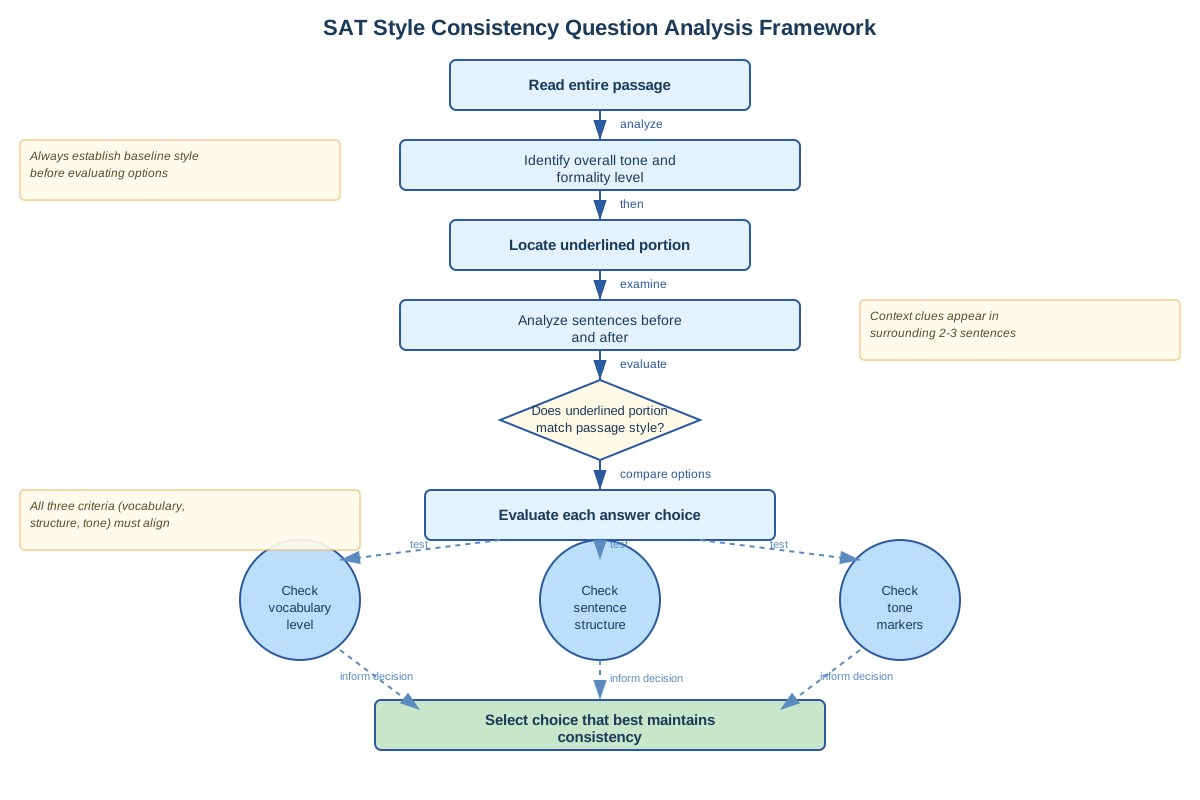
When approaching style consistency questions on the SAT, follow this systematic process:
Step 1: Read for Context - Never evaluate the underlined portion in isolation. Read at least 2-3 sentences before and after to establish the passage's tone, formality level, and vocabulary sophistication. Pay attention to the subject matter and apparent audience.
Step 2: Identify the Register - Determine whether the passage is formal academic, technical/scientific, journalistic, or another register. Note specific markers like vocabulary choices, sentence complexity, and use of personal pronouns or objective language.
Step 3: Spot the Disruption - If the question asks which choice maintains style, the underlined portion likely contains a disruption. Identify specifically what's inconsistent: Is it too casual? Too formal? Wrong tone? Imprecise vocabulary?
Step 4: Eliminate Obvious Mismatches - Quickly eliminate options that clearly don't match the established style. In formal passages, eliminate options with slang, colloquialisms, or casual intensifiers. In accessible passages, eliminate unnecessarily complex or pretentious language.
Step 5: Compare Remaining Options - Between the final two options, identify subtle differences in formality, precision, or tone. The correct answer will match the passage's style more closely in multiple dimensions.
Exam Tip: Watch for trigger words that signal style problems. In formal passages, words like "really," "totally," "kind of," "stuff," "things," "get," and "a lot" often indicate inappropriate casualness. In accessible passages, words like "utilize," "facilitate," "endeavor," and "commence" may signal unnecessary formality.
Time Management: Style consistency questions typically require 45-60 seconds. Spend 20-25 seconds reading context and establishing the style, then 20-25 seconds evaluating options. If you're uncertain, trust your ear—the correct answer should "sound right" in context.
Process of Elimination Tips:
- Eliminate options that introduce slang or colloquialisms in formal passages
- Eliminate options that use unnecessarily complex vocabulary when the passage is accessible
- Eliminate options that introduce subjective evaluation in objective passages
- Eliminate options that shift from third person to first/second person or vice versa
- Eliminate options that change the level of technicality without justification
Memory Techniques
MATCH Acronym for evaluating style consistency:
- Mood/Tone: Does the emotional quality match?
- Audience level: Is the sophistication appropriate?
- Technical language: Does the vocabulary fit the established pattern?
- Complexity: Do sentence structures align?
- Honesty to context: Does it serve the passage's purpose?
The Formality Spectrum Visualization: Picture a horizontal line with "Very Casual" on the left and "Very Formal" on the right. Place the passage somewhere on this line based on context clues, then evaluate whether each answer choice falls at approximately the same point.
The "Would My Teacher Accept This?" Test: For formal passages, ask whether the language would be appropriate in a research paper for a strict English teacher. For accessible passages, ask whether it would work in a quality newspaper article.
The Substitution Check: Mentally substitute the answer choice into the passage and read the full sentence aloud (silently). Your ear will often catch inconsistencies that your eye might miss.
Red Flag Words List: Memorize common casual words that signal problems in formal passages: really, totally, kind of, sort of, a lot, stuff, things, get (when used informally), cool, awesome, crazy, super.
Summary
Style consistency is a high-yield SAT Reading and Writing skill that tests whether students can recognize and maintain appropriate tone, formality, and linguistic patterns throughout a passage. Success requires identifying the established register through careful attention to vocabulary choices, sentence structures, and overall approach, then selecting revisions that align with these patterns. The most common disruptions involve casual language in formal contexts, unnecessarily complex language in accessible passages, and tone shifts from objective to subjective or vice versa. Students must read sufficient context before evaluating the underlined portion, systematically eliminate options that don't match the established style, and trust their ear for language when choosing between similar options. Mastering this skill requires understanding that effective writing maintains consistency not just in content but in how that content is expressed, ensuring that every sentence contributes to a unified, credible voice appropriate to the subject matter, audience, and purpose.
Key Takeaways
- Style consistency questions require reading enough context to establish the passage's tone, formality level, and vocabulary sophistication before evaluating answer choices
- The correct answer will match the established register in multiple dimensions: vocabulary, tone, complexity, and formality
- Casual language (slang, colloquialisms, informal intensifiers) is almost always incorrect in formal academic or scientific passages
- Unnecessarily complex or pretentious language disrupts passages written for general audiences
- Evaluate whether language is too formal, too casual, or appropriately matched to context rather than applying rigid rules about "correct" style
- Common disruptions include tone shifts, vocabulary mismatches, and structural inconsistencies that break the established pattern
- Trust your ear—the correct answer should sound natural and appropriate when read in context with surrounding sentences
Related Topics
Transitions and Logical Flow: While style consistency ensures unified voice, transitions ensure logical connections between ideas. Mastering both creates writing that is both coherent and cohesive.
Precision in Word Choice: Style consistency focuses on appropriateness to context, while precision focuses on accuracy of meaning. Together, these skills ensure language is both correct and appropriate.
Rhetorical Synthesis: Advanced questions may ask students to evaluate not just whether style is consistent but whether it's effective for the passage's purpose, building on style consistency foundations.
Tone and Purpose Analysis: Understanding how authors use style to achieve specific purposes deepens comprehension and prepares students for more sophisticated rhetorical analysis.
Concision and Redundancy: While concision eliminates unnecessary words, style consistency ensures necessary words match the passage's register, creating efficient and appropriate expression.
Practice CTA
Now that you understand the principles of style consistency, it's time to apply this knowledge through practice. The concepts covered in this guide will become automatic with repeated exposure to SAT-style questions. Challenge yourself with the practice questions to reinforce your ability to identify stylistic disruptions and select appropriate revisions. Use the flashcards to internalize key vocabulary and concepts. Remember: recognizing style consistency is a skill that improves with practice, and mastering it will not only boost your SAT score but also enhance your writing and critical reading abilities for college and beyond. You've built the foundation—now strengthen it through application!
Sign up free to keep reading
Create a free AnvayaPrep account to finish this SAT guide on Style consistency — plus flashcards and practice questions.