Overview
Comparisons are a fundamental grammatical structure tested extensively in the SAT Reading and Writing section. This topic examines how writers construct valid, logical, and parallel comparisons between two or more entities, ideas, or actions. On the SAT, comparison questions assess whether students can identify and correct errors in comparative structures, ensuring that sentences compare equivalent elements in grammatically sound ways.
Mastering sat comparisons is essential because these questions appear regularly throughout the exam and require students to recognize subtle structural flaws that might otherwise go unnoticed in casual reading. The SAT tests comparisons in multiple ways: through faulty parallelism, illogical comparison structures, incomplete comparisons, and ambiguous comparative phrases. Students must develop the ability to quickly identify what is being compared to what, verify that both elements are grammatically equivalent, and ensure the comparison makes logical sense.
Within the broader RW (Reading and Writing) section, comparisons connect directly to other Form, Structure, and Sense concepts including parallelism, modifier placement, and logical expression. Understanding comparisons strengthens overall sentence structure comprehension and enhances the ability to evaluate whether sentences communicate their intended meaning clearly and precisely. This topic serves as a bridge between pure grammatical knowledge and logical reasoning, requiring students to think critically about both the form and content of written expression.
Learning Objectives
- [ ] Identify key features of Comparisons
- [ ] Explain how Comparisons appears on the SAT
- [ ] Apply Comparisons to answer SAT-style questions
- [ ] Distinguish between logical and illogical comparison structures
- [ ] Recognize and correct faulty parallelism in comparative sentences
- [ ] Evaluate whether compared elements are grammatically equivalent
- [ ] Identify incomplete or ambiguous comparisons that require clarification
Prerequisites
- Basic sentence structure: Understanding subjects, verbs, and objects is necessary to identify what elements are being compared within a sentence
- Parts of speech recognition: Knowing nouns, adjectives, adverbs, and verb forms helps determine whether compared elements are grammatically parallel
- Modifier concepts: Familiarity with how modifiers function aids in recognizing when comparisons create ambiguous or illogical relationships
- Parallel structure fundamentals: Basic understanding of parallelism provides the foundation for recognizing when comparative elements must match in form
Why This Topic Matters
Comparison questions represent a high-frequency question type on the SAT, appearing in approximately 10-15% of all Reading and Writing questions. These questions test a student's ability to recognize both grammatical correctness and logical coherence, making them particularly valuable for distinguishing between mid-range and high-scoring test-takers. The College Board consistently includes comparison questions because they assess critical thinking skills that extend beyond memorized rules—students must actively analyze sentence structure and meaning.
In real-world applications, the ability to construct clear comparisons is essential for academic writing, professional communication, and analytical reasoning. Faulty comparisons can obscure meaning, create confusion, or even completely misrepresent intended ideas. For example, writing "The company's profits are higher than last year" creates an illogical comparison between profits (a thing) and a time period, when the writer meant to compare this year's profits to last year's profits.
On the SAT, comparison questions typically appear as multiple-choice items where students must select the version of a sentence that creates the most logical and grammatically correct comparison. These questions often embed comparison errors within longer sentences, requiring students to parse complex structures quickly. Common passage contexts include scientific comparisons (comparing experimental results), historical comparisons (contrasting time periods or figures), and literary analysis (comparing themes or characters). The ability to spot and correct comparison errors directly impacts a student's overall Reading and Writing score and demonstrates college-readiness in written communication.
Core Concepts
What Makes a Valid Comparison
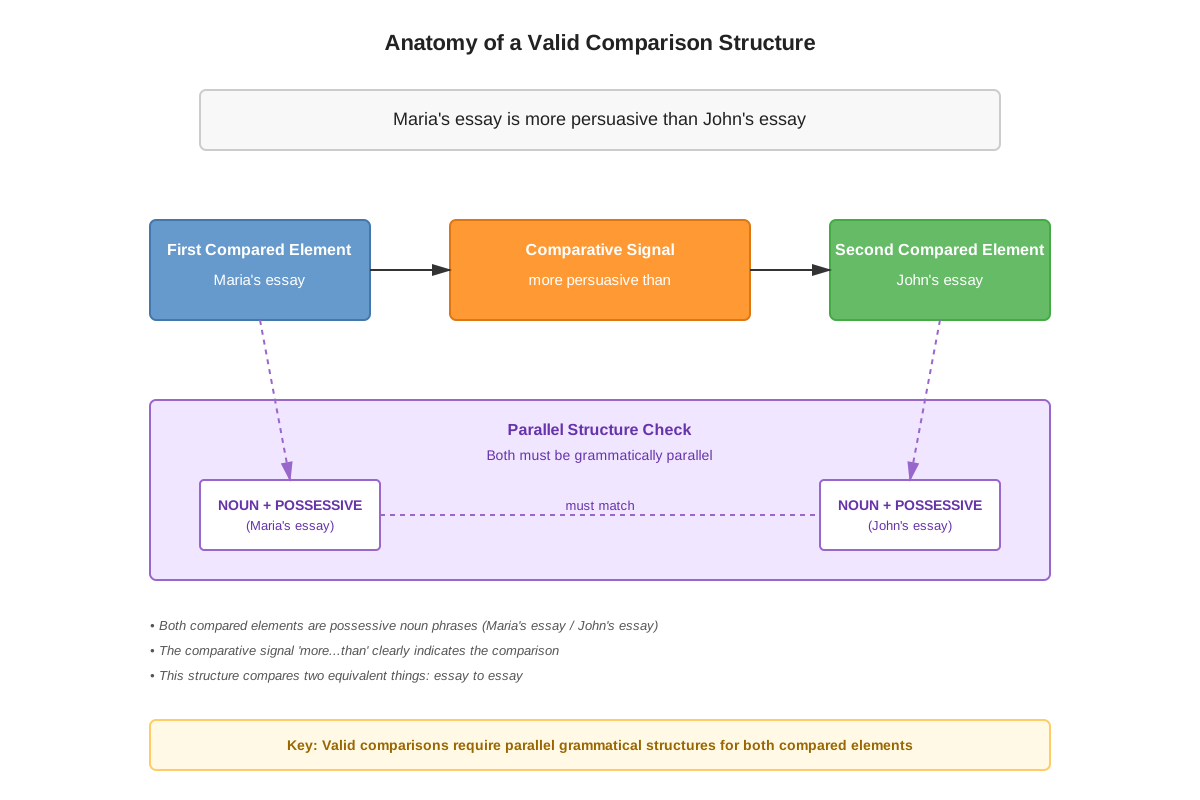
A valid comparison requires three essential elements: two or more items being compared, a comparative structure (such as "more than," "less than," "as...as," or "like"), and logical equivalence between the compared items. The fundamental rule is that comparisons must be between similar types of things—you cannot logically compare an object to an action, a person to a quality, or a thing to a time period.
Consider this invalid comparison: "The speed of the new train is faster than the old train." This sentence illogically compares "speed" (a quality) to "train" (an object). The corrected version must compare like to like: "The speed of the new train is faster than the speed of the old train" or more concisely, "The new train is faster than the old train."
Parallel Structure in Comparisons
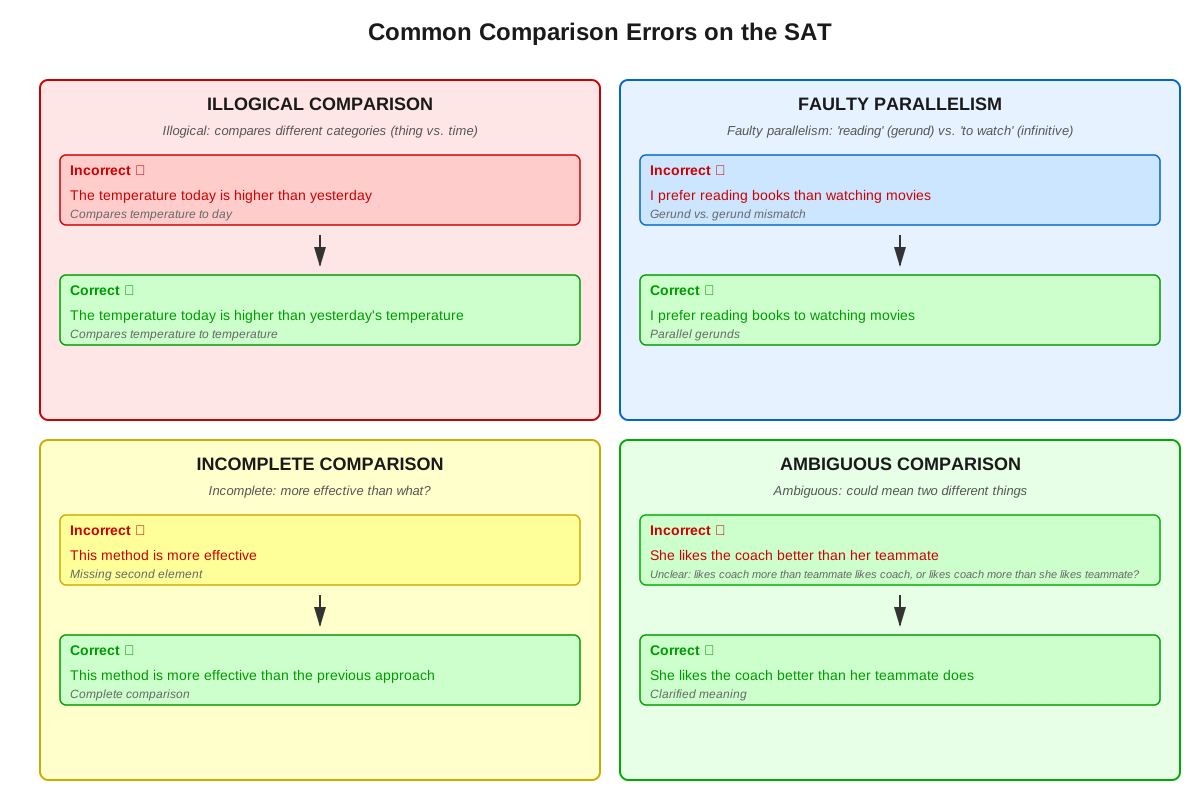
Parallelism in comparisons demands that compared elements share the same grammatical form. If one element is a noun phrase, the other must be a noun phrase; if one is a gerund, the other must be a gerund; if one is a clause, the other must be a clause. This principle extends to verb tenses, article usage, and prepositional structures.
Example of faulty parallelism: "She enjoys reading books more than to watch movies." The comparison pairs a gerund ("reading") with an infinitive ("to watch"). The parallel version would be: "She enjoys reading books more than watching movies" (both gerunds) or "She prefers to read books rather than to watch movies" (both infinitives).
Types of Comparison Structures
| Comparison Type | Structure | Example | Common Errors |
|---|---|---|---|
| Equality | as...as | The lake is as deep as the river. | Omitting second "as" |
| Superiority | more/er...than | This method is more effective than that one. | Comparing unlike items |
| Inferiority | less...than | The sequel was less engaging than the original. | Incomplete comparisons |
| Similarity | like, similar to | Her style is similar to her mentor's. | Comparing actions to things |
| Difference | unlike, different from | Unlike his peers, he studied daily. | Illogical contrasts |
Illogical Comparisons
Illogical comparisons occur when sentences compare fundamentally different categories of things. The SAT frequently tests this by creating sentences where the grammatical structure suggests an impossible comparison. These errors often involve possessive forms, abstract concepts, or implied subjects.
Example: "The population of Tokyo is larger than New York." This compares a population to a city. Correction: "The population of Tokyo is larger than that of New York" or "Tokyo's population is larger than New York's."
Another common pattern: "Like most students, Maria's grades improved." This sentence illogically compares students to grades. Correction: "Like most students, Maria improved her grades" or "Maria's grades, like those of most students, improved."
Incomplete Comparisons
An incomplete comparison lacks sufficient information to establish what is being compared or to what degree. These often appear with comparative adjectives or adverbs but fail to specify the second element of comparison.
Example: "This smartphone has a better camera." Better than what? The sentence needs completion: "This smartphone has a better camera than the previous model" or "This smartphone has a better camera than its competitors."
The SAT also tests incomplete comparisons with phrases like "more," "less," "faster," and "higher" that require a reference point. Students must recognize when a comparison word appears without its necessary counterpart.
Ambiguous Comparisons
Ambiguous comparisons occur when sentence structure allows multiple interpretations of what is being compared. These often involve unclear pronoun references or misplaced modifying phrases.
Example: "The coach praised the player more than the captain." This could mean either (1) the coach praised the player more than the coach praised the captain, or (2) the coach praised the player more than the captain praised the player. Clarification requires restructuring: "The coach praised the player more than she praised the captain" or "The coach, more than the captain did, praised the player."
Possessive Forms in Comparisons
When comparing something belonging to one entity with something belonging to another, proper use of possessive forms or substitute words like "that" or "those" is essential. Omitting these creates illogical comparisons.
Example: "The climate of California is milder than Arizona." This compares climate to a state. Corrections include: "The climate of California is milder than that of Arizona" or "California's climate is milder than Arizona's."
The word "that" substitutes for singular nouns, while "those" substitutes for plural nouns in comparisons, preventing awkward repetition while maintaining logical structure.
Comparative and Superlative Forms
Comparative forms (used for comparing two items) include "-er" endings or "more/less" before adjectives and adverbs. Superlative forms (used for comparing three or more items) include "-est" endings or "most/least" before adjectives and adverbs. The SAT tests whether students use the appropriate form based on the number of items being compared.
Incorrect: "Between the two options, this is the best." (Superlative used for two items)
Correct: "Between the two options, this is the better." (Comparative for two items)
Incorrect: "Of all three proposals, this one is more practical." (Comparative used for three items)
Correct: "Of all three proposals, this one is the most practical." (Superlative for three or more)
Concept Relationships
The concepts within comparisons form an interconnected system where understanding one element strengthens comprehension of others. Valid comparison structure serves as the foundation → which requires parallel structure → which prevents illogical comparisons → which might otherwise create ambiguous comparisons → all of which can result in incomplete comparisons if not properly executed.
Parallelism (a prerequisite concept) directly enables proper comparison construction, as compared elements must maintain parallel grammatical forms. This connection means that students who struggle with parallelism will inevitably struggle with comparisons. Conversely, mastering comparisons reinforces parallelism skills.
Modifier placement (another Form, Structure, and Sense topic) intersects with comparisons because misplaced modifiers can create ambiguous comparisons. When a modifier's position is unclear, readers cannot determine what is being compared to what.
The relationship between possessive forms and logical comparison structure is particularly important: possessive constructions often provide the grammatical mechanism for creating logical comparisons when comparing attributes or possessions of different entities.
Comparative and superlative forms connect to number agreement concepts, as the choice between these forms depends on counting the items being compared (two items versus three or more).
Understanding comparisons also prepares students for more advanced topics in logical expression and rhetorical synthesis, where writers must not only construct grammatically correct comparisons but also choose comparison structures that best serve their rhetorical purpose.
Quick check — test yourself on Comparisons so far.
Try Flashcards →High-Yield Facts
⭐ Comparisons must be between logically equivalent items—you cannot compare an object to a quality, a person to a time period, or an action to a thing.
⭐ Compared elements must maintain parallel grammatical structure—if one element is a gerund, the other must be a gerund; if one is a noun phrase, the other must be a noun phrase.
⭐ Use "that" or "those" to substitute for nouns in comparisons to avoid illogical structures, especially when comparing possessions or attributes (e.g., "California's climate is milder than that of Arizona").
⭐ Comparative forms (-er, more/less) are used for two items; superlative forms (-est, most/least) are used for three or more items.
⭐ Every comparison word (more, less, better, faster, etc.) requires a reference point—incomplete comparisons that lack the "than" phrase or comparison standard are incorrect.
- The word "like" compares nouns to nouns; "as" introduces clauses comparing actions or states.
- Possessive forms in comparisons often signal correct structure: "Maria's score exceeded John's" is more concise than "Maria's score exceeded the score of John."
- Ambiguous comparisons often result from unclear pronoun references or misplaced modifying phrases that could modify multiple elements.
- The phrase "as...as" requires both parts to create a valid equality comparison; omitting the second "as" creates an incomplete structure.
- When comparing groups or categories, ensure the comparison includes all members appropriately: "Unlike other students" (not "Unlike other students, Maria's approach...").
Common Misconceptions
Misconception: Any sentence with "more" or "less" automatically contains a valid comparison.
Correction: Comparison words require a complete structure including both elements being compared. "This phone is more expensive" is incomplete without specifying "more expensive than what."
Misconception: As long as two things are mentioned in a sentence, the comparison is automatically logical.
Correction: The grammatical structure must explicitly compare equivalent elements. "The museum's collection is larger than the library" illogically compares a collection to a building, not to the library's collection.
Misconception: "Like" and "as" are interchangeable in comparisons.
Correction: "Like" compares nouns or noun phrases ("She runs like an athlete"), while "as" introduces clauses comparing actions or states ("She runs as fast as an athlete runs").
Misconception: Comparative forms can be used regardless of how many items are being compared.
Correction: Comparative forms (better, more, less) are specifically for comparing two items; superlative forms (best, most, least) are required when comparing three or more items.
Misconception: Repeating the same noun in both parts of a comparison is always necessary.
Correction: While repetition can clarify comparisons, substitute words like "that," "those," or possessive forms often create more concise and equally clear comparisons ("California's climate is milder than Arizona's" rather than "California's climate is milder than Arizona's climate").
Misconception: If a comparison sounds natural in spoken English, it must be grammatically correct.
Correction: Many illogical comparisons are common in casual speech but incorrect in formal writing. "The team's performance was better than last season" sounds natural but illogically compares performance to a time period.
Worked Examples
Example 1: Identifying and Correcting Illogical Comparisons
Original Sentence: "The nutritional value of organic vegetables is often higher than conventional farming."
Analysis Process:
- Identify the comparison structure: "higher than" signals a comparison
- Identify what is being compared: "nutritional value" vs. "conventional farming"
- Evaluate logical equivalence: nutritional value (a quality) is being compared to farming (a practice/method)
- Recognize the error: these are not equivalent categories
- Determine what should be compared: nutritional value of organic vegetables vs. nutritional value of conventionally farmed vegetables
Correction Options:
- "The nutritional value of organic vegetables is often higher than that of conventionally farmed vegetables."
- "Organic vegetables often have higher nutritional value than conventionally farmed vegetables."
- "The nutritional value of organic vegetables is often higher than the nutritional value of those grown through conventional farming."
Key Takeaway: This example demonstrates Learning Objective 4 (distinguishing logical from illogical comparisons) by showing how to identify when compared elements belong to different categories and how to restructure the sentence to compare equivalent items.
Example 2: Correcting Faulty Parallelism in Comparisons
Original Sentence: "The study found that exercising regularly is more beneficial for heart health than to maintain a restrictive diet."
Analysis Process:
- Identify the comparison structure: "more beneficial...than" signals a comparison
- Identify the grammatical forms: "exercising" (gerund) vs. "to maintain" (infinitive)
- Recognize the parallelism error: compared elements use different verb forms
- Choose a consistent form: either both gerunds or both infinitives
- Consider which form fits the sentence structure: gerunds work better with "is beneficial"
Correction Options:
- "The study found that exercising regularly is more beneficial for heart health than maintaining a restrictive diet." (both gerunds)
- "The study found it more beneficial for heart health to exercise regularly than to maintain a restrictive diet." (both infinitives, but requires restructuring)
Additional Analysis: Notice that the first correction is more concise and maintains the original sentence structure more closely, making it the preferable choice on the SAT.
Key Takeaway: This example addresses Learning Objective 5 (recognizing and correcting faulty parallelism) by demonstrating how to identify non-parallel verb forms in comparisons and restructure them to maintain grammatical consistency.
Example 3: SAT-Style Question Application
Question Stem: Which choice completes the text with the most logical and precise comparison?
Passage: "The average lifespan of wild elephants is significantly longer than _______."
Answer Choices:
A) elephants in captivity
B) captive elephants
C) that of elephants in captivity
D) in captivity
Analysis Process:
- Identify what the first element is: "the average lifespan of wild elephants"
- Determine what needs to be compared: another lifespan, not elephants themselves
- Evaluate each choice:
- Choice A: compares "lifespan" to "elephants" (illogical)
- Choice B: compares "lifespan" to "elephants" (illogical)
- Choice C: compares "lifespan" to "that [lifespan] of elephants in captivity" (logical and parallel)
- Choice D: incomplete and unclear
- Select the choice that creates a logical comparison between equivalent elements
Correct Answer: C
Explanation: Choice C uses "that" to substitute for "the average lifespan," creating a logical comparison between the lifespan of wild elephants and the lifespan of captive elephants. Choices A and B illogically compare a lifespan to elephants themselves. Choice D creates an incomplete and ambiguous comparison.
Key Takeaway: This example demonstrates Learning Objective 3 (applying comparisons to answer SAT-style questions) by showing the systematic process of eliminating illogical comparisons and selecting the grammatically correct option.
Exam Strategy
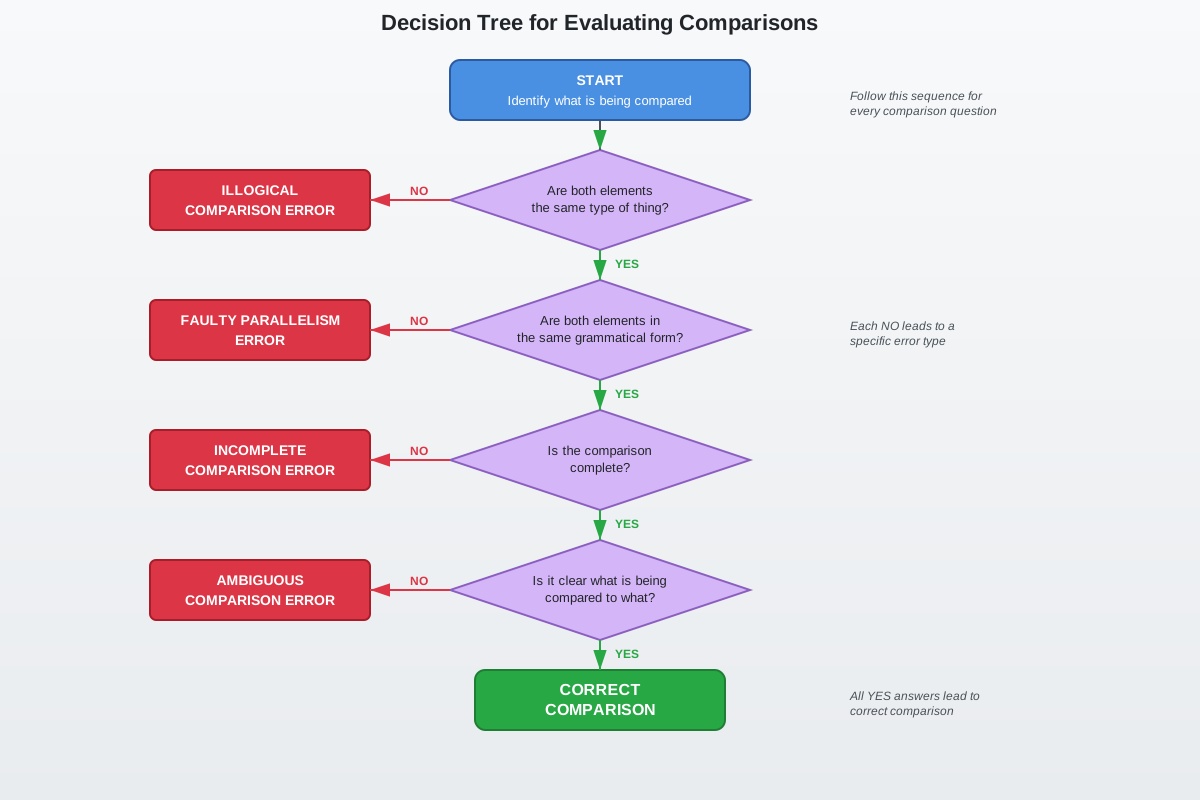
When approaching comparison questions on the SAT, follow this systematic process:
Step 1: Identify the Comparison Signal
Look for trigger words that indicate a comparison is being made: "more/less than," "as...as," "like," "unlike," "similar to," "different from," "-er than," or superlatives. These words immediately signal that you need to evaluate the comparison structure.
Step 2: Locate Both Elements
Identify exactly what is being compared to what. Underline or mentally note both elements. Ask yourself: "What is being compared to what?" If you cannot clearly identify both elements, the comparison may be incomplete.
Step 3: Check Logical Equivalence
Verify that both elements belong to the same category. Are you comparing a thing to a thing, a quality to a quality, an action to an action? If the categories don't match, the comparison is illogical.
Step 4: Verify Parallel Structure
Confirm that both elements use the same grammatical form. If one is a gerund, the other should be a gerund. If one is a noun phrase, the other should be a noun phrase.
Step 5: Eliminate Clearly Wrong Answers
On multiple-choice questions, eliminate any choices that create obvious illogical comparisons or break parallelism. This often eliminates 2-3 choices immediately.
Exam Tip: When you see possessive forms or the words "that" or "those" in answer choices, these often signal correct comparison structures. These words typically substitute for nouns to create logical comparisons.
Time Allocation: Comparison questions should take 30-45 seconds each. If you're spending more than a minute, you may be overthinking. Trust your systematic process and move forward.
Common Trigger Phrases to Watch For:
- "Unlike [noun], [noun's] [quality]..." (often illogical—should be "Unlike [noun], [noun]...")
- "[Quality] of [noun] is [comparative] than [noun]" (often illogical—needs "that of" or possessive)
- "More/less [adjective]" without "than" clause (incomplete comparison)
- "Between [two items]...most/least" (wrong form—should use comparative)
Process of Elimination Strategy:
First, eliminate choices that compare different categories (thing vs. quality, person vs. time). Second, eliminate choices with non-parallel structures. Third, eliminate incomplete comparisons. The remaining choice is likely correct.
Memory Techniques
The "APPLE" Mnemonic for Checking Comparisons:
- Are both elements present? (Check for completeness)
- Parallel structure maintained? (Check grammatical forms)
- Proper category match? (Check logical equivalence)
- Logical reference clear? (Check for ambiguity)
- Equivalent items compared? (Final verification)
Visualization Strategy: Picture a balance scale. For a comparison to work, both sides must hold the same type of item. If one side has apples and the other has the color red, the scale doesn't make sense—you can't weigh a thing against a quality. This mental image helps identify illogical comparisons.
The "That/Those" Rule: When you see a possessive or "of" phrase in the first element, remember: "That's the one that needs 'that' or 'those.'" This rhyme helps you remember to use substitute words in comparisons involving possessions or attributes.
Two vs. Three+ Rule: Hold up two fingers for comparative forms (better, more, less, -er) and three fingers for superlative forms (best, most, least, -est). This physical reminder helps you choose the correct form based on the number of items being compared.
The "Like vs. As" Distinction:
- "Like" = Linking Nouns (both start with consonants)
- "As" = Actions/Adjectives (both start with vowels)
This helps you remember that "like" compares nouns while "as" introduces clauses with actions or states.
Summary
Comparisons on the SAT test the ability to construct grammatically correct and logically sound comparisons between two or more elements. Valid comparisons require three essential components: clearly identified elements being compared, appropriate comparative structures (such as "more than," "as...as," or "like"), and logical equivalence between compared items. The most common errors involve illogical comparisons (comparing different categories like things to qualities), faulty parallelism (using different grammatical forms for compared elements), and incomplete comparisons (lacking necessary reference points). Students must systematically identify comparison signals, locate both elements being compared, verify logical equivalence and parallel structure, and recognize when substitute words like "that" or "those" are necessary to create valid comparisons. Mastering this topic requires understanding the distinction between comparative and superlative forms, recognizing possessive constructions in comparisons, and identifying ambiguous structures that could have multiple interpretations. Success on comparison questions directly impacts overall Reading and Writing scores and demonstrates essential college-level writing skills.
Key Takeaways
- Comparisons must be logically equivalent: always compare things to things, qualities to qualities, and actions to actions—never mix categories
- Parallel structure is non-negotiable: both elements in a comparison must use the same grammatical form (both gerunds, both infinitives, both noun phrases, etc.)
- Use "that" or "those" as substitutes when comparing possessions or attributes to avoid illogical structures and awkward repetition
- Comparative forms (better, more, -er) are for two items; superlative forms (best, most, -est) are for three or more items
- Every comparison word requires completion: "more," "less," "better," and similar terms need a "than" phrase or clear reference point
- Watch for possessive forms and substitute words in answer choices—these often signal correct comparison structures on the SAT
- Systematic analysis beats intuition: follow the five-step process (identify signal, locate elements, check logic, verify parallelism, eliminate wrong answers) rather than relying on what "sounds right"
Related Topics
Parallelism: Comparisons represent a specific application of parallel structure principles. Mastering comparisons strengthens overall parallelism skills and vice versa, as both require maintaining consistent grammatical forms across sentence elements.
Modifier Placement: Misplaced modifiers can create ambiguous comparisons by making it unclear what is being compared. Understanding modifier placement helps prevent comparison ambiguity.
Logical Expression: Comparisons are a subset of logical expression, which encompasses all ways sentences can fail to communicate their intended meaning clearly. Mastering comparisons builds skills for identifying other logical expression errors.
Pronoun Reference: The use of "that" and "those" in comparisons connects to broader pronoun reference concepts, as these words must clearly refer to specific antecedents.
Rhetorical Synthesis: Advanced comparison skills enable more sophisticated rhetorical choices, allowing writers to select comparison structures that best serve their persuasive or analytical purposes.
Practice CTA
Now that you've mastered the core concepts of comparisons, it's time to put your knowledge into action! Complete the practice questions to reinforce these skills and build the speed and accuracy you need for test day. Each practice question is designed to mirror actual SAT comparison questions, giving you authentic preparation. Don't forget to review the flashcards to cement high-yield facts in your memory. Remember: understanding the concepts is just the first step—consistent practice transforms knowledge into the automatic recognition skills that lead to top scores. You've got this!
Sign up free to keep reading
Create a free AnvayaPrep account to finish this SAT guide on Comparisons — plus flashcards and practice questions.