Overview
Frequently confused words represent one of the most predictable and high-yield question types in the SAT Reading and Writing (RW) section. These questions test a student's ability to distinguish between words that sound similar, look similar, or share related meanings but have distinct uses in standard written English. Unlike vocabulary questions that test obscure word meanings, frequently confused words questions assess precision in word choice—a fundamental skill for clear communication and a cornerstone of the SAT's Standard English Conventions domain.
The SAT consistently includes multiple questions per test that require students to select the correct word from a pair or set of commonly confused options. These questions appear deceptively simple but demand careful attention to context, grammatical function, and precise meaning. Mastering this topic provides one of the highest returns on study investment because the same word pairs appear repeatedly across different test administrations, making them highly predictable and learnable.
Understanding frequently confused words connects directly to broader Reading and Writing concepts including context clues, sentence structure analysis, and rhetorical effectiveness. The ability to distinguish between similar words demonstrates command of standard English conventions and supports success across all question types that require precise reading comprehension and grammatical accuracy. This skill extends beyond the SAT, forming the foundation for college-level writing and professional communication.
Learning Objectives
- [ ] Identify key features of frequently confused words
- [ ] Explain how frequently confused words appears on the SAT
- [ ] Apply frequently confused words to answer SAT-style questions
- [ ] Distinguish between homophones, homographs, and words with related but distinct meanings
- [ ] Analyze sentence context to determine the grammatically and semantically correct word choice
- [ ] Recognize the most commonly tested word pairs on the SAT and apply their correct usage patterns
Prerequisites
- Basic parts of speech identification: Understanding whether a word functions as a noun, verb, adjective, or adverb helps determine which confused word fits the sentence structure
- Sentence structure fundamentals: Recognizing subjects, verbs, and objects enables analysis of how a word functions within its context
- Reading comprehension skills: The ability to understand sentence meaning and context is essential for selecting the word that conveys the intended message
- Standard English grammar conventions: Familiarity with subject-verb agreement, verb tenses, and modifier placement supports correct word selection
Why This Topic Matters
In real-world communication, using the wrong word from a confused pair can undermine credibility, create ambiguity, or completely change intended meaning. Professional writing, academic papers, and formal correspondence all demand precision in word choice. The ability to distinguish between "affect" and "effect" or "principal" and "principle" marks the difference between competent and excellent writing.
On the SAT, frequently confused words questions appear with remarkable consistency—typically 2-4 questions per test in the Reading and Writing section. These questions carry the same weight as more complex grammar questions, making them high-value targets for score improvement. The College Board specifically tests these words because they represent common errors in student writing and because mastery indicates readiness for college-level composition.
These questions most commonly appear in short passages (25-150 words) where students must select the word that best completes a sentence. The incorrect options are always real words that might sound correct but don't fit the context. Questions may test homophones (words that sound alike), words with similar spellings, or words with related but distinct meanings. The SAT favors word pairs that appear frequently in academic and professional writing, ensuring the test assesses practical language skills rather than obscure vocabulary.
Core Concepts
Understanding Word Confusion Categories
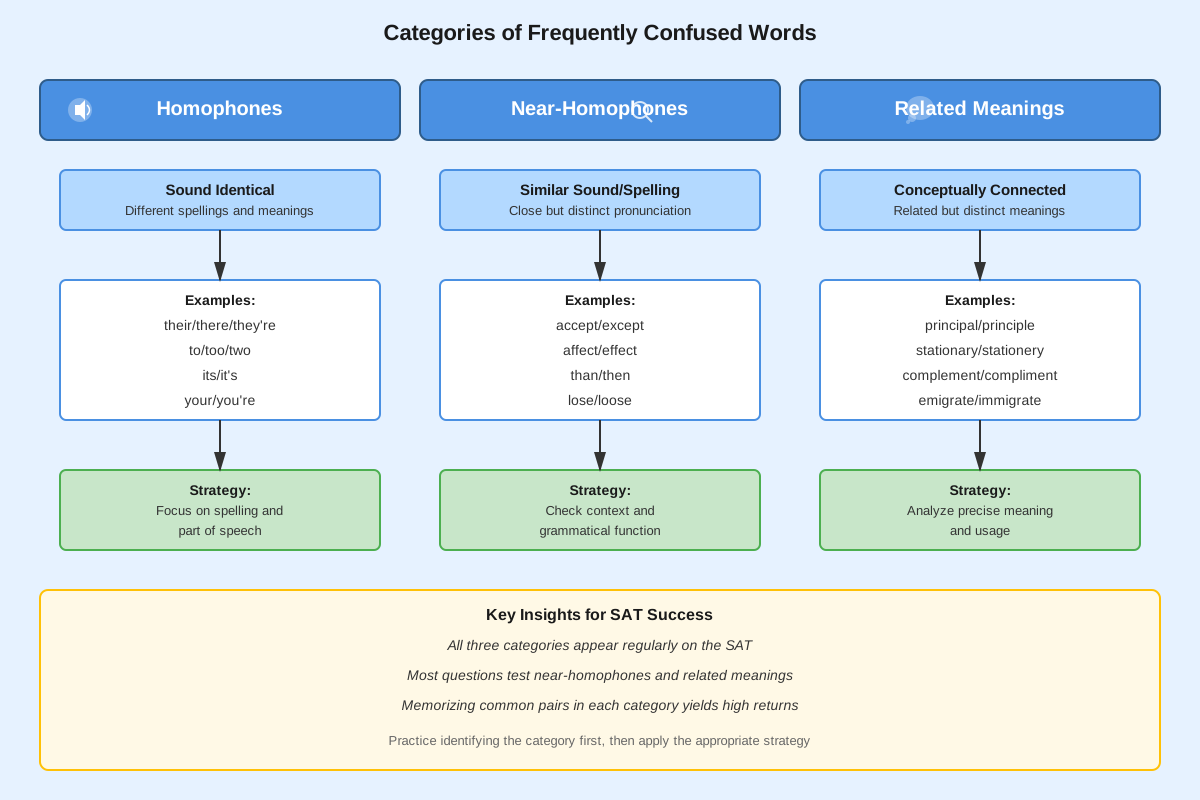
Frequently confused words fall into three primary categories that help organize study and recognition. Homophones are words that sound identical but have different spellings and meanings (their/there/they're). Near-homophones sound very similar but not identical (accept/except). Related meaning words share semantic connections but serve different functions or convey distinct nuances (imply/infer). Understanding these categories helps predict which aspect of the word—sound, spelling, or meaning—requires closest attention.
Homophones: Sound-Alike Words
Homophones represent the largest category of confused words on the SAT. These words sound identical when spoken but differ in spelling and meaning. The key to mastering homophones lies in memorizing their distinct definitions and typical usage contexts.
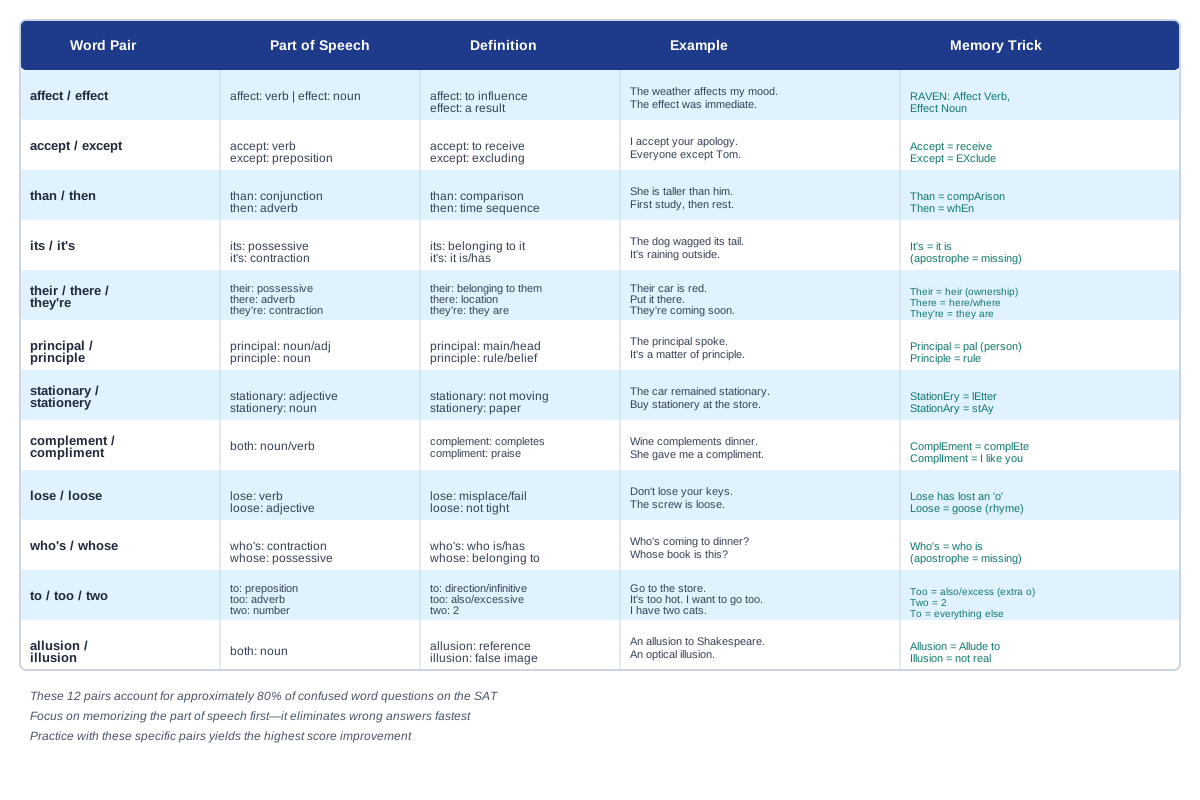
| Word Pair | Word 1 Definition | Word 2 Definition | Example | |
|---|---|---|---|---|
| their/there/they're | Possessive pronoun | Location/existence | Contraction of "they are" | |
| its/it's | Possessive pronoun | Contraction of "it is" | The dog wagged its tail; it's happy. | |
| your/you're | Possessive pronoun | Contraction of "you are" | Your book is here; you're late. | |
| to/too/two | Preposition/infinitive | Also/excessive | Number | Go to the store; it's too far; buy two items. |
| whose/who's | Possessive pronoun | Contraction of "who is" | Whose coat is this? Who's coming? |
Effect vs. Affect: The Classic Confusion
The effect/affect pair appears more frequently on the SAT than almost any other confused word combination. Effect functions primarily as a noun meaning "result" or "consequence" (The medicine had a positive effect). Affect functions primarily as a verb meaning "to influence" or "to impact" (The weather affects my mood).
The confusion intensifies because both words have secondary uses: "effect" can be a verb meaning "to bring about" (The new policy effected significant change), and "affect" can be a noun in psychology meaning "emotional expression" (The patient displayed flat affect). However, the SAT almost exclusively tests the primary uses—effect as noun, affect as verb.
Accept vs. Except: Inclusion and Exclusion
Accept (verb) means to receive, agree to, or approve something (I accept your apology). Except (preposition/conjunction) means excluding or but (Everyone attended except John). The pronunciation similarity creates confusion, but their grammatical functions differ completely. "Accept" always acts as a verb requiring a subject and object, while "except" introduces an exclusion or exception.
Principal vs. Principle: Leadership and Rules
Principal can function as both noun and adjective. As a noun, it means the head of a school or a sum of money (The principal announced new rules; invest the principal). As an adjective, it means "main" or "most important" (The principal reason for success). Principle functions only as a noun meaning a fundamental truth, law, or rule (She stood by her principles; the principle of gravity).
Exam Tip: Remember "The principal is your pal" for the school leader, and "principle" ends in "-le" like "rule."
Complement vs. Compliment: Completion and Praise
Complement (with an "e") means something that completes or goes well with something else (The wine complements the meal). Compliment (with an "i") means an expression of praise or admiration (She received a compliment on her presentation). These words share Latin roots but diverged in meaning, making context essential for correct selection.
Than vs. Then: Comparison and Time
Than introduces comparisons (She is taller than her brother). Then relates to time, meaning "at that time" or "next" (We ate dinner, then watched a movie). Despite different pronunciations in careful speech, many speakers blur these words in casual conversation, contributing to written confusion.
Stationary vs. Stationery: Movement and Materials
Stationary (with an "a") means not moving or fixed in place (The car remained stationary). Stationery (with an "e") means writing materials like paper and envelopes (She bought new stationery). The memory trick: stationery contains "er" like "paper."
Elicit vs. Illicit: Drawing Out and Illegal
Elicit (verb) means to draw out or evoke a response (The question elicited thoughtful answers). Illicit (adjective) means illegal or forbidden (The illicit trade was shut down). These words sound nearly identical but have completely unrelated meanings, making context crucial.
Contextual Analysis Strategy
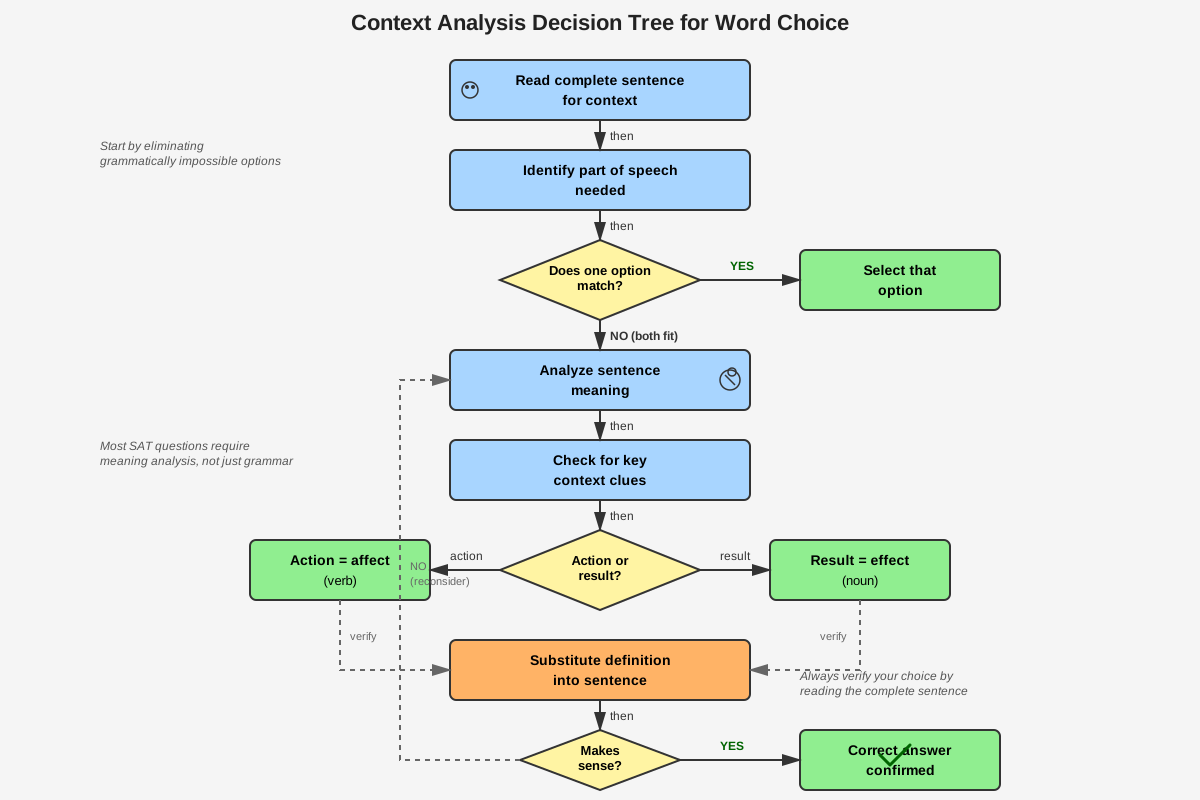
Successful word selection requires systematic context analysis. First, identify the word's grammatical function in the sentence—is it a noun, verb, adjective, or other part of speech? Second, determine the sentence's meaning—what concept is being expressed? Third, test each option by substituting it and reading the complete sentence. Fourth, eliminate options that create grammatical errors or semantic nonsense.
Concept Relationships
The core concepts within frequently confused words connect through shared patterns of confusion. Homophones (their/there/they're, its/it's) → require sound-based discrimination → leading to spelling-focused memorization strategies. Related meaning words (affect/effect, complement/compliment) → demand semantic precision → requiring definition-based study and context analysis.
These concepts connect to prerequisite knowledge of parts of speech because grammatical function often determines correct word choice (affect as verb vs. effect as noun). The topic also relates to broader RW skills including context clues—the surrounding sentence provides hints about which word fits—and sentence structure analysis, which reveals whether a noun, verb, or modifier is needed.
Mastering frequently confused words supports success with other SAT topics including rhetorical synthesis (choosing words that precisely convey intended meaning), transitions (selecting words that accurately show relationships between ideas), and standard English conventions (demonstrating command of proper usage). The precision required for these questions builds the careful reading habits essential for all Reading and Writing questions.
Quick check — test yourself on Frequently confused words so far.
Try Flashcards →High-Yield Facts
⭐ The SAT tests the same 20-30 word pairs repeatedly across different test administrations, making memorization highly effective
⭐ Effect is usually a noun (the result); affect is usually a verb (to influence)
⭐ Its (no apostrophe) is possessive; it's (with apostrophe) means "it is"
⭐ Accept means to receive; except means excluding
⭐ Than introduces comparisons; then relates to time
- Principal can be a noun (school leader, money) or adjective (main); principle is always a noun (rule, truth)
- Complement (with "e") means to complete; compliment (with "i") means to praise
- Stationary (with "a") means not moving; stationery (with "e") means writing materials
- Elicit means to draw out; illicit means illegal
- Whose is possessive; who's means "who is"
- Your is possessive; you're means "you are"
- Their is possessive; there indicates location; they're means "they are"
- To is a preposition/infinitive marker; too means also/excessive; two is the number
- Lose (one "o") is a verb meaning to misplace; loose (two "o"s) is an adjective meaning not tight
- Ensure means to make certain; insure means to provide insurance coverage
Common Misconceptions
Misconception: Apostrophes always indicate possession → Correction: In contractions like "it's," "you're," and "they're," apostrophes indicate missing letters, not possession. Possessive pronouns (its, your, their) never use apostrophes.
Misconception: "Effect" and "affect" are interchangeable → Correction: While both words have multiple uses, on the SAT, "effect" is almost always a noun (result) and "affect" is almost always a verb (to influence). Using them interchangeably creates grammatical errors.
Misconception: The correct word can be determined by sound alone → Correction: Many confused words sound identical or nearly identical (their/there/they're, accept/except). Correct selection requires understanding meaning and grammatical function, not just pronunciation.
Misconception: "Then" and "than" can both be used for comparisons → Correction: Only "than" introduces comparisons (taller than, more than). "Then" exclusively relates to time or sequence (first this, then that).
Misconception: If a word sounds right in the sentence, it must be correct → Correction: Many incorrect word choices sound acceptable in casual speech but violate standard written English conventions. The SAT tests formal written English, which requires precise word selection regardless of how words sound when spoken.
Misconception: Memorizing definitions alone is sufficient → Correction: Understanding definitions is necessary but insufficient. Students must also recognize how words function grammatically and appear in context. Practice with full sentences is essential.
Worked Examples
Example 1: Effect vs. Affect
Question: The new traffic pattern will _____ commute times for thousands of workers.
A) effect
B) affect
C) effects
D) affects
Solution Process:
Step 1: Identify the grammatical function needed. The blank follows "will," indicating a verb is required. The sentence structure is: subject (traffic pattern) + auxiliary verb (will) + main verb (blank) + object (commute times).
Step 2: Analyze the meaning. The sentence discusses how the traffic pattern will influence or impact commute times.
Step 3: Evaluate options. "Effect" as a verb means "to bring about" or "to cause to exist," which doesn't fit—the traffic pattern won't create commute times, it will change them. "Affect" as a verb means "to influence," which perfectly matches the intended meaning.
Step 4: Check verb form. "Will" requires the base form of the verb, eliminating options C and D which add unnecessary conjugation.
Answer: B) affect
Connection to Learning Objectives: This example demonstrates applying frequently confused words to answer SAT-style questions by analyzing both grammatical function (verb needed) and semantic meaning (influence vs. create).
Example 2: Multiple Confused Words
Question: The committee members were pleased that _____ proposal had such a positive _____ on community engagement.
A) their . . . affect
B) there . . . affect
C) their . . . effect
D) they're . . . effect
Solution Process:
Step 1: Analyze the first blank. It appears before "proposal," modifying the noun. This requires a possessive form showing the proposal belongs to the committee members. "Their" (possessive) fits; "there" (location) and "they're" (they are) don't make grammatical sense.
Step 2: Eliminate options. Options B is eliminated because "there proposal" is grammatically incorrect. Option D is eliminated because "they're proposal" (they are proposal) is nonsensical.
Step 3: Analyze the second blank. It follows "positive" (adjective) and precedes "on community engagement" (prepositional phrase). The structure "had such a positive [blank]" requires a noun. "Effect" (noun meaning result) fits; "affect" (verb meaning to influence) creates a grammatical error.
Step 4: Confirm the answer. "Their proposal had such a positive effect" is grammatically correct and semantically meaningful.
Answer: C) their . . . effect
Connection to Learning Objectives: This example requires identifying key features of multiple frequently confused word pairs and applying context analysis to determine correct usage for both homophones (their/there/they're) and related meaning words (affect/effect).
Exam Strategy
When approaching sat frequently confused words questions, follow this systematic process:
- Read the complete sentence first before looking at answer choices. Understanding the full context prevents premature elimination of correct answers.
- Identify the grammatical function required in the blank. Determine whether the sentence needs a noun, verb, adjective, or other part of speech. This immediately eliminates options that don't match the required function.
- Look for trigger phrases that signal specific word choices:
- Comparison words (more, less, better, worse) → use "than"
- Time sequences (first, next, after) → use "then"
- Possession indicators (belonging to, owned by) → use possessive forms without apostrophes for pronouns
- Influence/impact language → use "affect" as verb
- Result/outcome language → use "effect" as noun
- Test each option by substitution. Read the complete sentence with each answer choice inserted. Incorrect options often create subtle grammatical errors or meaning shifts.
- Apply the contraction test for apostrophe confusion. If the word has an apostrophe, expand it to the full form (it's → it is, you're → you are). If the expansion doesn't make sense, the apostrophe is wrong.
- Use process of elimination strategically. Often two options can be quickly eliminated based on grammatical function, leaving a 50/50 choice between words with similar meanings. At this point, focus on precise semantic differences.
Time Management: These questions should take 30-45 seconds each. If you're uncertain, mark your best guess and flag for review rather than spending excessive time on a single question.
Memory Techniques
Apostrophe Contractions Mnemonic: "If it has an apostrophe, it's a contraction" (it's = it is, you're = you are, they're = they are, who's = who is). This rule works for all pronoun confusions.
EFFECT/AFFECT Mnemonic: "The Arrow Affects the Apple; the Effect is an Eaten apple" (Affect = Action/verb; Effect = End result/noun). Visualize an arrow (action) hitting an apple (affect) and the result (effect) of a bitten apple.
ACCEPT/EXCEPT Visualization: "Accept has two C's like two hands receiving (accepting) something; Except has an X like a crossing-out (excluding) something."
PRINCIPAL/PRINCIPLE Memory Aid: "The principal is your PAL" (principal = person). "A principle is a ruLE" (both end in -le).
THAN/THEN Sequence: "THAN for compArison (both have A); THEN for whEN (both have E)."
COMPLEMENT/COMPLIMENT Distinction: "CompLEment compLEtes; CompLIment is nIce words."
STATIONARY/STATIONERY Association: "StationAry = stAy in place; StationEry = lettEr paper."
Homophone Family Grouping: Create mental categories:
- Possession Family: their, your, its, whose (no apostrophes)
- Contraction Family: they're, you're, it's, who's (apostrophes = missing letters)
- Location Family: there, where, here (all end in -ere/-here)
Summary
Frequently confused words questions on the SAT test the ability to distinguish between words that sound similar, look similar, or share related meanings but have distinct uses in standard written English. Success requires understanding three key elements: the grammatical function each word serves (noun, verb, adjective), the precise meaning each word conveys, and the context in which each word appropriately appears. The most commonly tested pairs—effect/affect, its/it's, their/there/they're, accept/except, than/then, and principal/principle—appear repeatedly across test administrations, making targeted memorization highly effective. Mastery demands both definitional knowledge and contextual application skills. Students should analyze sentence structure to determine required grammatical function, examine surrounding context to understand intended meaning, and systematically test each option through substitution. These questions represent high-yield study targets because they appear consistently, test predictable word pairs, and reward straightforward memorization combined with careful reading.
Key Takeaways
- Frequently confused words questions consistently appear 2-4 times per SAT test, making them high-value study targets with predictable content
- Effect is typically a noun (result/outcome); affect is typically a verb (to influence/impact)—this is the most commonly tested word pair
- Possessive pronouns (its, your, their, whose) never use apostrophes; contractions (it's, you're, they're, who's) always use apostrophes to show missing letters
- Grammatical function analysis (identifying whether a noun, verb, or adjective is needed) eliminates incorrect options before considering meaning
- Context clues in surrounding sentences reveal which word conveys the intended meaning when both options are grammatically possible
- Systematic memorization of the 20-30 most commonly tested word pairs provides the foundation for consistent success on these questions
- The contraction expansion test (replacing it's with "it is") immediately reveals whether an apostrophe belongs in the word
Related Topics
Context Clues and Vocabulary in Context: Understanding how surrounding text reveals word meaning supports both frequently confused words questions and vocabulary questions, building comprehensive word analysis skills.
Standard English Conventions: Frequently confused words represent one category within the broader domain of grammar and usage rules tested on the SAT, including subject-verb agreement, pronoun usage, and modifier placement.
Rhetorical Synthesis: Choosing words that precisely convey intended meaning connects directly to rhetorical effectiveness questions that ask students to select the best word or phrase to accomplish a specific purpose.
Sentence Structure and Boundaries: Understanding how words function within sentence structure supports identification of grammatical function, a key skill for frequently confused words questions.
Practice CTA
Now that you understand the patterns, definitions, and strategies for frequently confused words, it's time to cement your knowledge through active practice. Complete the practice questions to test your ability to distinguish between commonly confused word pairs in realistic SAT contexts. Use the flashcards to memorize the precise definitions and usage patterns of high-frequency word pairs. Remember: these questions represent some of the most predictable points on the SAT—consistent practice with these specific word pairs translates directly into score improvement. Every confused word pair you master is a question you'll answer correctly on test day!
Sign up free to keep reading
Create a free AnvayaPrep account to finish this SAT guide on Frequently confused words — plus flashcards and practice questions.