Overview
The distinction between their, there, and they're represents one of the most frequently tested conventions of Standard English on the SAT Reading and Writing section. These three homophones—words that sound identical but have different meanings and spellings—create a persistent challenge for test-takers because the ear cannot distinguish between them in spoken language. On the SAT, questions testing these words fall under the broader category of grammar and usage conventions, specifically within the domain of pronoun usage, adverbs of place, and contractions.
Mastering their there they're is essential for SAT success because these words appear in approximately 2-4 questions per test administration, making them high-yield content that directly impacts scores. The College Board specifically targets these homophones because they assess a student's command of Standard English conventions—a core competency for college readiness. Unlike more complex grammatical concepts that require extensive analysis, these questions test fundamental writing mechanics that students are expected to have mastered by the time they reach college-level coursework.
Within the broader RW (Reading and Writing) section architecture, homophone mastery connects to multiple competencies including pronoun-antecedent agreement, sentence structure, and the ability to recognize contextually appropriate word choice. Success with these distinctions demonstrates not just memorization but genuine understanding of how English grammar functions in formal academic writing. This topic serves as a gateway to more sophisticated grammar concepts while remaining independently testable and immediately applicable to score improvement.
Learning Objectives
- [ ] Identify key features of their there they're and distinguish between the three homophones in written text
- [ ] Explain how their there they're appears on the SAT and recognize the question formats used to test these distinctions
- [ ] Apply their there they're to answer SAT-style questions with 100% accuracy under timed conditions
- [ ] Analyze sentence context to determine which homophone correctly completes meaning and grammatical structure
- [ ] Construct original sentences demonstrating proper usage of each homophone in various grammatical contexts
- [ ] Evaluate answer choices by substituting the full forms of contractions to verify correctness
Prerequisites
- Basic parts of speech: Understanding nouns, pronouns, verbs, and adverbs is essential because "their" functions as a possessive pronoun, "there" as an adverb or expletive, and "they're" as a pronoun-verb combination.
- Pronoun-antecedent relationships: Recognizing what nouns pronouns refer back to helps identify when "their" (possessive) is the correct choice.
- Contraction formation: Knowing that apostrophes indicate omitted letters allows students to expand "they're" into "they are" for verification.
- Sentence structure fundamentals: Understanding subject-verb relationships helps distinguish between "they're" (subject + verb) and other options.
Why This Topic Matters
In real-world applications, the ability to distinguish between their, there, and they're directly impacts professional credibility. College essays, business communications, and formal correspondence all require mastery of these conventions. Employers consistently cite grammar errors—particularly homophone confusion—as factors that diminish candidates' perceived competence and attention to detail. Academic writing at the college level assumes students have internalized these distinctions, making them non-negotiable for success in higher education.
On the SAT their there they're questions appear with remarkable consistency. Statistical analysis of released SAT exams reveals that homophone questions, including this trio, appear in approximately 15-20% of all grammar-focused items in the Reading and Writing section. These questions typically present as sentence completion or error identification tasks where students must select the grammatically correct word from among the three homophones. The College Board favors these questions because they efficiently assess Standard English conventions with minimal reading comprehension demands, allowing for precise measurement of grammatical knowledge.
Common manifestations in exam passages include: sentences describing possession where "their" is tested against incorrect alternatives; existential constructions ("there is/are") where "there" must be distinguished from sound-alikes; and clauses requiring subject-verb combinations where "they're" serves as the contracted form of "they are." The SAT strategically embeds these words in contexts where all three options might seem plausible to students who rely on phonetic intuition rather than grammatical analysis, making systematic understanding essential for consistent accuracy.
Core Concepts
Their: The Possessive Pronoun
Their functions exclusively as a possessive determiner (possessive adjective) that indicates ownership or association by a plural antecedent or a singular gender-neutral antecedent. This word always precedes a noun or noun phrase, answering the question "whose?" In grammatical terms, "their" is the third-person plural possessive form, parallel to "his," "her," and "its" in the possessive pronoun family.
The structure follows this pattern: their + noun (or noun phrase). Examples include "their books," "their decision," "their responsibility." The noun that follows "their" represents what is possessed or associated with the plural subject. Critically, "their" never stands alone—it must always modify a noun.
In contemporary usage, "their" also serves as a singular gender-neutral possessive pronoun when the antecedent is indefinite or when gender inclusivity is desired: "Each student must bring their laptop" or "The applicant should submit their materials." The SAT recognizes this usage as Standard English, reflecting evolving grammatical conventions accepted by major style guides.
There: The Adverb and Expletive
There serves two distinct grammatical functions, both unrelated to possession. First, as an adverb of place, "there" indicates location or position, answering the question "where?" This usage includes phrases like "over there," "right there," or "there on the table." The word points to a physical or abstract location distinct from "here."
Second, and more commonly tested on the SAT, "there" functions as an expletive (or dummy subject) in existential constructions. In sentences beginning with "there is," "there are," "there was," or "there were," the word "there" occupies the subject position without carrying semantic meaning. Instead, it allows the actual subject to appear after the verb: "There are three reasons for this decision" (actual subject: "three reasons"). This construction is grammatically standard and frequently appears in formal academic writing.
The expletive usage follows this pattern: there + be verb + actual subject. Recognizing this structure helps students identify when "there" is correct, particularly in sentences where "their" might seem plausible if students incorrectly assume possession is being indicated.
They're: The Contraction
They're represents the contracted form of "they are," combining the third-person plural pronoun "they" with the present tense plural form of the verb "to be." The apostrophe indicates the omission of the letter "a" from "are." This contraction appears in both informal and formal writing, though some style guides recommend spelling out contractions in highly formal academic contexts.
The critical test for "they're" is substitutability: any instance of "they're" can be replaced with "they are" without changing the sentence's grammatical structure or meaning. If this substitution creates an ungrammatical or nonsensical sentence, "they're" is incorrect. This verification strategy provides a foolproof method for confirming correct usage.
"They're" always functions as a subject-verb combination, meaning it must be followed by a predicate complement (adjective, noun, or prepositional phrase): "They're intelligent" (adjective), "They're students" (noun), "They're in the library" (prepositional phrase). It cannot be followed immediately by a noun that it modifies, which distinguishes it from "their."
Comparison Table
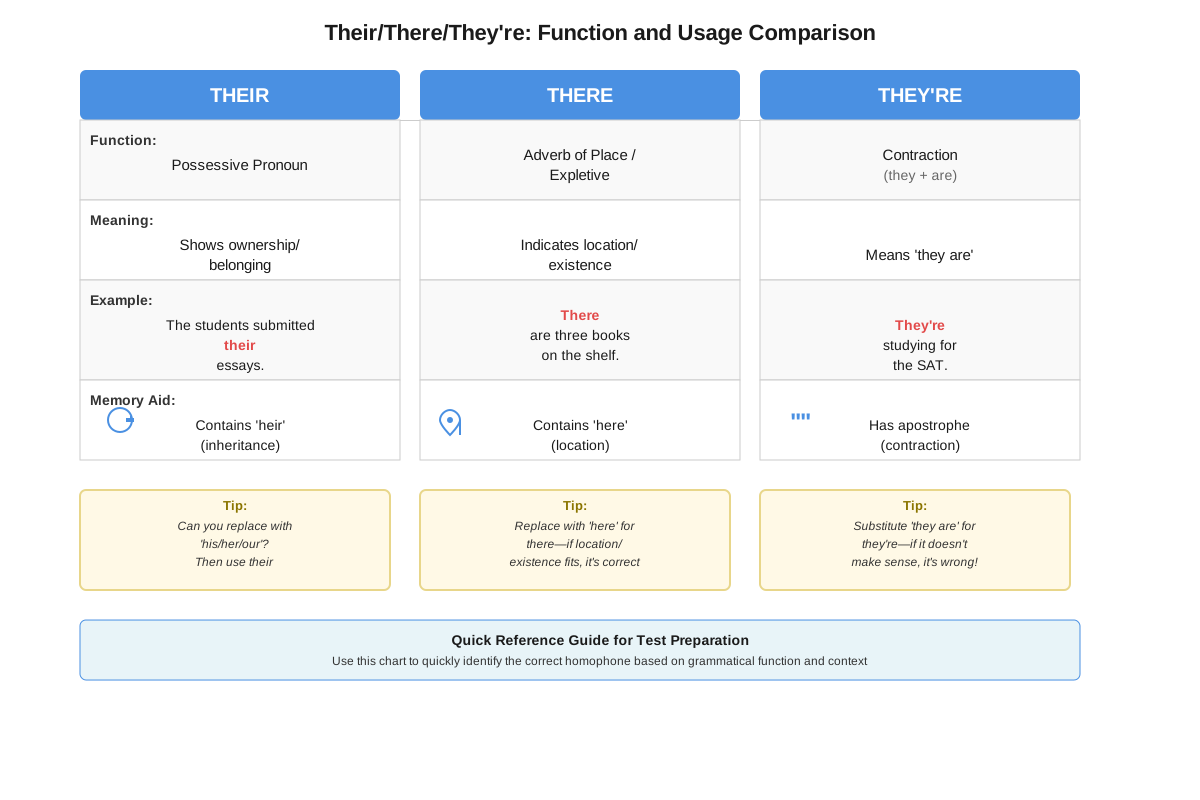
| Word | Part of Speech | Function | Substitution Test | Example |
|---|---|---|---|---|
| Their | Possessive determiner | Shows ownership/association | Replace with "his/her" | Their books are on the table. |
| There | Adverb/Expletive | Indicates location or introduces existence | Replace with "here" or remove in expletive | There are many solutions. |
| They're | Contraction | Combines "they" + "are" | Replace with "they are" | They're studying for exams. |
Contextual Decision Framework
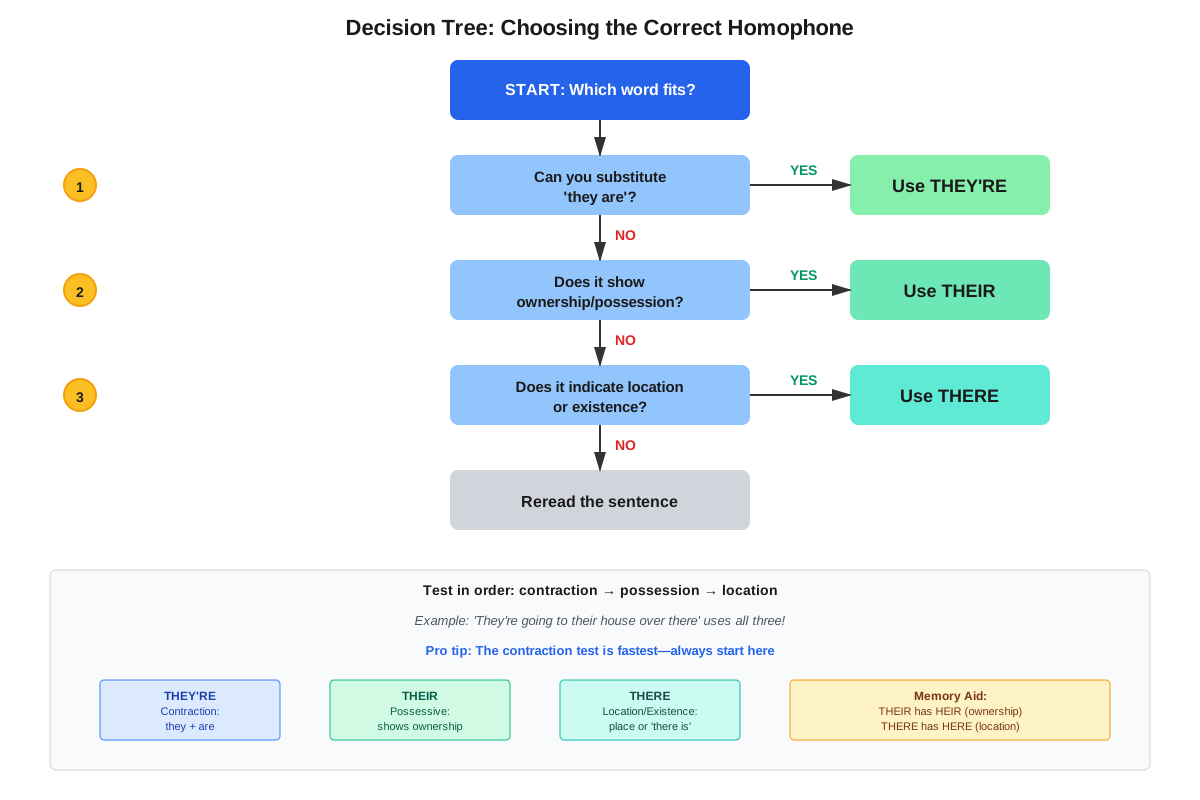
When encountering a blank or underlined word in an SAT their there they're question, apply this systematic analysis:
- Check for possession: Does the sentence indicate that something belongs to or is associated with a plural (or singular gender-neutral) entity? If yes, "their" is likely correct.
- Check for location or existence: Does the sentence point to a place or use a "there is/are" construction? If yes, "there" is likely correct.
- Check for "they are" substitution: Can you replace the word with "they are" and maintain grammatical sense? If yes, "they're" is correct.
- Verify with the following word: What comes immediately after? If it's a noun being modified, "their" is correct. If it's a be-verb, "there" is likely correct. If it's an adjective, noun, or prepositional phrase serving as a predicate complement, "they're" is correct.
Concept Relationships
The three homophones exist in a relationship of mutual exclusivity—only one can be correct in any given context, and their functions never overlap. Understanding this relationship prevents the common error of treating them as interchangeable variants.
Their connects to broader pronoun concepts, specifically pronoun-antecedent agreement. Mastery of "their" requires understanding what noun it refers back to (its antecedent) and ensuring number agreement. This connects to topics like pronoun case, pronoun clarity, and pronoun consistency within the Form, Structure, and Sense unit.
There in its expletive function relates to subject-verb agreement concepts because the verb following "there" must agree with the actual subject that appears after it: "There is one solution" versus "There are multiple solutions." This connects to sentence structure topics and the identification of true subjects versus grammatical placeholders.
They're connects to both contraction formation and subject-verb agreement. Understanding contractions links to apostrophe usage more broadly, while the "they are" construction reinforces verb conjugation and the proper formation of present tense statements.
Relationship map: Pronoun-antecedent agreement → enables correct use of → Their (possessive) ← distinguished from → There (location/expletive) ← distinguished from → They're (contraction) → requires understanding of → Subject-verb combinations → connects back to → Sentence structure fundamentals.
High-Yield Facts
⭐ Their is always possessive and must be followed by a noun or noun phrase that it modifies.
⭐ There in expletive constructions ("there is/are") is followed by a be-verb, then the actual subject.
⭐ They're can always be replaced with "they are" without changing grammatical structure.
⭐ If you can substitute "his" or "her" and the sentence makes grammatical sense, use "their."
⭐ If you can substitute "here" and the sentence makes locational sense, use "there."
- "Their" never contains an apostrophe and never stands alone without a noun.
- "There" can begin a sentence in expletive constructions but "their" and "they're" rarely do.
- The SAT will never accept a homophone error as correct, even if the sentence is comprehensible.
- Contractions like "they're" are acceptable in Standard English and appear in formal SAT passages.
- When "there" indicates location, it often appears with prepositions: "over there," "out there," "right there."
- The singular "their" (as in "each student brought their book") is now considered Standard English by the College Board.
- Approximately 95% of "their/there/they're" questions on the SAT can be solved in under 15 seconds using substitution tests.
Quick check — test yourself on Their there they're so far.
Try Flashcards →Common Misconceptions
Misconception: "Their" and "there" can be used interchangeably because they sound the same. → Correction: Homophones have identical pronunciation but completely different meanings and grammatical functions. Using the wrong homophone creates a grammatical error, not just a spelling mistake. The SAT treats homophone confusion as a substantive error in Standard English conventions.
Misconception: "They're" is too informal for the SAT and should be avoided. → Correction: Contractions are fully acceptable in Standard English and appear regularly in published SAT passages. The College Board does not penalize appropriate contraction use. If "they are" is grammatically correct, "they're" is equally correct.
Misconception: You can determine the correct word by how the sentence sounds when read aloud. → Correction: Because these three words are homophones, they sound identical in speech. Auditory processing cannot distinguish between them. Only grammatical analysis of function and context reveals the correct choice.
Misconception: "There" is only used to indicate physical location. → Correction: While "there" does function as an adverb of place, its more common function in formal writing is as an expletive in existential constructions ("there is/are"). This non-locational usage appears more frequently on the SAT than the locational usage.
Misconception: If a sentence mentions multiple people, "their" is automatically correct. → Correction: The presence of a plural subject does not automatically make "their" correct. The sentence must specifically indicate possession or association. A sentence like "The students are here" mentions multiple people but requires neither "their," "there," nor "they're" in that particular construction.
Misconception: The apostrophe in "they're" indicates possession, similar to "the student's book." → Correction: The apostrophe in "they're" indicates contraction (omission of letters), not possession. Possessive pronouns (their, his, her, its, our, your) never use apostrophes. Only possessive nouns use apostrophes.
Worked Examples
Example 1: Identifying the Correct Homophone in Context
Question: The research team presented _____ findings to the academic committee, demonstrating that _____ significant implications for future studies.
A) their . . . there are
B) there . . . their are
C) they're . . . there are
D) their . . . they're
Solution Process:
First blank analysis: The sentence indicates that findings belong to the research team. This is a clear possession relationship. Test: "The research team presented his/her findings" makes grammatical sense, confirming that the possessive form is needed. Therefore, "their" is correct for the first blank. This eliminates options B and C.
Second blank analysis: The phrase "_____ significant implications" needs completion. Test the remaining options:
- Option A: "there are significant implications" - This is an expletive construction where "there" introduces the existence of implications. Grammatically correct.
- Option D: "they're significant implications" - Expanding the contraction gives "they are significant implications," which is grammatically incorrect. "They are" requires a predicate adjective or noun, not a noun phrase that "they" would modify.
Answer: A - "their . . . there are"
Connection to learning objectives: This example demonstrates the application of substitution tests (replacing "their" with "his/her" and "they're" with "they are") and contextual analysis to distinguish between homophones in a complex sentence with multiple blanks.
Example 2: Error Identification and Correction
Question: The students submitted they're final projects on time, and there professor praised their attention to detail.
Which word, if any, is used incorrectly?
A) they're
B) there
C) their
D) No error
Solution Process:
Analyze each underlined homophone:
"they're final projects" - Expand the contraction: "they are final projects." This creates an ungrammatical construction. "They are" cannot directly modify "final projects." The sentence indicates possession (the projects belong to the students), so "their" is needed. Error identified in "they're."
"there professor" - This should indicate possession (the professor associated with the students). Test: "his/her professor" makes sense. Therefore, "their" is needed, not "there." Error identified in "there."
"their attention" - This indicates possession (attention belonging to the students). Test: "his/her attention" makes sense. This usage is correct.
The question asks for which word is used incorrectly. Since both "they're" and "there" are incorrect, but only one answer can be selected, examine the answer choices. In actual SAT format, the question would be structured to identify one error or would ask "which word FIRST appears incorrectly."
Answer: A - "they're" (appears first in the sentence)
Corrected sentence: The students submitted their final projects on time, and their professor praised their attention to detail.
Connection to learning objectives: This example requires identifying errors in authentic sentence contexts and applying the substitution test to verify corrections, demonstrating mastery of all three homophones simultaneously.
Exam Strategy
When approaching SAT their there they're questions, implement this systematic process:
Step 1: Identify the question type. These questions appear as either sentence completion (fill in the blank) or error identification (choose the incorrect word). Recognize them by the presence of the three homophones as answer choices or underlined in the passage.
Step 2: Read for context, not sound. Resist the temptation to "hear" the sentence in your mind, as this provides no useful information for homophones. Instead, analyze the grammatical structure and meaning.
Step 3: Apply the substitution tests systematically:
- For "their": Replace with "his/her" or "our"
- For "there": Replace with "here" (if locational) or remove it (if expletive)
- For "they're": Replace with "they are"
Step 4: Examine the word immediately following the blank or underlined word. This provides crucial grammatical clues:
- Noun following → likely "their"
- Be-verb following → likely "there"
- Adjective, noun (as predicate), or prepositional phrase following → likely "they're"
Trigger words and phrases that signal each homophone:
For their: ownership language ("belonging to," "associated with"), plural subjects performing actions on objects, phrases like "their own," "their respective"
For there: existence phrases ("there is," "there are," "there exists"), location indicators ("over," "right," "out"), pointing language
For they're: descriptive statements about groups, present-tense characterizations, phrases that could be expanded to "they are currently/actively"
Process of elimination: If you can definitively rule out two options using substitution tests, the remaining option must be correct—even if you're uncertain about its specific grammatical function. This is particularly useful under time pressure.
Time allocation: These questions should take no more than 15-20 seconds each. If you find yourself deliberating longer, apply the substitution tests mechanically rather than trying to "feel" the right answer. The tests provide objective verification.
Exam Tip: If you're unsure between two options, write out the full sentence with "they are" substituted for "they're." If it looks wrong on paper, eliminate "they're" immediately.
Memory Techniques
Mnemonic for "Their": "Their" has "heir" inside it - an heir inherits possessions, and "their" shows possession. The word literally contains the concept of ownership.
Mnemonic for "There": "There" has "here" inside it - both are location words. If you can replace it with "here," use "there."
Mnemonic for "They're": The apostrophe is a tiny "a" - it represents the missing "a" from "are." Visualize the apostrophe as a miniature letter "a" to remember that "they're" = "they are."
Visualization strategy: Create a mental image for each word:
- Their: Picture a group of people holding objects with name tags saying "THEIRS"
- There: Picture an arrow pointing to a location with a sign saying "HERE/THERE"
- They're: Picture two people (they) connected by an equals sign to the word "ARE"
Sentence memory device: Create a single sentence using all three correctly:
"They're going over there to pick up their books."
Memorize this sentence and use it as a reference template. When you encounter a question, mentally substitute the context into this template structure to verify which word fits the grammatical pattern.
Acronym for the substitution tests: HHA
- His/her for "their"
- Here for "there"
- Are for "they're"
Summary
Mastery of their, there, and they're requires understanding that these homophones serve completely distinct grammatical functions despite identical pronunciation. "Their" functions exclusively as a possessive determiner indicating ownership by a plural or gender-neutral singular antecedent and always precedes a noun. "There" serves either as an adverb indicating location or as an expletive introducing existential constructions with be-verbs. "They're" represents the contraction of "they are" and functions as a subject-verb combination requiring a predicate complement. The SAT tests these distinctions through sentence completion and error identification questions that appear with high frequency in the Reading and Writing section. Success requires systematic application of substitution tests rather than reliance on phonetic intuition: replace "their" with "his/her," "there" with "here," and "they're" with "they are" to verify correctness. These questions are highly predictable and should be answered with near-perfect accuracy through mechanical application of grammatical rules, making them among the most reliable score-improvement opportunities on the exam.
Key Takeaways
- Their, there, and they're are homophones with completely different grammatical functions that cannot be distinguished by sound alone
- "Their" is possessive and must modify a noun; test by substituting "his/her"
- "There" indicates location or introduces existence; test by substituting "here" or expanding "there is/are" constructions
- "They're" always equals "they are"; test by expanding the contraction
- These questions appear in 15-20% of grammar items on the SAT, making them high-yield content for score improvement
- Systematic application of substitution tests provides objective verification and should take less than 20 seconds per question
- The word immediately following the blank provides crucial grammatical clues about which homophone is correct
Related Topics
Pronoun-Antecedent Agreement: Mastering "their" provides foundation for understanding how all pronouns must agree with their antecedents in number, person, and gender. This broader topic extends to pronoun case and pronoun clarity.
Apostrophe Usage: Understanding "they're" as a contraction connects to the broader rules governing apostrophes in contractions versus possessives, including the distinction between "its/it's" and "your/you're."
Subject-Verb Agreement: The expletive use of "there" in constructions like "there are" requires identifying the true subject and ensuring verb agreement, connecting to fundamental sentence structure concepts.
Commonly Confused Words: This topic is part of a larger category including "affect/effect," "accept/except," "then/than," and other word pairs that the SAT frequently tests.
Standard English Conventions: All three homophones fall under the umbrella of conventions tested in the Reading and Writing section, connecting to broader grammatical competency required for college-level writing.
Practice CTA
Now that you've mastered the distinctions between their, there, and they're, it's time to cement your understanding through active practice. Attempt the practice questions designed specifically for this topic, applying the substitution tests and systematic analysis strategies you've learned. Use the flashcards to reinforce quick recognition of each word's function and to build the automatic recall that leads to perfect accuracy under timed conditions. Remember: these questions represent some of the most predictable points on the SAT—consistent practice transforms them from potential pitfalls into guaranteed correct answers. Your investment in mastering these homophones will pay immediate dividends in your Reading and Writing score!
Sign up free to keep reading
Create a free AnvayaPrep account to finish this SAT guide on Their there they're — plus flashcards and practice questions.