Overview
Subject-verb agreement is one of the most frequently tested grammar concepts in the SAT Reading and Writing (RW) section. This fundamental principle requires that subjects and verbs match in number—singular subjects take singular verbs, while plural subjects take plural verbs. While this rule sounds straightforward, the SAT deliberately constructs sentences that obscure the relationship between subjects and verbs, making this a high-yield topic that separates average scorers from top performers.
On the SAT, sat subject-verb agreement questions appear in approximately 10-15% of all Standard English Conventions questions, making them among the most common grammar items tested. These questions assess whether students can identify the true subject of a sentence and match it with the appropriate verb form, even when distracting phrases, clauses, or inverted sentence structures intervene. Mastering this topic is essential because subject-verb agreement errors are among the most noticeable grammatical mistakes in formal writing, and the SAT tests this skill in increasingly sophisticated ways.
Understanding subject-verb agreement connects directly to broader concepts within Form, Structure, and Sense, including sentence structure analysis, clause identification, and the relationship between grammatical elements. This topic serves as a foundation for recognizing how sentences convey meaning through proper grammatical relationships, and it reinforces skills needed for other rw questions involving modifiers, pronouns, and parallel structure. Students who master subject-verb agreement develop stronger sentence-parsing abilities that benefit their performance across multiple question types.
Learning Objectives
- [ ] Identify key features of subject-verb agreement in complex sentence structures
- [ ] Explain how subject-verb agreement appears on the SAT and recognize common trap patterns
- [ ] Apply subject-verb agreement rules to answer SAT-style questions accurately and efficiently
- [ ] Distinguish between true subjects and distracting intervening phrases or clauses
- [ ] Recognize and correct subject-verb agreement errors in sentences with compound subjects, indefinite pronouns, and collective nouns
- [ ] Analyze inverted sentence structures to identify subjects and match them with appropriate verb forms
Prerequisites
- Basic sentence structure: Understanding the fundamental components of a sentence (subject, verb, object) is essential for identifying which noun serves as the subject and which word functions as the main verb.
- Singular vs. plural nouns: Recognizing whether nouns are singular or plural allows students to determine the correct verb form needed for agreement.
- Verb conjugation basics: Familiarity with how verbs change form (e.g., "is" vs. "are," "has" vs. "have") enables students to select the grammatically correct option.
- Phrase and clause recognition: Distinguishing between essential sentence elements and modifying phrases helps students avoid being distracted by intervening words.
Why This Topic Matters
Subject-verb agreement represents a cornerstone of grammatically correct English writing and appears throughout academic, professional, and formal communication. In college-level writing, maintaining proper subject-verb agreement demonstrates linguistic competence and attention to detail—qualities that professors and employers value highly. Beyond the classroom, this skill ensures clarity in professional emails, reports, presentations, and any written communication where credibility matters.
On the SAT specifically, subject-verb agreement questions appear in 3-5 questions per test, making them one of the most reliable question types students will encounter. These questions typically appear in the Standard English Conventions domain and are considered medium difficulty, though they can range from straightforward to quite challenging depending on sentence complexity. The College Board consistently includes these questions because they assess a fundamental skill that predicts success in college-level reading and writing.
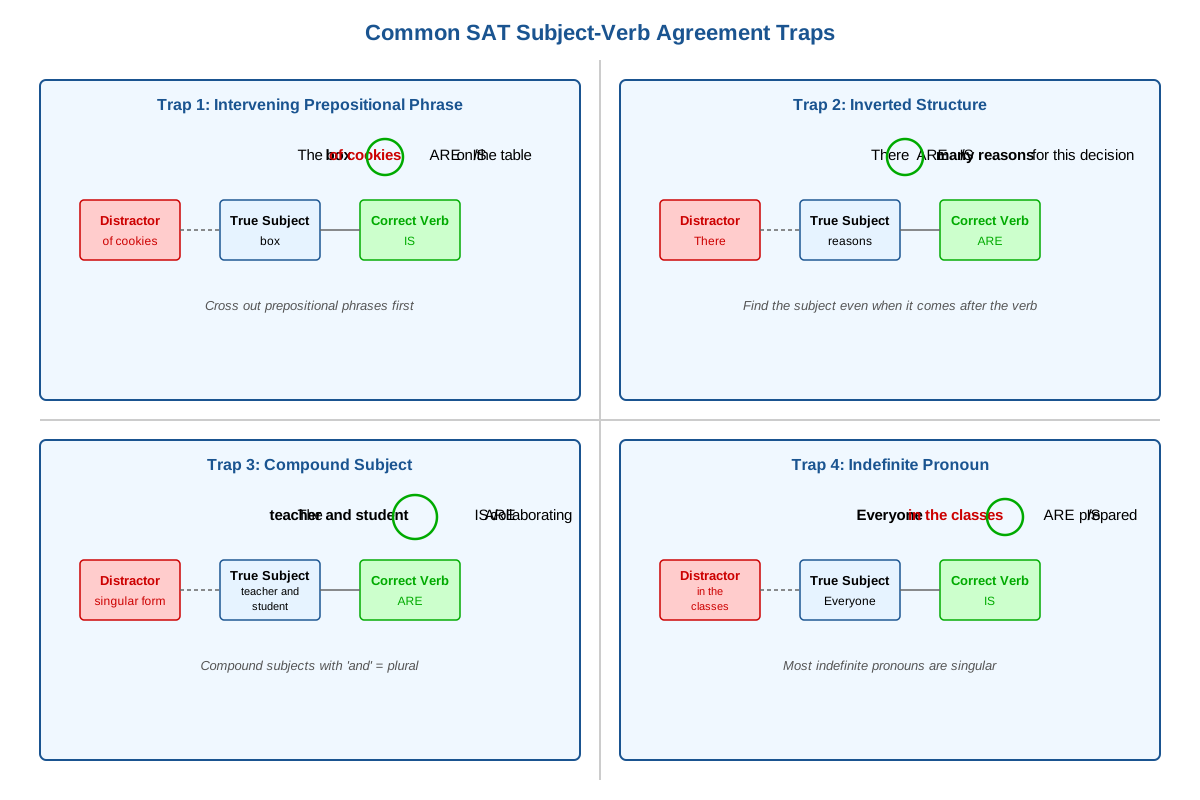
The SAT presents subject-verb agreement in several characteristic ways: sentences with long prepositional phrases separating subjects from verbs, sentences beginning with "there" or "here," sentences with compound subjects joined by "and" or "or," sentences featuring collective nouns or indefinite pronouns, and inverted sentence structures where the verb precedes the subject. Understanding these patterns allows students to anticipate challenges and apply systematic strategies rather than relying on what "sounds right"—an approach that often fails with complex constructions.
Core Concepts
The Fundamental Rule
Subject-verb agreement requires that subjects and verbs match in number and person. Singular subjects require singular verb forms, while plural subjects require plural verb forms. In present tense, this distinction is most visible with third-person subjects:
- Singular: "The student writes the essay."
- Plural: "The students write the essay."
The key challenge on the SAT involves identifying the true subject when sentence structure obscures this relationship. The test deliberately places words between subjects and verbs to create distance and confusion.
Intervening Phrases and Clauses
The most common SAT trap involves intervening phrases—prepositional phrases, participial phrases, or relative clauses that separate the subject from its verb. Students must learn to mentally eliminate these distractors:
Incorrect: The collection of rare stamps are valuable.
Correct: The collection of rare stamps is valuable.
The subject is "collection" (singular), not "stamps" (plural). The prepositional phrase "of rare stamps" merely describes the collection but doesn't change the subject's number. To identify the subject correctly, students should cross out prepositional phrases beginning with words like of, in, on, at, with, by, for, from, to, about, between, among, and through.
Compound Subjects
Compound subjects joined by different conjunctions follow specific rules:
| Conjunction | Rule | Example |
|---|---|---|
| and | Usually plural | "The teacher and the student are present." |
| or/nor | Verb agrees with nearest subject | "Neither the teacher nor the students are ready." |
| or/nor (reversed) | Verb agrees with nearest subject | "Neither the students nor the teacher is ready." |
When compound subjects refer to a single entity or concept, they take a singular verb: "Peanut butter and jelly is my favorite sandwich."
Indefinite Pronouns
Indefinite pronouns present particular challenges because their number isn't always intuitive:
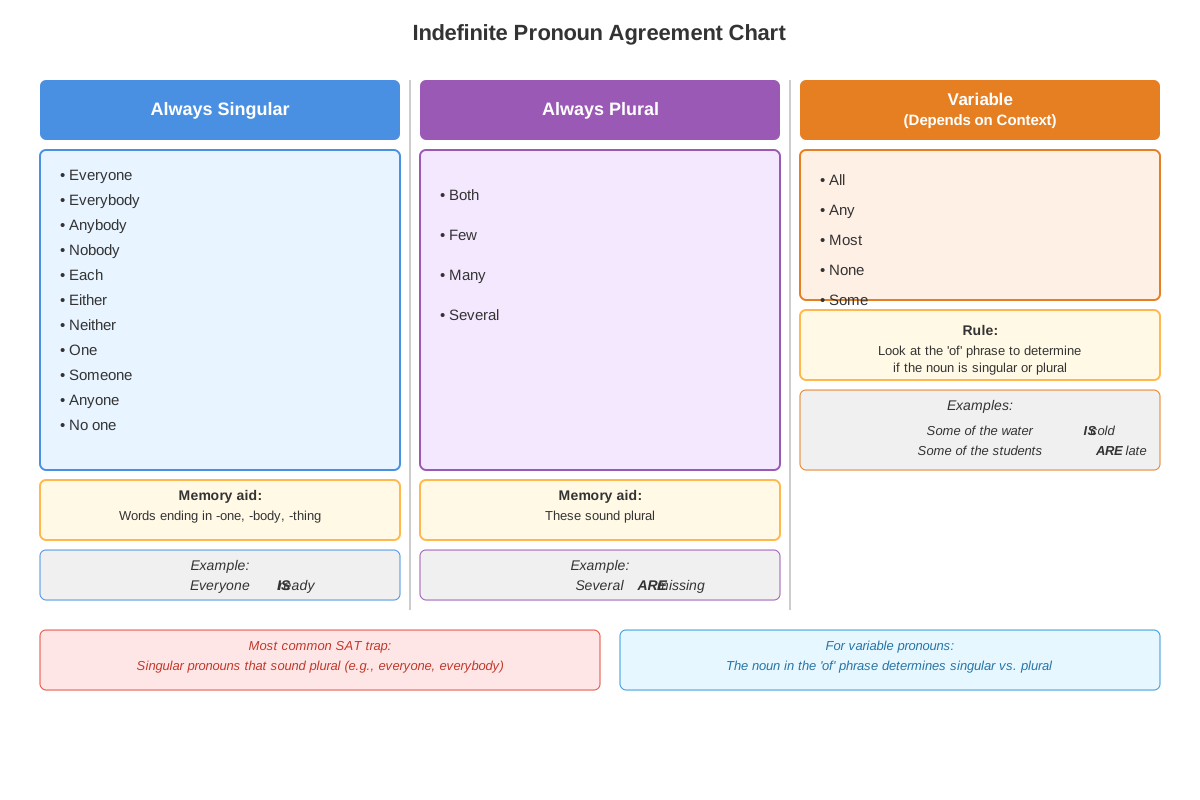
Always Singular: each, either, neither, one, everyone, everybody, everything, someone, somebody, something, anyone, anybody, anything, no one, nobody, nothing
Always Plural: both, few, many, several, others
Context-Dependent: all, any, most, none, some (singular with uncountable nouns; plural with countable nouns)
Examples:
- "Everyone in the three classes is taking the exam." (singular)
- "Few of the students are prepared." (plural)
- "Some of the water is contaminated." (singular—uncountable)
- "Some of the bottles are contaminated." (plural—countable)
Collective Nouns
Collective nouns (team, committee, family, group, jury, audience, class) typically take singular verbs in American English when the group acts as a single unit:
- "The committee meets every Tuesday."
- "The team is celebrating its victory."
However, when emphasizing individual members acting separately, plural verbs are acceptable (though less common on the SAT):
- "The committee disagree on the proposal." (British English or emphasizing individuals)
The SAT generally treats collective nouns as singular entities.
Inverted Sentence Structures
Sentences beginning with "there" or "here" or sentences with inverted word order place the verb before the subject. Students must identify the true subject following the verb:
- "There are three reasons for this decision." (subject: "reasons")
- "Here is the document you requested." (subject: "document")
- "Among the candidates was a former senator." (subject: "senator")
The words "there" and "here" are never subjects; they merely introduce the sentence.
Relative Pronouns in Dependent Clauses
When relative pronouns (who, which, that) serve as subjects of dependent clauses, the verb must agree with the pronoun's antecedent:
- "She is one of the scientists who are studying climate change." (who = scientists, plural)
- "She is the only one of the scientists who is studying this particular aspect." (who = one, singular)
The key is identifying what the relative pronoun refers to—this determines the verb's number.
Subjects Following Verbs
In questions and certain emphatic constructions, subjects follow verbs. Students must reorder the sentence mentally:
- "Where are the documents?" → "The documents are where?"
- "Rarely does the committee meet on Fridays." → "The committee does rarely meet on Fridays."
Titles, Quotations, and Words as Words
Titles of works, quotations, and words discussed as words take singular verbs regardless of their form:
- "The Canterbury Tales is a collection of stories." (title is singular)
- "Twenty dollars is too much for that item." (amount as single unit)
Concept Relationships
Subject-verb agreement connects intimately with sentence structure analysis. To apply agreement rules correctly, students must first identify the complete subject → then isolate the simple subject (the main noun or pronoun) → then determine its number (singular or plural) → finally select the verb form that matches.
This process builds on phrase and clause recognition: students must distinguish between essential sentence elements and modifying phrases/clauses that can be temporarily ignored. This skill connects to modifier placement and sentence boundaries, as understanding what modifies what helps identify the core subject-verb relationship.
The relationship flows as follows:
Sentence Structure Analysis → enables → Subject Identification → requires → Number Determination → leads to → Correct Verb Selection
Additionally, subject-verb agreement intersects with pronoun-antecedent agreement (another high-yield SAT topic), as both require tracking number and ensuring grammatical consistency. Mastering subject-verb agreement also strengthens sentence combining skills, as students learn to maintain agreement when creating complex sentences from simple ones.
Understanding collective nouns and indefinite pronouns in subject-verb agreement also prepares students for pronoun reference questions, where these same words create ambiguity or agreement challenges in different contexts.
High-Yield Facts
⭐ The verb must agree with the subject, not with nouns in intervening prepositional phrases or other modifying phrases.
⭐ Indefinite pronouns ending in -one, -body, or -thing are always singular and take singular verbs.
⭐ Compound subjects joined by "and" are usually plural; those joined by "or" or "nor" agree with the nearest subject.
⭐ Collective nouns (team, committee, family) typically take singular verbs in American English.
⭐ In sentences beginning with "there" or "here," the subject follows the verb, and the verb must agree with that subject.
- Relative pronouns (who, which, that) take verbs that agree with their antecedents, not with nearby nouns.
- Indefinite pronouns "both," "few," "many," and "several" are always plural.
- Titles, quotations, and amounts of money or time take singular verbs when treated as single units.
- Inverted sentence structures (verb before subject) don't change agreement rules—identify the subject first.
- The phrase "one of the [plural noun] who/that" takes a plural verb because the relative pronoun refers to the plural noun.
- Words like "all," "some," "most," and "none" can be singular or plural depending on the noun they refer to.
- Each, every, and any used as adjectives before subjects make those subjects singular.
Quick check — test yourself on Subject-verb agreement so far.
Try Flashcards →Common Misconceptions
Misconception: The verb should agree with the noun closest to it.
Correction: The verb must agree with the actual subject of the sentence, not necessarily the nearest noun. Intervening prepositional phrases often place plural nouns near singular subjects, creating a trap: "The box of chocolates is (not are) on the table."
Misconception: Compound subjects always take plural verbs.
Correction: While compound subjects joined by "and" typically take plural verbs, those joined by "or" or "nor" follow the proximity rule (agreeing with the nearest subject). Additionally, compound subjects referring to a single entity take singular verbs: "Macaroni and cheese is my favorite dish."
Misconception: "None" always takes a singular verb because it means "not one."
Correction: "None" can be singular or plural depending on context. When referring to countable items, it's often plural: "None of the students are ready." When referring to an uncountable quantity, it's singular: "None of the evidence is conclusive."
Misconception: Collective nouns are always singular.
Correction: While collective nouns typically take singular verbs in American English (especially on the SAT), they can take plural verbs when emphasizing individual members acting separately. However, consistency within a passage is crucial—if a collective noun takes a singular verb initially, it should remain singular throughout.
Misconception: Long, complex subjects are always plural.
Correction: Subject length doesn't determine number. "The collection of rare stamps from various countries around the world is (not are) valuable" remains singular despite the lengthy subject phrase. Students must identify the simple subject (collection) regardless of modifiers.
Misconception: "There" and "here" can serve as subjects.
Correction: "There" and "here" are expletives (introductory words) that never function as subjects. The actual subject follows the verb in these constructions: "There are several options" (subject: options).
Misconception: If a sentence sounds right, the agreement is correct.
Correction: Native speakers often make agreement errors in speech, especially with complex structures. The SAT tests formal written English, which follows stricter rules than conversational speech. Students must apply grammatical rules systematically rather than relying solely on what "sounds right."
Worked Examples
Example 1: Intervening Phrase
Question: The collection of paintings by various Renaissance artists (is/are) housed in the museum's west wing.
Step 1: Identify the complete subject
"The collection of paintings by various Renaissance artists"
Step 2: Eliminate intervening phrases
Cross out "of paintings" (prepositional phrase) and "by various Renaissance artists" (prepositional phrase). This leaves: "The collection"
Step 3: Determine the number
"Collection" is singular (one collection, even though it contains multiple paintings)
Step 4: Select the matching verb
Singular subject requires singular verb: "is"
Answer: "The collection of paintings by various Renaissance artists is housed in the museum's west wing."
Connection to Learning Objectives: This example demonstrates identifying key features of subject-verb agreement (intervening phrases) and applying the rule to select the correct answer. The trap here is the plural noun "paintings" positioned close to the verb, which might tempt students to choose "are."
Example 2: Compound Subject with "Or"
Question: Neither the students nor the teacher (was/were) aware of the schedule change.
Step 1: Identify the compound subject
"Neither the students nor the teacher" (compound subject joined by "nor")
Step 2: Apply the proximity rule
With "or" or "nor," the verb agrees with the nearest subject. The nearest subject is "teacher" (singular).
Step 3: Select the matching verb
Singular subject requires singular verb: "was"
Answer: "Neither the students nor the teacher was aware of the schedule change."
Alternative consideration: If the sentence were reversed—"Neither the teacher nor the students"—the verb would be "were" because "students" (plural) would be nearest to the verb.
Connection to Learning Objectives: This example shows how subject-verb agreement appears on the SAT with compound subjects and demonstrates the application of the proximity rule. Students must recognize that "neither...nor" constructions follow different rules than "and" constructions.
Example 3: Indefinite Pronoun
Question: Everyone in the three advanced chemistry classes (has/have) completed the laboratory assignment.
Step 1: Identify the subject
"Everyone" is the subject (an indefinite pronoun)
Step 2: Recognize the intervening phrase
"in the three advanced chemistry classes" is a prepositional phrase that should be mentally eliminated
Step 3: Determine the number of the indefinite pronoun
"Everyone" is always singular (despite referring to many people)
Step 4: Select the matching verb
Singular subject requires singular verb: "has"
Answer: "Everyone in the three advanced chemistry classes has completed the laboratory assignment."
Connection to Learning Objectives: This example illustrates a common SAT trap combining an indefinite pronoun with a plural noun in an intervening phrase. The phrase "three advanced chemistry classes" might mislead students toward the plural verb "have," but the singular indefinite pronoun "everyone" governs the agreement.
Exam Strategy
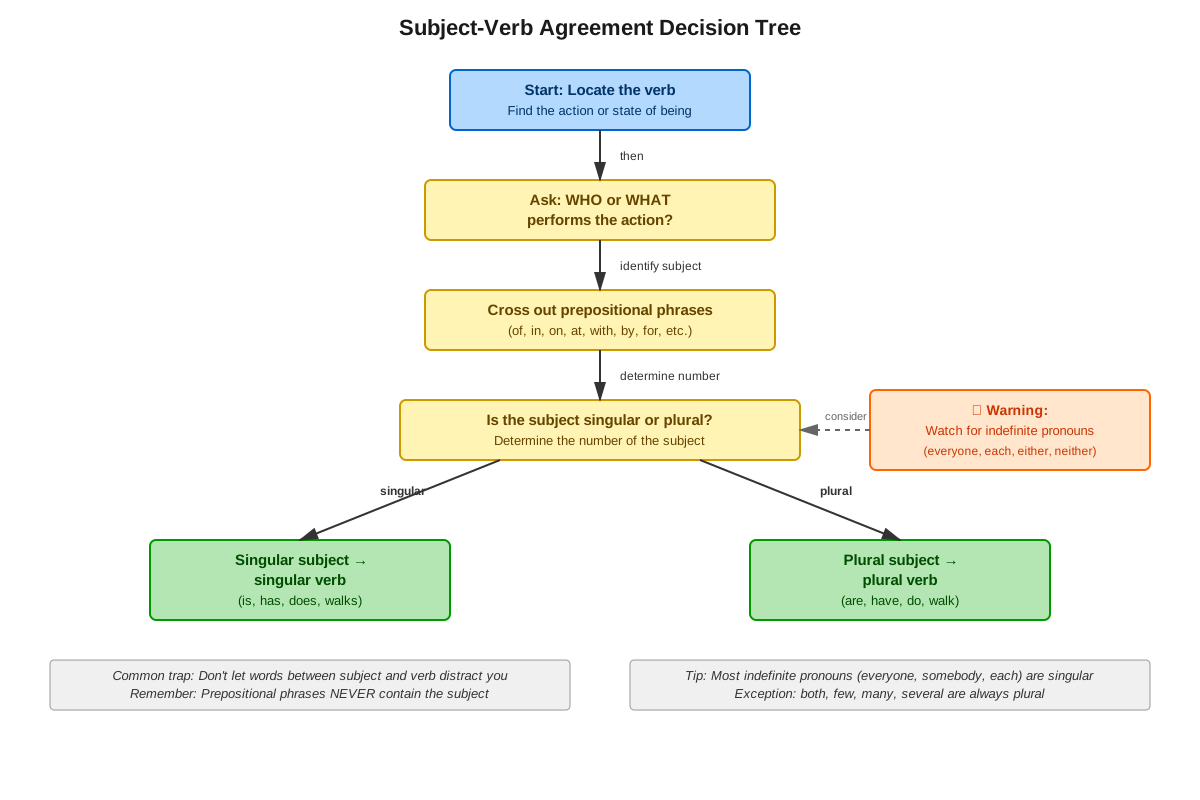
When approaching sat subject-verb agreement questions, follow this systematic process:
Step 1: Locate the verb in the underlined portion or answer choices. Verbs are often the changing element, with options like "is/are," "was/were," "has/have," or "does/do."
Step 2: Find the subject by asking "Who or what is performing the action?" Work backward from the verb if necessary, and be prepared for the subject to appear after the verb in inverted constructions.
Step 3: Eliminate intervening elements by crossing out prepositional phrases, participial phrases, and relative clauses. These modifiers distract from the core subject-verb relationship.
Step 4: Determine the subject's number (singular or plural). Pay special attention to indefinite pronouns, collective nouns, and compound subjects.
Step 5: Match the verb to the subject by selecting the form that agrees in number.
Exam Tip: If you're unsure about a complex sentence, try simplifying it to its core elements. "The collection...is" becomes much clearer than "The collection of paintings by various Renaissance artists is."
Trigger words and phrases to watch for:
- Prepositional phrases: "of," "in," "with," "by," "for"—these often separate subjects from verbs
- Indefinite pronouns: "everyone," "each," "neither," "both," "several"—memorize which are singular vs. plural
- Compound subject markers: "and," "or," "nor"—these signal different agreement rules
- Inverted structure markers: "there," "here," question format—the subject follows the verb
- Relative pronouns: "who," "which," "that"—these require identifying the antecedent
Process-of-elimination tips:
- Eliminate based on obvious number mismatches: If the subject is clearly singular, immediately eliminate plural verb options
- Watch for consistency within the passage: If a subject has been treated as singular earlier, it should remain singular
- Be suspicious of what "sounds right": The SAT deliberately creates sentences where the incorrect option might sound acceptable in casual speech
- Check both singular and plural options: Sometimes both verbs are conjugated correctly, but only one matches the subject's number
Time allocation advice:
Subject-verb agreement questions should take 20-30 seconds once you've mastered the strategy. If you find yourself spending more than 45 seconds, you may be overthinking. Apply the systematic five-step process, make your selection, and move forward. These questions reward methodical application of rules rather than prolonged deliberation.
Memory Techniques
FANBOYS + Subject-Verb Agreement Mnemonic: Remember "SAIPAN" for always-singular indefinite pronouns:
- Someone, Something, Somebody
- Anyone, Anything, Anybody
- I (one)
- P (person—as in "each person")
- A (another)
- No one, Nothing, Nobody, Neither, (and) Each, Either, Every, Everyone, Everybody, Everything
Visualization Strategy: Picture a bridge between the subject and verb. Intervening phrases are like decorations hanging from the bridge—they don't support the structure. Only the subject and verb form the essential connection.
The "Cross-Out" Technique: Physically or mentally draw lines through prepositional phrases. This kinesthetic action reinforces the habit of eliminating distractors: "The collection ~~of paintings~~ ~~by various artists~~ is valuable."
Collective Noun Reminder: Think "TEAM = Together Everyone Acts as a Matched unit" to remember that collective nouns typically take singular verbs in American English.
Compound Subject Acronym: "AND = Always Need Double" (plural verb) vs. "OR = One Rules" (nearest subject rules)
Inverted Structure Reminder: "THERE/HERE = Hunt for the Real subject"—these words signal that you need to look after the verb to find the actual subject.
Summary
Subject-verb agreement is a foundational grammar concept that requires subjects and verbs to match in number—singular with singular, plural with plural. The SAT tests this concept by creating complex sentences where intervening phrases, inverted structures, compound subjects, indefinite pronouns, and collective nouns obscure the relationship between subjects and verbs. Success on these questions requires systematically identifying the true subject, determining its number, and selecting the matching verb form while ignoring distracting elements. The most common traps involve prepositional phrases placing plural nouns near singular subjects, indefinite pronouns whose number isn't intuitive, and inverted sentences where subjects follow verbs. Students must apply grammatical rules methodically rather than relying on what "sounds right," as the SAT deliberately constructs sentences that may sound acceptable with incorrect agreement. Mastering this high-yield topic—which appears in 3-5 questions per test—requires understanding the core rule, recognizing common patterns, and practicing systematic identification strategies that work even with the most complex sentence structures.
Key Takeaways
- Subject-verb agreement requires matching number: singular subjects take singular verbs; plural subjects take plural verbs, regardless of intervening words
- Eliminate intervening phrases systematically: prepositional phrases and other modifiers between subjects and verbs are the SAT's most common trap
- Indefinite pronouns have fixed numbers: memorize which are always singular (-one, -body, -thing endings), always plural (both, few, many, several), or context-dependent (all, some, most, none)
- Compound subjects follow specific rules: "and" usually creates plural subjects; "or/nor" requires agreement with the nearest subject
- Inverted structures require careful subject identification: in sentences beginning with "there/here" or in questions, the subject follows the verb
- Collective nouns are typically singular in American English: treat groups acting as single units (team, committee, family) as singular on the SAT
- Apply rules systematically, not by ear: formal written English follows stricter agreement rules than conversational speech, so trust grammatical analysis over what "sounds right"
Related Topics
Pronoun-Antecedent Agreement: Building on subject-verb agreement, this topic ensures pronouns match their antecedents in number, gender, and person. Mastering subject-verb agreement provides the foundation for understanding how grammatical elements must maintain consistency throughout sentences.
Verb Tense and Consistency: While subject-verb agreement focuses on number matching, verb tense questions test whether verbs maintain appropriate and consistent time frames. Both topics require careful attention to verb forms.
Parallel Structure: This topic extends agreement principles to ensure that sentence elements in a series or comparison maintain consistent grammatical form. Understanding subject-verb agreement helps recognize when parallel elements need matching verb forms.
Modifier Placement: Since identifying subjects requires distinguishing them from modifying phrases, studying modifier placement reinforces the ability to parse complex sentences and identify core grammatical relationships.
Sentence Structure and Fragments: Understanding complete sentences requires recognizing subject-verb relationships, making subject-verb agreement foundational to identifying and correcting sentence fragments and run-ons.
Practice CTA
Now that you've mastered the core concepts of subject-verb agreement, it's time to reinforce your learning through active practice. Complete the practice questions to test your ability to identify subjects, eliminate distractors, and select correct verb forms under timed conditions. Use the flashcards to memorize high-yield rules about indefinite pronouns, collective nouns, and compound subjects. Remember: subject-verb agreement appears on every SAT, and these questions are highly predictable once you've internalized the patterns. Consistent practice transforms these medium-difficulty questions into reliable points that boost your Reading and Writing score. You've built the foundation—now apply it with confidence!
Sign up free to keep reading
Create a free AnvayaPrep account to finish this SAT guide on Subject-verb agreement — plus flashcards and practice questions.