Overview
Contractions are shortened forms of words or word combinations created by omitting certain letters and replacing them with an apostrophe. On the SAT Reading and Writing section, understanding contractions is crucial because the exam frequently tests whether students can distinguish between contractions and possessive pronouns, as well as identify when contractions are appropriate in formal and informal contexts. Questions involving contractions appear regularly in the Standard English Conventions domain, making this a high-yield topic that can directly impact your score.
The SAT's approach to testing contractions goes beyond simple recognition. The exam assesses whether students understand the grammatical function of contractions, can identify errors in their usage, and recognize when they're confused with similar-sounding words (homophones). This topic intersects with broader punctuation concepts, particularly apostrophe usage, and connects to questions about tone, formality, and grammatical correctness in written communication.
Mastering contractions for the SAT is essential because these questions are designed to be quick points—if you know the rules. The RW (Reading and Writing) section includes multiple questions where choosing between a contraction and its homophone determines whether you answer correctly or fall into a carefully constructed trap. Understanding this topic thoroughly ensures you can confidently navigate these questions in under 30 seconds each, preserving valuable time for more complex reasoning tasks.
Learning Objectives
- [ ] Identify key features of contractions and their proper formation
- [ ] Explain how contractions appears on the SAT and in what question formats
- [ ] Apply contractions knowledge to answer SAT-style questions accurately
- [ ] Distinguish between contractions and possessive pronouns in context
- [ ] Recognize common homophone errors involving contractions
- [ ] Evaluate whether a contraction is appropriate for a given writing context
- [ ] Correct errors in contraction usage within sentences and passages
Prerequisites
- Basic apostrophe usage: Understanding that apostrophes indicate omitted letters or possession is fundamental to recognizing how contractions function versus possessive forms.
- Parts of speech identification: Recognizing verbs, pronouns, and helping verbs enables students to understand what words are being combined in contractions.
- Homophone awareness: Familiarity with words that sound alike but have different meanings and spellings is essential for avoiding contraction-related errors.
- Sentence structure basics: Understanding subject-verb relationships helps identify where contractions fit grammatically within sentences.
Why This Topic Matters
In real-world writing, contractions serve an important stylistic function. They make writing sound more conversational and natural, which is why they appear frequently in informal communication, dialogue, personal essays, and contemporary journalism. Professional writers must know when contractions enhance readability and when they undermine formality. This practical skill extends beyond the SAT into college writing, professional communication, and any context where tone matters.
On the SAT, contraction questions appear with remarkable consistency. Approximately 2-4 questions per test directly assess contraction knowledge, typically in the Standard English Conventions category. These questions have a high success rate for prepared students but frequently trap unprepared test-takers who rely on "what sounds right" rather than grammatical understanding. The College Board specifically targets the most common contraction confusions: it's/its, they're/their/there, you're/your, and who's/whose.
The exam presents contraction questions in several formats: selecting the correct word to complete a sentence, identifying errors in underlined portions, and choosing revisions that maintain grammatical correctness. Passages may be formal or informal, and students must recognize that while contractions are grammatically correct, they may not always be stylistically appropriate. This dual consideration—correctness and appropriateness—makes contraction questions slightly more nuanced than simple grammar rules might suggest.
Core Concepts
What Are Contractions?
Contractions are formed by combining two words and omitting one or more letters, with an apostrophe marking the location of the missing letters. The apostrophe serves as a placeholder, signaling to readers that the word is a shortened form. Common contractions combine pronouns with verbs (I'm, you're, he's), auxiliary verbs with "not" (can't, won't, shouldn't), or other frequent word pairs (let's, o'clock).
The formation follows consistent patterns:
- Pronoun + verb: I + am = I'm, you + are = you're, it + is = it's
- Verb + not: do + not = don't, will + not = won't, should + not = shouldn't
- Auxiliary combinations: I + have = I've, they + will = they'll, who + is = who's
Contractions vs. Possessive Pronouns
The most frequently tested aspect of sat contractions involves distinguishing contractions from possessive pronouns. This confusion arises because several contractions sound identical to possessive pronouns but serve entirely different grammatical functions.
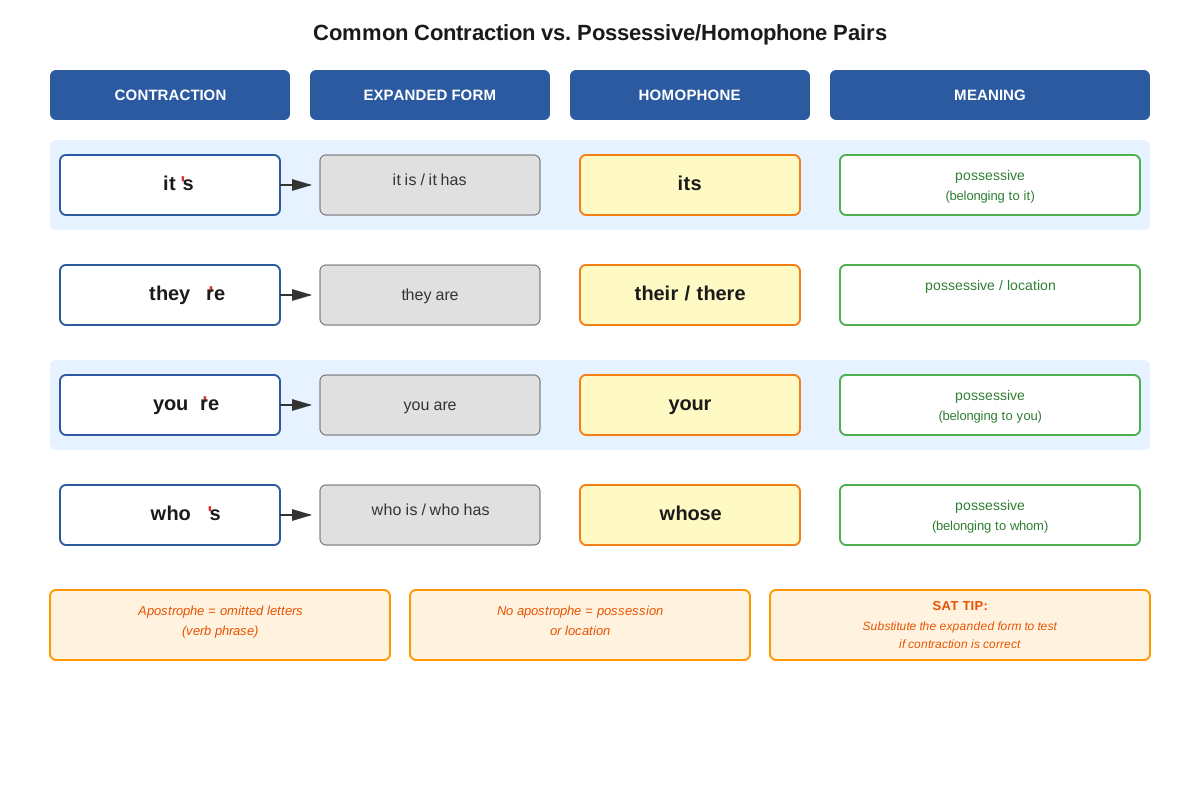
| Contraction | Meaning | Possessive Pronoun | Function |
|---|---|---|---|
| it's | it is / it has | its | belonging to it |
| you're | you are | your | belonging to you |
| they're | they are | their | belonging to them |
| who's | who is / who has | whose | belonging to whom |
| there's | there is / there has | theirs | belonging to them |
The critical distinction: contractions always contain a verb, while possessive pronouns show ownership and never contain apostrophes. This rule is absolute and provides a reliable test for determining correct usage.
Testing for Correct Usage
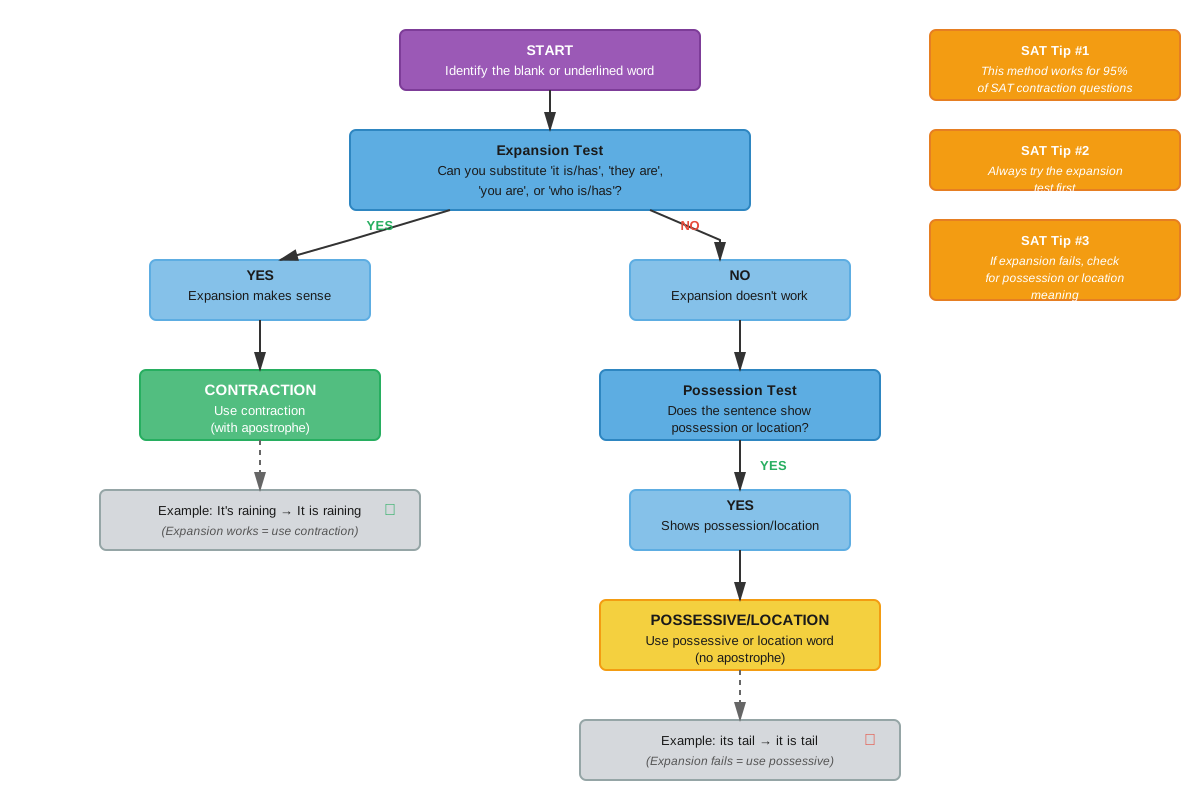
To determine whether a contraction or possessive pronoun is correct, expand the contraction to its full form and check if the sentence makes sense:
Example: "The dog wagged it's/its tail."
- Test with expansion: "The dog wagged it is tail." (incorrect)
- Test with expansion: "The dog wagged it has tail." (incorrect)
- Therefore, "its" (possessive) is correct: "The dog wagged its tail."
Example: "You're/Your going to succeed on the SAT."
- Test with expansion: "You are going to succeed on the SAT." (correct)
- Therefore, "you're" (contraction) is correct.
This expansion test works universally and should be the first strategy when encountering contraction questions.
Common Contraction Patterns
Understanding the patterns of contraction formation helps predict correct forms:
Pronoun + "to be" verb forms:
- I am → I'm
- you are → you're
- he/she/it is → he's/she's/it's
- we are → we're
- they are → they're
Pronoun + "have" forms:
- I have → I've
- you have → you've
- we have → we've
- they have → they've
- who has → who's
Verb + "not" forms:
- is not → isn't
- are not → aren't
- was not → wasn't
- were not → weren't
- have not → haven't
- has not → hasn't
- do not → don't
- does not → doesn't
- did not → didn't
- will not → won't (irregular)
- would not → wouldn't
- should not → shouldn't
- could not → couldn't
- cannot → can't
Special Cases and Irregularities
"Won't" is the only major irregular contraction, formed from "will not" rather than following the standard pattern of simply removing letters. This historical quirk dates to older English forms but remains standard today.
"Let's" contracts "let us" and functions as a suggestion or invitation. It should not be confused with "lets" (third-person singular verb meaning "allows").
"O'clock" contracts "of the clock" and is one of the few contractions considered appropriate in all formal contexts.
Formality Considerations
While contractions are grammatically correct, their appropriateness depends on context. The SAT occasionally tests whether students recognize that highly formal academic or professional writing traditionally avoids contractions. However, contemporary style guides increasingly accept contractions even in formal writing when they improve readability without sacrificing professionalism.
On the SAT, if a question asks about maintaining a formal tone, choosing the expanded form over the contraction may be appropriate. However, if the question focuses solely on grammatical correctness, contractions are never grammatically wrong—only potentially stylistically inappropriate.
Concept Relationships
The concept of contractions connects directly to apostrophe usage, as the apostrophe's primary functions are showing possession and indicating omitted letters in contractions. Understanding when apostrophes signal contractions versus possession prevents the most common errors.
Contractions relate to verb conjugation because most contractions involve verbs, particularly forms of "to be," "to have," and "to do." Recognizing these verb forms helps identify what the contraction represents and whether it fits the sentence's grammatical structure.
The relationship flows as follows:
Apostrophe rules → distinguish between possession and contraction → identify verb forms within contractions → test by expansion → verify grammatical correctness → consider stylistic appropriateness
Contractions also connect to homophone awareness, as the most tested errors involve words that sound identical but have different meanings and spellings. This relationship extends to broader vocabulary and spelling skills tested throughout the Reading and Writing section.
Quick check — test yourself on Contractions so far.
Try Flashcards →High-Yield Facts
⭐ Contractions always contain an apostrophe marking where letters have been omitted
⭐ Possessive pronouns (its, your, their, whose) never contain apostrophes
⭐ The expansion test (replacing the contraction with its full form) definitively determines correctness
⭐ "It's" always means "it is" or "it has"—never possession
⭐ "You're" always means "you are"—never possession
- "They're" (they are), "their" (possessive), and "there" (location/existential) are three distinct words with different functions
- "Who's" means "who is" or "who has," while "whose" indicates possession
- "Won't" is the irregular contraction of "will not"
- Contractions are grammatically correct in all contexts but may be stylistically inappropriate in highly formal writing
- The SAT tests contractions primarily through homophone confusion questions
- Every contraction involving a pronoun and verb can be expanded to verify correctness
- "Let's" (let us) differs from "lets" (allows) in both meaning and apostrophe usage
Common Misconceptions
Misconception: Possessive pronouns need apostrophes to show ownership.
Correction: Possessive pronouns (its, your, their, whose, hers, his, ours, theirs) never use apostrophes. Only nouns use apostrophes for possession (the dog's bone, Sarah's book).
Misconception: "It's" can be possessive because other possessives use apostrophes.
Correction: "It's" is exclusively a contraction meaning "it is" or "it has." The possessive form of "it" is "its" without an apostrophe, following the pattern of other possessive pronouns.
Misconception: If a word sounds right in a sentence, it must be correct.
Correction: Homophones sound identical but have different meanings and spellings. Relying on sound alone leads to errors. Always verify by expanding contractions or checking grammatical function.
Misconception: Contractions are grammatically incorrect or too informal for the SAT.
Correction: Contractions are grammatically correct. While they may be less formal, the SAT accepts them unless a question specifically asks about maintaining formal tone. Most contraction questions test correctness, not formality.
Misconception: "Whose" is only for people, while "who's" can refer to things.
Correction: "Whose" (possessive) can refer to people or things. "Who's" is always a contraction of "who is" or "who has" and must be followed by appropriate sentence structure for those verb forms.
Misconception: The apostrophe in contractions shows possession of the second word.
Correction: The apostrophe in contractions marks omitted letters, not possession. It's a completely different function from the possessive apostrophe, though the same punctuation mark serves both purposes.
Worked Examples
Example 1: It's vs. Its
Question: The committee announced (it's/its) decision after reviewing all the proposals.
Step 1: Identify the choice between a contraction and possessive pronoun.
- "it's" = contraction of "it is" or "it has"
- "its" = possessive pronoun meaning "belonging to it"
Step 2: Apply the expansion test.
- "The committee announced it is decision..." (incorrect—doesn't make grammatical sense)
- "The committee announced it has decision..." (incorrect—doesn't make grammatical sense)
Step 3: Determine the grammatical function needed.
The sentence requires a possessive form to show that the decision belongs to the committee. The word "decision" is a noun that needs a possessive modifier.
Step 4: Select the correct answer.
"Its" is correct because it shows possession without using an apostrophe.
Answer: The committee announced its decision after reviewing all the proposals.
Connection to Learning Objectives: This example demonstrates identifying key features of contractions (apostrophe indicates omitted letters), distinguishing between contractions and possessives, and applying the expansion test to answer SAT-style questions.
Example 2: Multiple Homophone Challenge
Question: (They're/Their/There) going to submit (they're/their/there) research findings (they're/their/there) at the conference.
Step 1: Analyze each blank separately using the expansion test and grammatical function.
First blank: "_____ going to submit"
- "They are going to submit" (makes sense—subject + verb)
- "Belonging to them going to submit" (doesn't make sense)
- "In that place going to submit" (doesn't make sense)
- Answer: "They're" (contraction of "they are")
Second blank: "submit _____ research findings"
- "submit they are research findings" (doesn't make sense)
- "submit belonging to them research findings" (makes sense—possessive modifying "findings")
- "submit in that place research findings" (doesn't make sense)
- Answer: "their" (possessive pronoun)
Third blank: "findings _____ at the conference"
- "findings they are at the conference" (doesn't make sense grammatically)
- "findings belonging to them at the conference" (doesn't make sense)
- "findings in that place at the conference" (makes sense—location)
- Answer: "there" (location/existential)
Complete Answer: They're going to submit their research findings there at the conference.
Connection to Learning Objectives: This example applies contraction knowledge to distinguish between three homophones, demonstrates the expansion test for multiple instances, and shows how grammatical function determines correct usage.
Exam Strategy
When approaching contraction questions on the SAT, follow this systematic process:
Step 1: Identify the question type
Look for underlined words that are contractions or possessive pronouns. Common triggers include it's/its, you're/your, they're/their/there, and who's/whose.
Step 2: Apply the expansion test immediately
Replace any contraction with its full form. If the sentence makes grammatical sense with the expansion, the contraction is correct. If not, you need the possessive or another homophone.
Step 3: Check grammatical function
Determine whether the sentence needs a verb (use contraction) or shows possession (use possessive pronoun). Contractions always include verbs; possessive pronouns never do.
Step 4: Eliminate obviously incorrect answers
If you've identified that a verb is needed, eliminate all possessive options. If possession is needed, eliminate all contractions.
Trigger words and phrases to watch for:
- Any underlined word containing an apostrophe
- Answer choices that are homophones
- Questions asking about "Standard English Conventions"
- Sentences where the underlined portion comes before a noun (often signals possessive need)
- Sentences where the underlined portion comes before a verb or adjective (often signals contraction need)
Time allocation advice:
Contraction questions should take 20-30 seconds maximum. They're designed to be quick points for prepared students. If you find yourself spending more than 45 seconds, apply the expansion test, make your best choice, and move on. These questions reward systematic application of rules rather than prolonged deliberation.
Process of elimination tips:
- If "it's" is an option and the sentence doesn't make sense with "it is" or "it has," eliminate it immediately
- If a possessive pronoun with an apostrophe appears as an answer choice, it's always wrong
- When three homophones appear (they're/their/there), test each systematically rather than relying on what "sounds right"
Memory Techniques
The Expansion Rule Mnemonic: "Can Expand? Contraction Exists!" (CECE)
If you can expand it to two words with a verb, it's a contraction. If you can't, it's not.
The Possessive Pronoun Rule: "Possessive Pronouns Prohibit Punctuation" (4 P's)
Possessive pronouns never have apostrophes: its, your, their, whose, hers, his, ours, theirs.
The IT'S Test: "Is This Sentence?"
When you see "it's," ask: "Is this sentence correct if I say 'it is'?" If yes, use "it's." If no, use "its."
The YOU'RE Test: "You Obviously Understand Replacing Everything"
Replace "you're" with "you are." If it works, you're correct!
Visualization Strategy: Picture the apostrophe as a tiny person standing in the gap where letters are missing. The apostrophe is literally holding the space where "i" disappeared from "it is" to make "it's."
The Three THERE's Rhyme:
- "THERE for WHERE" (location)
- "THEIR shows CARE" (possession—they care about their things)
- "THEY'RE means THEY ARE" (contraction)
Summary
Contractions are shortened word combinations marked by apostrophes that indicate omitted letters, most commonly combining pronouns with verbs or verbs with "not." On the SAT Reading and Writing section, contraction questions primarily test whether students can distinguish between contractions and their homophone possessive pronouns—particularly it's/its, you're/your, they're/their, and who's/whose. The fundamental rule is that contractions always contain verbs and can be expanded to their full forms, while possessive pronouns show ownership and never contain apostrophes. The expansion test provides a definitive method for determining correctness: replace the contraction with its full form and verify that the sentence remains grammatically sound. While contractions are always grammatically correct, they may occasionally be stylistically inappropriate in highly formal contexts, though the SAT rarely tests this distinction. Mastering contractions requires understanding their formation patterns, recognizing common homophone traps, and systematically applying the expansion test rather than relying on what "sounds right." These questions represent high-yield opportunities for quick points when approached with clear rules and consistent methodology.
Key Takeaways
- Contractions contain apostrophes marking omitted letters and always include verbs that can be expanded to full forms
- Possessive pronouns (its, your, their, whose) never use apostrophes and show ownership rather than verb relationships
- The expansion test definitively determines correctness: if replacing a contraction with its full form creates a grammatical sentence, the contraction is correct
- "It's" exclusively means "it is" or "it has"—never possession—making it the most frequently tested contraction on the SAT
- Homophone confusion drives most contraction errors; systematic testing rather than sound-based judgment prevents these mistakes
- Contraction questions should take 20-30 seconds and represent quick points for prepared students
- Understanding the grammatical function needed (verb vs. possession) allows immediate elimination of incorrect answer choices
Related Topics
Apostrophe Usage for Possession: Understanding how apostrophes show ownership in nouns (the student's book, the students' books) complements contraction knowledge and prevents confusion between the two apostrophe functions.
Subject-Verb Agreement: Since most contractions involve verbs, mastering subject-verb agreement ensures that expanded contractions maintain grammatical correctness and helps identify when contractions are used incorrectly.
Pronoun Cases: Understanding pronoun functions (subjective, objective, possessive) clarifies why possessive pronouns don't use apostrophes and how contractions fit into pronoun usage patterns.
Formal vs. Informal Tone: Recognizing stylistic differences in writing helps determine when contractions enhance readability versus when expanded forms better suit formal contexts.
Homophone Mastery: Expanding beyond contraction-related homophones to other commonly confused words (affect/effect, accept/except) builds comprehensive error-detection skills for the SAT.
Practice CTA
Now that you've mastered the core concepts of contractions, it's time to cement your understanding through active practice. Complete the practice questions to test your ability to distinguish between contractions and possessive pronouns under timed conditions, and use the flashcards to reinforce the expansion test and key rules. Remember: contraction questions are designed to be quick points for prepared students. With the systematic approach you've learned here, you can confidently tackle these questions in under 30 seconds each, freeing up valuable time for more complex reasoning tasks. Your preparation on this high-yield topic will directly translate to points on test day—make the most of it!
Sign up free to keep reading
Create a free AnvayaPrep account to finish this SAT guide on Contractions — plus flashcards and practice questions.